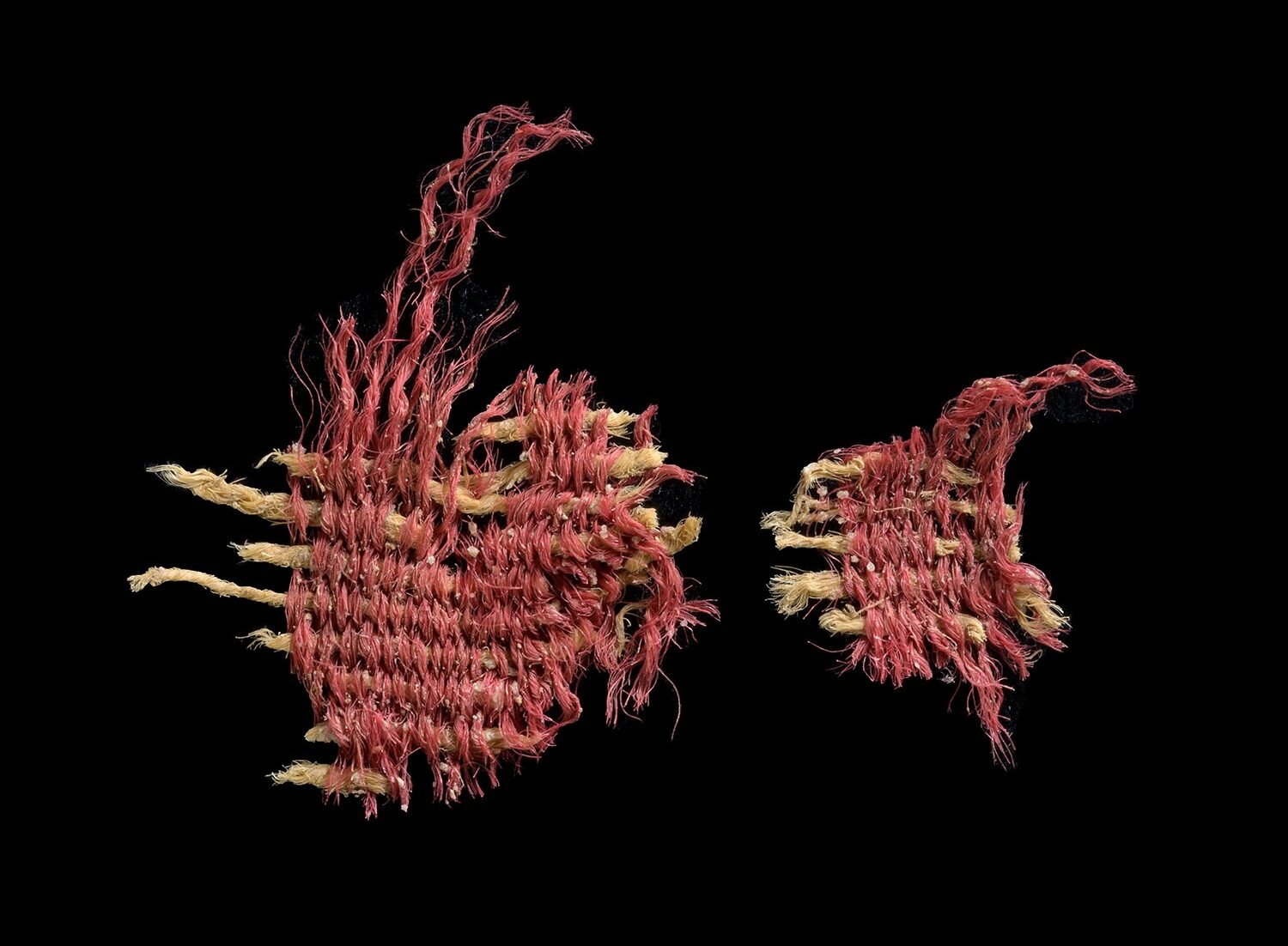
Dafna Gazit, Israel Antiquities Authority
Did it belong to The People’s Front of Judea, or the Judean People’s Front?
Who invented the loom?
The cochineal is a scale insect in the suborder Sternorrhyncha, from which the natural dye carmine is derived. A primarily sessile parasite native to tropical and subtropical South America through North America (Mexico and the Southwest United States), this insect lives on cacti in the genus Opuntia, feeding on plant moisture and nutrients. The insects are found on the pads of prickly pear cacti, collected by brushing them off the plants, and dried.
The insect produces carminic acid that deters predation by other insects. Carminic acid, typically 17–24% of dried insects' weight, can be extracted from the body and eggs, then mixed with aluminium or calcium salts to make carmine dye, also known as cochineal. Today, carmine is primarily used as a colorant in food and in lipstick.
Carmine dye was used in the Americas for coloring fabrics and became an important export good in the 16th century during the colonial period. Production of cochineal is depicted in the Codex Osuna (1565). After synthetic pigments and dyes such as alizarin were invented in the late 19th century, use of natural-dye products gradually diminished. Fears over the safety of artificial food additives renewed the popularity of cochineal dyes, and the increased demand has made cultivation of the insect profitable again, with Peru being the largest producer, followed by Mexico, Chile, Argentina and the Canary Islands.
Thought it was/is high pressure...
Cheetos’ color also comes from an insect.
There are quite a few products derived from bugs. Shelac is derived from the female lac bug, silk from worms, honey and beeswax from bees, and for the non-squeemish, food. many insects can be eaten (but not by me).

(Tola'at aka. Shani worm cocooned in hard shell protecting her eggs (larvae) feeding on Syrian hom-oak leaves
The scarlet worm actually gives up her life in order for the offspring to live. Humans should have such love for their young. Yet in today’s World of selfish individualism, humans would rather sacrifice their young, than sacrifice their future dreams and aspirations. On the third day the mother begins to die, which starts a process where she exudes a crimson dye that colors the baby larvae for life. It is this color that gives them their name the “Crimson, or Scarlet Worm”.
The little ones would then move on from their birthplace and live in the “identity´ released over them. Which is a picture of how we Christians gain our name from the One Who shed His blood on the cross (tree) for us to live. We are covered by His blood. The symbolism of the scarlet rope as it pertains to the salvation of man is amazing. On the fourth day, her hard shell turns into a pure white wax substance that resembles wool. It begins to flake and fall to the ground like a snowflake. One could almost say it resembles the mana which GOD fed the Israelites with for forty years.
Leviticus speaks of the importance of the blood in covering sin, and Psalm 22 refers to the Messiah with these words, for it is the blood that makes atonement for the soul. Leviticus 17:11 But I am a (crimson) worm and not a man…….” (Tola’at Shani is the crimson worm) Psalm 22:6
for it is the blood that makes atonement for the soul.I only shared what is related to this post, but if you so desire, you can read the whole commentary here
Leviticus 17:11
But I am a (crimson) worm and not a man…….” (Tola’at Shani is the crimson worm)
Psalm 22:6
Don’t wash it with whites, it will bleed all over them...........