To: BroJoeK
One proof that you're wrong has been posted by DiogenesLamp, endlessly, to make his points. Notice these numbers were for 1859 and reported to Congress in 1860, so they were public knowledge. The graph clearly shows that 92% of all US tariff revenues came from Northern and Western ports. And of the 8% which came from Southern ports, 83% of that came from New Orleans and Baltimore, both of which shipped much of their imports to Northerners in cities like St. Louis and Cincinnati. Only 1% of all Federal tariff revenues came from the Southern cities between Baltimore and New Orleans (including Galveston). That's the first proof, and it's indisputable, especially since DiogenesLamp has used those numbers so often to make his points. So then it's claimed that, yes, Northern cities may have paid the tariffs, but those goods all then trans-shipped to the South, so in reality, Southerners paid the tariffs. But they didn't, none of them did. That's because Northern cities imported raw materials, especially wool, cotton, silk, iron, sugar, coffee, tea and wines. What they "exported" to the South were finished products, especially goods made from wool, cotton, leather (i.e. shoes), silk, iron, wood & paper. Northerners also shipped to Southerners smoked fish, which were not imported and nearly all the tea, which was imported. So, how much of the raw material imported by Northern cities ended up in finished products they later "exported" to the South? 1. 30% of woolen goods were "exported" to the South, plus 2. 25% of cotton woven goods plus 3. 15% of silk goods 4. 35% of iron manufactured goods, but 5. 0% of sugar, coffee & wine imports were then "exported" to the South. The average then comes out around 15% of US raw material imports found their way into products then "exported" to the South.Except that is not proof. That merely shows WHERE the tariff was paid, not WHO paid it. We've had this discussion at least a dozen times before and I have explained that to you at least a dozen times before. You just talk for the sake of talking don't you?
And that corresponds to estimates of the South's GDP, which are around 15% of the US total annual GDP of $4.4 billion.
Estimates by who? Where are these estimates?
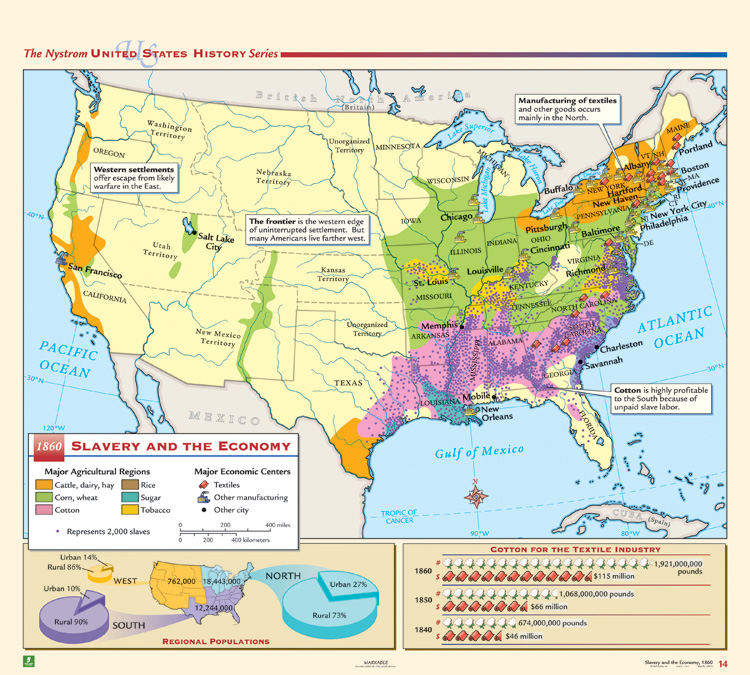
No, no!, it's claimed, we mustn't look at it that way. The only thing we are supposed to consider is this: Southern exports were 75+% of total US exports, and they "paid for" all of US imports, and therefore, don't you see?, "the South" (meaning slave labor), "paid for" nearly all the Federal import tariff revenues.
The standard pack of lies I see. Nobody said the South paid for "all" of US imports - just about 75% of them. The South does not mean exclusively slave labor of course. Most Southerners were White. Most worked in jobs requiring manual labor. Ergo, the majority of the South's labor was White.
And that is not 100% false, since cotton is clearly a Southern product and cotton alone accounted for around 50% of US total exports (including specie) in, say, 1860. So, we might logically say that slave-labor "paid for" about 50% of US import tariffs.
We might...if we were being dishonest. Not all cotton was grown and harvested with slave labor. That was a laughably wrong assumption from the start.
But once we look past cotton, the list of "Southern Products" drops off very rapidly. 1. 50% of US exports in, say, 1860, was raw cotton. 2. 6% of US exports were tobacco products, and right away there's a problem, since tobacco was mostly grown not in the Confederate South, but rather in Union states and regions.
False. Virginia, North Carolina, Kentucky, etc were the largest producers of Tobacco.
We know this because in 1861, when Confederate exports were deleted from US totals, tobacco exports fell only 14%. So 86% of allegedly Southern tobacco actually came from Union states.
1. I'd need to see the source for the statistics you are citing. I would also need to see that they aren't including goods exported from the Southern states. The blockade wasn't very effective in 1861.
3. one half of 1% of US exports was turpentine, allegedly a Southern product, but exports fell only 38% in 1861, so the majority was produced in Union states. 4. Finally, the most curious "Southern Product" items of all, hops and clover seed. These went from virtually no exports in 1860, but over $3 million total in 1861. How can that happen if these are truly "Southern Products"? The answer is, somebody has misclassified them. So the true answer for Southern exports is roughly 50% of total US exports, and nearly all of that was cotton.
Odd that you came to the "true answer" and all those Northern newspapers at the time got it so drastically wrong. You'd think the people at the time would understand the economics better than some guy over 160 years later......
Northern Democrat newspapers, of course, would parrot the lies of Southern Democrats. We should expect that Republican papers stuck closer to the known facts.
Several of the newspapers I cited were in fact Republican. The editorials I cited were from Northern papers calling for war because they recognized the loss of their cash cows - ie the Southern states, would be economically devastating to the Northern states. That doesn't seem to be a position Democrats at the time would champion.
First, we've already established that Southerners paid virtually no import tariffs directly.
First, we've already established that they did and that your denials are pure hogwash.
Indirectly, Southerners paid maybe 15% of total tariffs in the form of higher prices on tariff-protected manufactured goods they "imported" from the North.
yet more pure hogwash. The imported goods were hit with at first double the 15% rate they had been subject to before and eventually under the Morrill Tariff they were subject to a staggering 50% tariff. Needless to say, Northern manufacturers jacked up their prices only a tiny bit less in order to maximize profits. So the cost of manufactured goods rose dramatically.
Southern cotton did account for around 50% of total US exports, however, cotton itself was protected by a 19% tariff, so, when Southerners "imported" cotton products (i.e., clothing) from the North, some of the extra cost was for tariffs that protected their own products.
Clothing was one of the items subject to the dramatic increase in prices due to the tariff. It did not "protect" Southern products at all. In fact, Southerners saw their sales of cotton and other goods decrease during the Tariff of Abominations as Britain and France no longer had as much money to buy their products due to the tariff. The same no doubt was taking place in the 1860s.
As for Federal spending, there are no numbers showing long term preferences for Northern versus Southern projects, none.
Yet another falsehood from you.
Here are the real facts for the period 1850 to 1860: 1. 30% of all US voters in 1860, were Southerners. 2. 53% of Federal spending on fortifications went to the South. That is 76% more than the South's population justified. 3. 45% of Internal Improvements (aka infrastructure) spending went to the South. That is 50% more than the South's population justified. 4. 41% of Federal spending on lighthouses went to the South. That is 37% more than the South's population justified. 5. 52% of Federal hospitalization spending went to the South. That is 73% more than the South's population justified. 6. 34% of Federal pensions were paid to Southerners. That is 13% more than the South's population justified. 7. 44% is the overall average of Federal spending, in the South between 1850 and 1860, which is 47% more than the South's population justified. 8. 52% is the overall average of Federal spending in the South between 1789 and 1860, which is 73% more than the South's 1860 population justified. There are no numbers which purport to show the South getting less than it's "fair share" of Federal spending.
How odd that your numbers say the exact opposite of what Northern Newspapers were saying...and what Southern political leaders were saying...and what Southern commentators had been saying...and what tax expert Charles Adams said. How convenient your numbers are for your argument. Almost as if they were complete and utter BS.
Irrelevant, because Southerners exercised their political powers through control over the Democrat party, and Democrats ruled over Washington, DC, almost continuously from 1801 until secession in 1861. Democrat President Buchanan is a typical example of what Southerners called "Dough-faced" Northerners, meaning Northerners eager to bend over and kiss Southern... ah... rings. Buchanan was only a Northerner by about 10 miles -- meaning he was born 10 miles north of the Mason-Dixon line, and was happy to support Southerners on critical matters such as the 1857 SCOTUS Dred Scott decision. The Democrat party was full of people like Pres. Buchanan, and so were the old Whigs before around 1852. Indeed, it was the Old Republican, Virginia Senator John Randolph of Roanoke who first coined the term "Doughfaced Northerners" to describe such people. Through Northern Doughfaces, Southerners controlled the Democrat party and through the party they ruled over Washington, DC. 1. "In 1820 seventeen doughfaces made the Missouri Compromise possible. 2. "In 1836 sixty northern congressmen voted with the South in the passage of a gag rule to prevent anti-slavery petitions from being formally received in the House of Representatives. 3. "In 1847 twenty-seven northerners joined with the South in opposing the Wilmot Proviso, and 4. "In 1850 thirty-five supported a stronger fugitive slave law. 5. "By 1854 the South had changed its position on the Missouri Compromise and fifty-eight northerners supported its repeal in the Kansas–Nebraska Act.[4] 6. "Richards has classified 320 congressmen in the period from 1820 to 1860 as doughfaces. 7. "The two U.S. Presidents preceding Abraham Lincoln, Franklin Pierce[6] and James Buchanan, were both commonly referred to as doughfaces. 8. "Stephen A. Douglas was severely criticized by Lincoln as the "worst doughface of them all",[7] even though he broke with his party over the Lecompton Constitution for Kansas in 1857." From the beginning of the Republic until secession, Southern Democrats were never completely powerless and only for brief periods suffered any reduction in their absolute powers over Washington, DC.
Ah so even when a political leader was from the North and was elected by Northern voters, if he in any way cooperated or compromised with Southerners he was of course a "doughface" and was "controlled" by Southerners. ROTF! You actually seem to believe this crap.
Henry Clay was a Virginia-born slaveholder who represented Kentucky in Congress. Lincoln, like Jefferson Davis, was born in Kentucky while Clay was a young politician, a Jeffersonian Democratic-Republican. When other Democratic-Republicans began opposing those, it lead to the party's split, making Kentuckian Clay a Whig opposed to Tennessean Andrew Jackson's Democrats. Both Whig Clay and Democrat Jackson were Southern slaveholders.
Where someone is born is pretty much meaningless. Hell, Woodrow Wilson was born in Virginia. Its where a politician was raised and where he worked and where he was elected that matters. Clay was from a border state. Davis was a Southerner. Lincoln was a Northerner.
And yet, and yet... the 1828 Tariff of Abominations' greatest defender was a Democrat Southern Slaveholder named Andrew Jackson. So, it was not strictly North vs. South because there were many Southerners who fully understood the value of encouraging US producers. And it was Southern Democrat President Jackson who put down the nascent South Carolina rebellion with not only stern words, but also by sending a war-fleet with soldiers to invade Charleston Harbor, should the need arrise.
and yet and yet, Southerners as a whole were staunchly opposed to the Tariff of Abominations once they saw how destructive it was to their economy. Also, the Nullification Crisis was ended by a compromise. The tariff was done away with and tariff rates were lowered dramatically. South Carolina got what it wanted.
Of course they had plenty of political power, even in 1860, until they first sabotaged their own cause by splitting the Democrat party and then committed political suicide by declaring secession.
Of course they did not have the political power to stop the passage of the Morrill Tariff which they knew from experience was going to devastate their economy.
The original Morrill proposal in 1859 was to return tariffs from the historically low 1857 rates to those of the 1846 Walker Tariff, which had been proposed and supported by Democrats at the time. The original Morrill proposal increased overall rates from 16% to 26%.
the original Morrill tariff DOUBLED tariff rates. It went on to more than TRIPLE tariff rates eventually.
And so, like any good Democrat, you keep repeating your lies, even after you know the real truth of it. Maybe if you just say it often enough, maybe, somehow you can magically make it true, right? Once again, here's the truth: Corwin would provide no additional protection to slavery beyond what was already in the US Constitution. Any proposals which did provide extra protections, such as the ones by Mississippi Democrat Senator Jefferson Davis, were rejected by Republicans, causing Mississippi to join South Carolina in declaring secession. Corwin was supported 100% by Democrats and signed by Democrat President Buchanan. Corwin was opposed by a majority of Republicans, and only transmitted to states by incoming Pres. Lincoln, without endorsing it.
And you just repeat your endless lies and BS. Lincoln orchestrated passage of the Corwin Amendment. REPUBLICAN Senator Thomas Corwin wrote it. REPUBLICAN William Seward supported it. Lots of other REPUBLICANS supported it too. Regardless of whether Republicans or Democrats, the Corwin Amendment passed the Northern dominated Congress by the necessary 2/3rds supermajority AFTER the Southern delegation had withdrawn. Lincoln endorsed it in his all important first inaugural address. That's the truth.
Corwin could never offer Southerners the long list of explicit protections for slavery to be found in their new Confederate constitution.
Pure lie on your part as usual. The protections of slavery in the Confederate Constitution were not more than those that existed in the US at the time with the sole provision that the Confederate government itself could not outlaw slavery.....ie the same thing the Corwin Amendment would have done in the US Constitution.
You've obviously not read it, or are so brainwashed you can't see the truth when it's staring you in the face.
You've obviously not read it or you are lying. I've come to the conclusion that its the latter.
Here's what Lincoln said: "I understand a proposed amendment to the Constitution, which amendment, however, I have not seen, has passed Congress, to the effect that the federal government shall never interfere with the domestic institutions of the States, including that of persons held to service. To avoid misconstruction of what I have said, I depart from my purpose not to speak of particular amendments, so far as to say that holding such a provision to now be implied constitutional law, I have no objection to its being made express and irrevocable." He didn't endorse it, he said it made no change.
He said it passed and he had no objections. Of course in reality ole Abe was lying. He had not only seen it, he had orchestrated it.
And yet, protecting slavery was the biggest reason, sometimes the only reason, secessionists gave in their "Reasons for Secession" documents.
And yet of the 4 states that issued declarations of causes only one listed exclusively that even though none of the other grievances listed were unconstitutional while the Northern states' violation of the fugitive slave clause of the US Constitution actually was unconstitutional.
Plus, your 94.33% statistic is off by an order of magnitude.
No its not. Its directly from the 1860 US Census.
In fact, the numbers of families who owned slaves varied from: 1. 1/3 to 1/2 of families in the Deep South (SC, GA, FL, AL, MS, LA & TX) 2. 1/4 to 1/3 of families in the Upper South (VA, NC, TN & AR) 3. 5% to 15% in the Border South (DE, MD, KY & MO) Where you had 1/3 to 1/2 of families owning slaves, you also had another 1/3 or more of white families who worked for or joined socially with those slaveholding families.
Your estimates are WAY too high and are based on the faulty assumption that there could only be one slave owner per family. We know numerous examples of that not being true.
So, the average Confederate soldier did not own slaves himself, but his family, uncles, cousins & neighbors did, and so the soldier understood how important slavery was to them economically and also socially.
Except they didn't. Slave ownership was rare and of those who did own slaves, over half of them owned 5 or less. The big slave owners were a tiny minority.
I'm certain you were taught the truth as best it was understood at the time. But you didn't like the truth, somehow it made you feeeeeeel bad, and so you searched out a barrel of propaganda lies, and you've been drinking that Kool-Aid ever since. And now you're addicted and can't get off it.
No, I was taught the standard lies, propaganda and BS you constantly spew. I was absolutely shocked when I read more for myself and discovered the truth. It was an eye opening experience that made me start to question a lot of other things....ie the media, academia, the government, etc
Here's the real truth of it: Republicans were not the establishment in 1860, Democrats were and had been almost exclusively since 1801.
Laughable BS to say Republicans weren't part of the Establishment back then. Lincoln was the chief counsel and lobbyist for the Illinois Central Railroad - then the largest corporation on earth. If that's not Establishment, nothing is.
Republicans today are about 50% corrupt, meaning it takes a constant struggle to keep Republicans on the straight and narrow path. Democrats are 100% corrupt, meaning nothing can ever bring them to see the light of reason & virtue. So, if you believe a word that comes from Democrats, be it in 1860 or today, it's only because you hate the truth and wish to delude yourself with lies.
You keep making this idiotic assumption that the political parties never change. They do. They change drastically over time and the coalitions that drive the bus change. We've seen that in our own lifetimes. It has happened several times before. The Democrats of the JFK era were not nearly as corrupt as they are now. Even now there are some like RFK Jr who are not corrupt.
So long as you post lies here, you have no chance of persuading anyone who doesn't buy your lies. That's a fact.
That's exactly what I say about you.
To: FLT-bird
FLT-bird:
"Except that is not proof.
That merely shows WHERE the tariff was paid, not WHO paid it.
We've had this discussion at least a dozen times before and I have explained that to you at least a dozen times before.
You just talk for the sake of talking don't you?" All your handwaving here aside, the facts remain that:
- Virtually no Southerner ever paid US import tariffs directly.
We know this because only 1% of US tariffs were paid in Southern ports between Baltimore and New Orleans, including Galveston. Baltimore and New Orleans combined paid 7%, but much, if not most, of their imports went to Union cities like St. Louis and Cincinnati.
92% of import tariffs were paid in Northern and Western ports ("western" meaning Detroit, Chicago and San Francisco). - Yes, indirectly, Southerners paid higher prices due to tariffs on raw materials, like wool and cotton, which Northern manufacturers turned into finished products, like clothing and linens.
However, not 100% of Northern manufactures shipped to the South. - 15% was the overall average of imported raw materials which eventually shipped to Southern customers.
The number is low because 0% of items like coffee, sugar and wine were re-"exported" to Southerners.
Doubtless the reason is such imports shipped directly to Southern ports like Galveston, New Orleans, Mobile, Savanah Charleston and Baltimore -- that was the 8% of tariffs directly paid by Southerners. - Averages for other Northern manufactured products were higher -- 35% of iron manufacturers, 30% of woolens, 25% of cotton goods and 15% of silk products manufactured in the North from tariffed imports then shipped to Southern customers.
- Deep South cotton exports, which allegedly "paid for" Northern imports, were in fact only 50% of US total exports, including specie.
One proof is, in 1861, with no Confederate exports counted, Southern products exports fell by 71%, while Northern and Western exports increased by 59%.
In other words, a huge portion of what had been classified as "Southern products" were or could be, in fact, produced in Union states. - Bottom line: while cotton exports (circa $200 million in 1860) were important to the entire US economy ($4.4 billion GDP), they were not as important as Southerners liked to think.
Turned out, "King Cotton" was not "King in the North", or in Europe.
FLT-bird on 1860 US GDP:
"Estimates by who? Where are these estimates?" Historical US GDP numbers are readily available many places, including here.
To see the Civil War years, simply type in 1860 as the start date and 1865 as the end date.
You'll see that for 1860 our nominal GDP was $4.4 billion, rising to $10 billion in 1865.
If you're interested in such things, that nominal $10 billion in 1865 was an inflated peak not reached again until 1880.
However, you can also see that when measured in constant dollars, real GDP had returned to its 1865 levels already in 1868 and grew rapidly from there.
Estimates of Confederate GDP are trickier, because, on the one hand, in 1860 the South had never been more prosperous and average white heads of household were better off than their Northern cousins.
If considered a separate nation, the 1860 South would be the world's 4th richest, after the North and only Britain in Europe.
On the other hand, once the poverty of slaves is factored in, Southern per capita GDP is said to be about half the North's per capita GDP.
Based on that, and the South's population, we get a number for the South's GDP between 15% and 20%, depending on whether we're looking at just the Confederacy or every slave-state.
This site spells it out in detail.
FLT-bird: "The standard pack of lies I see.
Nobody said the South paid for "all" of US imports - just about 75% of them.
The South does not mean exclusively slave labor of course.
Most Southerners were White.
Most worked in jobs requiring manual labor.
Ergo, the majority of the South's labor was White."
Your 75% is a totally bogus number, but 50% is totally fair, and consists of only one major item -- King Cotton.
Cotton was grown mainly by slave-labor in the Deep South, as was sugar.
In the Deep Cotton South, slaves averaged 47% of the population.
FLT-bird can we say slave-labor produced most cotton? : "We might...if we were being dishonest.
Not all cotton was grown and harvested with slave labor.
That was a laughably wrong assumption from the start."
A reasonably fair estimate would be 80%, since, as Mississippians were unashamed to admit in their "Reasons for Secession" document:
"Our position is thoroughly identified with the institution of slavery-- the greatest material interest of the world.
Its labor supplies the product which constitutes by far the largest and most important portions of commerce of the earth.
These products are peculiar to the climate verging on the tropical regions, and by an imperious law of nature, none but the black race can bear exposure to the tropical sun.
These products have become necessities of the world, and a blow at slavery is a blow at commerce and civilization... "
That seems pretty clear to me, and notice that their word was not "some" or "the majority" or "nearly all", but rather "
none but the black race."
I don't know how you can dispute that word "none" without calling the 1861 secessionists liars, and why would they lie about it?
FLT-bird on Southern products: "False. Virginia, North Carolina, Kentucky, etc were the largest producers of Tobacco."
Kentucky was a Union state and tobacco was also grown in Union Southern Indiana, Illinois, Missouri and Maryland.
Bottom line: in 1861, when Confederate tobacco was removed from Union numbers, tobacco exports fell only 14%.
So tobacco was not a strictly "Southern Product".
FLT-bird: "1. I'd need to see the source for the statistics you are citing.
I would also need to see that they aren't including goods exported from the Southern states.
The blockade wasn't very effective in 1861."
Well, first of all, regardless of the blockade, it was impossible to include Confederate exports in Union numbers -- just think about it, it's not arguable.
Second, my source is here.
Also here, this source puts 1860 total exports at $400,122,296 which means that cotton exports -- at roughly $200 million -- were about 50% of the total.
FLT-bird: "Odd that you came to the "true answer" and all those Northern newspapers at the time got it so drastically wrong.
You'd think the people at the time would understand the economics better than some guy over 160 years later......"
I have no idea what "Northern newspapers" you're talking about, but here is what the New York Times (link above) said at the time:
"Such are the Treasury returns.
In them the value of cotton exported is put down at only $34,051,483 [in 1861], against $191,806,555 for 1860; the excess in value for that year being $157,755,073."
If you go on to read the rest of the New York Times article, you'll see that the reduction in Union imports more than offset the reduction in Union exports with a resulting
increase of Union specie reserves.
Morrill Tariff reduced imports helped make financing the war easier for the Union.
FLT-bird: "Several of the newspapers I cited were in fact Republican.
The editorials I cited were from Northern papers calling for war because they recognized the loss of their cash cows - ie the Southern states, would be economically devastating to the Northern states.
That doesn't seem to be a position Democrats at the time would champion."
First of all, I've read many, but far from all, of your posts and I've never seen actual data to support your many ridiculous claims.
Second, it's clear you don't yet understand that Democrats then, just as now, were the party of globalized business, especially then in the production and shipment of cotton.
Northern Big-City, Big-Business Democrats would suffer the most from a loss of Confederate states' exports.
In early 1861, Northern Democrats wanted to "live and let live" with Confederate states.
New York's Democrat Mayor Wood even wanted to secede New York City too, to stay on good terms with the South.
All that ended when rumors of Confederate "free trade" began to circulate, and Northern Democrats were filled with fears of losing everything in the South.
Republicans were less concerned about the economics than with the Constitutional, legal, moral and military issues related to secession.
FLT-bird on Southern tariff payments: "First, we've already established that they did and that your denials are pure hogwash."
So far, you've shown no evidence of even one Southerner paying even one import tariff directly.
You are simply parroting propaganda claims of the time, without any evidence to support such claims.
FLT-bird: "yet more pure hogwash.
The imported goods were hit with at first double the 15% rate they had been subject to before and eventually under the Morrill Tariff they were subject to a staggering 50% tariff.
Needless to say, Northern manufacturers jacked up their prices only a tiny bit less in order to maximize profits.
So the cost of manufactured goods rose dramatically."
Surely you realize that all that is just babbling nonsense, for reason #1, the new Morrill tariff didn't take effect until after the Deep South had already declared their secessions.
Confederates never paid the higher rates.
Reason #2, Morrill originally increased average rates from 17% to 26% or roughly 50%.
But on specific major items, the increase merely returned rates to their levels in the Democratic 1846 Walker Tariff:
TABLE COMPARING TARIFFS OF 1846 Walker, 1857 Democrat & 1860 MORRILL:
| Commodity | 1846 Walker | 1857 Democratic | 1860 Morrill |
|---|
| Woolens | 30% | 24% | 37% |
|---|
| Brown Sugar | 30% | 24% | 26% |
|---|
| Cotton | 25 | 19 | 25 |
|---|
| Iron mfg | 30 | 24 | 29 |
|---|
| Tobacco | 40 | 30 | 25 |
|---|
| Wines | 40 | 30 | 40 |
|---|
| Average of above tariffs: | 33% | 25% | 30% |
|---|
![]()
So, while the overall average of increases was about 50% -- from 17% to 26% -- on major items like wool, sugar, cotton and iron, the Morrill increase was only 20% and simply returned rates to those of the 1846 Walker Tariff.
FLT-bird: "Clothing was one of the items subject to the dramatic increase in prices due to the tariff.
It did not "protect" Southern products at all.
In fact, Southerners saw their sales of cotton and other goods decrease during the Tariff of Abominations as Britain and France no longer had as much money to buy their products due to the tariff.
The same no doubt was taking place in the 1860s."
And once again you revert to your old narrative, regardless of facts, and once again, facts don't support your narrative.
So, let's begin with the 1828 Tariff of Abominations -- here is a graph showing US cotton exports, compared to total exports, not including specie.
Notice, there is no drop-off in cotton exports after 1828:

Next, let's look at US cotton imports from foreign countries.
In 1860 cotton (19% tariff) was our third largest dollar import commodity, only exceeded in value by sugar (24% tariff) and woolens (24% tariff).
Those tariff rates were the lowest 1857 tariffs, passed by Democrats.
And cotton was our number 3 import despite the fact that the South was the world's largest cotton producer, the North still imported about 20% as much as the South exported -- and that's with the 19% tariff on cotton preventing even more foreign imports.
My point is, Southern cotton (19% tariff) and sugar (24%) were both protected by US tariffs, as was tobacco (30%).
Such tariffs were believed necessary to fund the Federal government and to prevent foreign competitors from snuffing out Southern products.
Finally, I notice you often like to argue against the 1859 Morrill proposal, which was effectively a return to the Democrat approved 1846 rates, based on Civil War era increases that were strictly the result of secession and war, not their causes -- you're trying to reverse cause and effect.
"Some historians in recent decades have minimized the tariff issue as a cause of the war, noting that few people in 1860–61 said it was of central importance to them.
Compromises were proposed in 1860–61 to save the Union, but they did not involve the tariff.[38]
Arguably, the effects of a tariff enacted in March 1861 could have made little effect upon any delegation which met prior to its signing."
Will stop here for now, continue on later...
228 posted on
06/10/2023 7:03:08 AM PDT by
BroJoeK
(future DDG 134 -- we remember)
To: FLT-bird; DiogenesLamp; x
FLT-bird:
"How odd that your numbers say the exact opposite of what Northern Newspapers were saying...and what Southern political leaders were saying...and what Southern commentators had been saying...and what tax expert Charles Adams said.
How convenient your numbers are for your argument.
Almost as if they were complete and utter BS." And so you've claimed, but where are actual data to support your claims?
I've never seen them.
The source of my numbers is here: John van Deusen’s 1928 book, Economic bases of Disunion in South Carolina.
Van Deusen's numbers were reported here.
FLT-bird: "Ah so even when a political leader was from the North and was elected by Northern voters, if he in any way cooperated or compromised with Southerners he was of course a "doughface" and was "controlled" by Southerners. ROTF!
You actually seem to believe this crap."
And still, typical of your Democrat mind-set, which values narrative over everything else, when presented with actual facts, all you can do is handwave them away.
The truth about "Doughfaces" is that the term was coined by Virginia Senator John Randolph, circa 1820, as a sign of disrespect for Northerners eager to do what Randolph wanted them to do.
At that time, it was the Missouri Compromise, which passed due to the support of Northern Democratic "Doughfaces".
The term caught-on and was used up until 1861 to describe Northerners like Democrat Presidents Pierce and Buchanan.
Over the years from 1820 to 1861 there were hundreds of Northern Democrat Doughfaces in Congress who helped Southerners pass their major agenda items.
So handwave away and ignore all you want, it's still a fact.
FLT-bird: "Where someone is born is pretty much meaningless.
Hell, Woodrow Wilson was born in Virginia.
Its where a politician was raised and where he worked and where he was elected that matters.
Clay was from a border state.
Davis was a Southerner.
Lincoln was a Northerner."
There were many Southerners.
- Wilson was born and raised in the South, as was Clay.
Wilson's family owned slaves, Clay was himself a slaveholder. - Lincoln's family was originally from Massachusetts and did not own slaves, so far as I know.
- Another Southern slaveholder who supported protective tariffs and even some internal improvements was Democrat Andrew Jackson.
- Even South Carolina's John C. Calhoun, when he was a Jeffersonian Democratic-Republican (until 1828), supported protective tariffs, internal improvements and the National Bank.
- Plus, Whig Presidents Harrison, Tyler and Taylor were all Southern Virginia born slaveholders.
And yet again, my point is simply this: your suggestions that every Southerner before 1860 was a anti-American Neanderthal Democrat is simply false.
In fact, many Southerners were as patriotic and pro-American as our Southern Founders like Washington, Jefferson, Madison and Monroe.
It's inconceivable to me why anyone would want to deny that.
FLT-bird: "and yet and yet, Southerners as a whole were staunchly opposed to the Tariff of Abominations once they saw how destructive it was to their economy.
Also, the Nullification Crisis was ended by a compromise.
The tariff was done away with and tariff rates were lowered dramatically.
South Carolina got what it wanted."
No, not all Southerners.
In Southern states the House vote was 17 for and 65 against the 1828 Tariff.
In Northern states the vote was 88 for and 29 against.
So, there were more Northerners opposed than there were Southerners for the tariff.
In 1828 the "Solid South" was not 100% solid.
And no, the rates were not immediately lowered dramatically and South Carolina did not soon get what it wanted.
Instead, five years later the 1833 Compromise Tariff began to reduce tariffs gradually back to their 1820 levels of around 20%.
What South Carolina wanted in 1830 was to secede and that couldn't happen because no other states were willing to join South Carolina over just the issue of tariffs.
What South Carolinians realized then was that in order to secede, they needed an issue strong enough to outrage all Southerners, and there was only one such issue -- slavery.
FLT-bird: "Of course they did not have the political power to stop the passage of the Morrill Tariff which they knew from experience was going to devastate their economy."
Southerners absolutely did stop Morrill in 1860, and could have stopped it in 1861, or at least forced a compromise, had not their election strategy been to split their majority Democrat party, making them two minority parties.
Yes, it's true, that as minorities, Southern Democrats would lose much of their power over Congress, but that was their choice.
Nobody forced Southern Democrats to split their majority party, and they had nobody but themselves to blame for the results.
FLT-bird: "The original Morrill tariff DOUBLED tariff rates.
It went on to more than TRIPLE tariff rates eventually."
That's a lie, and you need to stop lying, it's not that hard, you can easily look it up yourself.
The average rate under the Democrats' 1857 tariff was a low 17%.
The originial Morrill proposal returned those to the 1846 Walker Tariff rates of circa 26%.
That's a 50% increase, not double, much less triple.
And within those numbers, our largest imports -- wool, sugar, cotton & iron -- those increases were only 20% on average.
So there's no need for you to keep lying about this, just look the numbers up yourself.
Of course, the later war-time tariffs are totally irrelevant to this discussion.
Those rates were caused by the Confederacy and no Confederate ever paid those higher tariffs.
FLT-bird: "Lincoln orchestrated passage of the Corwin Amendment."
You have no evidence that Lincoln "orchestrated" anything.
The evidence we have clearly shows that New York Senator Seward led the Republican efforts, and that he was generally acting as a loose cannon, on his own.
In his 1st Inaugural, Lincoln said he'd not even seen the proposed amendment.
FLT-bird: "REPUBLICAN Senator Thomas Corwin wrote it.
REPUBLICAN William Seward supported it.
Lots of other REPUBLICANS supported it too."
Sure, but the majority of Republicans opposed Corwin, even with Seward's support for it.
100% of Democrats supported Corwin and it was signed by Democrat President Buchanan, not Lincoln.
FLT-bird: "Lincoln endorsed it in his all important first inaugural address.
That's the truth."
That's not the truth, and you can easily see this yourself if you simply imagine, today, some Republican politician saying in an interview, "I am not opposed to Donald Trump as our Presidential nominee".
Would you consider that a real endorsement??
Really??
I don't, but that's what Lincoln said about Corwin's Amendment.
FLT-bird: "Pure lie on your part as usual.
The protections of slavery in the Confederate Constitution were not more than those that existed in the US at the time with the sole provision that the Confederate government itself could not outlaw slavery.....ie the same thing the Corwin Amendment would have done in the US Constitution."
And yet again, you've seen the truth, but look the other way.
So here, yet again, is the list of explicit new protections for slavery in the new Confederate constitution (from post #170):
- Article I Section 9(4): "No bill of attainder, ex post facto law, or law denying or impairing the right of property in negro slaves shall be passed.[13]
The Confederate constitution explicitly says, "no... law impairing the right of property in negro slaves..."
- Article IV Section 2(1) "The citizens of each State shall be entitled to all the privileges and immunities of citizens in the several States; and shall have the right of transit and sojourn in any State of this Confederacy, with their slaves and other property; and the right of property in said slaves shall not be thereby impaired."[31]
The Confederate constitution explicitly claims a "right of transit and soujourn" with slaves.
Such purported "rights" are not found in the US Constitution, regardless of what Crazy Roger Tanney may have fantasized.
- Article IV Section 3(3) "In all such [Confederate] territory, the institution of negro slavery as it now exists in the Confederate States, shall be recognized and protected by Congress, and by the territorial government: and the inhabitants of the several Confederate States and Territories, shall have the right to take to such territory any slaves lawfully held by them in any of the states or territories of the Confederate states."[32]
The Confederate constitution explicitly makes slavery lawful in every Confederate territory.
The US Constitution did no such thing.
- Article I Section 9(1): "The importation of Negroes of the African race from any foreign country, other than the slave-holding States or Territories of the United States of America, is hereby forbidden..."
The Confederate constitution made importing slaves from the United States lawful.
United States law, as directed by the Constitution, forbade importing slaves, period.
Given these significant increases in protection for slavery in the Confederate constitution, there is no way Confederate states could seriously contemplate returning to the Union.
FLT-bird: "He said it passed and he had no objections.
Of course in reality ole Abe was lying.
He had not only seen it, he had orchestrated it."
Or so you claim, and yet without a scrap of evidence to support your claims, here or elsewhere.
FLT-bird on slavery: "And yet of the 4 states that issued declarations of causes only one listed exclusively that even though none of the other grievances listed were unconstitutional while the Northern states' violation of the fugitive slave clause of the US Constitution actually was unconstitutional."
So here again is the breakdown of "Reasons for secession" documents:
"Reasons for Secession*" Documents before Fort Sumter
| Reasons for Secession* | S. Carolina | Mississippi | Georgia | Texas | Rbt. Rhett | A. Stephens | AVERAGE OF 6 |
|---|
| Historical context | 41% | 20% | 23% | 21% | 20% | 20% | 24% |
|---|
| Slavery | 20% | 73% | 56% | 54% | 35% | 50% | 48% |
|---|
| States' Rights | 37% | 3% | 4% | 15% | 15% | 10% | 14% |
|---|
| Lincoln's election | 2% | 4% | 4% | 4% | 5% | 0% | 3% |
|---|
| Economic issues** | 0 | 0 | 15% | 0% | 25% | 20% | 10% |
|---|
| Military protection | 0 | 0 | 0 | 6% | 0% | 0% | 1% |
|---|
* Alabama listed only slavery in its "whereas" reasons for secession.
** Economic issues include tariffs, "fishing smacks" and other alleged favoritism to Northerners in Federal spending. ![]()
(I've included Rhett's letter and Stephens' speech because they were highly influential in convincing other Southerners to vote for secession.)
On the Fugitive Slave Clause, all of the first four "Reasons for Secession" documents mention it, along with other slavery related issues, but, curiously, neither Rhett nor Stephens brought it up, though both did discuss slavery at length.
But most (not all) ignored the key fact about Fugitive Slaves -- at Southerners' insistence, the 1850 Compromise made Fugitive Slaves a matter of national, not states' responsibility.
The 1850 Compromise tasked Washington, not the states, to enforce its Fugitive Slave laws -- so any complaints about Fugitive Slaves in "Reasons for Secession" documents were totally misdirected and bogus.
FLT-bird (is it false that 94.33% were not slaveholders?): "No its not.
Its directly from the 1860 US Census....
...Your estimates are WAY too high and are based on the faulty assumption that there could only be one slave owner per family.
We know numerous examples of that not being true."
Noooo... the 1860 census says there were 393,975 slaveholders, which is 1.26% of the total population of 31,183,582.
That implies that 98.7% of Americans were not slaveholders.
Of course, virtually 100% of Northerners were not slaveholders, so if we just look at the Southern white population, it was 8,289,782, making non-slaveholders ~95%.
However, in 1860, according to the US census, the average family was about 5 people, meaning there were roughly 1,660,000 Southern white families.
If we assume only one slaveholder per family, then about 24% of families "owned" slaves -- and that number corresponds to reports from the time that about 1/4 of Confederate soldiers owned slaves.
Now you wish to argue that maybe some families had more than one slaveholder, even though typically, "the man of the house" owned everything.
So, only in a few elite families were women high-status enough to legally own slaves.
How many? Maybe 10% at most.
Therefore, instead of there being 393,975 slaveholding families, there were only around 355,000 families who "owned" slaves, or 21% of all Southern families.
But that's all Southern families.
If we only look at the Confederacy, we find the white population was 5,582,222 CSA individuals, which means roughly 1,116,000 CSA white families.
Of those, 316,632 individuals owned slaves, and if we apply the 90% factor, we have 284,969 CSA slaveholding families, or 26% of all CSA families.
But that's just the CSA average.
If we look at high-slave states like South Carolina and Mississippi, and again allow for 10% multiple slaveholders in one family, we see South Carolina had 41% and Mississippi 44% of families owning slaves.
And just to make the point clear, for every such family who did not own slaves, there were other family members -- brothers, uncles, cousins, in-laws and close neighbors -- who did.
And that is why the entire culture -- the "Southern Way of Life" -- was built around their "peculiar institution".
Those are facts, deny them as much as you wish.
FLT-bird: "Except they didn't.
Slave ownership was rare and of those who did own slaves, over half of them owned 5 or less.
The big slave owners were a tiny minority."
Not as rare as you pretend.
First of all, 393,975 slaveholders means the average slaveholder owned ~10 slaves.
Second, I have no reason to doubt your number that "half of them owned 5 or less," suggesting an average for them of 2.5 slaves, or roughly 500,000 slaves "owned" by about 200,000 slaveholders.
That means the other approx. 3,500,000 slaves were "owned" by just 300,000 slaveholders or 13 per slaveholder.
Those were large operations and suggest their families were also larger than average -- instead of just five members, they were 7 or 8 -- suggesting that 23% of Confederates belonged to large families which "owned" slaves.
FLT-bird: "No, I was taught the standard lies, propaganda and BS you constantly spew.
I was absolutely shocked when I read more for myself and discovered the truth.
It was an eye opening experience that made me start to question a lot of other things....ie the media, academia, the government, etc"
Except that you never read a single word of truth on your own.
What you discovered was a pack of lies that you were too ignorant and innocent to distinguish from real facts and way too eager to believe as opposed to the harsh and unchanging truth.
FLT-bird: "Laughable BS to say Republicans weren't part of the Establishment back then.
Lincoln was the chief counsel and lobbyist for the Illinois Central Railroad - then the largest corporation on earth.
If that's not Establishment, nothing is."
Naw... Lincoln was a small-time independent country lawyer who defended all kinds of people, both innocent and guilty, rich and poor.
The "Establishment" figure you're thinking of, was a Democrat, a very high-level corporate executive in charge of vast railroad operations, including in Illinois, politically connected to the Democrat administration in Washington, DC.
You might even remember his name, because he represented the Confederacy's last-best hope for Civil War political victory.
He was George McClellan.
FLT-bird: "The Democrats of the JFK era were not nearly as corrupt as they are now.
Even now there are some like RFK Jr who are not corrupt."
Truthfully, I never paid much attention to RFK Jr until very recently, and I do admit to being kind of impressed with him now.
The poor fellow has one ton of courage, that's for sure.
So, maybe you can tell me, what elected offices has RFK Jr held?
What positions of high responsibility, in business or government or some other enterprise, has he managed?
And based on that, are we to conclude that some number less than 100% of Democrats are corrupt?
Of course, there are exceptions to every rule, for examples, I think the world of Democrat Andrew Jackson; Harry Truman was my kind of Democrat and I do grudgingly admire the Kennedy brothers, despite some hanky-panky which could make Slick William Clinton blush.
But in general, I think it's safe to say that virtually all Democrats were and are corrupt liars and deceivers, and only people predisposed to love their lies can be convinced to believe even one word of them.
And those sad people apparently include FLT-bird and DiogenesLamp here on Free Republic.
Sad {sigh} ![]()
229 posted on
06/10/2023 12:55:47 PM PDT by
BroJoeK
(future DDG 134 -- we remember)
FreeRepublic.com is powered by software copyright 2000-2008 John Robinson