That merely shows WHERE the tariff was paid, not WHO paid it.
We've had this discussion at least a dozen times before and I have explained that to you at least a dozen times before.
You just talk for the sake of talking don't you?"
All your handwaving here aside, the facts remain that:
- Virtually no Southerner ever paid US import tariffs directly.
We know this because only 1% of US tariffs were paid in Southern ports between Baltimore and New Orleans, including Galveston. Baltimore and New Orleans combined paid 7%, but much, if not most, of their imports went to Union cities like St. Louis and Cincinnati.
92% of import tariffs were paid in Northern and Western ports ("western" meaning Detroit, Chicago and San Francisco). - Yes, indirectly, Southerners paid higher prices due to tariffs on raw materials, like wool and cotton, which Northern manufacturers turned into finished products, like clothing and linens.
However, not 100% of Northern manufactures shipped to the South.- 15% was the overall average of imported raw materials which eventually shipped to Southern customers.
The number is low because 0% of items like coffee, sugar and wine were re-"exported" to Southerners.
Doubtless the reason is such imports shipped directly to Southern ports like Galveston, New Orleans, Mobile, Savanah Charleston and Baltimore -- that was the 8% of tariffs directly paid by Southerners. - Averages for other Northern manufactured products were higher -- 35% of iron manufacturers, 30% of woolens, 25% of cotton goods and 15% of silk products manufactured in the North from tariffed imports then shipped to Southern customers.
- 15% was the overall average of imported raw materials which eventually shipped to Southern customers.
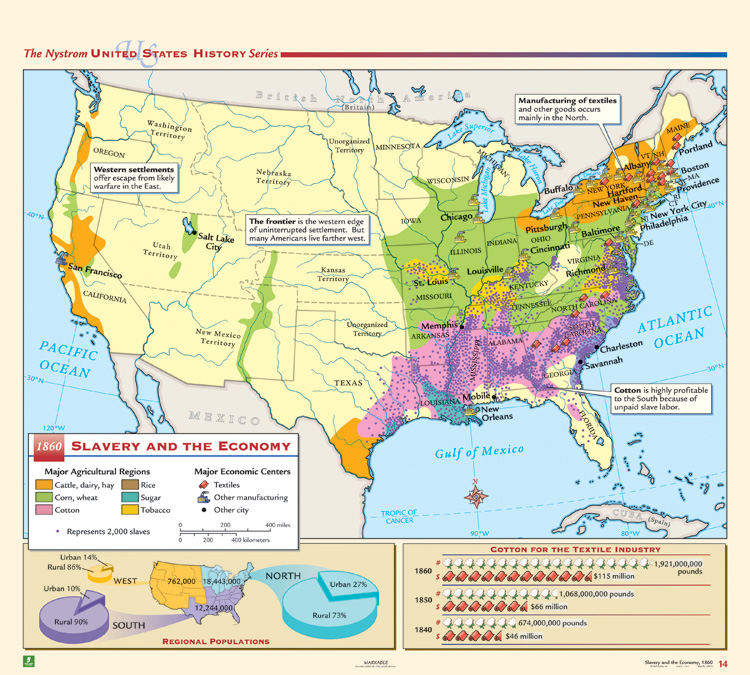
- Deep South cotton exports, which allegedly "paid for" Northern imports, were in fact only 50% of US total exports, including specie.
One proof is, in 1861, with no Confederate exports counted, Southern products exports fell by 71%, while Northern and Western exports increased by 59%.
In other words, a huge portion of what had been classified as "Southern products" were or could be, in fact, produced in Union states. - Bottom line: while cotton exports (circa $200 million in 1860) were important to the entire US economy ($4.4 billion GDP), they were not as important as Southerners liked to think.
Turned out, "King Cotton" was not "King in the North", or in Europe.
Historical US GDP numbers are readily available many places, including here.
To see the Civil War years, simply type in 1860 as the start date and 1865 as the end date.
You'll see that for 1860 our nominal GDP was $4.4 billion, rising to $10 billion in 1865.
If you're interested in such things, that nominal $10 billion in 1865 was an inflated peak not reached again until 1880.
However, you can also see that when measured in constant dollars, real GDP had returned to its 1865 levels already in 1868 and grew rapidly from there.
Estimates of Confederate GDP are trickier, because, on the one hand, in 1860 the South had never been more prosperous and average white heads of household were better off than their Northern cousins.
If considered a separate nation, the 1860 South would be the world's 4th richest, after the North and only Britain in Europe.
On the other hand, once the poverty of slaves is factored in, Southern per capita GDP is said to be about half the North's per capita GDP.
Based on that, and the South's population, we get a number for the South's GDP between 15% and 20%, depending on whether we're looking at just the Confederacy or every slave-state.
This site spells it out in detail.
FLT-bird: "The standard pack of lies I see.
Nobody said the South paid for "all" of US imports - just about 75% of them.
The South does not mean exclusively slave labor of course.
Most Southerners were White.
Most worked in jobs requiring manual labor.
Ergo, the majority of the South's labor was White."
Your 75% is a totally bogus number, but 50% is totally fair, and consists of only one major item -- King Cotton.
Cotton was grown mainly by slave-labor in the Deep South, as was sugar.
In the Deep Cotton South, slaves averaged 47% of the population.
FLT-bird can we say slave-labor produced most cotton? : "We might...if we were being dishonest.
Not all cotton was grown and harvested with slave labor.
That was a laughably wrong assumption from the start."
A reasonably fair estimate would be 80%, since, as Mississippians were unashamed to admit in their "Reasons for Secession" document:
- "Our position is thoroughly identified with the institution of slavery-- the greatest material interest of the world.
Its labor supplies the product which constitutes by far the largest and most important portions of commerce of the earth.
These products are peculiar to the climate verging on the tropical regions, and by an imperious law of nature, none but the black race can bear exposure to the tropical sun.
These products have become necessities of the world, and a blow at slavery is a blow at commerce and civilization... "
I don't know how you can dispute that word "none" without calling the 1861 secessionists liars, and why would they lie about it?
FLT-bird on Southern products: "False. Virginia, North Carolina, Kentucky, etc were the largest producers of Tobacco."
Kentucky was a Union state and tobacco was also grown in Union Southern Indiana, Illinois, Missouri and Maryland.
Bottom line: in 1861, when Confederate tobacco was removed from Union numbers, tobacco exports fell only 14%.
So tobacco was not a strictly "Southern Product".
FLT-bird: "1. I'd need to see the source for the statistics you are citing.
I would also need to see that they aren't including goods exported from the Southern states.
The blockade wasn't very effective in 1861."
Well, first of all, regardless of the blockade, it was impossible to include Confederate exports in Union numbers -- just think about it, it's not arguable.
Second, my source is here.
Also here, this source puts 1860 total exports at $400,122,296 which means that cotton exports -- at roughly $200 million -- were about 50% of the total.
FLT-bird: "Odd that you came to the "true answer" and all those Northern newspapers at the time got it so drastically wrong.
You'd think the people at the time would understand the economics better than some guy over 160 years later......"
I have no idea what "Northern newspapers" you're talking about, but here is what the New York Times (link above) said at the time:
- "Such are the Treasury returns.
In them the value of cotton exported is put down at only $34,051,483 [in 1861], against $191,806,555 for 1860; the excess in value for that year being $157,755,073."
Morrill Tariff reduced imports helped make financing the war easier for the Union.
FLT-bird: "Several of the newspapers I cited were in fact Republican.
The editorials I cited were from Northern papers calling for war because they recognized the loss of their cash cows - ie the Southern states, would be economically devastating to the Northern states.
That doesn't seem to be a position Democrats at the time would champion."
First of all, I've read many, but far from all, of your posts and I've never seen actual data to support your many ridiculous claims.
Second, it's clear you don't yet understand that Democrats then, just as now, were the party of globalized business, especially then in the production and shipment of cotton.
Northern Big-City, Big-Business Democrats would suffer the most from a loss of Confederate states' exports.
In early 1861, Northern Democrats wanted to "live and let live" with Confederate states.
New York's Democrat Mayor Wood even wanted to secede New York City too, to stay on good terms with the South.
All that ended when rumors of Confederate "free trade" began to circulate, and Northern Democrats were filled with fears of losing everything in the South.
Republicans were less concerned about the economics than with the Constitutional, legal, moral and military issues related to secession.
FLT-bird on Southern tariff payments: "First, we've already established that they did and that your denials are pure hogwash."
So far, you've shown no evidence of even one Southerner paying even one import tariff directly.
You are simply parroting propaganda claims of the time, without any evidence to support such claims.
FLT-bird: "yet more pure hogwash.
The imported goods were hit with at first double the 15% rate they had been subject to before and eventually under the Morrill Tariff they were subject to a staggering 50% tariff.
Needless to say, Northern manufacturers jacked up their prices only a tiny bit less in order to maximize profits.
So the cost of manufactured goods rose dramatically."
Surely you realize that all that is just babbling nonsense, for reason #1, the new Morrill tariff didn't take effect until after the Deep South had already declared their secessions.
Confederates never paid the higher rates.
Reason #2, Morrill originally increased average rates from 17% to 26% or roughly 50%.
But on specific major items, the increase merely returned rates to their levels in the Democratic 1846 Walker Tariff:
TABLE COMPARING TARIFFS OF 1846 Walker, 1857 Democrat & 1860 MORRILL:
| Commodity | 1846 Walker | 1857 Democratic | 1860 Morrill |
|---|---|---|---|
| Woolens | 30% | 24% | 37% |
| Brown Sugar | 30% | 24% | 26% |
| Cotton | 25 | 19 | 25 |
| Iron mfg | 30 | 24 | 29 |
| Tobacco | 40 | 30 | 25 |
| Wines | 40 | 30 | 40 |
| Average of above tariffs: | 33% | 25% | 30% |
So, while the overall average of increases was about 50% -- from 17% to 26% -- on major items like wool, sugar, cotton and iron, the Morrill increase was only 20% and simply returned rates to those of the 1846 Walker Tariff.
FLT-bird: "Clothing was one of the items subject to the dramatic increase in prices due to the tariff.
It did not "protect" Southern products at all.
In fact, Southerners saw their sales of cotton and other goods decrease during the Tariff of Abominations as Britain and France no longer had as much money to buy their products due to the tariff.
The same no doubt was taking place in the 1860s."
And once again you revert to your old narrative, regardless of facts, and once again, facts don't support your narrative.
So, let's begin with the 1828 Tariff of Abominations -- here is a graph showing US cotton exports, compared to total exports, not including specie.
Notice, there is no drop-off in cotton exports after 1828:

Next, let's look at US cotton imports from foreign countries.
In 1860 cotton (19% tariff) was our third largest dollar import commodity, only exceeded in value by sugar (24% tariff) and woolens (24% tariff).
Those tariff rates were the lowest 1857 tariffs, passed by Democrats.
And cotton was our number 3 import despite the fact that the South was the world's largest cotton producer, the North still imported about 20% as much as the South exported -- and that's with the 19% tariff on cotton preventing even more foreign imports.
My point is, Southern cotton (19% tariff) and sugar (24%) were both protected by US tariffs, as was tobacco (30%).
Such tariffs were believed necessary to fund the Federal government and to prevent foreign competitors from snuffing out Southern products.
Finally, I notice you often like to argue against the 1859 Morrill proposal, which was effectively a return to the Democrat approved 1846 rates, based on Civil War era increases that were strictly the result of secession and war, not their causes -- you're trying to reverse cause and effect.
- "Some historians in recent decades have minimized the tariff issue as a cause of the war, noting that few people in 1860–61 said it was of central importance to them.
Compromises were proposed in 1860–61 to save the Union, but they did not involve the tariff.[38]
Arguably, the effects of a tariff enacted in March 1861 could have made little effect upon any delegation which met prior to its signing."