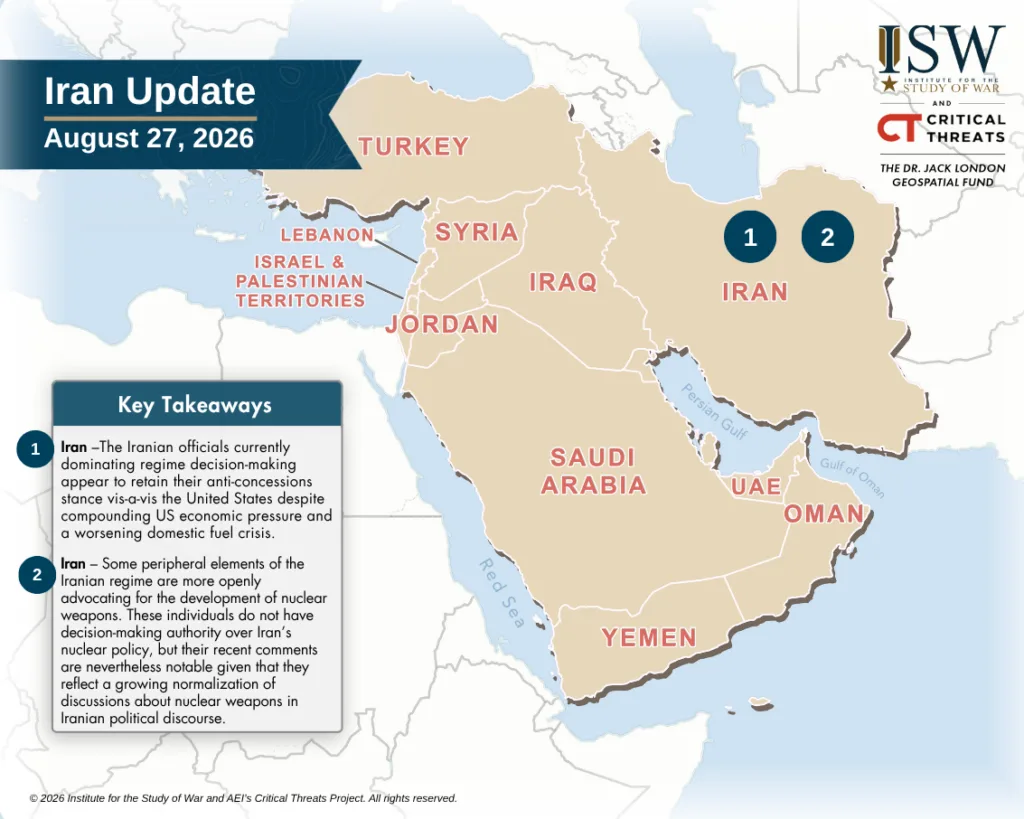
The Iranian officials currently dominating regime decision-making appear to retain their anti-concessions stance vis-à-vis the United States despite compounding US economic pressure and a worsening domestic fuel crisis. Iran is facing an acute fuel crisis, which has been exacerbated by the US naval blockade.[1] Western media has recently reported long lines at gas stations and gas station closures as a result of fuel shortages nationwide.[2] The lack of trade during the war has also led to shortages in foreign currency and basic goods, causing hyperinflation, all of which have reduced Iranians’ purchasing power and deteriorated Iran's economic conditions.[3]
Iran's domestic refining capacity has historically struggled to meet domestic consumption demand, making imported gasoline an important supplement to domestic supply.[4] Informed sources told anti-regime media on August 26 that the US blockade on Iranian ports, Ukrainian strikes on Russian refining infrastructure, and disruption to the Caspian Sea supply route between Iran and Russia have restricted Iran's refined gasoline imports.[5] Disruptions to Caspian Sea trade may refer to Ukraine's drone attack that targeted cargo ships and a naval vessel transporting military equipment between Russia and Iran in July.[6] The sources noted that Iran has yet to secure alternative fuel supplies to manage its current gasoline deficit, which is around 15 million liters per day, and that Iran has resorted to using fuel reserves to meet domestic demand.[7]
Key decision-makers in Supreme Leader Mojtaba Khamenei’s inner circle continue to threaten to respond to US economic pressure and do not appear to have softened their positions on core regime demands. Basij Commander Hossein Taeb warned on August 27 that Iran will respond to US economic pressure by imposing economic costs on the United States and Israel.[8] Taeb and Supreme National Security Council Secretary Mohsen Rezaei both emphasized on August 27 that the United States must fulfill its commitments in the US-Iran memorandum of understanding (MoU), which highlights their continued support for maximalist demands such as comprehensive sanctions relief.[9] The IRGC Navy separately likely attacked a Kuwaiti-flagged tanker in the Strait of Hormuz on August 27, underscoring how the regime retains its objective of securing control over maritime traffic in the strait.[10] Senior Iranian decision-makers interpreted the MoU as allowing Iran to determine traffic arrangements in the strait and the regime has repeatedly used force to materialize this interpretation.
These decision-makers’ insistence on maintaining maximalist demands despite immense economic pressure highlights their willingness to incur economic costs and the risk of potential domestic unrest. Unspecified sources told anti-regime media that the IRGC, likely referring to the ruling IRGC faction, is unwilling to use Iran's fuel reserves to satisfy domestic consumption while government officials, including President Masoud Pezeshkian, support using Iran's fuel reserves to “contain public concern over shortages and higher prices.”[11] This dispute between the anti-concessions and pro-concessions camps is consistent with previous conflicts between these factions, in which the latter has supported making limited concessions to the United States to obtain economic relief and maintain internal stability. The anti-concessions faction has, in contrast, prioritized achieving the regime's maximalist objectives over securing economic relief.
Some senior Pezeshkian administration officials are trying to downplay Iran's economic situation and reassure the public, likely to try to mitigate the risk of social unrest during this economic crisis. Central Bank of Iran (CBI) Governor Abdolnasser Hemmati claimed on August 27 that Iran has avoided inflation due to stabilizing measures adopted by the CBI and that the CBI has at least $17.2 billion US dollars in foreign currency reserves.[12] Hemmati also noted the CBI’s plans to create further employment opportunities.[13] Hemmati notably acknowledged last week that Iran is facing foreign currency reserve shortages, however. Iranian Oil Minister Mohsen Paknejad separately claimed that Iran is still exporting oil outside of the region, implying that Iran is still generating revenue from oil exports beyond the US blockade.[14] Other Iranian officials are also promoting new energy projects and plans to revive energy infrastructure, such as the South Pars Gas Field, that US and Israeli airstrikes damaged in the war.[15] Most of these measures are unlikely to alleviate Iran's energy deficit in the near term, indicating that the announcements may be intended primarily to reassure the Iranian population rather than signal actual economic improvements. Such messaging can help preserve public confidence and reduce the risk of panic buying and bank runs, which could intensify shortages of fuel and other basic goods.
The Iranian regime appears to be considering several courses of action to address the fuel crisis, including potentially raising gasoline prices. Raising fuel prices has previously caused widespread protests in Iran. Iranian Vice President for Executive Affairs and adviser to President Masoud Pezeshkian, Mohammad Jafar Ghaempanah, admitted on August 27 that there have been disruptions to Iran's gasoline imports since the start of the conflict.[16] Ghaempanah argued that Iran's gasoline subsidy system and restrictions that prevent increasing fuel prices are no longer sustainable, implicitly arguing that the government should increase fuel prices.[17] Other government officials have consistently signaled that they will not increase gas prices in recent weeks, however, almost certainly to avoid backlash from the Iranian population.[18] A previous fuel price increase in 2019 triggered large-scale protests across Iran.[19]
Some peripheral elements of the Iranian regime are more openly advocating for the development of nuclear weapons. These individuals do not have decision-making authority over Iran's nuclear policy, but their recent comments are nevertheless notable given that they reflect a growing normalization of discussions about nuclear weapons in Iranian political discourse. Some Iranian parliamentarians, including some affiliated with the ultra-hardline Paydari (Stability) Front, and commentators close to the regime have argued in recent months that Iran has incurred the costs of its nuclear program without receiving the deterrent benefit they associate with a nuclear weapon, which they claim challenges the logic of remaining a nuclear-threshold state.[20] A political analyst close to the regime argued on April 20 that complete nuclear deterrence requires possessing nuclear weapons and described threshold deterrence as “incomplete, limited, uncertain, and unstable,” for example.[21] These comments are consistent with a Reuters report from late March in which unspecified Iranian sources claimed that debates among hardliners over acquiring a nuclear weapon had become “louder, more public, and more insistent.”[22] The officials and commentators who have publicly advocated for weaponization do not control the regime's nuclear policy, and the available evidence does not indicate that senior leaders have authorized weapons production or that Iran currently has a feasible path to build a weapon. A member of the Supreme Leader's Office, Mehdi Fazaeli, acknowledged on July 27 that there have been stronger demands for nuclear weapons among some elites and parts of the public but added that these demands do not reflect official policy, for example.[23]
These parliamentarians and commentators’ support for nuclear weapons development reflects a public debate over how Iran should restore deterrence after the recent US-Israel-Iran War, similar to debates that followed the June 2025 Israel-Iran War.[24] Some advocates portray nuclear weapons as a way to compensate for perceived weaknesses in Iran's existing forms of deterrence, such as setbacks to the Axis of Resistance. IRGC-affiliated Mashregh News republished an assessment on August 23 that argued that the weakening of the Axis of Resistance and failures of Iran's conventional deterrence tools have strengthened support for crossing the nuclear threshold.[25] An expert close to the regime, Hassan Hanizadeh, similarly argued on July 9 that Iran must review its defense doctrine and defended the “military use of nuclear technology.”[26] These comments are notable given that some senior Iranian officials, such as Supreme Leader Adviser Mohammad Mokhber, have recently argued that Iranian control over the Strait of Hormuz provides Iran with the same, if not more, deterrence power as a nuclear weapon.[27] It is unclear whether the advocates of nuclear weapons development view the Strait of Hormuz as an insufficient form of deterrence, or whether they seek to both maintain control over the strait as well as develop a nuclear deterrent.
Some regime elements are also developing political and religious arguments that they may use to try to justify a future reversal of Iran's nuclear policy. Paydari-affiliated Parliamentary Cultural Commission member Hassan Ali Akhlaghi Amiri argued on July 20 that “different circumstances,” likely referring to the death of former Supreme Leader Ali Khamenei and appointment of Supreme Leader Mojtaba Khamenei, could reverse Ali Khamenei’s fatwa that prohibited the production and use of nuclear weapons.[28] Arguments that Mojtaba could alter his father's fatwa could allow proponents to present weaponization as consistent with the regime's religious framework.
The recent public discussions about nuclear weapons among peripheral elements of the regime may reflect decreased control over the information space by the Supreme Leader, as opposed to an actual increase in discussions about nuclear weapons. Ali Khamenei closely controlled the information space and limited discussions of this topic. It is unclear how much Mojtaba is controlling decision-making, let alone how much control he has over the information space and the regime's messaging. A more open information space could make discussions about developing nuclear weapons more public, rather than reflecting an actual uptick in such discussions within the regime.
Iranian-backed Iraqi militia Kataib Sayyid al Shuhada Spokesperson Kazem al Fartousi told Saudi-owned media on August 27 that the militias asked the Iraqi federal government to find unspecified “alternatives to their weapons” to convince them to disarm.[29] It is unclear what “alternatives” Fartousi was referring to, but Iraqi media reported on July 14 that unspecified Iranian-backed Iraqi militias had demanded guarantees from the Iraqi government before they disarm, including immunity from prosecution and protection from US or Israeli strikes.[30] Fartousi could have also been referring to jobs in Iraq's security establishment that Iraqi Prime Minister Ali al Zaydi has reportedly set aside for militia members willing to disarm.[31] Kataib Sayyid al Shuhada is one of several Iranian-backed Iraqi militias that have repeatedly refused to disarm, however.[32]
The Houthis likely launched multiple drones targeting oil infrastructure in the vicinity of Yanbu, Saudi Arabia, on July 27.[33] Greek security sources told Reuters that a Greek-operated air defense system and Saudi air defenses intercepted a “drone swarm” on August 27.[34] The Houthis have not claimed the attack at the time of this writing. Saudi and Greek air defenses previously intercepted Houthi ballistic missiles fired at Yanbu on July 25.[35] Houthi Spokesperson Yahya Sarea claimed that the group targeted Saudi Aramco oil facilities in Yanbu during the July 25 attack.[36] Saudi Arabia has increasingly relied on Yanbu and other Saudi Red Sea ports to export oil and circumvent Iran's control over the Strait of Hormuz.[37] ISW-CTP assesses that the Houthis likely seek to compel Saudi Arabia to end its blockade on Houthi ports and airports and meet Houthi demands by threatening Saudi oil infrastructure.[38]
The Republic of Yemen Government (ROYG)-aligned National Resistance Front reportedly seized a drone component shipment from a vessel off the Yemeni coast that was likely bound for the Houthis on August 27.[39] ROYG authorities previously seized multiple caches of electronic components that could be used for first-person view (FPV) drone production at Yemeni ports and land crossings on August 13.[40] The Houthis have increasingly shifted away from smuggling completed weapons systems toward components to support domestic weapons production in recent years.[41] Houthi domestic weapons production continues to rely on components smuggled into Yemen, however.[42] The Houthi maritime smuggling network expands across multiple littoral Red Sea African countries and Iran.[43]
links: https://understandingwar.org/research/middle-east/iran-update-august-27-2026/