Skip to comments.
Iranian Regime tv Channel One hacked while it was airing Khamenie speech
various
| 10-8-22
Posted on 10/08/2022 1:05:38 PM PDT by nuconvert
Iranian Regime national tv Channel One hacked about an hour ago. During a broadcast of Khamenie speech, a red crosshair appeared over his face and chanting of Women. Life. Freedom. There was writing to the side saying "Rise up. Join us". Also 4 photos at the bottom of the screen of young people killed and additional writing: "The blood of our youth is dropping from your paws".
Also, there was a huge banner in the middle of Tehran highway today that read: We are no longer afraid of you. We will fight.
Also, attempted attack on IRI ambassador in Denmark. Her bodyguard was stabbed. Diplomatic Security intervened before the attacker could stab the ambassador.
TOPICS:
KEYWORDS: basij; deathtothemullahs; denmark; ebrahimrigi; erdogan; iran; iranprotests; iraq; irgc; iri; israel; khameini; khamenei; kurdistan; lebanon; mahsaamini; mullahloversonfr; mullahsmustbekilled; najisharifizindashti; protests; qudsforce; raisi; receptayyiperdogan; shahrammaroufmola; syria; turkey; yemen; zahedi
Navigation: use the links below to view more comments.
first previous 1-20 ... 2,341-2,360, 2,361-2,380, 2,381-2,400, 2,401 next last
To: AdmSmith; nuconvert; blitz128; BeauBo; dennisw; adorno; Jonty30; USA-FRANCE
It certainly appears every move Iran/IRGC makes shows their intent to continue exercising ME power and control in Hormuz and elsewhere in that neighborhood.
I just heard a Bloomberg report on current activity with our Strategic Petroleum Reserve (SPR), and from our President. Apparently we had conferred with our major allies earlier this year regarding effective handling of our SPRs given trouble with Iran and the IRGC. Thus the Iran Mullocracy’s efforts have failed to blackmail the world to confirm and legalize their efforts to control world shipping.
Bloomberg reported we have been withdrawing enough from our SPR to add about 10% to our daily consumption needs. Thus we have been able to keep our gas prices from rising to excessively high daily rates. Of course at some point we will need to be refilling our SPR, and that will need Congressional action. Unfortunately Trump started speaking just as my phone rang and I did not hear his brief statements. Whoever controls Congress after this November, we must not allow Iran to change the Laws of the Sea, and continue their efforts to legally control world commerce.
2,381
posted on
08/20/2026 11:54:08 AM PDT
by
gleeaikin
(Question AuthPority: report facts and post their 'links" in yopur messages.I)
To: gleeaikin
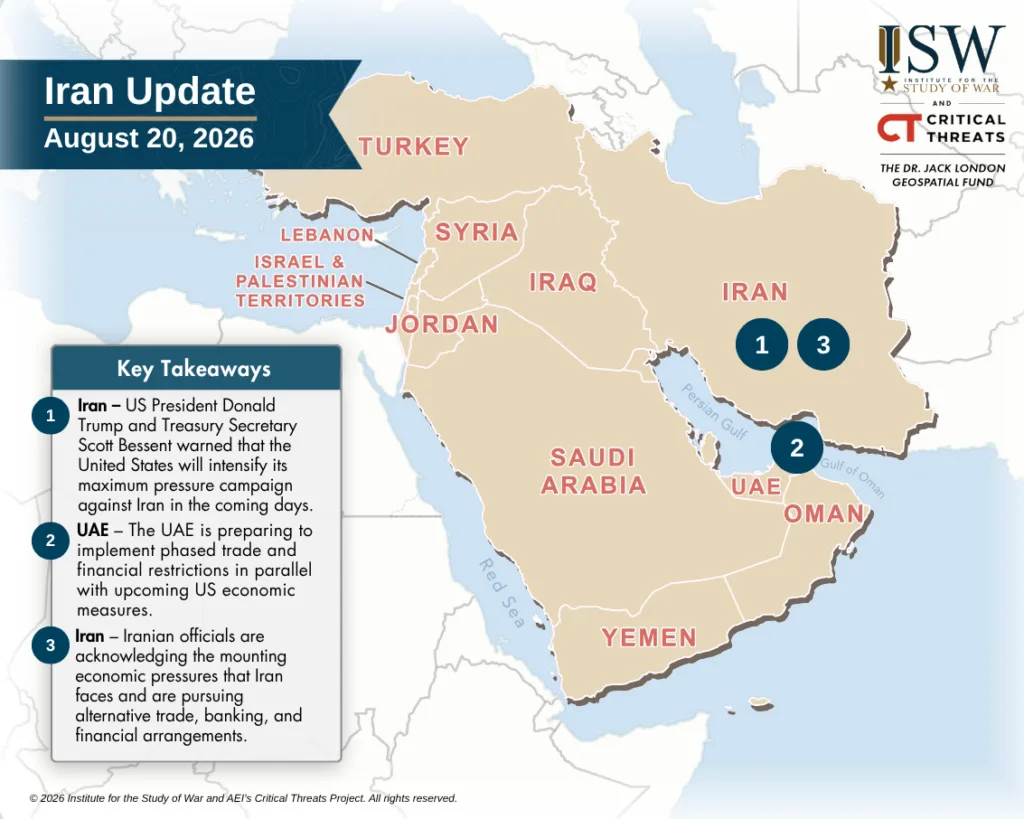
US President Donald Trump and Treasury Secretary Scott Bessent warned that the United States will intensify the US economic pressure campaign against Iran in the coming days to exploit growing Iranian economic vulnerabilities and deter further Iranian aggression in the war. Trump warned that countries will face “tremendous” economic consequences if their financial institutions, businesses, airports, or government entities provide any type of “lifeline” to Iran on August 19.[1] Trump reiterated his support for his maximum pressure campaign.[2] The US maximum pressure campaign, which the Trump administration first employed in 2018 and reinstated in 2025, sought to levy economic sanctions and other coercive economic measures to isolate Iran and change Iranian decisionmakers’ behavior.[3] Bessent announced on August 20 that the United States will announce additional economic measures against Iran and entities with commercial ties to Iran on August 24.[4] Bessent added that the United States would pair the existing blockade with the “toughest sanctions in history” to further constrain Iran's economy, curtail its ability to “project power through its proxies,” reduce its capacity to fund its military forces, and increase economic pressure on Iran through inflation and financial isolation.[5] Bessent stated that US economic pressure will ”collapse [the Iranian] regime.”[6]
The United Arab Emirates (UAE) is preparing to implement phased trade and financial restrictions in parallel with upcoming US economic measures.[7] The UAE announced on August 19 that it would cut off all trade and financial transactions with Iran after recent Iranian missile attacks against Emirati maritime targets.[8] Sources familiar with the matter told the Wall Street Journal that the UAE plans to phase its reduction of trade and financial engagement with Iran by adopting initial measures to restrict cargo and trade flows.[9] The UAE is a major trade partner for Iran, and Emirati imports account for nearly a third of Iranian imports, including basic goods.[10] The UAE wants to preserve diplomatic channels in case the US economic pressure campaign fails, according to unspecified sources, however.[11] An unspecified source familiar with the matter warned that the UAE could pursue Iranian-affiliated entities based in the UAE if Iran attacks the UAE again.[12]
Iranian officials are acknowledging the mounting economic pressures that Iran faces and are pursuing alternative trade, banking, and financial arrangements designed to reduce the impact of these pressures. Iran is not currently exporting any oil, according to Iranian Central Bank Governor Abdol Nasser Hemmati on August19.[13] Hemmati admitted that Iran is facing foreign currency reserve shortages, rising youth unemployment, and reconstruction costs.[14] Hemmati also acknowledged that sanctions will only worsen these conditions.[15] Iranian Energy Optimization and Strategic Management Organization Deputy Head Yaser Mirzaei said that Iran's domestic gasoline situation has become a “critical issue” requiring an immediate solution, noting that the lack of access to foreign exchange, logistics, and restrictions on foreign supply routes have limited imports.[16] Additional UAE restrictions will likely worsen Iran's foreign-exchange and trade challenges by limiting Iran's access to a hub for Iran's shadow-banking and sanctions evasion networks.[17] Approximately 80 percent of Iran's imported foreign exchange reportedly comes through the UAE, for example.[18]
Iran is seeking to invest in alternative routes and destinations for its oil exports to alleviate this economic pressure. Iran signed a deal to export oil to Tajikistan on August 15.[19] Hemmati and Iranian Parliament Speaker Mohammad Bagher Ghalibaf met with Iraqi officials and economic experts in Iraq between August 16 and 20.[20] Hemmati announced that the existing banking and financial obstacles between Iran and Iraq will be resolved in the coming weeks. Hemmati also noted that Iraqi Prime Minister Ali al Zaydi agreed to provide guarantees for Iranian contractors backed by Iranian assets in Iraqi banks.[21] Hemmati also stated that he advocated for the creation of financial corridors that create independence from Western-controlled financial systems in recent discussions with BRICS partners, indicating Iran's interest in diversifying its economic partnerships outside of the region.[22]
Several regional officials told Al Monitor on August 19 that Saudi Arabia wants the Iraqi federal government to take “punitive action” against the Iranian-backed Iraqi militias that have launched attacks targeting Saudi territory.[23] One regional official stated that Saudi Arabia wants the Iraqi government to arrest and prosecute the Iranian-backed Iraqi militia leaders responsible for ordering attacks on Saudi territory.[24] The Iraqi government has taken limited steps since late July to prevent further Iranian-backed Iraqi militia attacks targeting Saudi Arabia and other regional states in order to avoid possible future rounds of US or Saudi strikes in Iraq.[25] US and Saudi forces struck several Iraqi militia positions on July 28 in response to Iraqi militia attacks on Saudi energy infrastructure and US interests in Iraq and the region.[26]
Three informed sources also told Al Monitor that Saudi Arabia decided to refrain from striking Jurf al Sakhr, Babil Province, as part of its July 28 strikes in Iraq after Iraqi Prime Minister Ali al Zaydi asked for “time to deal with the area himself.”[27] Iranian-backed Iraqi militia Kataib Hezbollah has repeatedly refused to allow the Iraqi government to exercise sovereignty over Jurf al Sakhr for over a decade and has used the area to store weapons and launch attacks against US and foreign targets in Iraq and the region, including in March and April.[28] It remains unclear as of this writing how Zaydi intends to “deal” with Jurf al Sakhr, however. Qatari-owned regional media reported on August 19 that Zaydi plans to increase security measures and deploy a special Iraqi Counter Terrorism Service unit near Jurf al Sakhr to ”monitor” militia movements, but the report specified that this plan would not lead to raids on militia positions or a military incursion into the area.[29] This plan contradicts previous reporting, which claimed that Zaydi was preparing for Iraqi security forces to encircle Jurf al Sakhr.[30] ISW-CTP noted on August 19 that this reversal suggests that Zaydi is responding to Iranian-backed Iraqi groups’ pressure to limit Zaydi’s disarmament efforts.[31]
Islamic Revolutionary Guards Corps (IRGC) Quds Force Commander Brigadier General Esmail Ghaani warned unspecified Iranian-backed Iraqi militias against conducting additional attacks against Saudi Arabia during his August 10 visit to Baghdad, according to a regional official speaking to Al Monitor on August 19.[32] The source said that Ghaani was concerned about growing Saudi-Turkish ties, which almost certainly refers to Turkey, Saudi Arabia, and Pakistan's recent signing of a joint defense agreement.[33] Iranian-backed Iraqi militias have previously heeded Ghaani’s calls for restraint.[34] ISW-CTP has not recorded any additional Iraqi militia attacks on Saudi territory since July 28.
Iranian Parliament Speaker Mohammad Bagher Ghalibaf continued to meet with senior Iraqi officials on August 20.[35] Ghalibaf met with Iraqi National Security Advisor Qassem al Aboudi, during which Ghalibaf affirmed support for Iraqi government measures to “regulate” Iraqi militia weapons.[36] Iraqi Supreme Judicial Council President Faiq Zaidan also met with Ghalibaf on August 20 to discuss bilateral judicial and legal cooperation.[37] These meetings come after Ghalibaf reportedly met with unspecified Iraqi officials on August 19 to relay Iran's proposal for disarming the militias in a way that avoids a confrontation between the Iraqi federal government and the militias.[38] Iran has also reportedly proposed “freezing” or hiding the militias’ heavy weapons or transferring them to Iran until the militias reach a political settlement with the Iraqi government.[39] Iran has recently dispatched several senior officials to Iraq, such as Ghaani, to discourage militia disarmament while avoiding conflict between the Iraqi government and Iran-backed militias operating in Iraq.[40]
The Houthis claimed to launch drones targeting a “sensitive target” at the Najran Regional Airport and an unspecified oil facility in Najran, Saudi Arabia, on August 20.[41] The Houthis claimed to conduct these strikes in response to Saudi overflights in Houthi-controlled areas of Saada Governorate in northwestern Yemen.[42] Saudi officials have not confirmed either strike at the time of this writing. The Houthis have previously attacked the regional airport and an oil facility in Najran on August 4 and 14, respectively.[43] ISW-CTP continues to assess that the Houthis are attacking Saudi oil infrastructure primarily to raise Saudi political and economic costs to an untenable level and compel Saudi leaders to terminate military operations against the Houthis in Yemen.[44] IRGC spokesperson Brigadier General Hossein Mohebbi warned IRGC-affiliated media on August 20 that the Houthis’ military capabilities are improving and that Saudi Arabia will not be able to defend against future Houthi attacks.[45]
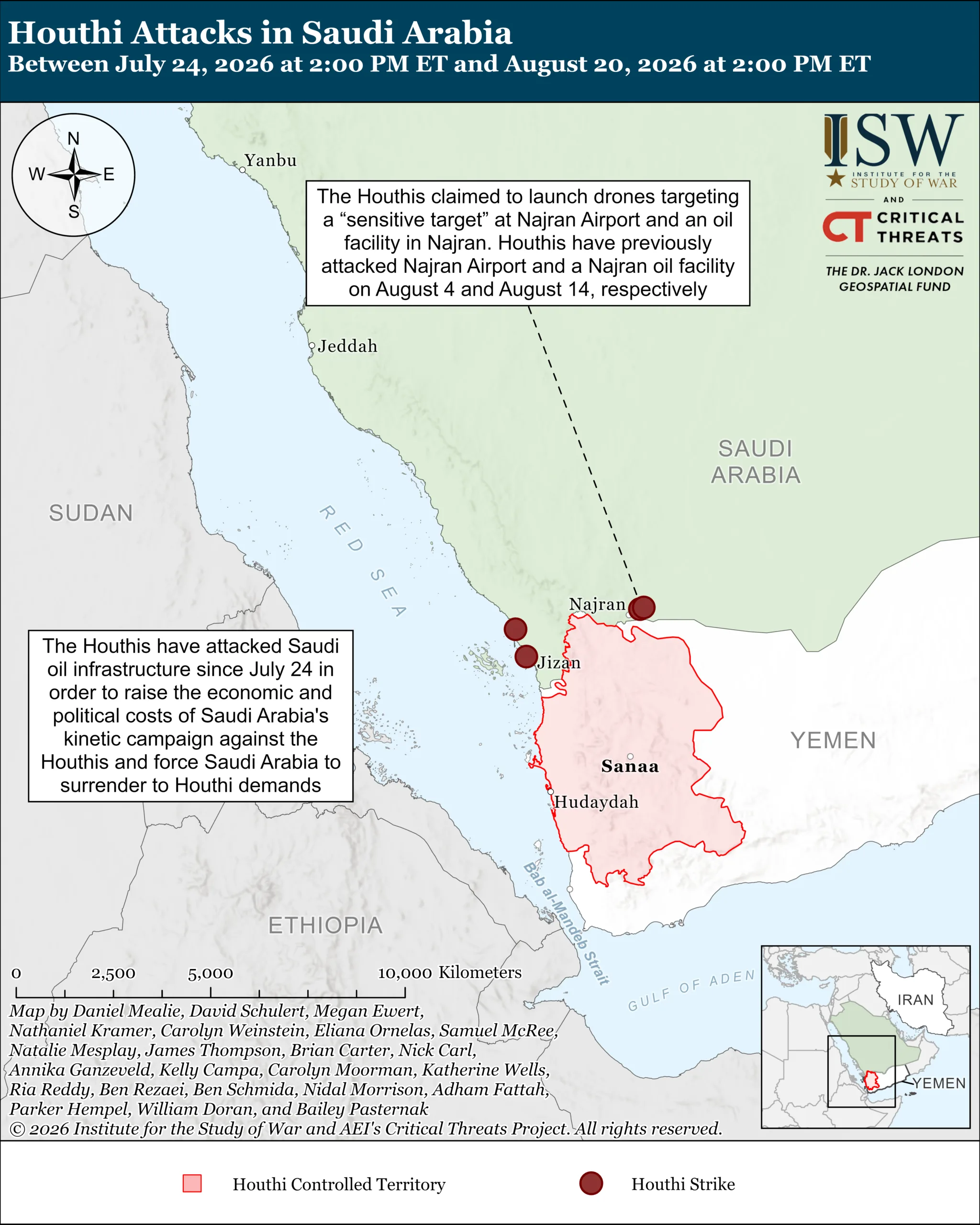
Three unspecified Houthi military sources and Republic of Yemen Government (ROYG) Information Minister Moammar al Eryani told Western media on August 19 that the Houthis are preparing to seize control of the Bab al Mandeb Strait.[46] The Houthi sources stated that 2,000 Houthi fighters recently deployed to “front lines” along Yemen's western coast in Taiz and Hudaydah governorates.[47] The sources also said that the Houthis aim to set conditions for an assault on the strait through recent Houthi-claimed attacks on ROYG naval assets.[48]
https://understandingwar.org/research/middle-east/iran-update-august-20-2026/
2,382
posted on
08/21/2026 5:57:39 AM PDT
by
AdmSmith
(GCTGATATGTCTATGATTACTCAT)
To: AdmSmith
“the loss of access to trade with the UAE (is) particularly significant to the domestic Iranian population.”
The thing that made Dubai successful, was how business friendly its policies were. If you were doing business in the region, you almost could not afford to not be based in Dubai. As such, much of the regions goods and financial flows go through there, and a lot of Iran’s business agents and contacts live there.
Normally a free-wheeling open city, the authorities there have the Middle Eastern ability to crack down like a police state if the Sheik tells them to. Iran’s agents will be scrambling to re-route shipments through a third country (likely Iraq), with payments through front companies. Emirati secret police could potentially round up Iranian businessmen, and put them on planes to Iran, or even hold them in custody, to jam up Iranian logistics and finance even more, before they can adapt.
Another thing hitting the fan now for Iran, is that even though their oil cargoes have not been leaving the Gulf for a while, many earlier cargoes that did were still in transit, at markets for sale (floating storage), or their payments were still in process. That buffer is pretty much expended by now, and the residual income stream from pre-blockade shipments is dwindling to a trickle.
To: BeauBo
2,384
posted on
08/22/2026 11:54:13 AM PDT
by
AdmSmith
(GCTGATATGTCTATGATTACTCAT)
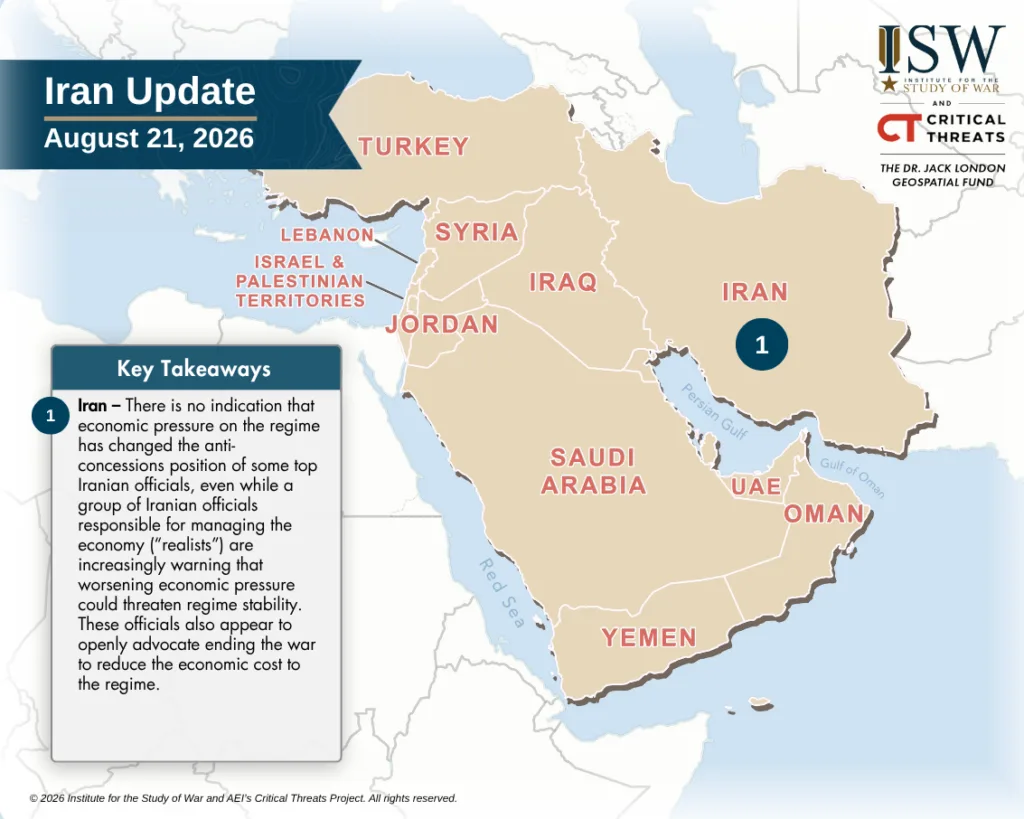
There is no indication that economic pressure on the regime has changed the anti-concessions position of some top Iranian officials, even while a group of Iranian officials responsible for managing the economy (“realists”) are increasingly warning that worsening economic pressure could threaten regime stability. These officials also appear to openly advocate ending the war to reduce the economic cost to the regime.[1] There appear to be two loose groups of Iranian leaders that have influence at this time. One, the pro-concessions or “realist” camp, is responsible for managing the economy and ostensibly answers to a voting constituency of everyday Iranians. These include Iranian President Masoud Pezeshkian and Parliament Speaker Mohammad Bagher Ghalibaf, among others. A second group, which includes Islamic Revolutionary Guards Corps (IRGC) Commander Major General Ahmad Vahidi, does not favor any concessions in negotiations and seeks full US surrender. This group is relatively stronger and more ideological.
Recent statements by “realist” officials show their view of the situation, which revolves around major concerns over economic hardship. Pezeshkian said on August 21 that the war must end at some point and argued that “it would be better to end it now,” while still adding that Iranians must be prepared to endure the ongoing economic hardship.[2] Ghalibaf similarly warned on August 21 that Iran cannot endure, regardless of its military strength, if its population is hungry and the country lacks financial circulation, economic growth, and domestic production.[3] Central Bank Governor Abdol Nasser Hemmati, another adherent to realist thinking, acknowledged on August 19 that Iranian oil exports had nearly ceased and that Iran faces foreign-exchange shortages, reconstruction costs, and increased youth unemployment.[4] Pezeshkian and Ghalibaf have generally favored negotiations, and their statements do not represent a major change in their positions.[5] Their focus on the war's economic costs suggests that they seek to convince senior regime officials to end the war before worsening conditions threaten regime stability.
Pezeshkian, Ghalibaf, Hemmati, and other officials responsible for managing the economy appear more likely than Vahidi and other anti-concession officials to view economic deterioration as a reason to change policy. It is notable that these officials also must answer, at least ostensibly, to the electorate, whereas figures like Vahidi do not. Pezeshkian, Ghalibaf, and Hemmati’s ability to change Iran's policy remains limited, however. ISW-CTP previously assessed that the faction around Vahidi continued to guide negotiation policy, while the more pro-concession group around Pezeshkian, Ghalibaf, and Foreign Affairs Minister Abbas Araghchi had less influence and primarily disagreed with Vahidi’s faction over how to achieve shared regime objectives.[6]
The failure of the US-Iran memorandum of understanding (MoU) appears to have further weakened the pro-concession, “realist” camp relative to Vahidi and other anti-concession officials. Pezeshkian had one notable success when he convinced Supreme Leader Mojtaba Khamenei to approve the MoU in June, in part by emphasizing the economic consequences of the blockade.[7] Iranian officials appear to believe that the MoU collapsed due to US subversion, not because of IRGC interference, and have repeatedly accused the United States of violating agreements and acting in bad faith.[8] This failure weakened the pro-concession argument that compromise with the United States would produce economic relief and strengthened the argument that the United States cannot be trusted, which the anti-concession camp can use to justify continued coercion rather than another agreement.[9] IRGC-affiliated Fars News reinforced this argument on August 21, criticizing Pezeshkian’s call to end the war and arguing that conciliatory positions signal weakness, encourage further attacks, and repeat the same mistake Iran allegedly made by showing flexibility before the two most recent wars.[10] The result of this dynamic is that the hardline, anti-concessions camp can use the perceived US “dishonesty“ to argue that the “realist,“ pro-concessions camp is being unrealistic in engaging with the United States. This enables the ascendant hardliners to continue to use force to enforce their preferred arrangement in the strait and to maintain maximalist demands rather than make concessions.[11]
Vahidi’s faction therefore remains in a stronger position to argue that continued pressure on the United States, rather than Iranian concessions, can secure the regime's objectives. ISW-CTP assessed on August 17 that Vahidi’s group would likely accept an agreement that meets Iran's demands (and complete US surrender) but would risk continued conflict rather than accept one that falls short of Iran's maximalist demands.[12] The “realist,” pro-concession group favors an arrangement similar to the original MoU to end the war and secure economic relief, while Vahidi and his allies seek broader aims, including continued Iranian control of the strait. The anti-concession faction also demanded that the United States lift the naval blockade and sanctions, withdraw US military forces from around Iran, pay war reparations, release frozen Iranian assets, and cease attacks on Iran's regional proxies.[13]
Regime decision making may therefore take a long time to react to economic deterioration, even as the economy gets much worse. Vahidi and other anti-concession officials appear to have a higher tolerance for domestic unrest because they may calculate that the regime can contain and suppress renewed protests without changing course. ISW-CTP continues to assess that Vahidi’s faction may tolerate substantial economic costs and potential unrest if doing so enables Iran to achieve its core objectives and may instead respond to instability by securitizing society and seeking alternative economic channels.[14] This greater tolerance for economic pain and unrest helps explain the anti-concession camp's preference for sustained pressure over compromise. Second Deputy Parliament Speaker Hamidreza Haji argued on August 20 that rising oil prices means “we are [the regime] winning,” adding that negotiations should not simply seek to end the war, and called on Gulf states to pressure the United States to accept Iran's conditions.[15] Ultra-hardliner Paydari (Stability) Front-affiliated Parliamentarian Mahmoud Nabavian similarly stated on August 21 that calls for peace under current conditions amount to “surrender.”[16] The Paydari Front is fully anti-negotiations, not just concessions. The pro-concessions faction appears to view worsening economic conditions as a reason to compromise before deteriorating economic conditions threaten regime stability, while the hardline anti-concessions and anti-negotiations factions appear willing to tolerate greater economic and domestic instability. Economic pressure could therefore become severe enough to threaten regime stability before the officials who currently dominate decision making conclude that Iran must make meaningful concessions.
The People's Republic of China (PRC) is resisting US efforts to economically isolate Iran, but Chinese economic engagement cannot offset the blockade if Iran cannot physically supply its largest oil customer. The PRC rejected sanctions and pressure on August 20 as a solution and reiterated its opposition to unilateral sanctions after the United States called on Beijing to cooperate with its economic pressure campaign.[17] The PRC bought more than 80 percent of Iran's exported oil before the recent war. Chinese refiners still appear willing to purchase Iranian crude, but Reuters reported on August 21 that the amount of Iranian oil available for September and October delivery has fallen sharply as cargoes already outside the blockade are sold and Iran struggles to replace them.[18] Some Chinese refiners are consequently turning to Brazilian and Iraqi crude.[19] Iranian decision makers will likely monitor whether the PRC and other trading partners resist US pressure, but foreign demand will provide diminishing relief if the blockade continues to restrict Iranian exports.
The US Treasury re-designated Hezbollah as an IRGC Quds Force-affiliated group on August 20.[20] The US Treasury also sanctioned ten Hezbollah-affiliated individuals involved in an international money-laundering operation for the group to avoid US sanctions and obtain foreign currency on August 20.[21] A US official told Reuters on August 20 that the redesignation is intended to demonstrate that Hezbollah is operating on Iran and the IRGC Quds Force's ”behalf.”[22] US Senior Advisor for Arab and African Affairs Massad Boulos stated that the redesignation also demonstrated US resolve to counter “terror financing networks“.[23] The US Treasury re-designation comes amid repeated reports in recent months that the IRGC has reorganized Hezbollah since 2024 to incorporate a decentralized command and control structure and fill command positions within the group's units.[24] The Israel Defense Forces has killed multiple IRGC Quds Force officers advising Hezbollah in various roles throughout the current Israeli campaign in Lebanon since March 2.[25]
The Lebanese government is continuing to balance the need to disarm Hezbollah with the latent threat that Hezbollah poses. Lebanese Deputy Prime Minister Tarek Mirti told Emirati media on August 21 that the Lebanese government will not “back down” from implementing the Trilateral Framework Agreement, which includes disarming Hezbollah.[26] Mirti stated that the Lebanese government does not want to undertake any decisions that would require using force against Hezbollah, which could “endanger national unity.”[27] Senior Lebanese officials, including Lebanese President Joseph Aoun and Prime Minister Nawaf Salam, have repeatedly emphasized the need to maintain Lebanese stability and avoid violence with Hezbollah.[28] Aoun told Lebanese media about the necessity of ”cooperating with Hezbollah” to disarm the group on July 10, for example.[29] Aoun and Mitri’s caution is understandable, given the risks to Lebanese stability implicit in any violent flare-ups between the government and Hezbollah. Any disarmament efforts that rely on cooperating with Hezbollah will almost certainly fail, however, because Hezbollah will not disarm of its own volition.[30]
Iranian-backed Iraqi militia Asaib Ahl al Haq is likely attempting to superficially comply with the Iraqi federal government's disarmament initiative by handing over unarmed drones and other unspecified weapons. A source familiar with Iraqi militias claimed on August 21 that Asaib Ahl al Haq handed fewer than 10 unarmed drones and other unspecified weapons to the Iraqi disarmament committee on August 19.[31] The source stated that Asaib Ahl al Haq had stored these weapons in one of its headquarters in Yusufiyah District, Baghdad Province.[32] The report is consistent with Shia Coordination Framework officials’ July 9 claim that militias handed over “scrap” missiles and inoperable drones while retaining functional heavy weapons.[33] The unarmed drones and unspecified weapons that Asaib Ahl al Haq reportedly handed over to the committee almost certainly constitute a fraction of the militia's total arsenal, however. The source added that Asaib Ahl al Haq did not hand over any missiles, even though the disarmament committee reportedly requires the militias to hand over short-range missiles.[34] Asaib Ahl al Haq controls several headquarters and bases across Iraq, at which the militia stores weapons including drones and missiles.[35] ISW-CTP has previously assessed that Asaib Ahl al Haq possibly announced its willingness to disarm in order to gain access to the 35,000 jobs in Iraq's security establishment that Iraqi Prime Minister Ali al Zaydi has reportedly set aside for militia members willing to disarm.[36]
https://understandingwar.org/research/middle-east/iran-update-august-21-2026/
2,385
posted on
08/22/2026 1:58:01 PM PDT
by
AdmSmith
(GCTGATATGTCTATGATTACTCAT)
The Islamic Republic is threatening to dominate the UAE and seize control of its territory, infrastructure and resources “for years.”
Hossein-Ali Haji-Deligani, a MP and former IRGC commander, declared that supposed compensation owed by the UAE could come at the price of placing “its entire territory at our disposal for years.” This is not a demand for financial compensation, it is an open threat against the sovereignty of a neighboring Arab state, with the regime treating Emirati land, infrastructure and resources as something it believes it has the right to control.
The statement exposes the imperial mentality behind the Islamic Republic’s regional ambitions. Its neighbors are not treated as sovereign states to coexist with, but as countries to intimidate, dominate and subordinate. From Iraq and Lebanon to Yemen and the Persian Gulf, the regime’s vision is not regional coexistence. It is regional domination.
https://x.com/TheIranWatcher/status/2091224754514461169
2,386
posted on
08/22/2026 2:00:59 PM PDT
by
AdmSmith
(GCTGATATGTCTATGATTACTCAT)
The Iran-backed Houthis are getting battered in Yemen and losing fighters and commanders.
The Houthis have held funerals for 16 members killed in Yemeni military drone strikes, including several figures carrying senior military ranks. Among the dead are individuals identified by the Houthis as a brigadier general, three colonels and other officers, with casualties spanning Saada, Sanaa, Hodeidah, Amran, Hajjah and other provinces.
The losses come as Yemeni government forces intensify pressure on Houthi positions and personnel, while the militia simultaneously threatens international shipping through the Bab el-Mandeb. The Houthis are threatening escalation abroad while being increasingly battered on the battlefield at home.
https://x.com/TheIranWatcher/status/2091139089667915866
2,387
posted on
08/22/2026 2:02:48 PM PDT
by
AdmSmith
(GCTGATATGTCTATGATTACTCAT)
2,388
posted on
08/24/2026 1:57:14 AM PDT
by
AdmSmith
(GCTGATATGTCTATGATTACTCAT)
“Why shouldn't we pursue the atomic bomb?” The Islamic Republic's most powerful security coordinator just said the quiet part out loud. Mohsen Rezaei, Secretary of the Supreme National Security Council and Mojtaba Khamenei’s representative on the body, made the extraordinary remark on state television while arguing that Iran was attacked despite remaining in the NPT and accepting international nuclear inspections.
A proposal to withdraw Iran from the NPT is now being pursued in parliament, while lawmakers have repeatedly demanded that the Islamic Republic revise its defense doctrine and move toward nuclear weapons. This is no longer fringe rhetoric. The official responsible for coordinating the regime's national security apparatus is publicly making the case for why Iran should pursue the bomb. For years, the Islamic Republic insisted its nuclear program was peaceful and that it had no interest in nuclear weapons. Its own senior officials are increasingly destroying that claim themselves.
https://x.com/TheIranWatcher/status/2091593016754524587
2,389
posted on
08/24/2026 2:40:05 AM PDT
by
AdmSmith
(GCTGATATGTCTATGATTACTCAT)
To: nuconvert; gleeaikin
🚨 A massive corruption scandal is exploding inside the Islamic Republic as a senior Pezeshkian official admits BOTH regime factions are involved in a fuel-smuggling racket worth billions. Esmail Saqab Esfahani, a presidential deputy responsible for fuel optimization and strategic energy management, says both major political wings of the regime are involved in fuel smuggling. He went even further, warning that if he tried to shut down their operations, “they would smash the windows of my office.”
This is not small-time border smuggling. Iranian officials have estimated that roughly 20–30 MILLION liters of fuel are smuggled every day. Moving fuel on that scale requires organized access to distribution, storage, transportation and border networks. The economics are staggering. Iran sells heavily subsidized fuel domestically for a fraction of regional prices, creating an enormous arbitrage opportunity potentially worth billions of dollars annually.
And now a senior government official is effectively saying politically connected networks inside the Islamic Republic are feeding from it and are powerful enough to threaten the officials tasked with stopping them.
Meanwhile, ordinary Iranians are told shortages, deficits and economic misery are entirely the product of sanctions. The regime subsidizes the fuel with public money, connected networks allegedly siphon it out of the country for enormous profits, and Iranians are left with the shortages and the bill. This is not corruption around the edges of the Islamic Republic. It is corruption embedded inside the system itself.
https://x.com/TheIranWatcher/status/2091575095726883117
What's new here isn't that massive quantities are being smuggled,
(this is from 2024: Pakistan's intelligence agencies have disclosed in their joint report a notable surge in the smuggling of Iranian oil within the country.
https://www.jpost.com/middle-east/iran-news/iranian-oil-smuggling-into-pakistan-exposes-official-terrorist-ties-801531 )
but that Iranian authorities are reporting it.
2,390
posted on
08/24/2026 3:13:37 AM PDT
by
AdmSmith
(GCTGATATGTCTATGATTACTCAT)
To: gleeaikin; nuconvert
Iran Update, August 24, 2026
The United States is targeting Iran's sanctions-evasion networks to deepen Iran's economic isolation and strengthen international sanctions enforcement. US Treasury Secretary Scott Bessent announced Operation Economic Outcast on August 24 aimed to “foreclose every other [financial] option available to the Iranian regime.”[1] Bessent stated that the United States will block every potential source of revenue that funds the Islamic Revolutionary Guard Corps (IRGC) and Iranian regime.[2] The US Treasury Department sanctioned 60 entities, individuals, and vessels on August 24 that enable the regime to procure illicit nuclear and missile technology, conduct cyber operations, and generate oil revenue, for example.[3] Bessent stated that the regime ultimately relies on countries that continue to fund Iran despite the risk funding Iran poses.[4] Bessent emphasized that countries can no longer operate in the ambiguity surrounding Iran's activities.[5] Bessent added that US officials, including military officials, are engaging with their international counterparts to emphasize that every country has a defined timeline to shut down problematic activities with Iran that the US Treasury has identified.[6] He warned that US Treasury officials “will do so unilaterally” if governments fail to act within these specified timeframes.[7] Bessent replied that “no one is above sanctions” in response to a question about the United States sanctioning the People's Republic of China (PRC) for its economic ties with Iran — China imported around 90 percent of Iranian oil exports before the US blockade.[8]
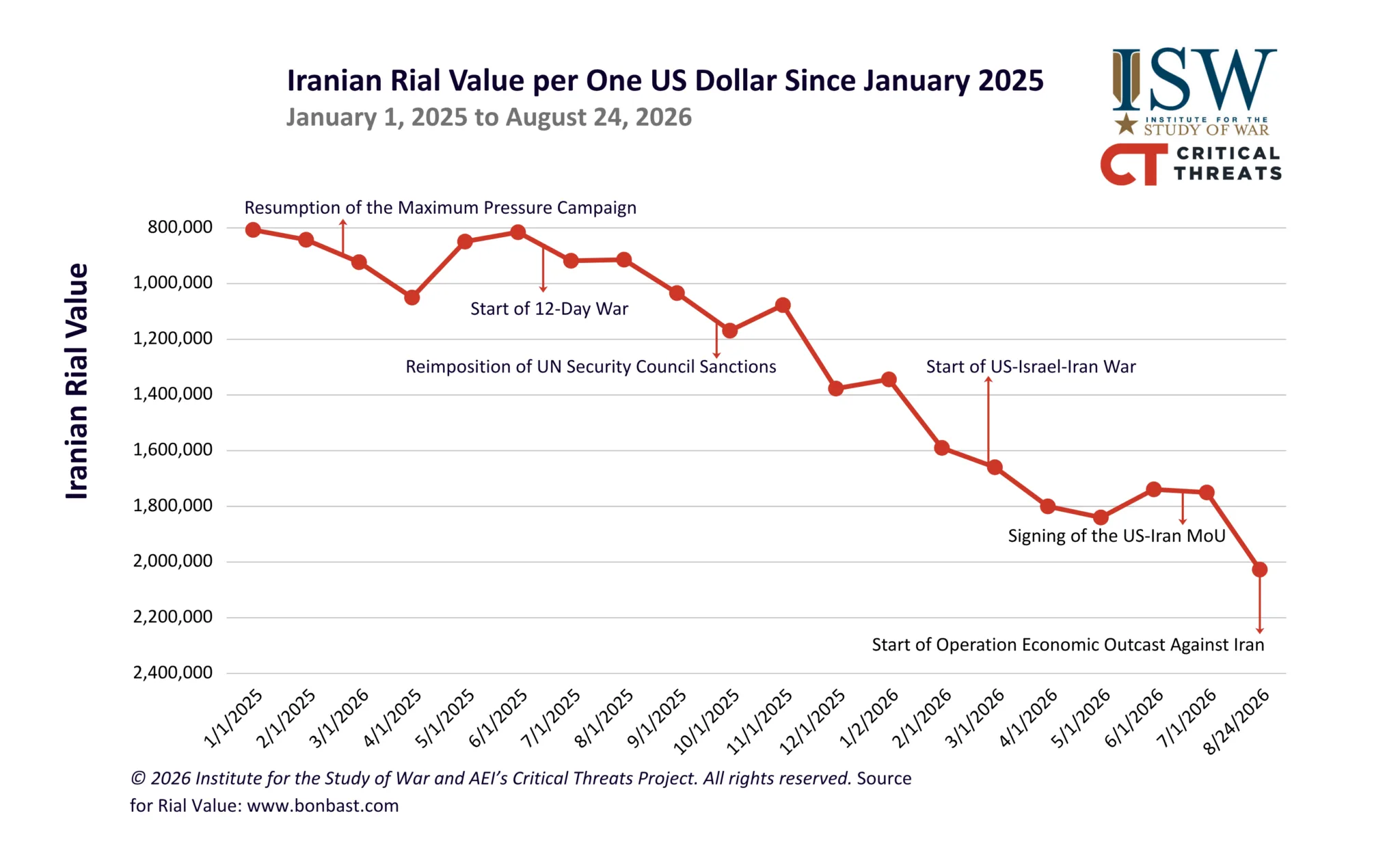
These economic steps come as the Iranian economy continues to deteriorate. The Iranian rial fell to a record low of 2.02 million rials to one US dollar on August 24 in anticipation of Bessent’s announcement.[9] Inflation has reached approximately 66 percent. Iranians have experienced a steep decline in their purchasing power and business prospects, according to Iranians speaking to the New York Times on August 22.[10] The rial's depreciation and the effects of the US naval blockade on the regime's ability to generate revenue through exports, as well as the regime's reported foreign currency shortages, likely put immense economic pressure on the domestic Iranian population, including Iranian security forces, who are on a government salary.[11] Bessent addressed Iranian soldiers in his August 24 announcement, stating that “as more of your paychecks stop or are just delayed, ask where your commanders are leading your country, to triumph or to ruin.”[12] Bessent notably compared Iranian security forces’ situation in enforcing a regime crackdown on internal dissent to the falling of the Berlin Wall “when ordinary soldiers decided to not shoot on their own people.”[13] Bessent’s plea to Iranian security forces follows his comments on August 20 that the new policy will set the conditions for ”regime collapse.”[14]
The Iranian regime is attempting to find routes to alleviate economic pain while simultaneously trying to deter and prepare for potential social unrest in response to compounding economic pressure. The regime is seeking alternative methods to alleviate economic pressure and generate revenue amid the looming economic crisis. Iranian Central Bank Governor Abdol Nasser Hemmati and Parliament Speaker Mohammad Bagher Ghalibaf discussed preserving and expanding economic ties between Iran and Iraq with Iraqi government officials and economic experts in Iraq from August 16 to 19.[15] These efforts come amid reports that Iraq and other regional countries are preparing land-based transregional pipelines to circumvent the Strait of Hormuz and weaken Iran's influence over international energy markets.[16] Iran is also attempting to establish alternative land routes to continue to export its petroleum products amid the US naval blockade.[17]
Iranian officials are also attempting to reassure the Iranian public of Iran's economic situation, likely in response to regime concerns about the potential for internal unrest. Hemmati claimed on August 24 that previous sanctions on Iran led to a decline in purchasing power but noted that “hardship is not the same as collapse.”[18] Hemmati claimed that Iran has no problem supplying foreign exchange currency to import basic goods.[19] Hemmati admitted to Iranian state TV on August 19 that Iran is facing foreign currency reserve shortages as well as heavy reconstruction costs, however.[20] A Tehran Chamber of Commerce member told an IRGC-affiliated outlet on August 24 that Iranian traders have already shifted their business from the United Arab Emirates (UAE) to the PRC after the UAE announced on August 18 that it would halt all trade and financial transactions with Iran.[21] ISW-CTP previously assessed that the UAE’s decision would further weaken Iran's already deteriorating economy by restricting both its access to essential imports and its ability to repatriate export revenues and circumvent sanctions.[22] The regime's messaging appears intended to project resilience and reassure domestic audiences.
The regime is simultaneously preparing for the possibility of renewed social unrest, which is consistent with its longstanding approach to suppressing dissent rather than addressing the underlying economic grievances that drive the unrest. The regime's brutal crackdown on the Iranian population in December 2025 and January 2026 effectively suppressed the protest movement for the time being.[23] The regime will likely employ a similar response in the event of renewed protest activity. IRGC, Basij Mohammad Rasollah Corps, and Law Enforcement Command — the regime's key institutions responsible for protest crackdowns commanders from Tehran Province — met on August 23 and announced an upcoming internal security exercise, “Janfada” [self-sacrifice], with 313,000 personnel to “bolster security.”[24] The regime likely chose 313,000 to invoke a religious reference, as 313 holds symbolic significance in Shia Islam — 313 individuals are meant to accompany Imam Mahdi upon his return.[25] The exercise likely serves to demonstrate to the domestic population the regime's capacity for mass mobilization within Iran. The regime seeks to project strength, control, and its latent capacity to suppress its people. Iranian exercises have traditionally served to signal capability and resolve rather than to train forces.[26]
Regime officials and outlets are issuing threats against foreign states, likely to deter them from complying with the US economic campaign against Iran. Iranian Supreme National Security Council Secretary Major General Mohsen Rezaei threatened on X on August 23 to designate any country that complies with US sanctions as an enemy.[27] Iranian military action would be consistent with Iran's previous use of force against countries to drive them away from the United States.[28] An outlet affiliated with the Supreme Leader's Office reinforced Rezaei’s threat on August 23 and warned that Iran would launch retaliatory attacks against the interests of such states.[29] The op-ed published an image of metal cages over reported Emirati fuel storage tanks, which is an implicit Iranian threat against Emirati energy infrastructure.[30] The UAE is the only Gulf country to have announced the severing of financial ties with Iran at the time of this writing.[31]
The Iraqi federal government and some Iranian-backed militias are likely attempting to reach an agreement to integrate militia elements operating outside the Popular Mobilization Forces (PMF) into recognized PMF units. The director of an unspecified Shia Coordination Framework leader's office leaked on August 24 that the Zaydi government and unspecified framework members had reached an agreement under which the militias would surrender their weapons to the PMF.[32] An Iranian-backed Iraqi militia-affiliated parliamentarian said in a media statement on August 24 that disarmament discussions between the Iraqi government and militias will focus on integrating militia fighters into the PMF.[33] The Iraqi media discussions suggest that this move would, in effect, mean that the Iranian-backed militia-controlled PMF would accept the weapons from Iranian-backed militias operating outside the state. It is not clear how exactly individual fighters would be “integrated” into the PMF, but some militias have fighters operating both inside and outside state auspices.[34]
This reported plan comes as some Shia Coordination Framework members have urged the Iraqi government to postpone the September 30 disarmament deadline, possibly to allow time for the Iraqi parliament to pass the PMF Service and Retirement Law.[35] A framework source told Iraqi media on August 23 that the process of transferring militia weapons to PMF-controlled warehouses would only begin after US forces leave Iraq and parliament approves the PMF Service and Retirement Law.[36] Zaydi’s September 30 deadline for disarmament currently corresponds with the planned withdrawal of US-led international coalition forces from Iraq.[37] An informed framework source told Iraqi media on August 23 that the framework will refer the PMF Service and Retirement draft Law to the Parliament Security and Defense Committee in the coming days.[38] The exact text of the current draft PMF Service Law is not public, but the framework source stated that the draft law guarantees PMF members’ rights and covers PMF ranks, career progression, retirement mechanisms, as well as the PMF’s “general structure.”[39] Parliamentary committees must review and approve draft laws before Parliament can convene and vote on the laws, which can take several weeks, if not months.[40]
The Israel Defense Forces (IDF) has identified “significant gaps” in Lebanese Armed Forces (LAF)’s efforts to secure pilot zones in southern Lebanon, according to Israeli military sources speaking to Saudi media on August 24.[41] The sources added that the LAF has only conducted “partial” searches of the pilot zones and has not yet searched private property for Hezbollah weaponry.[42] Hezbollah frequently conceals its materiel in civilian homes and private property to prevent Lebanese authorities from seizing the group's weapons and in order to deter adversaries from striking the group's assets by placing them in civilian areas.[43] LAF sources told Saudi media in early August that the Lebanese judiciary had not authorized the LAF to search private homes and property pursuant to the government's efforts to disarm Hezbollah.[44] ISW-CTP continues to assess that LAF efforts to disarm Hezbollah in the pilot zones in southern Lebanon will likely fail if the Lebanese government does not ensure that military forces have the will and authorities to search private property to confiscate Hezbollah materiel.[45]
Limited LAF efforts to secure pilot zones come amid stalled US-mediated Israel-Lebanon negotiations. These talks have stalled in part due to disagreements between the two delegations over the location of future pilot zones and selection of a third-party country to verify the LAF’s disarmament progress.[46] The Lebanese government reportedly refused in mid-August to set a date for the next round of negotiations due to Israel's refusal to expand the pilot zone program.[47] Lebanese ministerial sources reiterated to Lebanese media on August 23 that Israel and Lebanon have still not set a date for the next meeting.[48]
Iranian-backed Iraqi actors likely pressured Iraqi authorities on August 24 to release four Popular Mobilization Forces (PMF) members that Iraqi security forces had arrested earlier that day. A security source told Kurdish media that Iraqi security forces arrested PMF General Staff member Akram Abu Jaafar and three other PMF members in Baghdad City on August 24.[49] Iraqi authorities released Abu Jaafar and the other detained PMF officials to the PMF soon after their arrest, according to the PMF Media Department Director.[50] This incident comes after several Iranian-backed actors pressured the Iraqi government into surrendering an Iranian-backed Iraqi militia-affiliated PMF official to the PMF hours after the Counter Terrorism Service arrested the official in early August 2026.[51]
Iraqi national security adviser to the prime minister Qassem al Araji announced on August 23 that Iraq submitted a proposal to Iran and Saudi Arabia to establish an unspecified unified security coordination council.[52] Iran and Saudi Arabia have not responded to this proposal at the time of this writing. The details of the Iraqi proposal also remain unclear.
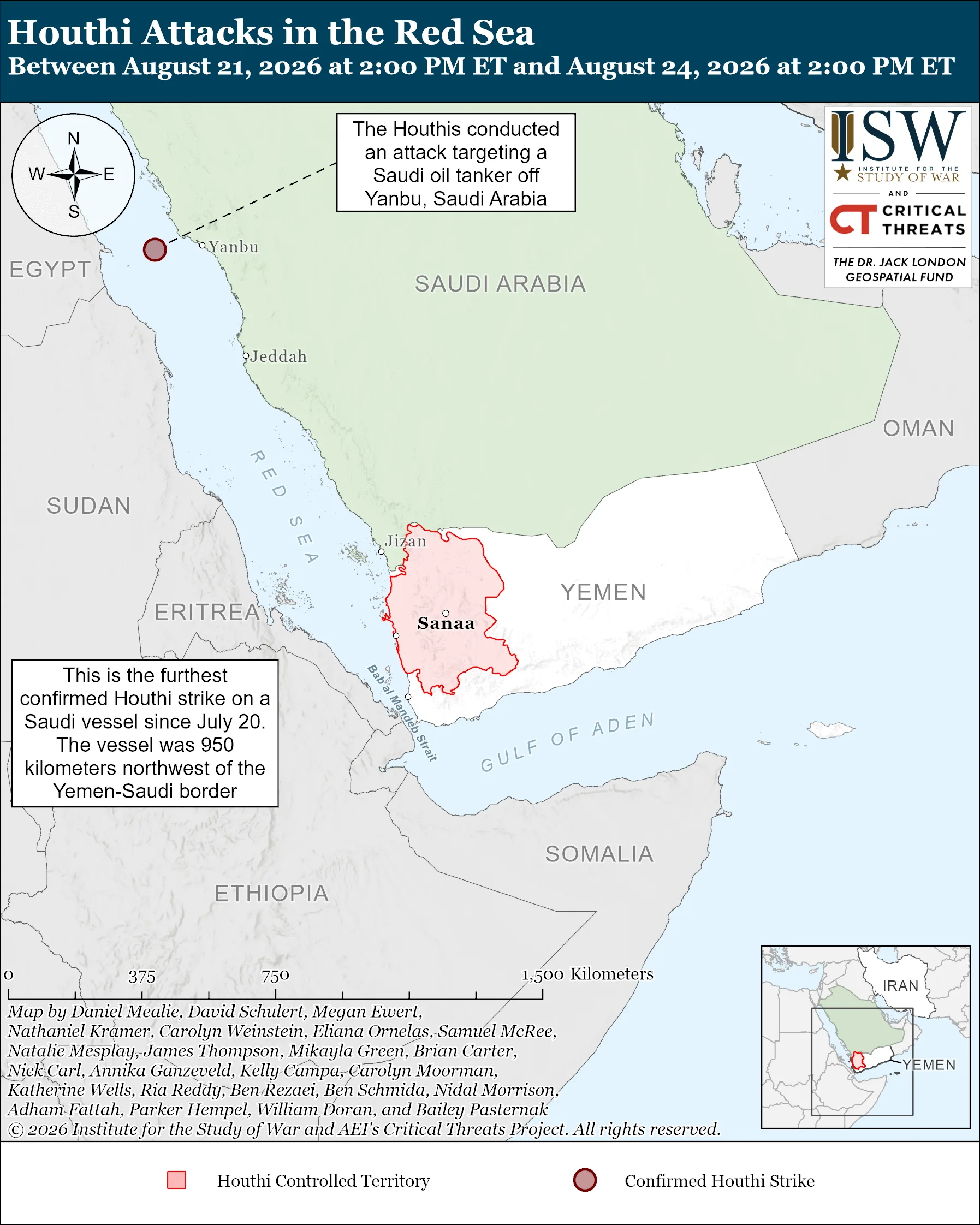
The Houthis struck a Saudi oil tanker roughly 950 kilometers north of Yemen in the northern Red Sea on August 24.[53] The strike is part of an effort to enforce the Houthi blockade on Saudi Arabia. Houthi military spokesperson Yahya Sarea announced on August 24 that the Houthis fired a ballistic missile at Saudi oil tanker AMZAN off the coast of Yanbu, Saudi Arabia.[54] United Kingdom Maritime Trade Operations (UKMTO) similarly reported that a projectile struck an oil tanker, almost certainly the AMZAN, 63 nautical miles west of Yanbu on August 24.[55] The strike is part of a broader Houthi effort to incapacitate the Saudi oil industry by disrupting supply chain nodes, including oil refineries, pipelines, and tankers, across Saudi Arabia and the Red Sea and raise Saudi political and economic costs to an untenable level to compel Saudi Arabia to end its kinetic campaign against the Houthis and accede to Houthi demands.[56] The Houthis’ demands to end the conflict include that Saudi Arabia lift its blockade on Houthi ports and airports, cease all military activity in Yemen, pay the Houthis war reparations, and fund Houthi salaries.[57]
The strike also demonstrates the Houthi ability to launch ASBM further than 500km, assuming the Houthi claim is accurate. The AMZAN was at least 950 kilometers north of the Saudi-Yemeni border at the time of the attack, making it the furthest confirmed Houthi attack on a Saudi vessel since the Houthis began to enforce their blockade on Saudi Arabia on July 20.[58] ISW-CTP has not observed any open-source reporting that confirms that the Houthis possess an ASBM with a range exceeding 500 kilometers.[59] The Houthis could have drastically decreased the warhead weight or taken other technical measures to improve the range of their ASBM. They could also have employed a drone and not a ballistic missile. ISW-CTP cannot determine from the open source what specific steps the Houthis took to target the AMZAN at this range.
https://understandingwar.org/research/middle-east/iran-update-august-24-2026/
Exchange rate: https://www.bonbast.com/graph/usd
2,391
posted on
08/25/2026 12:59:16 AM PDT
by
AdmSmith
(GCTGATATGTCTATGATTACTCAT)
Published 24AUG2026 Rewards for Justice @RFJ_USA
These individuals lead IRGC units that have targeted U.S. personnel with armed attacks and U.S. critical infrastructure with malicious cyber operations.
Help us disrupt these threats. Submit a tip today.

https://x.com/RFJ_USA/status/2091949459559129426
It's summer, so seniors are probably on vacation; that's likely why Majid Khademi was included. He was removed as early as April 6. https://en.wikipedia.org/wiki/Majid_Khademi
2,392
posted on
08/25/2026 2:18:17 AM PDT
by
AdmSmith
(GCTGATATGTCTATGATTACTCAT)
2,393
posted on
08/25/2026 3:32:33 AM PDT
by
AdmSmith
(GCTGATATGTCTATGATTACTCAT)
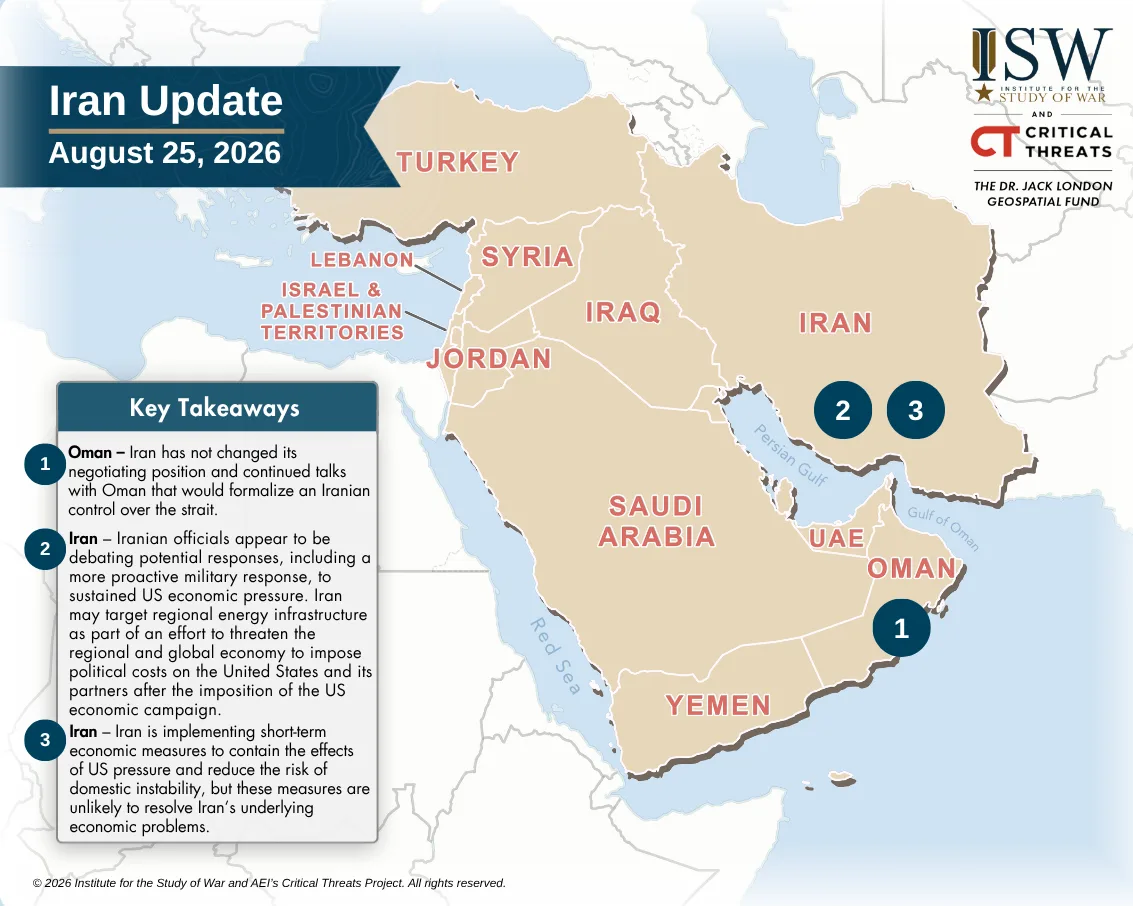
Iran has not changed its negotiating position and continues to seek formal control over transit through the Strait of Hormuz as Pakistan tries to revive US-Iran negotiations. Pakistani sources told Reuters on August 25 that there is “significant progress,” and some Iranian officials have expressed general willingness to reengage with the United States.[1] This Pakistani framing is unsurprising — a mediating party has a vested interest in ensuring mediation can occur — but the framing is at odds with reality. Iran's negotiating team has, according to regime media, continued to emphasize to mediators that the United States must return to the original memorandum of understanding (MoU) and implement Clause 5, which Iran interprets as granting Iran the authority to determine transit arrangements in the strait.[2] That Iran communicated this to the mediators suggests that the mediators are only ferrying unchanged viewpoints between the two sides, not making progress towards a deal.[3]
Iran has continued talks with Oman over transit arrangements that would formalize an Iranian role in controlling commercial traffic through the strait, which also demonstrates the lack of progress in talks.[4] Omani Foreign Minister Badr al Busaidi said on August 25 that Iran and Oman could soon announce a temporary corridor through the strait and other arrangements to restore safe navigation.[5] The United States is continuing to take steps to undermine Iran's efforts to control commercial traffic through the strait. The US Treasury Department warned on August 24 that companies could face sanctions or penalties if they comply with Iranian safe-passage requirements, including purchasing Iranian-linked insurance and services or complying with information requests.[6] The United States has also sought to keep commercial traffic moving without Iranian permission or fees, which creates a direct challenge to any Iranian influence or control over passage through the strait. US President Donald Trump stated on August 25 that the US Navy had cleared mines from international waters in the strait.[7] Two US officials confirmed that the US Navy cleared the traffic separation scheme between Iran and Oman.[8]
Iranian officials appear to be debating potential responses, including a more proactive military response, to sustained US economic pressure. Iranian Armed Forces General Staff-run outlet Defa Press argued on August 25 that Iran should move away from a reactive strategy in which it waits for an adversary to strike before responding and instead seizes the initiative by imposing costs during periods of pressure.[9] Defa Press argued that Supreme National Security Council Secretary (SNSC) Major General Mohsen Rezaei’s recent threats represent a shift from “reactive defense” toward “active deterrence and strategic initiative.”[10] Rezaei stated in an English-language post on X on August 23 that “if the economic war continues, not a single drop of oil will be exported — neither through the Strait of Hormuz nor from anywhere in the Persian Gulf.”[11] Rezaei added that Iran would regard any country's participation in or support for the US economic campaign against Iran as an act of war.[12] Defa Press argued that Iran could impose costs beyond the economic domain in response to sanctions, the blockade, and restrictions on Iranian oil exports.[13]
Iran may target regional energy infrastructure as part of an effort to threaten the regional and global economy to impose political costs on the United States and its partners after the imposition of the US economic campaign. Iran would ultimately aim to compel the United States to stop its economic program before Washington accomplishes its objectives in this scenario. Iran has struggled to reliably strike moving vessels, but it can locate and target fixed infrastructure.[14] Axios reported on August 25 that more than 500 ships used the southern channel under US protection in the past 30 days, and Iranian drones or missiles hit only about 2 percent of them.[15] Iran may decide to strike or conduct cyberattacks against static regional energy infrastructure or US civilian infrastructure to impose costs on global energy markets and the US homeland.
The regime is likely debating whether it should target regional energy infrastructure, however. Defa Press did not identify specific targets or call for immediate military action.[16] Defa Press warned that action without an imminent threat could escalate the conflict, encourage coalition-building against Iran, and impose additional political and economic costs.[17] These warnings suggest that Iranian officials are still weighing the risks of this approach and that the approach remains under intra-regime debate. Former Vice President Mostafa Hashemitaba criticized proposals to target neighboring countries’ oil facilities on August 24 and warned that such attacks could have “serious consequences” for Iran, for example.[18] Iranian Supreme Leader's website, the Voice of Iran, stated in an op-ed on August 23 that Iran could retaliate against states that participate in US economic restrictions and would target those countries’ interests.[19] The op-ed published an image of metal cages over reported Emirati fuel storage tanks, which is an implicit Iranian threat against Emirati energy infrastructure.[20]
Iran is implementing short-term economic measures to contain the effects of US pressure and reduce the risk of domestic instability, but these measures are unlikely to resolve Iran's underlying economic problems. The regime appears to recognize that continued economic deterioration could threaten domestic stability. Some issues, like rising gas prices, could serve as serious flashpoints for discontent.[21] Iranian officials are relying on measures that can temporarily support liquidity, employment, and household purchasing power without requiring politically costly reforms.[22] It remains unclear how the regime will address the long-term economic challenges caused by the recent US economic campaign.[23] Iranian Economic Affairs and Finance Minister Ali Madani Zadeh stated on August 24 that Iran has prepared alternative financial and trade channels and that the government is prioritizing employment, production, and household livelihoods.[24] The Central Bank of Iran separately announced on August 25 an initial $500 million USD injection of foreign-currency banknotes into the banking system. Iranian authorities also imposed additional restrictions on individuals and entities involved in foreign-exchange and gold speculation.[25] These measures may temporarily improve liquidity and limit market pressure, but they do not address Iran's broader foreign-currency, inflation, and energy problems.
Iranian-backed Iraqi Supreme Judicial Council President Faiq Zaidan met with several senior Iranian leaders in Tehran on August 25, reportedly to discuss bilateral judicial and legal cooperation between Iraq and Iran.[26] Zaidan and Iranian leaders also discussed recent US efforts to deepen Iran's economic isolation.[27] Zaidan met with Iranian President Masoud Pezeshkian, Parliament Speaker Mohammad Bagher Ghalibaf, SNSC Secretary Rezaei, and Judiciary Chief Gholam Ejei in Tehran on August 25 to discuss bilateral cooperation, according to Iranian and Iraqi media.[28] Iraqi media also reported on August 25 that Zaidan told Ejei that Iraq condemns “economic terrorism” against Iran, which is a reference to the latest US sanctions on Iran.[29]
Rezaei and Zaidan also discussed Iran-Iraq coordination against anti-regime Kurdish groups in Iraq along the Iraq-Iran border.[30] UK-based Saudi media reported on August 25 that Rezaei called for a resolution to the problem of anti-regime Kurdish groups operating on the Iran-Iraq border.[31] Zaidan reportedly emphasized the need to ensure border security and to address the threat posed by “anti-Iranian groups” along the Iran-Iraq border, according to Iraqi media.[32] Iran has historically pressured the Iraqi federal government to address anti-regime Kurdish groups that Tehran views as a threat to regime stability.[33]
Iraqi Prime Minister Ali Zaydi, Shia Coordination Framework forces, and Iranian Supreme Leader Representative Mohsen Qomi reportedly met in Baghdad on August 24 to discuss recent Iraqi federal government arrests that have targeted Popular Mobilization Forces (PMF) members.[34] An informed source told Iraqi media on August 25 that the framework asked Zaydi not to use military forces to arrest PMF fighters and instead rely on the judiciary to issue arrest warrants.[35] The source added that framework leaders criticized arrests of PMF leaders and demanded that Zaydi prevent similar operations, which they viewed as provocative.[36] The PMF is an organization largely beholden to the framework and its leadership, so this stance is unsurprising.[37] It is extremely difficult for the government to arrest PMF members without the use of force, but it is also hard to keep PMF members in government custody after their arrest due to the political pressure coming from the framework to release those arrested. Zaydi’s meetings with Iranian and framework officials follow the federal government's largely failed efforts to crack down on militia activity by force due to militia military strength and Iranian influence within Iraqi institutions.[38] Iranian-backed actors similarly impeded former Iraqi Prime Minister Mustafa al Kadhimi’s efforts to confront the militias.[39]
Office of the Commander-in-Chief of the Armed Forces Director Lieutenant General Abdul Amir al Shammari chaired a Baghdad Operations Command meeting on August 25 to discuss and review a “regional security plan” for Baghdad.[40] Zaydi merged several offices into the Office of the Commander-in-Chief of the Armed Forces on July 26[41] The office, which answers directly to Zaydi, now oversees the Interior and Defense ministries, the Counter Terrorism Service, the Iraqi National Intelligence Service, the PMF, border crossings, and military manufacturing.[42] The Baghdad Operations Command is the Iraqi Security Forces (ISF)’ operational headquarters responsible for security in Baghdad and in the surrounding area.[43] The meeting included representatives from the ISF, intelligence and security institutions, and the PMF.[44] Shammari reviewed implementation mechanisms for the “regional security plan,” explained areas of responsibility, and assigned duties to security forces and agencies during the meeting, according to Shammari’s statement.[45] The plan includes supporting local police agencies to enhance security and stability in Baghdad, intensifying unified intelligence efforts, and preventing the “militarization of the street,” among other aspects.[46] The initiation of this new security plan is notable given recent threats by Iranian-backed Iraqi militias to blockade the Green Zone in Baghdad, which houses the US Embassy and other Iraqi institutions, due to Iraqi federal government attempts to crack down on the militias.[47]
Framework actors are continuing their negotiation efforts between the Iraqi federal government and the Iraqi militias. A framework parliamentarian told Iraqi Kurdish media on August 25 that a framework committee, which includes Badr Organization head Hadi al Ameri and National State Forces Alliance head Ammar al Hakim, has begun talks with Kataib Hezbollah, Harakat Hezbollah al Nujaba, and Kataib Sayyid al Shuhada on disarmament.[48] These militias have been the most kinetically active in recent months, are historically closest with Iran, and have continuously refused to disarm.[49] The Islamic Resistance in Iraq, which is a coalition of Iraqi militias that includes the three militias, released a list of preconditions on August 17 that further indicated the militias have no intention to disarm.[50] Iraqi government spokesperson Haider al Aboudi confirmed on August 25 that September 30 is the “decisive date” to restrict arms to the state, despite efforts by some framework actors to postpone the deadline.[51]
Saudi Arabia is reportedly seeking to subsidize commercial vessel insurance costs to encourage and increase Saudi and international commercial shipping in the Red Sea amid the ongoing Houthi blockade on Saudi ports.[52] People familiar with the discussions told The Financial Times on August 24 that Saudi Arabia is in talks with London-based insurance brokers to establish a Saudi state-backed fund to subsidize ship insurance rates and provide more comprehensive coverage to ship owners operating in the Red Sea.[53] Commercial vessel insurance coverage and costs for vessels operating in the Red Sea have increased since the Houthis started the group's blockade on Saudi ports on July 20.[54] Insurance brokerage firms have begun charging higher insurance rates and restricted coverage options in the Red Sea region due to increased risk of Houthi attacks in the Red Sea.[55]
Saudi Arabia likely aims to support commercial carriers, which must be able to turn a profit and be relatively low risk. This will help maintain Saudi Arabia's ability to export oil and other goods to the global market at a sufficient level. Saudi Arabia has increasingly relied on Yanbu and other Saudi Red Sea ports to export oil and circumvent Iran's control over the Strait of Hormuz.[56] Saudi oil exports via the Red Sea have increased to 3.5 million barrels per day, up from 120,000 barrels per day prior to the current war, according to The Economist on July 30.[57]
https://understandingwar.org/research/middle-east/iran-update-august-25-2026/
2,394
posted on
08/26/2026 1:58:28 AM PDT
by
AdmSmith
(GCTGATATGTCTATGATTACTCAT)
To: BeauBo; blitz128; gleeaikin; nuconvert
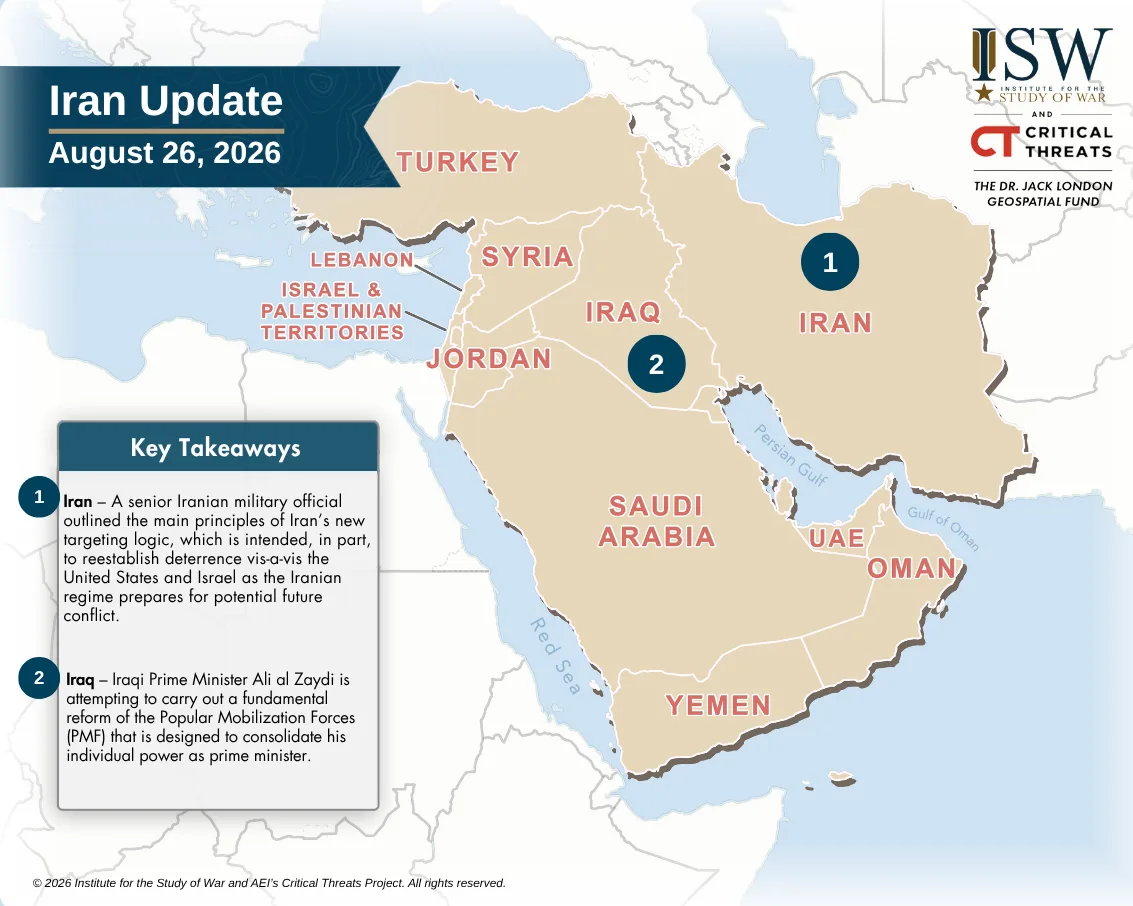
A senior Iranian military official outlined the main principles of Iran's new targeting logic, which is intended, in part, to reestablish deterrence vis-à-vis the United States and Israel as the Iranian regime prepares for potential future conflict. Iranian Artesh Spokesperson Brigadier General Mohammad Akraminia conducted an interview with regime media on August 26 in which he explained Iran's “new” military doctrine, which he described as a shift from “defensive” military action to “offensive” action.[1] Akraminia noted that this doctrinal shift emerged following the June 2025 12-Day War, which is consistent with statements from Iranian officials over the past year that Iran has shifted to an “offensive” and “proactive” military posture.
Akraminia laid out four key principles of Iran's new targeting logic. Akraminia claimed that Iran's new approach involves “rapid response” and that Iran responded to the start of US and Israeli operations in February 2026 “within two hours.”[2] The Iranian regime had struggled to respond quickly in previous rounds of conflict with Israel and the United States, including in the June 2025 War, when Israeli strikes on missile sites and dozens of Islamic Revolutionary Guards Corps (IRGC) Aerospace Force commanders disrupted Iran's ability to respond.[3]
Akraminia stated that another element of Iran's new targeting logic involves responding to individual strikes on Iranian territory with multiple strikes against various targets. ISW-CTP cannot confirm that Iran adopted this approach during the recent war, but this approach would be consistent with Iranian efforts to impose high costs on the United States and its regional partners and allies to degrade their willingness to continue the war and to coerce them to acquiesce to Iranian demands.
Akraminia claimed that Iran's new doctrine includes preemptive strikes against US assets, which is consistent with recent statements from Iranian officials to Western media that Iran is considering taking preemptive action against the United States and regional countries. Akraminia cited Iran's July 28 attack on the Muwaffaq Salti Airbase in Azraq, Jordan, after a four-day pause in strikes between the United States and Iran as an example of a preemptive strike. Akraminia claimed that US forces were “assembling personnel and equipment there to intensify attacks [against Iran].”[4] Unspecified Iranian officials similarly told the Wall Street Journal on August 16 that the IRGC has developed plans for potential “preemptive strikes.”[5] ISW-CTP assessed at the time that Iranian officials likely decided to publicize these plans to Western media to coerce the United States to surrender to Iranian demands as well as to restore deterrence vis-à-vis the United States and its regional partners.[6]
Akraminia lastly emphasized that the regime's new military doctrine includes expanding a conflict's geographic scope to encompass adversary interests across the region, including energy hubs, the Bab al Mandeb Strait, and undersea internet cables.[7] This statement also echoes what unspecified Iranian officials told the Wall Street Journal on August 16, specifically that the IRGC had reportedly devised plans for further escalation against the United States and its allies, including potential strikes on internet cables in the Persian Gulf.[8] Akraminia’s comments about expanding regional conflicts to the Bab al Mandeb Strait are consistent with the Iranian regime's effort during the recent conflict to encourage the Houthis to conduct attacks on international shipping.[9] Iran also sent advisers to Yemen and monitored the deployment of missiles, drone launchers, and naval weapons along the Red Sea coast during the conflict.[10]
Iraqi Prime Minister Ali al Zaydi is attempting to carry out a fundamental reform of the Popular Mobilization Forces (PMF) that is designed to consolidate his individual power as prime minister. Zaydi recently reestablished the Office of the Commander in Chief of the Armed Forces, which places several security institutions, including the PMF, under his authority.[11] A senior Iraqi government source separately told UK-based, Qatari-owned media on August 25 that unidentified actors, likely referring to Zaydi administration officials, made several amendments to the draft PMF Law that aim to limit the PMF’s operational powers.[12] The Iraqi government has not published the text of the draft PMF Law or submitted the draft law to the Iraqi Parliament at this time. The draft PMF Law likely refers to the Popular Mobilization Authority Law that former Prime Minister Mohammad Shia al Sudani withdrew from Parliament in August 2025 due to US opposition to the law.[13] The legislation would have likely increased Iran's influence in the Iraqi security establishment by formalizing key PMF structures, per a July 2025 version of the draft law.[14]
The senior Iraqi government source stated that the new amendments to the draft PMF Law eliminate provisions that make the PMF a “competitor” to the Iraqi Army.[15] The source stated that the amended draft law sets a retirement age of 60, which would force several current PMF leaders, including Popular Mobilization Commission Chairman Faleh al Fayyadh, to retire and enable Zaydi to make comprehensive changes to the PMF’s current leadership.[16] Zaydi has reportedly been considering “sweeping” leadership changes to the PMF, which could include appointing Iraqi Army and Counter Terrorism Service officers to PMF leadership positions.[17] Iraqi sources previously told UK-based, Qatari-owned media on August 12 that high-ranking Iraqi Army officers will be integrated into the PMF to assist with redistributing PMF fighters across brigades and provinces.[18] The replacement of senior PMF leaders with high-ranking Iraqi Army officers would in effect subordinate the PMF to the Iraqi Army. The Iraqi source speaking to UK-based, Qatari-owned media on August 25 similarly noted that the draft law aims to disperse PMF fighters to curb the existence of “factional blocs” within the PMF, likely referring to Iranian-backed Iraqi militia-controlled PMF brigades that do not answer to the prime minister.[19] These amendments highlight that Zaydi is attempting to dilute the power of the PMF, which would help consolidate his individual authority over this institution and as the Iraqi prime minister more broadly. The federal government could change these amendments or add new ones at any time before submitting the draft law to parliament.
Zaydi’s efforts to professionalize the PMF could fulfill US objectives regarding militia disarmament. The United States has applied intense financial pressure on Zaydi to disarm the militias due to militia attacks on US and foreign targets in Iraq and the region in recent months.[20] This US pressure provides Zaydi with political cover to attempt to reform the PMF, which some members of his Shia Coordination Framework coalition will likely oppose. Integrating the militias into the PMF and successfully implementing the reforms included in the reported draft law would probably address the United States’ core objectives concerning the militias, which include stopping militia attacks on US and allied targets in Iraq and the region as well as reducing Iranian influence in Iraq. An unidentified “high-ranking” source told Qatari media on August 25 that Zaydi discussed the PMF Law with unspecified US officials during his July visit to Washington, D.C.[21] The US officials reportedly expressed concern over some provisions of the draft law, but Zaydi emphasized that the law would regulate the status of PMF members and the PMF’s administrative structure.[22]
The success of these reforms would depend on Zaydi’s ability to enforce them and appoint professional personnel to undertake institutional changes throughout the PMF. The PMF has previously resisted Iraqi federal government attempts to reform the institution, such as under former Prime Minister Haider al Abadi’s administration. Zaydi’s efforts to reform the PMF will require him to appoint professional officers to senior PMF positions who incentivize good behavior, hold their subordinates accountable, and ensure adherence to the formal chain of command, thus professionalizing the organization. Zaydi is reportedly considering appointing Iraqi Army and Counter Terrorism Service officers to PMF leadership positions as part of his reform effort. Former Prime Minister Mustafa al Kadhimi executed similar reforms to the Iraqi National Intelligence Service to increase its efficiency and independence while serving as its head between 2016 and 2020.[23] Kadhimi then protected these gains as prime minister between 2020 and 2022 while reforming the security sector.[24]
The Iraqi Parliament is unlikely to approve this draft PMF Law, however. Parliamentary committees must review and approve draft laws before Parliament can convene and vote on the law.[25] The Parliamentary Security and Defense Committee is unlikely to approve the amended draft PMF Law, given that the committee includes parliamentarians from Iranian-backed Iraqi militia political wings that also control PMF brigades.[26] These parliamentarians would almost certainly oppose the draft law's provisions that reduce PMF leaders’ privileges.[27]
Iranian opposition to any Iraqi federal government attempts to weaken the Iraqi militias could undermine Zaydi’s efforts to subordinate the PMF under himself, even if this draft law were to pass through the Iraqi Parliament. Sources close to the federal government told Iraqi media on August 26 that Iran has become less flexible on militia disarmament in recent weeks and has attempted to convince the federal government to push back its September 30 deadline to restrict arms to the state.[28] The sources assessed that Iran's increased opposition to militia disarmament is due to stalled US-Iran negotiations and US economic pressure on Iran.[29] Iran has rejected militia disarmament for months, as corroborated during recent visits by IRGC Quds Force Commander Brigadier General Esmail Ghaani and Iranian Parliament Speaker Mohammad Bagher Ghalibaf to Baghdad.[30] The sources added to Iraqi media that additional Iranian officials, besides Ghaani and Ghalibaf, have also engaged with Iraqi officials on militia disarmament in recent weeks.[31]
Iran has reportedly presented alternatives to disarmament that have included the militias transferring heavy weapons to Iran or the PMF.[32] Even if Iran supports the transfer of weapons to the PMF, it likely opposes and would seek to undermine the amendments to the draft PMF Law outlined above given that those amendments, if successfully implemented, would weaken Iranian influence in the PMF. Iranian-backed Iraqi actors, including within the framework and members of Zaydi’s administration, have recently attempted to convince Zaydi to push back the September 30 deadline.[33] Zaydi’s security adviser and former Iraqi National Security Adviser Qasim al Araji, who is a member of the Iranian-backed Badr Organization, said on August 24 that the deadline is a “starting point” to restrict arms to the state.[34]
https://understandingwar.org/research/middle-east/iran-update-august-26-2026/
2,395
posted on
08/27/2026 5:00:02 AM PDT
by
AdmSmith
(GCTGATATGTCTATGATTACTCAT)
The world's most relaxed security checkpoint: the Islamic Republic-backed Houthis let their fighters through carrying assault rifles, but apparently draw the line at books. Footage shows Houthi personnel searching their own armed fighters for prohibited books, cassette tapes and other unauthorized material, while some stand there casually chewing qat. Nothing reveals an extremist movement's insecurity quite like fearing what its own fighters might read or hear.
https://x.com/TheIranWatcher/status/2092786950155514361
15 s video
2,396
posted on
08/27/2026 5:02:20 AM PDT
by
AdmSmith
(GCTGATATGTCTATGATTACTCAT)
2,397
posted on
08/27/2026 5:04:36 AM PDT
by
AdmSmith
(GCTGATATGTCTATGATTACTCAT)
How Osama Bin Laden Built a Terror Network & 9/11 | Aimen Dean | FO550 Raj Shamani Aimen Dean, former MI6 spy, went from pledging allegiance to Osama bin Laden to dismantling Al-Qaeda from within.
He explains:
◼ How a teenager from Saudi Arabia went from schoolboy to Al-Qaeda bomb maker in under two years
◼ What Bin Laden was actually like in person and why his first meeting was a deep disappointment
◼ How al Qaeda radicalization works step by step victimhood empowerment then violent action
◼ Why he believes a single book inspired Al-Qaeda, ISIS, and the entire modern jihadist movement
◼ What happened when he stumbled on mass graves in Bosnia that first cracked his faith in the cause
◼ How al Qaeda works
Chapters:
0:00 - Intro
3:38 - Osama Bin Laden: What Was He Really Like as a Person
5:18 - Growing Up in Saudi Arabia and the Roots of His Radicalization
11:34 - The Book That Inspired Al-Qaeda, ISIS and Modern Jihadism
16:38 - Joining the Jihad in Bosnia at 16
20:36 - Mass Graves and Atrocities That Shattered His Worldview
28:47 - Meeting Khalid Sheikh Mohammed, 9/11 Mastermind
32:32 - Entering Afghanistan and Training in Bin Laden’s Camps
37:54 - First Meeting With Bin Laden: What a Disappointment
40:29 - The Prophecy That Convinced a Suicide Bomber to Kill 224 People
48:18 - Pledging Allegiance to Bin Laden: The Handshake Oath
1:01:17 - Inside Al-Qaeda’s Secret Bomb-Making Camp
1:11:57 - His First Doubts About Jihad
1:21:19 - The Fatwa Al-Qaeda Twisted to Justify Killing Civilians
1:28:59 - Renouncing His Oath and Fleeing to Qatar
1:31:11 - Life After Fleeing Qatar
1:40:08 - Recruited by MI6: Why He Chose Britain Over America and France
1:44:06 - Life as a Double Agent Inside Al-Qaeda
1:48:00 - How Al-Qaeda Funds Itself: Kidnapping, Taxes and Smuggling
1:49:57 - Al-Qaeda vs. ISIS vs. Iran: Drug Trafficking
1:52:57 - How ISIS Used Women, Marriage and Sex Slavery to Recruit Fighters
1:59:26 - Thwarting a Chemical Weapons Attack on the New York Subway
2:04:01 - How a Journalist's Book Blew His Cover as a Double Agent
2:10:54 - Life After Espionage: Tracking Terrorist Finance
2:12:25 - Why Londonistan Happened and How the UK Became a Radicalization Hub
2:16:23 - Why America Is Not Immune to Radicalization
2:19:16 - The 3-Step Radicalization Cycle: Victimhood, Empowerment and Action
2:22:18 - The Moon Cycle Theory: New Jihadist Waves Every Decade
2:31:34 - The Personal Cost of Living Nine Lives
2:34:33 - BTS
2:35:04 - Outro
https://www.youtube.com/watch?v=zN_lhtJFsgg&t=217s
2,398
posted on
08/27/2026 5:17:47 AM PDT
by
AdmSmith
(GCTGATATGTCTATGATTACTCAT)
To: AdmSmith
“Iraqi Prime Minister Ali al Zaydi is attempting to carry out a fundamental reform of the Popular Mobilization Forces (PMF)”
Freeing Iraq from Iranian subversion is likely going to require freeing Iran from the current regime. The IRGC Quds Force whole reason for existing is to establish and support such fifth columns, to seize power in other countries.
To: BeauBo
2,400
posted on
08/27/2026 8:00:01 AM PDT
by
AdmSmith
(GCTGATATGTCTATGATTACTCAT)
Navigation: use the links below to view more comments.
first previous 1-20 ... 2,341-2,360, 2,361-2,380, 2,381-2,400, 2,401 next last
Disclaimer:
Opinions posted on Free Republic are those of the individual
posters and do not necessarily represent the opinion of Free Republic or its
management. All materials posted herein are protected by copyright law and the
exemption for fair use of copyrighted works.
FreeRepublic.com is powered by software copyright 2000-2008 John Robinson