Skip to comments.
Iranian Regime tv Channel One hacked while it was airing Khamenie speech
various
| 10-8-22
Posted on 10/08/2022 1:05:38 PM PDT by nuconvert
Iranian Regime national tv Channel One hacked about an hour ago. During a broadcast of Khamenie speech, a red crosshair appeared over his face and chanting of Women. Life. Freedom. There was writing to the side saying "Rise up. Join us". Also 4 photos at the bottom of the screen of young people killed and additional writing: "The blood of our youth is dropping from your paws".
Also, there was a huge banner in the middle of Tehran highway today that read: We are no longer afraid of you. We will fight.
Also, attempted attack on IRI ambassador in Denmark. Her bodyguard was stabbed. Diplomatic Security intervened before the attacker could stab the ambassador.
TOPICS:
KEYWORDS: basij; deathtothemullahs; denmark; ebrahimrigi; erdogan; iran; iranprotests; iraq; irgc; iri; israel; khameini; khamenei; kurdistan; lebanon; mahsaamini; mullahloversonfr; mullahsmustbekilled; najisharifizindashti; protests; qudsforce; raisi; receptayyiperdogan; shahrammaroufmola; syria; turkey; yemen; zahedi
Navigation: use the links below to view more comments.
first previous 1-20 ... 2,341-2,360, 2,361-2,380, 2,381-2,400, 2,401 next last
The latest security appointment may signal Vahidi is beating Ghalibaf in the power struggle. Mohsen Rezaei’s appointment as Secretary of the Supreme National Security Council is significant. Rezaei is old-guard IRGC to the core, having commanded the force for 16 years, and his return puts another heavyweight from the military establishment at the center of national security decision-making.
More importantly, he replaces Mohammad Bagher Zolghadr, who was considered relatively close to Ghalibaf and whose original appointment was publicly welcomed by him. Rezaei was also appointed Mojtaba Khamenei’s representative to the council, giving him two powerful roles at once.
With Ahmad Vahidi already commanding the IRGC, the move may be another sign that the old-guard security establishment is consolidating power behind him while Ghalibaf’s influence is being squeezed. Rather than Ghalibaf emerging on top, Vahidi may increasingly be the Islamic Republic regime's real power broker.
https://x.com/TheIranWatcher/status/2086605026538217718
Ahmad Vahidi continues his rapid climb through the Islamic Republic's military ranks.
Mojtaba Khamenei has formally appointed Vahidi as Commander-in-Chief of the IRGC and promoted him to major general, cementing a position he had effectively held since Mohammad Pakpour’s death. Vahidi was only appointed IRGC deputy commander in December 2025. Within months, he has gone from deputy to de facto commander and now formally to the top of the IRGC.
A former Quds Force commander, defense minister and interior minister, Vahidi represents the regime's most hardline wing. He has opposed an agreement with the United States and favors an aggressive, expansionist foreign policy built around military power and the Islamic Republic's regional proxy network. His rise puts that worldview increasingly at the center of the regime's decision-making.

https://x.com/TheIranWatcher/status/2086860803135676781
2,361
posted on
08/11/2026 1:36:47 AM PDT
by
AdmSmith
(GCTGATATGTCTATGATTACTCAT)
To: AdmSmith
Mojtaba has been very busy for someone nearly or already dead.
2,362
posted on
08/11/2026 9:09:24 AM PDT
by
nuconvert
( Warning: Accused of being a radical militarist. Approach with caution.)
To: nuconvert
The twelfth Imam's “minor occultation” began in the year 874 and his “major occultation” in the year 941; now there is an attempt to force Mojtaba into this model.
2,363
posted on
08/12/2026 3:28:48 AM PDT
by
AdmSmith
(GCTGATATGTCTATGATTACTCAT)
To: gleeaikin
Iran Update Special Report, August 11, 2026
Some observed indicators suggest that the Iraqi federal government is considering a major crackdown on Iranian-backed Iraqi militias, including by entering and retaking militia-controlled strongholds. Such an effort would require major mobilization, and the militias would likely be aware of any pending crackdown. Saudi media reported on August 11 that Iraqi Prime Minister Ali al Zaydi is considering two options for disarming the militias as part of the federal government's efforts to restrict arms to the state.[1] The Iraqi state could either reach agreements with the militias or take more “decisive measures,” such as sending security forces to control Jurf al Sakhr, south of Baghdad.[2] Kataib Hezbollah has refused to allow the Iraqi government to exercise sovereignty over Jurf al Sakhr for over a decade and has used the area to store weapons and launch attacks against US and foreign targets in Iraq and the region, including in March and April.[3] The Iraqi government is also taking other steps to rein in the militias. The Iraqi Interior Ministry has reportedly closed 71 ”fake” Popular Mobilization Forces (PMF) offices throughout Iraq as part of federal efforts to gain control over militia arms.[4] The PMF claimed that it had closed these offices itself, however.[5] The Interior Ministry closed two more offices in al Dora, Baghdad, on August 11.[6] The Iraqi Counter-Terrorism Service—a premier, US-trained force that has been increasingly penetrated by the militias in recent years—conducted other counter-militia raids in Baghdad in recent weeks.[7]
The Iranian-backed Iraqi militias are responding to these developments by threatening the Iraqi government. Iranian-backed Iraqi militias likely conducted a drone strike that destroyed shells for US-provided Iraqi tanks and armored vehicles at Camp Taji, north of Baghdad, on August 2.[8] ISIS is inactive in Iraq and lacks the technical know-how to conduct a drone strike, and there are no other plausible culprits currently operating in Iraq other than Iranian-backed or Iranian actors. An unspecified intelligence official also assessed that the attacks indicate that some militias opposed to disarmament are conducting spoiling attacks to slow or stop the crackdown.[9]
Previous Iraqi administrations, particularly under former Prime Minister Mustafa al Kadhimi, have conducted limited crackdowns on militia activity, but the combination of the Iranian infiltration of Iraqi government institutions and the strength of the Iraqi militias limited the scale of such efforts. Kadhimi opposed the militias but failed repeatedly to crack down on them. He reformed the Iraqi intelligence and security forces (a process undone by the Iranian-backed actors under the Sudani administration), which placed him in opposition to the militias.[10] Kadhimi repeatedly attempted to hold Iranian-backed militias, including Kataib Hezbollah, responsible for actions in Iraq that subverted Iraqi sovereignty.[11] Kataib Hezbollah repeatedly attacked the US Embassy and assassinated their Iraqi critics close to the government and protest movement.[12] Iraqi authorities in each Kadhimi-initiated crackdown would arrest several militia members but later release them in each instance under militia pressure.[13] Sudani—Kadhimi’s successor—did launch an investigation into Kataib Hezbollah clashes with the Federal Police in July 2025 that ultimately led to the removal of two Kataib Hezbollah PMF brigade commanders.[14] Sudani likely had more flexibility in pursuing Kataib Hezbollah given his backing from other militia factions, however. His effort was not part of a cohesive anti-militia strategy.
The US’ pressure on Zaydi to disarm the militias could compel him to act against the militias despite these limitations. US efforts to compel Baghdad to disarm the groups have only increased due to militia attacks against US and foreign targets in Iraq and the region in March and April, as well as in recent months.[15] The United States temporarily limited the Iraqi federal government's access to its oil revenue in the initial months of the war.[16] Oil accounts for over 90% of the Iraqi state's budget.[17] Western, regional, and Iraqi media have reported on the United States conditioning additional US support for and investment in the Iraqi state on Zaydi’s lessening of Iranian influence in Iraq, including via disarming the militias.[18] Iraqi media reported on August 11 that Zaydi is reportedly considering making “sweeping” leadership changes to the PMF, which is almost certainly related to US pressure against the militias.[19] Zaydi is reportedly considering appointing figures from the Iraqi army and the Counter-terrorism Service to leadership positions within the PMF, which would be unlikely to blunt the Iranian influence within the organization.[20] This is especially the case given indications that Baghdad may either integrate the militias into the PMF or have the militias give their weapons to the PMF.[21] None of these options would necessarily address the allegiance of the Iraqi militias to Iran and their willingness and ability to attack US and foreign interests in Iraq and the region, both issues being vital to secure US interests in Iraq.
Islamic Revolutionary Guards Corps (IRGC) Quds Force Commander Brigadier General Esmail Ghaani warned Iraqi militia leaders against armed confrontation with the Iraqi government and to reach a settlement to avoid handing over militia weapons to the state during an August 10 visit to Baghdad, according to informed sources speaking to Iraqi media.[22] Ghaani reportedly also met with political and security officials and Shia Coordination Framework officials, including Badr Organization leader Hadi al Ameri.[23] Ghaani’s reported emphasis on avoiding conflict with the Iraqi government could indicate Tehran’s concern over such a scenario. Iraqi, Western, and regional reports in recent months have described both Iranian pressure on some Iraqi militias to pursue politics over military activity as well as Iran's refusal for the militias to give their weapons to the federal government.[24] It is plausible that Iran may support the disarmament of Iraqi militias that Iran has had less control over in recent years, such as Asaib Ahl al Haq. The group played a role in the assassination attempt against Kadhimi and announced its willingness to disarm on June 2.[25]
Ghaani likely discussed Iranian-backed Iraqi militias’ recent attacks on Gulf states, namely Saudi Arabia, during his visit to Baghdad. Iraqi militias initially warned that they would attack US and Saudi interests in response to US-Saudi strikes on militia positions in Iraq on July 28.[26] The Islamic Resistance in Iraq, which is a coalition of Iranian-backed Iraqi militias, later announced on August 7 that it would postpone its planned attacks following mediation from Ameri.[27] The IRGC has coordinated Iraqi militias’ attacks on Gulf states throughout the war, and Reuters reported on June 19 that the IRGC Quds Force formed cells within Iraqi militias to report directly to Iran and attack Gulf states under IRGC orders as early as April.[28] Iranian state media also reported that US-Saudi strikes in Iraq on July 28 also killed four IRGC Quds Force officers, which indicates that the IRGC and the Quds Force, which is specifically responsible for maintaining Iran's Axis of Resistance, play an outsized role in determining Iraqi militia attacks on Gulf states.[29] Publicly reported information from Ghaani’s meetings in Baghdad provided no indication of what stance, if any, Ghaani may have expressed on recent Iraqi militia threats to attack Saudi Arabia, however.
Iranian leaders, including Ghaani, are likely attempting to draw the Iraqi government away from developing alternative oil export corridors to the Strait of Hormuz. An unspecified informed source told Iraqi media on August 10 that Ghaani also discussed prospects for Iran to permit Iraqi oil tankers to transit the Strait of Hormuz with militia leaders and Shia Coordination Framework leaders in Baghdad.[30] Iraqi media did not report whether Ghaani discussed any mechanism through which Iran would ensure safe passage for Iraqi vessels through the Strait or whether Iran intends to charge Iraqi vessels with transit fees.[31] Iran's offer to provide safe passage for Iraqi tankers would require Iraq to recognize Iranian control over the Strait, and thereby lend legitimacy to Iran's illegal efforts to codify its domination of the waterway. The arrangement would also cement Iraq's economic and political dependence on Iran because Iraq would need to rely on Iranian terms to export its oil, which accounts for up to 90 percent of the Iraqi government's revenues.[32]
Iranian leaders also almost certainly intend to preserve Iran's leverage over regional states, the United States, and the global economy by promoting an arrangement that would offer Iraq short-term economic relief and reduce Iraq's incentive to develop alternative oil export corridors to the Strait. Iraq is currently facing a liquidity crisis, primarily because of its inability to export oil through the Strait, and is unable to pay government employees as a result.[33] Ghaani’s discussion also comes amid Iraqi consultations with the United States and regional partners in recent weeks to develop pipelines and overland transit corridors through Iraq that could export oil to the Mediterranean and Red Seas, amid Iran's ongoing attempts to control the Strait of Hormuz.[34] The Iraqi Oil Ministry announced plans on August 10 to develop a new pipeline that will extend from Basra to the Syrian Mediterranean port of Baniyas with investment from US corporations, for example.[35] These projects challenge Iran's leverage over the global economy by creating alternatives for major oil-producing regional states to export fuel through the Strait, thereby reducing the waterway's importance to global commerce. Iranian leaders also likely intend to undercut regional rivals and adversaries, including Saudi Arabia, Turkey, and Syria, that are collaborating with Iraq to develop pipelines that would draw economic activity and oil exports away from the Strait.[36]
A sustained US naval blockade could increase economic and political pressure on Iran and may eventually compel at least some regime officials to accept greater concessions in negotiations. The Wall Street Journal reported on August 10 that US President Donald Trump has settled, “at least for now,” on allowing sanctions and the naval blockade time to impose economic costs on Iran, according to unspecified US officials.[37] The sources added that administration officials argued that sustained pressure could eventually force the regime to change its position.[38] The Iranian regime's recent appointments suggest that the officials who currently dominate decision-making may be less responsive to that pressure and more inclined to maintain maximalist positions, however.[39] Iranian President Masoud Pezeshkian previously pressured Supreme Leader Mojtaba Khamenei to approve the US-Iran memorandum of understanding as the first US naval blockade between April and June 2026 worsened Iran's economic conditions.[40] Mojtaba’s reported willingness to accept Pezeshkian’s resignation if Pezeshkian again tried to use that threat to influence policy suggests that Mojtaba may be less willing to accept pressure from pragmatist officials over deteriorating economic conditions.[41] Mojtaba’s recent appointment of former IRGC Commander Major General Mohsen Rezaei as Supreme National Security Council secretary and his elevation of other hardline security officials further separately indicate that the regime is consolidating decision-making around officials who are less inclined to quickly compromise.[42] Rezaei stated on August 11 that Iran will not reopen the Strait of Hormuz until the United States ends the war and naval blockade, releases Iran's frozen assets, and agrees to a region-wide ceasefire, including in Lebanon and Gaza.[43]
Iran is continuing to expand military pressure on Iranian Kurdish opposition groups in Iraqi Kurdistan Region. Iran launched three missile strikes against Komala’s headquarters near Erbil on August 11, according to a Komala Party official.[44] Komala claimed that Iran has now fired more than 103 missiles and drones at opposition camps since the war began.[45] Iranian Foreign Affairs Minister Abbas Araghchi and Patriotic Union of Kurdistan (PUK) head Bafel Talabani agreed on August 11 to strengthen the existing security coordination along the Iran-Iraq border and cooperate against “threats” under the existing Iran-Iraq security agreement.[46] Iran and Iraq signed a border security agreement in March 2023 aimed primarily at tightening security along the frontier with the Iraqi Kurdistan Region, including an Iraqi commitment to prevent armed Kurdish groups from using Iraqi territory to launch cross-border attacks against Iran.[47]
https://understandingwar.org/research/middle-east/iran-update-special-report-august-11-2026/
2,364
posted on
08/12/2026 3:41:53 AM PDT
by
AdmSmith
(GCTGATATGTCTATGATTACTCAT)
To: nuconvert
“The person heading counter-Israel operations in the Intelligence Ministry was himself an Israeli spy!” Former President Mahmoud Ahmadinejad discusses how incredibly difficult and frustrating it was for the Islamic Republic to break Israel's deep penetration of its security establishment. He points to the assassination of nuclear scientists and the theft of the regime's nuclear archive as examples of just how extensive that infiltration had become.
Ahmadinejad questioned how such enormous security failures could occur while those ultimately responsible were never publicly tried. He also pointed to the removal of senior IRGC intelligence figures while deeper questions about the infiltration remained unanswered.
The allegations are particularly striking given the long-running rivalry between the Intelligence Ministry and IRGC Intelligence, including during Hossein Taeb’s tenure. Taeb, who led IRGC Intelligence for more than a decade, has now been brought back by Mojtaba Khamenei to command the Basij. Ahmadinejad's comments paint a remarkable picture of a security establishment plagued by internal rivalries and extraordinary Israeli penetration at some of its most sensitive levels.
https://x.com/TheIranWatcher/status/2087266737313980564
2 min video in Persian
2,365
posted on
08/12/2026 4:24:59 AM PDT
by
AdmSmith
(GCTGATATGTCTATGATTACTCAT)
Iran Update Special Report, August 12, 2026
Iran is adapting its tactics based on lessons from recent conflicts, such as the Russia-Ukraine War. A senior US military official described to the New York Times the conditions under which Iran downed a US F-15E in April 2026.[1] The official said that Iran deployed a swarm of drones into an area that US fighter jets had entered before downing the US F-15E with a man-portable air defense system (MANPADS).[2] US military officials added that the drones transmitted the jet's GPS location, speed, and direction to Iranian commanders, which helped them successfully target the aircraft.[3] This account aligns with the US fighter pilot's report that he saw multiple Iranian drones hovering nearby before Iran shot down the aircraft.[4] Iran reportedly adopted this tactic from the Russia-Ukraine war.[5] Iran has sought to learn and implement important lessons about the modern battlefield since Russia invaded Ukraine, and Russia has directly assisted Iranian attacks on US forces and bases in this war by providing advanced drone tactics.[6] Reports about Iran's tactical adaptations are also likely part of a broader Iranian effort to improve targeting by incorporating lessons from its own wars in June 2025 and Spring 2026. US officials have warned that Iran has fired advanced, maneuverable missiles to target US bases in recent weeks, for example.[7]
The implementation of “pilot zones” to disarm Hezbollah in southern Lebanon under the June 26 Trilateral Framework Agreement remains delayed. The agreement stipulates that the LAF will be responsible for disarming Hezbollah in the “pilot zones” after the IDF withdraws from these areas.[10] The Lebanese Armed Forces (LAF) complained to Military Coordination Group for Lebanon Head Lieutenant General Joseph Clearfield (USMC) that the Israel Defense Forces (IDF) is obstructing LAF deployments in southern Lebanon on August 12.[11] The agreement's security annex stipulates that Clearfield’s coordination group will deconflict between IDF and LAF units in southern Lebanon and verify that both militaries implement the agreement's terms.[12] Neither the IDF nor the United States publicly responded to reports about the LAF’s claims. The two sides appear to be making limited diplomatic progress in ongoing talks. Reuters reported that Israel and Lebanon agreed on a monitoring mechanism comprised of military officials from third countries to verify Hezbollah disarmament in the “pilot zones” on August 12, which negotiators reportedly failed to agree on during talks in Rome between August 4 and 6.[13] An unspecified US State Department official told UK-based, Saudi-owned media on August 11 that US, Israeli, and Lebanese delegations are expected to resume direct negotiations in Rome in September 2026.[14]
Iraqi Prime Minister Ali al Zaydi’s reported plan to send security forces into Jurf al Sakhr, Babil Province, reportedly prompted Islamic Revolutionary Guards Corps (IRGC) Quds Force Commander Brigadier General Esmail Ghaani’s recent visit to Baghdad.[15] Shia Coordination Framework sources told US-funded regional media on August 11 that unspecified Iranian-backed Iraqi militia leaders previously told Ghaani that the Iraqi government was preparing to enter Jurf al Sakhr at “any moment,” which prompted Ghaani’s visit to Baghdad on August 10.[16] Informed sources told Iraqi media on August 11 that Ghaani warned Iraqi militia leaders against armed confrontation with the Iraqi government during his August 10 visit. Ghaani also told militia leaders to reach a settlement to avoid handing over militia weapons to the state.[17] Zaydi’s reported plan to retake militia strongholds is consistent with an earlier Saudi media report that Zaydi is considering two approaches to disarm the militias as part of the federal government's efforts to restrict arms to the state. One of these reported plans would entail deploying Iraqi security forces to take control of Jurf al Sakhr.[18] Iranian-backed Iraqi militia Kataib Hezbollah has refused to allow the Iraqi government to exercise sovereignty over Jurf al Sakhr for over a decade and has used the area to store weapons and launch attacks against US and foreign targets in Iraq and the region, including in March and April.[19]
An Iraqi security delegation will visit Saudi Arabia on August 13 to discuss measures to prevent future Iranian-backed Iraqi militia attacks on Saudi territory, according to a senior Iraqi government source speaking to Iraqi media on August 12.[20] Iraqi National Intelligence Service chief Hamid al Shatri and Iraqi Armed Forces Commander-in-Chief Office Director Lieutenant General Abdul Amir al Shammari will lead the delegation.[21] The source stated that the delegation will discuss strengthening security and intelligence coordination with Saudi Arabia to prevent repeated attacks.[22] This visit comes after the Iraqi government recently took several security precautions on August 7 to thwart Iraqi militia attacks on Saudi Arabia.[23]
The Houthis are attempting to compel Saudi Arabia to abandon its military campaign against the Houthis by threatening to attack Saudi oil infrastructure unless Saudi Arabia negotiates a settlement with the Houthis. Houthi media warned on August 11 that the Houthis will expand their attacks on Saudi oil infrastructure if Saudi Arabia continues to “stall” diplomatic efforts and mobilize for further kinetic activity against the Houthis.[24] The Houthi-affiliated threats come amid Saudi Arabia's current efforts to organize a multinational maritime coalition to ensure safe passage through the Red Sea and reports that Saudi Arabia is concentrating forces for a possible combined ground and maritime offensive against the Houthis.[25] The Houthis have attacked Saudi Aramco facilities since July 24, including terminals and storage units at the Red Sea ports of Yanbu and Jizan, to force Saudi Arabia to abandon its blockade on Houthi ports and airports.[26] ISW-CTP has assessed that Houthi attacks on Saudi oil infrastructure since July 24 primarily seek to raise Saudi political and economic costs to an untenable level and force Saudi leaders to terminate the military operations against the Houthis in Yemen.[27]
The Houthis also seek to coerce Saudi Arabia into accepting negotiations, likely because the group sees diplomatic engagement as a means to halt Saudi kinetic activity in Yemen and codify a Saudi surrender to Houthi demands. Houthi media urged Saudi leaders on August 10 to accept diplomacy and emphasized that the Houthis are prepared to negotiate an end to the current Houthi-Saudi conflict.[28] Houthi officials argued on August 11 and 12 that Saudi capitulation to Houthi demands under a negotiated settlement would ”not be costly” to Saudi Arabia.[29] Such messaging could also be aimed at Saudi partners, such as the United States, to inflame ongoing concerns about global energy disruptions and increase pressure on Saudi Arabia to abandon its campaign in Yemen.[30]
https://understandingwar.org/research/middle-east/iran-update-special-report-august-12-2026/
2,366
posted on
08/13/2026 1:35:33 AM PDT
by
AdmSmith
(GCTGATATGTCTATGATTACTCAT)
Iran Update Special Report, August 13, 2026
There are additional indicators that the Iraqi federal government is considering using force to disarm Iranian-backed Iraqi militias if they fail to disarm by September 30. Iraqi sources told Saudi media on August 12 that the Iraqi federal government has a plan to deploy the Iraqi Army, Counter Terrorism Service, and other “elite” units around Iraqi militia operation centers to restrict the militias’ freedom of movement and supplies after the September 30 disarmament deadline.[1] This plan as rendered in Saudi media is consistent with how US military doctrine describes an isolation mission, in which “a unit seals off an enemy, physically and psychologically, from sources of support and denies it freedom of movement.”[2] It is unclear if and how efforts to isolate Iranian-backed Iraqi militias would ultimately contribute to the militias’ full disarmament, however. Iraqi sources’ discussion of this plan to Saudi media may intend to encourage Iranian-backed Iraqi militias to acquiesce to the federal government and willingly disarm. This report also suggests that Iraqi security forces are preparing to enact such a plan if the militias do not oblige, however.
It is also unclear precisely which militias and areas of operation the Iraqi federal government would target under this plan, but this report comes after Saudi media previously reported on August 11 that Iraqi Prime Minister Ali al Zaydi is considering two approaches to disarm the militias as part of the Iraqi government's efforts to restrict arms to the state. One of the plans that Zaydi is reportedly considering would include deploying Iraqi security forces to take control of Jurf al Sakhr in Babil Province.[3] Iranian-backed Iraqi militia Kataib Hezbollah has refused to allow the Iraqi government to exercise sovereignty over Jurf al Sakhr for over a decade and has used the area to store weapons and launch attacks against US and foreign targets in Iraq and the region, including in March and April 2026.[4]
Iran and some Shia Coordination Framework members are concerned about Zaydi’s preparations to use force against the militias to directly disarm them or compel them to disarm. An Iraqi security source told Iraqi media on August 13 that the Iraqi federal government and the Islamic Revolutionary Guards Corps (IRGC) are engaging in intensive talks about the disarmament process.[5] It is unclear which Iraqi government actors are participating in talks with the IRGC, but Iraqi and regional media have reported on an active IRGC presence in Iraq.[6] The Iraqi government spokesperson appeared to confirm that Iranian advisors work with the PMF on August 9, for example.[7] Iran continues to firmly oppose militia disarmament. IRGC Quds Force Commander Brigadier General Esmail Ghaani swiftly traveled to Baghdad on August 10 in response to the Iraqi federal government's reported plan to send security forces to Jurf al Sakhr, for example.[8]
Some members of the Shia Coordination Framework, which is a coalition of Iraqi Shia parties that includes some with close ties to Iran, also continue to oppose disarmament. Informed sources separately told Saudi media on August 12 that unspecified Shia Coordination Framework leaders are concerned that Zaydi risks provoking an armed confrontation with the militias following Zaydi’s merger of several security offices into the Office of the Commander-in-Chief of the Armed Forces.[9] The office, which is directly under Zaydi’s control, will now oversee the interior and defense ministries, the Counter Terrorism Service, the Iraqi National Intelligence Service, the Iranian-backed Popular Mobilization Forces (PMF), border crossings, and military manufacturing.[10] The PMF is an Iraqi state security service comprised of many Iranian-backed Iraqi militias that answer to Iran instead of the Iraqi prime minister.[11] Unspecified framework actors are reportedly working on a settlement between Zaydi and the Iraqi militias that will provide Zaydi a “symbolic victory” and “save face” for militia leaders who refuse disarmament, according to Saudi media.[12]
Zaydi is also weighing using legal measures to disarm Iranian-backed Iraqi militias.[13] Iraqi media reported on August 11 that Zaydi reportedly directed the preparation of a draft law to restrict weapons to the state according to “constitutional procedures” during a meeting with Parliamentary Security and Defense Committee members.[14] The content of the draft law and how it would differ from the existing Iraqi constitutional prohibition on non-state armed groups is unclear.[15] It is also unclear if this potential law would successfully pass through Iraqi Parliament and if Iraqi authorities would implement it.
The Iraqi government is also considering disarming Iranian-backed Iraqi militias by requiring them to hand over their weapons to the Popular Mobilization Forces (PMF). A Shia Coordination Framework source told Iraqi media on August 9 that Iranian-backed Iraqi militias will hand over their weapons to the PMF before the September 30 deadline.[16] The spokesperson for Iranian-backed Iraqi militia Asaib Ahl al Haq’s political wing claimed on August 12 that the militia handed over its medium and heavy weapons, including drones and missiles, to unspecified PMF brigades.[17] Asaib Ahl al Haq controls three PMF brigades.[18] It remains unclear if other Iraqi militias would willingly give their weapons to the PMF, given the continued rejection of the government's calls to disarm by groups like Kataib Hezbollah, Kataib Sayyid al Shuhada, and Harakat Hezbollah al Nujaba.[19]
Reports of militias potentially transferring their weapons to the PMF come as Zaydi is considering “sweeping” leadership changes to the PMF, which could include appointing Iraqi Army and Counter Terrorism Service officers to PMF leadership positions.[20] High-ranking Iraqi Army officers integrated into the PMF would reportedly assist with redistributing PMF fighters across brigades and provinces, according to Iraqi sources speaking to UK-based Qatari media on August 12.[21] The PMF has previously resisted Iraqi government attempts to reform the organization, particularly under the Haider al Abadi administration, and it is unclear if Iranian-backed actors in the PMF would accept these changes.[22] Any changes to the PMF that fail to curb Iranian influence within the organization or address the allegiance of many of its members to Iran and their willingness and ability to attack US interests in Iraq and the region will not support US interests in Iraq.[23]
Iranian Armed Forces General Staff (AFGS)-affiliated media interpreted Supreme Leader Mojtaba Khamenei’s guidance to new Basij Commander Hossein Taeb as an indicator that the regime plans to strengthen its ability to monitor and repress the Iranian population. Mojtaba appointed Taeb as Basij commander on August 10 and tasked Taeb with making “every Iranian a Basiji,” using the people to “confront enemy threats,” and protecting the Islamic Revolution.[24] AFGS-affiliated media outlet Defa Press Agency interpreted the decree as instructing Taeb to use the Iranian people as “the vigilant eyes of society” to collect information for the regime to combat internal security threats.[25] Defa said that mosques will be “local security command center(s)” and called Iranian neighborhoods the “smallest security unit in the country” where religious leaders and the people “form a local threat monitoring network.”[26] Defa also emphasized that Iranian security services can use technology to analyze “threat patterns” and that the regime can deploy a combination of “human alertness” and “machine precision” to defend Iran from enemy hybrid warfare. Iran defines “hybrid warfare” as “hostile actors using all domains of power, including information, electronic, cultural, social, and military operations, to destabilize Iran.”[27] The security strategy that Defa outlined is not necessarily new. Iran has for years sought to develop a “neighborhood-based security” strategy to confront threats. The Defa report is nevertheless noteworthy given that it indicates that Taeb may seek to use regime loyalists at the local level to combat internal threats.[28]
Mojtaba’s appointment of Taeb reflects Taeb’s decades of experience in repressing counter-regime activities as a former Basij commander and the head of the Islamic Revolutionary Guards Corps (IRGC) Intelligence Organization.[29] Taeb led the Basij’s brutal suppression of the 2009 Green Movement, for which the United States sanctioned him in 2010.[30] Taeb also served as the IRGC Intelligence Organization chief for 13 years, which strengthens his background and experience in Iran's internal security apparatus. Taeb is notably the only Basij commander who has also served as the head of the IRGC Intelligence Organization. Taeb’s significant experience in suppressing protests and repressing anti-regime activity is notable given that the recent Winter 2025-2026 protest wave was the largest wave of protests in Iran in recent years. It is possible that Taeb’s appointment as Basij commander reflects a renewed focus by the regime on internal security issues, particularly during the current pause of kinetic conflict with the United States. Mojtaba may have appointed Taeb as Basij commander for other reasons beyond his experience, including the two men's personal ties. Taeb and Mojtaba served together during the Iran-Iraq War in the Habib Ibn Mazahir Battalion under the IRGC 27th Mohammad Rasoul Ollah Division.[31]
The Houthis deployed fiber-optic first-person view (FPV) drones to attack the Republic of Yemen Government (ROYG) forces in Yemen for the first time on August 11.[32] Two Yemen analysts published footage on August 12 that showed a Houthi fiber-optic FPV drone that ROYG forces captured in Marib Governorate on August 11.[33] Both analysts noted that this marked the first recorded instance of the Houthis deploying fiber-optic FPV drones.[34] The recovered Houthi FPV drone appears to utilize commercially available fiber-optic cable that is sold on People's Republic of China (PRC) e-commerce platforms.[35] The Houthi FPV drone does not appear to have an explosive payload, which indicates that the Houthis may have used the drone for reconnaissance.[36] ROYG forces may also have disarmed the drone's payload before filming the video, however.[37] A Yemen-based think tank previously reported in 2025 that the ROYG-affiliated, Saudi-backed National Resistance Forces’ (NRF) seizure of commercially available FPV drones intended for the Houthis indicated that the Houthis intended to deploy FPV systems in combat in Yemen.[38]
The capture of the Houthi fiber-optic FPV drone on August 12 comes amid the recent proliferation of FPV drone technology, including fiber-optic systems, among Iran's Axis of Resistance partners in the region. Lebanese Hezbollah and Iranian-backed Iraqi militias have deployed fiber-optic FPV drones to attack Israeli and US targets in Lebanon and Iraq since March 2026, respectively.[39] Syrian security forces recently seized an Iranian shipment of FPV drones intended for Hezbollah on July 16. The shipment included fiber-optic cable similar to the cable sold on PRC e-commerce platforms.[40]
Newly appointed Supreme National Security Council (SNSC) Secretary Mohsen Rezaei met with PRC Ambassador to Iran Cong Peiwu on August 11 to discuss regional affairs and the expansion of PRC-Iranian relations.[41] IRGC-affiliated outlet Tasnim News Agency reported on August 13 that Rezaei’s decision to meet a Chinese official in his first official meeting as SNSC secretary signals the Iranian regime's intent to deepen strategic ties with the PRC, including deeper “security ties.”[42] Both the official Iranian and PRC readouts of Rezaei and Cong's meeting include vague, boilerplate language that likely does not reflect what was discussed in the meeting, however.[43] Iran has directly benefitted from its military partnership with the PRC in this conflict. The PRC reportedly sold Iran an advanced reconnaissance satellite that Iran used to target US military bases across the region during the war, for example.[44] The PRC also supported Iran's ballistic missile program by sending Iran missile fuel precursors during the conflict.[45] ISW-CTP noted in July 2026 that Iran is attempting to bolster its air defense capabilities with assistance from the PRC.[46]
The Houthis continued to attack Saudi oil infrastructure on August 13.[47] A Houthi military source told Houthi media on August 13 that two Houthi drones struck the Saudi Aramco refinery in Jizan, Saudi Arabia.[48] The source added that the strike was in response to Saudi “violations” of Houthi airspace in Yemen and recent Saudi attacks in Yemen's Saada and Hajjah governorates.[49] Saudi officials and media have not confirmed the Houthi attack on Jizan at the time of this writing, however. This would mark the third attack targeting the Jizan refinery that the Houthis have conducted since July 24.[50] ISW-CTP continues to assess that the Houthis are attacking Saudi oil infrastructure in order to force Saudi Arabia to end its blockade of Houthi ports and airports and cease military operations in Yemen by imposing political and economic costs on Saudi Arabia.[51]
Saudi-backed NRF naval forces reportedly sank two Houthi vessels in the Red Sea over the past two days.[52] NRF-affiliated media reported that NRF naval forces engaged three Houthi vessels and sank one. NRF forces fired an anti-tank guided missile that sank a Houthi vessel that functioned as a one-way drone attack platform.[53] The reports did not specify the locations of the vessels. The NRF’s targeting of Houthi vessels may have been intended to destroy assets that the Houthis could use to support their blockade on Saudi vessels and ports in the Red Sea. The Houthis have attacked several vessels transiting the Red Sea since July 22 as part of their effort to enforce their blockade on Saudi ports, including an attack on an allegedly Saudi-linked cargo ship on August 11.[54]
https://understandingwar.org/research/middle-east/iran-update-special-report-august-13-2026/
2,367
posted on
08/14/2026 12:53:12 AM PDT
by
AdmSmith
(GCTGATATGTCTATGATTACTCAT)
The Houthis’ recent escalation against Saudi Arabia & Yemeni government forces may reveal a broader shift in Saudi strategy. After years of de-escalation, Riyadh seems to be strengthening its options in #Yemen, the #RedSea & across the region.

https://x.com/Ndawsari/status/2087648478096752814
2,368
posted on
08/14/2026 12:55:29 AM PDT
by
AdmSmith
(GCTGATATGTCTATGATTACTCAT)
To: AdmSmith; nuconvert; BeauBo; blitz128; dennisw; adorno; BroJoeK; USA-FRANCE; bert; Jonty30; ...
When I read the one line sentence in your comment 2363 regarding “occultations” and presumed head of Iran, Mojtaba, I realized how limited my understanding was of Shia Islam. Here is what AI answered when I requested better understanding of this complex sentence.
AI Answer: “This sentence connects a fundamental theological concept in Twelver Shia Islam with modern Iranian politics, drawing an analogy between the medieval disappearance of the Shia Messiah and the highly secretive governance of Iran’s Supreme Leader, Mojtaba Khamenei.
1. The Theological Meaning of “Occultations”: In Twelver Shia theology, “Occultation” (Ghaybah) refers to the belief that the Twelfth Imam (Muhammad al-Mahdi) did not die but was miraculously hidden by God from human sight to protect his life. He remains alive and in the world, spiritually guiding humanity until he returns as the Mahdi (the promised savior) to establish ultimate justice.
—Twelver Shia tradition divides this into two distinct periods:
-The Minor Occultation (874 – 941 CE): Following the death of his father (the 11th Imam), the 12th Imam went into hiding. During these 67 years, he communicated with the Shia community exclusively through a succession of four trusted deputies (ambassadors).
-The Major Occultation (941 CE – Present): When the fourth deputy died without naming a successor, the Major Occultation began. Since 941 CE, there has been no direct or official intermediary between the Hidden Imam and the world.
2. The Significance of the Sentence and “Mojtaba”: The quote uses this historical, divine framework to comment on contemporary political events in Iran following the death of Supreme Leader Ayatollah Ali Khamenei.
—His son, Mojtaba Khamenei, was appointed as the new Supreme Leader. However, since his appointment, Mojtaba has vanished entirely from public sight—no public speeches, no audio recordings, and no fresh photographs have been released. Officially, Iranian security and parliament members claimed his absolute isolation was necessary due to “security concerns” and the risk of enemies using “occult sciences” against him.
—The sentence “now there is an attempt to force Mojtaba into this model” is a critical, mocking, or analytical commentary pointing out two main things:
-Paralleling the Hidden Imam: Because Mojtaba is completely hidden from the public and allegedly communicates only through a tight web of intermediaries and written statements, observers are noting that the regime is forcing Mojtaba to operate like the Twelfth Imam during the Minor Occultation.
-Religious vs. Dynastic Legitimacy: Inheriting the Supreme Leadership from his father opened the regime up to severe criticism of becoming a hereditary dynasty—the exact opposite of the 1979 Islamic Revolution’s goals.
—By Cloaking Mojtaba’s physical absence in mystical or highly religious secrecy (such as warning against “occult forces”), the state might be attempting to manufacture a spiritual or messianic aura around him to justify his rule, even though he lacks the high clerical credentials traditionally required for the position
==In short, the sentence means the Iranian regime is treating a modern, embattled political leader as if he were a divinely concealed Imam from early Islamic history.”
I hope this AI explanation helps made the complexity of Sunni and Shia religious politics in the Middle East more understandable. Who is bombing who and why has certainly been a confusing development this past year after Trump attacked Iran’s Mullocracy and IRGC hardliners.
The fight between Saudi Arabia, which controls the all important annual Hajj experience for all Muslims and Iran’s competition honoring a different interpretation of Islam and its own holy sites continues. This conflict was further strengthened by the last decade’s Hajj tragedy which killed at least 4,000 visitors and many Saudis as well. The fact 400 Iranian clerics were killed thereby must still be a strong motivating factor in these bombings and Iran’s support of
anti-Saudi Houthis.
2,369
posted on
08/14/2026 10:35:31 AM PDT
by
gleeaikin
(Question Authority: report facts and post their 'links" in your messages.I)
To: AdmSmith; nuconvert; All
Iran allies and supporters have challenged Saudi Arabia’s right to possess the Kaahba and hold the annual holy Islamic Hajj celebration. The fact other Muslims have now stated Saudis should be denied this “right” must certainly have been a wake-up call.
2,370
posted on
08/14/2026 10:52:16 AM PDT
by
gleeaikin
(Question Authority: report facts and post their 'links" in your messages.I)
To: gleeaikin
Iran Update Special Report, August 14, 2026
Several Iraqi sources have described planning in recent days by Iraqi Prime Minister Ali al Zaydi for a possible operation to retake one of Kataib Hezbollah's strongholds as part of a broader crackdown on Iranian-backed Iraqi militias. Zaydi reportedly ordered a study of the security and logistical conditions in Kataib Hezbollah's stronghold of Jurf al Sakhr in Babil Province, according to unspecified Iraqi political sources on August 14.[1] The sources told UK-based, Qatari-owned media that this study intends to develop mechanisms for Iraqi security forces to deploy near all entrances to Jurf al Sakhr and evacuate some Popular Mobilization Forces (PMF) headquarters in the area as well as headquarters of groups operating under the guise of the PMF.[2] The PMF is an Iraqi state security service that includes multiple Iraqi militias that answer to Iran instead of the prime minister.[3] Iraqi military, security, and counterterrorism authorities—as well as “disciplined” PMF brigades—would then enter Jurf al Sakhr to assert control.[4] It is unclear which “disciplined” PMF brigades the Iraqi sources were referring to. An Iraq analyst noted in June 2026 that over half of the PMF brigades either attacked or supported attacks on US and foreign targets in Iraq and the region during the war.[5] Saudi media first reported that Zaydi was considering deploying Iraqi security forces to take control of Jurf al Sakhr on August 11.[6] Kataib Hezbollah has refused to allow the Iraqi government to exercise sovereignty over Jurf al Sakhr for over a decade and has used the area to store weapons and launch attacks against US and foreign targets in Iraq and the region, including in March and April 2026.[7] Conducting an operation to retake Jurf al Sakhr on the scale described by these sources would require significant planning, mobilization, and coordination among Iraqi security forces.
Iraqi sources’ discussions of plans in recent days to use force against the militias may intend to encourage Iranian-backed Iraqi militias to acquiesce to the federal government and voluntarily disarm by September 30.[8] Iraqi political sources claimed on August 14 that the Iraqi government prefers to reassume control over Jurf al Sakhr through diplomacy and calibrated pressure on the militias rather than deploying Iraqi security forces to “storm” the town.[9] Zaydi’s reported preparations for such an operation, including by studying local security and logistical conditions, suggest that Iraqi security forces are preparing to enact such a plan if the militias do not oblige, however.[10]
Iran continues to use force against commercial shipping to impose costs on regional states and enforce its claimed control over the Strait of Hormuz. The United Arab Emirates accused Iran of attacking two Abu Dhabi National Oil Company (ADNOC) tankers transiting the strait with drones on August 13.[11] United Kingdom Maritime Trade Operations separately reported on August 14 that two vessels—likely the ADNOC tankers—sustained minor damage from drone strikes in the strait.[12] ADNOC has disabled vessel transponders, staggered secretly timed transits, and used ship-to-ship transfers off the coast of Fujairah to move its tankers through the strait undetected.[13]
Some clerics close to the Supreme Leader's office appear to be trying to contain intra-regime polarization over negotiations with the United States. Supreme Leader Political-Ideological Office head Ali Saeedi warned on August 14 that framing Iran's choices as “negotiation or war” could deepen political polarization.[14] Saeedi stressed that negotiations can serve Iran's interests if conducted under Supreme Leader Mojtaba Khamenei’s supervision and alongside continued “resistance and steadfastness.”[15] Saeedi’s remarks suggest that some officials close to Mojtaba’s office may be trying to keep intra-regime debates over negotiations from developing into a broader political confrontation. Tehran Interim Friday Prayer Leader Ahmad Khatami similarly rejected both an “only war” and “only peace” approach on August 14, arguing that Iran should combine “active resistance” with “intelligent diplomacy,” including ceasefires when they serve Iran's interests.[16]
Likely Iranian-backed Iraqi militias fired drones targeting unspecified targets in Erbil, Iraqi Kurdistan, on August 14. An Iraqi security source told Saudi media that air defense systems in Erbil intercepted six drones that unspecified actors launched from Ninewa Province.[17] Iranian-backed Iraqi militias repeatedly launched attacks from positions in Ninewa Province targeting US interests in Iraqi Kurdistan in Spring 2026.[18] Informed sources told Iraqi media in late July 2026 that Iran has pressured the Iraqi federal government not to identify the militias responsible for recent attacks in Iraqi Kurdistan and regional countries.[19]
A member of Iranian-backed militia Asaib Ahl al Haq’s political wing stated on August 14 that no actor within or outside of Iraq should be able to prosecute Iraqi militias under Iraq's Anti-Terrorism Law.[20] The Sadiqoun member’scomments follow reports that Iraqi Prime Minister Ali al Zaydi is planning to present a new draft law to parliament that would support restricting arms to the state.[21] It remains unclear how this draft law would differ from existing laws that limit militia activity outside of the state, including Article Nine of the 2005 Iraqi Constitution.[22] The Sadiqoun member additionally argued that there are unspecified justifications for the militias to possess weapons and that the Iraqi government should not set a deadline for disarming the militias until US forces withdraw from Iraq.[23] Iranian-backed Iraqi militias have continued to use a variety of excuses to retain their arms. The Sadiqoun member also claimed that the militias have strong popular support.[24] Iranian-backed Iraqi militias have engaged in human rights violations in numerous instances, however. The militias helped the Iraqi state suppress the 2019 Tishreen Uprising protests and have refused to allow residents to return to multiple areas of Iraq, including Jurf al Sakhr, after helping the Iraqi government free these areas from Islamic State in Iraq and al Sham (ISIS) control.[25] The Sadiqoun member's comments notably conflict with other Asaib Ahl al Haq-affiliated figures’ previous statements supporting efforts to restrict arms to the state.[26] The member's statement is an indicator of possible internal fissures within Asaib Ahl al Haq on the issue of disarmament.
A member of former Iraqi Prime Minister Mohammad Shia al Sudani’s coalition claimed on August 13 that all militias, including Iranian-backed Kataib Hezbollah and Harakat Hezbollah al Nujaba, agreed to restrict weapons to the state during a State Administration Coalition meeting.[27] Kataib Hezbollah and Harakat Hezbollah al Nujaba have continuously refused to disarm.[28] These militias are among the most closely tied to Iran, and Iranian officials have also consistently opposed militia disarmament efforts.[29] ISW-CTP has not observed any indicators that Kataib Hezbollah or Harakat Hezbollah al Nujaba have changed their stance on disarmament.
Themember of Sudani’s coalition also claimed that the militias’ only disagreement at this time is over the mechanism for handing over weapons to the state.[30] It is unclear if the militias are expected to hand over their weapons to the PMF or another Iraqi state institution. A Shia Coordination Framework source told Iraqi media on August 9 that the militias will hand over their weapons to the PMF before the September 30 disarmament deadline.[31] It is also unclear which weapons the militias would hand over to the state. Unspecified Shia Coordination Framework sources and sources close to the militias have previously told Iraqi and regional media that some militias intend to surrender small arms and inoperable weapons while keeping operational heavy weapons.[32] Such a reality would effectively circumvent efforts to disarm the militias.
Republic of Yemen Government (ROYG) customs authorities seized two caches of electronic components that could be used for first-person view (FPV) drones at Yemeni ports and land crossings on August 13.[33] ROYG authorities seized 23 fiber-optic cable spools at the Wadiah crossing in Hadramawt Governorate, on the Yemen-Saudi Arabia border, according to Yemeni media.[34] Yemeni media also reported that ROYG authorities confiscated nearly 3,700 “dual-use” electronic components at the port of Aden, which authorities claimed could be used to assemble drones or for other illicit purposes.[35] A US-based Yemen analyst suggested that the Houthis were responsible for the smuggling attempt and reported that the equipment was intended to be used to assemble fiber-optic FPV drones.[36] ISW-CTP cannot confirm whether the Houthis were responsible for the smuggling attempt or what the intended use of the equipment was, however. Houthi-affiliated smugglers have previously used the Wadiah crossing to traffic drugs and other contraband into Saudi Arabia.[37]
The smuggling incidents follow the Houthis’ recent first deployment of a fiber-optic FPV drone in combat, which ROYG forces captured in Marib Governorate on August 11.[38] Members of Iran's Axis of Resistance, including Hezbollah and Iranian-backed Iraqi militias, have adopted and proliferated FPV drones as strike platforms to attack US and Israeli forces and military assets in the region since March 2026.[39]
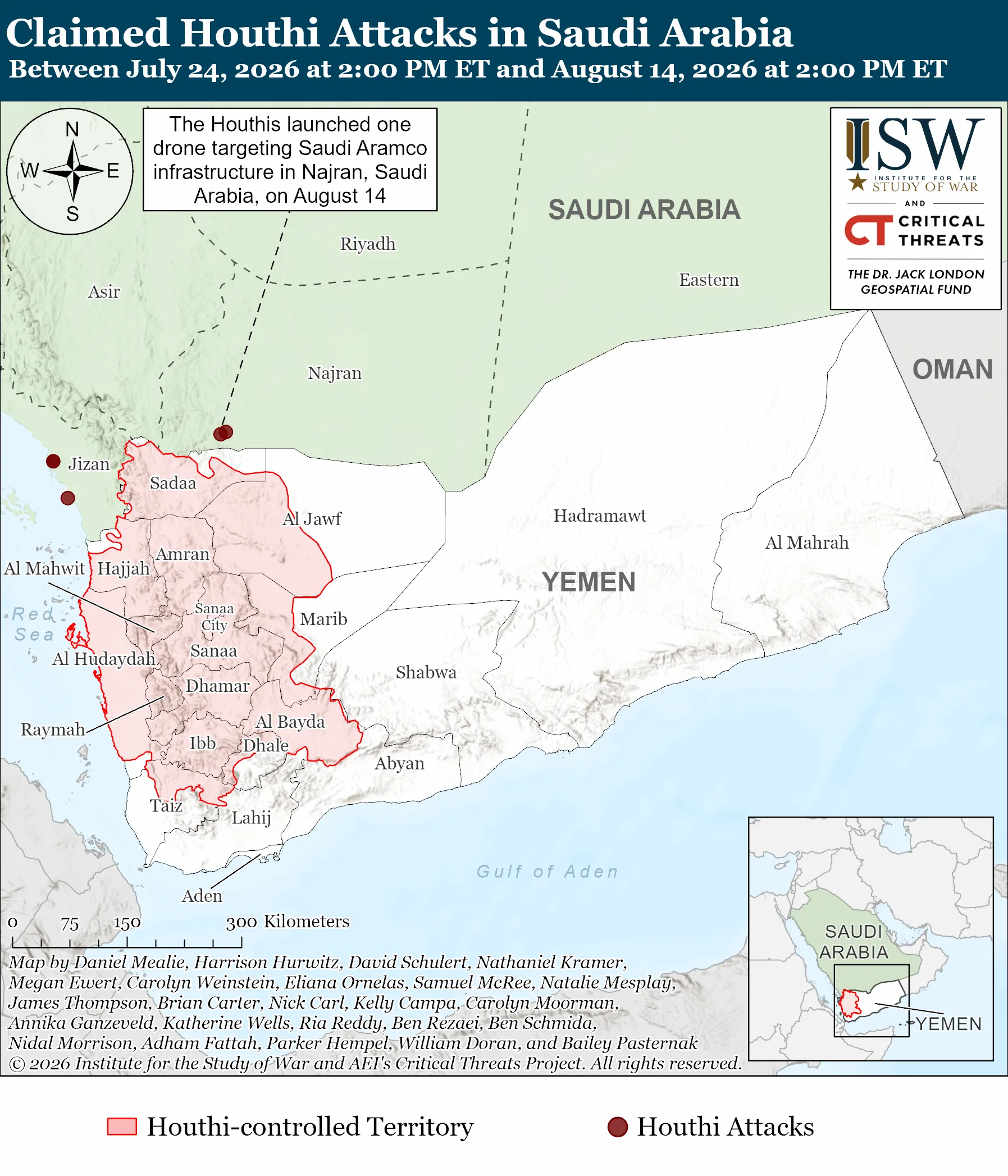
A Houthi military source told Houthi media on August 14 that the Houthis launched a drone targeting Saudi oil infrastructure in Najran, near the Yemen-Saudi Arabia border.[40] The source claimed that the Houthis attacked Saudi Aramco facilities in Najran in retaliation for Saudi aircraft overflights in Houthi-controlled Saada Province, in northwestern Yemen.[41] A Houthi military source previously told Houthi media on August 13 that Houthi drones targeted and struck the Saudi Aramco refinery at the Red Sea port of Jizan.[42] ISW-CTP continues to assess that the Houthis have threatened and attacked Saudi oil infrastructure in order to raise the political and economic costs of the Saudi blockade on Houthi ports and vessels and compel Saudi Arabia to cease its kinetic activity in Yemen.[43]
https://understandingwar.org/research/middle-east/iran-update-special-report-august-14-2026/
2,371
posted on
08/15/2026 12:48:36 AM PDT
by
AdmSmith
(GCTGATATGTCTATGATTACTCAT)
2,372
posted on
08/15/2026 12:52:58 AM PDT
by
AdmSmith
(GCTGATATGTCTATGATTACTCAT)
To: nuconvert
Ahmad Vahidi, commander-in-chief of the IRGC, told Iran's armed forces that their performance during six months of war had demonstrated that “Islam can be made to rule the world.” In a message published on Saturday, Vahidi praised IRGC, army, police and Basij forces, saying they had “brought the most heavily armed army in the history of the world to its knees.”
He compared their operations to the early Islamic battles of Badr and Khaybar and said that under Supreme Leader Mojtaba Khamenei’s command, Iranian forces had “opened the gates of uprising for the oppressed of the world.” Vahidi also said their campaign had revived hopes of defeating dominant global powers and predicted that the world would soon be more prepared for what he described in religious terms as the advent of ultimate Islamic rule.
https://www.iranintl.com/en/202608158389
2,373
posted on
08/15/2026 12:59:08 AM PDT
by
AdmSmith
(GCTGATATGTCTATGATTACTCAT)
To: gleeaikin
——now there is an attempt to force Mojtaba into this model-—
The operative word is force.
In the presence of existential panic, what must an institutional rock that is shackled to a near total inability to change, do? Foremost must be the thought, What does Allah will? How will the will of Allah be revealed? Why is the will of Allah not revealed?
Clue: The will of Allah is that the oppressive Shia theocracy that is Iran is ended. That is Allah’s will.
2,374
posted on
08/15/2026 5:41:26 AM PDT
by
bert
( (KE. NP. +12) Quid Quid Nominatur Fabricatur)
To: AdmSmith; blitz128; BeauBo; adorno; nuconvert
“Iran is continuing to expand military pressure on Iranian Kurdish opposition groups in Iraqi Kurdistan Region.”
The link below is a 22+ minute review of what has been going on with various parts of the scattered Kurdish populations since Trump and Israel killed the top of Iranian leadership early this year.
https://www.youtube.com/watch?v=gZoVT4uXLDo
It summarizes the various parts of the Kurdish people, where they are located, and who are their various leaders. Then it goes into considerable detail on how the diminished Iran leadership has been persistently attacking, especially the Iraq border area and into the Kurdish enclave in northern Iraq. Around minute 13 the discussion turns to ideas of Kurdish response to US activity, which was specifically blunted by being told don’t fight Iran, and lack of any useful gift of military hardware to do so.
I suspected Turkey where some of Trump’s male family members have tried to establish projects with Erdogan’s sons-in-law might have caused this result, but I think I recently saw something about Turkey changing its mind about Kurds fighting in Iran. Something to check on later.
2,375
posted on
08/15/2026 3:05:21 PM PDT
by
gleeaikin
(Question Authority: report facts and post their 'links" in yopur messages.I)
To: gleeaikin; nuconvert
Iran Update Special Report, August 17, 2026
The Iranian regime is signaling that it would prefer to continue or even escalate fighting with the United States and its regional partners rather than make any serious concessions regarding its maximalist demands if the regime cannot force them to accede to Iran's demands. The regime is signaling that it could expand the scope and severity of its attacks against the United States and its allies if they do not acquiesce to Iran's maximalist demands, which include lifting the US naval blockade and US sanctions, securing recognition of Iran's control over the Strait of Hormuz, and stopping regional cooperation on policies the regime deems hostile to its interests, among others. The Islamic Revolutionary Guards Corps (IRGC) has reportedly devised new plans for further escalation, including preemptive strikes on internet cables in the Persian Gulf, fomenting domestic unrest in countries with Shia communities like Kuwait and Bahrain, and “potentially” ground operations in Kuwait, according to Iranian officials speaking to the Wall Street Journal (WSJ) and public statements.[1] Iranian officials’ decision to publicize these plans to WSJ was likely meant to have an informational effect, even if the regime is seriously considering these options. Senior Iranian military commanders, including IRGC Political Deputy Yadollah Javani, have warned in recent days that Iran is shifting to an “offensive posture.”[2] A senior Iranian official similarly told Reuters on August 17 that Iran will adopt a “fully offensive” posture and conduct an attack to break the US naval blockade if diplomatic efforts to lift the blockade fail.[3] These threats are likely intended to coerce the United States to surrender to Iranian demands as well as to restore deterrence vis-à-vis the United States and its regional partners by signaling the regime's willingness to expand the scope of its attacks and conduct preemptive attacks.
The regime is likely simultaneously preparing to try to make fighting more costly for the United States should there be a renewal of hostilities. The WSJ report added that the IRGC “used the calm created by the [memorandum of understanding (MOU)]” to coordinate attack plans with its partners and proxies in the region.[4] Officials familiar with Arab intelligence findings said that the Iranian regime sent advisers to Iraq, Yemen, and Lebanon to discuss plans, including a plan for confrontation with Saudi Arabia in coordination with Iranian-backed Iraqi militias and the Houthis.[5] The IRGC reportedly supervised the deployment of “missiles, naval weapons, and drone launchers” to positions around the Red Sea, provided the Houthis with intelligence and target lists, including Saudi ports and energy facilities, and advised the Houthis on how to defend against Saudi retaliation.[6] ISW-CTP has repeatedly assessed that the Houthis’ attacks on Saudi Arabia as well as its blockade on Saudi ports advance Iranian efforts to impose economic costs on the United States and its regional partners to erode their willingness to continue the war and force them to give in to Iranian demands. Arab intelligence officials similarly told WSJ on August 17 that Iran's hardline leadership, which ISW-CTP has assessed since March 2026 is dominated by IRGC Commander Major General Ahmad Vahidi, is preparing the Iranian armed forces to “widen the war” and “raise costs” for the United States and its allies.[7] This report is consistent with a New York Times (NYT) report on August 1 that senior IRGC Quds Force officers held calls with Hezbollah, Houthi, and Iraqi militia commanders during the ceasefire to coordinate efforts to expand the conflict with the United States.[8]
Vahidi and his inner circle would likely accept a deal with the United States if the United States surrendered to the regime's demands. Axios reported on August 17 that the United States tried to establish a diplomatic backchannel with Vahidi in May 2026 to determine whether the Iranian negotiating team's position accurately reflected Vahidi and his faction's demands, according to three sources with direct knowledge of the matter.[9] Vahidi reportedly communicated to the United States that he “fully” supported Iran's negotiating delegation and would “prefer to solve this crisis through negotiations.”[10] Vahidi previously presumably approved the US-Iran MoU in April 2026, given his outsized role in decision-making in recent months and reports that Iranian negotiators did not have the independent authority to approve the MoU.[11] Iranian leaders have interpreted the MoU differently from the United States, particularly its fifth clause regarding the Strait of Hormuz. The regime has interpreted the clause to mean that Iran would maintain control over the Strait of Hormuz, which diverges from the US interpretation.[12] Iran has since attacked ships that have attempted to bypass Iranian control in the strait to enforce its interpretation of the MoU. These actions suggest that Vahidi and his faction would likely accept a deal that meets their demands but are unlikely to accept one that falls short, even if failing to reach an agreement would risk renewed conflict.[13]
Vahidi’s faction may be willing to accept some economic costs and potential unrest if doing so enables them to achieve their core objectives. Some Iranian officials and media have expressed concerns in recent weeks about Iran's worsening economic conditions and the potential for domestic unrest. Regime media outlet Mehr News Agency argued on August 17 that anti-regime media is trying to “create a perception of a nationwide crisis” by highlighting Iran's economic problems.[14] Mehr argued that this reporting is a “psychological operation” intended to amplify grievances among dissatisfied groups and encourage the belief among these groups that protests are the only way to solve the economic crisis.[15] Iranian First Vice President Mohammad Reza Aref separately stated on August 16 that the regime needs to confront US economic pressure through proper planning and policies and called for the regime to prepare for “worst-case scenarios,” possibly referring to domestic unrest.”[16] The recent Winter 2025-2026 protest wave was the largest wave of protests in Iran in recent years and stemmed from discontent about Iran's economic situation.[17] It is unclear whether the risk of internal unrest would be sufficient to drive Vahidi to make concessions to receive economic relief, however. Vahidi may prefer to take other actions, such as securitizing society and seeking alternative export routes, to mitigate the risks of domestic unrest and economic collapse.
Reports of growing regime concerns about Iran's economic conditions and the possibility of domestic unrest come amid Hossein Taeb’s appointment as Basij commander on August 10.[18] Taeb has decades of experience in repressing anti-regime activities as a former Basij commander and the head of the IRGC Intelligence Organization.[19] Taeb led the Basij’s brutal suppression of the 2009 Green Movement, for which the United States sanctioned him in 2010, for example.[20] Taeb’s appointment may, in part, reflect the regime's anticipation of potential unrest amid mounting economic pressure.
Iran reportedly launched two drones targeting Iraqi Kurdistan Regional Government (KRG) Prime Minister Masrour Barzani’s office and the KRG’s intelligence chief's residence in Erbil on August 17, according to the KRG.[21] The KRG security agency announced on August 17 that an unknown actor had launched two drones from Iranian territory at Barzani’s home but did not clarify whether the drones hit their intended target.[22] The agency reported that the attack did not cause any casualties.[23] Neither Iran nor any Iranian-backed group has claimed responsibility for the attacks at the time of this writing. Iranian Foreign Affairs Minister Abbas Araghchi, speaking to his Iraqi counterpart Fuad Hussein, and a senior Iranian official, speaking to Hezbollah-affiliated media, both denied Iran's involvement in the attacks.[24] The senior Iranian official claimed that Iran's adversaries conducted the attacks as a “false flag” operation.[25] Neither Iran nor Iranian-backed Iraqi militias claimed responsibility for a similar attack on KRG President Nechirvan Barzani’s house on March 28.[26] Several militias condemned the attack at the time.[27] Iraqi militias have conducted several drone attacks on targets in Erbil since the beginning of the war on February 28, but these attacks have largely been concentrated on US positions.[28]
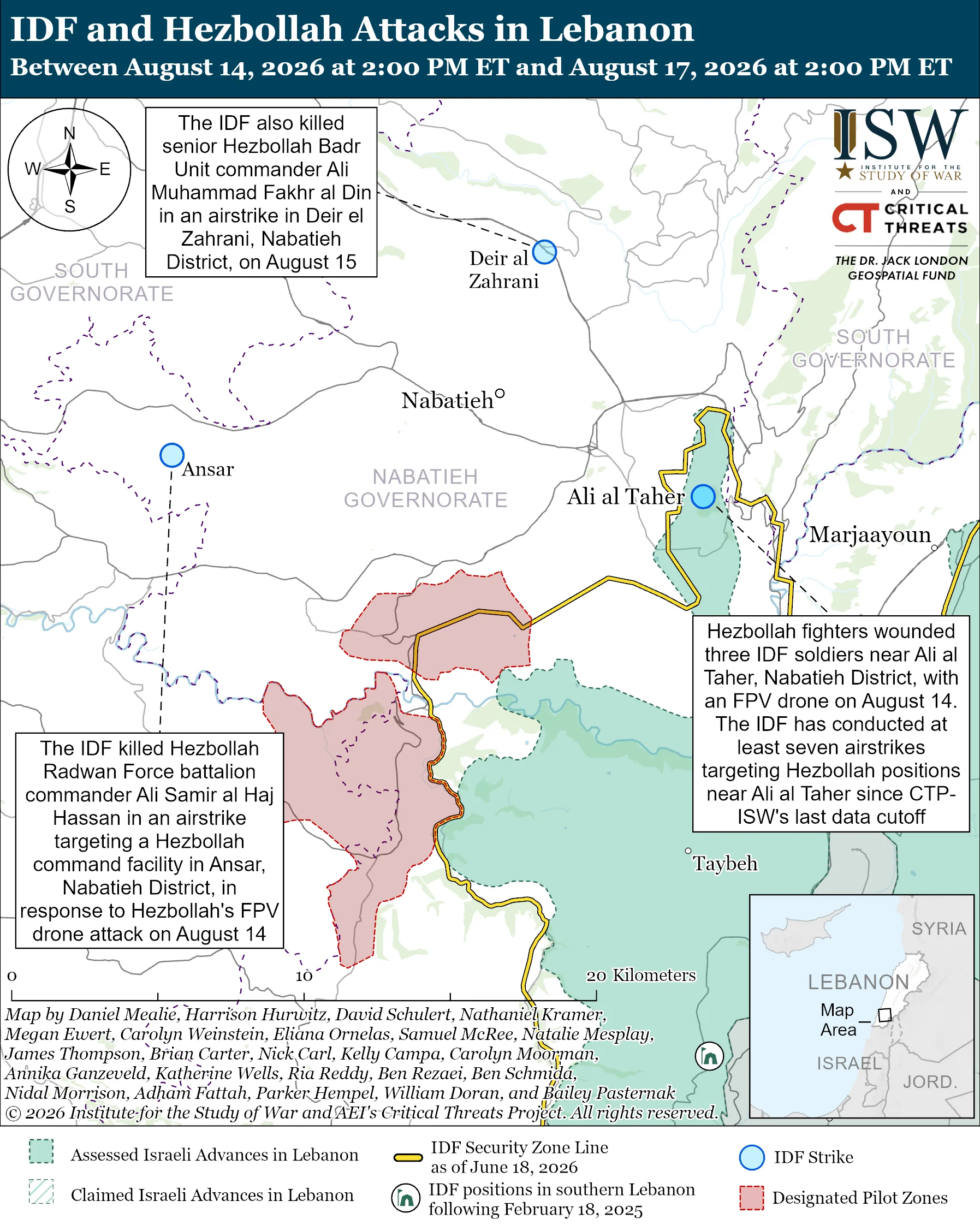
The Israel Defense Forces (IDF) conducted airstrikes targeting Hezbollah commanders following a Hezbollah drone attack that injured three IDF soldiers operating in Ali al Taher, Nabatieh Governorate, on August 14.[29] The IDF reported that it killed Hezbollah Radwan Force battalion commander Ali Samir al Haj Hassan in an airstrike targeting a Hezbollah command facility in Ansar, Nabatieh Governorate, on August 14 in response to a Hezbollah first-person view (FPV) drone attack in Ali al Taher.[30] The Radwan Force is Hezbollah's elite special operations unit that conducts cross-border infiltrations and attacks on Israeli positions.[31] The IDF reported that it also killed senior Hezbollah Badr Unit commander Ali Muhammad Fakhr al Din in a separate airstrike in Deir el Zahrani, Nabatieh Governorate, on August 15.[32] The Badr Unit is one of Hezbollah's geographic units and is responsible for the area north of the Litani River, particularly around Nabatieh District and the southern Bekaa Valley. The Badr Unit is one of the main Hezbollah units that has engaged Israeli forces in southern Lebanon.[33] Hezbollah claimed that the IDF strikes killed 11 people, including civilians, but did not acknowledge that its fighters were killed.[34] Hezbollah also has not claimed responsibility for the drone attack on August 14 at the time of this writing. The recent escalation in southern Lebanon has centered around control over Ali al Taher, which serves as a key reconnaissance position and launch site for Hezbollah. The area is also advantageous for the IDF to observe Hezbollah ground force movements given its high elevation.[35] An unspecified political source close to Hezbollah's leadership told UK-based, Saudi-owned media on August 17 that Hezbollah is prepared to fight “in full force” if the IDF attempts to seize Hezbollah's positions in Ali al Taher.[36] The IDF took “complete control” of the territory surrounding Ali al Taher in late June 2026, but the area still contains one of Hezbollah's largest underground command-and-control (C2) facilities and approximately 15 trapped Hezbollah fighters.[37] Israeli media reported on August 16 that the IDF seeks to kill the remaining Hezbollah fighters and destroy infrastructure in the area. The IDF has also blocked recent Hezbollah efforts to resupply its trapped fighters.[38]
There appear to be fissures within the Iranian-backed Badr Organization over its support for Iraqi Prime Minister Ali al Zaydi’s efforts to disarm Iranian-backed Iraqi militias. Badr Organization Political Bureau head Mohammad Naji Mohammad issued a statement on August 14 that criticized Zaydi’s disarmament efforts.[41] Mohammad added that no one, including the Iraqi prime minister, should be allowed to disarm the militias because doing so would cause “internal strife.” Mohammad's comment completely disregards the militias’ role in causing such strife by conducting attacks on US interests in Iraq and neighboring countries.[42] The militias’ attacks in Iraq undermine Iraqi sovereignty and the Iraqi federal government's efforts to stay out of Iran's conflicts with the United States and Israel. Mohammad, also known as Abu Jassim al Askari, led Badr’s Inspection and Investigations Directorate in the early 2000s, according to a Saddam Hussein-era Iraqi intelligence report on the Badr Organization.[43] Some Iraq analysts have also noted that Abu Jassim led several Badr units that facilitated attacks on the Iraqi Kurdistan Region in March and April 2026.[44] Mohammad's August 14 statement on disarmament notably appears to contradict Badr Organization Secretary General Hadi al Ameri’s position on the issue. Ameri has played a key role in the Iraqi federal government's disarmament efforts in recent months, including by serving on the Shia Coordination Framework's disarmament committee.[45] The Badr Organization's media office denied the existence of that committee in early June, however, which could have been a response to internal Badr opposition to Ameri’s involvement in the committee.[46]
The Iraqi Counter Terrorism Service (CTS) arrested Iranian-backed Iraqi militia Harakat Hezbollah al Nujaba reconnaissance unit leader Abbas Hussein Yaqubi in Dhi Qar Province on August 17.[47] A security source told Iraqi media on August 17 that CTS forces raided the Harakat Hezbollah reconnaissance unit leader's home in Dhi Qar Province.[48] The Iraqi Parliamentary Security and Defense Committee chairman confirmed to Kurdish media on August 17 that CTS Special Forces arrested Yaqubi, who is also the Popular Mobilization Forces (PMF) Baghdad Belt Operations Command intelligence director.[49] The PMF is an Iraqi security service that includes many Iranian-backed Iraqi militias, such as Harakat Hezbollah al Nujaba, that answer to Iran instead of the Iraqi prime minister.[50] This operation follows several recent Iraqi government attempts to crack down on Iranian-backed Iraqi militias, including an attempted raid on a Harakat Hezbollah al Nujaba base in Jurf al Naddaf in late July 2026.[51] The arrest also comes amid indicators that the Iraqi federal government is preparing to use force to disarm Iranian-backed Iraqi militias.[52] Yaqubi’s arrest could be part of a broader effort to set conditions for such an operation.
Some Iranian-backed Iraqi actors are portraying Iranian-backed Iraqi militias as defenders of Iraq's sovereignty to justify their continued existence, likely in an effort to build public support amid the Iraqi government's efforts to disarm the militias.[53] Iranian-backed Badr Organization Political Bureau head Mohammad Naji Mohammad stated on August 14 that Iraqi “resistance” was established to defend the “state.”[54] A member of Iranian-backed Iraqi militia Asaib Ahl al Haq’s political wing similarly stated on August 14 that the militias fought for Iraq's sovereignty and retain strong popular support.[55] These claims come as the Iraqi federal government has taken steps to crack down on the militias amid continued US pressure to curb Iranian influence in Iraq.[56] Some Iranian-backed Iraqi militia officials likely calculate that framing the militias as defenders of Iraqi sovereignty could generate public support for their continued armament and justify their continued existence.
Unspecified sources speaking to Saudi media on August 17 claimed that unspecified Iraqi armed factions are planning to assassinate Iraqi Supreme Judicial Council President Faiq Zaidan in response to the Iraqi government's disarmament efforts.[57] The sources indicated that the threats are directly related to the Iraqi government's militia disarmament and anti-corruption campaigns.[58] Zaidan has previously supported efforts to restrict weapons to the state.[59]
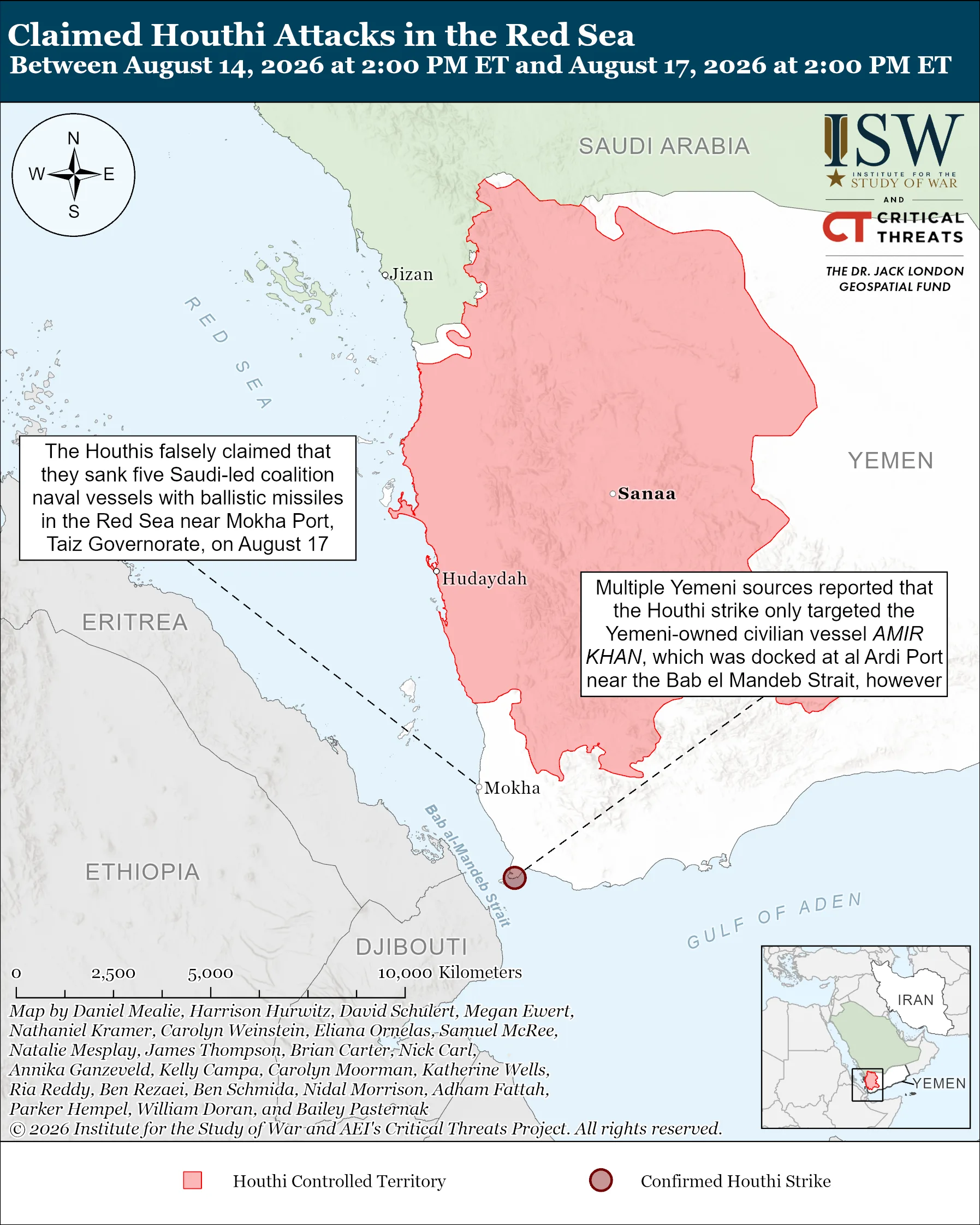
The Houthis are framing their attack on a Yemeni civilian vessel near the Bab al Mandeb Strait as a strike on Saudi-coalition naval vessels, likely to try to deter the Saudi-led multinational maritime defense coalition from operationalizing its mission to protect Red Sea maritime trade by signaling that the Houthis could target the coalition's vessels.[60] The Houthis claimed that they struck five Saudi-coalition naval vessels with ballistic missiles in the Red Sea near Mocha Port, Taiz Governorate, on August 17.[61] The Houthis added that they sank one Saudi-coalition landing craft and four nearby patrol boats.[62] Multiple Yemeni sources reported on August 17 that the Houthi strikes only targeted the AMIR KHAN, a Yemeni-owned civilian vessel docked in Al Ardi Port, near the Bab el Mandeb Strait, however.[63] The strike reportedly caused severe damage to the vessel and the harbor's berth but did not cause casualties.[64] The Houthi claim follows Saudi Arabia's July 2026 formation of a multinational maritime defense coalition tasked with protecting Red Sea shipping from Houthi and Iranian threats to the Bab al Mandeb Strait.[65] The Houthis’ attempt to frame their recent attack on a Yemeni civilian vessel as an attack on the coalition's vessels likely served as an implicit threat and intended to signal the group's willingness to target Saudi-coalition naval vessels to deter the coalition from operationalizing its mission. ISW-CTP previously assessed that the Houthis likely view the coalition as a threat to their blockade of Saudi ports and vessels and the broader Houthi campaign to coerce Saudi Arabia into lifting its blockade of Houthi-controlled ports and airports.[66]
https://understandingwar.org/research/middle-east/iran-update-special-report-august-17-2026/
2,376
posted on
08/18/2026 12:17:40 AM PDT
by
AdmSmith
(GCTGATATGTCTATGATTACTCAT)
“The Iraqi government will lose any confrontation with our armed groups.” Quds Force commander Esmail Qaani effectively warned the Iraqi government that it is outgunned inside its own country, saying the state would lose any confrontation with Iraq's Islamic Republic-backed militias. That warning is especially significant because the Iraqi government has promised President Trump that Islamic Republic-backed militias will be disarmed, with a September 30 deadline for bringing weapons under state control. Qaani instead instructed the militias to keep their weapons, declaring that “these weapons belong to the Islamic Republic,” while criticizing groups willing to disarm.
That is an extraordinary assertion of power over another country. The Islamic Republic is effectively telling Iraq that its proxy forces are too powerful for the central government to challenge. September 30 is becoming a direct test of Iraqi sovereignty: who ultimately controls the guns inside Iraq, the Iraqi state or the Islamic Republic?
https://x.com/TheIranWatcher/status/2087878346671550955
The Islamic Republic wants to reproduce in Iraq what it built in Lebanon with Hezbollah: a state within a state.
The model is simple - keep a formal government in place, but maintain heavily armed militias outside its control, powerful enough to intimidate institutions, veto decisions and challenge the central government when necessary. That creates dual sovereignty: an official Iraqi state alongside a parallel armed order aligned with the Islamic Republic.
Disarmament is a red line because the Islamic Republic will not willingly surrender the armed network that gives it power over Iraq. Quds Force commander Esmail Qaani has communicated that disarmament must be held off, but the Islamic Republic will never voluntarily green-light dismantling the armed network that gives it power over Iraq. These militias are not merely allies. Their independent military power is what gives the Islamic Republic enormous leverage over Iraq without governing it directly. Disarm the militias, and that leverage is severely undermined.
https://x.com/TheIranWatcher/status/2087850478822433012
The Islamic Republic's proxy stranglehold over Iraq is heading toward an unavoidable confrontation with the Iraqi state.
Prime Minister Ali al-Zaidi has set a September 30 deadline to bring weapons under state control and disarm Islamic Republic-backed militias.
The pressure is coming from both directions. The United States is demanding disarmament, with Iraq's access to crucial dollar flows and therefore its economic stability potentially at stake. Meanwhile, the Islamic Republic wants its armed network preserved. Kata’ib Hezbollah is now threatening al-Zaidi, warning that its “patience is running out.” Al-Zaidi says he will not retreat “even if it costs me my life.” This is becoming a battle over Iraq itself: state sovereignty on one side, the Islamic Republic's parallel armed order on the other.

https://x.com/TheIranWatcher/status/2089523689926660158
2,377
posted on
08/18/2026 12:30:21 AM PDT
by
AdmSmith
(GCTGATATGTCTATGATTACTCAT)
To: AdmSmith; nuconvert; Jonty30; BeauBo; blitz128; adorno; dennisw; BroJoeK; Political Junkie Too; ...
In comment #2375, I posted a detailed video link which included a review of the various elements of the Kurdish people. This ethnically United population of more than 30 million people is scattered among 5 countries and has long dreamed of being a country of its own. This has in fact been achieved to some degree by the successful formation of a semi autonomous government in northern Iraq, which has cooperated with both the US government over the years, as well as the post Saddam Iraq government. However hopes for unification have not been helped by the formation of 3 distinct Kurdish groups that do not always agree on measures to adopt, and also other smaller Kurdish groups.
Kurds have been seriously mistreated by Iran for decades, and Iraq anti-government militias have also been causing trouble recently. Whether it is responding to one or to both threats, the Kurds have decided to present a united front to maintain and advance their continued existence. Below is a 34.5 minutes video describing the current state of conflict especially with the current threatenlng Iran Mullocracy, now being dominated by the militant IRGC fighters.
https://www.youtube.com/watch?v=p3m035gcDgM
Kurds occupy a mountainous band of territory bordering much of southwestern Iraq. This terrain is very well known to the Kurdish residents, and very rugged land for anyone outside to try to conquer. How this develops bears watching, although reporting from such lands is especially difficult.
There is an ongoing problem the formal Iraq government and the US are trying to coordinate. That is disarmament of pro Iran, armed Iraq militias before a Sept. 30 plan for the US to remove our troops from Iraq is activated. Unification of Kurdish factions may help deal with this to some degree, while also distracting Iran’s military in its ongoing clash with the US and support to Iraq’s anti government militias.
A separate, but related issue, is the escalating conflict between the Iran backed Houthis of Yemen, and Saudi Arabia. I was surprised to see that the population controlled by Houthis and the citizens of SA are somewhat comparable in numbers. Around 40 percent of the SA population are NOT citizens of that country, so it seems the Houthis and Saudis may be more evenly matched than I previously thought. I am also concerned about reports I saw last night that our President is angry at the Omani government, which I thought was trying to coordinate peace efforts now, rather than the Pakistanis.
There are also reports that the Balouchi(sp) tribal population of the eastern Iran deserts, and western Pakistan have fought with their own governments in the past. Currently it appears the balouchi are actively fighting the Iran government since they, like the Kurds, have been mistreated by that government. Unfortunately, they are in desert territory which does not have the advantages of stealth and secrecy rugged mountains afford the Kurds. Nevertheless, it appears Iran/IRGC has plenty to be concerned about.
2,378
posted on
08/18/2026 10:37:42 AM PDT
by
gleeaikin
(Question Authority: report facts and post their 'links" in yopur messages.I)
To: gleeaikin; nuconvert
Iran Update Special Report, August 18, 2026
Russia has continued to provide direct military support to Iran through weapons and weapons components transfers. NBC News reported on August 18 that Russia has transferred drone components, ammunition, and TNT explosives to Iran via the Caspian Sea as of July 2026, citing a European government document that NBC obtained and that an unspecified Western official verified.[1] NBC added that Iran uses TNT in its ballistic missile warheads and drones, citing Iran's Ministry of Defense and Armed Forces Logistics.[2] The document and the official reported that over two dozen Russian ships have carried deliveries to Amirabad Port in Iran's Mazandaran Province via the Caspian Sea.[3] Iran and Russia have historically used the Caspian Sea to trade military and non-military goods.[4] Israel struck sites in Bandar Anzali, including facilities to disrupt Russian shipments of military equipment to Iran, earlier in the war.[5] Ukraine more recently struck several sanctioned cargo vessels in the Caspian Sea on July 25 that Russia reportedly used to transport military cargo between Russia and Iran.[6]
This evidence of Russia's drone component transfers to Iran is indicative of the active military support that Russia has provided Iran and its drone program in recent months. Iran has reportedly used “Russian-enhanced versions” of Shahed drones and Russian targeting intelligence to attack US forces and assets during the war, according to US intelligence officials.[7] Russia has also directly assisted with Iran's attacks on US forces and bases during the war by providing Iran with “advanced drone tactics.”[8] The New York Times (NYT) reported on August 11 that Iran has learned and adopted drone tactics it observed in the Russia-Ukraine War to better evade US air defenses.[9] Regime media highlighted the NYT report on August 18.[10]
The Emirati Defense Ministry stated that Iran launched two ballistic missiles at the United Arab Emirates (UAE) on August 18.[11] The Emirati Defense Ministry added that its air defenses detected one ballistic missile that fell outside Emirati territorial waters and another that landed within them.[12] Iranian regime media denied responsibility for the attack.[13] It is unclear at the time of writing whether Iran intended to attack a target within Emirati territory or a target in Emirati territorial waters, such as a vessel. Iran has attacked Abu Dhabi National Oil Company tankers near the Emirati coast in recent days.[14] Iran has typically fired cruise missiles and drones to target vessels, however. Iran may have also attempted to attack the UAE to deter the UAE from assisting with US efforts to secure freedom of navigation in the strait, as it has previously.[15]
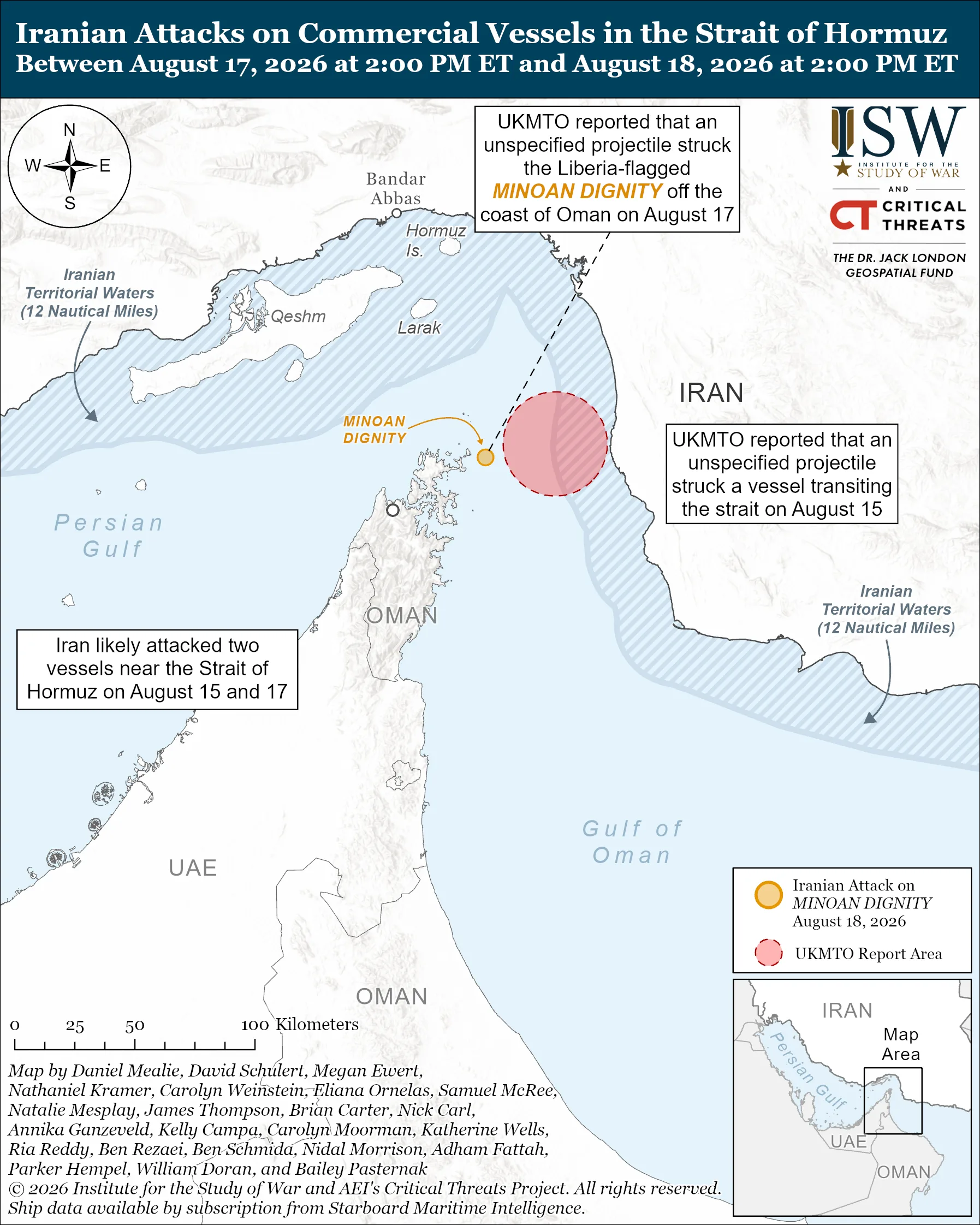
Iran likely attacked two vessels in the Strait of Hormuz as part of its effort to consolidate its control over the waterway. United Kingdom Maritime Trade Operations (UKMTO) reported on August 18 that an unspecified actor fired an unspecified projectile that struck a vessel that was transiting the strait through Omani territorial waters.[16] UKMTO separately reported on August 17 that an unspecified actor struck the Liberian-flagged Minoan Dignity with an unspecified projectile on August 15 as the vessel transited the strait through Omani waters. The attack killed one crew member.[17] Iran has repeatedly struck vessels using Omani waters in order to coerce vessels and shipping companies to transit the strait through Iranian territorial waters.[18] It is unclear at this time whether the Iranian attacks on commercial vessels are related to the Emirati Defense Ministry's announcement about Iranian ballistic missile launches.
The Islamic Resistance in Iraq's recently released list of preconditions for discussing militia disarmament with the Iraqi federal government indicates that Islamic Resistance in Iraq militias have no intention of disarming.[19] The preconditions include a complete and “genuine” US withdrawal from Iraqi territory and assurances that the United States does not return to Iraq, the “liberation” of Iraqi political and economic decision-making from US “hegemony,” the withdrawal of Turkish forces from northern Iraq, and disbanding the Iraqi Kurdish Peshmerga due to their US-Israeli alignment.[20] The Islamic Resistance of Iraq includes Kataib Hezbollah, Harakat Hezbollah al Nujaba, and Kataib Sayyid al Shuhada, all of which are among the closest Iraqi militias to Iran and have been the most kinetically active in recent months.[21] These militias have continuously refused to disarm and likely recognize that the Iraqi federal government will not be able to implement all of their demands, which suggests that the militias made these demands without any intention to disarm.[22]
The Islamic Resistance in Iraq also condemned Iraqi Prime Minister Ali al Zaydi’s “provocative and irresponsible” actions, in reference to recent Iraqi federal government attempts to crack down on the militias.[23] Iraqi authorities have closed 71 “fake” headquarters of the Iranian-backed Popular Mobilization Forces (PMF) and raided a likely Harakat Hezbollah al Nujaba base in recent weeks, for example.[24] The PMF is an Iraqi state security service that includes multiple Iraqi militias that answer to Iran instead of the Iraqi prime minister.[25] The Iraqi Counter Terrorism Service also arrested a Harakat Hezbollah al Nujaba reconnaissance unit leader in Dhi Qar Province on August 17.[26] An open-source intelligence (OSINT) analyst reported on August 17 that Iraqi authorities handed the militia leader over to PMF authorities following threats from the militias.[27] Previous Iraqi administrations, particularly under former Prime Minister Mustafa al Kadhimi, have conducted limited crackdowns on militia activity, but Iran's infiltration of Iraqi government institutions and the relative strength of the Iraqi militias have limited the scale of such efforts. Kadhimi tried multiple times to arrest militia members but would later release them due to militia pressure, for example.[28]
A member of Iranian-backed Iraqi militia Asaib Ahl al Haq’s political wing, Sadiqoun, falsely claimed on August 18 that Iraqi militias’ current capabilities are limited to “simple weapons.”[29] Iranian-backed Iraqi militias have conducted numerous missile and drone attacks against US and partner forces in Iraq and the region throughout the war.[30] The Sadiqoun member's comments follow reports of Iraqi militias circumventing the federal government's disarmament efforts, including by handing over inoperable weapons.[31]
[32] An informed source told Iraqi media on August 18 that the committee includes representatives from the PMF in addition to other governmental ministries and security institutions.[33] Farmers living in the al Saidan, al Jir, and al Uwaysat villages demanded the renewal of temporary agricultural land contracts and the return of displaced families, according to Iraqi media.[34] The source noted that the committee will complete its investigation into Jurf al Sakhr and submit a report to Zaydi within 10 days.[35] Kataib Hezbollah and other Iraqi militias liberated Jurf al Sakhr from the Islamic State in Iraq and al Sham (ISIS) control in late 2014 and displaced the area's predominantly Sunni residents.[36] The militias continue to exercise control over Jurf al Sakhr and do not permit civilians or government officials to enter the area.[37] The committee's visit follows reports that Zaydi may be planning an operation to encircle and enter Jurf al Sakhr if the militias do not comply with the Iraqi government's September 30 disarmament deadline.[38]
Members of the Iraqi Parliament's Security and Defense Committee reportedly failed to reach a consensus on Zaydi’s request for the committee to draft a law to restrict weapons to the state.[39] Zaydi met with the committee on August 17.[40] Zaydi has mentioned presenting such a law to parliament in recent days.[41] Iraqi media reported on August 17 that disagreement among committee members prevented the committee from reaching a consensus on the disarmament law, but that the federal government would draft the law and submit it to Parliament for discussion and approval.[42] A member of the Sunni Azm Alliance heads the committee, which also includes parliamentarians from various parties, such as Asaib Ahl al Haq’s Sadiqoun political wing.[43] Iraqi media also reported that unspecified parliamentarians who are not affiliated with Iranian-backed Iraqi militias held separate meetings to discuss the law.[44] The parliamentarians reportedly discussed which weapons would be referenced in the law, possible mechanisms to address weapons depots, the possible integration of disarmed groups into other security institutions, and security guarantees that the government can provide militias to convince them to hand over their weapons.[45] It remains unclear how Zaydi’s draft law differs in intent or practice from existing Iraqi laws that forbid armed groups from operating in Iraq.
A Patriotic Union of Kurdistan (PUK) parliamentarian and member of Parliament's Security and Defense Committee told Iraqi Kurdish media on August 18 that the Iraqi federal government is expected to submit the PMF draft law to Parliament within the next two weeks.[46] It is unclear if the parliamentarian is referring to the PMF Retirement and Service Law or the Popular Mobilization Authority Law. The PUK parliamentarian said that the Iraqi federal government is sending the draft law to Parliament to address demands from some armed groups within the PMF.[47] Zaydi separately directed the head of Parliament's Security and Defense Committee on August 12 to complete its review of the PMF draft law for presentation to Parliament, according to Iraqi media.[48] The “PMF draft law” may refer to two recent draft laws that address the PMF but were recently withdrawn from Parliament for various reasons. Former Prime Minister Mohammad Shia al Sudani withdrew the PMF Retirement and Service draft law from Parliament in March 2025.[49] The draft law would have reportedly required around 3,500 PMF leaders, including Popular Mobilization Committee Chairman Faleh al Fayyadh, to retire due to their age.[50] Sudani also withdrew the Popular Mobilization Authority draft law from Parliament in August 2025, reportedly due to US pressure.[51] The Popular Mobilization Authority draft law would have likely increased Iran's influence in the Iraqi political and security spheres by formalizing key structures of the PMF.[52] It is unclear if parliamentary committees have revised either of these draft laws. Parliamentary committees must review and approve draft laws before Parliament as a whole can discuss and vote on the laws.[53] Both laws may be undergoing the legislative process given that Zaydi and the PUK parliamentarian appear to be referencing distinct draft laws. Zaydi’s order for the parliamentary committee to complete its review of a PMF draft law implies that the federal government already re-submitted the draft law. The PUK parliamentarian remarked nearly a week after Zaydi’s order that the federal government is soon expected to submit a PMF draft law to parliament, however.[54]
The Houthis claimed that they launched drones targeting an oil refinery in Jizan, Saudi Arabia, on August 18.[55] A Houthi military source told Houthi media on August 18 that the Houthis attacked the Saudi Aramco oil refinery in Jizan in retaliation for Saudi military overflights in Houthi-controlled parts of Saada and Hajjah governorates, northwestern Yemen.[56] The Houthis have claimed four attacks on the Jizan refinery since the Houthis began targeting Saudi oil infrastructure on July 24.[57] Saudi Arabia has not confirmed the attack at the time of writing.[58] ISW-CTP continues to assess that the Houthis are attacking Saudi oil infrastructure primarily to raise Saudi political and economic costs to an untenable level and compel Saudi leaders to terminate military operations against the Houthis in Yemen.[59] The Houthi Council of Ministers reiterated on August 17 the Houthis’ demands that Saudi Arabia cease all military operations in Yemen, lift its blockade on Houthi-controlled ports and airports, pay Houthi officials’ salaries, and pay the Houthis war reparations for Saudi and Republic of Yemen Government (ROYG)-aligned military operations in Yemen.[60] The Houthis seek to force Saudi Arabia to surrender and accept these demands by attacking Saudi oil infrastructure, Saudi vessels transiting the Bab al Mandeb Strait and Red Sea, and other Saudi assets.[61]
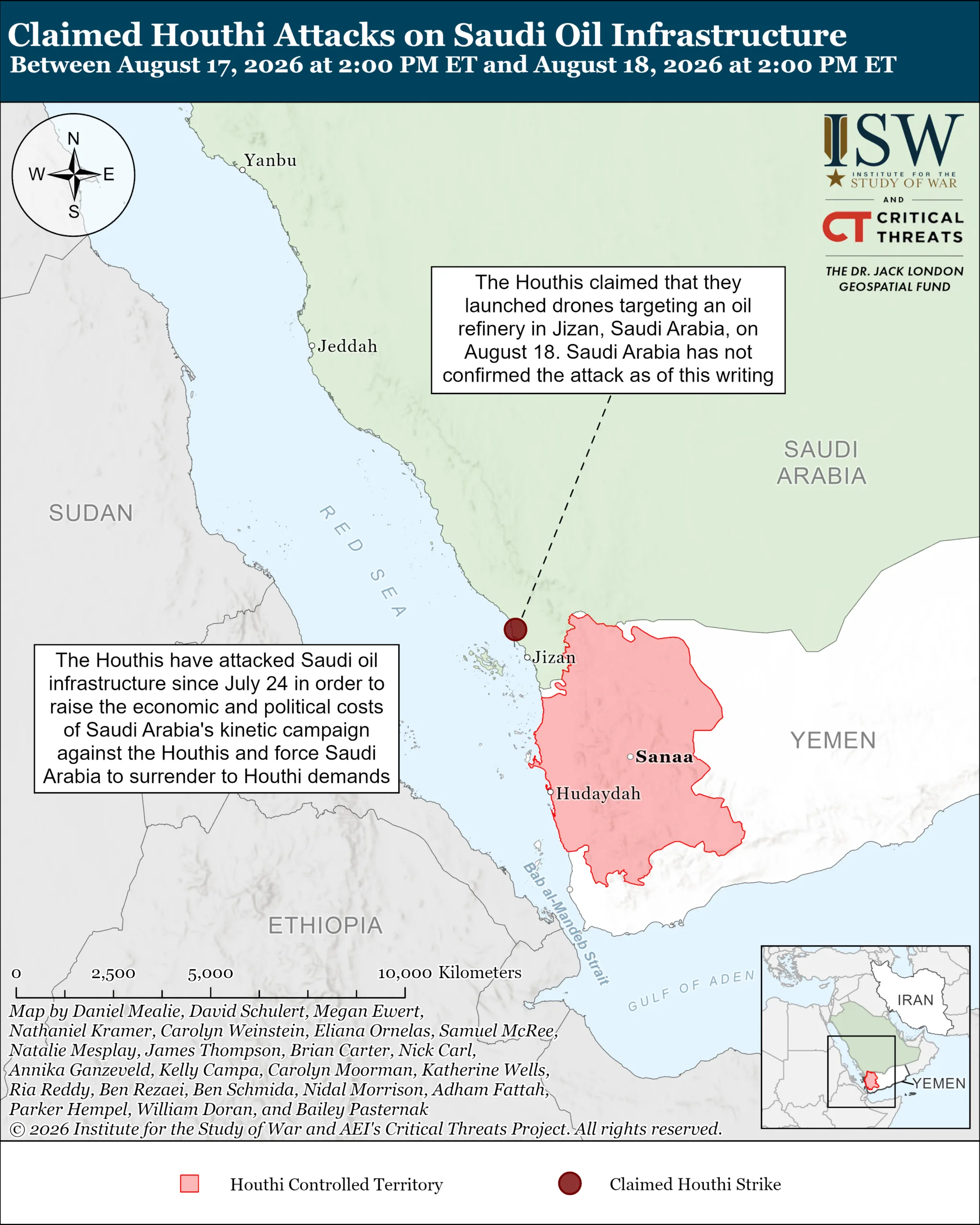
https://understandingwar.org/research/middle-east/iran-update-special-report-august-18-2026/
2,379
posted on
08/18/2026 11:11:18 PM PDT
by
AdmSmith
(GCTGATATGTCTATGATTACTCAT)
To: gleeaikin; nuconvert; blitz128; BeauBo
Iran Update, August 19, 2026
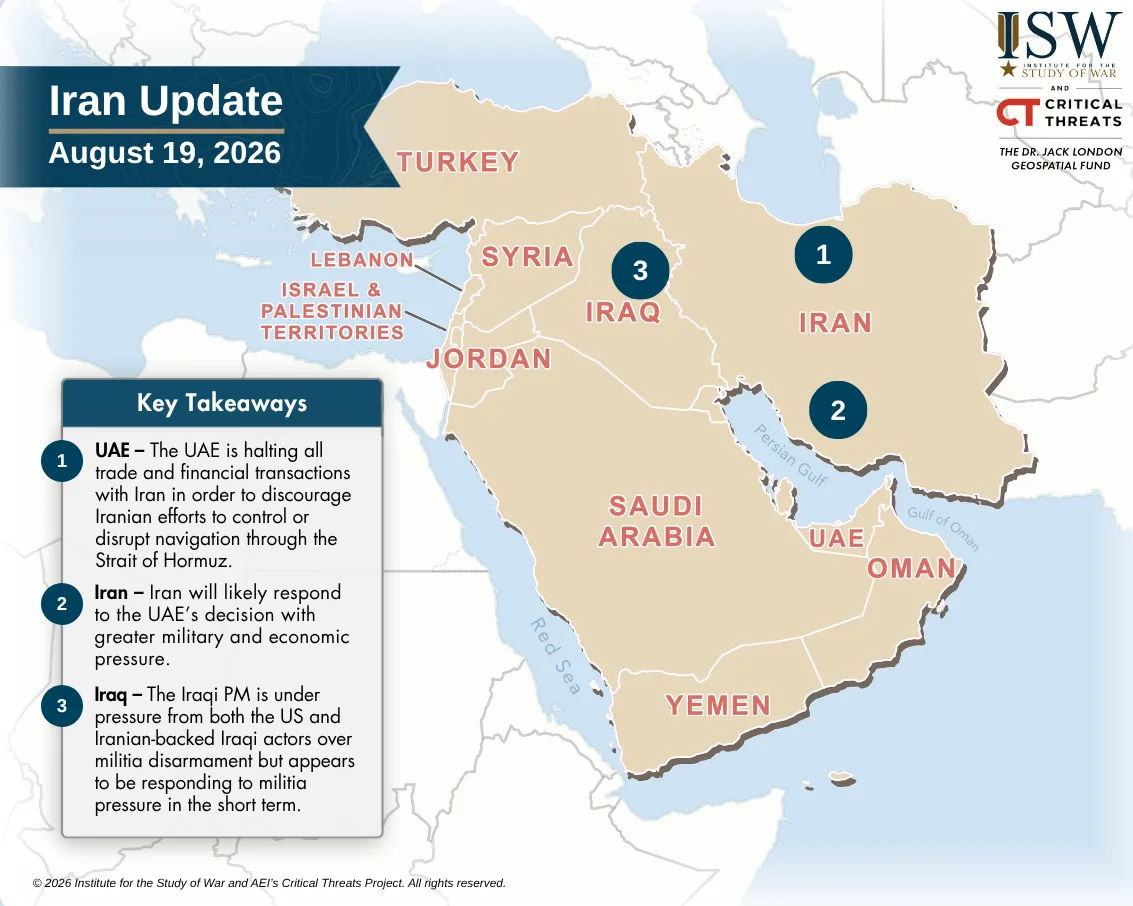
The United Arab Emirates (UAE) is intensifying economic pressure on Iran to discourage Iranian efforts to control or disrupt navigation through the Strait of Hormuz. The UAE announced on August 18 that it would halt all trade and financial transactions with Iran.[1] The announcement comes after the UAE accused Iran of launching missiles from Iranian territory toward the UAE on August 18.[2] The UAE later said the missiles unsuccessfully targeted vessels to disrupt ”maritime navigation.”[3] Iranian Foreign Affairs Ministry spokesperson Esmail Baghaei denied that Iran launched these attacks.[4] Iran has recently attacked tankers near the Emirati coast.[5]
The UAE has previously supported US efforts to undermine Iranian control of the strait, which suggests that the UAE’s decision is part of a broader effort to raise the costs of Iran's attempts to control or disrupt maritime traffic.[6] The timing of the UAE‘s decision also suggests that the UAE may seek to influence ongoing Iran-Oman negotiations over the future management of the strait. The Associated Press reported on August 18, citing two regional officials, that the Trump administration told Oman that it opposes elements of the yet-to-be-announced Iran-Oman agreement, including joint Iranian-Omani management of the strait's exit route.[7] An Iranian analyst close to the regime separately stated on August 18 that the UAE is playing a significant role in increasing US pressure on Oman over the agreement.[8] The UAE’s decision may, therefore, also seek to prevent any Iran-Oman arrangement that grants Iran any control over navigation through the strait.
The UAE’s decision will further weaken Iran's already deteriorating economy by restricting both its access to essential imports and its ability to repatriate export revenues and circumvent sanctions. Roughly one-third of Iran's imports have come from the UAE, and the largest proportion of Iranian imports in the last five years come from the UAE have made the UAE.[9] The UAE also serves as a critical hub for Iran's shadow-banking and sanctions-evasion networks through which Iran generates significant revenue.[10] Approximately 80 percent of Iran's imported foreign exchange reportedly comes through the UAE.[11] Cutting this channel will exacerbate Iran's pre-existing foreign-currency shortages and make it more difficult for the regime to finance both imports and exports.[12] An Iranian sanctions-focused analyst assessed on August 19 that the impact will be particularly significant amid the ongoing US naval blockade on Iran because trade between Iran and the UAE occurs beyond the US naval blockade line in the Persian Gulf, and thus, the UAE likely provided Iran with an important channel for obtaining goods despite the blockade.[13] The UAE’s decision will compound the economic pressure that the blockade has already imposed on Iran.
Iran will likely respond to the UAE’s decision with greater military and economic pressure against the UAE rather than abandon its efforts to secure greater control over the Strait of Hormuz. Iran will likely view the UAE’s actions as both an immediate economic threat and a broader challenge to its core objectives, which include controlling the strait. Iran could seek to impose costs on UAE shipping or territorial security to demonstrate the consequences of opposing Iranian efforts to control or disrupt navigation through the strait. Such actions would be consistent with Iran's repeated use of force against Gulf states to compel them to accept Iranian demands since the start of the US-Iran war in February 2026. ISW-CTP previously also assessed that Islamic Revolutionary Guards Corps Commander Major Ahmad Vahidi’s faction — whom ISW-CTP continues to assess is driving regime decision-making — may be willing to accept some economic costs and the risk of renewed war if doing so enables them to achieve their core objectives, including Iranian control over the strait.[14] Increasing Emirati alignment with the United States will also drive longer-term hostility between the UAE and Iran. It is not clear the extent to which the Iranian regime decisionmakers have internalized the ramifications of long-term hostility with the UAE, given the economic relationship between the two states.
The resulting economic pressure on Iran from the UAE’s decision will nevertheless likely increase regime concerns about domestic unrest, but it is unclear whether those concerns will compel Vahidi’s faction to make meaningful concessions. The UAE supplies almost 37 percent of Iran's essential goods imports (which are not prohibited under the US blockade and sanctions), which makes the loss of access to trade with the UAE particularly significant to the domestic Iranian population.[15] The Emirati decision to impose economic penalties on Iran comes after Iranian officials and media have expressed growing concern in recent weeks about deteriorating economic conditions and the potential for domestic unrest.[16] The regime already appears to be pursuing multiple measures to mitigate these risks rather than reconsider its core demands, however. Iran has taken initial steps to increase access to foreign currency and strengthen alternative economic relationships, including with Tajikistan, although the effectiveness of these efforts remains unclear.[17] The regime is also simultaneously preparing for potential unrest, which is consistent with its longstanding approach to suppressing dissent rather than addressing the underlying economic grievances that drive the unrest.[18]
Iraqi Prime Minister Ali al Zaydi is under pressure from both the United States and Iranian-backed Iraqi actors over Iraqi militia disarmament but appears to be responding primarily to militia pressure at this time. Qatari-owned regional media reported on August 19 that Zaydi’s plan to increase security measures and deploy a special Iraqi Counter Terrorism unit near Jurf al Sakhar, south of Baghdad, was only to monitor the movement of people and vehicles and would not lead to a raid or a military incursion into the militia's key site.[19] This is a reversal from previous reporting, which claimed that Zaydi was preparing for Iraqi security forces to retake Jurf al Sakhar.[20] Kataib Hezbollah has refused to allow the Iraqi government to exercise sovereignty over Jurf al Sakhr for over a decade and has used the area to store weapons and launch attacks against US and foreign targets in Iraq and the region, including in March and April.[21] Conducting an operation to retake the area would require significant planning, mobilization, and coordination among Iraqi security forces. It would also be a notable move in favor of US pressure on the Iraqi federal government to disarm the militias. Zaydi’s hesitation to follow through on this operation demonstrates how much influence Iranian-backed Iraqi actors retain over Zaydi’s government.
The recently reported plan to only “monitor” Jurf al Sakhr indicates that Iranian-backed actors, including the militias and leaders within the ruling Shia Coordination Framework, have coerced Zaydi into responding to their directives rather than complying with US pressure to rein in the militias. Zaydi initiated the government's disarmament campaign and set September 30 as the deadline for the campaign's completion. Zaydi initiated the campaign and set this deadline in part due to US pressure on Baghdad, which included offers of additional US funding and investment in Iraq if Zaydi is successful.[22] Multiple Iranian-backed Iraqi militias, including those that are closest to Iran and that have been the most kinetically active in recent months, continue to refuse to disarm and resist government efforts to rein them in.[23] The Iraqi militias are also circumventing and delaying the government's disarmament efforts, including by handing in inoperable or small amounts of weapons.[24] Many Iranian-backed actors pressured the Iraqi government into surrendering a Harakat Hezbollah al Nujaba leader over to the Popular Mobilization Forces (PMF)–which contains a number of Iranian-backed militias–after Iraqi authorities arrested the leader earlier in August.[25] The Supreme Judicial Council then dropped his charges.[26][27] Pressure from Iranian-backed actors similarly thwarted former Prime Minister Mustafa al Kadhimi’s attempts to crack down on the militias.[28]
Members of the framework are reportedly concerned about the government's recent attempts to crack down on the militias and the potential for armed confrontation between the militias and the government. Some framework members are even attempting to negotiate settlements between the federal government and the militias that have included “weapons management” proposals and delaying government demands to disarm until after US forces leave Iraq.[29] Zaydi’s September 30 deadline currently corresponds with the planned withdrawal of US-led international coalition forces from Iraq.[30]
Iran has also dispatched senior Iranian officials to Baghdad in recent days to discourage conflict between the Iraqi federal government and the militias. These officials are also discouraging disarmament. Iraqi sources told Saudi media on August 19 that Iranian Parliament Speaker Mohammad Bagher Ghalibaf relayed Iranian proposals to unspecified Iraqi officials that aimed to avoid a confrontation between the federal government and the militias.[31] Iran also reportedly proposed “freezing” or hiding heavy weapons and transferring weapons to Iran until the militias reach a political settlement.[32] Zaydi’s supposed previous plan to send Iraqi security forces to Jurf al Sakhr reportedly prompted IRGC Quds Force Commander Brigadier General Esmail Ghaani’s recent visit to Baghdad on August 10, during which he urged militia leaders to avoid armed confrontation with the government and to reach a settlement to avoid handing militia weapons to the state.[33]
Iranian Judiciary Chief Gholam Hossein Mohseni Ejei made several new appointments within the judiciary on August 19 amid renewed concern in the regime over domestic unrest.[34] It is unclear why the regime has decided to reshuffle and promote these officials. The judiciary's official media outlet reported that Ejei made at least 23 judiciary appointments to the Supreme Judicial Council and across several provincial judiciaries on August 19.[35] The appointments included new heads of various divisions within the Supreme Judicial Council, such as chief justice, deputy judiciary chief, prisons organization head, and social affairs and crime prevention minister.[36]
The regime, including nonjudicial bodies, may be engaged in this judiciary reshuffle to prepare to prosecute anti-regime elements. Ejei stated on August 17 that Iranian officials must remain vigilant against foreign infiltration and attempts to undermine national unity. Ejei separately stated on August 17 that he ”personally received recommendations“ for judiciary appointments from IRGC and Intelligence Ministry officials.[37] It is unclear if Ejei had recommended these appointees and then the IRGC and/or Intelligence Ministry officials approved these appointees or vice versa, but it is nevertheless notable for extra-judicial bodies to make recommendations for judiciary appointments.
It also remains unclear if Supreme Leader Mojtaba Khamenei was involved in deciding these appointments. Ejei’s August 17 statement and August 19 appointments come after Mojtaba appointed former IRGC Intelligence Organization Head Hossein Taeb as Basij commander on August 10 and tasked Taeb to use the Basij to increase surveillance of Iran's population.[38] ISW-CTP assessed that Taeb’s appointment may, in part, reflect the regime's anticipation of potential unrest amid mounting economic pressure due to Taeb’s previous roles in brutal protest suppression.[39]
Iranian Parliament Speaker Mohammad Bagher Ghalibaf probably continued Iranian efforts to cement Iraqi economic dependence on Iran during meetings with senior Iraqi officials in Baghdad on August 19. Iraqi and Iranian media reported that Ghalibaf arrived in Baghdad on August 19 and has meetings with various Iraqi officials and political blocs, including Zaydi and the Shia Coordination Framework, until August 21.[40] Ghalibaf said that Iran is “one” with Iranian-backed Iraqi militias during a joint press conference with Iraqi First Deputy Parliament Speaker Adnan Faihan, who is a member of Asaib Ahl al Haq’s political bloc.[41] Ghalibaf also said during the conference that his visit to Iraq accompanies Iranian efforts to create a “new regional order” in the Middle East without “foreign interference,” referring to the United States.[42]
Iraqi Parliament Speaker Haibat al Halbousi requested that Iran grant Iraq a “special status” under which Iraq could export oil through the Strait of Hormuz during a meeting with Ghalibaf on August 19.[43] Iraqi media previously reported that IRGC Quds Force Commander Brigadier General Esmail Ghaani discussed prospects of Iranian permission for Iraqi oil tankers to transit the Strait with militia and framework leaders in Baghdad on August 10.[44] Iranian Central Bank Governor Abdolnasser Hemmati also visited Baghdad on August 16 and 17 to discuss an agreement that would facilitate “commercial and financial transactions” between Iraq's and Iran's central banks, which Iran could use to receive Iraqi payments for safe passage through the strait.[45] These discussions come amid Iraqi consultations with the United States and other regional governments to develop pipelines and overland oil export corridors from Iraq to the Mediterranean and Red Sea that would bypass the strait.[46] Such infrastructure projects challenge Iran's long-term leverage over the global economy by offering regional oil producers alternatives to exporting fuel through the strait, which would reduce the waterway's importance to global commerce if completed. ISW-CTP continues to assess that Iran seeks to draw Iraq away from pursuing alternative oil export routes and maintain Iran's long-term leverage by discussing the possibility of a deal to export Iraqi oil through the strait.[47] Any Iranian offer to provide safe passage for Iraqi tankers would also legitimize Iran's illegal efforts to codify its domination of the strait by requiring Iraq to recognize Iranian control over the waterway.
Ghalibaf also discussed other economic initiatives with Iraqi officials on August 19, including reviving cross-border railways and developing Iraqi-Iranian “border markets,” in a meeting with Iraqi President Nizar Amedi.[48] These trade initiatives combined intend to cement Iraq's economic and political dependence on Iran by requiring Iraq to rely on Iranian terms to export Iraqi oil, which accounts for up to 90 percent of Iraqi government revenues, and expand cross-border economic activity.[49]
Ghalibaf also likely discussed Iranian Kurdish opposition activity in Iraq, which the Iranian regime continues to be concerned about, during his meetings with senior Iraqi officials in Baghdad on August 19. Iranian state media reported on August 19 that Ghalibaf will discuss border security and counterterrorism issues with Iraqi leaders during his visit to Iraq.[50] Iranian leaders consider Iranian Kurdish opposition groups in Iraqi Kurdistan a counterterrorism concern and a threat to the regime in Tehran.[51] Iran has repeatedly demanded that the Iraqi government dismantle Iranian Kurdish opposition militia bases in Iraqi Kurdistan and remove the militias from the vicinity of the Iran-Iraq border since 2021.[52] Iranian forces have also frequently attacked anti-regime Kurdish militias in Iraqi Kurdistan during the Spring 2026 War.[53] The Iraqi Kurdistan Regional Government (KRG) more recently accused Iran of conducting a drone attack on KRG Prime Minister Masrour Barzani’s office and the KRG’s intelligence chief's residence in Erbil on August 17.[54] Iranian officials subsequently denied Iran's involvement.[55]
An Iraqi militia with a political wing, probably referring to either Asaib Ahl al Haq or Kataib al Imam Ali, handed over 20 Iranian-made fixed-wing drones to the Iraqi government on August 19, according to a senior Iraqi official speaking to UK-based Saudi media.[56] Asaib Ahl al Haq and Kataib al Imam Ali both have political wings and announced their willingness to disarm on July 2, differing from more militias more closely aligned with Iran that have refused to disarm thus far.[57] The Iraqi official said that unspecified US officials attended the handover and that the Iraqi federal government is specifically focused on collecting drones and “cross-border” missiles from the militias, instead of conventional weapons like artillery or small arms.[58] Militias have predominantly used drones and rockets to attack US positions in Iraq and reportedly Gulf states since the start of the war.[59] An unspecified militia leader told Saudi media that the militia that handed over weapons to the Iraqi federal government on August 19 gave drones that could target Israel.[60] The unspecified militia leader claimed that the Iraqi militias have most of the same weapons that the Iraqi army possesses.[61] It will be difficult for the Iraqi federal government to verify the level of disarmament for the militia cooperating with the government or any other militia due to the covert nature of the Iraqi militias, including those within the PMF, however.
https://understandingwar.org/research/middle-east/iran-update-august-19-2026/
2,380
posted on
08/20/2026 8:06:06 AM PDT
by
AdmSmith
(GCTGATATGTCTATGATTACTCAT)
Navigation: use the links below to view more comments.
first previous 1-20 ... 2,341-2,360, 2,361-2,380, 2,381-2,400, 2,401 next last
Disclaimer:
Opinions posted on Free Republic are those of the individual
posters and do not necessarily represent the opinion of Free Republic or its
management. All materials posted herein are protected by copyright law and the
exemption for fair use of copyrighted works.
FreeRepublic.com is powered by software copyright 2000-2008 John Robinson