Skip to comments.
Iranian Regime tv Channel One hacked while it was airing Khamenie speech
various
| 10-8-22
Posted on 10/08/2022 1:05:38 PM PDT by nuconvert
Iranian Regime national tv Channel One hacked about an hour ago. During a broadcast of Khamenie speech, a red crosshair appeared over his face and chanting of Women. Life. Freedom. There was writing to the side saying "Rise up. Join us". Also 4 photos at the bottom of the screen of young people killed and additional writing: "The blood of our youth is dropping from your paws".
Also, there was a huge banner in the middle of Tehran highway today that read: We are no longer afraid of you. We will fight.
Also, attempted attack on IRI ambassador in Denmark. Her bodyguard was stabbed. Diplomatic Security intervened before the attacker could stab the ambassador.
TOPICS:
KEYWORDS: basij; deathtothemullahs; denmark; ebrahimrigi; erdogan; iran; iranprotests; iraq; irgc; iri; israel; khameini; khamenei; kurdistan; lebanon; mahsaamini; mullahloversonfr; mullahsmustbekilled; najisharifizindashti; protests; qudsforce; raisi; receptayyiperdogan; shahrammaroufmola; syria; turkey; yemen; zahedi
Navigation: use the links below to view more comments.
first previous 1-20 ... 2,321-2,340, 2,341-2,360, 2,361-2,380 ... 2,401-2,404 next last
To: AdmSmith; BeauBo; blitz128; PIF; dennisw; SpeedyInTexas; USA-FRANCE; BroJoeK; nuconvert; adorno; ...
Your comment 2331 is one of the most interesting pieces of diverse information I have seen in some time. A lot of your efforts have been specifically devoted to providing important daily information regarding conflicts between Russia and Ukraine, and the US and Iran. Viewing both threads on a daily basis quickly enables one to see that these two main war activities affect many other countries. The interactive responses from many quarters paint a very complex world situation that far too few can even imagine.
The very small UAE has managed to use their incredible wealth from oil resources to build a world class metropolitan center. Now we can see they are a significant investor in Africa. The US government has been quite concerned with the magnitude of Chinese penetration into African economies. The question of world control of rare earth minerals has been a serious concern since China has tried quite effectively to corner the market. Our most advanced technologies and the future are intimately connected with use of these rare earths.
The UAE is definitely a force to be followed with interest based on the facts contained in this comment. Their efforts in Africa can potentially be a force for good in the world, or be confined to narrow self interest. This very informative comment, charts, and maps form an excellent basis for further exploration of this potential, and the possible effects on our most concerning current events.
Until I saw this comment 2331 today, I had no idea that the UAE was a major actor in Africa. UAE is already affected by the current conflict between the US, Israel and Iran. We should certainly take a serious interest in their future plans for investment and commerce in Africa. Something our own country should obviously be doing already.
2,341
posted on
08/07/2026 6:40:04 AM PDT
by
gleeaikin
(Question Authority: report facts and post their 'links" in your messages.I)
To: AdmSmith; BeauBo; dennisw; blitz128; nuconvert; adorno
If the Iran/Oman agreement is settled with incoming ships subject to Iran control, and outgoing ships to Oman’s waters, this has several useful implications. This is one reason that Iran still wants to maintain some control over part of the exit arrangements. Allowing free exit of all this ME oil would certainly help lower world oil prices. This would make President Trump and many of us very happy. It would NOT make Russia happy. Although allowing Iran to control all incoming shipping would give Iran potential control of incoming products. Most of those products would be much easier by weight and volume to import overland, than exporting the massive quantities of oil would be, given the time and effort and potential vulnerability involved in building alternate exit means like pipelines and tunnels.
2,342
posted on
08/07/2026 7:01:09 AM PDT
by
gleeaikin
(Question Authority: report facts and post their 'links" in your messages.I)
To: gleeaikin
I do not know what is wrong with my send button, I know I did NOt hit it four times.
2,343
posted on
08/07/2026 7:08:26 AM PDT
by
gleeaikin
(Question Authority: report facts and post their 'links" in your messages.I)
To: AdmSmith; nuconvert
The question of who now controls negotiations is certainly confusing. I recently read a report regarding the current health of the dead Ayatollah’s son. In addition to the severe injuries he sustained to his body and his brain, he is persistently suffering from other illness or infection. This leaves his mental ability to have a meaningful role in any serious discussions a serious question. It seems we either need to know more realistic information about his ongoing health, or find out who really controls his body, living or dead. Only then can we be likely to know who really controls Iran’s negotiations.
2,344
posted on
08/07/2026 7:18:11 AM PDT
by
gleeaikin
(Question Authority: report facts and post their 'links" in your messages.I)
To: gleeaikin
Iran Update Special Report, August 7, 2026
The Islamic Resistance in Iraq, which is a coalition of Iranian-backed Iraqi militias, announced on August 7 that it would postpone its response to recent US-Saudi strikes on militia positions in Iraq due to mediation by Badr Organization head Hadi al Ameri.[1] The Islamic Resistance in Iraq, which is a coalition of Iranian-backed Iraqi militias, said on June 29 that it would respond to recent US-Saudi strikes on militia positions in Iraq after August 6.[2] The US-Saudi strikes killed at least 20 members of the Iranian-backed Popular Mobilization Forces (PMF), which is an Iraqi state security service that includes many Iranian-backed Iraqi militias that answer to Iran instead of the Iraqi prime minister.[3] Multiple political and government security sources told Iraqi media on August 7 that Iraqi Prime Minister Ali al Zaydi and Ameri agreed to postpone the Iraqi security establishment's plan for “special operations” against militias suspected of involvement in attacks against Saudi Arabia, combined with a “widespread” force deployment and military readiness campaign, to allow for Iraqi federal government diplomacy.[4] Hadi al Ameri has often served as the mediator between the Iraqi federal government and the Iraqi militias due to his deep ties with Iran and Badr’s greater integration into the Iraqi state compared to other Iraqi militias.[5] Iraqi media reported on August 7 that the Iraqi federal government raised the level of security preparedness and that unspecified Iraqi Security Forces (ISF) regiments moved from Anbar, Salah al Din, and Ninewa provinces to Baghdad Province in response to Iraqi intelligence indicating the militias planned to attack Saudi Arabia within the next 48 hours.[6] The militias store and distribute weapons within Baghdad Province.[7] The Iraqi prime minister also ordered the ISF to inspect all checkpoints and apprehend any vehicle or driver carrying illegal materials, weapons, or explosives.[8] Iran has smuggled weapons to its Iraqi partners for decades.[9] An unidentified Iraqi security source told Saudi media on August 7 that the scale of the deployments is “unprecedented.”[10] Part of the Iraqi source's intent is likely to suggest to Saudi Arabia that Iraq is taking Saudi Arabia's security concerns seriously; ISW-CTP can only corroborate a few deployments near Baghdad.[11] Zaydi and Ameri’s agreement ended the enhanced security precautions, according to Iraqi media, which would presumably improve the Islamic Resistance in Iraq's freedom of movement.[12]
Zaydi and Ameri’s agreement causing the Islamic Resistance in Iraq to pause its attack plans follows an August 5 Iraqi media report in which informed sources said that the Iraqi militias had already decided to make their response contingent on Saudi Arabia meeting militia demands.[13] The reported militia demands included an official apology from Saudi Arabia, compensation for the victims’ families and damage caused to Iraqi property, and limiting anti-militia discourse in Iraqi media.[14] ISW-CTP noted on August 6 that the militias could still resort to using force at any time, particularly if Saudi Arabia does not agree to their demands.[15]
The Iraqi militias were reportedly planning multiple “imminent” attacks on Saudi Arabia coordinated with the Islamic Revolutionary Guards Corps (IRGC) and the Houthis, according to a senior Saudi official speaking to Western and regional media.[16] The Saudi official added that the attacks could target civilian and economic sites, including energy infrastructure, according to Saudi, US, and other regional reports.[17] An Iraqi government source told anti-regime media on August 7 that the militias were also planning to attack Kuwait, Jordan, and Syria.[18] Multiple nearby countries have pressured the Iraqi federal government to stop militia attacks on their territories in recent weeks.[19] UK-based, Qatari media also reported on August 7 that unspecified intelligence demonstrated that Kataib Hezbollah and Harakat Hezbollah al Nujaba planned to attack Saudi Arabia.[20] These militias have attacked many regional countries recently and are some of the closest Iraqi militias to Iran ideologically.[21] The IRGC has played a direct role supporting militia activity in Iraq in recent months, per a Reuters report on June 19 detailing that the IRGC directly supported Iraqi militia cells in their attacks on the Gulf states hosting US forces between late April and mid-May.[22] The recent US-Saudi strikes on Iraqi militia positions in Iraq also killed multiple IRGC officers.[23]
The scale of the Iraqi federal government's security precautions to thwart militia attacks on Saudi Arabia demonstrates the continued armament of the Iraqi militias in the face of the government's ongoing efforts to restrict arms to the state. The Iraqi federal government continues to insist that it will complete such efforts by its September 30 deadline, which corresponds with the planned withdrawal of US-led international coalition forces from Iraq.[24] A Shia Coordination Framework source told Iraqi media on August 7 that the framework, which includes Iranian-backed political parties, considers the September 30 deadline “flexible.”[25] Saudi media also reported on August 5 that some framework members have begun to assert conditions and reservations concerning militia disarmament amid regional tensions and claimed threats to Iraqi internal security.[26] Multiple Iraqi militias, especially Kataib Hezbollah, Harakat Hezbollah al Nujaba, and Kataib Sayyid al Shuhada, continue to refuse to disarm and will likely continue to use a myriad of excuses to remain armed.[27] Some Iraqi militias are also attempting to circumvent the disarmament process, including by handing over inoperable weapons to the government.[28] The federal government also lacks accurate information on the militias and their arms due to the covert nature of the groups, including those within the PMF.
Iran may have supported the Iraqi militias’ planned attack against Saudi infrastructure as part of Iran's broader pressure campaign to coerce the United States and its allies into agreeing to further diplomatic concessions. An attack to the extent the militias reportedly planned, or even the threat of such an attack, would be consistent with Iran's established pattern of using military escalation and regional instability to gain leverage.[29] Reports of the planned attack come as Iranian decisionmakers reportedly want further economic concessions under the Iran-Oman Strait of Hormuz agreement.[30] Regional mediators told the Wall Street Journal (WSJ) on August 6 that the IRGC is trying to extract further concessions from the United States and its allies under the Iran-Oman Strait of Hormuz agreement.[31] The agreement appears to be based on the US-Qatari proposed traffic management scheme under which inbound traffic would transit through Iranian waters, while outbound traffic would pass through Omani waters, according to mediators speaking to WSJ in recent days.[32] WSJ described Iran's preferred concessions as more explicit references to Iran's role in managing traffic in the strait, charging transit fees, and “assurances” that the United States will lift its naval blockade on Iranian ports and sanctions on Iranian oil sales.[33]
The mediators, in their mention of the IRGC seeking more US concessions, are likely referring to the political faction in Iran that is attempting to extract more concessions from the United States while making fewer concessions in return.[34] ISW-CTP has referred to this group as the “anti-concessions” faction and assesses it consists of IRGC Commander Major General Ahmad Vahidi and many of those around him.[35] The mediators confirmed that the IRGC’s response to the latest draft of the Iran-Oman agreement is holding up talks.[36] A mediator told an Axios reporter on August 7 that the Iranian Supreme National Security Council, which is dominated by Vahidi’s anti-concessions faction, is reviewing the agreement.[37]
It remains unclear whether the agreement that Iranian negotiators — Parliament Speaker Mohammad Bagher Ghalibaf and Foreign Affairs Minister Abbas Araghchi — sent to Iranian decisionmakers for approval includes transit fees or proposes any further economic relief for Iran. US officials and mediators previously stated that the proposal did not involve transit fees.[38] Ghalibaf and Araghchi reportedly supported some form of the agreement that they viewed as an acknowledgment of Iranian control over the strait.[39] Reports on the status of the agreement come amid the United States continuing its economic campaign against Iran.[40] The US Treasury imposed further sanctions on the regime's shadow banking network on August 7 to restrict the Iranian regime's ability to generate revenue that it could use to reconstitute.[41] Iranian Central Bank Governor Abdolnasser Hemmati stated that these August 7 sanctions contradict US Treasury Secretary Scott Bessent’s statements about Iran reaching a deal on the Strait of Hormuz.[42] Hemmati’s statement indicates that the regime continues to tie sanctions relief and the lifting of the blockade as conditions to a settlement over the strait.
Low-level Iranian regime officials and media meanwhile continue to claim that Iran is only negotiating with Oman, and not the United States, over management of the strait.[43] Regime officials and media may be continuing to voice this narrative to reassure Iran's domestic audience and the regime's anti-negotiation camp that Iran is not conceding to the United States, however.[44]
The Houthis have increasingly coordinated with the IRGC and Iraqi militias to attack Saudi Arabia in recent weeks, likely as part of a multi-pronged effort to compel Saudi Arabia to accept Houthi demands. Western and regional media reported on August 7 that Houthis planned “imminent” coordinated strikes with the Iraqi militias on Saudi targets, including energy infrastructure, according to US, Saudi, and other regional reports.[45] Two regional sources also told Reuters on July 30 that Saudi Arabia and unspecified regional partners assess that the Houthis attacked Saudi Arabia on July 27 from Iraqi territory in coordination with the Iraqi militias and under IRGC supervision.[46] US-Saudi airstrikes, in response to the attacks on Saudi Arabia, reportedly killed a senior Houthi member on July 29, according to an independent Yemeni journalist.[47] The Houthis also reportedly established a new headquarters in a Kataib Hezbollah stronghold south of Baghdad to coordinate with the militias.[48]
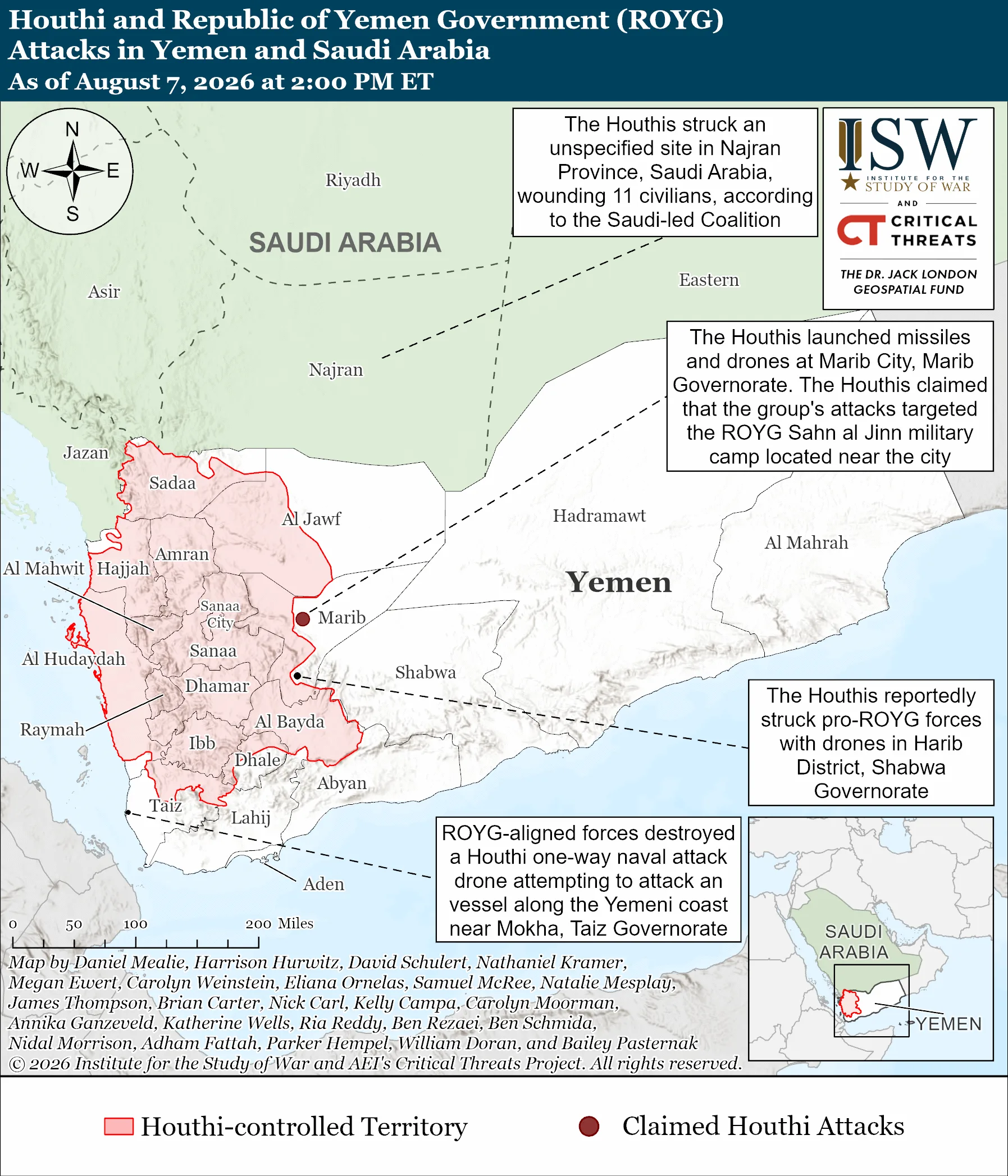
This increased Houthi coordination with the Iraqi militias comes amid continued Houthi attacks against Saudi Arabia and the Saudi-backed Republic of Yemen Government (ROYG) targets.[49] The Houthis attacked an unspecified target in Najran Province in southern Saudi Arabia and wounded 11 civilians in the attack.[50] The Houthis previously struck the Najran Regional Airport with a drone on August 4.[51] The Houthis also struck ROYG-affiliated military positions in Yemen on August 7.[52] The Houthis attacked the Sahn al Jinn military camp using ballistic missiles and drones on August 7, but ROYG-affiliated media and an independent journalist said that at least 20 ballistic missiles and multiple drones struck Marib City and killed at least two people.[53] The military camp is close to the city, and it is unclear if the casualties were civilians or military. The Houthis also reportedly struck ROYG-affiliated units in Shabwa Governorate on August 7.[54]
The Houthis are continuing to attack ships to prevent them from entering Saudi ports as part of their so-called “blockade” of Saudi ports. ROYG state media and an independent Yemeni journalist reported that ROYG-affiliated forces destroyed a Houthi one-way naval attack drone attempting to strike an unspecified vessel near Mokha, Taiz Governorate, on August 7.[55] The Houthis likely sunk an Indian cargo vessel with a one-way naval attack drone on August 4.[56] The Houthis have claimed multiple attacks against Saudi-owned or operated civilian vessels in recent days to compel commercial vessels to comply with the group's blockade of Saudi ports.[57]
Senior Houthi officials stated on August 7 that the Houthis will continue to sustain their naval blockade and strike Saudi and Saudi-affiliated targets until Saudi Arabia accepts Houthi demands, including the lifting of the Saudi “blockade” on shipping and aid to Houthi-controlled Yemeni territory, paying Houthi civil servant salaries, and allowing Iranian flights to land at Houthi airports.[58] Houthi officials, including Houthi military spokesperson Yahya Sarea and Houthi Supreme Political Council President Mahdi Mashaat, stated that the Houthis will continue to enforce their blockade on Saudi Arabia and attack Saudi-affiliated forces that threaten the Houthis until the Houthis achieve their objectives.[59]
Saudi Arabia, Turkey, and Pakistan are expanding defense cooperation in response to shared regional threats, including threats from Iran and Iranian-backed actors.[60] These agreements reflect a broader regional effort to strengthen coordination against common threats, mostly but not exclusively emanating from Iran. Saudi Arabia, Turkey, and Pakistan signed a joint defense agreement on August 7 that includes a collective defense provision for “mutual support only for defense.”[61] Saudi Arabia and Pakistan previously signed a mutual defense agreement in September 2025, and Pakistan later deployed 8,000 troops, a fighter squadron, and an air defense system to Saudi Arabia under that pact.[62] Saudi Arabia also announced a proposed 14-country maritime defense coalition in July 2026 to protect shipping in the Red Sea, Bab el Mandeb, and Gulf of Aden.[63] The new arrangement reflects a broader regional trend in which states are building partnerships and coalitions to protect themselves and their interests from persistent security threats.[64] Syria has also increased coordination with Saudi Arabia and the United Arab Emirates (UAE) amid shared concerns about Iranian and the Axis of Resistance's activity.[65] These arrangements will create long-term strategic challenges for Iran by strengthening coordination among regional states that increasingly view Iranian and Iranian-backed activity as a common threat even if these agreements remain limited in scope.
Lebanese officials will reportedly convene on August 10 to discuss redeveloping pipeline and overland transit projects to export Iraqi oil through Lebanon.[66] These projects are unlikely to create a near-term alternative to export routes through the Strait of Hormuz and are liable to security threats within Syria, however. Lebanese media reported on August 7 that unspecified officials scheduled a near-future meeting to discuss developing a pipeline that would extend from Iraq to Lebanon.[67] Saudi media reported on August 7 that Lebanese Prime Minister Nawaf Salam will convene a Lebanese ministerial meeting on August 10 to discuss establishing an overland tanker truck route from Iraq through Syria to Lebanon's primary oil refinery in Tripoli, on the Mediterranean coast.[68] It is unclear whether Iraqi officials will join Salam’s ministerial meeting, however. Salam previously discussed Iraqi fuel exports to Lebanon and prospects of reviving the long-defunct Kirkuk-Tripoli oil pipeline with Iraqi Prime Minister Ali al Zaydi in Baghdad on July 26.[69] Iraq has discussed several proposals with the United States and regional partners in recent weeks to develop alternative routes to the Strait of Hormuz for Iraqi oil exports, amid Iranian efforts to control traffic in the strait and the Persian Gulf.[70] Salam’s plans to discuss only logistical prerequisites, including repairs to the Tripoli refinery and derelict crossings on the Lebanon-Syria border, in the August 10 meeting indicate that Iraqi-Lebanese energy corridor plans will require significant time, resources, and preparation to successfully implement.[71] These extensive requirements suggest that Iraq and Lebanon will be unable to fully implement an alternative oil export route to the Strait of Hormuz in the near term.
The Islamic State of Iraq and al Sham (ISIS) would likely conduct attacks on overland transportation projects — including both trucks and pipelines — within Syrian territory. ISIS fighters frequently attack tanker trucks and oil infrastructure in northern and eastern Syria as part of the group's “economic war” against the Syrian state and other anti-ISIS actors.[72] ISIS attacked an Iraqi tanker truck in northern Syria's Aleppo Province on June 16, for example.[73] ISIS has abundant incentives to attack Iraqi oil tanker trucks and other oil infrastructure because of the group's long-standing conflict with the Iraqi government and the prospects of both economic gains from stealing oil and damage to Iraq's heavily oil-dependent economy.[74] Iraq and Lebanon must be able to rely on the Syrian government to suppress ISIS activity to ensure the safe and reliable transit of Iraqi oil through Syrian territory. ISIS’s growing militant activity in Syria's major urban centers may limit the Syrian government's ability to ensure safe passage for Iraqi oil convoys to Lebanon, however.[75]
Iran could, in the future, leverage members of the Axis of Resistance, including the Iraqi militias and Hezbollah, to conduct clandestine attacks on Iraqi-Lebanese oil infrastructure projects if Iran or one or more of its partners feels doing so would deter an adversary from taking a specific action. Iran has a strategic interest in maintaining positive relations with the Iraqi government because Iran is heavily economically dependent on Iraq, which could deter direct Iranian attacks on Iraqi oil projects.[76] The IRGC could direct its Axis of Resistance proxies, or front groups under their control, to disrupt future Iraqi-Lebanese oil infrastructure and transportation projects within Syria to express discontent with Iraqi or Lebanese government activities that challenge Iran's interests.
Lebanese and Israeli representatives developed a tentative “shortlist” of countries whose forces could verify Hezbollah disarmament efforts in southern Lebanon during recent negotiations in Rome, according to Reuters on August 7.[77] A Lebanese official told Reuters that the candidate countries could deploy ground forces to southern Lebanon to confirm that the Lebanese Armed Forces (LAF) have successfully disarmed Hezbollah in “pilot zones” agreed on by Israel, Lebanon, and the United States under the June 26 Trilateral Framework Agreement.[78] The official did not disclose which countries Israel and Lebanon have agreed on as potential verifying agents but clarified that the United States will issue final approval for one or more countries on the “shortlist.”[79] Israeli and Lebanese negotiators previously disagreed on mechanisms to monitor LAF activity in the “pilot zones” before the latest round of negotiations in Rome between August 4 and 6.[80] Israeli, Lebanese, and US officials have planned to resume direct negotiations on September 1.[81]
The LAF announced on August 7 that an Israeli drone struck an LAF bulldozer in Mansouri, Tyre District.[82] The LAF said that the attack mildly wounded one Lebanese soldier.[83] The Israel Defense Forces (IDF) has not commented on the incident at the time of this writing.
An unspecified source told Saudi media on August 7 that a Shia Coordination Framework delegation arrived in Tehran to discuss the Iraqi federal government's disarmament campaign.[84] It is unclear which framework members comprise the delegation, but the framework includes multiple Iranian-backed parties. The source added to Saudi media that the framework is forming a committee to negotiate disarmament with the Iraqi militias.[85]
https://understandingwar.org/research/middle-east/iran-update-special-report-august-7-2026/
2,345
posted on
08/08/2026 2:45:05 AM PDT
by
AdmSmith
(GCTGATATGTCTATGATTACTCAT)
Ismail Jahangir, spokesperson for Iran's Judiciary, announced that Mohammad Bagher Kharrazi, Secretary-General of Hezbollah Iran, has been criminally charged due to his recent statements against some officials of the Islamic Republic and was summoned today to the Special Court for Clerics. The Judiciary spokesperson said that given Mr. Kharrazi’s status as a cleric, the examination of his charges falls under the jurisdiction of the Special Court for Clerics. He added, “The charges will be announced after they are formally communicated to him, but if we look at it from a legal perspective, he could face multiple security-related charges.”
Kharrazi recently claimed that in the event of Masoud Pezeshkian’s resignation again, Mojtaba Khamenei, leader of the Islamic Republic, would accept it. He also stated that Mohammad Bagher Zolghadr would be removed from the position of Secretary of the Supreme National Security Council, with Mohsen Rezaee taking his place, and that Abbas Araghchi, the Foreign Minister, has been informed that he will no longer be allowed to intervene in negotiations.
The Office of the President of Iran has described his statements about Masoud Pezeshkian’s resignation as “utter nonsense and pure fabrication,” and the Office of the Leader of the Islamic Republic has also denied the quote attributed to Mojtaba Khamenei. Nevertheless, after this denial, Mohammad Bagher Kharrazi did not fully back down from his claim. His office stated in a communiqué, “Out of respect for the martyred leader and also the Supreme Leader,” it “accepts in fact” the denial from the Leader's office—an expression from seminary terminology that here means it considers it valid at the time of issuance and under the current circumstances.
https://x.com/bbcpersian/status/2086032706375135390
Who is Mohammad Baqer Kharrazi? The “trouble-making insider” that did not stop with Khamenei’s denials

On the margins of the power structure in the Islamic Republic, there is always a trace of “troublesome insiders” who do not have official status but are so close to the circles of power that their words cannot be ignored.
Family ties, clerical attire, or affiliation with an even lesser-known organization allow them to report behind the scenes decisions, accuse or threaten government officials, and make statements that provoke reactions and denials from the highest levels of power, but they themselves remain on the safe fringes of power and come back with a new claim after a while.
He recently claimed that Iranian President Massoud Pezeshkian had resigned or threatened to step down “27 or 28 times” and said that Supreme Leader Mojtaba Khamenei had written in response that he would agree to it if the president resigned. Mr. Kharrazi claimed that Mohammad Baqer Zolghadr was supposed to be removed from the post of secretary of the Supreme National Security Council and that Mohsen Rezaei would replace him. He also claimed that Foreign Minister Abbas Araghchi had been told that he was no longer allowed to interfere in the negotiations.
After the revolution, Mohammad Baqer Kharrazi completed his high school education and entered the seminary of Qom. According to his biography, he learned jurisprudence and principles from his father and a number of other seminary teachers, attended the foreign lessons of Hossein Vahid Khurasani and his father, studied philosophy with Muhammad Taqi Mesbah Yazdi and Abdollah Javadi Amoli, and learned mysticism from Hasan Hassanzadeh Amoli.
Mohammad Baqer Kharrazi himself has never held a high position in the government, but his family members have been present in various sectors, from the seminary and the diplomatic apparatus to the Supreme Leader's house. This background has caused his words, even when he does not provide any evidence, to be reflected in the margins more than the statements of a cleric or political activist.
The Kharrazi family's bond with the Khamenei family was formed through Susan Kharrazi, Mohammad Baqer’s sister. She is married to Massoud Khamenei, the third son of Ali Khamenei and the younger brother of the new Supreme Leader of the Islamic Republic, Mojtaba Khamenei.
In other words, Mohammad Baqer Kharrazi is Massoud Khamenei’s brother-in-law, who has rarely appeared in public and has reportedly been in charge of the Office for the Preservation and Publication of his father's works.
The scope of these ties is not limited to the Khamenei family. One of Sadegh Kharrazi’s sons is married to the daughter of Mohammad Reza Khatami and Zahra Eshraghi, a bond that connects the Kharrazi family to Mohammad Khatami’s family on the one hand and to the descendants of Ruhollah Khomeini on the other.
These family connections partly explain why Mohammad Baqer Kharrazi’s claims about behind-the-scenes events are gaining traction in the Iranian government. He recently claimed to have been friends with Mojtaba Khamenei for nearly 40 years and participated in private meetings with him.
https://www.bbc.com/persian/articles/cn0n97ek65yo
2,346
posted on
08/08/2026 4:09:28 AM PDT
by
AdmSmith
(GCTGATATGTCTATGATTACTCAT)
“Kill the naked women (those who don't wear hijab)!” Mohammad Bagher Khazali, secretary-general of Hezbollah Iran, declares: “I issue a fatwa: kill the naked [women]. If the government intervenes, strike them too. This government is satanic and under America's control.”
This comes amid attempts by some Western-facing Islamic Republic propaganda outlets and accounts to portray mandatory hijab enforcement as a thing of the past. The rhetoric coming from figures inside the system tells a very different story.
https://x.com/TheIranWatcher/status/2085802401236177017
1 min video
2,347
posted on
08/08/2026 4:36:59 AM PDT
by
AdmSmith
(GCTGATATGTCTATGATTACTCAT)
Elements of Iraq's Popular Mobilization Forces (PMF) are openly threatening to seize the Kaaba in Saudi Arabia, Islam's holiest site. Saudi Arabia now appears to be facing the prospect of a two-front confrontation with Iran-aligned forces: the Houthis in Yemen to the south, and PMF factions and other militias in Iraq to the north. For the Islamic Republic, Saudi Arabia is not only a geopolitical rival but also the custodian of Mecca and Medina. The road to Jerusalem, it appears, first runs through Mecca.
https://x.com/TheIranWatcher/status/2085764239986200734
20 s video
But this is just office chair propaganda—just look at those new, clean uniforms.
2,348
posted on
08/08/2026 4:39:22 AM PDT
by
AdmSmith
(GCTGATATGTCTATGATTACTCAT)
2,349
posted on
08/08/2026 6:58:52 AM PDT
by
AdmSmith
(GCTGATATGTCTATGATTACTCAT)
Iran Update Special Report August 8, 2026
Iran is trying to secure additional US concessions before “reopening” the Strait of Hormuz while using both messaging and force to signal its continued intent to control maritime traffic through the strait. Iranian Foreign Affairs Minister Abbas Araghchi stated on August 8 that Iran and Oman are close to an agreement on a temporary transit route through the strait but emphasized that “reopening” the strait remains “subject to other conditions.”[1] Iranian Supreme National Security Council (SNSC) Secretary Mohammad Bagher Zolghadr separately conditioned the strait's “reopening” on six demands for the United States, including lifting the naval blockade and sanctions, withdrawing military forces from around Iran, paying war reparations, releasing frozen Iranian assets, and ceasing attacks on Iran's regional allies.[2] The SNSC is Iran's highest national security and foreign policy decision-making body.[3] The Wall Street Journal similarly reported on August 7 that the Islamic Revolutionary Guards Corps (IRGC) has pressured Iranian negotiators to demand an end to the blockade, oil sanctions relief, and other concessions.[4] These demands suggest that hardline elements within the regime, including IRGC Commander Major General Ahmad Vahidi and his inner circle, are shaping Iran's negotiating position. CTP-ISW continues to assess that this faction dominates Iranian decision-making and seeks to secure the benefits of an agreement without relinquishing Iran's leverage over the strait.[5]
Iran has simultaneously continued to use force to coerce actors to accept Iranian control over the strait. The Emirati Foreign Affairs Ministry reported on August 8 that an Iranian missile struck an oil tanker affiliated with the United Arab Emirates (UAE)’s state oil company in the strait but caused no casualties.[6] Iran's repeated attacks on commercial shipping in the strait demonstrate that Iran continues to use force to try to establish control over the strait amid ongoing negotiations.
The US naval blockade is imposing high costs on Iran's oil exports and broader economy, but this pressure has not yet caused Iranian decisionmakers to soften their position on the strait. The Financial Times, citing shipping and satellite data providers, reported on August 7 that Iranian tankers have not loaded any crude oil at Kharg Island for at least a week.[7] The blockade has also prevented tankers from returning to Iran after unloading in Asia, which will likely limit Iran's oil storage capacity and may force Iran to curb crude production.[8] The Financial Times added that Iran's oil storage levels have not increased recently, which may suggest Iran has already reduced its crude production as its ability to export or store additional oil becomes constrained.[9] Iran previously repurposed older tankers and empty vessels for temporary offshore oil storage to alleviate some of the mounting pressure on onshore facilities during the US naval blockade from April to mid-June 2026.[10] Iranian President Masoud Pezeshkian acknowledged on August 8 that the blockade has also blocked Iran's previous import routes and has forced Iran to use more difficult and costly alternatives.[11] Increased economic pressure may strengthen arguments within the regime for reaching an agreement, but Iran's current maximalist position on the strait suggests that economic costs have not yet given pro-negotiation officials sufficient leverage to secure broader concessions from the dominating faction within the regime.[12]
https://understandingwar.org/research/middle-east/iran-update-special-report-august-8-2026/
2,350
posted on
08/09/2026 4:42:21 AM PDT
by
AdmSmith
(GCTGATATGTCTATGATTACTCAT)
Iraqi forces have busted an Iran-linked militia cell that was using Iraq as a launchpad for drone attacks against neighboring countries.
The three-man cell was dismantled in Babil, where Iraqi authorities seized advanced drones and related equipment before they could be deployed for operations outside the country. The network had direct links to Iranian figures involved in drone operations.
This is how the Islamic Republic projects power while maintaining plausible deniability: use Iraqi territory, local militias and covert cells to launch attacks, then distance itself from the consequences. Iraq is being used as a battlefield and forward operating base for the Islamic Republic's regional proxy warfare against countries like Saudi Arabia.

https://x.com/TheIranWatcher/status/2086250157968904358
2,351
posted on
08/09/2026 4:45:34 AM PDT
by
AdmSmith
(GCTGATATGTCTATGATTACTCAT)
Iran Update Special Report, August 9, 2026
Iranian Supreme Leader Mojtaba Khamenei appointed his former senior military adviser, Major General Mohsen Rezaei, as the new Supreme National Security Council (SNSC) secretary on August 9.[1] The SNSC is Iran's highest national security and foreign policy decision-making body.[2] Mojtaba appointed previous SNSC Secretary Mohammad Bagher Zolghadr as the supreme leader's political adviser shortly after, which is effectively a demotion.[3] Rezaei is a long-term senior regime insider who has held multiple senior positions in the regime, including Islamic Revolutionary Guard Corps (IRGC) commander and Expediency Discernment Council secretary.[4] Rezaei is a hardliner likely aligned with the anti-concessions faction, which appears willing to negotiate with the United States to secure Iran's maximalist aims, including control of the Strait of Hormuz and US troop withdrawal from the region, but is unwilling to present any Iranian concessions.[5] Rezaei told regime media on August 3 that Iran should not abandon its control over the strait and that Iran's drone and missile attacks on US regional bases have compelled US commanders, forces, and equipment further out of the region, which suggests that he subscribes to the belief that Iranian military action has accomplished key Iranian objectives and that trading Iran's accomplishments as concessions is therefore unwise.[6]
The Iranian regime has continued to threaten regional states against assisting US efforts to undermine Iran's control of the Strait of Hormuz while simultaneously refusing to negotiate with the United States. Iranian Parliament Deputy Speaker Hamid Babai stated on August 9 that Iran will attack “any country that wants to assist the United States” in its efforts to restore freedom of navigation in the strait.[7] Iran and its partners in the region have repeatedly attacked regional states to deter them from assisting US efforts in the strait.[8] Iranian Foreign Affairs Minister Abbas Araghchi reiterated on August 9 that Iran will not engage in talks with the United States while the United States is in violation of the Memorandum of Understanding signed in June and that talks between Iran and Oman are in the “final stages” but will not reopen the strait.[9]
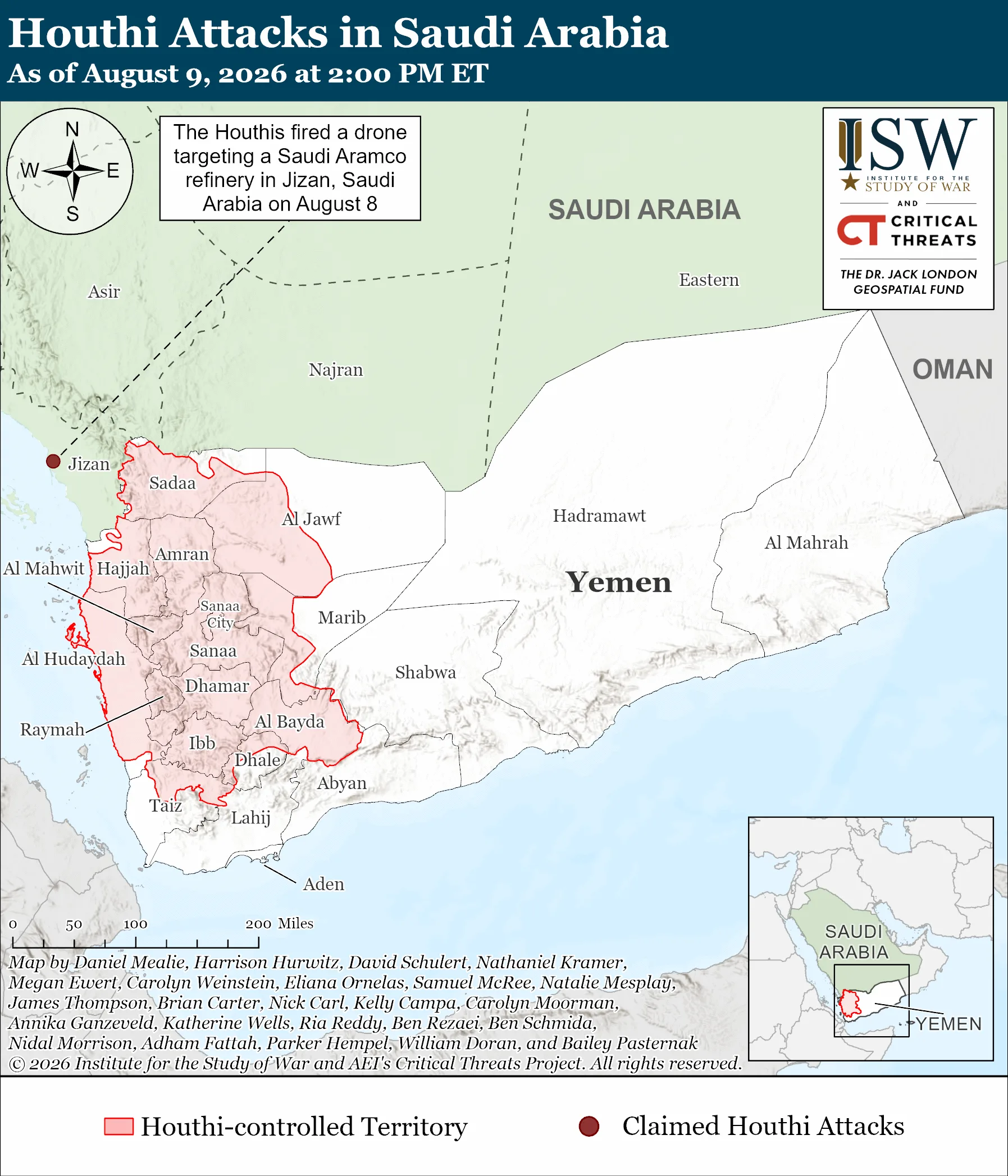
The Houthis conducted a drone attack that struck a Saudi Aramco refinery in Jizan, Saudi Arabia, on August 8.[10] The Saudi Energy Ministry confirmed on August 8 that firefighters extinguished a fire at an Aramco refinery facility in Jizan.[11] Houthi military spokesperson Yahya Sarea claimed on August 9 that the Houthis targeted the Aramco refinery in Jizan with a drone.[12] The Houthi attack comes after Saudi Arabia signed a defense pact with Turkey and Pakistan on August 7 in response to shared regional threats, including threats from Iran and Iranian partners like the Houthis.[13] Senior Houthi officials have said they will sustain the naval blockade and attacks on Saudi and Saudi-affiliated targets until Saudi Arabia lifts its “blockade” on shipping and aid to Houthi-controlled Yemen.[14]
https://understandingwar.org/research/middle-east/iran-update-special-report-august-9-2026/
2,352
posted on
08/09/2026 11:47:08 PM PDT
by
AdmSmith
(GCTGATATGTCTATGATTACTCAT)
NAIROBI, Aug. 3 — The head of the U.S. military's Africa Command (AFRICOM) said the Al-Shabaab group in Somalia remains one of Al-Qaeda’s wealthiest and most active affiliates, warning that part of the militant group's revenue is sent to the broader extremist network. General Dagvin Anderson said regional cooperation involving Kenya, Somalia, Ethiopia, Djibouti and other East African countries was essential to countering the Islamist insurgency, citing Al-Shabaab's close ties to Al-Qaeda.
“Al-Shabaab is one of Al-Qaeda’s most active and best-funded affiliates, and we are concerned that a portion of the revenue it generates flows back to the wider Al-Qaeda network,” Anderson said in an interview with Kenya's Citizen
TV.
https://www.garoweonline.com/en/news/somalia/africom-says-al-shabaab-funnels-part-of-its-revenue-to-al-qaeda-network
2,353
posted on
08/09/2026 11:58:49 PM PDT
by
AdmSmith
(GCTGATATGTCTATGATTACTCAT)
Danny Citrinowicz: Mohsen Rezaei, a former IRGC commander and close Khamenei ally, was named secretary of Iran's Supreme National Security Council My interview ynet regarding this development:
A. The Supreme National Security Council of Iran has lost some of its luster. There is an attempt to revive it, based on a clear understanding that this is an important body that balances the system and helps the supreme leader make the right decisions B.There is probably dissatisfaction with the way Zolghadr functioned, because he failed to establish a body capable of helping the leadrr. Of course, there is a question mark here because we do not really know, but there is no doubt that the system is taking shape.
C.It may be that Zolghadr did not see himself as aligned with the current positions of the leadership itself, and that is why the change was made. Will this alter Iran's positions regarding negotiations with the United States? I doubt it. Could it strengthen the Supreme National Security Council? That is possible D. Rezaei’s background in the Revolutionary Guards is expected to preserve the strong connection between the IRGC and the council. He noted that Rezaei had also served as an adviser to Ali Khamenei and had, in his words, in a sense mentored Mojtaba
E.Would not exaggerate and say that the system is out of control. It is under control, and we can see that they are managing to establish a consensus regarding their policy on the Strait of Hormuz. F. Zolghadr will now serve as an adviser to Mojtaba Khamenei in order to keep him close, a method also employed by his father, Ali Khamenei.
Ultimately, these developments need to be kept in perspective. Iran's political system is clearly undergoing a period of internal adjustment, and the resulting shifts may well be generating tensions within the leadership. Some of these moves also appear designed to weaken particular figures and competing centers of influence likr Ghalibaf. The controversy surrounding Pezeshkian’s possible resignation further illustrates the challenges of governing Iran in the aftermath of Khamenei’s elimination and amid an ongoing military campaign. These pressures may be complicating the decision-making process in Tehran and creating greater uncertainty at the top.
But the broader picture remains clear: whatever internal maneuvering is taking place, the system itself remains deeply ideological, rigid, and fundamentally uncompromising.
https://x.com/citrinowicz/status/2086695655783776709
2,354
posted on
08/10/2026 11:53:06 AM PDT
by
AdmSmith
(GCTGATATGTCTATGATTACTCAT)
To: AdmSmith; nuconvert; BeauBo; blitz128; PIF; SpeedyInTexas; USA-FRANCE; BroJoeK; Jonty30; ...
An Iraq militia group’s threat to seize the Kaaba, the most holy site in Islam, perfectly illustrates the complicated mess that is the Middle East. They are going through the shakedown Europe went through centuries ago after Henry VIII’s lust sparked the Catholic/Protestant division. Thus resulting in more than a hundred years of religious wars.
Roughly 7 to 17 million people are estimated by historians to have died during the European wars of religion during the 16th and 17th centuries. Deaths were often from direct combat or massacres, and then the associated famines or diseases. I wonder how many people, not in Ukraine or Russia, will die in the next year because both those countries indicate about half their normal harvest is being destroyed by warfare. I wonder how long it will take for the many affected c countries in the UN to wake up and start protesting vigorously. Are there additional sanctions that could be issued against Russia since Russia could reduce the problem by immediately going home?
Like Christianity, Islam has two major main branches, the Sunni and the Shia. Although some issues were fought out after Mohammed’s death, the incredible oil wealth situation has provided strong motives for disagreement today. The Kaaba in Saudi Arabia is the focus of the great annual Hajj each faithful Muslim is supposed to attend before he dies. This week long event falls on a different day or even month each year. Sometimes it falls in seasons with terribly hot weather, a real trial to many elderly trying to complete their Hajj before they die.
Around a decade ago, a terrible tragedy occurred one roasting Hajj month. This celebration is supposed to be a leveling of class differences among all Muslims. Nevertheless, a crucial path was blocked so certain MORE important Muslims could have an easier time performing the universal rituals. A panic began among the waiting throngs in the blistering heat. This resulted in death to an estimated 4,000 visitors in addition to many dead Saudis. Clerics from many Muslim countries died, such as close to 100 from Nigeria. But the “winners” in this deadly game of unequal rights were the Iranians. They lost about 400 clerics to this crushing stampede. Needless to say they were outraged. They are no doubt very happy to lob bombs on Saudi Arabia, or provide them to the Houthis.
Since many of the ME countries have populations following both sects, needless to say, there is still bitterness and concern over the question of who controls the most important religious site. Some are majority Sunni, or majority Shia, but others are more blended. It could be many years before these differences are reconciled and sorted out by these countries. Even Catholics, Protestants, and Jews have not completely figured it out. Hopefully it will not take Muslims over 100 more years of active conflict to settle their differences.
2,355
posted on
08/10/2026 3:13:06 PM PDT
by
gleeaikin
(Question Authority: report facts and post their 'links" in your messages.I)
To: gleeaikin; nuconvert
Iran Update Special Report, August 10, 2026
The Iranian armed forces are undergoing an extensive reorganization that reflects lessons that the regime learned from the June 2025 and Spring 2026 wars. Iranian Supreme Leader Mojtaba Khamenei instructed Armed Forces General Staff (AFGS) Chief Major General Ali Abdollahi Aliabadi on August 10 to “complete the process” of merging the AFGS and the Khatam ol Anbia Central Headquarters (KOACH).[1] The AFGS is responsible for developing strategic guidance and military policy while the KOACH is responsible for joint and wartime operations.[2] The two organizations previously operated as a single institution, but former Supreme Leader Ali Khamenei separated them in 2016.[3] ISW-CTP has reported indicators over the past year that suggested that the regime was considering merging the AFGS and KOACH. ISW-CTP reported in December 2025 that Khamenei was considering merging the AFGS and KOACH, citing unverified social media reports.[4] ISW-CTP also assessed on June 23 that Abdollahi may have been serving as the AFGS deputy chief and KOACH commander simultaneously, given that AFGS-affiliated media had begun referring to Abdollahi as the AFGS deputy chief.[5]
The regime likely calculates that merging the AFGS and KOACH will help streamline coordination between the Artesh and Islamic Revolutionary Guards Corps (IRGC), reduce institutional redundancies, and enable military leaders to make wartime decisions more quickly and effectively. The United States and Israel successfully conducted decapitation campaigns that targeted senior Iranian leaders during the June 2025 and Spring 2026 wars, which likely degraded Iranian forces’ ability to coordinate and respond effectively.[6] A New York Times report from late March noted that US-Israeli combined force strikes against Iranian commanders had fractured the regime and complicated its ability to coordinate retaliatory strikes, for example.[7] The regime made initial efforts to improve coordination after the June 2025 War by forming the Defense Council in August 2025 to streamline wartime decision-making.[8]
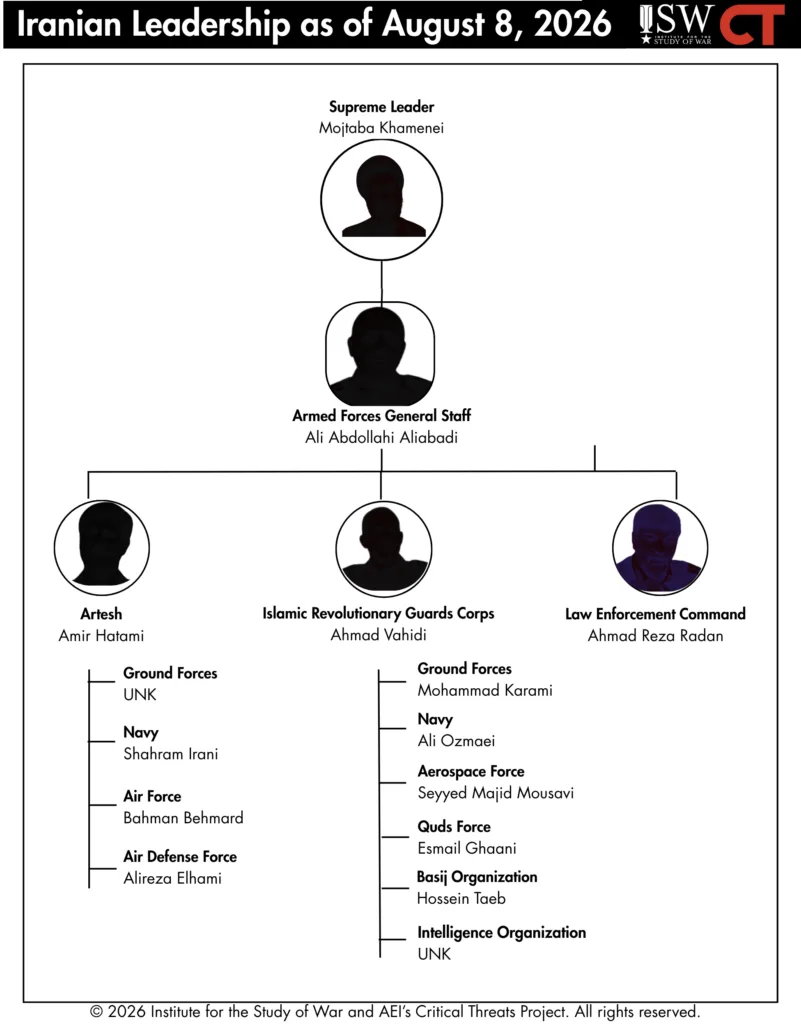
Iranian Supreme Leader Mojtaba Khamenei appointed several Iranian officials to senior military positions on August 10.[9] These appointments largely formalize the structure of the armed forces that has existed for several months and consolidate both Mojtaba and his inner circle's authority.
Islamic Revolutionary Guards Corps (IRGC) Commander Major General Ahmad Vahidi has de facto led the IRGC since US-Israeli combined force strikes killed his predecessor, Major General Mohammad Pakpour, on February 28.[10] ISW-CTP has assessed since March 2026 that Vahidi and his inner circle are playing an outsized role in regime decision-making.[11] Vahidi has played a significant behind-the-scenes role in US-Iran negotiations and supported using force against the United States and Israel on multiple occasions to achieve Iranian objectives. Vahidi reportedly advocated for striking Israel in June, two months after the United States and Iran had agreed to a ceasefire, in order to condition a US-Iran deal on the cessation of Israeli operations against Hezbollah, for example.[12] Vahidi has held multiple senior roles in the regime, such as IRGC Quds Force commander, defense and armed forces logistics minister, interior minister, AFGS deputy chief, and IRGC deputy commander.[13] The United States sanctioned Vahidi in October 2022 for his role in directing the Law Enforcement Command (LEC), which nominally operates under the Interior Ministry, during the 2022-2023 Mahsa Amini protests.[14] Vahidi is also implicated in the 1994 AMIA bombing in Argentina, which killed 85 people.[15] He remains the subject of an Interpol Red Notice.[16]
IRGC Deputy Commander Major General Mostafa Izadi served in senior IRGC command positions during the Iran-Iraq War.[17] Izadi subsequently served as the IRGC Ground Forces commander from 1989 to 1992 and has held multiple senior roles in the AFGS.[18] Izadi has most recently served as the head of the KOACH Cyber and Emerging Threats Headquarters since 2017, where he focused on “addressing modern warfare challenges.”[19] Izadi is notably one of only nine Iranian commanders who hold the rank of major general.[20]
Basij Commander Hossein Taeb helped Mojtaba engineer the 2005 presidential election in favor of hardline candidate Mahmoud Ahmadinejad.[21] Taeb later led the Basij’s suppression of the 2009 Green Movement, which broke out in response to Ahmadinejad's rigged reelection as president.[22] The United States sanctioned Taeb in 2010 for his involvement in suppressing the 2009 protests.[23] Taeb subsequently served as the head of the IRGC Intelligence Organization from 2009 to 2022 and then served as an adviser to the IRGC commander.[24] Former Supreme Leader Ali Khamenei dismissed Taeb in 2022 for incompetence.[25] Taeb’s appointment as Basij commander therefore reflects Taeb’s deep personal ties to Mojtaba. Taeb has known Mojtaba since the Iran-Iraq War, when he and Mojtaba served together in the Habib Ibn Mazahir Battalion under the IRGC 27th Mohammad Rasoul Ollah Division.[26]
AFGS Chief Major General Ali Abdollahi Aliabadi has commanded the AFGS since March 2026.[27] Aliabadi replaced Major General Abdol Rahim Mousavi, who was killed during the Spring 2026 War.[28] Aliabadi fought in the Iran-Iraq War and later served as the IRGC Air Force deputy commander from 1997 to 2001 under then-IRGC Air Force Commander Mohammad Bagher Ghalibaf.[29] The IRGC Air Force was later renamed the IRGC Aerospace Force in 2009.[30] Aliabadi also served as the LEC deputy commander under Ghalibaf in the early 2000s, governor of Gilan and Semnan provinces from 2005 to 2009, and deputy interior minister for security and law enforcement from 2009 to 2014.[31] Aliabadi’s LEC and Interior Ministry positions highlight his experience in Iran's internal security apparatus. Aliabadi served as the AFGS coordination deputy–the third most senior position in the AFGS–for nine years prior to becoming the KOACH commander in July 2025.[32] It is therefore not surprising that Mojtaba appointed Aliabadi to head this institution. Anti-regime media reported in April that President Masoud Pezeshkian had criticized both Vahidi and Aliabadi for “unilaterally” escalating strikes against Gulf states and steering Iran into “a huge catastrophe,” highlighting the central role Aliabadi has played in recent months.[33]
AFGS Deputy Chief Brigadier General Kiomars Heydari served under Aliabadi as the KOACH deputy commander.[34] Heydari began his military career as a Basij volunteer during the Iran-Iraq War.[35] Heydari has extensive experience in the Artesh Ground Forces, initially serving in the 81st Armored Division in Kermanshah and later serving as the Southwestern Regional Headquarters commander.[36] Heydari was appointed as the Artesh Ground Forces commander in 2016 and warned in November 2022 at the height of the Mahsa Amini Protest Movement that protesters would “no longer have a place” in Iran if then-Supreme Leader Ali Khamenei ordered a more brutal crackdown on them.[37] Heydari’s comment confirmed the Artesh Ground Forces’ role in protest suppression, a role that has historically been assumed primarily by the LEC, Basij, and IRGC Ground Forces.
IRGC Navy Commander Rear Admiral Ali Ozmaei previously served as deputy commander of the IRGC’s First and Fifth Naval Regions.[38] Ozmaei replaced Rear Admiral Alireza Tangsiri on July 4.[39]
These appointments follow Mojtaba’s appointment of his former senior military adviser, Major General Mohsen Rezaei, as the new Supreme National Security Council (SNSC) secretary on August 9. Rezaei replaced Mohammad Bagher Zolghadr, whom Mojtaba appointed as a political adviser.[40] Mojtaba may have conducted the recent flurry of appointments to strengthen his hold over the SNSC and other major organizations.[41] ISW-CTP cannot independently confirm that Mojtaba actually made the recent appointments, however. Rezaei and Zolghadr are ideologically aligned and served together in the IRGC, which suggests that the reshuffling was not done to change the policy posture of the SNSC.[42] Mojtaba’s appointments reinforce the regime's current maximalist and hardline positions, including absolute Iranian control of the Strait of Hormuz, the removal of US troops from the region, and the development of Iran's nuclear program, among others. ISW-CTP assessed on March 8, when Mojtaba became supreme leader, that he would likely pursue hardline domestic and foreign policies similar to those of his father.[43]
The recent appointments underscore that the Iranian regime is reconsolidating the upper echelons of its leadership structure after the US-Israeli decapitation campaigns. This new cadre of Iranian leadership will come with its own prerogatives and desires to shape Iranian decision-making. It is unclear at this time how and to what degree these figures will be able to do so.
Republic of Yemen Government (ROYG) forces and the Houthis exchanged fire across multiple Yemeni governorates between August 7 and 10.[44] ROYG Armed Forces Spokesperson Colonel Majed Nuzaili announced on August 8 that unspecified ROYG units targeted Houthi positions on several fronts in retaliation for Houthi attacks on ROYG military camps and civilian areas in Marib and Hadramawt governorates on August 6 and 7.[45] The ROYG-affiliated, Saudi-backed National Resistance Forces said it shelled Houthi command and control centers and positions in southern Hudaydah Governorate on August 8 in response to Houthi attacks in Marib and Hadramawt Governorates.[46] The Houthis responded to these attacks by conducting a drone and missile attack targeting Saudi “mobilization” and weapons depots at the ROYG-controlled Mocha Port in Taiz Governorate on August 9, which killed four ROYG soldiers and three civilians.[47] ROYG forces also conducted several drone attacks on Houthi positions and vehicles in Marib Governorate on August 10 following the Houthi attack on Mocha Port.[48] The extent to which this exchange of fire marks a significant escalation is unclear. Houthi and ROYG forces have fought at low levels since 2023, but the recent fighting follows reports that Saudi Arabia is preparing for a naval and possible land offensive to end the Houthi “chokehold” on Saudi Red Sea oil exports.[49] The Houthis have imposed a blockade on Saudi Arabia since July 20, which has reduced Saudi Arabia's ability to export oil and other goods.[50]
The Iraqi federal government appears to be taking limited steps to prevent further Iranian-backed Iraqi militia attacks against Saudi Arabia and other regional states in order to avoid further strikes on Iraq. Iraqi officials who met with a Saudi intelligence delegation on August 8 pledged to prevent the use of Iraqi territory for attacks against Saudi Arabia and asked for information to help prevent future attacks, according to local sources speaking to Iraqi media on August 8.[51] The Saudi delegation said that Saudi Arabia does not want escalation but will not hesitate to act against militia threats if the Iraqi government fails to do so.[52] US and Saudi forces struck several Iraqi militia positions on July 28 in response to Iraqi militia attacks on Saudi energy infrastructure and US interests in Iraq and the region.[53] Iraqi sources separately told Qatari media on August 10 that the Iraqi federal government formed the Badia Operations Command to enhance coordination between Iraqi forces deployed to the Muthanna desert near the Iraqi borders with Saudi Arabia and Kuwait.[54] The sources stated that the Iraqi federal government formed the command to prevent militias from launching attacks from this area, which they did in March and April.[55] The Iranian-backed Popular Mobilization Forces (PMF) Jazeera and Badia Operations Command, which operates in the area, is affiliated with Kataib Hezbollah.[56] The PMF is a state security service that includes multiple Iranian-backed Iraqi militias, such as Kataib Hezbollah, that answer to Iran instead of the Iraqi prime minister.[57] Iraqi federal government Spokesperson Haider al Aboudi also announced on August 8 that Iraqi authorities dismantled an armed network, arrested its members, and seized drones and other equipment.[58] Unspecified sources told Saudi media on August 9 that the network planned to conduct attacks outside Iraq and maintained contact with Iranian officials responsible for managing drone attacks (read more on Iranian activities in Iraq below).[59] Saudi media added that the network included three militia members in Babil Province.[60]
The Iraqi Interior Ministry announced on August 10 that it closed 71 “fake” PMF offices across Iraq as part of the government's disarmament efforts.[61] The Popular Mobilization Commission (PMC), which oversees PMF training, administration, and planning, denied that the offices were affiliated with the PMF and said that the PMC’s General Directorate of Security and Discipline closed the offices as part of the state's efforts to register weapons.[62] Likely Kataib Hezbollah member Abu Zainab al Lami heads the PMC’s General Directorate of Security and Discipline, which oversees the PMF’s internal affairs.[63] The Interior Ministry's efforts to register civilian weapons began in 2023 and differ from the federal government's disarmament campaign, which has mainly focused on disarming Iranian-backed Iraqi militias.[64] The PMC’s claim that it closed the offices as part of the state's efforts to register weapons, instead of the state's efforts to disarm the militias, could be an attempt to distance the PMF and the militias within it from accusations of conducting kinetic activity outside of the state, as is implied in the Interior Ministry's statement.
Iranian-backed Iraqi militias’ transfer of weapons to the Iranian-backed PMF would harm US interests in Iraq by strengthening Iranian influence in the Iraqi security establishment. A Shia Coordination Framework source told Iraqi media on August 9 that Iraqi militias will hand over their weapons to the PMF before the Iraqi federal government's September 30 disarmament deadline, which corresponds with the planned withdrawal of US-led coalition forces from Iraq.[65] The framework source added that the PMF will supervise the inventory and storage of the militia weapons it receives.[66] Some Iraqi government officials have suggested that the militias will avoid disarmament by handing over weapons to the PMF.[67] The PMF contains many Iraqi militias that answer to Iran and is led by Iranian-backed Iraqi actors.[68] Over half of the PMF’s brigades either conducted or supported militia attacks against US and foreign targets in Iraq and the region in March and April.[69] Transferring militia weapons to the PMF would thus harm US interests by transferring weapons to an organization that Iran has heavily infiltrated. Badr Organization head Hadi al Ameri met with several unspecified PMF brigade commanders on August 9, according to Iraqi media.[70] Ameri reportedly discussed distributing militia fighters among PMF brigades to build more integrated formations that are less connected to previous religious and political leadership.[71] The integration of fighters into different PMF units would not reduce Iranian influence in the PMF if the units continued to answer to Iran. Ameri also reportedly discussed including military officers within the PMF’s structure and a new structure for ranks and leadership positions.[72] The 2016 PMF Law is currently the only Iraqi legislation that covers the PMF.[73] Multiple Iraqi administrations, including under former Prime Minister Haider al Abadi, have attempted to regulate the PMF via executive orders but the PMF has only implemented some of the provisions.[74] Iranian-backed actors have attempted since 2025 to pass new legislation to formalize key PMF structures.[75]
It is unclear if Iraqi militias would be willing to hand over their weapons to the PMF. Multiple Iraqi militias, particularly Kataib Hezbollah, Harakat Hezbollah al Nujaba, and Kataib Sayyid al Shuhada, continue to refuse to disarm.[76] Kataib Sayyid al Shuhada leader Abu Alaa al Walai sarcastically offered on August 8 to buy weapons from any militia that sells them.[77] The militias are using a variety of excuses to remain armed and will likely continue to do so.[78] A Kataib Hezbollah-affiliated parliamentarian suggested on August 8 that Iraq would normalize relations with Israel if the PMF disarmed.[79] The militias have consistently circumvented the disarmament process, including by handing over inoperable weapons.[80]
Iranian-backed Iraqi militias may have conducted a drone strike that destroyed shells for US-provided Iraqi tanks and armored vehicles at Camp Taji, north of Baghdad, on August 2, according to security and intelligence sources speaking to Saudi media on August 10.[81] ISW-CTP has not observed further information to corroborate the Saudi report at the time of this writing. Iraqi authorities previously attributed an explosion at Camp Taji to a fire caused by high temperatures at an Iraqi Army 9th Armored Division ammunition depot.[82] Two Iraqi officers told Saudi media on August 10 that thermal footage showed an object approaching from south of the base before the ammunition depot and tank shells exploded.[83] One of the officers said the explosion destroyed all of the 9th Armored Division's unloaded shells and the majority of its tank equipment.[84] A security source said that the attack occurred while 9th Armored Division forces were deployed to secure the Arbaeen Pilgrimage.[85] An intelligence official said that the drone was launched from an unspecified site south of Baghdad.[86] Iranian-backed Iraqi militias control multiple areas south of Baghdad and have previously launched drone attacks from those areas.[87] The official added that the attack indicates that some militias opposed to disarmament are attempting to strip the Iraqi military of military assets that it could use against the militias as part of pre-emptive plans for “friction” with Iraqi authorities.[88] An unspecified political official quoted a militia leader who said the militias are prepared to confront the Iraqi government or the United States if they use force to try to disarm them.[89]
US-funded Arabic-language media reported on August 8 additional details of the IRGC’s role in directing Iraqi militia attacks on Iraqi Kurdistan and neighboring countries.[90] The IRGC reportedly operates small cells of between five and ten Iraqi fighters from the main Iraqi militias who maintain a “lower profile” and “bypass” Iraqi militia leadership, according to unspecified sources.[91] The sources added that the cell members wear civilian clothing with no insignia and launch drones from different areas in Iraq to make their operations harder to track by the Iraqi federal government.[92] The cells have reportedly conducted drone attacks against unspecified targets in Iraqi Kurdistan and neighboring countries.[93] Unspecified actors have launched multiple drones against US targets in Iraqi Kurdistan in recent weeks.[94] Iraqi militias have also launched recent attacks on Gulf countries, such as the July 27 attacks on Saudi oil infrastructure.[95] The sources added that the cells report directly to Haji Hamed, the head of the IRGC’s advisory mission in Iraq, and that the IRGC established the cells over the past several months as Iraqi militias began to hand over weapons to the Iraqi federal government.[96] Iraqi militias Asaib Ahl al Haq and Kataib al Imam Ali both announced their willingness to disarm on July 2.[97] The August 8 report follows a similar June 19 Reuters report that the IRGC formed militia cells to report directly to the IRGC and attack Gulf countries between late April and mid-May.[98] The IRGC may have decided to reactivate or create new cells similar to the ones it used in April and May in reaction to Asaib Ahl al Haq and Kataib al Imam Ali's announcement. Iran may have also maintained the militia cells the entire time. Iraqi government Spokesperson Haider al Aboudi appeared to confirm on August 9 that the PMF is working with foreign advisers, almost certainly from Iran.[99] Recent US-Saudi airstrikes on militia positions killed at least 4 IRGC Quds Force officers.[100]
https://understandingwar.org/research/middle-east/iran-update-special-report-august-10-2026/
2,356
posted on
08/11/2026 12:58:10 AM PDT
by
AdmSmith
(GCTGATATGTCTATGATTACTCAT)
2,357
posted on
08/11/2026 1:03:40 AM PDT
by
AdmSmith
(GCTGATATGTCTATGATTACTCAT)
Why is the appointment of Hossein Taeb considered so significant within the series of military, security, and intelligence appointments carried out by Mojtaba Khamenei today?
Because most of the names appointed by Mojtaba Khamenei were originally holding their positions within state institutions, and therefore their appointments were not so much a transfer from outside the system as they were a consolidation and redistribution of influence. As for Hossein Taeb, his story is different. He is returning to the forefront through a new appointment, after having been removed from the presidency of the Revolutionary Guard’s intelligence apparatus during his father Khamenei’s era. And for this reason, his appointment acquires a special significance, as Mojtaba does not content himself with keeping the system’s men in their positions, but also brings back security figures associated with the previous phase to influential roles, foremost among them Hossein Taeb, who is considered the loyal security and intelligence figure to Mojtaba in the past and present.
https://x.com/MohamadAhwaze/status/2086881351693742150
True, and that indicates that Mojtaba exists.
2,358
posted on
08/11/2026 1:08:06 AM PDT
by
AdmSmith
(GCTGATATGTCTATGATTACTCAT)
The UAE warned for years about the threat posed by the Muslim Brotherhood, while many in the West treated them as an ordinary political movement.
Their infiltration begins with building networks and associations, recruiting young people, exploiting religious rhetoric, and influencing the media, society, and politics. What the UAE warned about yesterday has now become a national security issue in Western capitals.
https://x.com/llSO1ll/status/2086450971383857475
2,359
posted on
08/11/2026 1:17:56 AM PDT
by
AdmSmith
(GCTGATATGTCTATGATTACTCAT)
Many Muslim countries understand the threat of political Islam better than the West does. Egypt banned the Muslim Brotherhood. Saudi Arabia designated it a terrorist group. The UAE lists it and its affiliates as terrorist organizations. Jordan banned it in 2025 after authorities accused Brotherhood members of weapons training and plotting attacks That is not “Islamophobia”. That is Muslim-majority states saying: we know the difference between peaceful Islam and terrorism.
Europe, meanwhile, keeps pretending that making this distinction is bigotry.
And the result is visible.
The UAE has gone so far as to restrict state-funded scholarships for Emirati students going to British universities, citing fears of Islamist radicalization and Muslim Brotherhood influence on UK campuses.
Think about that for a second. A Muslim-majority country is worried that its young people may become more radicalized in Britain than at home. That should be a national scandal in the UK, but the BBC never bothered reporting it.
Mohamed Atta was born and educated in Egypt, but the 9/11 operational cell formed in Hamburg, Germany, around the al-Quds mosque network. Anis Amri left Tunisia and later carried out the Berlin Christmas market attack after moving through Europe and connecting with jihadist networks in Germany. Salman Abedi, the Manchester Arena bomber, was a British-Libyan radicalized inside the UK's Islamist ecosystem.
Roshonara Choudhry, a promising British student, stabbed an MP after consuming al-Qaeda preacher Anwar al-Awlaki’s online lectures in the UK.
This is the uncomfortable pattern: the West did not merely “receive” radicalization from the Middle East. In many cases, it incubated it. European countries produced thousands of ISIS foreign fighters. The UK reported around 900 British nationals who travelled to Syria, with up to 400 returning to continue spreading radicalism in the UK; German authorities tracked about 910 people who left for Syria or Iraq for Islamist reasons.
Meanwhile, while Europe drifts further into anti-Israel politics, several Muslim-majority countries moved in the opposite direction: the UAE, Bahrain, Morocco, and Sudan entered the Abraham Accords framework with Israel. That should tell us something. The problem is not “Islamophobia”. The problem is extremism.
And Europe's failure has been its refusal to distinguish between ordinary Muslims who might want normal lives, and Islamist movements that want power, censorship, intimidation, and eventually violence.
Banning the Muslim Brotherhood is not an attack on Muslims. Deporting Illegal immigrants with known ties to terror organizations is not “Islamophobia”. It is a defense of Muslims, Jews, Christians, secular citizens, dissidents, women, minorities, and democratic states.
The Middle East learned this lesson the hard way. The West is still pretending not to understand it.

https://x.com/destinationXIX/status/2074368061193462102
2,360
posted on
08/11/2026 1:23:10 AM PDT
by
AdmSmith
(GCTGATATGTCTATGATTACTCAT)
Navigation: use the links below to view more comments.
first previous 1-20 ... 2,321-2,340, 2,341-2,360, 2,361-2,380 ... 2,401-2,404 next last
Disclaimer:
Opinions posted on Free Republic are those of the individual
posters and do not necessarily represent the opinion of Free Republic or its
management. All materials posted herein are protected by copyright law and the
exemption for fair use of copyrighted works.
FreeRepublic.com is powered by software copyright 2000-2008 John Robinson