Skip to comments.
Iranian Regime tv Channel One hacked while it was airing Khamenie speech
various
| 10-8-22
Posted on 10/08/2022 1:05:38 PM PDT by nuconvert
Iranian Regime national tv Channel One hacked about an hour ago. During a broadcast of Khamenie speech, a red crosshair appeared over his face and chanting of Women. Life. Freedom. There was writing to the side saying "Rise up. Join us". Also 4 photos at the bottom of the screen of young people killed and additional writing: "The blood of our youth is dropping from your paws".
Also, there was a huge banner in the middle of Tehran highway today that read: We are no longer afraid of you. We will fight.
Also, attempted attack on IRI ambassador in Denmark. Her bodyguard was stabbed. Diplomatic Security intervened before the attacker could stab the ambassador.
TOPICS:
KEYWORDS: basij; deathtothemullahs; denmark; ebrahimrigi; erdogan; iran; iranprotests; iraq; irgc; iri; israel; khameini; khamenei; kurdistan; lebanon; mahsaamini; mullahloversonfr; mullahsmustbekilled; najisharifizindashti; protests; qudsforce; raisi; receptayyiperdogan; shahrammaroufmola; syria; turkey; yemen; zahedi
Navigation: use the links below to view more comments.
first previous 1-20 ... 2,001-2,020, 2,021-2,040, 2,041-2,060 ... 2,461-2,478 next last
To: gleeaikin
Too many factions that believe THEY are running things.
2,021
posted on
05/10/2026 1:19:55 PM PDT
by
rktman
(Destroy America from within? On hold! Enlisted USN 1967 proudly. 🚫💉! 🇮🇱🙏! Winning currently!)
To: rktman; AdmSmith; nuconvert; BeauBo; dennisw; USA-FRANCE
“Too many factions that believe THEY are running things,” and therefore too many factions with which to successfully negotiate any acceptable peace deal.
2,022
posted on
05/10/2026 2:14:05 PM PDT
by
gleeaikin
(Question Authority: report facts and post their links" in your messages.)
Iran Update Special Report, May 10, 2026
US President Donald Trump stated on May 10 that Iran's latest counterproposal is “totally unacceptable.”[1] Iranian regime media reported on May 10 that the regime had sent its counterproposal to the United States via Pakistani mediators.[2] Individuals familiar with Iran's counterproposal told the Wall Street Journal on May 10 that Iran's counterproposal calls for an end to the war, the “gradual opening of the Strait of Hormuz,” and the lifting of the United States’ naval blockade on Iranian ports.[3] The United States and Iran would conduct nuclear negotiations over a 30-day period, according to the counterproposal.[4] The individuals speaking to the Wall Street Journal stated that Iran offered to dilute some of its highly enriched uranium (HEU) stockpile and transfer the rest to a third country, but stipulated that Iran must receive guarantees that it would be able to retrieve its transferred HEU if negotiations fail or the United States exits the agreement.[5] Iran also offered to halt uranium enrichment for an unspecified period shorter than 20 years and refused to dismantle its nuclear facilities.[6] This counterproposal bears similarities to Iran's previous proposals, in which Iran has sought to end the war and address the Strait of Hormuz issue before engaging in nuclear negotiations with the United States.[7] US President Donald Trump has insisted that Iran must hand over its HEU stockpile and permanently suspend uranium enrichment.[8] President Trump posted on Truth Social on May 10 that Iran has been “playing games” with the United States and has been delaying negotiations.[9] Israeli media reported on May 10 that Trump will call Israeli Prime Minister Benjamin Netanyahu today, presumably to discuss Iran's response.[10]
Iran likely conducted attacks against a commercial vessel and some Gulf countries on May 10. These attacks may be intended to sustain high oil prices and thereby impose economic pressure on the United States in order to compel the United States to make concessions in negotiations. United Kingdom Maritime Trade Operations (UKMTO) reported on May 10 that an unspecified projectile struck the SAFESEA NEHA bulk carrier near the coast of Doha, Qatar.[11] The Emirati and Kuwaiti defense ministries separately reported on May 10 that their air defenses intercepted Iranian drones.[12] Iran has not claimed responsibility for these attacks, but the timing of the attacks is notable given that they correspond with Iran sending its counterproposal to the United States. Iran may have calculated that these attacks would sustain high oil prices. CTP-ISW previously assessed that some elements of the Iranian regime may calculate that Iran can impose sufficient economic pressure on the United States, including by keeping global oil prices high, to coerce the United States to make concessions.[13]
Iran is attempting to coerce countries into lifting economic pressure on Iran in order to be able to transit through the Strait of Hormuz. Artesh Spokesperson Brigadier General Mohammad Akraminia warned on May 10 that vessels belonging to countries that have sanctioned Iran will “face problems” if they attempt to pass through the strait.[14] Akraminia’s warning comes after Iran's “Persian Gulf Strait Authority” sent an email on May 6 to shipping companies with vessels in the Persian Gulf stipulating that vessels belonging to countries that have sanctioned Iran will not be allowed to transit through the strait.[15] This stipulation effectively requires countries that have sanctioned Iran to lift sanctions before their vessels can pass through the strait. Iran is also attempting to generate revenue by imposing a toll scheme in the strait. The email from the ”Persian Gulf Strait Authority” also demanded that vessels must pay the body in Iranian rials and gain issuances of guarantees from Iranian banks in order to ensure safe passage through the strait, which would force any country that wishes for its vessels to transit through the strait to violate US sanctions.[16] Iranian Supreme Leader Mojtaba Khamenei likely referred to Iran's toll scheme in a written statement on April 30, in which he emphasized that Iran would reap “economic gains” from its “new management” of the strait.[17]
Iranian media has publicized meetings between Supreme Leader Mojtaba Khamenei and senior Iranian officials in recent days, likely to portray Mojtaba as an active decision-maker in the regime amid reports that Mojtaba has been marginalized. Iranian media reported on May 10 that Khatam ol Anbia Central Headquarters Commander Ali Abdollahi Aliabadi met with Mojtaba to brief him on the status and readiness of Iran's armed forces.[18] Mojtaba reportedly gave Aliabadi orders and “guiding measures” for future Iranian military operations. The Khatam ol Anbia Central Headquarters is responsible for joint and wartime operations. Iranian President Masoud Pezeshkian previously accused Aliabadi and IRGC Commander Major General Ahmad Vahidi of “acting unilaterally” and “driving escalation” during the war.[19] This report comes after Iranian state media reported on May 7 that Pezeshkian had met with Mojtaba for nearly two and a half hours.[20] The publicization of two meetings between Mojtaba and senior Iranian officials within the span of several days may be meant to counter reports that Mojtaba has largely been sidelined by the IRGC and is not playing a central role in regime decision-making.[21]
The Israel Defense Forces (IDF) reportedly established a clandestine military outpost in the Iraqi desert to support its air campaign against Iran, according to unspecified individuals familiar with the matter speaking to the Wall Street Journal on May 9.[22] Israeli and Western media reported that the IDF deployed commando units and search-and-rescue teams to the outpost before the start of the war on February 28 to recover Israeli pilots if Iranian forces shot down Israeli fighter jets.[23] The outpost also reportedly served as a logistical hub for the Israeli Air Force.[24] One source told the Wall Street Journal that the IDF conducted airstrikes targeting members of the Iraqi Security Forces (ISF) to prevent them from approaching the outpost.[25] An Iraqi security source told Saudi media on May 10 that the United States advised Iraqi military personnel not to approach the area where the IDF had established the outpost for “security reasons.”[26] This report comes after Iraqi media reported on March 3 that the ISF had sent troops to investigate local reports that unspecified forces had landed in Anbar Province.[27] The Iraqi Joint Operations Command (JOC) confirmed on March 4 that unspecified forces conducted an airstrike and fired at the responding troops, killing one Iraqi soldier, injuring two others, and damaging two ISF vehicles.[28] The JOC stated on May 10 that the ISF did not find any troops or military equipment during search operations in the Iraqi desert, however.[29]
IRGC Quds Force Commander Brigadier General Esmail Ghaani met with Shia Coordination Framework leaders and unspecified Iranian-backed Iraqi militia commanders to discuss government formation during a visit to Baghdad, according to an informed source speaking to Iraqi media on May 10.[30] The source claimed that the Iranian regime has “reservations” about the Shia Coordination Framework's nomination of Ali al Zaydi as prime minister designate due to US support for Zaydi.[31] Iraqi media reported on May 9 that Zaydi is leading a committee formed by the Shia Coordination Framework to oversee the implementation of “mechanisms” to disarm Iranian-backed Iraqi militias.[32] The committee is reportedly close to finalizing a disarmament plan.[33] US President Donald Trump congratulated Zaydi on his nomination on April 30.[34]
https://understandingwar.org/research/middle-east/iran-update-special-report-may-10-2026/
2,023
posted on
05/10/2026 9:37:11 PM PDT
by
AdmSmith
(GCTGATATGTCTATGATTACTCAT)
2,024
posted on
05/10/2026 11:17:00 PM PDT
by
AdmSmith
(GCTGATATGTCTATGATTACTCAT)
Sal Mercogliano- What’s Going on With Shipping?
11MAY2026
“A Wall of Fire”: Eyewitness View of an Attack in the Strait of Hormuz | Week 10 Recap
It focuses on a raw and harrowing firsthand look at the aftermath of a drone strike on the CMA CGM San Antonio in the Strait of Hormuz. A crew member walks through the devastated Engine Control Room and workshop, showing twisted metal, charred furniture, and heavy steel doors that were completely blown off their hinges by the explosive blast wave. The footage captures the intense reality of the attack, with the narrator pointing out where he and other crew members were sitting when the “wall of fire” swept through the room, miraculously surviving with only minor injuries like singed hair despite the significant physical destruction to the vessel’s interior.
https://www.youtube.com/watch?v=pzlSXBmKylA
2,025
posted on
05/10/2026 11:59:18 PM PDT
by
AdmSmith
(GCTGATATGTCTATGATTACTCAT)
Two months in: What container data tells us about the Hormuz crisis
Of the 53 container vessels initially caught inside when transits became untenable, only nine have successfully exited the Strait. Two of those required a second attempt before making it through. Two MSC vessels were seized by Iranian authorities—the most severe outcome of the crisis. One additional vessel sustained damage after being struck by debris.
That leaves 42 vessels, crews, cargo, and capital in a state of indefinite commercial limbo.
https://www.kpler.com/blog/two-months-in-what-container-data-tells-us-about-the-hormuz-crisis
2,026
posted on
05/11/2026 3:22:36 AM PDT
by
AdmSmith
(GCTGATATGTCTATGATTACTCAT)
To: AdmSmith; BeauBo; dennisw; nuconvert; PIF; blitz128; USA-FRANCE; Jonty30
The 32+ minute video linked in comment # 2025 reports that while under a dozen ships made it through the Strait with their transponders on, a number of other ships running dark probably also made it through in that period. The narrator predicts that Trump’s Operation Freedom regarding shipping is probably going to be ineffective from here on. The boats of the IRGC Navy seem to be operating erratically or unpredictably, which probably indicates poorer management with top IRGC leaders now dead.
2,027
posted on
05/11/2026 12:19:02 PM PDT
by
gleeaikin
(Question Authority: report facts and post their links" in your messages.)
Iran Update Special Report, May 11, 2026
Iranian leaders are trying to dictate the terms for ending the war, which illustrates that the Iranian regime perceives that it has the upper hand in the conflict at this time. Iran's proposed terms would require the United States to give up its leverage over Iran before any negotiations could take place, which would likely make it more challenging to extract nuclear concessions from Iran. Islamic Revolutionary Guards Corps (IRGC) Baghiyatollah Sociocultural Headquarters Commander Major General Mohammad Ali Jafari stated on May 11 that Iran will not enter negotiations with the United States until the United States accepts Iran's terms.[1] Jafari stated that Iran's terms include an end to the war on “all fronts,” the lifting of sanctions, the release of frozen Iranian assets, compensation for war-related damages, and recognition of Iran's sovereignty over the Strait of Hormuz.[2] Jafari is a long-time member of the IRGC and previously served as the IRGC commander between 2007 and 2019.[3] Jafari, along with other IRGC officials such as IRGC Commander Major General Ahmad Vahidi, pushed for Mojtaba Khamenei’s appointment after the death of Ali Khamenei.[4] Jafari has ties to Vahidi dating back to the Iran-Iraq War, and the terms he outlined likely reflect Vahidi’s negotiating position.[5] IRGC-affiliated Tasnim News Agency echoed Jafari’s remarks and emphasized that Iranian demands include an end to the US naval blockade and Iranian “management” of the Strait of Hormuz.[6] These terms would fulfill Iran's war aims while stripping the United States of its leverage in future negotiations.
Iran has not provided any guarantees that it would engage in nuclear negotiations, let alone make nuclear concessions, even if the United States accepted its terms. The Wall Street Journal reported on May 10 that Iran offered to halt enrichment for a period of less than 20 years and dilute or transfer its highly enriched uranium in its recent counterproposal to the United States.[7] Tasnim News Agency rejected the Wall Street Journal report and claimed that the report was “not based on reality,” especially its content related to Iran's nuclear materials.[8] Atomic Energy Organization of Iran head Mohammad Eslami told Iranian Parliamentary National Security and Foreign Policy Commission members on May 11 that nuclear technology and enrichment are not negotiable.[9] Commission members emphasized the need to protect Iran's nuclear facilities, preserve Iran's nuclear achievements, and defend Iran's nuclear rights.[10]
Commercially available maritime data appears to indicate that some vessels may be complying with Iran's new transit regulations in the Strait of Hormuz.[11] Recognition of Iran's “sovereignty” over the strait would fundamentally remake regional and global maritime norms in a manner extremely detrimental to US interests. Commercially available maritime data shows that 21 vessels have transited through the Strait of Hormuz since ISW-CTP’s last data cutoff, including nine vessels that entered the strait and 12 that exited it.[12] Eight of the 21 vessels used the Iranian-approved transit route.[13] IRGC-affiliated Tasnim News Agency also claimed that several vessels used the Iranian-approved route on May 11.[14] Some of the vessels that transited through the strait self-reported their destination as the nationalities of their owners and crews, likely to avoid being attacked by Iranian forces. Some vessels similarly declared the nationalities of their owners and crews while passing through the Red Sea to avoid Houthi attacks during the Houthis’ attack campaign against international shipping between October 2023 and November 2024.[15] The high number of vessels that used the Iranian-approved transit route suggests that these vessels may have complied with Iranian transit regulations. Iran's “Persian Gulf Strait Authority” recently outlined on May 6 a series of stringent conditions that vessels must meet if they wish to safely pass through the strait.[16] These conditions include paying Iran a fee and providing extensive information about the vessel's owner and crew. Iran has also continued to selectively allow only certain ships to transit through the Strait. Bloomberg reported on May 11 that a tanker carrying liquified natural gas (LNG) from Qatar turned away from the strait after approaching an area that Iran claims to control, while IRGC-affiliated media claimed that Iran prevented the vessel from passing through the strait.[17]
Reuters reported on May 7 that the United Arab Emirates (UAE) has taken steps to continue exporting oil through the Strait of Hormuz despite Iranian efforts to “control” the strait.[20] Iran's recent attacks against the UAE may have been intended, in part, to impose a cost on the UAE for violating Iran's regulations in the strait and to demonstrate Iran's “control” over the waterway. Reuters, citing industry sources and shipping data firms, reported that the UAE has taken steps, such as turning off its ships’ automatic identification systems (AIS) and using ship-to-ship transfers, to evade Iranian detection.[21] The Abu Dhabi National Oil Company (ADNOC) used these methods in April 2026 to export at least 6 million barrels of crude oil on four tankers from the UAE, including from Fujairah Port. Iran conducted a drone attack against an unspecified target in the Fujairah Petroleum Industrial Zone on May 4.[22] Iran also attacked an ADNOC tanker with drones as it attempted to pass through the strait on May 4.[23] Iran may have conducted these attacks in response to the UAE ignoring Iranian transit regulations in the strait and to demonstrate Iran's “control” over traffic in the strait.
Iranian Armed Forces General Staff-run media claimed that the Iranian regime has deployed 10,000 first-person view (FPV) drones to the Artesh Ground Forces since the 12-Day War in June 2025.[24] Iranian forces would likely use these drones to try to defend against potential ground operations in Iranian territory. Defa Press claimed on May 10 that the Iranian Defense and Armed Forces Logistics Ministry and Artesh Self-Sufficiency Jihad Organization have supplied the Artesh Ground Forces with 10,000 FPV drones and “related ammunition” in recent months.[25] The outlet added that the Artesh Ground Forces began integrating FPV drones at the brigade level following the 12-Day War in June 2025.[26] The integration of FPV drones at the brigade level suggests that the drones are likely intended to confront potential ground operations.[27] Iran could also use FPV drones in operations against Kurdish and Baloch militants in northwestern and southeastern Iran, respectively.[28]
Iran is likely providing Hezbollah and Iranian-backed Iraqi militias with FPV drone technology. Hezbollah and Iraqi militias have consistently conducted attacks targeting Israeli and US forces and assets using FPV drones during the current conflict.[29] FPV drones, particularly fiber-optic FPV drones, have enabled Hezbollah to conduct successful high-precision attacks on Israeli military targets at a relatively low cost.[30] An Israeli research organization reported on May 11 that most fiber-optic FPV drones cost Hezbollah between $300 and $400 USD per unit, whereas radio-controlled FPV drones cost over $1,000 USD per unit.[31] Fiber-optic FPV drones are also resistant to jamming because they do not emit a transmission signal that electronic warfare systems can disrupt.[32] The Israel Defense Forces (IDF) has also struggled to disrupt Hezbollah's FPV drone capabilities because Hezbollah has decentralized its command-and-control (C2) network for FPV drone operators and dispersed them across various units in southern Lebanon.[33] An Israeli military correspondent reported on May 11 that the IDF has killed less than 10 of Hezbollah's roughly 100 FPV drone operators during the current conflict due to Hezbollah's decentralized C2 network.[34] Hezbollah has demonstrated the capability to use FPV drones in cross-border attacks on sensitive military equipment. The group recently posted video footage of two FPV drone attacks damaging an Israeli Iron Dome missile defense battery near the Israel-Lebanon border on May 7 and 8, for example.[35] IDF sources confirmed on May 11 that a Hezbollah drone struck an Iron Dome battery and announced that the IDF is investigating the incident.[36]
The Defa Press report comes after The Economist reported on May 8 that Russia offered to provide Iran with 5,000 short-range fiber-optic drones, citing Russian intelligence documents likely from the first six weeks of the US-Israel-Iran War.[37] Russia reportedly also offered Iran an unspecified number of longer-range satellite-guided drones equipped with Starlink terminals as well as training for Iranian personnel to operate both systems.[38] One of the diagrams in the Russian intelligence documents depicted Russian-trained Iranian drone operators attacking an amphibious landing force through coordinated drone swarms launched from concealed positions in response to a US operation to reopen the Strait of Hormuz or seize Kharg Island.[39]
Iran is attempting to rebuild its internal security apparatus, likely in part due to concerns about renewed public unrest. The combined force struck multiple Iranian internal security institutions during its six-week campaign in February and March.[40] Iranian President Masoud Pezeshkian stated during a meeting with Iranian Law Enforcement Command (LEC) Commander Brigadier General Ahmad Reza Radan and other LEC commanders on May 11 that his administration will “seriously pursue and provide” the LEC with equipment and resources to rebuild damaged LEC facilities.[41] This meeting comes after anti-regime media reported on April 28 that the Supreme National Security Council (SNSC) convened a meeting chaired by SNSC Secretary Mohammad Bagher Zolghadr—a close ally of IRGC Commander Major General Ahmad Vahidi — to discuss the possible resumption of protests due to worsening economic conditions.[42] It is notable that Pezeshkian met with Radan because Pezeshkian is one of Iran's officials who is most concerned about Iran's struggling economy. Pezeshkian has previously emphasized the importance of financial gains from negotiations, such as sanctions relief and the release of frozen Iranian assets, as necessary for Iran to pay for the estimated $300 billion USD in losses from the war with the United States and Israel.[43]
https://understandingwar.org/research/middle-east/iran-update-special-report-may-11-2026/
2,028
posted on
05/11/2026 9:50:15 PM PDT
by
AdmSmith
(GCTGATATGTCTATGATTACTCAT)
2,029
posted on
05/12/2026 12:31:19 AM PDT
by
AdmSmith
(GCTGATATGTCTATGATTACTCAT)
A clear divide within the GCC on Iran:
Saudi Arabia remains diplomatically engaged with the Islamic Republic, now with 6 calls since the war started. Along with:
Oman: 5 calls & 2 meetings
Qatar: 5 calls
Practically no engagement:
UAE: 1 call (VP-Ghalibaf)
Kuwait: 0
Bahrain: 0
https://x.com/MehranHaghirian/status/2053825459658404206
2,030
posted on
05/12/2026 2:07:57 AM PDT
by
AdmSmith
(GCTGATATGTCTATGATTACTCAT)
To: AdmSmith; nuconvert; BeauBo; blitz128; Jonty30
Woman as military is not unknown among Arab countries. Libya’s Gadaffi had his own Corp of elite women guards. I think Ukraine may have some. A point to consider if sending small arms to Freedom fighters in Iran is that woman have made excellent snipers in some armies. They have more patience than most men and stay awake better when under stress. Some lighter weight sniper rifles might be useful.
AI says: “The Soviet Union famously utilized over 2,000 female snipers during World War II, with others like the Indian National Army (Rani of Jhansi Regiment) employing women in combat roles. While other nations traditionally restricted women from combat, specialized training and recruitment in the Red Army produced famous, highly effective female snipers, such as Lyudmila Pavlichenko with 309 confirmed kills, making her one of the deadliest in history. and Roza Shanina: A highly skilled sniper credited with 59 kills. The Central Women’s Sniper Training School was an academy that produced 1,061 graduates who saw action on the Eastern Front.
In the 1940s the Indian National Army’s Rani of Jhansi Regiment, a volunteer unit, included women in combat roles. In 2023, the U.S. Army had its first active-duty female soldier graduate from the sniper school. Red Army commanders believed women made excellent snipers, noting they were often more patient, focused, and sensitive to delicate tasks than their male counterparts.”
2,031
posted on
05/12/2026 12:28:10 PM PDT
by
gleeaikin
(Question Authority: report facts and post their links" in your messages.)
Iran Update Special Report, May 12, 2026
Iran's consistent pursuit of international recognition of Iranian sovereignty over the Strait of Hormuz reinforces ISW-CTP’s previous assessment that Iran views control of the waterway as its most important tool of deterrence against future US or allied military action, because such recognition would allow it to restrict activity in the strait whenever it wills.[1] Senior Iranian officials have repeatedly signaled that Iran does not intend to relinquish its claims to the Strait of Hormuz, including through statements attributed to Supreme Leader Mojtaba Khamenei and public comments by close advisers.[2] Iran is simultaneously attempting to normalize and formalize its control of the strait through rhetoric and operational measures. IRGC Navy Political Deputy Brigadier General Mohammad Akbarzadeh claimed on May 12 that the strait's “operational area” has expanded from “around islands such as Hormuz and Hengam” and a narrow “20-30 mile corridor into a 200-300 mile crescent stretching from Jask and Sirik to beyond Qeshm Island and the Greater Tunb.”[3] It is unclear what Akbarzadeh means by “operational area” in this context. Akbarzadeh’s omission of other countries’ land and maritime territories in the strait in his statement to Iranian media suggests Iran's intent to define much of the surrounding maritime space as effectively under Iranian management, however. Supreme Leader adviser Mohammad Mokhber more explicitly stated on May 8 that the strait carries strategic value comparable to a nuclear weapon, enabling Iran to influence the global economy “with one decision,” and asserting that Iran “will not lose the strait under any circumstances.”[4] Iran also instituted a new transit regime on May 7 that requires vessels to receive Iranian regulations by email and submit detailed ownership, nationality, and crew information to Iran's ”Persian Gulf Strait Authority” to obtain authorization for passage.[5] IRGC-affiliated media continues to frame routine maritime transit as contingent on Iranian permission, such as on May 12, when IRGC-affiliated media reported that Iranian forces “allowed” a second Qatari tanker to pass through the strait.[6]
Iran has made clear that it will not negotiate without guarantees or credible deterrence against future military attacks, including sovereignty over the Strait of Hormuz. An Al Jazeera journalist, citing a well‑informed source familiar with the negotiations, reported on May 12 that the Iranian negotiating team has been instructed to insist on five preconditions before entering nuclear talks: a complete end to the war on all fronts, the lifting of all sanctions, the release of frozen Iranian assets, compensation for war‑related damages and losses, and formal recognition of Iran's sovereign rights over the Strait of Hormuz.[7] Former IRGC commander and Mojtaba Khamenei confidant Major General Mohammad Ali Jafari publicly articulated these same demands on May 11, signaling alignment between Iran's negotiating strategy and senior IRGC leadership.[8] Sobh‑e No, a newspaper affiliated with Parliament Speaker Mohammad Bagher Ghalibaf, who led Iran‘s negotiating team, separately reported Iran's latest proposal, which provided a similar list of uncompromising positions.[9] The framework reported by Sobh-e No also proposed a monitoring mechanism and a UN Security Council resolution as a guarantee against future US or allied attacks.[10]
Iranian sovereignty and control over the Strait of Hormuz would have severe consequences for global shipping for all countries dependent on maritime trade, but especially the Gulf States. The Economist reported on May 12 that the ongoing conflict has already cut Saudi oil exports by roughly a third and UAE exports by about half, while Bahrain, Qatar, and Kuwait are exporting almost no energy products.[11] The head of Saudi Aramco warned on May 10 that if trade and shipping remain constrained for more than a few weeks, supply disruptions could persist for years, with markets potentially not normalizing until 2027.[12] Iran, if its control of the strait were to be recognized, could impose similar costs on the Gulf States at any time and for any reason, and point to the recognition of its control to legitimize its actions.
The United States has continued to impose economic pressure on Iran through the naval blockade and sanctions. US Central Command (CENTCOM) announced on May 12 that US naval forces have redirected 65 Iranian commercial vessels and disabled four more.[13] US President Trump told CNN on May 12 that he is confident the United States will get Iran's highly enriched uranium despite the lack of progress in negotiations.[14] He added that the United States does not need to rush anything because of the blockade, which the Trump Administration assesses has continued to apply pressure on Iran. The US Treasury Department on May 11 sanctioned three Iranian individuals affiliated with Iran's illicit oil sales to the People's Republic of China (PRC).[15] The Treasury sanctioned IRGC Shahid Purja’fari Oil Headquarters chief Ahmad Mohammadi Zadeh, finance chief Samad Fathi Salami, and commercial chief Mohammadreza Ashrafi Ghehi. The IDF reported that it killed Ghehi in strikes on Tehran on April 5.[16]
Some European countries have indicated their willingness to assist the US mission to secure commercial shipping in the Strait of Hormuz. British and Lithuanian officials have caveated their involvement by noting that they will not assist until “conditions allow,” and they have a “clear” understanding of US requirements, respectively. British Defense Minister John Healey stated during a virtual summit with counterparts from at least 40 nations on May 12 that the United Kingdom would contribute autonomous mine-hunting equipment, Typhoon fighter jets, and the destroyer HMS Dragon to help secure commercial navigation in the strait, but only “when conditions allowed.”[17] Lithuania may also contribute to minesweeping efforts after the country's Defense Council sent a proposal to Parliament on May 11 advocating for the provision of 40 soldiers and personnel to help the US mission.[18] Lithuanian President Gitanas Nausėda stated on May 12 that the implementation of the proposal still awaits a clear understanding of US operational needs in the strait and the role other allies would play, however. France announced on May 6 that it sent its Charles de Gaulle aircraft carrier group to the Red Sea to assist in the potential mission.[19]
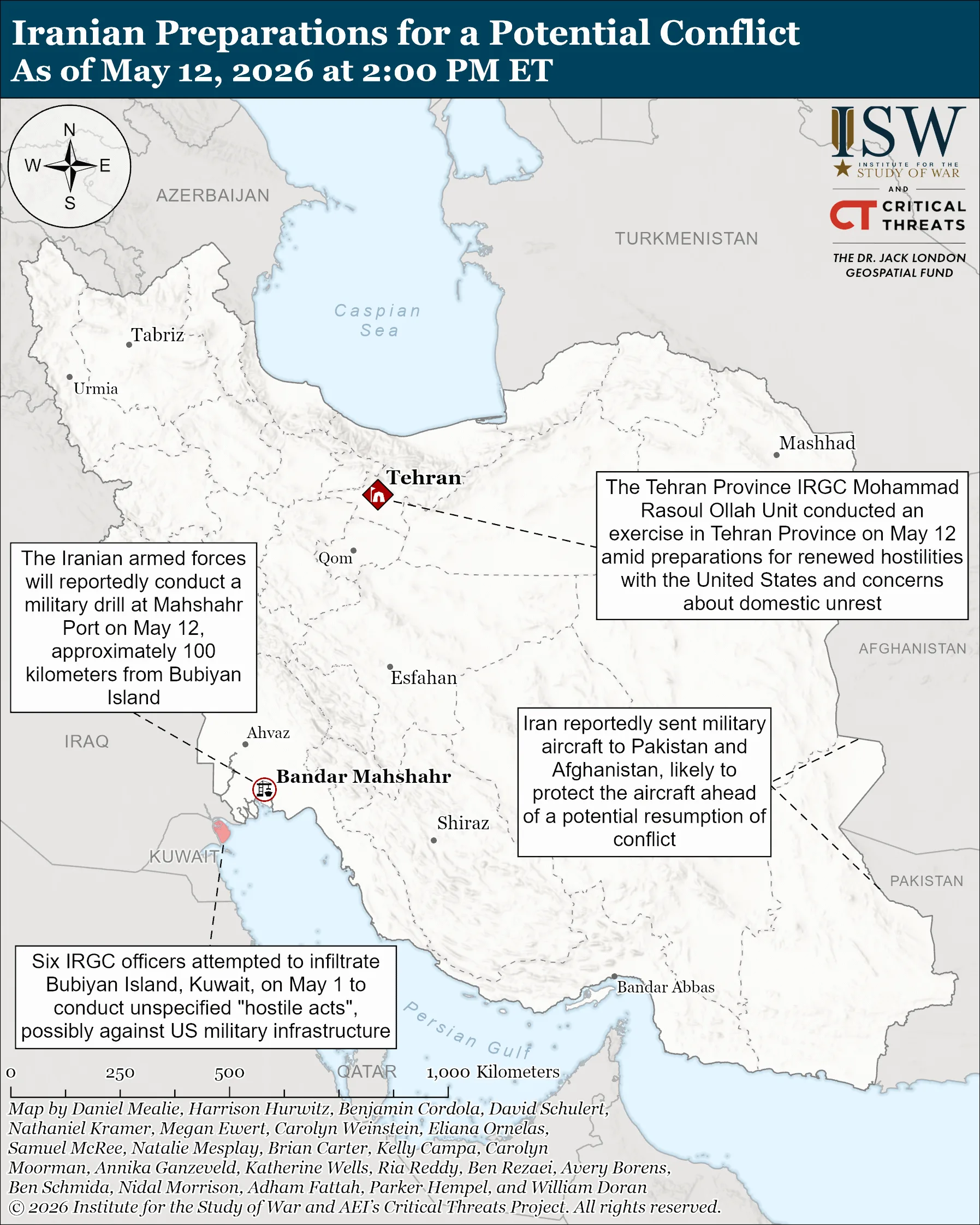
Iran is likely preparing for a resumption of hostilities.[20] The Kuwaiti government stated on May 12 that six Islamic Revolutionary Guard Corps (IRGC) officers attempted to infiltrate Kuwait's Bubiyan Island on May 1, though their exact objective was unclear.[21] Kuwaiti state media reported on May 12 that six IRGC officers attempted to infiltrate Bubiyan Island on May 1 via a chartered fishing boat to carry out unspecified “hostile acts” against Kuwait.[22] The IRGC officers reportedly engaged Kuwaiti military forces on Bubiyan Island on May 1, which led Kuwaiti forces to capture two IRGC Navy (IRGC-N) colonels, an IRGC-N captain, and an IRGC Ground Forces lieutenant, while two other IRGC Navy captains managed to flee, according to Kuwaiti state media.[23] Kuwaiti state media added that the engagement injured a Kuwaiti soldier.[24]
The IRGC’s attempt to insert six officers onto Bubiyan Island amid uncertainty about the future of the ceasefire indicates that Iran is preparing for resumed hostilities. Bubiyan Island offers a host of opportunities for the IRGC to stage operations, conduct intelligence, sabotage nearby facilities, or some combination of all three.
It is particularly notable in the context of the insertion attempt that the Iranian military will reportedly conduct drills at Mahshahr Port on May 12, which is approximately 100 kilometers away from Bubiyan Island. Mahshahr hosts the IRGC Navy 3rd Imam Hossein Region base, but it is unclear at which base the exercise will take place.[25] The combined force previously struck the IRGC Navy 3rd Imam Hossein Region base on March 2.[26] The IRGC Navy could use these drills to prepare for new operations if the ceasefire collapses or to disperse vessels ahead of resumed strikes.
Iran may also be trying to protect some of its military assets by repositioning them in countries it calculates that the United States would not attack. CBS reported on May 12 that Iran repositioned military and civilian aircraft in Pakistan and Afghanistan, respectively, shortly after the ceasefire on April 8.[27] This movement would shield the aircraft from strikes. Pakistan has been the primary mediator for US-Iran talks after the ceasefire.[28] US officials with knowledge of the matter reportedly told CBS that Iran sent multiple aircraft, including an Iranian Air Force RC-130 recon aircraft, to Pakistani Air Force Base Nur Khan near Rawalpindi “days after President Trump announced the ceasefire.”[29] This report added that Iran sent civilian aircraft to Afghanistan, but that it was unclear whether Iran also sent military aircraft.[30] Pakistan's Foreign Affairs Ministry confirmed on May 12 the presence of Iran's aircraft but denied that they had “[any] linkage whatsoever to any military contingency or preservation arrangement.”[31]
The Iranian regime appears to view preparations for renewed conflict with the United States and Israel as inseparable from preparations to secure the regime internally and conduct operations against potential domestic unrest. The Tehran Province IRGC Mohammad Rasoul Ollah Unit conducted an exercise in Tehran Province on May 12.[32] The unit commander, Brigadier General Hassan Hassanzadeh, stated that the exercise aimed to improve combat readiness against US-Israeli “enemy” activity.[33] The Mohammad Rasoul Ollah Unit is one of the regime's most important internal security formations and serves as the primary IRGC command responsible for security in Tehran Province.[34] The unit also oversees major Basij and rapid-response security units in the capital and historically played a central role in suppressing unrest in Tehran Province.[35] Exercise imagery showed IRGC personnel operating mounted heavy machine guns, shoulder-fired rocket-propelled grenades (RPG), motorcycles, and trucks during the exercise.[36] The Iranian regime previously used heavy machine guns to brutally crack down on protesters during the December 2025-January 2026 protest.[37] The exercise comes after anti-regime media reported on April 28 that the Supreme National Security Council (SNSC) convened a meeting chaired by SNSC Secretary Mohammad Bagher Zolghadr—a close ally of IRGC Commander Major General Ahmad Vahidi—to discuss the possible resumption of protests due to worsening economic conditions.[38]
Western media reported that the United Arab Emirates (UAE) and Saudi Arabia launched undeclared strikes against Iran during the war. The Wall Street Journal reported on May 11 that the UAE struck an Iranian oil refinery on Lavan Island around the time President Trump announced the ceasefire on April 8, citing people familiar with the matter.[39] Iran stated at the time that the refinery had been struck and retaliated with strikes against the UAE and Kuwait.[40] The UAE has not publicly acknowledged its strike on the refinery at the time of this writing. Iran has targeted the UAE more than any other country during the war. Reuters reported on May 12 that Saudi Arabia also launched undeclared strikes against Iran during the war, citing two Western and two Iranian officials.[41] One of the Western officials added that Saudi strikes were in retaliation for Iranian aggression against Saudi Arabia. It is unclear what the targets of the Saudi strikes were.
The IRGC appears to be consolidating influence over Iran's internal power and leadership structure under IRGC Commander Major General Ahmad Vahidi and his inner circle. An anti-regime outlet, citing journalists and regime-affiliated media, reported on May 12 that Iranian Supreme Leader Mojtaba Khamenei appointed Mehdi Khamoushi as his new chief of staff.[42] Khamoushi reportedly replaced former Supreme Leader Ali Khamenei’s Deputy Chief of Staff for Political and Security Affairs, Ali Asghar Hejazi.[43] Anti-regime media previously reported that figures around Mojtaba sought to remove Hejazi because Hejazi opposed Mojtaba’s succession.[44] Hejazi reportedly warned the Assembly of Experts members that Mojtaba’s selection would hand full control of the country to the IRGC and permanently eliminate administrative institutions.[45] The New York Times reported on March 16 that IRGC Commander Major General Ahmad Vahidi, former IRGC Commander Major General Mohammad Ali Jafari, and other senior IRGC-linked figures pushed the Assembly of Experts to select Mojtaba following Ali Khamenei’s death.[46] Khamoushi’s reported appointment, therefore, appears consistent with a broader pattern in which Mojtaba and IRGC-aligned actors increasingly sideline figures who oppose the growing role of the IRGC in political decision-making. ISW-CTP previously assessed that Vahidi and his inner circle likely consolidated substantial influence over Iran's military response, negotiations policy, and strategic decision-making following the outbreak of the war with the United States and Israel.[47]
The IDF continues to invest in expanding its first-person view (FPV) drone capabilities and countermeasures. An Israeli military correspondent reported on May 12 that the IDF is developing a factory to indigenize Israel's FPV drone and drone component production.[48] The IDF intends to eliminate its reliance on Chinese component manufacturers for FPV drones and has assessed that the factory will be capable of producing thousands of drones per month by mid-July.[49]
The correspondent also reported that the IDF Ground Technological Division is experimenting with rotating barbed-wire fencing as a countermeasure against Hezbollah's fiber-optic FPV drones.[50] Ukrainian forces first implemented this countermeasure to disable Russian FPV drones in September 2025, in which a battery-operated motor rotates strands of barbed wire to catch and sever FPV drones’ fiber-optic cables.[51] A senior IDF officer assessed on May 12 that combining several FPV drone countermeasures is likely to be more effective against Hezbollah FPV drones than any single method deployed at scale.[52] The IDF has adopted many drone countermeasures, such as equipping Israeli soldiers with hunting shotguns for targeting FPV drones, from Ukrainian and Russian battlefield adaptations.[53] The IDF has expanded its investment in FPV drone capabilities and countermeasures as Hezbollah has demonstrated its ability to strike sensitive military targets on Israeli territory. Hezbollah conducted two FPV drone attacks that damaged an Israeli Iron Dome missile defense battery in northern Israel on May 7 and 8, for example.[54] The IDF has struggled to disrupt Hezbollah's FPV drone capabilities because Hezbollah has decentralized its command-and-control (C2) network for FPV drone operators, dispersing operators across units in southern Lebanon.[55]
https://understandingwar.org/research/middle-east/iran-update-special-report-may-12-2026/
2,032
posted on
05/12/2026 9:33:52 PM PDT
by
AdmSmith
(GCTGATATGTCTATGATTACTCAT)
To: gleeaikin
2,033
posted on
05/12/2026 9:50:22 PM PDT
by
AdmSmith
(GCTGATATGTCTATGATTACTCAT)
Danny Citrinowicz (served 25 years in a variety of command positions units in Israel Defense Intelligence (IDI) including as the head of the Iran branch in the Research and Analysis Division (RAD) in the Israeli defense intelligence and as the division's representative in the US.):
We need to be honest with ourselves: so far, this campaign has been a major strategic failure.
There were certainly important operational achievements, and the level of coordination between U.S. Central Command and the Israel Defense Forces was highly impressive. But wars are not judged by tactical successes alone, they are judged against their original strategic objectives.
The Iranian regime did not fall, and at this stage there is no indication that it is close to collapsing. There was no regime change in Iran; instead, there was a change within the regime, and arguably for the worse. The crisis appears to have strengthened Mojtaba Khamenei and the more hardline elements of the Islamic Revolutionary Guard Corps, giving them greater influence over Iran's decision-making process.
On the conventional front, Iran still retains most of its military capabilities. Even where damage was inflicted, it has not fundamentally altered Tehran’s ability or willingness to resume military confrontation. On the nuclear front, Iran continues to possess a massive stockpile of enriched uranium, including the same roughly 440 kilograms enriched to near-weapons-grade levels. More importantly, the regime still possesses the scientific and technical expertise necessary to enrich to 90% if it chooses to do so. And beyond that, Iran still maintains leverage over the Strait of Hormuz — which remained open and stable before the war began.
I do not know how this conflict will ultimately end. But if these are the conditions under which it concludes, then this will be remembered as a profound strategic failure — one that leaves behind a far worse regional reality than the one that existed before the campaign began. Ignoring that reality will not improve the situation; it will only deepen the problem. Iran built its national security doctrine around asymmetric capabilities. Damage to its navy or air force, however significant tactically, does not fundamentally undermine its ability to wage this kind of confrontation.
That is the reality, whether policymakers are comfortable acknowledging it or not. A serious strategy for weakening the Iranian regime in the future has to begin with an honest recognition of this reality. It is possible that the United States is planning additional, more significant steps. But if we are assessing the campaign as it stands today, the outcome is deeply negative. Without acknowledging that, Washington risks building its next phase on a false premise — and that is exactly how tactical achievements turn into strategic failure.
No wonder Iran is not surrendering at the negotiating table if this is indeed the reality. It is time to go back to the drawing board rather than keep insisting on an approach that has already failed. And it starts with one basic understanding: Iran is not Venezuela. Conventional cost-benefit calculations do not necessarily work against a regime that is willing to sacrifice its own population to preserve its rule.
There is no textbook solution here. Not the Kurds, not arming the opposition, and not targeted killings. None of these, on their own, provides a strategic answer to the Iranian problem set. It is time to think seriously about a different strategy, because the current approach is not containing the threat. It is producing a security reality that is, almost by definition, worse than the one that existed before. If the objective is to weaken the Iranian regime over time, then repeating tools that have already failed is not strategy.
https://x.com/citrinowicz/status/2054342253624115277
2,034
posted on
05/12/2026 10:15:14 PM PDT
by
AdmSmith
(GCTGATATGTCTATGATTACTCAT)
To: AdmSmith; BeauBo; blitz128; PIF; dennisw; nuconvert; Jonty30; adorno; USA-FRANCE; MalPearce; ...
According to the 21+ minute video linked below, Israel’s military representative to the US, Danny C., is dead wrong. In this undated narrative posted today, he says,”The Iranian regime did not fall, and at this stage there is no indication that it is close to collapsing.”
https://www.youtube.com/watch?v=UVtPKnBqdJg
Given this long video apparently provided on May 6, if it is accurate, then based on seeing the entire video I would not be surprised to see Iran surrendered or in Civil War before our November elections. It opens showing city dwellers with 5 gallon water bottles trudging to the local water truck distribution site. The last 2 minutes summarize all the deadly details described in the video and suggests likely final results.
The IRGC with the Mullah’s deserves the blame. Their greed for money and highjacking of water power electricity production combined with their complete disregard for any honest warnings from water experts yields disastrous results. Forty years of reckless water pumping has emptied a once ample aquifer used for city living and farming. The current drought makes everything worse, and there is not enough water to sustain a 1/2 million active military.
Everywhere water tank trucks are providing survival water, but the gasoline supply is getting worse. Iran military are given 20 bullets for 2 soldiers. The 1/2 million active military need large amounts of water for desert hydration and healthy personal sanitation. Artesh soldiers (non political military) are deserting in droves. They and IRGC troops may soon be at each other’s throats. The elected grand Mullah was still in Moscow for medical treatment, the head of Parliament is trying to be somewhat reasonable, and the IRGC have NOT changed their stripes. In other words, a negotiated settlement is currently impossible.
Our military was very successful in knocking out key power dams, key bridges, and key roads. All these needed to maintain the IRGC’s power. They have been shocked by how successfully we have hit just the right places at the right time. For example they were moving their key weapons around at night. Now with the key bridges and roads blocked their major weapons are kept in one vulnerable location. Everyone suspects some very high level person or people are providing this information to us and Israel thus suspicion and distrust are rampant.
Information about dissident groups and ethnicities is given. The bottom line is how quickly enough people will be desperate enough and angry enough to turn on one another, create a condition of total collapse which would include inability to maintain the Hormuz blackmail.
I certainly hope our leadership has plans for dealing effectively with any of the multiple disastrous outcomes that are becoming likely.
2,035
posted on
05/13/2026 11:09:38 AM PDT
by
gleeaikin
(Question Authority: report facts and post their links" in your messages.)
Iran Update Special Report, May 13, 2026
Iran's efforts to reconstitute its military capabilities during the ceasefire period are consistent with the behavior of any military organization when given time and space to reconstitute itself after combat. ISW-CTP has continued to assess that Iran will exploit the ceasefire period to reorganize and regenerate its military capabilities at the tactical and operational levels, where it can recover relatively quickly.[1] Recent leaked US intelligence assessments, as reported by Western media, estimate that Iran has regained access to 90 percent of its underground missile storage and launch facilities, many of which remain at least partially operational, that were buried due to US-Israeli airstrikes.[2] Iranian forces have likely also reestablished communications between units and commanders and begun restoring force morale—both of which were disrupted during the war due to US-Israeli airstrikes and had significantly degraded Iran's ability to conduct operations to achieve its objectives.[3] Recent US intelligence assessments also estimate that Iran still has about 70 percent of its mobile launchers and 70 percent of its prewar missile stockpile, including both ballistic and cruise missiles.[4] US forces buried some of these assets during combat operations, which rendered the buried assets combat ineffective. Any military force, including the Iranians, would use the time and space granted by the ceasefire to reconstitute itself. The restoration of underground missile storage and launch facilities means that Iran was degraded operationally and then prepared itself for a new round of fighting. US forces have surely also prepared for a new round of fighting. Russia has reportedly supported Iranian reconstitution efforts by sending drone components to Iran.[5]
These tactical and operational reconstitution efforts, however, do not necessarily offset the strategic effects achieved during the war against ballistic missile production facilities. The US-Israeli combined force aimed to disrupt the Iranian missile force at the operational level to prevent it from executing its campaign plan while degrading it at the strategic level in order to prevent it from expanding its stockpile and building more advanced systems.[6] The combined force struck virtually every element of the production and supply chain at the strategic level, from raw material facilities (preparing steel, aluminum, missile fuel, etc.) to final assembly plants, and severely degraded Iran's defense industrial base that supports its military capabilities.[7] Iran's long-term recovery depends on rebuilding this defense industrial base, a process likely constrained by limited access to resources due to the US naval blockade and ongoing sanctions targeting Iranian illicit oil sales and the procurement of weapons-related systems and components.[8] Iran will need significant time and resources to rebuild these capacities and will likely face challenges in reconstituting its military capabilities, given the scale of the damage to the production chain and limited resources available.
Iran's growing emphasis on the Strait of Hormuz reflects a broader, emerging consensus around the idea that the Strait of Hormuz must be central to Iranian strategy and deterrence in the future. Iranian strategy before October 7 and the events thereafter, including the Spring 2026 war, revolved primarily around ballistic missiles, drones, and its proxy and partner network as deterrents and force projection tools. Naval assets around the Strait of Hormuz featured only secondarily and as part of this wider three-pillar system, not as the main element. The failure of Iran's direct attacks on Israel in 2024 exposed the limits of Iran's missile arsenal, which failed to effectively penetrate Israeli defenses or destroy critical military targets at scale.[9] Iran's traditional deterrence architecture also failed to prevent repeated US and Israeli strikes in 2024, 2025, and 2026.[10] The series of US and Israeli attacks over the last two years demonstrates that traditional Iranian measures have failed to discourage or prevent military attack. This has led to a shift wherein Iranian officials have begun to elevate the position of the strait in Iranian strategic thinking and discourse. Iranian officials are now viewing the strait as co-equal to nuclear weapons in achieving deterrence, while also enabling Tehran to extract revenue and compel states to follow Iranian rules and regulations about behavior towards Tehran.[11]
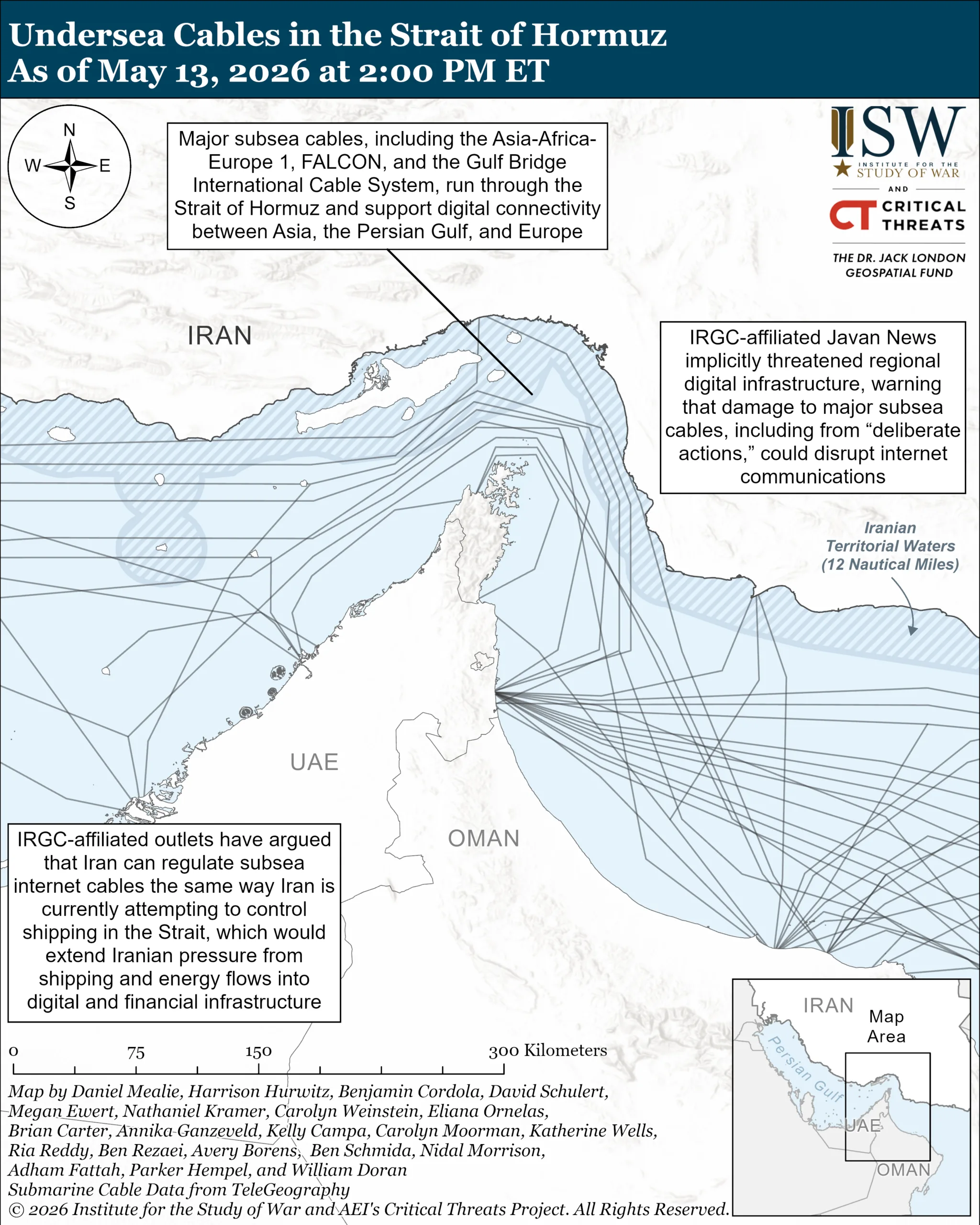
Some regime officials and outlets have floated new ideas about how the regime could use the Strait of Hormuz to prevent actions that the regime believes are contrary to its interests. Artesh Spokesperson Brigadier General Mohammad Akraminia stated on May 13 that Iran will no longer allow US weapons to pass through the strait to regional bases, which presumably includes US warships bound for Manama, Bahrain—the headquarters of the US 5th Fleet.[12] Such rules could extend to French or UK naval vessels as well, if those countries act in a manner that Tehran believes is contrary to Iranian interests. The United Kingdom (UK) has naval facilities in Bahrain, and France has naval facilities in the United Arab Emirates (UAE).[13] Islamic Revolutionary Guards Corps (IRGC)-affiliated Fars and Tasnim news agencies recently published articles urging the regime to assert sovereignty over subsea fiber-optic cables running through the strait and charge foreign operators for using cables installed on seabeds under Iranian control.[14] Major subsea cables, including the Asia-Africa-Europe 1 (AAE-1), FALCON, and the Gulf Bridge International Cable System, run through the Strait of Hormuz and support digital connectivity between Asia, the Gulf, and Europe.[15] Three of seven cables–FALCON, GBICS, OMRAN/EPEG cables–connect to Iran and run through the strait.[16] Fars argued that “cables have the same status as ships” in the strait and that Iran can apply the same transit rules to fiber-optic cables that it applies to vessels.[17] Tasnim proposed requiring annual licenses from foreign cable operators and forcing major technology companies such as Google, Microsoft, Meta, and Amazon to operate under Iranian law.[18] Tasnim also proposed giving Iranian companies exclusive authority to repair and maintain the cables.[19] Such a system would undermine sanctions against Iran while also ensuring that Iran controls the economic lifeline—the internet—that many businesses in the Gulf rely upon. Iran could decide to throttle these cables if it felt doing so was desirable.
Many of these proposals, if accepted and operationalized, would also provide Iran with new revenues that would enable it to reconstitute its military forces. Iran's military has suffered significant degradation to its industrial base. Rebuilding this industrial base under sanctions and with limited revenue would be extremely difficult and require challenging prioritization compromises between the missile program, for example, and internal security or infrastructure. Akraminia added that “strategic control” of the strait would provide Iran with new revenues and strengthen its power.[20]
Other regime outlets have floated military ideas to disrupt commerce further during the war. IRGC-affiliated Javan News previously implicitly threatened regional digital infrastructure on May 3 by warning that simultaneous damage to several major subsea cables, including through “deliberate actions,” could cause widespread disruptions to communications and digital infrastructure across the Persian Gulf.[21]
Some regional states appear to be complying with Iranian-imposed transit procedures in the Strait of Hormuz, which normalizes Iran's claim that vessels need Iranian permission to transit the waterway. Five unspecified sources told Reuters on May 12 that Iraq and Pakistan reached agreements with Iran to move crude oil and liquefied natural gas (LNG) through the strait.[22] Iraq reportedly secured safe passage for two large crude carriers, each carrying about two million barrels of crude oil, and is trying to secure Iranian permission for additional transits.[23] Two Qatari LNG tankers are also reportedly heading to Pakistan after Iran and Pakistan reached an agreement.[24] These arrangements would reinforce Iran's effort to force regional states to treat Iranian approval as a prerequisite for safe passage through the Strait.
Regional and international efforts to bypass Iranian control of the strait indicate that Iran's maritime coercion is imposing economic and security costs on the Gulf states and energy exports. The Wall Street Journal reported on May 12 that Gulf states have expanded overland trade and logistics routes across the Arabian Peninsula to reduce reliance on the strait, including routes through Saudi Arabia, the UAE, and Oman.[25] Truck traffic at a Gulf of Oman port reportedly surged from 100 trucks per day before the conflict to 7,000 trucks per day.[26] Saudi Aramco is leaning on its East-West pipeline to Yanbu, Saudi Arabia, and the UAE is pushing more crude through Fujairah.[27] The Wall Street Journal added that these routes can help absorb market shocks but cannot replace maritime shipping capacity, however.[28]
Western countries have continued to make efforts to secure commercial shipping in the strait. This effort will reportedly not occur until after hostilities, however. Australian Defense Minister Richard Marles stated on May 13 that Australia will support a UK- and French-led multinational mission to secure shipping through the strait and will contribute an E-7A Wedgetail surveillance aircraft.[29] Italian Defense Minister Guido Crosetto stated on May 13 that Italy is repositioning two minesweepers closer to the Persian Gulf as a precautionary measure.[30]
Hezbollah is demonstrating the ability to coordinate more complex attacks on Israeli military targets using first-person view (FPV) drones. Israeli media reported that Hezbollah conducted a two-wave attack targeting an Israel Defense Forces (IDF) site in northern Israel on May 12, using a “swarm” of several FPV drones.[31] Israeli media claimed that two drone impacts in the attack's first wave caused a fire at the site, and that several drones in the larger second wave circled the site for several minutes before striking targets.[32] The IDF and Israeli media did not report any specific battle damage or casualties from the attack. Israeli reporting corresponds to Hezbollah's claims that it launched at least five FPV drones targeting an IDF border post near Margaliot, northern Israel, on May 12.[33] Hezbollah claimed that it struck several military targets, including counter-drone electronic warfare equipment, at the site.[34]
The attack indicates that Hezbollah can conduct complex FPV drone attacks requiring coordination between several FPV drone operators, even if Hezbollah cannot yet deploy FPV drones at scale. Israeli media claimed the attack was the first instance of a coordinated, multiple-drone attack targeting a single site in Israel and Hezbollah's most complex FPV drone attack yet.[35] Hezbollah has previously claimed to have conducted attacks using two FPV drones simultaneously.[36] The attack also indicates that Hezbollah's decentralized command-and-control (C2) network for FPV drone operators, which has dispersed operators across various units in southern Lebanon, has not inhibited the group's ability to conduct coordinated attacks.[37] Israeli reporting that several FPV drones circled the site for several minutes indicates that Israeli countermeasures largely failed to intercept the drones or prevent them from surveying targets.[38] ISW-CTP cannot confirm whether Hezbollah used fiber-optic FPV drones, which are impervious to Israeli jamming, in its attack on May 12.[39] A swarming attack using fiber-optic FPV drones would likely require more skilled operators and coordination to prevent drones from tangling their cables while surveying and striking targets in a single area of operations.
Saudi Arabia and Kuwait struck multiple Iranian-backed Iraqi militia positions in Iraq in early April, according to informed sources speaking to Western media on May 13.[48] One Western official and another person briefed on the matter told Reuters on May 13 that Saudi Arabia conducted airstrikes on sites near the Saudi-Iraq border from which Iranian-backed Iraqi militias launched drone and missile attacks against Saudi Arabia and other Gulf states.[49] Iranian-backed Iraqi militias have claimed multiple drone attacks targeting US bases in Saudi Arabia, Kuwait, and Bahrain during the war.[50] Three Iraqi officials also told Reuters that unspecified actors launched at least two rocket attacks targeting during the war, including one that struck an Iranian-backed Iraqi militia Kataib Hezbollah facility in southern Iraq in early April, killing several fighters.[51] Iraqi media previously reported on April 7 that unspecified actors launched an attack from Kuwait targeting a Kataib Hezbollah-owned house in Basra Province.[52] ISW-CTP attributed this strike to the US-Israeli combined force at the time.[53] Protesters carrying Popular Mobilization Forces (PMF) flags attempted to storm the Kuwaiti Consulate in Basra City on April 7 in response to the attack.[54] The PMF is an Iraqi state security service, but many Iranian-backed Iraqi militias control PMF brigades that answer to Iran instead of the Iraqi prime minister.[55] Neither Saudi Arabia nor Kuwait has publicly acknowledged striking Iraqi territory at the time of this writing.
https://understandingwar.org/research/middle-east/iran-update-special-report-may-13-2026/
2,036
posted on
05/13/2026 9:36:30 PM PDT
by
AdmSmith
(GCTGATATGTCTATGATTACTCAT)
2,037
posted on
05/14/2026 9:46:18 AM PDT
by
AdmSmith
(GCTGATATGTCTATGATTACTCAT)
Iran Update Special Report, May 14, 2026
Iran may be prioritizing upholding the “legitimacy” of its claims to the Strait of Hormuz over toll collection at this time. This prioritization helps Iran encourage states to implicitly recognize its control over the strait while avoiding international concerns over paying the Iranians and incurring sanctions risk. Legitimizing any aspect of Iranian control over the strait, with or without tolls, is unacceptable due to the precedent it sets. Iran has touted its ability to charge tolls on ships transiting the Strait of Hormuz, but it remains unclear how many vessels have paid the tolls. Lloyd's List reported in late March 2026 that “at least” two vessels paid the toll in Yuan, but Iranian officials on April 16 noted that no tolls had been collected.[1] Iran only announced it received its first toll payment on April 23.[2] Iran also appears to be providing toll exemptions for so-called “friendly” countries, which implies that a set of state behaviors approved by Iran is sufficient to avoid tolls on vessels bound for a state's ports. Iranian Foreign Minister Abbas Araghchi said on March 26 that the People's Republic of China (PRC), Russia, India, Iraq, and Pakistan were “friendly” states, and their vessels could pass through the strait.[3] Others, like Malaysia and Thailand, have separate deals that permit them to travel through the strait. Most of these states, including India, Russia, Malaysia, Pakistan, and Thailand, are not subject to fees.[4] Japanese Prime Minister Sanae Takaichi announced on May 14 that she also negotiated with Iran the safe passage of a Japanese-managed oil tanker through the strait without paying a toll.[5] Iranian regime-affiliated media reported on May 14 that at least six Chinese vessels also safely passed through the strait, although it is unclear whether they had to pay a toll.[6] All of these countries notably have relatively friendly relationships with Iran, including Japan, which has long acted as a mediator between Iran and the United States.[7] The decision by Tehran to exempt so-called ”friendly” countries suggests that Iranian officials decided to prioritize encouraging states to follow its transit protocols by lifting fees, which, by implication, confers legitimacy and recognition upon Iran's claims of sovereignty over the Strait of Hormuz.
Iran is likely prioritizing the implementation of the protocol over the tolls at this time in order to present itself as a reasonable actor that is willing to “open” the strait to “free” travel without tolls.[8] Recognizing Iran's protocol—which bars certain countries from accessing the strait and not others based on their behavior—is unacceptable because it implies that the Strait of Hormuz is sovereign Iranian territory. The PRC only explicitly opposes the toll system and Iranian “blockade,” but has not explicitly opposed Iranian claims to sovereignty, for example.[9] The Strait of Hormuz is an international waterway. Recognizing Iran's claims to the strait now will enable it to change which countries it deems as “hostile” and bar access selectively and for any reason.[10] It is not a given, for example, that Iran would recognize the United Kingdom or France as “friendly” countries, for example, given their participation in sanctions against Iran.
Iran has continued to enforce its protocols in the Strait of Hormuz by attacking ships. United Kingdom Maritime Trade Operations (UKMTO) reported on May 14 that likely Iranian forces seized the Honduras-flagged Hui Chuan 38 nautical miles northeast of Fujairah, United Arab Emirates (UAE), and moved it towards Iranian territorial waters.[11] Reuters reported on May 14 that Iran likely sank an Indian cargo vessel off the coast of Oman in the Strait of Hormuz region that was traveling from Somalia to the UAE.[12] Iranian Foreign Affairs Minister Abbas Araghchi stated on May 14 that Iran considers the strait open for all commercial vessels but that they must “cooperate” with Iranian naval forces.[13] Allowing Iran to continue enforcing these protocols would be detrimental to US and international commercial interests, as it would mean Iran could prevent ships from traversing the strait anytime it wants.
PRC companies have been reportedly discussing arms sales routed via third-party countries with Iranian officials, but currently it is unclear to what extent PRC officials have decided to approve these sales and subsequent weapons shipments, according to New York Times reporting on May 13 that cited US officials.[14] The US officials did not specify what military equipment PRC companies were discussing with Iranian officials, but earlier reports prior to the current war suggested that Iran sought PRC shoulder-fired surface-to-air missiles and anti-ship missiles.[15] The US officials noted that at least one of the proposed transit countries was in Africa.[16] The PRC has provided assets to support Iranian military capabilities in this war and in the past. The PRC sent missile fuel precursors to support Iranian missile reconstitution efforts following the June 2025 Israel-Iran War and also provided satellite imagery of US facilities in the Middle East during the current war.[17]The PRC government closely controls and approves the export of military and dual-use goods, so it is unlikely that companies in the PRC would export military equipment without clear approval from the PRC.[18] US officials have reached “different conclusions” about whether the arms have already been sent to the transit countries, though the New York Times noted that none of the PRC weapons have been used against US forces in the current war.[19]
https://understandingwar.org/research/middle-east/iran-update-special-report-may-14-2026/
2,038
posted on
05/14/2026 11:37:53 PM PDT
by
AdmSmith
(GCTGATATGTCTATGATTACTCAT)
2,039
posted on
05/14/2026 11:39:59 PM PDT
by
AdmSmith
(GCTGATATGTCTATGATTACTCAT)
To: nuconvert; gleeaikin
Another execution by the Islamic Republic of Iran
Mohammad Abbasi, one of the detainees from the January 2026 (Dey 1404) nationwide protests, was executed at dawn on Wednesday, May 13 (23 Ordibehesht) at Karaj’s Ghezel Hesar Prison; an execution where even the right to a final visit was denied to his family.
His death sentence had previously been issued by Branch 15 of the Tehran Revolutionary Court, presided over by Abolghasem Salavati, and subsequently upheld by Branch 39 of the Supreme Court. Abbasi was arrested in connection with the killing of Shahin Dehghani Kakavandi, a lieutenant colonel in the law enforcement forces in Malard, and was sentenced to death on the charge of “Moharebeh” (enmity against God).
In the same case, the 25-year prison sentence for Fatemeh Abbasi, Mohammad Abbasi’s daughter, was also upheld without change by the Supreme Court. She is currently imprisoned in the women's ward of Evin Prison.
According to a source close to the Abbasi family, prison authorities had initially asked the family to go to Ghezel Hesar for a final meeting, but once they arrived, permission to visit was denied. After leaving the prison, the family learned only through a telephone call that Mohammad Abbasi’s execution had been carried out.

https://x.com/IRObservatory/status/2054955064360419787
It is just one fate among tens of thousands
2,040
posted on
05/15/2026 2:00:29 AM PDT
by
AdmSmith
(GCTGATATGTCTATGATTACTCAT)
Navigation: use the links below to view more comments.
first previous 1-20 ... 2,001-2,020, 2,021-2,040, 2,041-2,060 ... 2,461-2,478 next last
Disclaimer:
Opinions posted on Free Republic are those of the individual
posters and do not necessarily represent the opinion of Free Republic or its
management. All materials posted herein are protected by copyright law and the
exemption for fair use of copyrighted works.
FreeRepublic.com is powered by software copyright 2000-2008 John Robinson