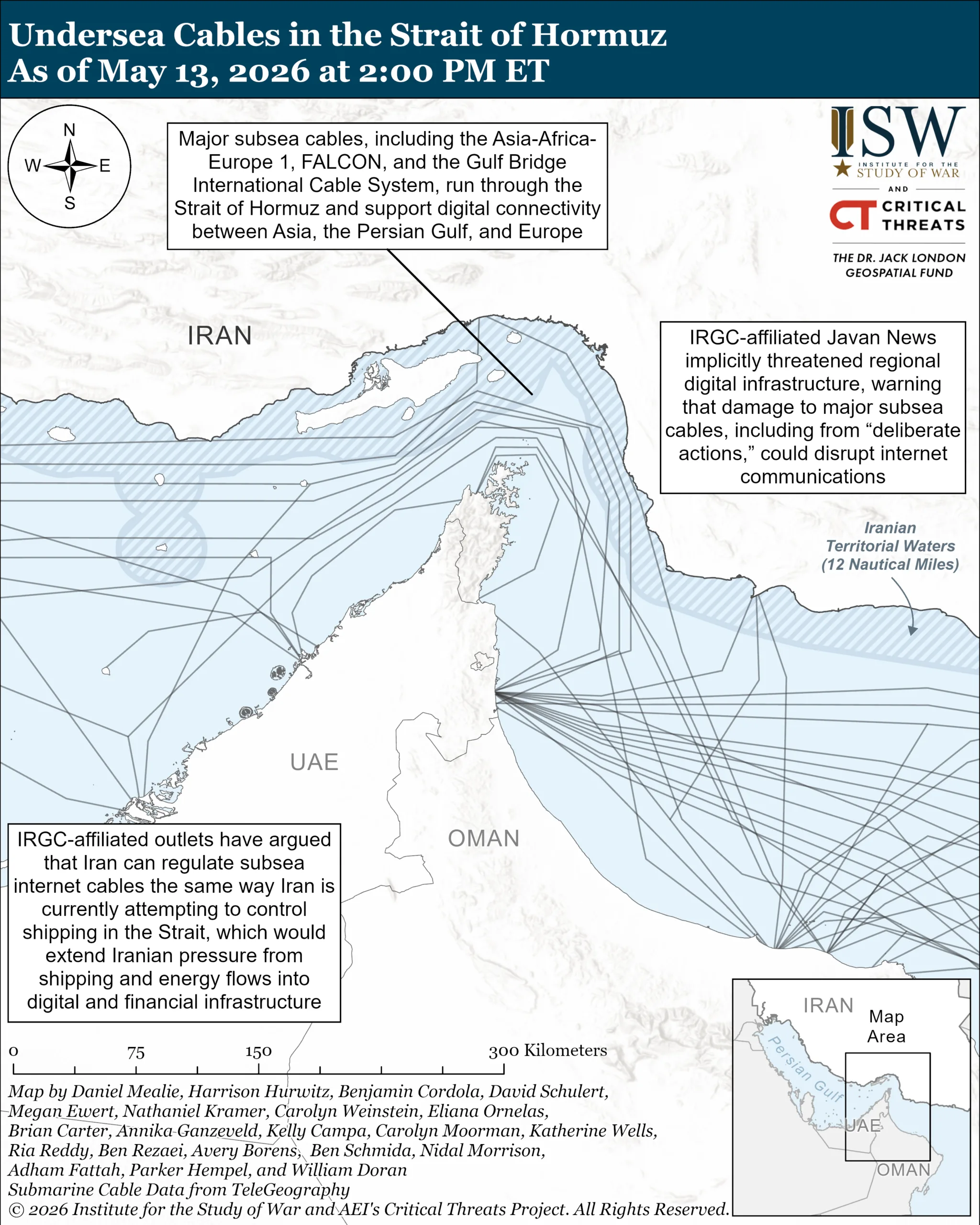
Iran's consistent pursuit of international recognition of Iranian sovereignty over the Strait of Hormuz reinforces ISW-CTP’s previous assessment that Iran views control of the waterway as its most important tool of deterrence against future US or allied military action, because such recognition would allow it to restrict activity in the strait whenever it wills.[1] Senior Iranian officials have repeatedly signaled that Iran does not intend to relinquish its claims to the Strait of Hormuz, including through statements attributed to Supreme Leader Mojtaba Khamenei and public comments by close advisers.[2] Iran is simultaneously attempting to normalize and formalize its control of the strait through rhetoric and operational measures. IRGC Navy Political Deputy Brigadier General Mohammad Akbarzadeh claimed on May 12 that the strait's “operational area” has expanded from “around islands such as Hormuz and Hengam” and a narrow “20-30 mile corridor into a 200-300 mile crescent stretching from Jask and Sirik to beyond Qeshm Island and the Greater Tunb.”[3] It is unclear what Akbarzadeh means by “operational area” in this context. Akbarzadeh’s omission of other countries’ land and maritime territories in the strait in his statement to Iranian media suggests Iran's intent to define much of the surrounding maritime space as effectively under Iranian management, however. Supreme Leader adviser Mohammad Mokhber more explicitly stated on May 8 that the strait carries strategic value comparable to a nuclear weapon, enabling Iran to influence the global economy “with one decision,” and asserting that Iran “will not lose the strait under any circumstances.”[4] Iran also instituted a new transit regime on May 7 that requires vessels to receive Iranian regulations by email and submit detailed ownership, nationality, and crew information to Iran's ”Persian Gulf Strait Authority” to obtain authorization for passage.[5] IRGC-affiliated media continues to frame routine maritime transit as contingent on Iranian permission, such as on May 12, when IRGC-affiliated media reported that Iranian forces “allowed” a second Qatari tanker to pass through the strait.[6]
Iran has made clear that it will not negotiate without guarantees or credible deterrence against future military attacks, including sovereignty over the Strait of Hormuz. An Al Jazeera journalist, citing a well‑informed source familiar with the negotiations, reported on May 12 that the Iranian negotiating team has been instructed to insist on five preconditions before entering nuclear talks: a complete end to the war on all fronts, the lifting of all sanctions, the release of frozen Iranian assets, compensation for war‑related damages and losses, and formal recognition of Iran's sovereign rights over the Strait of Hormuz.[7] Former IRGC commander and Mojtaba Khamenei confidant Major General Mohammad Ali Jafari publicly articulated these same demands on May 11, signaling alignment between Iran's negotiating strategy and senior IRGC leadership.[8] Sobh‑e No, a newspaper affiliated with Parliament Speaker Mohammad Bagher Ghalibaf, who led Iran‘s negotiating team, separately reported Iran's latest proposal, which provided a similar list of uncompromising positions.[9] The framework reported by Sobh-e No also proposed a monitoring mechanism and a UN Security Council resolution as a guarantee against future US or allied attacks.[10]
Iranian sovereignty and control over the Strait of Hormuz would have severe consequences for global shipping for all countries dependent on maritime trade, but especially the Gulf States. The Economist reported on May 12 that the ongoing conflict has already cut Saudi oil exports by roughly a third and UAE exports by about half, while Bahrain, Qatar, and Kuwait are exporting almost no energy products.[11] The head of Saudi Aramco warned on May 10 that if trade and shipping remain constrained for more than a few weeks, supply disruptions could persist for years, with markets potentially not normalizing until 2027.[12] Iran, if its control of the strait were to be recognized, could impose similar costs on the Gulf States at any time and for any reason, and point to the recognition of its control to legitimize its actions.
The United States has continued to impose economic pressure on Iran through the naval blockade and sanctions. US Central Command (CENTCOM) announced on May 12 that US naval forces have redirected 65 Iranian commercial vessels and disabled four more.[13] US President Trump told CNN on May 12 that he is confident the United States will get Iran's highly enriched uranium despite the lack of progress in negotiations.[14] He added that the United States does not need to rush anything because of the blockade, which the Trump Administration assesses has continued to apply pressure on Iran. The US Treasury Department on May 11 sanctioned three Iranian individuals affiliated with Iran's illicit oil sales to the People's Republic of China (PRC).[15] The Treasury sanctioned IRGC Shahid Purja’fari Oil Headquarters chief Ahmad Mohammadi Zadeh, finance chief Samad Fathi Salami, and commercial chief Mohammadreza Ashrafi Ghehi. The IDF reported that it killed Ghehi in strikes on Tehran on April 5.[16]
Some European countries have indicated their willingness to assist the US mission to secure commercial shipping in the Strait of Hormuz. British and Lithuanian officials have caveated their involvement by noting that they will not assist until “conditions allow,” and they have a “clear” understanding of US requirements, respectively. British Defense Minister John Healey stated during a virtual summit with counterparts from at least 40 nations on May 12 that the United Kingdom would contribute autonomous mine-hunting equipment, Typhoon fighter jets, and the destroyer HMS Dragon to help secure commercial navigation in the strait, but only “when conditions allowed.”[17] Lithuania may also contribute to minesweeping efforts after the country's Defense Council sent a proposal to Parliament on May 11 advocating for the provision of 40 soldiers and personnel to help the US mission.[18] Lithuanian President Gitanas Nausėda stated on May 12 that the implementation of the proposal still awaits a clear understanding of US operational needs in the strait and the role other allies would play, however. France announced on May 6 that it sent its Charles de Gaulle aircraft carrier group to the Red Sea to assist in the potential mission.[19]
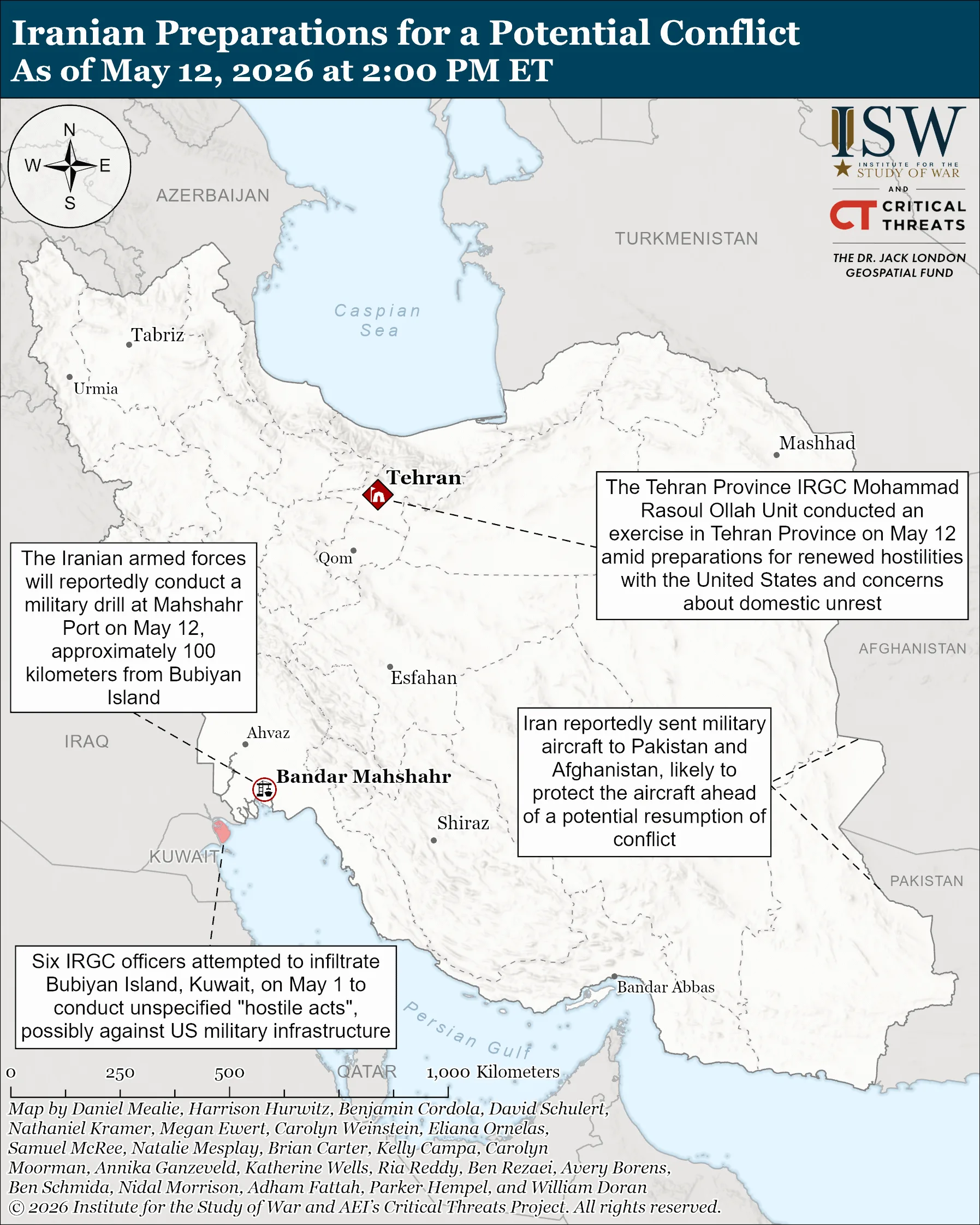
Iran is likely preparing for a resumption of hostilities.[20] The Kuwaiti government stated on May 12 that six Islamic Revolutionary Guard Corps (IRGC) officers attempted to infiltrate Kuwait's Bubiyan Island on May 1, though their exact objective was unclear.[21] Kuwaiti state media reported on May 12 that six IRGC officers attempted to infiltrate Bubiyan Island on May 1 via a chartered fishing boat to carry out unspecified “hostile acts” against Kuwait.[22] The IRGC officers reportedly engaged Kuwaiti military forces on Bubiyan Island on May 1, which led Kuwaiti forces to capture two IRGC Navy (IRGC-N) colonels, an IRGC-N captain, and an IRGC Ground Forces lieutenant, while two other IRGC Navy captains managed to flee, according to Kuwaiti state media.[23] Kuwaiti state media added that the engagement injured a Kuwaiti soldier.[24]
The IRGC’s attempt to insert six officers onto Bubiyan Island amid uncertainty about the future of the ceasefire indicates that Iran is preparing for resumed hostilities. Bubiyan Island offers a host of opportunities for the IRGC to stage operations, conduct intelligence, sabotage nearby facilities, or some combination of all three.
It is particularly notable in the context of the insertion attempt that the Iranian military will reportedly conduct drills at Mahshahr Port on May 12, which is approximately 100 kilometers away from Bubiyan Island. Mahshahr hosts the IRGC Navy 3rd Imam Hossein Region base, but it is unclear at which base the exercise will take place.[25] The combined force previously struck the IRGC Navy 3rd Imam Hossein Region base on March 2.[26] The IRGC Navy could use these drills to prepare for new operations if the ceasefire collapses or to disperse vessels ahead of resumed strikes.
Iran may also be trying to protect some of its military assets by repositioning them in countries it calculates that the United States would not attack. CBS reported on May 12 that Iran repositioned military and civilian aircraft in Pakistan and Afghanistan, respectively, shortly after the ceasefire on April 8.[27] This movement would shield the aircraft from strikes. Pakistan has been the primary mediator for US-Iran talks after the ceasefire.[28] US officials with knowledge of the matter reportedly told CBS that Iran sent multiple aircraft, including an Iranian Air Force RC-130 recon aircraft, to Pakistani Air Force Base Nur Khan near Rawalpindi “days after President Trump announced the ceasefire.”[29] This report added that Iran sent civilian aircraft to Afghanistan, but that it was unclear whether Iran also sent military aircraft.[30] Pakistan's Foreign Affairs Ministry confirmed on May 12 the presence of Iran's aircraft but denied that they had “[any] linkage whatsoever to any military contingency or preservation arrangement.”[31]
The Iranian regime appears to view preparations for renewed conflict with the United States and Israel as inseparable from preparations to secure the regime internally and conduct operations against potential domestic unrest. The Tehran Province IRGC Mohammad Rasoul Ollah Unit conducted an exercise in Tehran Province on May 12.[32] The unit commander, Brigadier General Hassan Hassanzadeh, stated that the exercise aimed to improve combat readiness against US-Israeli “enemy” activity.[33] The Mohammad Rasoul Ollah Unit is one of the regime's most important internal security formations and serves as the primary IRGC command responsible for security in Tehran Province.[34] The unit also oversees major Basij and rapid-response security units in the capital and historically played a central role in suppressing unrest in Tehran Province.[35] Exercise imagery showed IRGC personnel operating mounted heavy machine guns, shoulder-fired rocket-propelled grenades (RPG), motorcycles, and trucks during the exercise.[36] The Iranian regime previously used heavy machine guns to brutally crack down on protesters during the December 2025-January 2026 protest.[37] The exercise comes after anti-regime media reported on April 28 that the Supreme National Security Council (SNSC) convened a meeting chaired by SNSC Secretary Mohammad Bagher Zolghadr—a close ally of IRGC Commander Major General Ahmad Vahidi—to discuss the possible resumption of protests due to worsening economic conditions.[38]
Western media reported that the United Arab Emirates (UAE) and Saudi Arabia launched undeclared strikes against Iran during the war. The Wall Street Journal reported on May 11 that the UAE struck an Iranian oil refinery on Lavan Island around the time President Trump announced the ceasefire on April 8, citing people familiar with the matter.[39] Iran stated at the time that the refinery had been struck and retaliated with strikes against the UAE and Kuwait.[40] The UAE has not publicly acknowledged its strike on the refinery at the time of this writing. Iran has targeted the UAE more than any other country during the war. Reuters reported on May 12 that Saudi Arabia also launched undeclared strikes against Iran during the war, citing two Western and two Iranian officials.[41] One of the Western officials added that Saudi strikes were in retaliation for Iranian aggression against Saudi Arabia. It is unclear what the targets of the Saudi strikes were.
The IRGC appears to be consolidating influence over Iran's internal power and leadership structure under IRGC Commander Major General Ahmad Vahidi and his inner circle. An anti-regime outlet, citing journalists and regime-affiliated media, reported on May 12 that Iranian Supreme Leader Mojtaba Khamenei appointed Mehdi Khamoushi as his new chief of staff.[42] Khamoushi reportedly replaced former Supreme Leader Ali Khamenei’s Deputy Chief of Staff for Political and Security Affairs, Ali Asghar Hejazi.[43] Anti-regime media previously reported that figures around Mojtaba sought to remove Hejazi because Hejazi opposed Mojtaba’s succession.[44] Hejazi reportedly warned the Assembly of Experts members that Mojtaba’s selection would hand full control of the country to the IRGC and permanently eliminate administrative institutions.[45] The New York Times reported on March 16 that IRGC Commander Major General Ahmad Vahidi, former IRGC Commander Major General Mohammad Ali Jafari, and other senior IRGC-linked figures pushed the Assembly of Experts to select Mojtaba following Ali Khamenei’s death.[46] Khamoushi’s reported appointment, therefore, appears consistent with a broader pattern in which Mojtaba and IRGC-aligned actors increasingly sideline figures who oppose the growing role of the IRGC in political decision-making. ISW-CTP previously assessed that Vahidi and his inner circle likely consolidated substantial influence over Iran's military response, negotiations policy, and strategic decision-making following the outbreak of the war with the United States and Israel.[47]
The IDF continues to invest in expanding its first-person view (FPV) drone capabilities and countermeasures. An Israeli military correspondent reported on May 12 that the IDF is developing a factory to indigenize Israel's FPV drone and drone component production.[48] The IDF intends to eliminate its reliance on Chinese component manufacturers for FPV drones and has assessed that the factory will be capable of producing thousands of drones per month by mid-July.[49]
The correspondent also reported that the IDF Ground Technological Division is experimenting with rotating barbed-wire fencing as a countermeasure against Hezbollah's fiber-optic FPV drones.[50] Ukrainian forces first implemented this countermeasure to disable Russian FPV drones in September 2025, in which a battery-operated motor rotates strands of barbed wire to catch and sever FPV drones’ fiber-optic cables.[51] A senior IDF officer assessed on May 12 that combining several FPV drone countermeasures is likely to be more effective against Hezbollah FPV drones than any single method deployed at scale.[52] The IDF has adopted many drone countermeasures, such as equipping Israeli soldiers with hunting shotguns for targeting FPV drones, from Ukrainian and Russian battlefield adaptations.[53] The IDF has expanded its investment in FPV drone capabilities and countermeasures as Hezbollah has demonstrated its ability to strike sensitive military targets on Israeli territory. Hezbollah conducted two FPV drone attacks that damaged an Israeli Iron Dome missile defense battery in northern Israel on May 7 and 8, for example.[54] The IDF has struggled to disrupt Hezbollah's FPV drone capabilities because Hezbollah has decentralized its command-and-control (C2) network for FPV drone operators, dispersing operators across units in southern Lebanon.[55]
https://understandingwar.org/research/middle-east/iran-update-special-report-may-12-2026/