Skip to comments.
Iranian Regime tv Channel One hacked while it was airing Khamenie speech
various
| 10-8-22
Posted on 10/08/2022 1:05:38 PM PDT by nuconvert
Iranian Regime national tv Channel One hacked about an hour ago. During a broadcast of Khamenie speech, a red crosshair appeared over his face and chanting of Women. Life. Freedom. There was writing to the side saying "Rise up. Join us". Also 4 photos at the bottom of the screen of young people killed and additional writing: "The blood of our youth is dropping from your paws".
Also, there was a huge banner in the middle of Tehran highway today that read: We are no longer afraid of you. We will fight.
Also, attempted attack on IRI ambassador in Denmark. Her bodyguard was stabbed. Diplomatic Security intervened before the attacker could stab the ambassador.
TOPICS:
KEYWORDS: basij; deathtothemullahs; denmark; ebrahimrigi; erdogan; iran; iranprotests; iraq; irgc; iri; israel; khameini; khamenei; kurdistan; lebanon; mahsaamini; mullahloversonfr; mullahsmustbekilled; najisharifizindashti; protests; qudsforce; raisi; receptayyiperdogan; shahrammaroufmola; syria; turkey; yemen; zahedi
Navigation: use the links below to view more comments.
first previous 1-20 ... 1,801-1,820, 1,821-1,840, 1,841-1,860 ... 2,461-2,479 next last
To: AdmSmith
1,821
posted on
03/18/2026 9:51:44 AM PDT
by
nuconvert
( Warning: Accused of being a radical militarist. Approach with caution.)
To: nuconvert; AdmSmith; adorno; dennisw; USA-FRANCE
I went to your link about shooting at the Basij check point. When I scrolled down a bit I found something that said BREAKING, and below that it said “Spain has just announced it is give another EU 1 billion to Ukraine for assistance.” I guess Trump woke them up a bit. ;-)
1,822
posted on
03/18/2026 8:04:05 PM PDT
by
gleeaikin
(Question Authority: report facts, and post their links in your message.)
To: nuconvert; AdmSmith; dennisw
Here is the information for this very short and very loud video.
“More and more reports of drive-by shooting attacks against Basij militia checkpoints in Iran.
The regime is under pressure and more and more Basij militia members are refusing to show up for work in the morning.”
Does anyone have information for where the drive by shooters are getting these rapid fire weapons. Is Israel (Mossad) supplying them, or are retirees from the Artesh (regular military) helping supply the protesters.
1,823
posted on
03/18/2026 8:13:06 PM PDT
by
gleeaikin
(Question Authority: report facts, and post their links in your message.)
Iran Update Special Report, March 18, 2026
The Israel Defense Forces (IDF) struck Iran's most important energy infrastructure, including facilities linked to the South Pars natural gas field and the Asaluyeh processing hub in Bushehr Province on March 18.[1] These facilities are central to Iran's domestic natural gas supply and broader energy system, which supports a significant portion of Iran's economic activity and regime revenue.[2] Iran consumes roughly 94 percent of its natural gas production internally, according to data by the Gas Exporting Countries Forum, meaning disruptions will primarily strain domestic supply.[3] Damage to these facilities will likely disrupt Iran's electricity generation capacity, given their role in supplying fuel to the power sector. Over 90 percent of Iran's electricity is generated by gas-powered thermal plants.[4] Israeli media reported on March 18 that the strikes reportedly damaged up to one-fifth of Iran's gas processing capacity.[5] Israel previously struck Iranian energy infrastructure, including gas processing facilities linked to the South Pars field and the Fajr-e Jam Gas Refinery in Bushehr Province, during the June 2025 Israel-Iran War.[6]
Iran exports a small share of its natural gas, primarily to Iraq and Turkey, meaning disruptions will also affect regional energy consumption.[7] An Iraqi official reported that Iranian gas flows to Iraq stopped completely following the strikes.[8] Disrupting natural gas supplies accounts for more than one-third of Iraq's gas and electricity needs, according to Iraq's electricity ministry.[9] Iran has repeatedly reduced gas exports to Iraq due to domestic shortages, which have previously caused electricity crises that contributed to unrest and protests in Iraq.[10] The United States has issued sanctions waivers since 2018 to allow Iraq to continue importing Iranian gas and electricity to mitigate such instability.[11] An unspecified Israeli official told Axios on March 18 that the strike was meant to signal that Israel could expand attacks on Iran's energy sector if Iran continues disrupting maritime trade and energy flows through the Strait of Hormuz.[12]
The IDF killed Iranian Intelligence Minister Esmail Khatib in an airstrike on March 18.[13] Both Iranian officials and the IDF confirmed his death on March 18.[14] Khatib was responsible for coordinating the regime's repression of the Iranian population in his role within the Ministry of Intelligence and Security, including overseeing the regime‘s crackdowns on the Winter 2025-2026 protests and the 2022 Mahsa Amini protests.[15] The United States sanctioned both Khatib and the ministry in 2022 for engaging in cyber attacks against the United States and allies.[16] Khatib’s killing follows Israel's March 17 assassinations of prominent regime officials, Supreme National Security Council (SNSC) Ali Larijani and Basij Commander Gholamreza Soleimani.[17] It is unclear how or where the IDF targeted Khatib, but the Wall Street Journal reported on March 18 that tips from Iranian civilians led to the strikes that killed Soleimani.[18]
The combined force's decapitation campaign and targeting of security services is reportedly causing paranoia among Iranian regime officials and members of Iranian security services. Israeli strikes targeting internal security services are reportedly hurting “rank-and-file morale” and are driving security forces to sleep in vehicles, mosques, or sports facilities in order to avoid targeting.[19] Israel reportedly learned of an Iranian effort to shield security forces in local sports complexes in the event of targeting, according to the Wall Street Journal.[20] Israeli strikes on sports complexes hosting security forces have reportedly been among the “deadliest” of the war and killed hundreds of security services and military personnel.[21] Some residents also reported that some Tehran police stations have been abandoned.[22] Tips from Iranian civilians have contributed to Israeli targeting of locally positioned security personnel as the war has continued.[23] Unspecified sources told the Wall Street Journal on March 18 that Israeli intelligence officers have been placing individual calls to Iranian commanders to threaten them to stand aside during civil uprisings.[24] Israel employed a similar tactic during the June 2025 12-Day War.[25]
The combined force struck multiple Iranian internal security targets on March 18, including Islamic Revolutionary Guards Corps (IRGC), Basij, and Law Enforcement Command (LEC) facilities in Tehran, Alborz, and Lorestan Provinces.[26] The LEC is Iran's primary uniformed police force responsible for law enforcement and crowd control.[27] The Basij is a paramilitary organization subordinate to the IRGC that the regime uses extensively to suppress protests and enforce internal security. The IDF stated on March 18 that Israeli aircraft struck the LEC logistics and support division and an IRGC security unit headquarters responsible for suppressing protests in western Tehran Province.[28] The LEC logistics and support division is responsible for sustaining police operations, including equipment supply, vehicle maintenance, storage, distribution of riot-control gear, and general logistical support to internal security forces. The combined force previously struck the main building on March 3.[29] These strikes will likely degrade the regime's internal security capabilities by disrupting the sustainment, mobility, and operational readiness of forces responsible for protest suppression. An unspecified Israeli official told anti-regime media on March 18 that Israeli drones targeted Basij and LEC patrols attempting to approach locations where Chaharshanbe Suri celebrations were taking place.[30] The official added that the attacks disrupted Iran's repression apparatus and effectively created “an air umbrella” for civilians during the celebrations.[31] Footage circulating on social media shows LEC and Basij personnel taking cover under bridges or establishing checkpoints in tunnels in order to avoid aerial surveillance and drone strikes.[32]
The combined force has widely targeted elements of Iran's internal security apparatus that contribute to the repression of the Iranian population, as CTP-ISW has extensively documented. The IDF has reportedly dropped at least 2,200 munitions on targets affiliated with the IRGC, Basij, and other internal security forces.[33] The combined force has targeted internal security institutions at the highest level – such as the Basij Organization Headquarters – down to Basij street checkpoints and local police stations, particularly in Tehran, since the war began. An Israeli targeting list seen by the Wall Street Journal included LEC computer equipment, vehicles, and police gear, for example.[34] The IDF reportedly targeted motorcycle units involved in protest suppression on an unspecified date, likely referring to the Imam Ali Battalions.[35] The Imam Ali Battalions are Basij security units trained and equipped to suppress urban protests and conduct anti-riot operations and intimidate and arrest protesters under IRGC direction.[36]
Israeli strikes on Iran's internal security apparatus have not only been concentrated in Tehran, however. The combined force has targeted numerous internal security installations throughout Iran's northwestern provinces, which are home to Kurdish-populated areas and are also hotspots for protests and civil unrest. Documents reviewed by the Wall Street Journal confirmed that the IDF has recently struck around 34 distinct internal security targets in Ilam Province.[37] CTP-ISW has observed at least 14 strikes on internal security sites in Ilam Province in northwestern Iran since the beginning of the war (see below).[38]
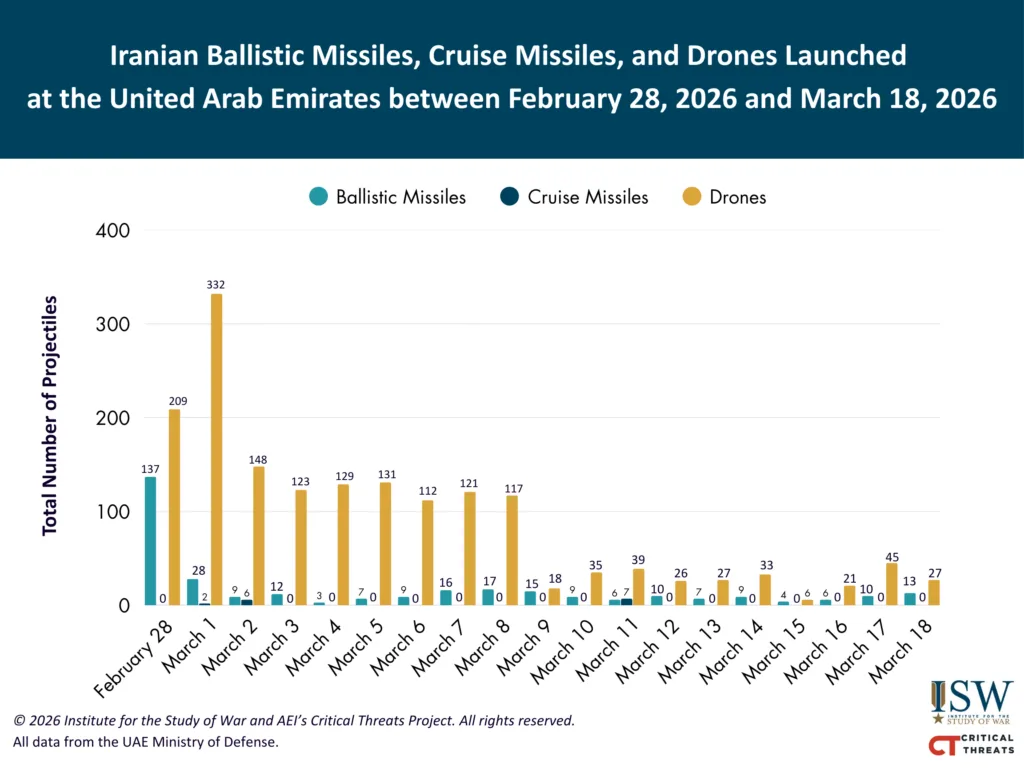
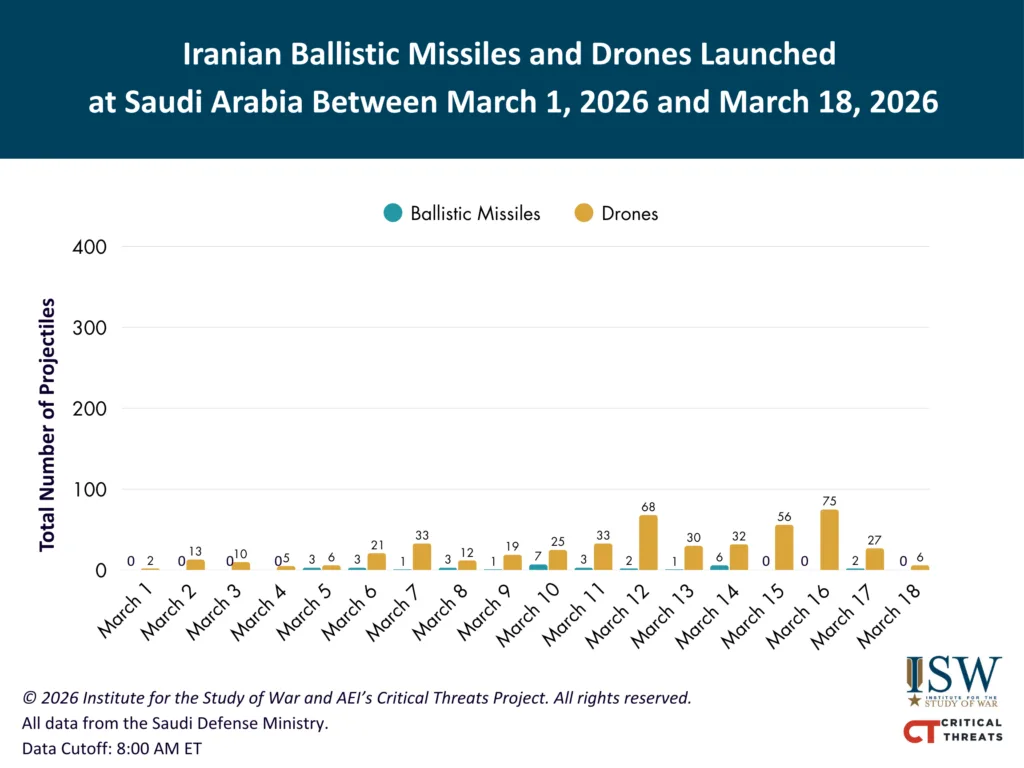
more + maps https://understandingwar.org/research/middle-east/iran-update-special-report-march-18-2026/
1,824
posted on
03/19/2026 12:57:47 AM PDT
by
AdmSmith
(GCTGATATGTCTATGATTACTCAT)
1,825
posted on
03/19/2026 1:36:25 AM PDT
by
AdmSmith
(GCTGATATGTCTATGATTACTCAT)
To: gleeaikin
1,826
posted on
03/19/2026 3:34:45 AM PDT
by
nuconvert
( Warning: Accused of being a radical militarist. Approach with caution.)
To: nuconvert
1,827
posted on
03/19/2026 3:53:32 AM PDT
by
AdmSmith
(GCTGATATGTCTATGATTACTCAT)
To: nuconvert
1,828
posted on
03/19/2026 3:57:14 AM PDT
by
AdmSmith
(GCTGATATGTCTATGATTACTCAT)
To: AdmSmith
I follow that website all day.
1,829
posted on
03/19/2026 4:04:31 AM PDT
by
nuconvert
( Warning: Accused of being a radical militarist. Approach with caution.)
To: nuconvert
1,830
posted on
03/19/2026 4:30:51 AM PDT
by
AdmSmith
(GCTGATATGTCTATGATTACTCAT)
To: nuconvert; AdmSmith; BeauBo; dennisw; USA-FRANCE
Back in 2022, your old Comment #7, which I am reading today for the first time said, “he [Obama] did not have the same reservations [when he did not interfere in Iran protests] when he sent billions to the Regime. Sorry to question the democrat messiah, but I must.”
I too was surprised then that the money was going, but I also realized there was probably some one or more valid reasons to do so. Today I decided to see how much AI knows, so here it is.
“AI Overview:
==The Obama administration did not send “new” U.S. taxpayer money to Iran in 2016. Instead, the payment consisted of old money—specifically, a $400 million principal that Iran had paid into a U.S.-managed trust fund for military equipment prior to the 1979 Iranian Revolution, plus $1.3 billion in interest.
*Here are the key details regarding the settlement:
—Failed 1979 Arms Deal: The money was part of a settlement to resolve a decades-old dispute at the Iran-U.S. Claims Tribunal in The Hague. Iran had paid for U.S. military equipment that was never delivered after the Shah was overthrown in 1979.
—The Total Amount ($1.7 Billion): The total settlement included the $400 million principal and $1.3 billion in interest (a “compromise” amount agreed upon rather than a higher interest payment a tribunal might have ordered).
—”Pallets of Cash”: The payment was made in cash (euros, Swiss francs, and other foreign currencies) and flown to Iran on an unmarked cargo plane. The Obama administration stated this was necessary because international sanctions still in place at the time prohibited Iran from using the formal global banking system.
—Prisoner Release Correlation: The initial $400 million cash delivery occurred on January 17, 2016, the same day Iran released four American prisoners and the same weekend the Iran Nuclear Deal was implemented.
—Leverage vs. Ransom: While the Obama administration denied the payment was a “ransom,” officials later admitted the delivery was intentionally delayed until the prisoners were safely released to ensure “maximum leverage”.’”
More from AI Deep Dive:
“==In 2016, the Obama administration transferred $1.7 billion to Iran, which was composed of old money belonging to Iran that had been frozen since 1979.
The payment was a settlement for a decades-old legal dispute over a failed arms deal between the U.S. and the Shah of Iran.
*Breakdown of the $1.7 Billion Payment:
—$400 Million (The Principal): This was the original amount Iran had paid into a U.S. trust fund for military equipment (specifically fighter jet parts) before the 1979 Revolution. The equipment was never delivered after the revolution, and the U.S. had held the funds since then.
—$1.3 Billion (The Interest): This portion represented the accumulated interest on that $400 million over the 37 years it was held by the U.S..
*Key Details of the Transfer:
—Form of Payment: The total amount was delivered in cash (specifically foreign currencies like euros and Swiss francs) because U.S. sanctions prohibited direct dollar transfers to Iranian banks.
—Source of Funds: The $1.3 billion in interest was paid from the U.S. Treasury’s Judgment Fund, a permanent account used to pay court judgments and settlements against the federal government.
—The “Ransom” Controversy: While the administration maintained the payment settled a long-standing claim at The Hague Tribunal, the timing of the first $400 million shipment coincided with the release of several American prisoners. U.S. officials later admitted the money was used as “leverage” to ensure the prisoners were allowed to leave.
—Broader Context: This $1.7 billion settlement was separate from the $50 billion to $150 billion in Iranian assets that were unfrozen globally as part of the Iran Nuclear Deal (JCPOA). Those funds were also Iran’s own money (mostly oil revenue) held in foreign banks, not new U.S. taxpayer money.”
Thus this whole issue was from the old Shah of Iran who died here during Cancer treatment, an unsettled debt that belonged to the country of Iran which was long withheld because of how the new rulers behaved in the start of their power (kidnap 44 US Embassy personnel for many months). So fortunately, no US taxes, yours or mine, were part of this business deal. ;-)
1,831
posted on
03/19/2026 8:19:19 PM PDT
by
gleeaikin
(Question Authority: report facts, and post their links in your message.)
To: gleeaikin
My post #7 is a link, so maybe you misnumbered it?
Anyway, the source of the money has been known for yrs, and is irrelevant, as far as I’m concerned. The decision to give it was unbelievably stupid. That’s what I thought then & now.
1,832
posted on
03/20/2026 3:22:33 AM PDT
by
nuconvert
( Warning: Accused of being a radical militarist. Approach with caution.)
To: nuconvert
Iran Update Special Report, March 19, 2026
Israeli strikes on Iranian internal security forces, including decapitation strikes, have likely caused shock and confusion within the Iranian internal security apparatus and disrupted internal security operations to some degree. It remains impossible to assess based on the available open-source evidence to what degree internal security operations have been disrupted. The IDF has targeted internal security and political figures at every echelon, from senior leaders such as Supreme Leader Ali Khamenei, Supreme National Security Council (SNSC) Secretary Ali Larijani, and Basij Organization Commander Brigadier General Gholamreza Soleimani to low-ranking Basij members manning checkpoints.[1] The IDF has also shifted from targeting high-level headquarters to smaller sites, including checkpoints, roadblocks, and local police stations.[2] Some of the strategic-level strikes are unlikely to have immediate effects on tactical units. It remains unclear, for example, how much Soleimani’s death will affect Basij forces’ ability to operate. But all strikes have both kinetic and psychological effects. The psychological effects include shock and fear caused by a sense that Israel can target any Iranian servicemember at any time and for any reason. Mossad has amplified this sense of fear in some cases by calling individual Iranian officers, but the strikes also generate this effect on their own. Fear and shock have caused some Iranian internal security personnel to abandon established headquarters and bases, set up improvised facilities, and adapt command-and-control structures under pressure, for example.[3] Some Iranian security forces are hiding under bridges, and Soleimani was reportedly operating from a tent in a wooded area before he was killed, for example.[4] Allowing overpasses to dictate one's tactical deployments rather than determining deployments based on tactical realities is certainly suboptimal. Running a headquarters out of a tent rather than an established facility is certainly suboptimal, though not necessarily wholly ineffective. These reports indicate a notable level of operational shock across the regime's coercive apparatus, including the Islamic Revolutionary Guards Corps (IRGC), Basij, and Law Enforcement Command (LEC), and suggest that elements of Iran's internal security system are functioning suboptimally at this time.
Israel would need to sustain these psychological effects by continuing to target Iranian security officers in order to achieve its objective of “creating conditions for regime change.”[5] The operational-level disruption caused by this shock and demoralization could “create the conditions for regime change” over time and if desertions or refusal to obey orders spread. But the disruption will not cause regime collapse without an indigenous force to exploit the disruption.[6] The current level of disruption appears limited and is likely insufficient to meet Israel's objectives at this time. Shock will dissipate, potentially quickly, if strikes on internal security targets subside.
These operational-level effects are not causing strategic-level consequences at this time. Strategic-level decapitation strikes, including the killing of senior leaders such as Ali Khamenei, have caused political tensions and infighting within the regime. This infighting has not led to a breakdown within the regime, however, and largely represents ongoing political fights over succession that will persist. The strategic level could become less relevant if shock and disruption become severe enough at the operational level that internal security forces can no longer function and opposition groups exploit the security forces’ shock. CTP-ISW has not observed any evidence that opposition groups are exploiting security forces’ shock or that opposition forces believe it is possible to exploit the disruption of security forces at this time. Such evidence may be difficult to detect in the open source, however.
The Israel Defense Forces (IDF) struck vessels at a major Caspian Sea port in northern Iran that Iran uses to conduct trade with Russia. The IDF targeted “dozens” of vessels, including the Artesh Navy Moudge-class frigate IRIS Deylaman, at the 4th Artesh Naval District Headquarters at Bandar Anzali Port, Gilan Province, on March 18.[7] Israeli officials stated that more than five of the targeted vessels possessed anti-aircraft capabilities that could threaten combined force aircraft.[8] An IDF spokesperson confirmed that the IDF also hit a command center and a shipyard.[9] The Bandar Anzali governor stated on March 19 that Israeli airstrikes also targeted a customs building and an unspecified shipping organization.[10] The shipping organization was likely Shahid Tamjidi Offshore Industries, which an Israeli open-source intelligence (OSINT) account reported on March 18 that Israeli airstrikes had targeted.[11] Shahid Tamjidi Offshore Industries is a subsidiary of the Iranian Defense and Armed Forces Logistics Ministry.[12]
Israeli media reported on March 19 that the Israeli strikes in Bandar Anzali “shut down” a critical supply line between Iran and Russia for both basic goods, such as wheat imports, and military equipment.[13] An Israeli journalist separately amplified reports that the IDF may have targeted a vessel that had returned from Russia in the past 24 hours and was suspected of carrying drone-related technology.[14] CTP-ISW is unable to verify this report. Iran and Russia have previously traded military equipment through this Caspian Sea route, however. Former US National Security Council spokesperson John Kirby previously announced in June 2023 that Russian ships were transporting Iranian Shahed drones from Amirabad Port, Mazandaran Province, in northern Iran to Makhachkala, Russia, via the Caspian Sea.[15]
India, Pakistan, Iraq, Malaysia, and China are negotiating with Iran to allow their vessels to transit through an IRGC-managed “safe corridor” in the Strait of Hormuz, according to sources “with direct knowledge of the transits” speaking to UK-based shipping intelligence firm Lloyd's List on March 18.[78] Nine vessels have reportedly used this corridor so far, including two Indian-flagged liquefied petroleum gas (LPG) tankers, six unspecified bulk carriers, a Pakistani-flagged oil tanker, and three US-sanctioned LPG tankers.[79] Lloyd's List reported that, in one instance, a vessel paid $2 million USD to transit the Strait of Hormuz. Ships are required to submit detailed ownership and cargo data through IRGC-linked intermediaries before being approved to transit through the “safe corridor.”[80] Lloyd's List also identified IRGC naval activity on Larak Island in the Strait of Hormuz, where vessels are being diverted around, on satellite imagery.[81] Lloyd's List reported that overall traffic through the Strait of Hormuz has dropped sharply, with only 15 transits taking place between March 15 and 17. Ninety percent of these transits involved Iranian-linked vessels.[82] UKMTO has recorded 21 maritime attacks and incidents since March 1, but the last confirmed Iranian attack on a commercial vessel took place on March 11.[83]
The Iranian regime is continuing to take steps to securitize Iranian society. Iranian authorities arrested dozens of individuals across multiple provinces on March 18 and 19 for allegedly spying for Israel and engaging in other anti-regime activities.[160] The Iranian Intelligence Ministry and IRGC Intelligence Organization claimed that they have arrested over 200 individuals since the start of the war.[161] Security forces in Sistan and Baluchistan Province arrested 13 individuals reportedly linked to anti-regime militant groups on March 19.[162] Iranian authorities claimed that the arrested individuals were collecting intelligence on military movements, security facilities, and air defense sites, and were preparing to conduct “terrorist attacks.”[163] The regime separately executed three individuals in Qom Province on March 19 who had participated in the December 2025-January 2026 protests.[164] The Iranian regime has sustained its internet shutdown and continued to seize Starlink devices to restrict the flow of information.[165]
more + maps https://understandingwar.org/research/middle-east/iran-update-special-report-march-19-2026/
1,833
posted on
03/20/2026 4:24:50 AM PDT
by
AdmSmith
(GCTGATATGTCTATGATTACTCAT)
To: nuconvert; BeauBo; BroJoeK; AdmSmith
Whether returning the money was stupid or merely unfortunate, I have intermittently seen this return mischaracterized as using OUR taxpayer money, often in a racially negative discussion or information setting. I have seen in the more recent past that Brussels was very cautious about considering using interest from Russian frozen assets to assist Ukraine. I wonder if some kinds of international legal decisions were made regarding return of the Iran government’s payment for merchandise not received plus interest accrued during the years those funds were held, which caused/influenced Brussel’s decisions in the Ukraine/Russia case?
1,834
posted on
03/20/2026 9:17:40 PM PDT
by
gleeaikin
(Question Authority: report facts, and post their links in your message.)
To: nuconvert
I was looking at #66, but perhaps I accidentally typed #67 as I was also looking at that comment while doing my AI search, but my difficult, opinionated old Chromebook deleted the number 6, leaving #7.
1,835
posted on
03/20/2026 9:35:12 PM PDT
by
gleeaikin
(Question Authority: report facts, and post their links in your message.)
To: gleeaikin
Conflicted: The Strait of Hormuz and How the Iran War Will End
18MAR2026 In this episode of Conflicted Aimen and Thomas lay out the whole story of the Strait of Hormuz, from ancient times all the way up to right now —explaining why the Iran War is happening, and how it is almost certainly to end.
The episode explores:
-How the Strait of Hormuz caused Noah’s Flood
-The medieval Kingdom of Hormuz
-How the Gulf is always caught up in the Iranian plateau’s endless boom-and-bust political cycle
-How Europeans staked a claim on Hormuz in 1507—and never really left
-The fact that the U.S. did indeed go into this war with a plan for Hormuz
-How the U.S. will take Kharg Island—and what they will do with it
-The ingenuity of Gulf Arab leadership in planning workarounds for the eventuality of the Strait being closed
-How European powers and other allies are really contributing to the war effort
https://www.youtube.com/watch?v=i3D7jmVnqlU
1,836
posted on
03/21/2026 4:14:58 AM PDT
by
AdmSmith
(GCTGATATGTCTATGATTACTCAT)
Iran Update Special Report, March 20, 2026
Circumstantial evidence suggests that Iranian Supreme Leader Mojtaba Khamenei is still badly injured or otherwise incapacitated. Mojtaba has yet to appear in public or in any new images or videos since becoming the supreme leader on March 8.[1] The regime has instead recycled old images and videos of him and issued only written statements.[2] This continued absence has fueled rumors about Mojtaba’s status. The regime could easily dispel these rumors with a simple video, but has not, despite having many incentives to do so. This comes as US officials have stated that Mojtaba was seriously wounded.[3]
Mojtaba emphasized narrative control, economic resilience, and regional policy in his Nowruz written statement on March 20.
Iranian leaders have said that they will continue to impede international shipping around the Strait of Hormuz after the war ends. Iranian Parliament Speaker Mohammad Bagher Ghalibaf said on X on March 17 that “the Strait of Hormuz situation won't return to its pre-war status.”[12] Expediency Discernment Council member Mohammad Mokhber stated on March 19 that there will be a ”new regime for the Strait of Hormuz” following the war.[13] He said that Iran can use its position along the strait to “sanction [the West] and prevent their ships from passing through this waterway” even after the war ends.[14] Iran has recently allowed certain vessels to transit the strait through an IRGC-managed “safe corridor.”[15] A Tehran parliamentarian said on March 19 that the Iranian parliament is considering a proposal to impose fees on vessels that seek to transit the Strait of Hormuz.[16] Iranian Supreme Leader Mojtaba Khamenei wrote in his first statement since becoming the supreme leader that Iran will forcefully ”extract reparations from the enemy” and will “take” or destroy US and Israeli assets.[17] Daily oil exports from the Middle East have fallen by at least 60 percent since the start of the war.[18]
The IDF reportedly killed Basij Organization Intelligence Chief Esmail Ahmadi.[38] ISW-CTP assessed on March 19 that Israeli strikes targeting the Iranian internal security services, including decapitation strikes, have likely caused shock and confusion within the internal security apparatus and disrupted internal security operations to some degree.[39] The IDF also killed Basij Organization Commander Brigadier General Gholamreza Soleimani and his deputy Ghassem Ghoreyshi in airstrikes in Tehran on March 17.[40] The Basij is a paramilitary force generally designed for social control and civil defense.
The IDF also killed the following individuals in its ongoing decapitation strikes:
IRGC Spokesperson Brigadier General Ali Mohammad Naeini.[41] Naeini played a key role in spreading regime propaganda and disinformation. Naeini repeatedly issued threats to attack US and Israeli interests in the region. The United Kingdom sanctioned Naeini following the October 2024 Iranian missile attacks on Israel.[42]
IRGC Aerospace Force Commander in Esfahan Mehdi Ghoreyshi.[43] The IRGC Aerospace Force is the principal operator of the Iranian missile and drone arsenals. The combined force has targeted several missile, drone, and air defense sites in Esfahan Province since February 28 to degrade Iranian capabilities there.
The IDF also killed an Iranian Intelligence and Security Ministry official, Mehdi Rostami Shamestan.[44] Shamastan played a role in promoting attacks against Israeli and Jewish civilians across the world.
more + maps https://understandingwar.org/research/middle-east/iran-update-special-report-march-20-2026/
1,837
posted on
03/21/2026 4:25:26 AM PDT
by
AdmSmith
(GCTGATATGTCTATGATTACTCAT)
To: AdmSmith
1,838
posted on
03/21/2026 4:45:50 AM PDT
by
AdmSmith
(GCTGATATGTCTATGATTACTCAT)
To: nuconvert; BeauBo
Iran Update Special Report, March 21, 2026
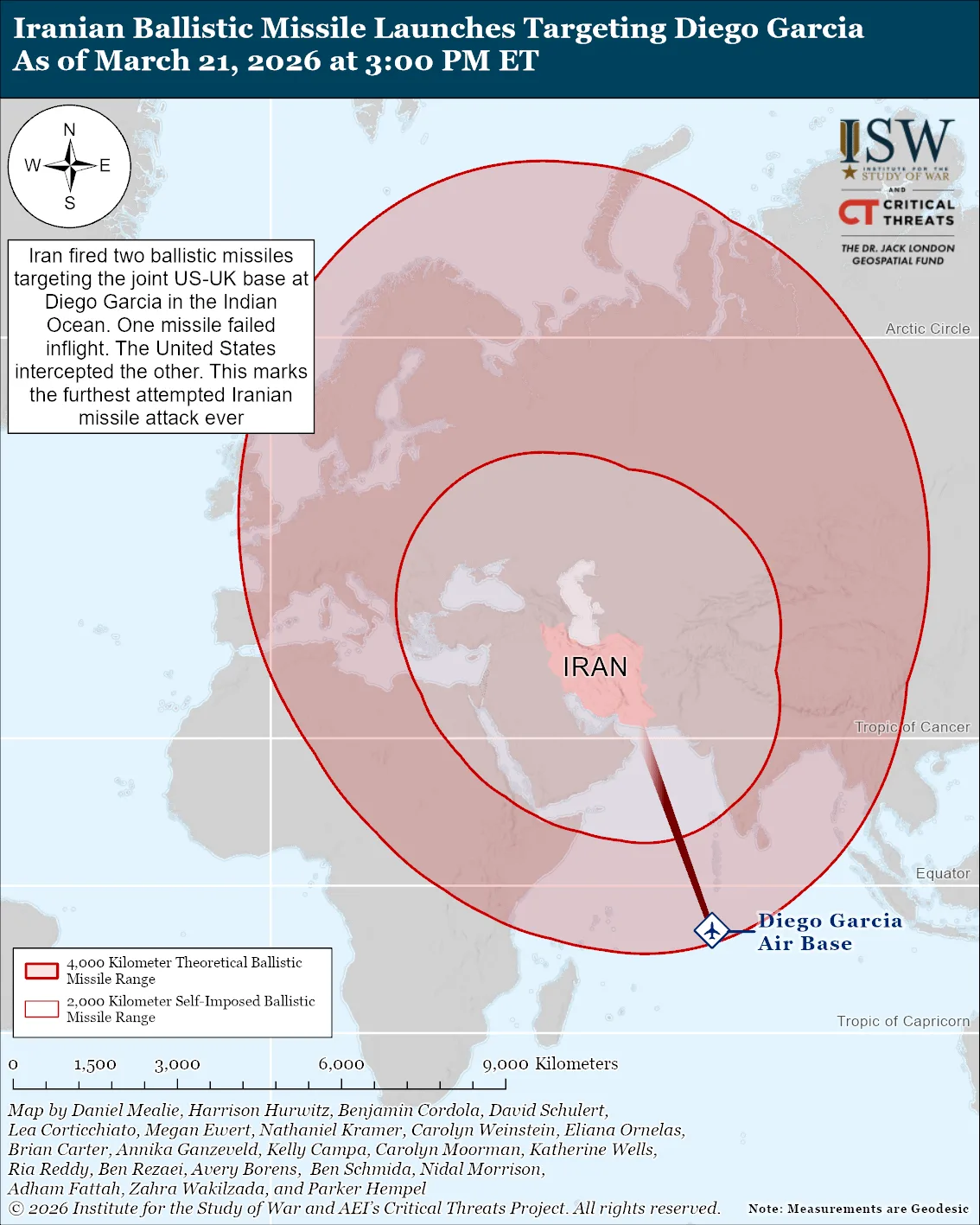
Iran launched two ballistic missiles targeting the US-UK base at Diego Garcia in the Indian Ocean on March 21, marking the furthest ever attempted Iranian missile strike.[1] The attack demonstrated that Iranian missiles can reach beyond the 2,000-kilometer limit that the regime has long claimed to have self-imposed. One missile failed inflight, and the United States intercepted the other.[2] Diego Garcia is located just over 4,000 kilometers from southern Iran. It is unclear exactly what system Iran used in the attack. It could have been a modified version of one of its longer-range missiles or a previously unknown capability. The attempted attack upends some assumptions about the Iranian missile program, and especially the threat that they may pose to Europe. The nature of that threat depends on the system Iran used and how reliably it can hit targets beyond the 2,000-kilometer range, however.
The Islamic Revolutionary Guards Corps (IRGC) has reportedly expanded its influence over regime decision-making amid a growing power vacuum caused by leadership losses and Supreme Leader Mojtaba Khamenei’s apparent inability to exercise full authority.[3] Two senior Israeli officials told Axios on March 21 that the IRGC has mainly filled the power vacuum that has formed in the regime as a result of Israeli decapitation strikes.[4] Israel has conducted several decapitation strikes since the war began, which have likely disrupted centralized command and control to some extent and created uncertainty around senior decision-making.[5] US and Israeli officials reportedly assess that Mojtaba remains alive, but they have not observed clear evidence that he is personally giving orders, which is consistent with ISW-CTP’s assessment that circumstantial evidence suggests that Mojtaba Khamenei is still badly injured or otherwise incapacitated.[6] The loss of key leadership and Mojtaba’s reported inability to govern at least partially explain the rising role of the IRGC, and specifically hardline IRGC figures close to Mojtaba, such as IRGC Commander Brigadier General Ahmad Vahidi, Parliament Speaker Mohammad Bagher Ghalibaf, and former IRGC Commander Major General Mohammad Ali Jafari. These IRGC officers were reportedly among the individuals who pushed to get Mojtaba selected as the next supreme leader.[1] All three have historically held senior positions across Iran's military, political, and internal security institutions.[7] They represent a network of influential and highly ideological actors with deep ties to the regime's coercive apparatus.[8] These individuals are among the most aggressive and repressive elements within the IRGC.
The United States Treasury Department issued a short-term waiver on March 20, permitting the sale of Iranian oil already in transit.[9] The waiver does not allow for new purchases of oil. Treasury Secretary Scott Bessent said that the waiver will inject around 140 million barrels of oil into the global market. Daily oil exports from the Middle East have fallen by at least 60 percent since the war began.[10] Bessent added that the United States will continue to maintain maximum pressure on Iran to limit its access to the international financial system and, therefore, any revenue generated from the oil sales.[11]
https://understandingwar.org/research/middle-east/iran-update-special-report-march-21-2026/
1,839
posted on
03/22/2026 1:02:53 AM PDT
by
AdmSmith
(GCTGATATGTCTATGATTACTCAT)
What's Going on With Shipping Sal Mercogliano
21MAR2026 Strait of Hormuz 3-Week Recap | What is the Status of the Ships, Transits and Escort Mission?
In this episode, we recap the first three weeks of the war between the United States, Israel, and Iran with a focus on commercial shipping in and around the Persian Gulf, Strait of Hormuz and Gulf of Oman.
https://www.youtube.com/watch?v=q64cOs7GN_4
1,840
posted on
03/22/2026 3:10:22 AM PDT
by
AdmSmith
(GCTGATATGTCTATGATTACTCAT)
Navigation: use the links below to view more comments.
first previous 1-20 ... 1,801-1,820, 1,821-1,840, 1,841-1,860 ... 2,461-2,479 next last
Disclaimer:
Opinions posted on Free Republic are those of the individual
posters and do not necessarily represent the opinion of Free Republic or its
management. All materials posted herein are protected by copyright law and the
exemption for fair use of copyrighted works.
FreeRepublic.com is powered by software copyright 2000-2008 John Robinson

