Skip to comments.
On this date in 1863
Posted on 07/04/2018 6:19:14 AM PDT by Bull Snipe
A glorious 4th of July for the Union cause. General Lee's Army of Northern Virginia begins it retreat from Pennsylvania after having been defeated by General Meade's Army of the Potomac at the Battle of Gettysburg. General Grant accepts the surrender of the City of Vicksburg from General Pemberton. About 32,000 Confederate soldiers stack their weapons and are paroled by the Union forces. This is the second Confederate Army to surrender to Grant. The Union now controls the Mississippi river and the Confederate state is split into two parts.
TOPICS: History
KEYWORDS: militaryhistory
Navigation: use the links below to view more comments.
first previous 1-20 ... 141-160, 161-180, 181-200 ... 221-237 next last
To: BroJoeK
Yes, I think you are correct about Lincoln.
The proof is what happened on Good Friday, 1865 in Ford’s Theater.
161
posted on
07/09/2018 10:27:51 PM PDT
by
Sontagged
(TY Lord Jesus for being the Way, the Truth & the Life. Have mercy on those trapped in the Snake Pit!)
To: gandalftb
gandalftb:
"...my family took up arms after the Civil War began, not before." Understood, and that matters if you're in the self-flagellation business.
All you're really saying is they served in the Union army, presumably honorably, nothing to apologize for in that.
gandalftb: "No hand-wringing or self-flagellation, real simple, I try to be completely honest and open.
Both sides have their points."
Well... the points both sides agree on are never discussed here, why bother?
The points we disagree on invariably begin with Lost Causer lies accusing Union leadership, soldiers & voters of endless nefarious nonsense.
Our function here is to correct their lies, and we don't begin by apologizing for telling the truth -- do you follow me so far?
gandalftb: "My family acted on their own initiative, based on common decency and faith.
Law enforcement efforts were largely irrelevant."
No, law enforcement is 100% the point of this discussion, because 1861 secessionists used the lack of law enforcement as their claim of a material breech of contract/constitution legally justifying their declarations of secession.
Why was law enforcement less than adequate when for every year before 1861 Southern Democrats had been in power, or highly influential, in Washington, DC?
I'm suggesting four reasons, beginning with: the numbers were relatively small, so no significant threat to the "peculiar institution".
But I also think Fire Eaters wanted the issue, because without it they had nothing constitutional to complain of.
gandalftb: "Remember, the Constitution guarantees justice.
Fighting slavery was a simple recognition that slaves were people and deserve to be treated as such, not property."
Interesting, the Constitution uses the word "justice" in three places, one of which is:
"A Person charged in any State with Treason, Felony, or other Crime, who shall flee from Justice, and be found in another State... "
The very next clause says:
"No Person held to Service or Labour in one State, under the Laws thereof, escaping into another..."
Obviously, "justice" is in the eyes of the beholders.
gandalftb: "You say 'Allowing a small number of discontented slaves to escape'.
Who did this allowing?
Slaves were worth an average of about $1,000 (1860 dollars).
Property owners would not have allowed such valuable property to be lost."
Right, all through the antebellum period the South was an armed camp, with citizen slave patrols and slave-catcher bounty hunters scouring the country for fugitives.
Many operated in Northern states under control of Federal authorities.
And yet small numbers did escape because Federal authority was weak and/or Northern states turned a blind eye to the Underground Railroad.
My point here is that those escapees had to come mainly from such Border States as Missouri and Maryland which were close to free-states and also had large populations of anti-slavery whites to help them.
And, as it turned out, successful Fugitives also provided Deep South secessionists with a convenient constitutional breech to justify declarations of secession.
It was a loud complaint with very little actual cost to those particular slave-holders.
You disagree?
162
posted on
07/10/2018 6:53:35 AM PDT
by
BroJoeK
((a little historical perspective...))
To: x
You are apparently laboring under the misconception that Abraham Lincoln was a New Yorker, rather than an Illinoian (or an Illinoisian or an Illinoisan). Why would he care about the particular interests of New York City businessmen? I use "New York" as a synechdoche to describe the larger influence cartel that took control of Washington DC for the purpose of passing legislation that favored the continuation of money flowing through the hands of this Cartel. (Same cartel that is running Washington DC today.)
If Lincoln were as cynical a politician as you think and if it were all about the money, why didn't he throw in with the slave states? His friend and fellow Whig Alexander Stephens did so with a vengeance. If they would have all the money and the power it would seem like a logical move for an opportunist.
The slave states were the cash cow for the cartel. They didn't have a majority, and so they no longer controlled the money flow of Washington DC. Why would he throw in with the lesser power? I dare say Lincoln was smarter than Alexander Stephens.
163
posted on
07/10/2018 7:47:50 AM PDT
by
DiogenesLamp
("of parents owing allegiance to no other sovereignty.")
To: DiogenesLamp; BroJoeK; rockrr
“What would happen if slavery “expanded” into Kansas, and Nebraska, and other western territories? (where it couldn’t really expand because you couldn’t make plantation farming work in any of these territories)”
Great question.
There was considerable fear among abolitionists about the expansion of slavery into the western territories.
In 1848, the Mexican Cession territory included all land from TX to California. Its status regarding slavery was the leading major issue nationally. Had the Democrats prevailed, there could have been slave states from the Atlantic to the Pacific.
Spanish and Anglo landholders had been enslaving Indians there for generations.
While there was only about 24 slaves brought from the South in the territory, and plantation farming was unlikely, it was a hot topic.
In 1859, New Mexico passed an elaborate slave code that permitted the owning of African-American slaves by former Mexicans and supported the rights of all slave owners.
To: DiogenesLamp; Sontagged; x; DoodleDawg; rockrr; gandalftb
DiogenesLamp:
"I think it was more than bankers.
I think it was the shipping moguls, Insurance people, warehousing people, manufacturing people.
In short, I think it was everyone who was making money off of the South's trade with Europe." And every one, without exception, was Democrat -- social friends, political allies & business partners to the Southern slave-power -- who supported the South and voted with them in Congress.
DiogenesLamp: "I think Lincoln actually hated slavery, but I am less sure about this than I was at one time, because i've seen so many examples of him massaging the appearance of his conduct to place it in a better light."
Young Lincoln's parents were anti-slavery, it's one reason they left Kentucky for Indiana.
Lincoln hated slavery, but also recognized the Constitution protected it, and there was only so much that could be done to restrict it.
DiogenesLamp: "He was from Kentucky, and I believe he had an uncle that had slaves, and so it's a little unclear how he might have developed a hatred for slavery having grown up amongst it."
Lincoln's ancestors moved from Massachusetts to eventually Virginia & Kentucky by 1780.
Some of the wealthier owned slaves -- his Uncle Mordecai is said to have owned "a slave", while his father's Uncle Isaac may have owned 40 slaves.
But Lincoln's parents were never well-off and, more important, they belonged to a strict Baptist church which opposed slavery.
When young Lincoln's family moved from Kentucky to Indiana, Lincoln said there were two reasons and one was slavery.
So Lincoln was taught anti-slavery as a child.
DiogenesLamp: "I now believe this may have been an artifice meant to appeal to the voting segment he saw as his path to power "
Hardly!
In January 1837 Lincoln was not yet 28 years old and was serving in the Illinois state legislature.
A proposal came up for vote: condemning abolitionism and abolitionist societies.
The vote in the Illinois Senate was 18 to 0, in the House 77 to 6.
So clearly the wave of the political future in Illinois in 1837 was to support slavery and oppose abolitionists.
Lincoln was one of the six House members who voted "no".
DiogenesLamp: "He may have projected this as his public persona, and perhaps he even convinced himself over time that this was correct, but it seems strange that he would eschew his own culture and embrace that of others. "
This just has to be DiogenesLamp speaking of himself, projecting his own experiences onto Lincoln, typical Democrat.
The fact is that Lincoln was taught anti-slavery as a child and opposed it publicly from an early age, though he did also acknowledge the law and Constitution.
DiogenesLamp: "You could also look at Joseph Stalin as the instrument of God in defeating the Nazis.
But if you look at Joseph Stalin in that way, it becomes unclear why God would work through such an evil man who murdered more people than did the Nazis."
In fact, one reason Stalin's people were willing to fight & die against Nazis was that Stalin allowed them, for the first time, to openly worship in churches.
It is also the fact that Stalin, unlike Hitler, did not focus his insane hatreds on God's people, Jews.
That is something God would take notice of, imho, in judging the lesser of two evils.
DiogenesLamp: "Maybe Stalin wasn't the instrument of God, and perhaps Lincoln wasn't either?
I've noted in these discussions how much personal suffering the Lincoln family endured during the war years, and i've expressed bafflement that God would so badly treat a man doing God's work."
And you've been smacked down every time, but totally ignore the rebukes!
In fact virtually nobody in Lincoln's time lived the idyllic live we take for granted today.
Many children died young, many spouses suffered illnesses, physical & mental.
Jefferson Davis especially endured many family disasters.
See this link (post #1299) for a summary.
DiogenesLamp: "One would think God would at least shield and protect a righteous man from tragedy and his enemies."
God had serious work for Lincoln to do.
When that work was complete God called him Home.
DiogenesLamp: "I finally started to realize the truth because I became aware of two pieces of information that didn't make any sense.
1. New York paid most of the tariffs (taxes) into Washington DC.
2. The South produced 80% of all export value, and import values must roughly balance, therefore the South was producing most of the money that ended up in New York.
What I couldn't understand was why the money was ending up in New York when it was produced in the South."
Regardless of how often you post it, that's still a total misrepresentation of the facts.
Deep South cotton represented roughly $200 million 5% of a $4.4 billion US economy.
Yes, cotton was the single largest US export, accounting for about half of the $400 million 1860 total, including specie (California gold, Nevada silver).
But the US economy could & did get along without cotton during the Civil War, indeed doubled to nearly $10 billion by 1865.
As for why "the money" ended up in New York, well, for one thing, that's where it started!.
New Yorkers loaned the money which paid for Southern land and purchased slaves to produce cotton which then moved on NewYork-financed railroads to Southern harbors for transport on New York ships to Europe, etc.
On their return those ships brought imports to warehouses in New York where tariffs were paid before sale all across the country.
Of course you might well suppose that some elite Southern commercial interests could want a bigger piece of that action, but the fact is that not one of them even mentioned it in 1861 (for example, here).
That's what makes it pure fantasy on DiogenesLamp's part.
![]()
165
posted on
07/10/2018 9:37:12 AM PDT
by
BroJoeK
((a little historical perspective...))
To: DiogenesLamp; gandalftb
DiogenesLamp:
"I recall you saying Iowa Militia wanted to take up arms against the other slave states, but did it not occur to them to attack the closest slave state?" Certainly nothing like that was posted on this thread.
Can you point to where that was claimed?
166
posted on
07/10/2018 9:42:33 AM PDT
by
BroJoeK
((a little historical perspective...))
To: DiogenesLamp; rustbucket; gandalftb; x; jeffersondem; rockrr; DoodleDawg
rustbucket post #108:
"In 1788-90 states had peaceably, unilaterally and with the approval of their own state conventions withdrawn from Union under the Articles of Confederation."DiogenesLamp #147: "Good aggregation of information, but pointless I think.
Our opposition is driven by an emotional need to see a distinction between what the 13 slave owning colonies did, and what the 11 slave owning states did."
Among our Lost Causers, rustbucket is exceptionally honest, straightforward and thorough, orders of magnitude more so than, for examples, DiogenesLamp or jeffersondem.
Still his argument cannot be made without lying about it, as we see in the line quoted above.
In fact, the word "unilaterally" is a lie because "secession" in 1788 was done peacefully & lawfully by mutual consent, not "unilaterally".
The truth is that no legitimate Founder at any time ever proposed or supported unilateral, unapproved declaration of secession at pleasure, meaning absent the kinds of compelling necessity spelled out in their Declaration of Independence.
167
posted on
07/10/2018 10:07:05 AM PDT
by
BroJoeK
((a little historical perspective...))
To: DiogenesLamp; rustbucket; rockrr; x
DiogenesLamp:
"Many's the time I wanted some piece of information that I had previously posted, and could no longer find it." Much as it pains me, I'll do you a serious favor and show you how to find every post you've ever made and every comment or link in every post.
Do a word search here:
Posts by DiogenesLamp
No problem, you're welcome, and no I never, ever, look at any old posts except my own, for exactly the reason you state here.
168
posted on
07/10/2018 10:19:41 AM PDT
by
BroJoeK
((a little historical perspective...))
To: gandalftb; rustbucket; DiogenesLamp; Pelham; FLT-bird; Rome2000; Ambrosia; central_va; BroJoeK
“Also, it is irritating when BroJoeK descends into name calling and insults, no need for that in an adult discussion.”
The problem is that somewhere along the way you contradicted northern orthodoxy about something - perhaps Lincoln's decision to fight the war “at pleasure.”
Ooops, I think that phrase may have been copyrighted in recent days.
But you did probably rub some northern fur the wrong way and so words have had to be posted to grind you down.
The fortunate thing for you: you didn't live in the northern states about 157 years ago. If you had expressed your opinions then you would have been locked in a dungeon and kept there without a trial.
Or worse.
By the way, I disagree with some of the things you have written but have not found it necessary to name call. Or even to name call at pleasure.
To: DiogenesLamp; x
x:
"All of this was debated at length a century and a half ago."DiogenesLamp: "I must have missed that.
Last I checked, someone raised a massive army and went down and killed other people who objected.
Perhaps you and I have different understanding of the word "debate." "
You did miss it.
In fact, there was an actual public debate which began roughly in November 1860 and lasted until about April 12, 1861.
Indeed, the debate was more-or-less settled in the Union with the ideas expressed by Democrat President Buchanan to the effect that it was unconstitutional & unlawful for states to unilaterally declare secession at pleasure, but there was nothing the Union should do to stop them.
That's where things stood when President Lincoln took office and that's where they remained until, until... until Confederates:
- Provoked war by seizing dozens of major Federal properties -- forts, ships, arsenals, mints, etc.
- Started war by assaulting and seizing Union troops in Union Fort Sumter.
- Formally declared war on the United States, May 6, 1861.
- Waged war in Union states & territories -- 30 of the first 52 larger battles in the Union, not Confederacy.
- Refused to stop fighting on any terms better than Unconditional Surrender.
Or as one leading Confederate put it:
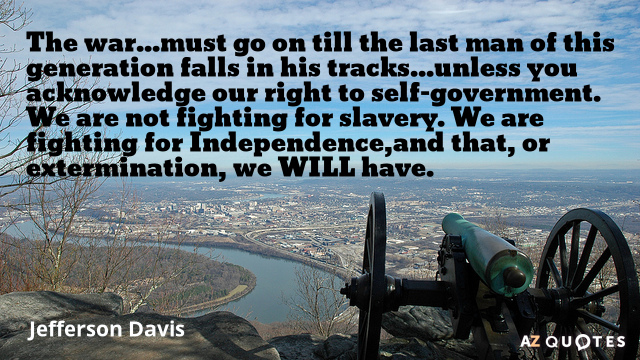
All of which by now DiogenesLamp knows well, by heart, but absolutely refuses under any circumstances to recognize.
{sigh}
DiogenesLamp: "One cannot seriously believe the break from the thousand year old government of the United Kingdom was reasonable, but a break from a four score and seven year old coalition of states is not.
The idea is silly."
What's truly "silly" is DiogenesLamp's complete refusal to recognize the important distinction between the absolute necessity of independence in 1776 versus the total at pleasure declarations of secession beginning in late 1860.
DiogenesLamp: "Ah, but there was a consensus.
The Consensus of the Northern states was to let the "errant sisters" go in peace.
Lincoln deliberately tossed a monkey wrench into the peace by sending a war flee to force the Union member into the Mouth of Charleston Harbor."
A total lie because Lincoln's alleged "war fleet" (two ships on the morning of April 12, a transport and a smasll revenue cutter), was simply Jefferson Davis' excuse to do what he had already ordered done anyway: seize Forts Sumter & Pickens by military force, if necessary.
- "It is scarcely to be doubted that for political reasons the U.S. govt. will avoid making an attack so long as the hope of retaining the border states remains.
- There would be to us an advantage in so placing them that an attack by them would be a necessity, but when we are ready to relieve our territory and jurisdiction of the presence of a foreign garrison that advantage is overbalanced by other considerations.
- "The case of Pensacola then is reduced [to] the more palpable elements of a military problem and your measures may without disturbing views be directed to the capture of Fort Pickens and the defence of the harbor.
- You will soon have I hope a force sufficient to occupy all the points necessary for that end.
- As many additional troops as may be required can be promptly furnished."
[Jefferson Davis to Braxton Bragg, 3 Apr 1861]"
170
posted on
07/10/2018 10:57:31 AM PDT
by
BroJoeK
((a little historical perspective...))
To: gandalftb
While there was only about 24 slaves brought from the South in the territory, and plantation farming was unlikely, it was a hot topic. Lots of emotion, little reality. Cotton won't grow in West Texas, New Mexico, Arizona or Southern California without modern irrigation systems, so it wasn't really practical to have slavery in the territories.
But I believe a lot of people didn't know this at the time. (The slave plantation people probably did though.)
I regard the debate over slavery in the territories to be much like modern debates on Abortion or Homosexuality, where many people opine, but few actually know the facts of the debate.
People may have been ignorant, but they still had opinions.
171
posted on
07/10/2018 11:31:07 AM PDT
by
DiogenesLamp
("of parents owing allegiance to no other sovereignty.")
To: BroJoeK
Certainly nothing like that was posted on this thread. Can you point to where that was claimed?gandalftb wrote:
"When Fort Sumter was fired on, the early Iowa regiments were self financed with gray uniforms. They didn’t think of being a part of the Union Army, they planned to attack the Confederacy on their own."
172
posted on
07/10/2018 11:35:39 AM PDT
by
DiogenesLamp
("of parents owing allegiance to no other sovereignty.")
To: BroJoeK
Much as it pains me, I'll do you a serious favor and show you how to find every post you've ever made and every comment or link in every post. Do a word search here: Thank you for your consideration, but that doesn't help. I write so many posts, sometimes what I want is buried a hundred pages into my history. Also I do not always recall a specific word that will help me zero in to a specific post.
I already knew how to do that, but as I mentioned, the stuff i'm usually seeking is buried too deep into my posting history.
173
posted on
07/10/2018 11:40:46 AM PDT
by
DiogenesLamp
("of parents owing allegiance to no other sovereignty.")
To: DiogenesLamp; x
DiogenesLamp:
"And more importantly, opposing the expansion of the representation vote for the people who were paying 80% of the bills.
You see, this is the sort of thing that makes me cynical.
Three years ago I didn't know the South was paying the vast majority of the bills." Here's what makes me cynical of DiogenesLamp's endless repetitions:
- 80% is absolutely not true, even 50% ($200 million) is overstating because the South imported about $200 million per year from the North, meaning they had tons of help, not to mention slaves, getting their work done.
- That alleged 80% was not mentioned in any 1861 "Reasons for Secession" document by secessionists themselves to justify disunion.
- That alleged 80% was not mentioned by any Unionists in 1861 as reasons to justify Union.
DiogenesLamp:
"I didn't know that New York was collecting the money and sending a good chunk to Washington DC.
I didn't know about the money side of this part of history.
When I found out about it, I started looking more deeply at it." You didn't know it because it's not true, and what you "found out" is a crock of lies packaged in Lost Causer mythology.
And what you "looked more deeply at" was simply more Lost Causer lies.
The fact is that New York did collect a lot of Federal tariffs, all of which went into Federal bank accounts.
But the reasons were, duh... by 1800 New York was the largest city, harbor, transportation, warehousing & finance center.
Nothing to do with "crony capitalism" and everything to do with its many natural advantages.
DiogenesLamp: "What would happen if slavery "expanded" into Kansas, and Nebraska, and other western territories? (where it couldn't really expand because you couldn't make plantation farming work in any of these territories) "
But you didn't need cotton plantations to make slavery work.
All you needed was something (anything) to produce for cash and a population willing to tolerate slave-holders.
And what made slavery especially amenable in the Deep South was precisely what Mississippians said in their "Reasons for Secession" document:
"Our position is thoroughly identified with the institution of slavery-- the greatest material interest of the world.
Its labor supplies the product which constitutes by far the largest and most important portions of commerce of the earth.
These products are peculiar to the climate verging on the tropical regions, and by an imperious law of nature, none but the black race can bear exposure to the tropical sun."
In other words, Mississippians told us the reason slavery worked so well there was because white folks couldn't work in tropical heat.
Slaves could also work in states like Kansas and Nebraska, but there they'd have to compete with white workers who didn't want slave-holders around.
DiogenesLamp: "They would lower tariffs, and they would probably modify the shipping laws to make it easier for competitors to carry their shipping traffic.
This would deprive New York of a lot of money.
It was therefore in New York's best interest to hype the horrors of slavery so as to manipulate people into siding with their coalition."
And yet that is not what any of the 1861 "Reasons for Secession" documents complained about.
DiogenesLamp on Lincoln: "The one thing he absolutely would not tolerate is the possibility of it [slavery] becoming the majority power, and able to stop the money stream going into New York."
Total fantasy, you have no quotes from Lincoln or anybody else to that effect.
It is a figment of your imagination and nothing else.
DiogenesLamp: "Perhaps i'm cynical, but every path I see always leads back to the money.
Not morals, Money.
The morals are always camouflage for the money.
Same as today in the modern Democrat (Urban Liberal) Party."
I'd not call that "cynical", but rather extreme partisan blindness -- you've latched onto Lost Causer narratives to the point where no contrary fact of any kind matters to you any more.
![]()
174
posted on
07/10/2018 1:11:00 PM PDT
by
BroJoeK
((a little historical perspective...))
To: BroJoeK
Among our Lost Causers, rustbucket is exceptionally honest, straightforward and thorough ...Blush
Still his argument cannot be made without lying about it, as we see in the line quoted above.
In fact, the word "unilaterally" is a lie because "secession" in 1788 was done peacefully & lawfully by mutual consent, not "unilaterally".
Perhaps I misspoke. I meant "unilaterally" in the sense that they each decided, one at a time in their own independent conventions from 1787 to 1790, to secede the failing Union under the Articles to join in a different Union proposed by the Constitutional Convention. The ninth state to ratify was New Hampshire on June 21, 1788. Virginia, New York, North Carolina, and Rhode Island ratified later.
Perhaps "independently" might have been a better choice of words in my post above. I was not "lying," just struggling over the right word to use if a single word could describe what the original states did.
The states that seceded in 1860-61 did something similar to those that left the Articles. They seceded from a Union that their voters and/or elected secession conventions were no longer happy with. The states decided one at a time in their own independent conventions and/or by a vote by their voters to secede. Once they seceded, delegates from the first six states that seceded convened in Montgomery, Alabama on February 4, 1861 and by February 8 developed their own provisional Constitution which was largely based on the US Constitution. Texas and the states who seceded after Texas were joining a government with a provisional Constitution.
The original 13 states seceded and joined a Union with a proposed Constitution. In a sense, that Constitution might have been called provisional in that amendments suggested by the various ratification conventions were quickly added to it after the government was formed. On September 25, 1789, the US Congress approved twelve articles of amendment to the Constitution, ten of which (The Bill of Rights) were approved by enough states as Amendments on December 15, 1791.
To: DiogenesLamp; gandalftb
DiogenesLamp:
"Lots of emotion, little reality.
Cotton won't grow in West Texas, New Mexico, Arizona or Southern California without modern irrigation systems, so it wasn't really practical to have slavery in the territories." Just so we're clear on this point: no law of nature or humans restricted slavery to cotton plantations.
Slaves could be, and were, used anywhere slavery was tolerated.
176
posted on
07/10/2018 1:36:04 PM PDT
by
BroJoeK
((a little historical perspective...))
To: DiogenesLamp; gandalftb
DiogenesLamp quoting gandalftb:
"When Fort Sumter was fired on, the early Iowa regiments were self financed with gray uniforms.
They didn’t think of being a part of the Union Army, they planned to attack the Confederacy on their own." Thanks for looking that up and confirming my opinion that gandalftb never claimed the Iowa militia would "take up arms against the other slave states."
Clearly the word gandalftb used was "Confederacy".
Missouri was a Union state, as you well know.
Of course there were many battles fought in Missouri as Confederates attempted to win by force what they could not win with votes, and it's likely only luck which kept gandalftb's ancestors out of that particular fight.
177
posted on
07/10/2018 1:45:08 PM PDT
by
BroJoeK
((a little historical perspective...))
To: rustbucket
rustbucket:
"Perhaps "independently" might have been a better choice of words in my post above.
I was not "lying," just struggling over the right word..." Sure, but the fact remains that "secession" in 1788 was done by mutual consent, not unilaterally as in 1861.
In 1788, had fewer than 3/4 -- 9 states -- ratified, the new Constitution would be defunct and the old Articles of Confederation remain in effect.
That's mutual consent and it's not what happened in 1861.
178
posted on
07/10/2018 2:03:22 PM PDT
by
BroJoeK
((a little historical perspective...))
To: DiogenesLamp; BroJoeK
What would happen if slavery "expanded" into Kansas, and Nebraska, and other western territories? (where it couldn't really expand because you couldn't make plantation farming work in any of these territories) Well those areas would vote with the Southern coalition against the Chicago/NewYork/WashingtonDC coalition.
They would lower tariffs, and they would probably modify the shipping laws to make it easier for competitors to carry their shipping traffic.
Why? They might want lower tariffs than some Easterners, but what possible reason would the Plains States have for joining your economic jihad against New York?
Most of the customers for their wheat and beef were in the big cities of the East. They could sell grain and meat abroad, but they would never be in the position cotton growers were in with respect to Britain.
There were too many other sources of grain and meat around the world, and there were other markets Westerners could sell to. The big cities of the East were their biggest markets. What reason would they have for hating them at this point in history?
What possible reason would Plains farmers have for wanting New Orleans or Charleston or Norfolk to replace New York City? Wouldn't it just be replacing one faraway metropolis with another? What would be in it for them?
Indeed, Middlewesterners benefited from having other means of transportation than just the Mississippi River. Being able to send products east to New York by rail or down the Great Lakes and St. Lawrence was advantageous to them. Ruining New York to make oneself subservient to New Orleans wasn't smart economics.
And that's all before we even get to slavery and the cultural differences that separated the two regions.
179
posted on
07/10/2018 5:47:08 PM PDT
by
x
To: BroJoeK
That's mutual consent and it's not what happened in 1861.Sorry, I fail to see your distinction. I believe you are straining at a gnat (look it up).
In both cases, states separately seceded from a government that they believed had failed them. In both cases, a new Constitution was developed by delegates from different states. In both cases, the new Constitution was subsequently ratified by states that had seceded from a former Union. In both cases, the new Constitution became effective after a certain number of states had ratified it.
In 1788, had fewer than 3/4 -- 9 states -- ratified, the new Constitution would be defunct and the old Articles of Confederation remain in effect.
That's mutual consent and it's not what happened in 1861
In 1861, had fewer than 5 of the then seceded states (71%), the new Constitution would be defunct, and the seceded states would have remained free, sovereign, and independent states like North Carolina and Rhode Island were until they ratified the US Constitution.
That's mutual consent, and it happened in 1861.
Navigation: use the links below to view more comments.
first previous 1-20 ... 141-160, 161-180, 181-200 ... 221-237 next last
Disclaimer:
Opinions posted on Free Republic are those of the individual
posters and do not necessarily represent the opinion of Free Republic or its
management. All materials posted herein are protected by copyright law and the
exemption for fair use of copyrighted works.
FreeRepublic.com is powered by software copyright 2000-2008 John Robinson