Micro has been observed and is proven.
Macro is just a theory.
It has never been observed or proven and it is a plain and simple lie to say otherwise."
No, there is no difference, period.
It's precisely the same process, which when observed has been called "micro-evolution", and when inferred in longer time scales is sometimes called "macro-evolution".
But let me remind you again, that scientific terminology is intended to be precise in definitions.
So, a process which has been observed, and confirmed, is not called a "theory", but rather a "fact".
So, we are saying that since so-called "micro-evolution" has been observed, and confirmed, it is now classified as a fact, not theory.
By contrast, longer-term so-called "macro-evolution" cannot be observed directly, and so remains a "theory", however, it is theoretically precisely the same thing as the fact of "micro-evolution".
The theory simply says: if you continue "micro-evolution" for many millions of years, it can lead to separated populations evolving into new biological classifications we call species, genera or families, etc,
Physical evidence of "macro-evolution" can be seen in thousands of fossil species found, plus millions of living species' DNA analyzed.
They all, without exception, point to related species with common ancestors.
DeoVindiceSicSemperTyrannis: "It is not just that macro supposedly takes more time, it is also that macro claims to chance one species into another.
This process that you claim produces new species has NEVER been observed in nature."
But, first of all, that word you used, "species", is strictly, 100% a man-made scientific construct.
In and of itself, it means nothing specific, except "somewhat different from other species".
Indeed, I heard your man, Ken Ham refer to breeds of dogs as "species of dogs" -- so that word "species" is less that precise.
Precisely how different species are, is a matter of definitions and interpretations.
That's why the advent of DNA analyses in recent decades has created such turmoil in the biological classification system -- species which were once considered distantly related are now found, by matching their DNAs, to be much closer and visa versa.
So when, precisely should different "breeds" or "sub-species" be reclassified as separate "species"?
It's a matter of definitions, and definitions have recently been changing, a little.
One example I like, and have cited here before, is zebras -- since to casual human observation "all zebras look alike".
Well, they are not "all alike".
Amongst all zebras, there are about a dozen different "breeds" and "subspecies", which can readily interbreed, within three separate species which don't normally interbreed in the wild, and two separate genera which physically can't interbreed naturally.
And yet they are all considered "zebras", but they are not all the same.
Both fossil records and DNA analysis tell us those different zebra classifications all evolved within the past few million years.
Did we actually "see" it happen". No, of course not.
But the physical evidence is powerful enough that in other contexts, could convict a man of murder, or of being a child's father!
Yes, you are totally free to close your eyes and wave your hands claiming, "it doesn't exist".
But still, it does, FRiend.
DeoVindiceSicSemperTyrannis: "For real evolution to happen DNA would have to be gained.
But that is a problem because although it has been shown that parts of DNA can be lost or corrupted, it has never been shown to be gained."
In fact, new DNA instructions are found to have been gained, even in human beings, even in the past few thousands of years, of which a little thought produces several examples:
- skin color adapted to more or less winter sunlight.
- Very high mountain dwellers adapted for lower oxygen in the atmosphere.
- Sickle-cells developed to defeat malaria.
- Tolerance for milk in adults who keep dairy animals.
DeoVindiceSicSemperTyrannis: "Also your claim that the many theories on the origin of life all equally likely to have happened is absurd and unscientific."
And yet again we see the anti-scientist hoping to redefine what is, or is not, "scientific".
Sorry, pal, but when you take your stance against science, you lose all naming rights for what is, or is not, "scientific".
In this particular example, we are dealing with the fact of several different hypotheses proposed for the origins of life on earth, including abiogenesis, panspermia, alien space-ships and, of course, Divine Miracles.
Within the "abiogenesis" category are several different hypotheses, and my point here is: none of these various hypotheses has been either strongly confirmed or falsified.
They are all still "works in progress", and may or may not contribute to some final theory, if & when such a thing is ever confirmed.
That's why I say each is as likely, or unlikely as another to be true, or false.
As of today, nobody knows for sure.
So, in what way is that a problem for you?
DeoVindiceSicSemperTyrannis: "I'm not sure what you mean when you call Hoyle's calculation's ludicrous.
You yourself say that if life spontaneously arose it would be in the form of the most simple of organisms.
But that is just what Hoyle calculated for.
His calculations were based on a single celled organism, You can't get any simpler than that."
Oh, but certainly you can!
We can begin with the fact that even today there are "critters" which straddle the border between "living" and "chemistry", most notably viruses, but also including the prion said to cause Mad Cow Disease.
These are not, in themselves, alive, but require a living host to function.
However, they are still vastly, orders of magnitude, more complex than would be the first complicated chemistry we could remotely classify as "life".
And that complex chemistry is precisely what scientists today hope to demonstrate, someday, maybe, with luck...
Such chemistry needs three basics -- 1) a membrane to keep out what it doesn't want, and keep itself in, 2)some kind of ability to absorb energy (aka "eat"), and 3) reproduction.
Such complex chemistry was orders of magnitude less complex than today's simplest cells, therefore making Hoyle's old calculations ludicrous.
But as long as it continued to reproduce imperfectly, then evolution would operate to steadily increase its complexity, eventually becoming something we can classify as "living".
Anyway, that's one abiogenist hypothesis.
DeoVindiceSicSemperTyrannis: "Also if evolution were really true, then one would expect to find thousands and thousands of transitional forms in the fossil layer.
Do we find this? No."
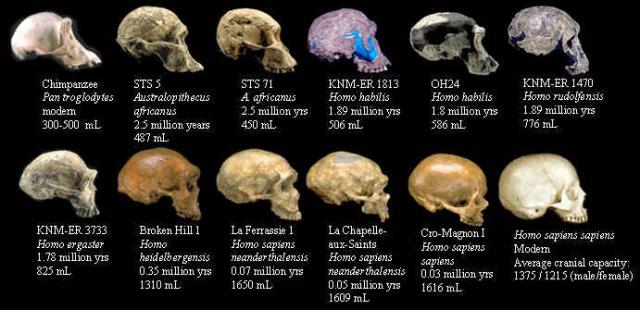
The truth of this matter is that no fossil has ever been found which was not "transitional", between its ancestors and descendants, if any.
Every fossil, and every DNA analyzed, fits somewhere on the great "tree of life", pointing back to common ancestors.
Yes, some fossils are more obviously "transitional" than others, but all show numerous similarities to their more closely related ancestors and descendants.
Thus, despite the estimate of only 1% of all species which ever lived having recovered fossils, many of today's species can be traced back many millions of years through their fossils.
And of course, of all the "transitional forms" ever found, none are more striking than these:
DeoVindiceSicSemperTyrannis: "I said before the who theory of evolution goes against the Second Law of Thermodynamics, which makes it highly questionable."
But of course, it does no such thing, because the earth has continuously received new energy input from the sun.
That makes your whole thermodynamics argument moot & void, and surely somebody has long since pointed this out to you?
So why do you keep making it?