You keep trying to equate them but they are radically different. Why? Microevolution makes for a more specialized species using DNA that the organism already has. Sometimes in Microevolution DNA is actually lost. Macroevolution assumes that DNA is somehow magically GAINED. And not only is it gained, the DNA gains must be positive. So far all DNA corruption we have ever seen have been negative. Big difference. One is scientific fact, the other is theory. Your claim that there have been positive gains in DNA are ridiculous. The high altitude one you mentioned isn't a DNA gain, it is situational. Anyone who lives in such climate their body adjusts to it. Same for the milk one. The body is a great adjuster. But it didn't have to mutate to adjust. For instance, if you were born and raised in Alaska you will have a higher tolerance to cold, whereas if you born and raised in Florida and then moved to Alaska, you may find yourself shivering all the time. Not a DNA issue, just a born and raised situational one. The sickle cell anemia one is not positive as you represent it. It often causes the person effected with it to die younger unless treated. great positive mutation there.
You keep claiming there are thousands of examples of missing links. The problem with many of them is that they are based on fragments too small to really determine anything. For instance take Nebraska Man, which was supposed to be an intermediate form between apes and man. Scientists built this whole assumption based on a single tooth that they found among some tools. The pictures they made of it all looked very convincing. However, it later turned out to be the tooth of a pig. These so-called evolutionary proofs keep on getting debunked based on further information. Also, a lot of these finds assume that there is one shape for the human skull and all human skulls found have to be that shape. Sorry but it's not that way. There is great genetic diversity among people, and you can find plenty of people today with slightly different shaped heads. Also, some groups of people throughout the ages have done things to change the shape of their heads. Yet they are still human. Take a look at these. The first is a woman from a trive in Africa that does head shaping, the middle one an African ambassador, Tutankhamen, and the last is an aborigine (note the heavy eyebrow ridge):




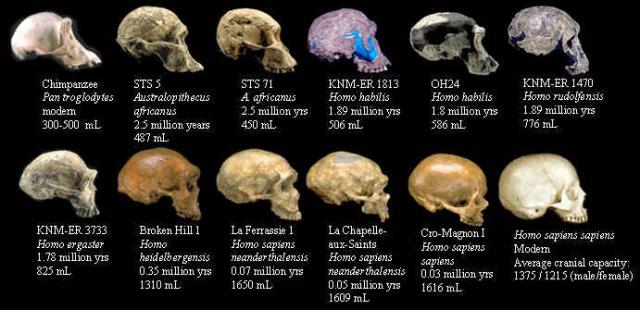
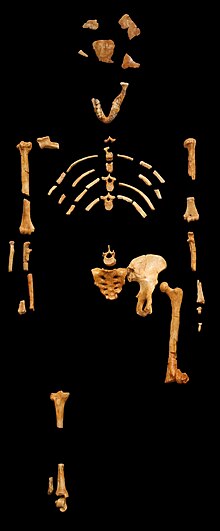
When looking at that list of skulls you have, they are all either men, or apes of various kinds (some of them extinct). If their diet was poor, their bones may be a bit deformed. This is what scientists believe is the case with the so-called Neanderthal man. The famous anatomist, Dr. Rudolph Virchow, upon looking at the Neanderthal bones found that the specimen had was simply an old person with a bad case of rickets (lack of vitamin D) and also arthritis. Homo heidelbergensis is also obviously human. The Australopithecus is acknowledged by many scientists to have simply been a chimpanzee. Matter of fact, in the case. of the Lucy skeleton, the scientist actually broke apart the pelvis, which was said to have looked too much like a primate's and then reglued it back together in a more human looking shape. It is circular reasoning to use assumptions of human evolution for the reconstruction and then using it as evidence for evolution. Dr. David Raup, curator of the Chicago Field Museum of Natural History (an expert on the fossil record) says:
"Well, we are now about 120 years after Darwin, and knowledge of the fossil record has been greatly expanded...ironically, we have even fewer examples of evolutionary transition than we had in Darwin's time. By this I mean that some of the classic cases of Darwinian change in the fossil record, such as the evolution of the horse in North America, have had to be discarded or modified as the result of more detailed information."
Also, to let you know, just because two organisms have "similar" looking DNA (i.e. they have large chunks of their amino acid protein sequences that are similar) that does not mean they are closely related to each other or one came before or after the other. It is the parts that differ and not the parts that are similar that matter. For instance, a rhodospirillum rubrum bacterium shares more of its DNA with a horse than with a yeast. A lamprey eel has only a 15% difference in DNA with a horse. and there is only an 8% difference between the DNA of a pigeon and a turtle. Nobody is going to make the argument that those are closely related.
Another thing. If evolution was real, then you would expect to find the less evolved specimens in the lower rock layers and the more evolved ones in the higher layers. So why then do we find numerous examples of the supposedly less evolved specimens and the supposed missing links on layers higher than the specimens that supposedly came after them? Also, why do you find a specimen and its supposed ancestor in the same layer? Also, why are these charts (like the one you posted) purporting to show an evolutionary sequence take specimens of various different ages, that were found on various different continents, and on various different layers (often with the human ones in layers lower than the "missing links", and put them in line as if one was supposedly the ancestor of the others? This is ridiculous bs and is entirely unscientific.
DeoVindiceSicSemperTyrannis:
"You keep trying to equate them but they are radically different. Why?
Microevolution makes for a more specialized species using DNA that the organism already has.
Sometimes in Microevolution DNA is actually lost. Macroevolution assumes that DNA is somehow magically GAINED.
And not only is it gained, the DNA gains must be positive." First of all, just to be strictly clear: there's no such thing as DNA being "gained" or "lost" -- so that entire argument is null and void.
What happens instead is that every generation, without exception, is born with a small number of more-or-less random DNA mutations -- a handful out of four billion letters in our DNA code.
Most of these mutations fall into what is sometimes labeled "junk DNA" and so produce no known effects.
Of those which do produce effects most are negative, and so get weeded out by natural selection.
But a very small number of mutations actually benefit the offspring, and so natural selection passes them down to following generations.
And that's it -- so-called micro-evolution, or macro-evolution, it's all the same, short term or long term.
No actual DNA is "gained" or "lost", it's just instructions which change -- i.e., from brown eyes to blue, or dark hair to blonde, etc.
Yes, when you compare DNA of various creatures, you do see some have more code letters than others, but this has nothing to do with how "advanced" they are -- humans do not have "more DNA" than other creatures, indeed some have more than we do.
The difference is in the code itself, not in the number of letters.
DeoVindiceSicSemperTyrannis: "So far all DNA corruption we have ever seen have been negative.
Big difference.
One is scientific fact, the other is theory."
No, the scientific fact is that we can see recent small DNA changes in mankind which are beneficial, and of which I listed a small number in post #248 above.
But just so we're clear: those are not actual additions, or "gains" to the DNA code, just changes to the code which benefit mankind.
DeoVindiceSicSemperTyrannis: "Your claim that there have been positive gains in DNA are ridiculous.
The high altitude one you mentioned isn't a DNA gain, it is situational.
Anyone who lives in such climate their body adjusts to it.
Same for the milk one.
The body is a great adjuster.
But it didn't have to mutate to adjust."
Sorry, sir, but it's your lack of understanding of recent DNA analyses which is laughable -- you've got it all wrong.
In fact, in recent years specific DNA code has been identified for all the changes I listed, and others too -- i.e., Tibetan and Andean high altitude adaptations (not the same), milk tolerance among dairying people, sickle cells to fight malaria.
Again, these are not "gains" or "losses", but changes from one set of instructions to something different.
Analyzing the code (compared to others without those changes) also tells us about when such changes first happened.
DeoVindiceSicSemperTyrannis: "You keep claiming there are thousands of examples of missing links.
The problem with many of them is that they are based on fragments too small to really determine anything.
For instance take Nebraska Man, which was supposed to be an intermediate form between apes and man."
So-called Nebraska man was first published in 1922, reevaluated and retracted in 1927.
It is not considered a hoax, but honest mistake corrected as soon as new evidence came to light.
Consider: in the past 150+ years hundreds of early human and pre-human sites have been carefully excavated, producing thousands of bones from dozens of human-like species or sub-species.
Some include nearly complete skeletons.
So there's no way, FRiend, that you can legitimately hide behind your claim of "too small to determine anything".
There's lots of data, for anyone who wants to look.
DeoVindiceSicSemperTyrannis: "These so-called evolutionary proofs keep on getting debunked based on further information."
The fact is, you must look back 90 years to find your example of "Nebraska man", while in the mean time hundreds and hundreds of other ancient individuals were carefully excavated & analyzed scientifically, some of them even including their DNA.
DeoVindiceSicSemperTyrannis: "When looking at that list of skulls you have, they are all either men, or apes of various kinds (some of them extinct)."
Please take a closer look: only two of those skulls are from living creatures today -- the first skull of a modern chimpanzee, and the last skull of a modern human being.
All the other skulls in between, without exception, come from extinct "transitional forms" between chimps and humans.
All were dated, and are shown in the sequence they lived -- from oldest to most recent.
The point should be so clear and obvious nobody can miss it: each succeeding "transitional form" was slightly less chimp-like and slightly more human-like, just as evolution theory predicts.
DeoVindiceSicSemperTyrannis: "The famous anatomist, Dr. Rudolph Virchow, upon looking at the Neanderthal bones found that the specimen had was simply an old person with a bad case of rickets (lack of vitamin D) and also arthritis."
Virchow died in 1902, he studied one Neanderthal skull in the late 1800s, pronouncing it an old deformed human.
Since that time, remains of hundreds of other Neanderthals have been excavated and studied, including many Neanderthal children.
So today there is no scientific doubt: Virchow got it wrong and Neanderthals were a separate sub-species of humans, who lived at the same time as humans, but were driven to extinction quite likely at the hands of humans.
DeoVindiceSicSemperTyrannis: "Homo heidelbergensis is also obviously human."
Pre-human Homo heidelbergensis follows Homo egaster in the photo, egaster remains dated from 1.8 million to 1.3 million years ago, with heidelbergenis following from 1.3 million to 200,000 years ago.
Homo heidelbergensis predate Neanderthals, Denisovans and modern humans, and may be the common ancestors of all three later populations.
Homo heidelbergensis were replaced by Neanderthals in Europe and by Denisovans in Asia.
Ancient Heidelbergensis were not human, they were pre-human, and may well have been our ancestors.
DeoVindiceSicSemperTyrannis: "The Australopithecus is acknowledged by many scientists to have simply been a chimpanzee."
As you can see by finding Australopithecus in the photo, next after the chimpanzee, it is the most ancient and most chimp-like of the "transitional forms".
But it was certainly not 100% chimpanzee -- it had already made some changes towards becoming more human-like.
And every "transitional form" after it became less chimp-like and more human-like.
DeoVindiceSicSemperTyrannis: "...in the case. of the Lucy skeleton, the scientist actually broke apart the pelvis, which was said to have looked too much like a primate's and then reglued it back together in a more human looking shape."
Lucy's pelvis was found in a broken-apart condition, and was glued together by researchers.
Later analysis showed the first reconstruction to be in error -- didn't fit the other bones -- so it was redone, making her more human-like.
Bottom line: Lucy was certainly more chimp-like than human, however she was also more human-like than any modern chimp.
DeoVindiceSicSemperTyrannis: "Dr. David Raup, curator of the Chicago Field Museum of Natural History..."
Raup is certainly no anti-evolutionist, and so I highly suspect that his words here are misquoted or seriously taken out of context.
It would not be the first time you people have done such things.
And, the real fact of this matter is: the fossil record today is orders of magnitude more complete than it was in Darwin's time, and yes, each new discovery has sometimes required rethinking previous conclusions.
However no new discovery has ever challenged the basic idea of evolution theory.
DeoVindiceSicSemperTyrannis: "For instance, a rhodospirillum rubrum bacterium shares more of its DNA with a horse than with a yeast.
A lamprey eel has only a 15% difference in DNA with a horse. and there is only an 8% difference between the DNA of a pigeon and a turtle."
First of all, your numbers here are wildly off, even considering that results much depend on exactly what is compared, and how it's done.
So to restore some sanity here, let's remember the general rule is: the more closely related the species, the more similar their DNA.
Thus for a few examples, human beings DNA are said to be 99.5% the same as each other, we share 96% with chimpanzees, 90% with cats, 80% with cows, 75% with rats, 60% with chickens, and so on down the list until we see numbers like 15% with bacteria.
All of these numbers correspond to evolution theory predictions, and confirm what the fossil record shows.
DeoVindiceSicSemperTyrannis: "...why then do we find numerous examples of the supposedly less evolved specimens and the supposed missing links on layers higher than the specimens that supposedly came after them?"
Two obvious explanations can usually be determined by researchers on site:
- Over the course of geological history, when continents collide, pushing up mountains, sometimes fossils in newer rock are forced underneath fossils in older rock.
- Some time in the past, younger fossils high up on a hillside erode, get washed downhill and land lower down, below rocks & fossils of an older age.
The first case is more common, and rather easily worked out by geologists.
The second case, of fossils washed downhill, could be more problematic, but I think also quite rare, since you would not expect fossils to long survive open-air exposure to the elements.
Bottom line: no confirmed case has ever been found which seriously falsifies evolution theory.
DeoVindiceSicSemperTyrannis: "...why are these charts (like the one you posted) purporting to show an evolutionary sequence take specimens of various different ages, that were found on various different continents, and on various different layers (often with the human ones in layers lower than the "missing links", and put them in line as if one was supposedly the ancestor of the others?
This is ridiculous bs and is entirely unscientific."
What is certainly "ridiculous and entirely unscientific" is your callous disregard for and total misrepresentation of the facts, sir.
Scientifically, every site excavated, every fossil found, every bone analyzed is carefully dated according to the best available methods, including geological and forensic comparisons, plus radiometric tests.
Over 150 years, this has been done on hundreds of human related sites and thousands of others showing non-human evolution.
None has ever seriously contradicted or falsified evolution theory, all your spurious claims here notwithstanding.