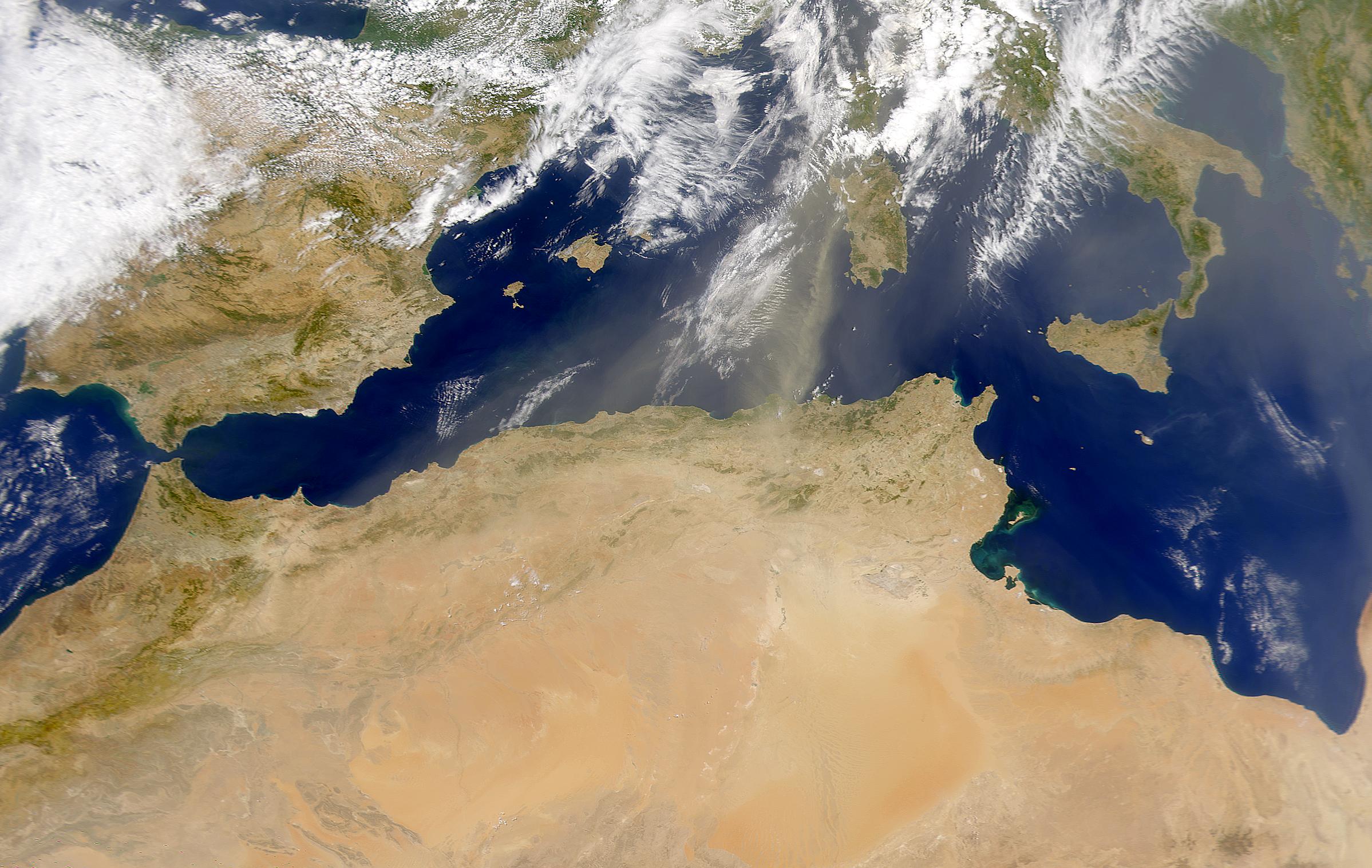
Dust in the Mediterranean - Image NASA
Posted on 09/02/2011 10:47:31 AM PDT by Ernest_at_the_Beach
From the Universitat Autonoma de Barcelona a suggestion that ocean CO2 sequestration is driven by iron laden dust blown into the oceans that cause phytoplankton blooms, resulting in the ocean as a CO2 sink. It’s another take on the proposed experiment from a couple of years ago where a researcher wanted to drop a barge of powdered iron into the ocean to watch what happens. It was actually tried, and was reported to be a failure.
Dust in the Mediterranean - Image NASA
Climate in the past million years determined greatly by dust in the Southern Ocean
A group of scientists led by researchers from the Universitat Autònoma de Barcelona (UAB) and the Swiss Federal Institute of Technology (ETH Zürich) has quantified dust and iron fluxes deposited in the Antarctic Ocean during the past 4 million years. The research study published in Nature evidences the close relation between the maximum contributions of dust to this ocean and climate changes occurring in the most intense glaciation periods of the Pleistocene period, some 1.25 million years ago. Data confirms the role of iron in the increase in phytoplankton levels during glacial periods, intensifying the function of this ocean as a CO2 sink.
Dust, formed by particles of soil, plants, etc. affects the climate by altering the energetic balance of the atmosphere and provides iron and other micronutrients necessary to marine organisms. Scientists considered that dust fluxes deposited by the wind into the Antarctic Ocean increased during glacial periods and that iron fertilisation may have stimulated marine productivity, contributing significantly to the CO2 reduction in the atmosphere during the most recent Pleistocene glacial periods (in the past 800,000 years). However, the magnitude of these effects and their role in the evolution of the climate system had remained unclear.
Records of the period studied in this research work – the longest and most detailed up to date on the Southern Ocean – reveal a sharp increase in dust and iron inputs during the Climate Transition of the Middle Pleistocene Epoch (1,250,000 years ago) in which fluxes tripled. This transition marked a global climate change with the beginning of glacial periods lasting 100,000 years, in comparison to the gradual intensification of glacial cycles occurring in the three million years immediately before, when periods lasted 41,000 years.
For the first time results show the close connection between the highest levels of dust deposited in the Antarctic Ocean and the lowest concentrations of CO2 in the atmosphere, which gave way to the appearance of the deep glaciations typical of Earth’s recent history. The study indicates that the dust most probably played a key role in fertilising microscopic algae of the Southern Ocean, emphasising its role as a CO2 sink. These microorganisms grow uptaking the CO2 found in the atmosphere and when they die they sink releasing carbon into the depths of the ocean.
For Antoni Rosell Mele, ICREA researcher at the Institute of Environmental Science and Technology of UAB, and Alfredo Martínez Garcia, currently researcher at EHT Zürich who earned his PhD at UAB, the research carried out offers new clues on the causes behind the most intense glaciations of the Pleistocene Epoch, particularly on how interactions between dust with oceanic biology influence CO2 and the climate. It also allows scientists to understand how future changes in atmospheric circulation and the superficial biology of oceans can make the Antarctic Ocean change the efficiency with which it captures and removes carbon dioxide from the atmosphere.
There are in fact initiatives to fertilise the Southern Ocean with iron with the purpose of reproducing the natural process observed during glaciations and reduce today’s levels of CO2 in the atmosphere. It is an issue which has generated much controversy. “Although our data indicates that this process occurred naturally during glacial periods, we must take into account that ocean circulation was completely different to what it is now, and this made the role of iron fertilisation more efficient in capturing carbon dioxide from the atmosphere. There are also several unknown aspects of what could happen to marine ecosystems if iron were artificially added in large quantities, and therefore its commercial application continues to be unviable at the moment”, researchers conclude.
Researchers from the universities of Edinburgh and Princeton also participated in the research.
Caption: http://www.uab.es/uabdivulga/img/UAB_InvestigadorsPolsAntartic.jpg
Reference:
Martinez-Garcia, A.; Rosell-Melé, A; Jaccard, S.L.; Geibert, W.; Sigman, D.M.; Haug, G.H. (2011). “Southern Ocean dust-climate coupling during the past 4,000,000 years”. Nature, doi: 10.1038/nature10310.
OMG! I hope nobody looks behind my refrigerator.
Disclaimer: Opinions posted on Free Republic are those of the individual posters and do not necessarily represent the opinion of Free Republic or its management. All materials posted herein are protected by copyright law and the exemption for fair use of copyrighted works.
