
Posted on 08/05/2009 7:57:45 PM PDT by Chode
This will be a general purpose thread for F1 news and pings that really don't require a thread of their own.
Feel free to go to my home page for an updated version. Carriage Hill just sent me a newer version than what I had.
Dunno about F1, but I recall Jim Hall experimenting with movable wings in Can-Am racing and them being outlawed?
He kept coming up with innovations and the mandarins of the sport kept banning them.
Than you both very much!
The season is about to heat up!
Brilliant!
Ford got Work to Do.
.
“Gurney flaps” and Wicker bills
Have come along Way.
This is only an experimental wing and may not be used on their car. Yesterday they had a conventional DRS system on their car.
Jim Hall and His Vacuum Car was a little before my Time.
He’s a Tenacious Texan with a
Big “Toe In” walk!
I went to the CanAm race at Laguna Seca in 1970 just to see that car run. Vic Elford humiliated the field in qualifying but the Chevy threw a rod in race morning warmup and the car did not race that day. :^(
That’s Cool. !
I visited Jim’s Personal Garage and He had some Great Cars including the Precursor for the Corvette that they tested at His own ‘Rattlesnake’tract near Midland TX.
.
Wonder if he’s still living?
His son Jim Jr. was a decent sort.
So coming out of a corner, the wing opens to shed drag and increase acceleration and top speed. But to get there, it has to go through this:

Can you say "parachute?"
It's not only going to create a YUGE amount of drag -- which is berry berry bad for acceleration -- it's also going to radically alter the balance of the car, like about 20x worse than everybody else's 'simple' wings when they open. And the fact that it only presents this profile for a fraction of a second is irrelevant because that's still long enough to turn the car into a spinning top.
Two more points about the fully open position (shown below):

That looks suspiciously like your garden variety airplane wing. Racecar wings make downforce by creating lift, just like airplane wings, only the lift vector on a racecar is aimed at the earth, not away from it. So in broad strokes, if you turn a racecar wing upside down, if becomes an airplane wing.
It's beyond my means to figure out what's going on with lift in this configuration because that would require knowing what the upside-down wing's resultant angle of attack is, and I don't have a clue, but I can tell you two negative consequences it'll have if it's creating lift in the "usual" direction (up, not down).
#1, why would you want the wing over the back wheels making lift (not downforce) when you're trying to accelerate? That will play hell with your traction.
And #2, one of the bedrock principles of wing-generated lift is that lift is ALWAYS proportional to drag. So if the wing in that configuration is making ANY lift, it also is making drag.
https://en.wikipedia.org/wiki/Lift-induced_drag
And drag, you might be aware, slows you down. So why would you deliberately put a device on your car to make it go faster that also increases drag? It makes NO sense.
This is where resultant angle of attack comes back in. That wing could be oriented to catch the air coming up off the rear of the car so that it's lift-neutral (or close to it). But if it's not doing something lift-wise, what was the point in making it do the Hokey-Pokey in the first place?
I think it's an April Fool's joke played a bit early. I'll betcha a sack full of double White Castles with cheese it won't be on the car at Melbourne.
Can you say "parachute?"
It's not only going to create a YUGE amount of drag -- which is berry berry bad for acceleration -- it's also going to radically alter the balance of the car, like about 20x worse than everybody else's 'simple' wings when they open.
As you know, drag is also a function of velocity. When the wing transitions from the closed to the open position, making a "parachute," the car just came out of a turn, so it is going relatively slower, thus less drag. But consider this: At the end of the straight when it transitions back, it will make a second parachute right when you want it most to shed speed for the upcoming corner. And you will be going at a higher velocity at the end of the DRS straight than at the beginning, so you will receive more aero braking at the end of the straight.
#1, why would you want the wing over the back wheels making lift (not downforce) when you're trying to accelerate? That will play hell with your traction.
If the upper element makes a little lift, that would negate some of the downforce from the lower wing element and the ground effect package, which makes up the majority of downforce on these cars. That translates to less rolling resistance on the back wheels during the long straights when you don't need all of the downforce you would need when cornering. The fact that you don't need all that downforce when in a straight line is how they get away with DRS in the first place.
#2, one of the bedrock principles of wing-generated lift is that lift is ALWAYS proportional to drag. So if the wing in that configuration is making ANY lift, it also is making drag.
The upper wing element, whether concave up or concave down, will by itself make the same amount of drag when it is oriented horizontally to the ground.
This is where resultant angle of attack comes back in. That wing could be oriented to catch the air coming up off the rear of the car so that it's lift-neutral (or close to it). But if it's not doing something lift-wise, what was the point in making it do the Hokey-Pokey in the first place?
The gap between the upper and lower elements is much larger when the wing is inverted DRS as compared to non-inverted DRS, so there may be less overall drag with the inverted setup due to due to different interactions between the upper and lower wing elements. If this is true, (big if!) then the lowered drag for the entire DRS time period will make up for the momentary "parachute" at the entry to the straight. And we've already determined that the parachute effect at the end of the straight is desirable.
I think it's an April Fool's joke played a bit early. I'll betcha a sack full of double White Castles with cheese it won't be on the car at Melbourne.
As much as I love White Castles, no bet because I don't think it will be there either.
I considered that but the probability is that there will be some few straights that will be too short to reach aerodynamic or rev-limited top speed, in which case there will be less speed to scrub off because of the reduction in acceleration at the beginning of the acceleration phase as a result of the added drag and the reduced downforce.
Drag changes at the square of the change in velocity, so the flate-plat drag it creates during the reconfiguration to high downforce will create a more profound de-accleration at the braking end, ... but there will be less speed that needs scrubbing off.
Plus any upset to the car's balance will be greater. Imagine what that much drag for just an instant is going to do to brake bias when it has such a long moment arm (from the front axle) and it's so high above the tarmac. I would think the brief instant that thing is in high-drag mode is plenty long enough to provoke lock-ups at the front.
Heck, hit that at 220 mph and the car might even wheelie!
[/sarc]
And deliberately creating aero braking squanders an opportunity to do regernative braking. Is there already too much momentum for regenerative and friction braking? I expect so, at least on the higher-speed straights, but now you've introduced a third variable into de-accleration formula, which already was pretty complex just balancing friction braking against regenerative.
"If the upper element makes a little lift, that would negate some of the downforce from the lower wing element and the ground effect package,"
Whether you call it lift or downforce makes no difference, any increase in (wing-generated) lift always will be accompanied by an increase in drag. You're robbing from Peter to pay Paul if you install an active aero system, the stated purpose of which is to reduce the drag profile, then configure it so it makes more drag. Regardless of its purpose, drag slows you down.
The old V-6T hybrids had a reputation for breaking the tires loose under acceleration in (at least) 4th gear. I would expect a car with less downforce and smaller tires but with 1000 bhp potentially on tap to be more of the same, maybe worse. A rear wing that creates lift in the slowest/most critical phase of acceleration seems to me bassackwards.
The whole gizmo is an homage to Rube Goldberg.

The FIA has addressed 'cheating' claims around the Mercedes HPP F1 engine.
Nikolas Tombazis, FIA's single-seater technical director:
"There are a lot of nuances when discussing such a matter, because there is what the regulations intended, and to keep the compression ratio at 16:1 was one of the core objectives when the regulations were discussed with the PU manufacturers back in 2022, when they were finalised."
"There is also the topic of what is exactly written in the regulations, and it became obvious that what was written in the regulations, there could be ways that one team could have a higher ratio, and so in terms of discussion of somebody cheating or breaking the rules, that's never been a topic of discussion.
"There has been a lot of emotion on the topic, but I think it has never been the position of the FIA that somebody is doing something illegal.
"It is unavoidable that with new regulations, there are going to be some areas where solutions are found which are beyond what the rules intended, so what we're trying to do with the E-Vote is close this topic and find a solution.
"I don't think this topic ever needed to get to this level of attention. I'm not saying it is not important, but does it matter to cause all this excitement for many months? Frankly, no on that.
"We need to be even-handed, and we don't want to stifle innovation.
"I am sure there will be people who are unhappy that we're not acting soon enough, and there will be people who are unhappy that we're not letting things be, and part of our job is to try to keep that balanced.
"People tend to remember when something isn't exactly as they please, and forget when something goes their way, and that creates a degree of high emotion."
https://racingnews365.com/fia-address-cheating-claims-as-mercedes-engine-saga-nears-end
First of all, the wing will always make some amount of drag regardless of whether it's making lift, downforce, or is completely neutral. It's just a matter of how much drag is created vs. how much lift/downforce. Second, it will make exactly the same drag no matter if the wing is right side up or upside down, but you're not considering the reduced rolling resistance from unloading the rear wheels during the straight, and you're ignoring the theoretical reduction in total drag caused by interactions between the two wing elements while in inverted DRS position due to the vastly increased slot gap.
The point is, Ferrari must have either wind tunnel or Computational Fluid Dynamics data that was encouraging enough that they actually took the time and money to build and test the thing. They didn't just wake up one morning and decide to build it on a whim.
But I think they got the real-world data they wanted, and we won't see this wing at Melbourne or any other race because in its current form it's illegal. F1 rules state that the DRS transition must be made within 400 milliseconds, and that transition appears to take much longer than that. F1 has said the basic concept is legal, however. But with a 400 millisecond transition, I don't think you'll be losing much in the way of regenerative braking.
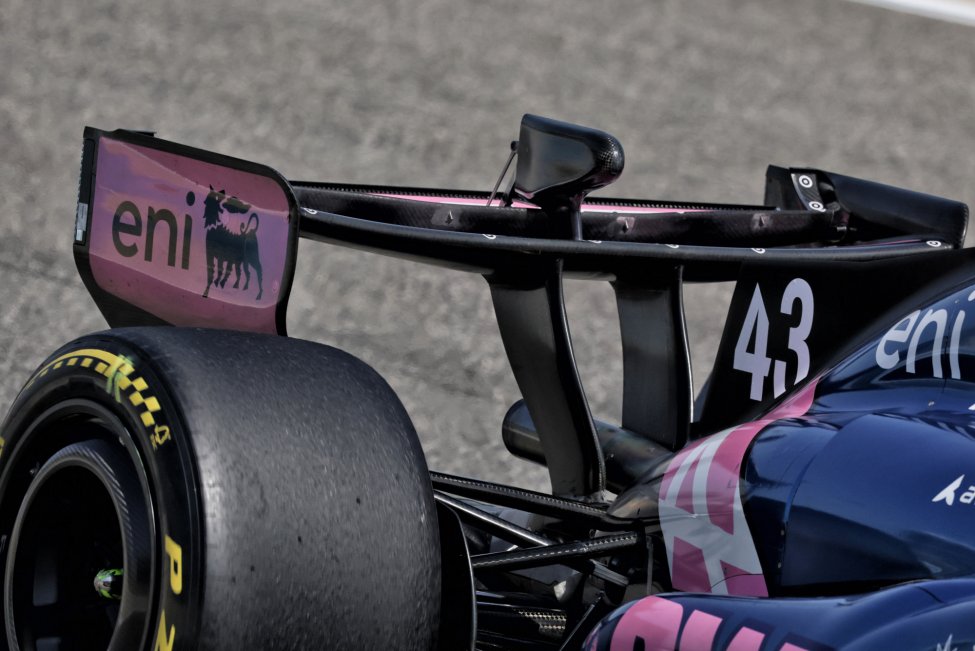
Alpine has decided to lower the upper element to reduce straight-line drag in DRS mode.
It seems Honda is to blame for Aston Martin’s abysmal pace, at least in part. I’ve not seen anything breaking down the problems between ICE and electric but reliability is lacking. Plus, Newey is telling some of the other teams that their energy recovery is so bad they’re not even meeting the minimum benchmark Honda had agreed to.
The F1 press is running the story that Aston might be in danger of getting eliminated by the 107% rule at Melbourne. The quickest time in Q1 there last year was about 1:16. If they’re on that same pace this year, A-M has to be within about 5-1/3rd seconds or they get eliminated. As in disqualified from the race.
“The quickest time in Q1 there last year was about 1:16. If they’re on that same pace this year, A-M has to be within about 5-1/3rd seconds or they get eliminated. As in disqualified from the race.”
It’s likely that the FIA will waive the rule (it’s been done in the past) and it will make for a better show and also give full race testing to AM.
I believe there will be significant loss of race cars during this race, either because of failure or bad driving...
They've waived the rule because it was raining, or other force majeure. I don't recall it ever being waived just because one team was too slow.
BUT ... there's a first time for everything, eh wot?
Formula 1 ‘Closed Cockpit’ Concept shows the future of the Halo as a Safer Enclosed Canopy

They long ago sold the sport's birthright for a pot of porridge so why the hell not?
I just came across this interesting tidbit of F1 trivia.
The last native-born American to win an F1 race was Peter Revson. Today marks the 87th anniversary of his birth.
Yes, he was part of the cosmetics family.
He was killed in a crash at the 1974 GP of South Africa.
Will Buxton says (he’s hearing that) Cadillac is burning out it’s staff because of overwork. Many of them are getting by on 3 hours sleep a night. And Cadillac already has burned through a billion dollars.
https://www.motorsportweek.com/2026/02/25/will-buxton-cadillac-done-before-f1-season-has-begun/
Disclaimer: Opinions posted on Free Republic are those of the individual posters and do not necessarily represent the opinion of Free Republic or its management. All materials posted herein are protected by copyright law and the exemption for fair use of copyrighted works.