I know Iridium Flares are something different, they involve Iridium satellites, but check this out...
From spaceweather.com for May 27, 2009:
(SpaceWeather.com is a NASA-related website)
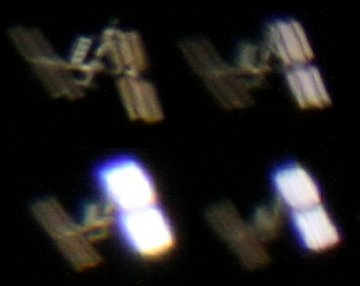
SPACE STATION FLARES: Lately, a growing number of observers are reporting intense "flares" coming from the International Space Station (ISS). A typical sighting begins with a normal, sedate flyby: The station soars overhead, cutting silently through the stars with no hint that something extraordinary is about to happen. Then, a startling explosion of light boosts the station's luminosity 10-fold or more. Some observers have witnessed flares of magnitude -8 or twenty-five times brighter than Venus.
On May 22nd, Dutch amateur astronomer Quintus Oostendorp watched a flare through his backyard telescope. A movie he recorded using his Canon 1000D shows what happened (Click to view a 0.7 MB Quicktime movie):
See spaceweather.com for May 27, 2009:
http://spaceweather.com/archive.php?view=1&day=27&month=05&year=2009
Article continues...
The bright flash is sunlight glinting off the station's enormous solar arrays. Earlier this year, on March 20th, astronauts unfurled a new pair of arrays on the space station's starboard side, adding 8000 sq. feet of light-catching surface area to the station's profile. The extra area increases both the chances and the luminosity of flares. "It is a spectacular sight!" says Oostendorp.
No one knows when they will happen or how bright they will be. That's what makes the hunt for "space station flares" so much fun. Check the Simple Satellite Tracker for flyby times--and let the hunt begin!
more flares: from Maximilian Teodorescu of Dumitrana, Romania; from Rafael Schmall of Hungary, Somogy, Kaposfo; from Kevin Kell of Yarker, Ontario, Canada; from Martin Gembec of Litice nad Orlici, Czech Republic; from Nicolas Biver of Versailles, France;
From spaceweather.com for May 27, 2009:
http://spaceweather.com/archive.php?view=1&day=27&month=05&year=2009