Astronomy Picture of the Day
Discover the cosmos! Each day a different image or photograph of our fascinating universe is featured, along with a brief explanation written by a professional astronomer.
2004 May 16 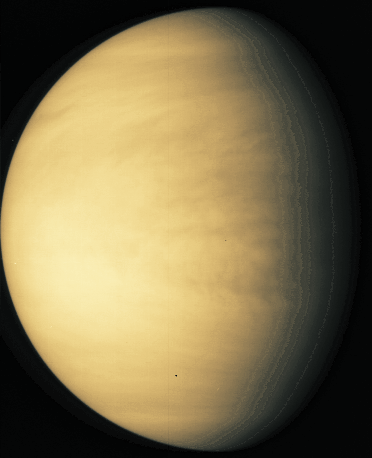
Posted on 05/16/2004 4:51:55 AM PDT by petuniasevan
Discover the cosmos! Each day a different image or photograph of our fascinating universe is featured, along with a brief explanation written by a professional astronomer.
2004 May 16
Explanation: This picture by the Galileo spacecraft shows just how cloudy Venus is. Venus is very similar to Earth in size and mass - and so is sometimes referred to as Earth's sister planet - but Venus has a quite different climate. Venus' thick clouds and closeness to the Sun (only Mercury is closer) make it the hottest planet - much hotter than the Earth. Humans could not survive there, and no life of any sort has ever been found. When Venus is visible it is usually the brightest object in the sky after the Sun and the Moon. More than 20 spacecraft have visited Venus including Venera 9, which landed on the surface, and Magellan, which used radar to peer through the clouds and make a map of the surface. This visible light picture of Venus was taken by the Galileo spacecraft that orbited Jupiter from 1995 to 2003. Many things about Venus remain unknown, including the cause of mysterious bursts of radio waves.
.
European satellite see Great Wall of China from space
EUROPEAN SPACE AGENCY NEWS RELEASE
Posted: May 15, 2004
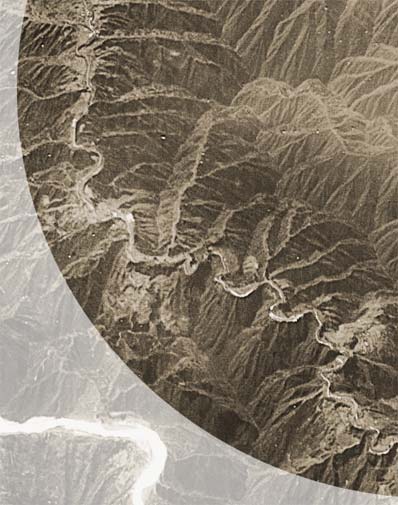 Proba shows Great Wall. Credit: ESA Download larger image version here |
The 21 hours spent in space last October by Yang Liwei - China's first ever space traveller - were a proud achievement for his nation. The only disappointment came as Liwei informed his countrymen he had not spotted their single greatest national symbol from orbit.
"The Earth looked very beautiful from space, but I did not see our Great Wall," Liwei told reporters after his return.
China has cherished for decades the idea that the Wall was just about the only manmade object visible to astronauts from space, and the news disappointed many. A suggestion was made that the Wall be lit up at night so it can definitely be seen in future, while others called for school textbooks to be revised to take account of Liwei's finding.
However such revisions may be unnecessary, according to American astronaut Eugene Cernan, speaking during a visit to Singapore: "In Earth's orbit at a height of 160 to 320 kilometres, the Great Wall of China is indeed visible to the naked eye."
Liwei may well have been unlucky with the weather and local atmospheric or light conditions with sufficiently low-angled sunlight the Wall's shadow if not the Wall itself could indeed be visible from orbit.
What is for sure is that what the human eye may not be able to see, satellites certainly can. Proba's High Resolution Camera (HRC) acquired this image of the Wall from 600 km away in space. The HRC is a black and white camera that incorporates a miniature Cassegrain telescope, giving it far superior spatial resolution to the human eye.
So while the HRC resolves mad-made objects down to five square metres, astronauts in low Earth orbit looking with the naked eye can only just make out such large-scale artificial features as field boundaries between different types of crops or the grid shape formed by city streets. They require binoculars or a zoom lens to make out individual roads or large buildings.
Proba (Project for On Board Autonomy) is an ESA micro-satellite built by an industrial consortium led by the Belgian company Verhaert, launched in October 2001 and operated from ESA's Redu Ground Station (Belgium).
Orbiting 600 km above the Earth¹s surface, Proba was designed to be a one-year technology demonstration mission of the Agency but has since had its lifetime extended as an Earth Observation mission. It now routinely provides scientists with detailed environmental images thanks to CHRIS - a Compact High Resolution Imaging Spectrometer developed by UK-based Sira Electro-Optics Ltd - one of the main payloads on the 100 kg spacecraft.
Also aboard is the HRC, a small-scale monochromatic camera made up of a miniature Cassegrain telescope and a 1024 x 1024 pixel Charge-Coupled Device (CCD), as used in ordinary digital cameras, taking 25-km square images to a resolution of five metres. Proba boasts an 'intelligent' payload and has the ability to observe the same spot on Earth from a number of different angles and different combinations of optical and infra-red spectral bands. A follow-on mission, Proba-2, is due to be deployed by ESA around 2005.
Gravity Probe B continues toward science operations
NASA STATUS REPORT
Posted: May 15, 2004
As of Day #24 of the mission, all spacecraft subsystems are functioning properly on Gravity Probe B, a NASA experiment to test two predictions of Albert Einstein's Theory of General Relativity. The orbit is stable and meets our requirements for next month's transition into the science phase of the mission, upon completion of the spacecraft initialization and orbit checkout. Furthermore, Gravity Probe B has successfully achieved several important milestones over the past week.
All four gyroscopes have now been digitally suspended for over a week. At launch, the gyros were unsuspended. Once on orbit, each gyro was first suspended in analog mode, which provides coarse control of the gyro's suspended position within its housing. Analog mode is used primarily as a backup or safe mode for suspending the gyros. Each gyro was then suspended digitally. The digital suspension mode is computer-controlled; it puts less torque on the gyros than analog mode and enables their position to be controlled with extremely high precision.
At the end of last week, the Gravity Probe B team practiced Low Temperature Bakeout (LTB), in which discs of sintered titanium (very tiny titanium balls, smaller than cake sprinkles) are "warmed up" a few Kelvin, thereby attracting helium molecules to them. This process will remove any remaining helium from the gyro housings after full gyro spin-up. Last week's practice LTB procedure had the added benefit of imparting a very small amount of spin-up helium gas to the gyros. Following the practice LTB, the SQUID gyro read-out data revealed that gyro #1, gyro #3, and gyro #4 were slowly spinning at 0.001, 0.002, and 0.010 Hz, respectively (1 Hz = 60 rpm). Amazingly, the Gyro Suspension Systems (GSS) were able to measure gas spin-up forces at the level of approximately 10 nano-newton (10-8 N). This means that the GP-B science team is able to interpret data from gyro spin rates four to five orders of magnitude smaller than what was planned for the GP-B science experiment.
Earlier this week, the GP-B spacecraft flew "drag free" around gyro #1, maintaining translation control of the spacecraft to less than 500 nanometers. The term, "drag-free" means that the entire spacecraft literally floats in its orbit -- without any friction or drag -- around one the gyros. Pairs of proportional micro thrusters put out a steady and finely controlled stream of helium gas, supplied by the Dewar, through its porous plug. Signals from the Gyro Suspension System (GSS) control the output of the micro thrusters, balancing the spacecraft around the selected gyro. The initial Drag Free Control (DFC) checkout lasted 20 minutes, as planned. Then, a two-hour DFC session was tested, during which the spacecraft roll rate was increased and then returned to its initial rate, maintaining drag-free status throughout the test. Achieving DFC indicates that we are on track to meet the science mission control requirements.
Last, but not least, early this week, the Attitude & Translation Control system (ATC) successfully used data from the on-board star sensors to point the spacecraft towards the guide star, IM Pegasi. This was the final step before initiating the dwell scan process, a series of increasingly accurate scans with the on-board telescope that enable the ATC to lock onto the guide star. Two days ago, the telescope's shutter was opened, and a first dwell scan was completed. We are now in the final stages of repeating the dwell scan to home in on the guide star and lock onto it.
The Initialization & Orbit Checkout phase of the Gravity Probe B mission remains on track for completion within 60 days after launch, at which time the 13-month science data collection will begin. This will be followed by a two-month final calibration of the science instrument assembly.
NASA's Gravity Probe B mission, also known as GP-B, will use four ultra-precise gyroscopes to test Einstein's theory that space and time are distorted by the presence of massive objects. To accomplish this, the mission will measure two factors -- how space and time are warped by the presence of the Earth, and how the Earth's rotation drags space-time around with it.
NASA's Marshall Space Flight Center in Huntsville, Ala., manages the Gravity Probe B program for NASA's Office of Space Science. Stanford University in Stanford, Calif., developed and built the science experiment hardware and operates the science mission for NASA. Lockheed Martin of Palo Alto, Calif., developed and built the GP-B spacecraft.

YES! You too can be added to the APOD PING list! Just ask!
Thank You.
Disclaimer: Opinions posted on Free Republic are those of the individual posters and do not necessarily represent the opinion of Free Republic or its management. All materials posted herein are protected by copyright law and the exemption for fair use of copyrighted works.