|
Posted on 05/08/2003 5:34:33 AM PDT by SAMWolf
|
|
 are acknowledged, affirmed and commemorated.
|

| Our Mission: The FReeper Foxhole is dedicated to Veterans of our Nation's military forces and to others who are affected in their relationships with Veterans.
Where the Freeper Foxhole introduces a different veteran each Wednesday. The "ordinary" Soldier, Sailor, Airman or Marine who participated in the events in our Country's history. We hope to present events as seen through their eyes. To give you a glimpse into the life of those who sacrificed for all of us - Our Veterans.
|
|
|
|
The Battle of the Coral Sea John James Powers, born in New York City 3 July 1912, graduated from the Naval Academy in 1935. After serving at sea for 5 years, he underwent flight training, reporting 21 January 1941 to Bombing Squadron 5, attached to famed Yorktown (CV-5).  Next morning while the great carrier battle continued, he joined the attack on Shokaku, scoring an important bomb hit. His intrepid, low-bombing run, however, brought Powers into heavy antiaircraft fire and his plane plunged into the sea. Lt. Powers was declared dead; but, for his indomitable spirit in this series of attacks, was awarded the Medal of Honor posthumously. According to the citation: "... completely disregarding the safety altitude and without fear or concern for his own safety, he courageously pressed home his attack, almost to the very deck of an enemy carrier and did not release his bomb until he was sure of a direct hit." Congressional Medal of Honor Awarded Posthumously JOHN JAMES POWERS Rank and organization: Lieutenant, U.S. Navy. Born: 13 July 1912, New York City, New York. Accredited to: New York. Other Navy award: Air Medal with 1 gold star. For distinguished and conspicuous gallantry and intrepidity at the risk of his life above and beyond the call of duty, while pilot of an airplane of Bombing Squadron 5, Lt. Powers participated, with his squadron, in five engagements with Japanese forces in the Coral Sea area and adjacent waters during the period 4 to 8 May 1942. 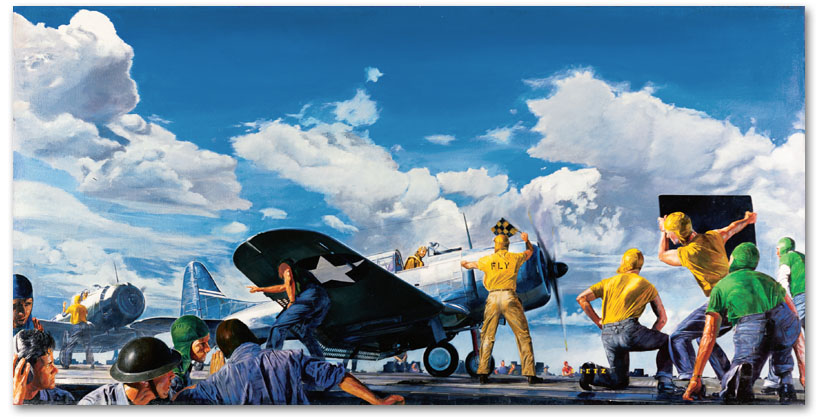 Three attacks were made on enemy objectives at or near Tulagi on 4 May. In these attacks he scored a direct hit which instantly demolished a large enemy gunboat or destroyer and is credited with two close misses, one of which severely damaged a large aircraft tender, the other damaging a 20,000-ton transport. He fearlessly strafed a gunboat, firing all his ammunition into it amid intense antiaircraft fire. This gunboat was then observed to be leaving a heavy oil slick in its wake and later was seen beached on a nearby island. On 7 May, an attack was launched against an enemy airplane carrier and other units of the enemy's invasion force. He fearlessly led his attack section of three Douglas Dauntless dive bombers, to attack the carrier. On this occasion he dived in the face of heavy antiaircraft fire, to an altitude well below the safety altitude, at the risk of his life and almost certain damage to his own plane, in order that he might positively obtain a hit in a vital part of the ship, which would insure her complete destruction. This bomb hit was noted by many pilots and observers to cause a tremendous explosion engulfing the ship in a mass of flame, smoke, and debris. The ship sank soon after. That evening, in his capacity as Squadron Gunnery Officer, Lt. Powers gave a lecture to the squadron on point-of-aim and diving technique. During this discourse he advocated low release point in order to insure greater accuracy; yet he stressed the danger not only from enemy fire and the resultant low pull-out, but from own bomb blast and bomb fragments. Thus his low-dive bombing attacks were deliberate and premeditated, since he well knew and realized the dangers of such tactics, but went far beyond the call of duty in order to further the cause which he knew to be right. 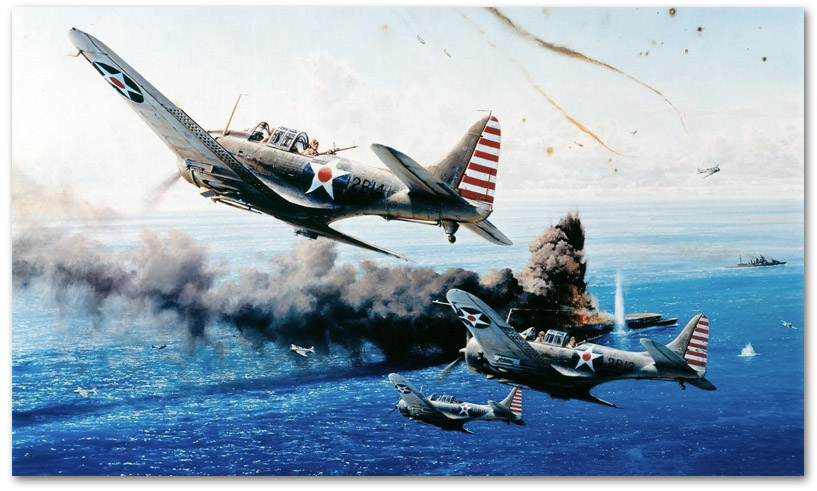 The next morning, 8 May, as the pilots of the attack group left the ready room to man planes, his indomitable spirit and leadership were well expressed in his own words, "Remember the folks back home are counting on us. I am going to get a hit if I have to lay it on their flight deck." He led his section of dive bombers down to the target from an altitude of 18,000 feet, through a wall of bursting antiaircraft shells and into the face of enemy fighter planes. Again, completely disregarding the safety altitude and without fear or concern for his safety, Lt. Powers courageously pressed home his attack, almost to the very deck of an enemy carrier and did not release his bomb until he was sure of a direct hit. He was last seen attempting recovery from his dive at the extremely low altitude of 200 feet, and amid a terrific barrage of shell and bomb fragments, smoke, flame and debris from the stricken vessel.
|
Too close for comfort
Ordeal in Vitiaz Strait
Strike of the Aztec Eagles...Mexican P-47 Thunderbolt Pilot from Mexico's expeditionary force over Luzon 1945

How about this snippy??
Thanks... I believe he was among those assigned to the Enterprise pioneering nighttime carrier operations when killed.
Stalin was in a hurry. The Americans had recently crossed the Rhine and the Soviet leader was concerned that they might capture Berlin before him. To speed up his campaign, he split the command of the Berlin operation between Marshall Zukhov in the centre and Marshall Konev in the south. Stalin thus effectively triggered a race between his two most senior commanders, as both of them were eager to be credited with the conquest of the German capital.
On the 15th of April, Soviet forces launched one of the most powerful artillery barrages in history. Over a million shells were fired against German positions west of the Oder. But when Zukhov's troops advanced from their bridgeheads, they found that the Germans had withdrawn to fortified positions on the Seelow heights further inland, having learned of the imminent Soviet attack from a captured Russian soldier.
Zukhov's attack clearly wasn't going according to plan. He decided to send in wave after wave against the German defences. "We started to fire at the masses," says one former German machine gunner. "They weren't human beings for us. It was a wall of attacking beasts who were trying to kill us. You yourself were no longer human." There was confusion all around. According to one Russian veteran, Soviet artillery was fired without proper guidance, killing scores of Red Army soldiers.
It took Zukhov three days to break the German resistance, far longer than planned. Huge numbers of Soviet tanks were lost because they were used as battering rams against the German positions. Over 30,000 Soviet soldiers died compared to the 10,000 soldiers lost by the Germans. In the end, the high Soviet casualty rate was largely a result of Stalin's hurry to reach Berlin.
Yes I have read "The Last 100 Days"...but could do with a re-read.
Having been studying Hitler intensly along with Shhhtalingrad!
Presently Reading Tolands Pulitzer winner on Hitler....enjoy Toland writting style..his way of bringing the reader to keep points in histories flow.
With Stalingrad..have also been backtracking on Nikita Krushchev and General Zhukov;
Both had a tension filled relationship with Stalin..and were afraid of Him.
During a meeting in the Kremilin during Sept of the Stalingrad defense..Zukhov and Vasilevsky are wispering in hushed tones concerning another solution while Stalin goes over a map.
Stalin blutrs out...."What other way out"!!;
Both men knew Stalin to shoot Generals in meetings infront of onlookers.
Nikita...he danced the knife edge too thru the war : )
Disclaimer: Opinions posted on Free Republic are those of the individual posters and do not necessarily represent the opinion of Free Republic or its management. All materials posted herein are protected by copyright law and the exemption for fair use of copyrighted works.


