|
Posted on 04/29/2003 5:34:59 AM PDT by SAMWolf
|
|
 are acknowledged, affirmed and commemorated.
|

| Our Mission: The FReeper Foxhole is dedicated to Veterans of our Nation's military forces and to others who are affected in their relationships with Veterans. We hope to provide an ongoing source of information about issues and problems that are specific to Veterans and resources that are available to Veterans and their families. In the FReeper Foxhole, Veterans or their family members should feel free to address their specific circumstances or whatever issues concern them in an atmosphere of peace, understanding, brotherhood and support.
|
|
|
|
"It was a disaster which lay hidden from the World for 40 years . . . an official American Army cover-up."  What was that terrible event so heinous as to prompt those accusations of perfidy 43 years later from the British news media from some American newspapers and in a particularly antagonistic three-part report from the local news of the ABC affiliate in Washington D. C. WJLA-TV? It was two hours after midnight on 28 April, 1944. Since the moon had just gone down, visibility was fair. The sea was calm. A few hours earlier, in daylight, assault forces of the U S 4th Infantry Division had gone ashore on Slapton Sands, a stretch of beach along the south coast of England that closely resembled a beach on the French coast of Normandy, code-named Utah, where a few weeks later U.S. troops were to storm ashore as part of history's largest and most portentous amphibious assault: D-Day The assault at Slapton Sands was known as Exercise Tiger, one of several rehearsals conducted in preparation for the momentous invasion to come. So vital was the exercise of accustoming the troops to the combat conditions they were soon to face that commanders had ordered use of live naval and artillery fire, which could be employed because British civilians had long ago been relocated from the region around Slapton Sands. Individual soldiers also had live ammunition for their rifles and machine guns.  In those early hours of 28 April off the south coast in Lyme Bay, a flotilla of eight LSTs (landing ship, tank) was plowing toward Slapton Sands, transporting a follow-up force of engineers and chemical and quartermaster troops not scheduled for assault but to be unloaded in orderly fashion along with trucks, amphibious trucks, jeeps and heavy engineering equipment. Out of the darkness, nine swift German torpedo boats suddenly appeared. On routine patrol out of the French port of Cherbourg, the commanders had learned of heavy radio traffic in Lyme Bay. Ordered to investigate, they were amazed to see what they took to be a flotilla of eight destroyers. They hastened to attack. German torpedoes hit three of the LSTs. One lost its stern but eventually limped into port. Another burst into flames, the fire fed by gasoline in the vehicles aboard. A third keeled over and sank within six minutes. There was little time for launching lifeboats. Trapped below decks, hundreds of soldiers and sailors went down with the ships. Others leapt into the sea, but many soon drowned, weighted down by water-logged overcoats and in some cases pitched forward into the water because they were wearing life belts around their waists rather than under their armpits. Others succumbed to hypothermia in the cold water.  When the waters of the English Channel at last ceased to wash bloated bodies ashore, the toll of the dead and missing stood at 198 sailors and 551 soldiers, a total of 749, the most costly training incident involving U.S. forces during World War II. Allied commanders were not only concerned about the loss of life and two LSTs -- which left not a single LST as a reserve for D-Day -- but also about the possibility that the Germans had taken prisoners who might be forced to reveal secrets about the upcoming invasion. Ten officers aboard the LSTs had been closely involved in the invasion planning and knew the assigned beaches in France; there was no rest until those 10 could be accounted for: all of them drowned. A subsequent official investigation revealed two factors that may have contributed to the tragedy -- a lack of escort vessels and an error in radio frequencies. Although there were a number of British picket ships stationed off the south coast, including some facing Cherbourg, only two vessels were assigned to accompany the convoy -- a corvette and a World War I-era destroyer. Damaged in a collision, the destroyer put into port, and a replacement vessel came to the scene too late.  Because of a typographical error in orders, the U.S. LSTs were on a radio frequency different from the corvette and the British naval headquarters ashore. When one of the picket ships spotted German torpedo boats soon after midnight, a report quickly reached the British corvette but not the LSTs. Assuming the U.S. vessels had received the same report, the commander of the corvette made no effort to raise them. Whether an absence of either or both of those factors would have had any effect on the tragic events that followed would be impossible to say -- but probably not. The tragedy off Slapton Sands was simply one of those cruel happenstances of war. Meanwhile, orders went out imposing the strictest secrecy on all who knew or might learn of the tragedy, including doctors and nurses who treated the survivors. There was no point in letting the enemy know what he had accomplished, least of all in affording any clue that might link Slapton Sands to Utah Beach. Nobody ever lifted that order of secrecy, for by the time D-Day had passed, the units subject to the order had scattered. Quite obviously, in any case, the order no longer had any legitimacy particularly after Gen. Eisenhower's Supreme Headquarters, Allied Expeditionary Force, in July 1944 issued a press release telling of the tragedy. Notice of it was printed, among other places, in the soldier newspaper, Stars & Stripes.  The long beach at Slapton and its evacuated hinterland was the great practice ground for the invasion of Europe. During many months U.S. forces attacked with heavy bombardment and live ammunition in large-scale maneuvers. With the end of the war, the tragedy off Slapton Sands -- like many another wartime events involving high loss of life, such as the sinking of a Belgian ship off Cherbourg on Christmas Eve, 1944, in which more than 800 American soldiers died--received little attention. There were nevertheless references to the tragedy in at least three books published soon after the war, including a fairly detailed account by Capt. Harry C. Butcher (Gen. Eisenhower's former naval aide) in My Three Years With Eisenhower (1946). The story was also covered in two of the U.S. Army's unclassified official histories: Cross-Channel Attack (1951) by Gordon A. Harrison and Logistical Support of the Armies Volume I (1953) by Roland G. Ruppenthal. It was also related in one of the official U.S. Navy histories, The Invasion of France and Germany (1957) by Samuel Eliot Morrison. In 1954, 10 years after D-Day, U.S. Army authorities unveiled a monument at Slapton Sands honoring the people of the farms, villages and towns of the region "who generously left their homes and their lands to provide a battle practice area for the successful assault in Normandy in June 1944." During the course of the ceremony, the U.S. commander of the North Atlantic Treaty Organization, Gen. Alfred M. Guenther, told of the tragedy that befell Exercise Tiger.  All the while, a detailed and unclassified account of the tragedy rested in the National Archives. It had been prepared soon after the end of the war by the European Theater Historical Section. For anybody who took even a short time to investigate, there clearly had been no cover-up other than the brief veil of secrecy raised to avoid compromise of D-Day. Yet, in at least one case -- WJLA-TV in Washington -- the news staff pursued its accusations of cover-up even after being informed by the Army's Public Affairs Office well before the first program aired about the various publications including the official histories that had told of the tragedy.
|
Last time the french beat anyone and they executed her for it.
 <=== Click only if you R-E-S-P-E-C-T Aretha

History
During WW I the Italian and British Navy developed small and fast crafts equipped with torpedoes and machine guns for escort purposes in costal areas. The main target of the Italian ships were the Austro-Hungarian submarines at the Adriatic Sea but they were also used to attack capital ships. Their greatest success were the destruction of the battleships Szent István (June 1918) and Wien (November 1917).
In 1916 the Imperial German Navy started to operate with small torpedo carrying boats for usage in shallow costal waters. The first experiments with modified civil sport boats were unsuccessful so they ordered 6 experimental crafts at Fr. Lürsen (Vegesack), Naglo shipyard (Zweuthen/Berlin) and Max Oertz (Hamburg) equipped with Maybach airship petrol engines. These trials were canceled at the end of the war.
The new German Reichsmarine continued these trials in the early twenties. In 1926 they ordered three more experimental crafts at different shipyards based on the submarine destroyers of WW I. After these trials a batch of 6 boats was ordered at Fr. Lürsen in 1929.
The basic design of these boats was improved with the following generation of the German S-Boats. By the Allied these boats were called "E-Boats" (Enemy-Boats).

Armament and Protection
The boate were armed with 2 torpedo tubes and a 20mm AA guns. They also could be fitted with rails for laying mines and depth charges. During the war the AA armament was strengthened with additional 40mm (Bofors) and 37mm AA guns to withstand the growing menace by Allied fighter-bombers, MGB, frigates and destroyers. They were equipped with passive radar systems (German FuMB). During the war trials were made to equip these boats with active radar systems.
Their main armour was the speed (up to 43 kts) and artificial smoke aggregates. Later the boats were modified with an armoured bridge.
Duties and Operation Areas
Their main duties during the war were laying mines and attacking coastal convois with torpedoes.
But they also were used to escort capital ships giving them AA-support and anti-submarine warfare.
By the end of the war the German Navy had deployed 14 S-Boat Flotillas.
he main operational area was the British Channel. During the occupation of Norway and Denmark ("Operation Weserübung") in 1940 two flotillas escorted the capital ships and beached troops. Other flotillas operated in the Black Sea, the Mediterranean Sea and the Baltic Sea.

This is the Bronze Sculpture that was dedicated to the men of the LSTs in Washington DC. at the Navy Memorial on Pennsylvania Ave. Thursday October 26, 2000 . The sculpture was designed by Mr. Leo C. Irrera. It will be called LARGE SLOW TARGET.
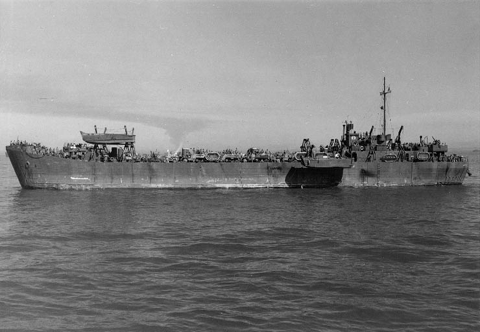
During World War 2 there were 1051 LST's (Landing Ship Tank) built to carry troops and supplies to American and Allied troops fighting in Europe and the Pacific theaters. When WW2 ended most of the LST's were scrapped, modified, or given to Navies of other countries. Some remained in service and saw action in Korea, Viet Nam, and even the Cuban Blockade.
A few WW2 type LST's remain in service today, but not in the USA. One goal of the LST Association is to reacquire an operational LST from one of the foreign countries, restore it, and put it on display as a memorial to to the sailors who manned these ships and to those who died serving their country on an LST.

Abbreviation LST, naval ship specially designed to transport and deploy troops, vehicles, and supplies onto foreign shores for the conduct of offensive military operations. LSTs were designed during World War II to disembark military forces without the use of dock facilities or the various cranes and lifts necessary to unload merchant ships. They gave the Allies the ability to conduct amphibious invasions at any location on a foreign shore that had a gradually sloped beach. This ability permitted the Allies to assault poorly defended sectors, thereby achieving operational surprise and in some cases even tactical surprise.
Specially designed landing ships were first employed by the British in "Operation Torch," the invasion of North Africa in 1942. The British recognized the need for such ships after the debacle at Dunkirk in 1940, when they left behind tons of badly needed equipment because no vessels were available with the capability to bridge the gap between the sea and the land. Following the evacuation, Prime Minister Winston Churchill sent his minister of supply a memorandum posing the question "What is being done about designing and planning vessels to transport tanks across the sea for a British attack on enemy countries? These must be able to move six or seven hundred vehicles in one voyage and land them on the beach, or, alternatively, take them off the beaches. . . ." As an interim measure, three shallow-draft tankers were converted to LSTs. The bows were redesigned so that a door, hinged at the bottom, and a 68-foot- (21-metre-) long double ramp could be fitted to the vessels. These modifications made it possible for vehicles to disembark directly from the ship to the beach. Both the new design and the vessel were considered unsatisfactory, but the concept was sound. At the request of the British, the Americans undertook the redesign and production of LSTs in November 1941, and John Niedermair of the Bureau of Ships designed a ship with a large ballast system. Deep-draft ships were necessary to cross the ocean, and shallow-draft vessels were required to bridge the water gap. A new proposed ballast system gave one ship both capabilities: when at sea, the LST took on water for stability, and when conducting landing operations, the water was pumped out to produce a shallow-draft vessel. The American-built LST Mk2, or LST(2), was 328 feet in length and 50 feet wide. It could carry 2,100 tons. Built into the bow were two doors that opened outward to a width of 14 feet. Most Allied vehicles could be transported on, and off-loaded from LST(2)s. The lower deck was the tank deck, where 20 Sherman tanks could be loaded. Lighter vehicles were carried on the upper deck. An elevator was used to load and off-load vehicles, artillery, and other equipment from the upper deck; in later models, a ramp replaced the elevator. The vessel was powered by two diesel engines, and it had a maximum speed of 11.5 knots and a cruising speed of 8.75 knots. LSTs were lightly armed with a variety of weapons. A typical American LST was armed with seven 40-millimetre and 12 20-millimetre antiaircraft guns.
Numerous other types of landing ships were produced by the British and Americans during the war. Examples are: the Landing Ship, Infantry (Large), or LSI(L), named Auxiliary Personnel Attack Ship (APA) by the U.S. Navy; the Landing Ship, Headquarters, or LSH, named Command Ship by the U.S. Navy; Landing Ship, Dock, or LSD; and Landing Ship, Medium, or LSM. Some vessels called landing ships did not have the capability to off-load troops and supplies onto beaches; they were in fact simply transports or command-and-control vessels.
During the Korean War, LSTs were employed in the Inchon Landing. Limited numbers of LSTs were produced in the 1950s and '60s. The most prominent were the diesel-powered Newport LSTs, which were built for the U.S. Navy in the 1960s. These vessels displaced more than 8,000 tons full load and transported amphibious craft, tanks, and other combat vehicles, along with 400 men, at speeds of up to 20 knots. Such speeds were made possible by abandoning the bow doors of their World War II predecessors in favour of an extendable ramp supported by huge projecting derrick extensions on each side of the bow. As the ship beached, the ramp would shoot forward hydraulically 112 feet. Vehicles and troops would land over the ramp, while amphibious craft in the tank deck would disembark from stern gates.
As he said, "Some E-boats came in and slaughtered us."
|
Keeping Watch
 US soldiers sit at childrens' desks in a primary school classroom in Fallujah, Iraq Tuesday April 29, 2003. U.S. soldiers opened fire Monday night in Fallujah on Iraqis at a nighttime demonstration against the American presence here after people shot at them with automatic rifles, soldiers said Tuesday. The director of the local hospital said 13 people were killed and 75 wounded. (AP Photo/David Guttenfelder)  U.S soldiers sit on top of school desks at a primary school in Fallujah, Iraq manning sniper positions at the windows Tuesday April 29, 2003.  A US soldier mans a position from a primary school window in Fallujah, Iraq Tuesday April 29, 2003.  A US soldier mans a position on the roof of a primary school in Fallujah, Iraq Tuesday April 29, 2003
|
Disclaimer: Opinions posted on Free Republic are those of the individual posters and do not necessarily represent the opinion of Free Republic or its management. All materials posted herein are protected by copyright law and the exemption for fair use of copyrighted works.


