|
 are acknowledged, affirmed and commemorated.
|
Posted on 02/04/2003 5:34:11 AM PST by SAMWolf
|
are acknowledged, affirmed and commemorated.
|

| Our Mission: The FReeper Foxhole is dedicated to Veterans of our Nation's military forces and to others who are affected in their relationships with Veterans. We hope to provide an ongoing source of information about issues and problems that are specific to Veterans and resources that are available to Veterans and their families. In the FReeper Foxhole, Veterans or their family members should feel free to address their specific circumstances or whatever issues concern them in an atmosphere of peace, understanding, brotherhood and support.  To list previous Foxhole Threads or to add The Foxhole to your sidebar Click on the Logo
|
|
|
|
A small group of die-hard aviators fended off Japanese invaders at Guadalcanal, code-named "Cactus." Believing the amphibious assault to be a temporary, diversionary raid (and seeing that they were outnumbered 3-to-1), Japanese ground forces on Guadalcanal initially withdrew into the jungle, expecting air attacks to drive the Americans off. Over the next two days, land-based Japanese navy planes, including Mitsubishi G4M bombers (Allied code name "Betty") and Zero ("Zeke") fighters, downed 20 percent of the U.S. Navy fighters sent against them but lost nearly half their own. The loss of four cruisers and a destroyer in the sea battle of Savo on the night of August 9, combined with the continuing threat of daylight air attack, caused the U.S. Navy to withdraw. The Marines were left on "the Canal" with what they referred to as the only unsinkable aircraft carrier in the Solomon Islands -- the Guadalcanal airfield. They used captured construction equipment to finish the 2,600-foot runway, adding an extra 1,200 feet for good measure.  Major John L. Smith scored 19 aerial victories and earned the Medal of Honor over Guadalcanal. (National Archives) Although bereft of taxiways, revetments, drainage and radar, the airfield -- christened Henderson Field after Marine Major Lofton Henderson, who died leading a dive-bomber attack in the June 4 Battle of Midway -- boasted Japanese hangars, machine shops and radio installations, a pagodalike control tower complete with a warning siren for air raids, and even an ice plant. But not until August 20 did Guadalcanal -- code-named "Cactus" -- take delivery of 12 Douglas SBD Dauntless dive bombers and their escort of 19 Grumman F4F-4 Wildcat fighters, the advance squadrons of Marine Air Group (MAG) 23. "I was close to tears and I was not alone," said Maj. Gen. Archer Vandergrift, the Marine ground commander, "when the first SBD taxied up and this handsome and dashing aviator jumped to the ground. 'Thank God you have come,' I told him." Within 12 hours the fledgling "Cactus Air Force" helped finish off a Japanese infantry assault. The next day, the American fliers gave an enemy bomber raid from Rabaul, New Britain, a rude welcome. In his first combat engagement, Captain John Lucien Smith, commanding Marine Fighter Squadron (VMF) 223, and four F4Fs met the fighter escort, 13 Zeros of the crack Tainan Kokutai (naval air group) led by Lieutenant Shiro Kawai, head-on. All four Wildcats survived, though two were badly damaged and one cracked up attempting a dead-stick landing. No Zeros were destroyed, but Smith thought the skirmish "did a great deal of good" by giving the Marines a better idea of the Zero's capabilities while giving them confidence in the performance and durability of their own Wildcats. Later that week, Captain Marion Carl, who had downed a Zero at Midway, got two Bettys and another Zero. Carl and Smith were to become friendly rivals. The balance of power on Guadalcanal seesawed with the waxing and waning of fighter strength at Henderson. By the end of August the Cactus Air Force included 14 Bell P-400 Airacobra fighter-bombers (export versions of the company's P-39) of the 67th Fighter Squadron, U.S. Army Air Forces (USAAF), and 19 F4Fs of VMF-224, under Major Robert E. Galer. (In less than two weeks Galer would knock down four enemy planes, go down in the water and swim ashore. His gallantry would eventually garner him 13 kills and the Medal of Honor.) 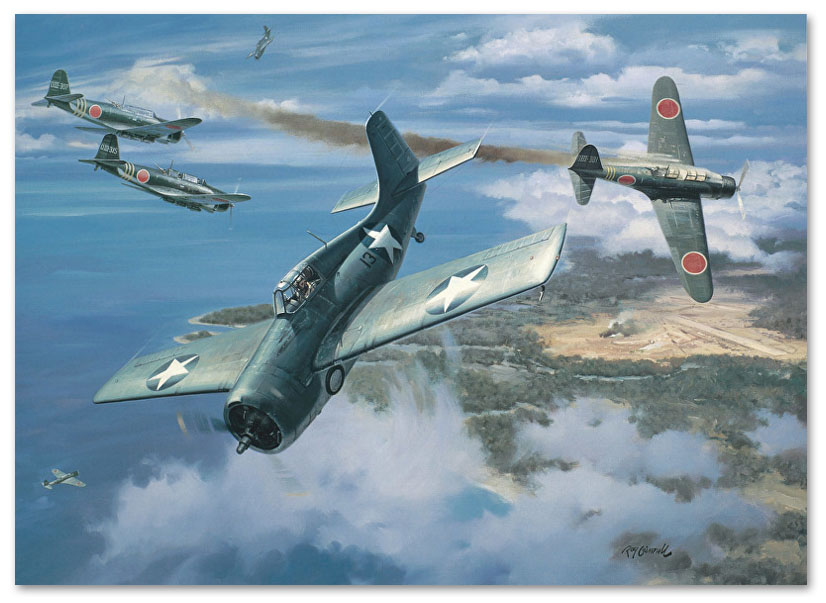 By the afternoon of September 10, however, only three P-400s remained, with 22 SBDs and 11 F4Fs. (Among the missing was Marion Carl.) Two dozen Navy Wildcats hurriedly flew in to reinforce them; the Airacobras proved barely enough to help repulse an attack on Bloody Ridge, just south of the airfield. During the course of the Bloody Ridge battle, Henderson received 60 planes, including 18 more F4Fs,12 SBDs and six Grumman TBF Avenger torpedo bombers, but the Japanese reinforced Rabaul with 60 fighters and 72 medium bombers. By mid-October, 224 Japanese planes had fallen to the Cactus Air Force, including 111 1/2 to VMF-223 and 19 to Smith, who, as the highest-scoring American airman to date, was awarded the Navy Cross and the Medal of Honor. His erstwhile opponent as top gun, Carl, had actually made it back to Henderson after spending five days with the natives, only to find that Smith had pulled ahead of him in victories. ("Dammit, General," he urged Brig. Gen. Roy S. Geiger, the Marine air commander, "ground him for five days!") Carl finished with 18 1/2 kills and a Navy Cross.  Joe Foss (standing second from left) and pilots of VMF-121 at Henderson Field in February 1943. By that time, Captain Foss was in command of the squadron and had earned the Medal of Honor. (National Archives) Seven of the pilots who had arrived with Smith and Carl in August went out as aces; six were killed and six wounded. Of the Dauntless squadron, only the commander, Lt. Col. Richard C. Mangrum, was able to walk away when he was evacuated on October 12; all his men had been killed, wounded, or hospitalized. "These guys had stopped [the Japanese] cold," said Captain Joseph J. Foss, who would become Cactus' premier ace, "and now it was our turn." Foss -- "Smokey Joe" for his cigar habit -- was executive officer of Major Leonard K. "Duke" Davis' VMF-121, which moved up to relieve VMF-223 on October 9. "We were fired upon by Japanese troops as we landed," recalled Lieutenant Jefferson J. DeBlanc of VMF- 112, some of whose pilots arrived a month later in transport planes. "We were always under fire on takeoffs and landings." Pilots were quartered in mud-floored tents in the frequently flooded coconut grove called "Mosquito Grove," between the airstrip and the beach. The latrine was a trench, with a log for a seat; the bathtub was the Lunga River. There were only two meals a day -- dehydrated potatoes, Spam, cold hash and captured Japanese rice -- and cigarettes. Malaria, dysentery, dengue fever, beriberi and myriad lesser known tropical diseases stalked the garrison. No man could get out of duty with less than a 102-degree fever, but by October more than 2,000 had been hospitalized.  Working conditions were also daunting. Fuel had to be hand-pumped out of 55-gallon drums (and strained through chamois, since native porters sometimes cooled their feet in it) into 12-quart buckets before being poured into airplanes. There were plenty of bombs but no bomb hoists; the SBDs' 500-pounders had to be hand- loaded. The Wildcats' turbochargers, not to be engaged below 10,000 feet but wired open anyway, wore out the engines in 25 to 50 flying hours. "Almost daily," wrote the 67th Squadron historian, "and almost always at the same time -- noon, 'Tojo Time' -- the bombers came." Advance notice arrived from coastwatchers up the archipelago or, once incoming Japanese bombers learned to detour out of their sight, via Henderson's new long-range SCR (signal corps radio) 270 radar. The Wildcats, the Dauntlesses and the P-400s scrambled to take off two at a time -- through a blinding pall of dust or, if it had rained, through wheel-sucking mud -- on a treacherous runway pocked with half-filled bomb and shell craters and rutted by the solid rubber tail wheels of carrier aircraft. Almost invariably one or two planes failed to take off. The "ground pounders," the SBDs and P-400s, scuttled off over the treetops to work over enemy ground positions -- or at least to keep out of the way of the impending airstrike. The Wildcat pilots had their work cut out for them just raising their landing gear (which took 29 turns of a hand crank), struggling to form up, trimming their aircraft and testing their guns. (Early Wildcat guns had a tendency to jam during hard maneuvers; furthermore, if the oil necessary to prevent rust on the guns in the humid sea-level air was not removed before takeoff, it froze at altitude, jamming the actions.) Most important, the pilots had to reach the Japanese bombers' altitude before the Zekes fell on them.  In his first combat mission, attempting to intercept bombers at 24,000 feet, Lieutenant James Percy of VMF-112 suffered a partial turbocharger failure 10,000 feet short of the enemy formation. "I continued to climb very slowly on low blower, but it was obvious I wasn't going to reach [the enemy's] altitude in time to intercept," Percy recalled. "As the bombers passed about 3,000 feet over me, I noticed their bomb bay doors were open. As I grasped what that meant, their bombs started falling toward me. All I could do was duck my head and pray. Bombs passed all around me, but I was not hit." (Percy's luck held; in June 1943 he survived a 2,000-foot fall with a shot-up parachute into the waters off the Russell Islands.) Down below, a black flag would go up at the "Pagoda" -- air raid imminent -- and the triple-A (anti-aircraft artillery) would open up. Around the runway, slit trenches and bomb shelters rapidly filled (a sign over one shelter entrance read, "Beneath these portals pass the fastest men in the world") as the first bombs began to fall at one end of the field, and the explosions "walked" across to the other side. Diving, whether to attack or to escape, was the one maneuver at which the Wildcat bested the Zero. "The Zeros had superior maneuverability," said 2nd Lt. Roger A. "Jughead" Haberman, a division leader in Foss' flight who ultimately scored seven victories. "In two-and-a-half turns against a Wildcat they could have you boresighted. But our planes were heavier than theirs, so if you got into trouble, you could dive earthward away from them." Usually.  In Foss' first combat on October 13, he was jumped by a Zeke flown by Petty Officer 1st Class Kozaburo Yasui of the Tainan Kokutai. Foss later recalled: "That bird came by like a freight train and gave me a good sprinkling, but I knew I had him. I pulled up and gave him a short burst, and down he went." But while Foss was credited with the kill, Yasui in fact survived (he would bring his own score up to 11 before he was killed over Guam on June 19, 1944) -- and his two wingmen, Petty Officer 2nd Class Nobutaka Yanami and Seaman 1st Class Tadashi Yoneda, bounced Foss. Their bullets hit his oil cooler, and his engine seized. "The only thing I could do to get out -- I was right over the field -- was to just wheel over and dive straight down," Foss recalled. He plunged from 22,000 feet right down to the deck. "I'd read that a Zero couldn't follow such a dive; its wings would come off trying to pull out. Well, whoever wrote that was a fiction writer because those boys just kept on my tail, pumping lead!" Anti-aircraft gunners cleared the Zekes from his tail, and Foss coasted in to a dead-stick crash landing. The Americans knew the Japanese had the edge in experience. Most Yanks were straight out of flying school, with less than 300 hours in training aircraft. "Some of the pilots," wrote Percy, "barely had enough time in the F4Fs to get safely airborne." Many Zero aces, veterans of the Sino-Japanese War, counted 800 hours of flying time even before the United States entered the war.
|
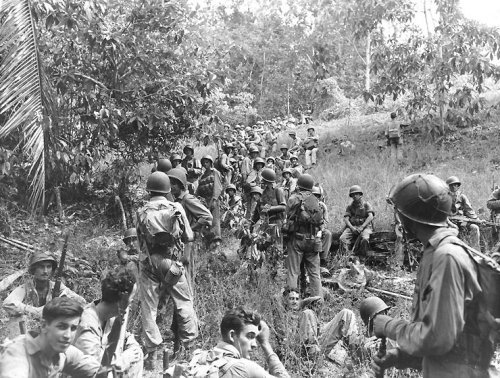
Hubby's uncle Ralph was a member of the original team of Merrill's Marauders.
How are you?
Bullets began flying all over the place. The cockpit filled up with smoke blinding me. I never did get a look at what was on my tail before I bailed out.
The parachute opened at 10,000 feet and I floated down off Near Island a few miles off the coast of Guadalcanal, about 30 miles from home. I was dunked into the ocean 400 yards off the island and started to swim to shore. I got within hailing distance of the beach but the current prevented me from landing.
I was just about to give up when a native boy paddled out in a canoe, grabbed me, and hauled me aboard more dead than alive.
After being taken ashore, the native gave Captain Carl a drink of Coconut milk and then brought the aviator from the island to a native village on Guadalcanal where he was fed and housed for the night.
The natives agreed to take me to headquarters the next morning. Before we got out of the village, a Japanese party began heading for it. I went into the Jungle and hid. Early the next morning we started home. Two native police and a large group of native villagers accompanied me. On the way home I found a deserted radio shack and spent four hours trying to get it going.
We went a short way further when we encountered large groups of natives fleeing in our direction. They told us there were 2,000 Japanese between us and the U.S. headquarters and that it was impossible to get through them.
Captain Carl was taken to the hut of an educated native who had studied medicine. The man had a small launch and agreed to take the young pilot up the coast to headquarters.
We planned to leave at three-thirty that day, but the engine wouldn’t start. I was a former aeronautical engineer so I spent the rest of the day taking it apart and finally got it running. We left at dawn and had no trouble arriving.
Captain Carl’s first question when he arrived was “What’s Smitty’s score?” He grimaced when he was told that Major John L. Smith, his closest competitor, had shot down a total of 16 planes and pulled ahead of Captain Carl during the five days that he was missing. “Ground him for five days, General,” Captain Carl said to Brigadier General Roy S. Geiger, commander of the 1st MAW. “That will give me a chance to catch up.”
In his first television interview in some time, Saddam Hussein said he was "shocked, shocked" that he was accused of harboring al Qaeda.
I posit he will be even more shocked by Colin Powell's Ginsu knife sales pitch tomorrow,
. . .and fatally shocked by a BLU-113 with his DNA programmed into its GPS guidance system.
. . .the penalty for producing a disgruntled ex-chief bodyguard.
Godspeed swift victory and safe return to the finest fighting force on earth.
God Bless Our Troops, Our Veterans and their families.
In his first television interview in some time, Saddam Hussein said he was "shocked, shocked" that he was accused of harboring al Qaeda.
"Round up the usual suspects."
Disclaimer: Opinions posted on Free Republic are those of the individual posters and do not necessarily represent the opinion of Free Republic or its management. All materials posted herein are protected by copyright law and the exemption for fair use of copyrighted works.
