Skip to comments.
US is working on doubling aid to Argentina to $40 billion by tapping private funding sources
AP via Yahoo ^
| Wed, October 15, 2025
| FATIMA HUSSEIN and ANDREA VULCANO
Posted on 10/15/2025 2:17:06 PM PDT by Kazan
WASHINGTON (AP) — The Trump administration is looking to provide an additional $20 billion in financing for Argentina through a mix of financing from sovereign funds and the private sector.
That would come on top of the $20 billion credit swap line that the U.S. Treasury pledged to Argentine President Javier Milei and his government this month to bolster the South American nation's collapsing currency.
“We are working on a $20 billion facility that would complement our swap line, with private banks and sovereign funds that, I believe, would be more focused on the debt market,” Treasury Secretary Scott Bessent told reporters Wednesday. He called it “a private-sector solution” and said "many banks are interested in it and many sovereign funds have expressed interest.”
At a White House meeting Tuesday with Milei, Republican President Donald Trump said his administration wanted to help “our neighbors” with the aid package, but he also suggested that the money could be pulled if Milei's party did not prevail in the Oct. 26 midterm elections.
“If he loses, we are not going to be generous with Argentina," Trump said.
The Argentine peso weakened slightly Wednesday after Trump's comments. The peso depreciated about 0.7%, with the dollar — the currency Argentines rely on to save — trading at 1,395 pesos, compared with 1,385 pesos the previous day.
(Excerpt) Read more at finance.yahoo.com ...
TOPICS: News/Current Events
KEYWORDS: argentina; bailout; bessentbuddybailout; bottomlesspitt; debt; deficit; didntvote4this; inflation; magabankruptcy; magasocialism; worstpresidentever
Why is it in our national interest to bailout Argentina?
1
posted on
10/15/2025 2:17:06 PM PDT
by
Kazan
To: Kazan
I guess, I am helping Argentina.
I have 1000 pesos leftover from past trip to Argentina!
Looks like it is not even worth a buck.
2
posted on
10/15/2025 2:20:54 PM PDT
by
AZJeep
(sane )
To: AZJeep
A good tourist destination at those rates? A good ribeye’s gotta be cheap down there. Winter here will be summer there-good time to visit.
To: Kazan
It sure is easy to spend OPM.
4
posted on
10/15/2025 2:33:01 PM PDT
by
rottndog
(Posse Comitatus does not Trump the Constitution. )
To: Kazan
Well they switched to a conservtive government from a near communist one before.
“ Frente de Todos ‘ —progressives as THEY call it.
5
posted on
10/15/2025 2:38:34 PM PDT
by
Phoenix8
To: DIRTYSECRET
On no!
I am dedicated to help Mielei.
Even If I loose all my money!
6
posted on
10/15/2025 3:01:44 PM PDT
by
AZJeep
(sane )
To: Kazan
They seem to have enough money to implement various instruments of surveillance and social control.
https://english.elpais.com/international/2024-07-30/javier-mileis-government-will-monitor-social-media-with-ai-to-predict-future-crimes.html# (July 2024)
Javier Milei’s government will monitor social media with AI to ‘predict future crimes’
Argentina’s new Artificial Intelligence Unit Applied to Security will be tasked with surveillance in the real and virtual worlds. Experts warn about privacy violations
The adjustment and streamlining of public agencies that President Javier Milei is driving in Argentina does not apply to the areas of security and defense. After restoring the State Intelligence Secretariat and assigning it millions of reserved funds —for which he does not have to account — the president has now created a special unit that will deal with cyberpatrolling on social media and the internet, the analysis of security cameras in real time and aerial surveillance using drones, among other things. In addition, he will use “machine learning algorithms” to “predict future crimes,” as the sci-fi writer Philip K. Dick once dreamed up, later made famous by the film Minority Report. How will Milei do all that? Through artificial intelligence, the executive announced.
Among his plans to downsize the State, President Milei has been saying that he intends to replace government workers and organizations with AI systems. The first role that he will give to this technology, however, will be an expansion of state agencies: on Monday his government created the Unit of Artificial Intelligence Applied to Security.
The new agency will report to the Ministry of Security. “It is essential to apply artificial intelligence in the prevention, detection, investigation and prosecution of crime and its connections,” states the resolution signed by Minister Patricia Bullrich, who cites similar developments in other countries. The belief behind the decision is that the use of AI “will significantly improve the efficiency of the different areas of the ministry and of the federal police and security forces, allowing for faster and more precise responses to threats and emergencies.”
The Artificial Intelligence Unit will be made up of police officers and agents from other security forces. Its tasks will include “patrolling open social platforms, applications and websites,” where it will seek to “detect potential threats, identify movements of criminal groups or anticipate disturbances.” It will also be dedicated to “analyzing images from security cameras in real time in order to detect suspicious activities or identify wanted persons using facial recognition.” The resolution also awards it powers worthy of science fiction: “Using machine learning algorithms to analyze historical crime data and thus predict future crimes.” Another purpose will be to discover “suspicious financial transactions or anomalous behavior that could indicate illegal activities.”
The new unit will not only deal with virtual spaces. It will be able to “patrol large areas using drones, provide aerial surveillance and respond to emergencies,” as well as perform “dangerous tasks, such as defusing explosives, using robots.”
Rights at risk
Various experts and civil organizations have warned that the new AI Unit will threaten citizens' rights.
“The government body created to patrol social networks, applications and websites contradicts several articles of the National Constitution,” said Martín Becerra, a professor and researcher in media and information technology. “The government of Milei (and Bullrich) is anti-liberal. It decrees new regulations, reinforces the state’s repressive function, increases the opacity of public funds and eliminates norms that sought to protect the most vulnerable,” he warned on his social media accounts.
For Natalia Zuazo, a digital policy specialist, the initiative essentially means “illegal intelligence disguised as the use of ‘modern’ technologies.” Among the implicit risks, she explained that there will be little control and many different security forces with access to the information that’s collected.
The Center for Studies on Freedom of Expression and Access to Information at the University of Palermo said its research on cyber-patrolling practices in Argentina and other Latin American countries indicates that “the principles of legality and transparency are often not met. The opacity in the acquisition and implementation of technologies and the lack of accountability are worrying. In the past, these technologies have been used to profile academics, journalists, politicians and activists.” In that context, “without supervision or checks and balances, privacy and freedom of expression are threatened.”
The Argentine Observatory of Information Technology Law pointed out that the Security resolution “justifies the measure by invoking comparative experiences, of which the slightest analysis is never carried out.” It asked: “Are the security systems of China or India really comparable with those of France or Singapore and, at the same time, all of them with that of Argentina?”
The researcher Becerra particularly questioned the function of predicting crimes assigned to the new unit, noting that it is “something in which the use of AI has explicitly failed and which, therefore, must be avoided.”
The Philip K. Dick story that gave rise to the Steven Spielberg film warned about the problems of predicting crimes. “We stopped them [future criminals] before they could commit any act of violence,” said one of the characters in the story. “So the commission of the crime itself is absolutely a metaphysical question. We claim that they are guilty. And they, in turn, constantly claim that they are innocent. And in a certain sense they are innocent.”
None of this is about preventing crime. It's about tamping down on freedom - of speech, of movement.
Anyone who embraces Milei also embraces the surveillance and control apparatus that his government is implementing.
7
posted on
10/15/2025 4:07:34 PM PDT
by
yelostar
(AI will be the scapegoat when the SHTF. )
To: Kazan
Especially since Argentina is using the money to sell agriculture products to the Chinese in direct competition with US farmers.
Stop bankrolling our competitors!
8
posted on
10/15/2025 7:56:06 PM PDT
by
mac_truck
(aide toi et dieu t'aidera)
To: Kazan
Looks like another 20 billion down the drain. Zelensky must be giving them lessons in financial security.
Don't cry for us Argentina
We got the money
We'll keep our distance
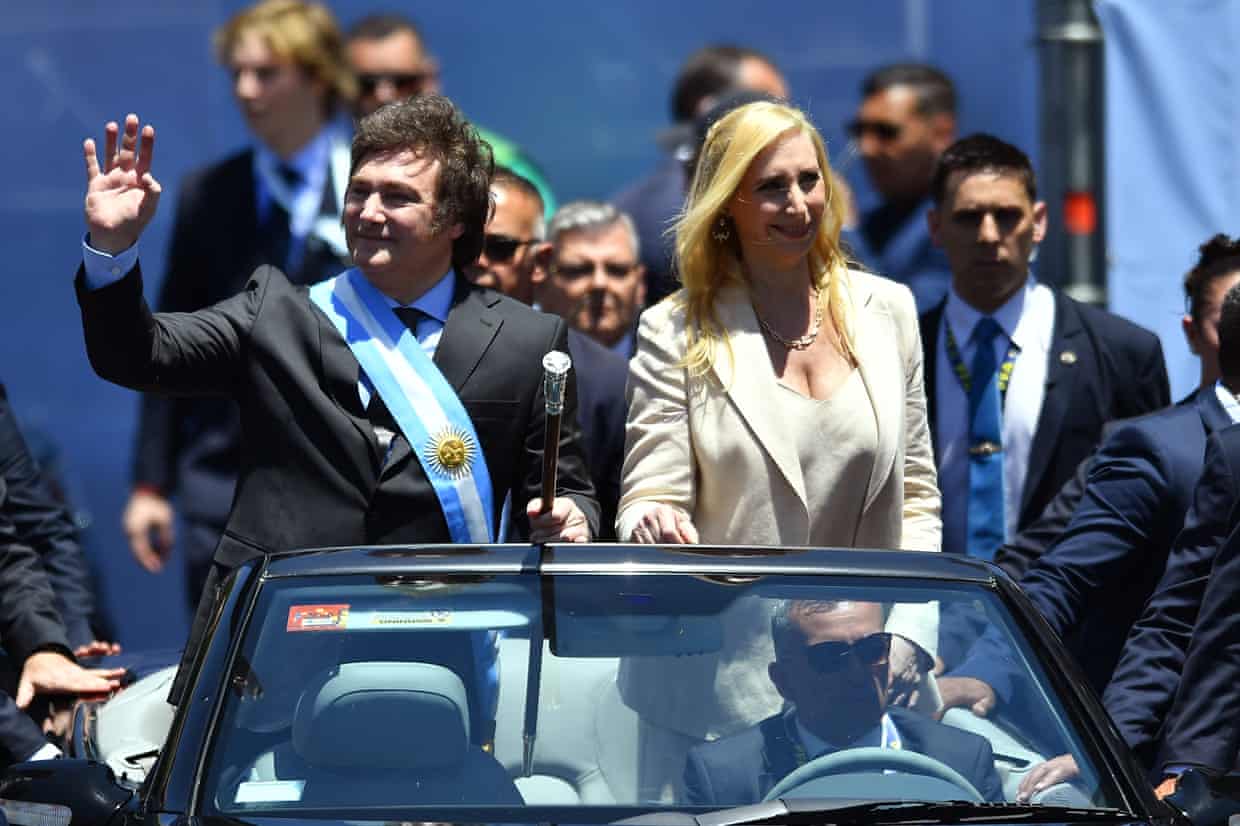
"Karina Milei(who serves as the Secretary General of the Presidency) pocketed 3% from each contract related to the purchase of medicines [1] [3]. Spagnuolo initially denied his involvement but later admitted it and was subsequently dismissed from his position [1] [2]. The alleged scheme reportedly generated between $500,000 and $800,000 per month in bribes, with 3% of that amount purportedly going to Karina Milei [1]"
https://www.theguardian.com/world/2025/aug/27/javier-milei-sister-argentina-alleged-kickbacks
To: Kazan
Make Argentina Great Again?
10
posted on
10/16/2025 4:57:37 PM PDT
by
Kevin C
To: DIRTYSECRET
I’ve been there and wasn’t impressed. Buenos Aires is the Paris of South America like Tallahassee is the Paris of Florida.
To: Kevin C; mac_truck; All
12
posted on
10/27/2025 4:20:10 PM PDT
by
Drago
Disclaimer:
Opinions posted on Free Republic are those of the individual
posters and do not necessarily represent the opinion of Free Republic or its
management. All materials posted herein are protected by copyright law and the
exemption for fair use of copyrighted works.
FreeRepublic.com is powered by software copyright 2000-2008 John Robinson