Skip to comments.
Catholic Caucus: Daily Mass Readings 11-November-2026
Universalis/Jerusalem Bible ^
Posted on 11/11/2026 2:09:19 PM PST by annalex
Mmm dd, 2026
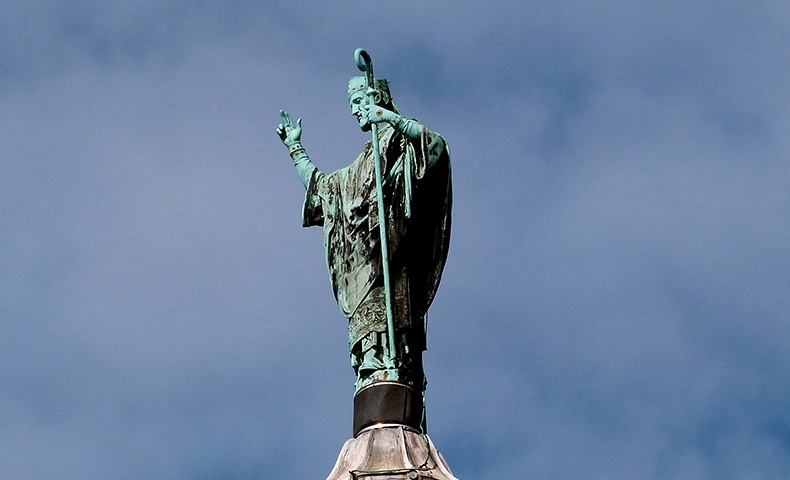
Saint Martin of Tours, Bishop
on Wednesday of week 32 in Ordinary Time

St. Martin of Tours Catholic Church, LuisvilleReadings at MassThis is a preview of Universalis. The Universalis app gives you every day of every year, not just the single week you’re seeing now, and it doesn’t need the Internet. It gives you the official New American Bible version for the readings at Mass. As well as the Mass, it gives you the Liturgy of the Hours. It costs $9.99-12.99 on your phone, or £19.99 (about $26.50) on your computer. Get it now. Liturgical Colour: White. Year: A(II). Readings for the feria Readings for the memorial These are the readings for the feria
It was purely by his own compassion that God saved usRemind your people that it is their duty to be obedient to the officials and representatives of the government; to be ready to do good at every opportunity; not to go slandering other people or picking quarrels, but to be courteous and always polite to all kinds of people. Remember, there was a time when we too were ignorant, disobedient and misled and enslaved by different passions and luxuries; we lived then in wickedness and ill-will, hating each other and hateful ourselves. But when the kindness and love of God our saviour for mankind were revealed, it was not because he was concerned with any righteous actions we might have done ourselves; it was for no reason except his own compassion that he saved us, by means of the cleansing water of rebirth and by renewing us with the Holy Spirit which he has so generously poured over us through Jesus Christ our saviour. He did this so that we should be justified by his grace, to become heirs looking forward to inheriting eternal life.
| Responsorial Psalm | Psalm 22(23) |
|---|
The Lord is my shepherd: there is nothing I shall want. The Lord is my shepherd; there is nothing I shall want. Fresh and green are the pastures where he gives me repose. Near restful waters he leads me, to revive my drooping spirit. The Lord is my shepherd: there is nothing I shall want. He guides me along the right path; he is true to his name. If I should walk in the valley of darkness no evil would I fear. You are there with your crook and your staff; with these you give me comfort. The Lord is my shepherd: there is nothing I shall want. You have prepared a banquet for me in the sight of my foes. My head you have anointed with oil; my cup is overflowing. The Lord is my shepherd: there is nothing I shall want. Surely goodness and kindness shall follow me all the days of my life. In the Lord’s own house shall I dwell for ever and ever. The Lord is my shepherd: there is nothing I shall want.
| Gospel Acclamation | cf.2Th2:14 |
|---|
Alleluia, alleluia! Through the Good News God called us to share the glory of our Lord Jesus Christ. Alleluia! Alleluia, alleluia! For all things give thanks, because this is what God expects you to do in Christ Jesus. Alleluia!
No-one has come back to praise God, only this foreignerOn the way to Jerusalem Jesus travelled along the border between Samaria and Galilee. As he entered one of the villages, ten lepers came to meet him. They stood some way off and called to him, ‘Jesus! Master! Take pity on us.’ When he saw them he said, ‘Go and show yourselves to the priests.’ Now as they were going away they were cleansed. Finding himself cured, one of them turned back praising God at the top of his voice and threw himself at the feet of Jesus and thanked him. The man was a Samaritan. This made Jesus say, ‘Were not all ten made clean? The other nine, where are they? It seems that no one has come back to give praise to God, except this foreigner.’ And he said to the man, ‘Stand up and go on your way. Your faith has saved you.’ Continue These are the readings for the memorial
| First reading | Isaiah 61:1-3 |
|---|
He has sent me to proclaim a year of favour from the LordThe spirit of the Lord has been given to me, for the Lord has anointed me. He has sent me to bring good news to the poor, to bind up hearts that are broken; to proclaim liberty to captives, freedom to those in prison; to proclaim a year of favour from the Lord, a day of vengeance for our God, to comfort all those who mourn and to give them for ashes a garland; for mourning robe the oil of gladness, for despondency, praise.
| Responsorial Psalm |
|---|
| Psalm 88(89):2-5,21-22,25,27 |
|---|
I will sing for ever of your love, O Lord. I will sing for ever of your love, O Lord; through all ages my mouth will proclaim your truth. Of this I am sure, that your love lasts for ever, that your truth is firmly established as the heavens. I will sing for ever of your love, O Lord. ‘I have made a covenant with my chosen one; I have sworn to David my servant: I will establish your dynasty for ever and set up your throne through all ages. I will sing for ever of your love, O Lord. ‘I have found David my servant and with my holy oil anointed him. My hand shall always be with him and my arm shall make him strong. I will sing for ever of your love, O Lord. ‘My truth and my love shall be with him; by my name his might shall be exalted. He will say to me: “You are my father, my God, the rock who saves me.”’ I will sing for ever of your love, O Lord.
| Gospel Acclamation | Jn13:34 |
|---|
Alleluia, alleluia! I give you a new commandment: love one another just as I have loved you, says the Lord. Alleluia!
I was naked and you clothed me; sick, and you visited meJesus said to his disciples: ‘When the Son of Man comes in his glory, escorted by all the angels, then he will take his seat on his throne of glory. All the nations will be assembled before him and he will separate men one from another as the shepherd separates sheep from goats. He will place the sheep on his right hand and the goats on his left. ‘Then the King will say to those on his right hand, “Come, you whom my Father has blessed, take for your heritage the kingdom prepared for you since the foundation of the world. For I was hungry and you gave me food; I was thirsty and you gave me drink; I was a stranger and you made me welcome; naked and you clothed me, sick and you visited me, in prison and you came to see me.” Then the virtuous will say to him in reply, “Lord, when did we see you hungry and feed you; or thirsty and give you drink? When did we see you a stranger and make you welcome; naked and clothe you; sick or in prison and go to see you?” And the King will answer, “I tell you solemnly, in so far as you did this to one of the least of these brothers of mine, you did it to me.”’ Continue Christian Art Each day, The Christian Art website gives a picture and reflection on the Gospel of the day. The readings on this page are from the Jerusalem Bible, which is used at Mass in most of the English-speaking world. The New American Bible readings, which are used at Mass in the United States, are available in the Universalis apps, programs and downloads.
You can also view this page with the Gospel in Greek and English. |
TOPICS: Catholic; General Discusssion; Prayer; Worship
KEYWORDS: catholic; lk17; mt25; ordinarytime; prayer
For your reading, reflection, faith-sharing, comments, questions, discussion.
1
posted on
11/11/2026 2:09:19 PM PST
by
annalex
To: annalex
KEYWORDS: catholic; lk17; mt25; ordinarytime; prayer;
2
posted on
11/11/2026 2:10:01 PM PST
by
annalex
(fear them not)
To: nickcarraway; NYer; ELS; Pyro7480; livius; ArrogantBustard; Catholicguy; RobbyS; marshmallow; ...

Alleluia Ping Please FReepmail me to get on/off the Alleluia Ping List.
3
posted on
11/11/2026 2:10:55 PM PST
by
annalex
(fear them not)
To: annalex
4
posted on
11/11/2026 2:11:20 PM PST
by
annalex
(fear them not)
To: annalex
| Luke |
| | English: Douay-Rheims | Latin: Vulgata Clementina | Greek NT: Byzantine/Majority Text (2000) |
| | Luke 17
|
| 11. | And it came to pass, as he was going to Jerusalem, he passed through the midst of Samaria and Galilee. | Et factum est, dum iret in Jerusalem, transibat per mediam Samariam et Galilæam. | και εγενετο εν τω πορευεσθαι αυτον εις ιερουσαλημ και αυτος διηρχετο δια μεσου σαμαρειας και γαλιλαιας |
| 12. | And as he entered into a certain town, there met him ten men that were lepers, who stood afar off; | Et cum ingrederetur quoddam castellum, occurrerunt ei decem viri leprosi, qui steterunt a longe : | και εισερχομενου αυτου εις τινα κωμην απηντησαν αυτω δεκα λεπροι ανδρες οι εστησαν πορρωθεν |
| 13. | And lifted up their voice, saying: Jesus, master, have mercy on us. | et levaverunt vocem, dicentes : Jesu præceptor, miserere nostri. | και αυτοι ηραν φωνην λεγοντες ιησου επιστατα ελεησον ημας |
| 14. | Whom when he saw, he said: Go, shew yourselves to the priests. And it came to pass, as they went, they were made clean. | Quos ut vidit, dixit : Ite, ostendite vos sacerdotibus. Et factum est, dum irent, mundati sunt. | και ιδων ειπεν αυτοις πορευθεντες επιδειξατε εαυτους τοις ιερευσιν και εγενετο εν τω υπαγειν αυτους εκαθαρισθησαν |
| 15. | And one of them, when he saw that he was made clean, went back, with a loud voice glorifying God. | Unus autem ex illis, ut vidit quia mundatus est, regressus est, cum magna voce magnificans Deum, | εις δε εξ αυτων ιδων οτι ιαθη υπεστρεψεν μετα φωνης μεγαλης δοξαζων τον θεον |
| 16. | And he fell on his face before his feet, giving thanks: and this was a Samaritan. | et cecidit in faciem ante pedes ejus, gratias agens : et hic erat Samaritanus. | και επεσεν επι προσωπον παρα τους ποδας αυτου ευχαριστων αυτω και αυτος ην σαμαρειτης |
| 17. | And Jesus answering, said, Were not ten made clean? and where are the nine? | Respondens autem Jesus, dixit : Nonne decem mundati sunt ? et novem ubi sunt ? | αποκριθεις δε ο ιησους ειπεν ουχι οι δεκα εκαθαρισθησαν οι δε εννεα που |
| 18. | There is no one found to return and give glory to God, but this stranger. | Non est inventus qui rediret, et daret gloriam Deo, nisi hic alienigena. | ουχ ευρεθησαν υποστρεψαντες δουναι δοξαν τω θεω ει μη ο αλλογενης ουτος |
| 19. | And he said to him: Arise, go thy way; for thy faith hath made thee whole. | Et ait illi : Surge, vade : quia fides tua te salvum fecit. | και ειπεν αυτω αναστας πορευου η πιστις σου σεσωκεν σε |
5
posted on
11/11/2026 2:13:56 PM PST
by
annalex
(fear them not)
To: annalex

Catena Aurea by St. Thomas Aguinas
CHAP. 17
17:1119
11. And it came to pass, as he went to Jerusalem, that he passed through the midst of Samaria and Galilee.
12. And as he entered into a certain village, there met him ten men that were lepers, which stood afar off:
13. And they lifted up their voices, and said, Jesus, Master, have mercy on us.
14. And when he saw them, he said unto them, Go shew yourselves unto the priests. And it came to pass, that, as they went, they were cleansed.
15. And one of them, when he saw that he was healed, turned back, and with a loud voice glorified God,
16. And fell down on his face at his feet, giving him thanks: and he was a Samaritan.
17. And Jesus answering said, Were there not ten cleansed? but where are the nine?
18. There are not found that returned to give glory to God, save this stranger.
19. And he said unto him, Arise, go thy way: thy faith hath made thee whole.
AMBROSE. After speaking the foregoing parable, our Lord censures the ungrateful;
TITUS BOSTRENSIS. saying, And it came to pass, shewing that the Samaritans were indeed well disposed towards the mercies above mentioned, but the Jews not so. For there was enmity between the Jews and the Samaritans, and He to allay this, passed into the midst of both nations, that he might cement both into one new man.
CYRIL OF ALEXANDRIA. The Saviour next manifests His glory by drawing over Israel to the faith. As it follows, And as he entered into a certain village, there met him ten men that were lepers, men who were banished from the towns and cities, and counted unclean, according to the rites of the Mosaic law.
TITUS BOSTRENSIS. They associated together from the sympathy they felt as partakers of the same calamity, and were waiting till Jesus passed, anxiously looking out to see Him approach. As it is said, Which stood afar off, for the Jewish law esteems leprosy unclean, whereas the law of the Gospel calls unclean not the outward, but the inward leprosy.
THEOPHYLACT. They therefore stand afar off as if ashamed of the uncleanness which was imputed to them, thinking that Christ would loathe them as others did. Thus they stood afar off, but were made nigh unto Him by their prayers. For the Lord is nigh unto all them that call upon him in truth. (Ps. 145:18.) Therefore it follows, And they lifted up their voices, and said, Jesus, Master, have mercy upon us.
TITUS BOSTRENSIS. They pronounce the name of Jesus, and gain to themselves the reality. For Jesus is by interpretation Saviour. They say, Have mercy upon us, because they were sensible of His power, and sought neither for gold and silver, but that their bodies might put on again a healthful appearance.
THEOPHYLACT. They do not merely supplicate or entreat Him as if He were a man, but they call Him Master or Lord, as if almost they looked upon Him as God. But He bids them shew themselves to the priests, as it follows, And when he saw them, he said, Go, shew yourselves unto the priests. For they were examined whether they were cleansed from their leprosy or not.
CYRIL OF ALEXANDRIA. The law also ordered, that those who were cleansed from leprosy should offer sacrifice for the sake of their purification.
THEOPHYLACT. Therefore in bidding them go to the priests, he meant nothing more than that they were just about to be healed; and so it follows, And it came to pass that as they went they were healed.
CYRIL OF ALEXANDRIA. Whereby the Jewish priests who were jealous of His glory might know that it was by Christ granting them health that they were suddenly and miraculously healed.
THEOPHYLACT. But out of the ten, the nine Israelites were ungrateful, whereas the Samaritan stranger returned and lifted up his voice in thanksgiving, as it follows, And one of them turned back, and with a loud voice glorified God.
TITUS BOSTRENSIS. When he found that he was cleansed, he had boldness to draw near, as it follows, And fell down on his face at his feet giving him thanks. Thus by his prostration and prayers shewing at once both his faith and his gratitude.
It follows, And he was a Samaritan.
THEOPHYLACT. We may gather from this that a man is not one whit hindered from pleasing God because he comes from a cursed race, only let him bear in his heart an honest purpose. Further, let not him that is born of saints boast himself, for the nine who were Israelites were ungrateful; and hence it follows, And Jesus answering him said, Were there not ten cleansed?
TITUS BOSTRENSIS. Wherein it is shewn, that strangers were more ready to receive the faith, but Israel was slow to believe; and so it follows, And he said unto him, Arise, go thy way, thy faith has made thee whole.
AUGUSTINE. (de Quæst. Ev. l. ii. qu. 40.) The lepers may be taken mystically for those who, having no knowledge of the true faith, profess various erroneous doctrines. For they do not conceal their ignorance, but blazen it forth as the highest wisdom, making a vain show of it with boasting words. But since leprosy is a blemish in colour, when true things appear clumsily mixed up with false in a single discourse or narration, as in the colour of a single body, they represent a leprosy streaking and disfiguring as it were with true and false dyes the colour of the human form. Now these lepers must be so put away from the Church, that being as far removed as possible, they may with loud shouts call upon Christ. But by their calling Him Teacher, I think it is plainly implied that leprosy is truly the false doctrine which the good teacher may wash away. Now we find that of those upon whom our Lord bestowed bodily mercies, not one did He send to the priests, save the lepers, for the Jewish priesthood was a figure of that priesthood which is in the Church. All vices our Lord corrects and heals by His own power working inwardly in the conscience, but the teaching of infusion by means of the Sacrament, or of catechizing by word of mouth, was assigned to the Church. And as they went, they were cleansed; just as the Gentiles to whom Peter came, having not yet received the sacrament of Baptism, whereby we come spiritually to the priests, are declared cleansed by the infusion of the Holy Spirit. Whoever then follows true and sound doctrine in the fellowship of the Church, proclaiming himself to be free from the confusion of lies, as it were a leprosy, yet still ungrateful to his Cleanser does not prostrate himself with pious humility of thanksgiving, is like to those of whom the Apostle says, that when they knew God, they glorified him not as God, nor were thankful. (Rom. 1:21.) Such then will remain in the ninth number as imperfect. For the nine need one, that by a certain form of unity they may be cemented together, in order to become ten. But he who gave thanks was approved of as a type of the one only Church. And since these were Jews, they are declared to have lost through pride the kingdom of heaven, wherein most of all unity is preserved. But the man who was a Samaritan, which is by interpretation guardian, giving back to Him who gave it that which he had received, according to the Psalm, My strength will I preserve for thee, (Ps. 59:9.) has kept the unity of the kingdom with humble devotion.
BEDE. He fell upon his face, because he blushes with shame when he remembers the evils he had committed. And he is commanded to rise and walk, because he who, knowing his own weakness, lies lowly on the ground, is led to advance by the consolation of the divine word to mighty deeds. But if faith made him whole, who hurried himself back to give thanks, therefore does unbelief destroy those who have neglected to give glory to God for mercies received. Wherefore that we ought to increase our faith by humility, as it is declared in the former parable, so in this is it exemplified in the actions themselves.
Catena Aurea Luke 17
6
posted on
11/11/2026 2:14:51 PM PST
by
annalex
(fear them not)
To: annalex
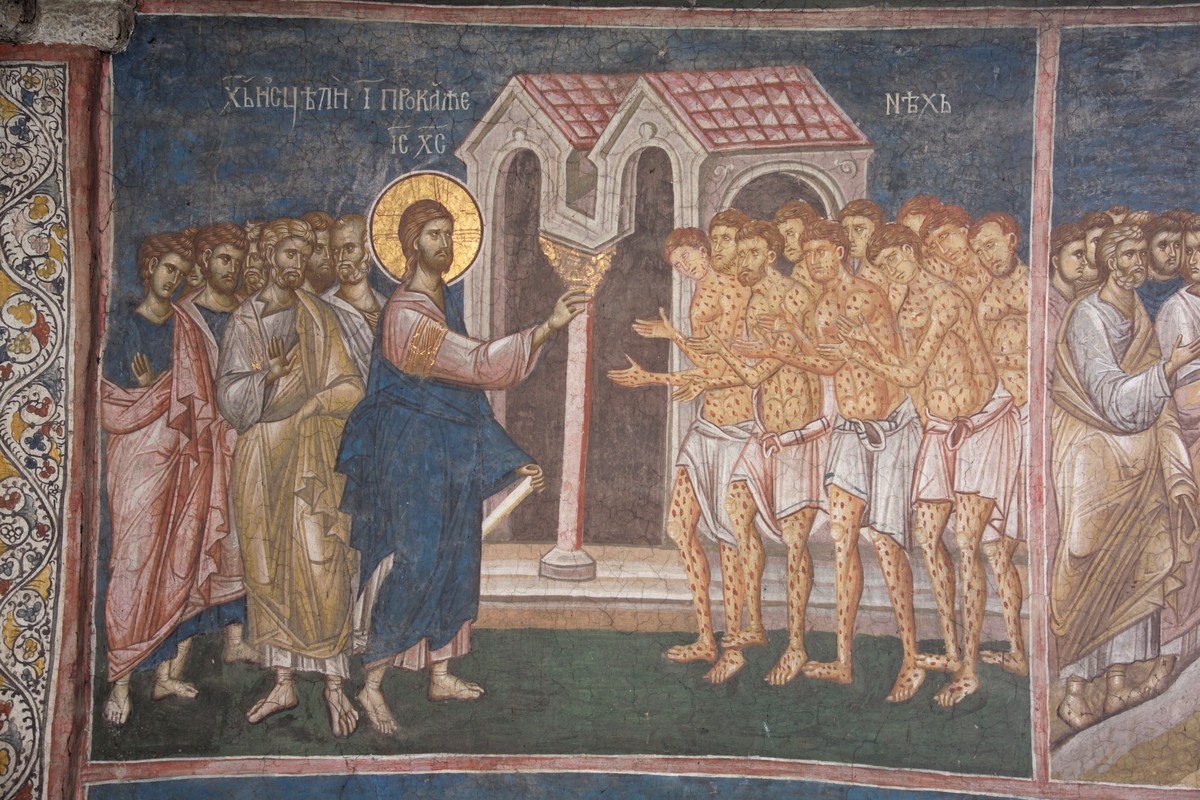
Christ healing the ten lepers
Decani, Serbia
7
posted on
11/11/2026 2:15:22 PM PST
by
annalex
(fear them not)
To: annalex
Saint of the Day for November 11
(c. 316 – November 8, 397)
Saint Martin of Tours’ Story
A conscientious objector who wanted to be a monk; a monk who was maneuvered into being a bishop; a bishop who fought paganism as well as pleaded for mercy to heretics—such was Martin of Tours, one of the most popular of saints and one of the first not to be a martyr.
Born of pagan parents in what is now Hungary, and raised in Italy, this son of a veteran was forced at the age of 15 to serve in the army. Martin became a Christian catechumen and was baptized when he was 18. It was said that he lived more like a monk than a soldier. At 23, Martin of Tours refused a war bonus and told his commander: “I have served you as a soldier; now let me serve Christ. Give the bounty to those who are going to fight. But I am a soldier of Christ and it is not lawful for me to fight.” After great difficulties, he was discharged and went to be a disciple of Hilary of Poitiers.
He was ordained an exorcist and worked with great zeal against the Arians. Martin became a monk, living first at Milan and later on a small island. When Hilary was restored to his see following his exile, Martin returned to France and established what may have been the first French monastery near Poitiers. He lived there for 10 years, forming his disciples and preaching throughout the countryside.
The people of Tours demanded that he become their bishop. Martin was drawn to that city by a ruse—the need of a sick person—and was brought to the church, where he reluctantly allowed himself to be consecrated bishop. Some of the consecrating bishops thought his rumpled appearance and unkempt hair indicated that he was not dignified enough for the office.
Along with Saint Ambrose, Martin rejected Bishop Ithacius’s principle of putting heretics to death—as well as the intrusion of the emperor into such matters. He prevailed upon the emperor to spare the life of the heretic Priscillian. For his efforts, Martin was accused of the same heresy, and Priscillian was executed after all. Martin then pleaded for a cessation of the persecution of Priscillian’s followers in Spain. He still felt he could cooperate with Ithacius in other areas, but afterwards his conscience troubled him about this decision.
As death approached, Martin’s followers begged him not to leave them. He prayed, “Lord, if your people still need me, I do not refuse the work. Your will be done.”
Reflection
Martin’s worry about cooperation with evil reminds us that almost nothing is either all black or all white. The saints are not creatures of another world: They face the same perplexing decisions that we do. Any decision of conscience always involves some risk. If we choose to go north, we may never know what would have happened had we gone east, west, or south. A hyper-cautious withdrawal from all perplexing situations is not the virtue of prudence; it is in fact, a bad decision, for “not to decide is to decide.”
Let us pray that we are able to journey this life of ours with the same passion and zeal as Martin of Tours. And let us hope that our efforts, however brave or futile, can convert hearts to God’s overflowing grace. Saint Martin: Pray for us!
Saint Martin of Tours is a Patron Saint of:
Horses
Soldiers
South Africa
franciscanmedia.org
8
posted on
11/11/2026 2:18:05 PM PST
by
annalex
(fear them not)
To: annalex
9
posted on
11/11/2026 2:19:02 PM PST
by
annalex
(fear them not)
To: annalex
NAVARRE BIBLE COMMENTARY(RSV)
Ad Majorem Dei Gloriam (To the Greater Glory of God)
Today’s First Reading
From: Titus 3:1-7
Respect for Lawful Authority
----------------------------
[1] Remind them to be submissive to rulers and authorities, to be obedient, to be ready for any honest work, [2] to speak evil of no one, to avoid quarreling, to be gentle, and to show perfect courtesy toward all men.
Renewal of the Christian Life in the Holy Spirit
------------------------------------------------
[3] For we ourselves were once foolish, disobedient, led astray, slaves to various passions and pleasures, passing our days in malice and envy, hated by men and hating one another; [4] but when the goodness and loving kindness of God our Savior appeared, [5] he saved us, not because of deeds done by us in righteousness, but in virtue of his own mercy, by the washing of regeneration and renewal in the Holy Spirit, [6] which he poured out upon us richly through Jesus Christ our Savior, [7] so that we might be justified by his grace and become heirs in hope of eternal life.
***********************************************************************
Commentary:
1-8. In the last part of the epistle St Paul deals with the way believers conduct themselves in society at large (vv. 1-8); he warns Titus to see that the Church does not become a place where people argue (vv. 9-11); and finally he gives him some little personal commissions and messages (vv. 12-14) and ends with the usual words of farewell (v.15).
The scheme of the first section (vv. 1-8), like the previous chapter, is as follows: first he describes the requirements of Christian living, specifically the attitude towards civil authority and one's fellow-citizens (vv. 1-2); then he gives the theological reasoning behind it (vv. 3-8): for a Christian, moral behavior is a consequence of faith.
1-2. Respect for lawful authority (cf. Roman 13:1-7; Tim 2:2; 1 Pet 2: 13-14) was particularly difficult and meritorious in the situation in Crete, where the local population (many of them Jews) were not at all happy with their Roman overlords. However, the freedom of the children of God (cf. Rom 8:21) which the Christian acquires at Baptism does not mean he has to be opposed to existing structures: the main thing it leads him to is personal improvement: "The acute need for radical reforms of the structures which conceal poverty and which are themselves forms of violence, should not let us lose sight of the fact that the source of injustice is in the hearts of men. Therefore it is only by making an appeal to the moral potential of the person and to the constant need for inner conversion, that social change will be brought about which will truly be in the service of man. For it will only be in the measure that they collaborate freely in these necessary changes through their own initiative and solidarity, that people, awakened to a sense of their responsibility, will grow in humanity" (SCDF, "Libertatis Nuntius", 11, 8).
Gentleness and courtesy are expressions of the new commandment of love; they show that a person is spiritually mature, and they are very effective in drawing souls closer to Christ. "To criticize, to destroy, is not difficult; any unskilled laborer knows how to drive his pick into the noble and finely-hewn stone of a cathedral. To construct: that is what requires the skill of a master" (St. J. Escriva, "The Way", 456).
3-7. The main subject of the chapter is the theological basis of social obligations (vv. 1-2); every Christian should bear witness to salvation history, to the change from sin to grace, and the change from an era of slavery and error to the era of freedom and rebirth ushered in by Christ.
The "old regime" is sketched out in a very vivid way (v. 3), showing the effects of sin on man in his three dimensions: in relation to himself, sin makes a person foolish, rebellious, wayward, a slave; in respect of God, he becomes hateful in his rebellious pride; and as far as others are concerned he becomes their enemy--"hating one another".
However, the coming of Christ has opened up a new panorama (vv. 4-7). As elsewhere in these letters (cf. 1 Tim 3:15; Tit 2:11-14), we have here a hymn to Christ which may well have come from primitive Christian liturgy or from a confession of faith. It summarizes Christian teaching on the Incarnation, the Redemption and the application of salvation to the individual.
According to this text, the Incarnation is the revelation of God our Savior, who makes known his goodness ("benignity", a word which often occurs in the Old Testament and sometimes in the New: cf. Rom 2:4; 11:22; Gal 5:22; Eph 2:7) and "loving goodness" (literally "philanthropy", a word taken from Greek). The Redemption is referred to in Old Testament language: "he saved us in virtue of his own mercy."
Finally, the Christian's access to salvation is something gratuitous: without any prior merit on our part, God's mercy has sought us out (v. 5; cf. note on Rom 3:27-31); Baptism is the door to salvation, for it is the sacrament of "regeneration and renewal" (cf. Eph 5:26); the Holy Spirit sent by Christ (cf. Jn 14:26) makes the waters of Baptism effective; his grace gives life to the soul and entitles it to eternal life (cf. Gal 4:7; Rom 8:16-17). The Council of Trent specified that "justification is not only the remission of sins, but sanctification and renovation of the interior man through the voluntary reception of grace and gifts whereby a man becomes just instead of unjust and a friend instead of an enemy, that he may be an heir in the hope of life everlasting" ("De Iustificatione", chap. 7).
The magnificent resume of faith in Christ contained in Titus 3:3-7 also helps Christians see how to approach their work and social involvement; the Second Vatican Council has reminded us once again that "the promised and hoped-for restoration has already begun in Christ. It is carried forward in the sending of the Holy Spirit and through him continues in the Church in which, through our faith, we learn the meaning of our earthly life, while we bring to term, with hope of future good, the task allotted to us in the world by the Father, and so work out our salvation" ("Lumen Gentium", 48).
10
posted on
11/11/2026 3:03:23 PM PST
by
fidelis
(Ecce Crucem Domini! Fugite partes adversae! Vicit Leo de tribu Juda, Radix David! Alleluia!)
Today’s Gospel Reading From: Luke 17:11-19
The Ten Lepers
--------------
[11] On the way to Jerusalem He (Jesus) was passing along between Samaria and Galilee. [12] And as He entered the village, He was met by ten lepers, who stood at a distance [13] and lifted up their voices and said, "Jesus, Master, have mercy on us." [14] When He saw them He said to them, "Go and show yourselves to the priests." And as they went they were cleansed. [15] Then one of them, when he saw that he was healed, turned back, praising God with a loud voice; [16] and he fell on his face at Jesus' feet, giving Him thanks. Now he was a Samaritan. [17] Then said Jesus, "Were not ten cleansed? Where are the nine? [18] Was no one found to return and give praise to God except this foreigner?" [19] And He said to him, "Rise and go your way; your faith has made you well."
***********************************************************************
Commentary:
11-19. The setting of this episode explains how a Samaritan could be in the company of Jews. There was no love lost between Jews and Samaritans (cf. John 4:9), but shared pain, in the case of these lepers, overcame racial antipathy.
The Law of Moses laid down, to prevent the spread of the disease, that lepers should live away from other people and should let it be known that they were suffering from this disease (cf. Leviticus 13:45-46). This explains why they did not come right up to Jesus and His group, but instead begged His help by shouting from a distance. Before curing them our Lord orders them to go to the priests to have their cure certified (cf. Leviticus 14:2ff), and to perform the rites laid down. The lepers' obedience is a sign of faith in Jesus' words. And, in fact, soon after setting out they are cleansed.
However, only one of them, the Samaritan, who returns praising God and showing his gratitude for the miracle, is given a much greater gift than the cure of leprosy. Jesus says as much: "Your faith has made you well" (verse 19) and praises the man's gratefulness. The Gospel records this event to teach us the value of gratefulness: "Get used to lifting your heart to God, in acts of thanksgiving, many times a day. Because He gives you this and that. Because you have been despised. Because you haven't what you need or because you have.
"Because He made His Mother so beautiful, His Mother who is also your Mother. Because He created the sun and the moon and this animal and that plant. Because He made that man eloquent and you He left tongue-tied....
"Thank Him for everything, because everything is good" (St J. Escriva, "The Way", 268).
11
posted on
11/11/2026 3:04:23 PM PST
by
fidelis
(Ecce Crucem Domini! Fugite partes adversae! Vicit Leo de tribu Juda, Radix David! Alleluia!)
12
posted on
11/11/2026 3:06:34 PM PST
by
fidelis
(Ecce Crucem Domini! Fugite partes adversae! Vicit Leo de tribu Juda, Radix David! Alleluia!)
Disclaimer:
Opinions posted on Free Republic are those of the individual
posters and do not necessarily represent the opinion of Free Republic or its
management. All materials posted herein are protected by copyright law and the
exemption for fair use of copyrighted works.
FreeRepublic.com is powered by software copyright 2000-2008 John Robinson