
Posted on 10/29/2026 4:45:41 PM PDT by ebb tide
During the “Christ the King” pilgrimage organized by the Society of St. Pius X (SSPX) in October 2026, I learned more vividly than ever that a pilgrimage’s true success does not rest on a basilica, a sanctuary, or even an official authorization from local authorities. Rather, a pilgrimage can be made fruitful by souls who refuse to let the world dictate the terms of their love for God.
This year, limitations on the SSPX pilgrimage were tangible. After the episcopal consecrations at Écône in July, the Bishop of Tarbes and Lourdes banned the SSPX from celebrating its liturgies or praying publicly within the Lourdes sanctuary of Our Lady. Yet the pilgrimage went ahead: rearranged, divided into groups, and hosted at the SSPX-linked convent of Maison Saint-Ignace and nearby locations, with eight Masses celebrated across two days, along with processions, confessions, and the Stations of the Cross.
Two holy places. Two groups of faithful Catholics. Two restrictions imposed in the same season.Tweet this quote
Pilgrims congregated in assigned groups—white, yellow, red, and blue—with each group waiting for its appointed Mass, arriving on time, wearing assigned wristbands, and leaving almost immediately after Mass to make room for the next group. Such experiences were humbling but were profoundly Catholic.
Seen from the outside, this year’s pilgrimage may have seemed to be one reduced in scale. When experienced from within, however, this year’s pilgrimage was purified in the crucible of ongoing liturgical and doctrinal disputes between the Vatican and the SSPX.
When some elements in the Vatican try to restrict the outward expression of the Catholic Faith by persecuting the Traditional Latin Mass (TLM), we may be tempted to be discouraged or bitter.
Nonetheless, thanks to the immense providence of God, grace is not subject to logistical arrangements. The Holy Sacrifice of the Mass, offered in the ancient and venerable Roman Rite, remains no less beautiful when celebrated in a courtyard instead of beneath a lofty Gothic vault. Our Lady remains Queen even when her children may have to suffer a bit of inconveniences to pay her homage. And Our Lord Jesus Christ will not surrender His kingship because those in power would prefer that He reign only behind closed doors.
Catholicism has never been a religion of comfort. It is a religion of the Cross. The early Christians did not have grand basilicas to worship God in; instead, they had upper rooms, catacombs, and fields and faced the constant threat of arrest.
Moreover, they did not have splendid processions sanctioned by the empire but had the Eucharist carried in secrecy and adored with trembling love. If our fathers in the Faith could worship under persecution, then surely we can worship despite the banality and inconvenience of added paperwork, color-coded wristbands, the threat of fines, and the humiliation of being told where we may and may not pray.
No one seemed interested in staging a protest against the Lourdes authorities’ unjust decision to restrict this year’s pilgrimage. On the other hand, everyone seemed interested in adoring God.Tweet this quote
The restrictions by the Lourdes authorities did not daunt the zeal of many SSPX pilgrims in carrying out our devotions to the Mother of God this past weekend. If anything, these limitations only served to sharpen our resolve to ensure that the Reign of Christ the King remains firmly entrenched in our hearts, in our families, and eventually in society at large.
I witnessed elderly pilgrims climb the steep paths towards the Maison Saint-Ignace with their rosaries clenched around their fingers. I watched on as young families carried children and held missals with an undeniable air of determination. I saw priests hear confessions for hours, as though the shortage of space in the grounds of Maison Saint-Ignace had only raised their desires to act as channels of God’s mercy. No one seemed interested in staging a protest against the Lourdes authorities’ unjust decision to restrict this year’s pilgrimage. On the other hand, everyone seemed interested in adoring God.
Lourdes belongs to Our Lady in a way that no ecclesiastical or secular regulation can ever rescind. The Blessed Virgin Mary appeared here to Bernadette Soubirous in 1858, calling herself the Immaculate Conception, and she has welcomed sinners, sufferers, and even skeptics to this rocky corner of the Pyrenees ever since.
The sanctuary authorities may determine where a public ceremony may be held, but they cannot ever decide where God’s grace may descend. Importantly, they can neither forbid the solicitous Mother of God from looking upon her children, nor cancel the power of a humble “Ave Maria” whispered at the grotto.
Though collective SSPX celebrations were prohibited in the sanctuary, pilgrims could still visit the grotto of Massabielle individually, pray their rosaries there, and make use of the Lourdes baths privately.
And so we did. I saw pilgrims approach Our Lady’s grotto in silence, some teary-eyed, others visibly handicapped and weary, after having arrived from afar. Surely, the Mother of God recognized her own!
The Holy Sacrifice of the Mass, offered in the ancient and venerable Roman Rite, remains no less beautiful when celebrated in a courtyard instead of beneath a lofty Gothic vault.Tweet this quote
Such is the beauty and mystery of Marian piety: it is tender, but it is not weak. It is filial, but it is not purely sentimental. We did not go to Lourdes to make a political statement or stage a rebellion against the Lourdes (and Vatican) authorities. Rather, we went because Mary is our Mother, because She leads us to Her Son, Jesus, and because in an age of chaos, Our Lady is the surest guarantor of virtue after God and the most steadfast means of remaining faithful Catholics.
Sunday, October 25, 2026, marked the Feast of Christ the King, and the irony in Lourdes could hardly have been more pronounced. In a world that opposes Christ’s reign over society, faithful Catholics who attend SSPX chapels found it impossible to assemble openly in His honor, no doubt due to the decision of the authorities in Lourdes.
Nonetheless, those very obstacles became a message in themselves. If Christ is King, His kingship does not rely on the whims of governments, bishops’ synods, media corporations, or Church officials. Christ’s royal reign rests on His own authority—His role as Creator, Redeemer, and eternal Lord.
The world may neglect Jesus, scorn Him, or reduce Him to a symbol; yet the man or woman of faith believes knows that He is truly present—Body, Blood, Soul, and Divinity—and that all earthly power is fleeting in His sight.
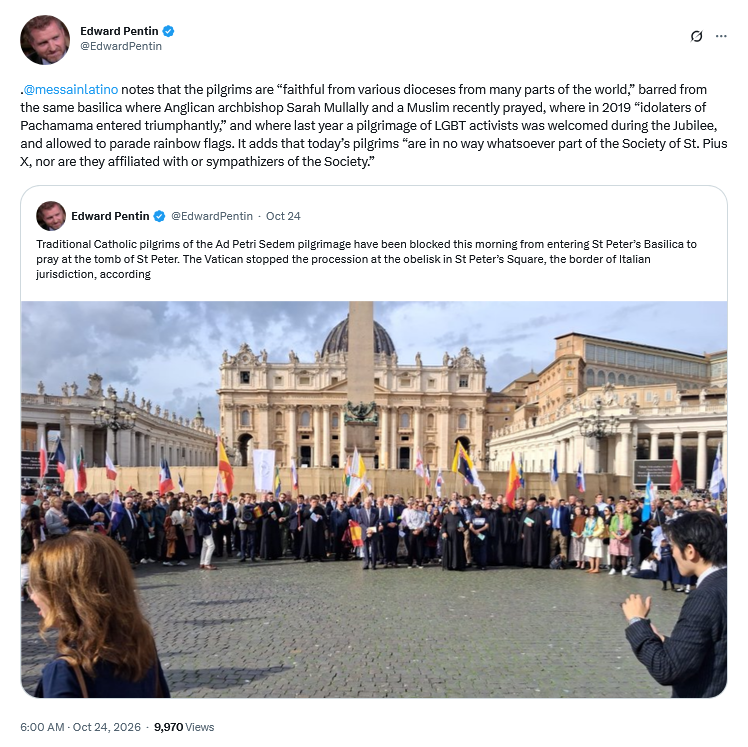
While we in Lourdes were banned from organizing public processions in the sanctuary grounds, other pilgrims of the annual Summorum Pontificum pilgrimage, organized since 2012 in gratitude for Pope Benedict XVI’s 2007 motu proprio, were refused entry to St. Peter’s Basilica for their prayer service—after years in which they had congregated there, even when Mass itself was unavailable—to sing the Credo and pray at the tomb of St. Peter, Prince of the Apostles. Whatever the precise administrative reasoning, the Vatican’s decision was devastating: faithful Catholics were forbidden from praying in the basilica built over the grave of the first Pope.
Two holy places. Two groups of faithful Catholics. Two restrictions imposed in the same season. Indeed, the Vatican’s draconian restrictions on the TLM (in both SSPX and non-SSPX communities) hit faithful Catholics like a ton of bricks during the weekend of the feast of Christ the King.
Some will claim that faithful Catholics’ commitment to the TLM and Catholic Tradition places us in opposition to the Papacy. Nothing could be more mistaken. We cherish the Papacy because Christ Himself founded it, and we venerate Peter’s Successor because Our Lord prayed that his faith would not fail. Yet genuine love is not obsequious flattery, and true fidelity does not mean always turning a blind eye.
No regulation can cancel the Mass, and no bureaucratic decree can separate a soul from the Heavenly Mother who leads it to her Son, who is true God and true King.Tweet this quote
To love the Pope is to pray for him, suffer for him, and eagerly await the day when the Chair of Peter radiates clarity, courage, and unbroken fidelity to the deposit of Faith once again. It is precisely because we love the Papacy that we hold our Pope accountable to the divine mission entrusted to him by Our Lord Jesus Christ. The Pope is not the author of Divine Revelation; he is its servant and guardian. The Church is not a corporation whose brand may be redesigned by every successive administration; she is the Mystical Body of Christ, entrusted with a Faith transmitted by the apostles, to the saints, and to us.
That is why recent Vatican developments cannot extinguish our filial love for the Papacy. It may cause us pain; it may bring us to tears. Admittedly, we cannot respond to restrictions with division, resentment, or disdain. We can respond through prayer, penance, and a deeper fidelity to the See of Peter as Christ established it—not as successive crises may distort it.
Many people have accused traditional Catholics of being obsessed with the past. Nevertheless, being in Lourdes on the Feast of Christ the King, I did not feel as though I were regressing backward into the annals of a past long gone. The TLM, the Rosary, the sacraments, and the doctrine of the Church are not museum pieces confined to be relics of a bygone past. Rather, they are the means by which modern man is rescued from the tyranny of the world, the flesh, and the devil.
Significantly, our fidelity to Catholic doctrine is neither nostalgia nor a preference for lace, Latin, or ancient Gregorian chant, however much we may love them. It is fidelity to the whole Christ: Christ the Priest, Christ the Victim, Christ the King, and Christ the Judge. It is fidelity to the Catholic dogmas that make sense of human life—original sin, redemption, grace, the Real Presence, the Divine Motherhood of the Blessed Virgin Mary, the authority of the Catholic Church, and the necessity of conversion for eternal salvation.
As the pilgrimage drew to its close on Sunday evening, I returned one last time to the grotto. The crowds had dispersed, and the spring water dripped steadily from the rock at the grotto, as it has for generations. Before I departed, I bowed my head towards the statue of Our Lady at the grotto, feeling wistful and reflective, knowing God is in charge of all things, and thinking of how no regulation can cancel the Mass, and no bureaucratic decree can separate a soul from the Heavenly Mother who leads it to her Son, who is true God and true King.
Parle, commande, règne,
Nous sommes tous à Toi.
Jésus, étends Ton règne,
De l’univers, sois Roi.
Marie, Notre Dame de Lourdes, priez pour nous!
Dear FRiends,
We need your continuing support to keep FR funded. Your donations are our sole source of funding. No sugar daddies, no advertisers, no paid memberships, no commercial sales, no gimmicks, no tax subsidies. No spam, no pop-ups, no ad trackers.
If you enjoy using FR and agree it's a worthwhile endeavor, please consider making a contribution today:
Click here: to donate by Credit Card
Or here: to donate by PayPal
Or by mail to: Free Republic, LLC - PO Box 9771 - Fresno, CA 93794
Thank you very much and God bless you,
Jim
Ping
Disclaimer: Opinions posted on Free Republic are those of the individual posters and do not necessarily represent the opinion of Free Republic or its management. All materials posted herein are protected by copyright law and the exemption for fair use of copyrighted works.