Skip to comments.
Catholic Caucus: Daily Mass Readings 30-September-2026
Universalis/Jerusalem Bible ^
Posted on 09/30/2026 1:12:50 PM PDT by annalex
30 September 2026
Saint Jerome, Priest, Doctor
on Wednesday of week 26 in Ordinary Time
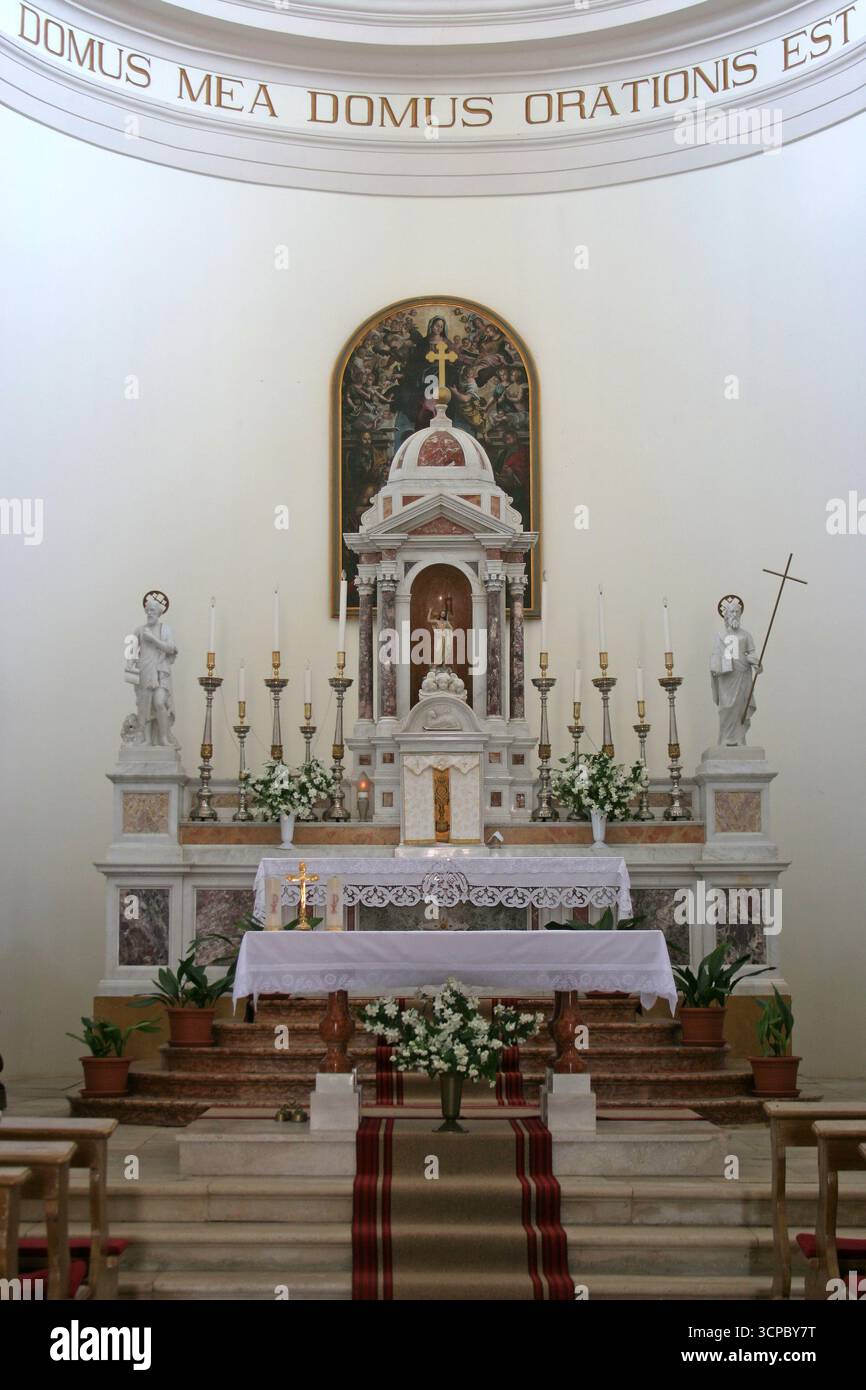
parish church of Saint Jerome in Vizinada, Croatia Readings at MassLiturgical Colour: White. Year: A(II). Readings for the feria Readings for the memorial These are the readings for the feria
| First reading |
|---|
| Job 9:1-13,14-16 |
|---|
How can man be in the right against God?Job spoke to his friends: Indeed, I know it is as you say: how can man be in the right against God? If any were so rash as to challenge him for reasons, one in a thousand would be more than they could answer. His heart is wise, and his strength is great: who then can successfully defy him? He moves the mountains, though they do not know it; he throws them down when he is angry. He shakes the earth, and moves it from its place, making all its pillars tremble. The sun, at his command, forbears to rise, and on the stars he sets a seal. He and no other stretched out the skies, and trampled the Sea’s tall waves. The Bear, Orion too, are of his making, the Pleiades and the Mansions of the South. His works are great, beyond all reckoning, his marvels, past all counting. Were he to pass me, I should not see him, nor detect his stealthy movement. Were he to snatch a prize, who could prevent him, or dare to say, ‘What are you doing?’ How dare I plead my cause, then, or choose arguments against him? Suppose I am in the right, what use is my defence? For he whom I must sue is judge as well. If he deigned to answer my citation, could I be sure that he would listen to my voice?
| Responsorial Psalm |
|---|
| Psalm 87(88):10-15 |
|---|
Let my prayer come into your presence, O Lord. I call to you, Lord, all the day long; to you I stretch out my hands. Will you work your wonders for the dead? Will the shades stand and praise you? Let my prayer come into your presence, O Lord. Will your love be told in the grave or your faithfulness among the dead? Will your wonders be known in the dark or your justice in the land of oblivion? Let my prayer come into your presence, O Lord. As for me, Lord, I call to you for help: in the morning my prayer comes before you. Lord, why do you reject me? Why do you hide your face? Let my prayer come into your presence, O Lord.
| Gospel Acclamation | Ps118:105 |
|---|
Alleluia, alleluia! Your word is a lamp for my steps and a light for my path. Alleluia! Alleluia, alleluia! I have accepted the loss of everything and I look on everything as so much rubbish if only I can have Christ and be given a place in him. Alleluia!
'I will follow you wherever you go'As Jesus and his disciples travelled along they met a man on the road who said to him, ‘I will follow you wherever you go.’ Jesus answered, ‘Foxes have holes and the birds of the air have nests, but the Son of Man has nowhere to lay his head.’ Another to whom he said, ‘Follow me’, replied, ‘Let me go and bury my father first.’ But he answered, ‘Leave the dead to bury their dead; your duty is to go and spread the news of the kingdom of God.’ Another said, ‘I will follow you, sir, but first let me go and say goodbye to my people at home.’ Jesus said to him, ‘Once the hand is laid on the plough, no one who looks back is fit for the kingdom of God.’ Continue These are the readings for the memorial
| First reading |
|---|
| 2 Timothy 3:14-17 |
|---|
All scripture is inspired by God and can profitably be used for teachingYou must keep to what you have been taught and know to be true; remember who your teachers were, and how, ever since you were a child, you have known the holy scriptures – from these you can learn the wisdom that leads to salvation through faith in Christ Jesus. All scripture is inspired by God and can profitably be used for teaching, for refuting error, for guiding people’s lives and teaching them to be holy. This is how the man who is dedicated to God becomes fully equipped and ready for any good work.
| Responsorial Psalm |
|---|
| Psalm 118(119):9-14 |
|---|
Lord, teach me your statutes. How shall the young remain sinless? By obeying your word. I have sought you with all my heart; let me not stray from your commands. Lord, teach me your statutes. I treasure your promise in my heart lest I sin against you. Blessed are you, O Lord; teach me your statutes. Lord, teach me your statutes. With my tongue I have recounted the decrees of your lips. I rejoiced to do your will as though all riches were mine. Lord, teach me your statutes.
| Gospel Acclamation | cf.Ac16:14 |
|---|
Alleluia, alleluia! Open our heart, O Lord, to accept the words of your Son. Alleluia!
The fishermen collect the good fish and throw away those that are no useJesus said to the crowds: ‘The kingdom of heaven is like a dragnet cast into the sea that brings in a haul of all kinds. When it is full, the fishermen haul it ashore; then, sitting down, they collect the good ones in a basket and throw away those that are no use. This is how it will be at the end of time: the angels will appear and separate the wicked from the just to throw them into the blazing furnace where there will be weeping and grinding of teeth. ‘Have you understood all this?’ They said, ‘Yes.’ And he said to them, ‘Well then, every scribe who becomes a disciple of the kingdom of heaven is like a householder who brings out from his storeroom things both new and old.’ Continue Christian Art Each day, The Christian Art website gives a picture and reflection on the Gospel of the day. The readings on this page are from the Jerusalem Bible, which is used at Mass in most of the English-speaking world. The New American Bible readings, which are used at Mass in the United States, are available in the Universalis apps, programs and downloads.
You can also view this page with the Gospel in Greek and English. |
TOPICS: Catholic; General Discusssion; Prayer; Worship
KEYWORDS: catholic; mt17; ordinarytime; prayer
For your reading, reflection, faith-sharing, comments, questions, discussion.
1
posted on
09/30/2026 1:12:50 PM PDT
by
annalex
To: All
KEYWORDS: catholic; lk9; mt13; ordinarytime; prayer;
2
posted on
09/30/2026 1:14:01 PM PDT
by
annalex
(fear them not)
To: nickcarraway; NYer; ELS; Pyro7480; livius; ArrogantBustard; Catholicguy; RobbyS; marshmallow; ...

Alleluia Ping Please FReepmail me to get on/off the Alleluia Ping List.
3
posted on
09/30/2026 1:15:06 PM PDT
by
annalex
(fear them not)
To: annalex
4
posted on
09/30/2026 1:15:40 PM PDT
by
annalex
(fear them not)
To: annalex
| Luke |
| | English: Douay-Rheims | Latin: Vulgata Clementina | Greek NT: Byzantine/Majority Text (2000) |
| | Luke 9
|
| 57. | And it came to pass, as they walked in the way, that a certain man said to him: I will follow thee withersoever thou goest. | Factum est autem : ambulantibus illis in via, dixit quidam ad illum : Sequar te quocumque ieris. | εγενετο δε πορευομενων αυτων εν τη οδω ειπεν τις προς αυτον ακολουθησω σοι οπου αν απερχη κυριε |
| 58. | Jesus said to him: The foxes have holes, and the birds of the air nests; but the Son of man hath not where to lay his head. | Dixit illi Jesus : Vulpes foveas habent, et volucres cæli nidos : Filius autem hominis non habet ubi caput reclinet. | και ειπεν αυτω ο ιησους αι αλωπεκες φωλεους εχουσιν και τα πετεινα του ουρανου κατασκηνωσεις ο δε υιος του ανθρωπου ουκ εχει που την κεφαλην κλινη |
| 59. | But he said to another: Follow me. And he said: Lord, suffer me first to go, and to bury my father. | Ait autem ad alterum : Sequere me : ille autem dixit : Domine, permitte mihi primum ire, et sepelire patrem meum. | ειπεν δε προς ετερον ακολουθει μοι ο δε ειπεν κυριε επιτρεψον μοι απελθοντι πρωτον θαψαι τον πατερα μου |
| 60. | And Jesus said to him: Let the dead bury their dead: but go thou, and preach the kingdom of God. | Dixitque ei Jesus : Sine ut mortui sepeliant mortuos suos : tu autem vade, et annuntia regnum Dei. | ειπεν δε αυτω ο ιησους αφες τους νεκρους θαψαι τους εαυτων νεκρους συ δε απελθων διαγγελλε την βασιλειαν του θεου |
| 61. | And another said: I will follow thee, Lord; but let me first take my leave of them that are at my house. | Et ait alter : Sequar te Domine, sed permitte mihi primum renuntiare his quæ domi sunt. | ειπεν δε και ετερος ακολουθησω σοι κυριε πρωτον δε επιτρεψον μοι αποταξασθαι τοις εις τον οικον μου |
| 62. | Jesus said to him: No man putting his hand to the plough, and looking back, is fit for the kingdom of God. | Ait ad illum Jesus : Nemo mittens manum suam ad aratrum, et respiciens retro, aptus est regno Dei. | ειπεν δε ο ιησους προς αυτον ουδεις επιβαλων την χειρα αυτου επ αροτρον και βλεπων εις τα οπισω ευθετος εστιν εις την βασιλειαν του θεου |
5
posted on
09/30/2026 1:18:12 PM PDT
by
annalex
(fear them not)
To: annalex

Catena Aurea by St. Thomas Aguinas
9:57–62
57. And it came to pass, that, as they went in the way, a certain man said unto him, Lord, I will follow thee whithersoever thou goest.
58. And Jesus said unto him, Foxes have holes, and birds of the air have nests; but the Son of man hath not where to lay his head.
59. And he said unto another, Follow me. But he said, Lord, suffer me first to go and bury my father.
60. Jesus said unto him, Let the dead bury their dead; but go thou and preach the kingdom of God.
61. And another also said, Lord, I will follow thee; but let me first go bid them farewell, which are at home at my house.
62. And Jesus said unto him, No man, having put his hand to the plough, and looking back, is fit for the kingdom of God.
CYRIL OF ALEXANDRIA. (non occ.) Although the Almighty Lord is bountiful, He does not grant to every one absolutely and indiscriminately heavenly and divine gifts, but to those only who are worthy to receive them, who free themselves and their souls from the stains of wickedness. And this we are taught by the force of the angelic words, And it came to pass, that, us they went in the way, a certain man said unto him, Lord, I will follow thee. First indeed there is much tardiness implied in the manner of his coming. It is next shewn that he is filled with too great presumption. For he sought not to follow Christ simply as several others of the people, but rather caught at the honour of the Apostleship. Whereas Paul says, No one taketh the honour to himself but he that is called of God. (Heb. 5:4.)
ATHANASIUS. (non occ.) He dared also to match himself with the incomprehensible power of the Saviour, saying, I will follow thee whithersoever thou goest; for to follow the Saviour simply to hear His teaching is possible to human nature, as it directs itself towards men, but it is not possible to go with Him wherever He is; for He is incomprehensible, and is not confined by place.
CYRIL OF ALEXANDRIA. In another respect also our Lord deservedly gives him a refusal, for He taught that to follow the Lord, a man must take up his cross, and renounce the affection of this present life. And our Lord finding this lacking in him does not blame him, but corrects him.
It follows, And Jesus says to him, The foxes have holes, &c.
THEOPHYLACT. For having seen our Lord drawing much people to Him, he thought that he received reward from them, and that if he followed our Lord, he might obtain money.
BEDE. Therefore it is said to him, Why do you seek to follow Me for the riches and gain of this world, when so great is My poverty that I have not even a place of rest, and take shelter under another man’s roof.
CHRYSOSTOM. See how our Lord sets forth by his works the poverty which he taught. For him was no table spread, no lights, no house, nor any such thing.
CYRIL OF ALEXANDRIA. Now under a mystical signification He applies the name of foxes and birds of the air to the wicked and crafty powers of evil spirits. As if He said, Since foxes and birds of the air have their abode in thee, how shall Christ rest in thee? What fellowship has light with darkness? (2 Cor. 6:14.)
ATHANASIUS. Or herein our Lord teaches the greatness of His gift, as if He said, All created things may be confined by place, but the Word of God has incomprehensible power. Say not then, I will follow thee whithersoever thou goest. But if thou wouldest be a disciple, cast off 1 foolish things, for it is impossible for him who remains in foolishness to become a disciple of the Word.
AMBROSE. Or, He compares foxes to heretics, because they are indeed a wily animal, and, ever intent upon fraud, commit their robberies by stealth. They let nothing be safe, nothing be at rest, nothing secure, for they hunt their prey into the very abodes of men. The fox again, an animal full of craft, makes no hole for itself, yet likes to lie always concealed in a hole. So the heretics, who know not how to construct a house for themselves, circumscribe and deceive others. This animal is never tamed, nor is it of use to man. Hence the Apostle, A heretic after the first and second admonition reject. (Tit. 3:10.) But the birds of the air, which are frequently brought in to represent spiritual wickedness, build as it were their nests in the breasts of the wicked, and as long as deceit reigns over the affections, the divine principle has no opportunity to take possession. But when a man has proved his heart to be innocent, upon him Christ leans in some measure the weight of His greatness, for by a more abundant shedding of grace He is planted in the breasts of good men. So then it does not seem reasonable that we should think him faithful and simple, who is rejected by the judgment of the Lord, notwithstanding that he promised the service of unwearied attendance; but our Lord cares not for this kind of service, but only purity of affection, nor is his attendance accepted whose sense of duty is not proved. For the hospitality of faith should be given with circumspection, lest while opening the interior of our house to the unbelieving, through our imprudent credulity we fall a snare to the treachery of others. Therefore that you may be aware that God despises not attendance upon him but deceit, He who rejected the deceitful man chose the innocent. For it follows, And he said unto another, Follow me. But He says this to him, whose father He knew to be dead. Hence it follows, But he said, Lord, suffer me first to go and bury my father.
BEDE. He did not refuse the discipleship, but his wish was, having fulfilled the filial duty of burying his father, to follow Christ more freely.
AMBROSE. But the Lord calls those upon whom He has compassion. Hence it follows, And Jesus said, Let the dead bury their dead. Since we have received as a religious duty the burial of the human body, how is it thus that the burial even of a father’s dead body is forbidden, unless you are to understand that human things are to be postponed to divine? It is a good employment, but the hindrance is greater, for he who divides his pursuits, draws down his affections; he who divides his care, delays his advances. We must first set about the things which are most important. For the Apostles also, that they might not be occupied in the office of distributing alms, ordained ministers for the poor.
CHRYSOSTOM. (Hom. 27. in Matt.) But what more necessary than the burial of his father, what more easy, seeing that there would not be much time given to it? We are then hereby taught that it becomes us not to spend even the slightest portion of our time in vain, although we have a thousand things to compel us, nay to prefer spiritual things to even our greatest necessities. For the devil watchfully presses close upon us, wishing to find any opening, and if he causes a slight negligence, he ends in producing a great weakness.
AMBROSE. The performance of a father’s burial is not then prohibited, but the observance of religious duty is preferred to the ties of relationship. The one is left to those in like condition, the other is commanded to those who are left. But how can the dead bury the dead? unless you here understand a twofold death, one a natural death, the other the death of sin. (Rom. 9:11.) There is also a third death, by which we die unto sin, live unto God.
CHRYSOSTOM. (ubi sup.) By thus saying, their dead, he shews that this man’s father was not his dead, for I suppose that the deceased was of the number of the unbelieving.
AMBROSE. Or because the throat of the ungodly is an open sepulchre, their memory is ordered to be forgotten whose services die together with their bodies. Nor is the son recalled from his duty to his father, but the faithful is separated from the communion of the unbelieving; there is no prohibition of duty, but a mystery of religion, that is, that we should have no fellowship with the dead Gentiles.
CYRIL OF ALEXANDRIA. Or else, his father was borne down with years, and he thought he was doing an honourable act in proposing to pay the kind offices which were due to him, according to Exodus, Honour thy father and thy mother. (Exod. 20:12.) Hence when calling him to the ministry of the Gospel, our Lord said, Follow me, he sought for a time of respite, which should suffice for the support of his decrepit father, saying, Permit me first to go and bury my father, not that he asked to bury his deceased father, for Christ would not have hindered the wish to do this, but he said, Bury, that is, support in old age even till death. But the Lord said to him, Let the dead bury their dead. For there were other attendants also bound by the same tie of relationship, but as I consider dead, because they had not yet believed Christ. Learn from this, that our duty to God is to be preferred to our love for our parents, to whom we shew reverence, because through them have we been born. But the God of all, when as yet we were not, brought us into being, our parents were made the ministers of our introduction.
AUGUSTINE. (de Con. Ev. l. ii. c. 23.) Our Lord spoke this to the man to whom He had said, Follow me. But another disciple put himself forward, to whom no one had spoken any thing, saying, I will follow thee, O Lord; but let me first go and bid them farewell who are at home, lest perchance they look for me as they are wont.
CYRIL OF ALEXANDRIA. Now this promise is worthy of our admiration and full of all praise, but to bid farewell to those who are at home, to get leave from them, shews that he was still somehow divided from the Lord, in that he had not yet resolved, to make this venture with his whole heart. For to wish to consult relations who would not agree to his proposal betokens one somewhat wavering. Wherefore our Lord condemns this, saying, No man, having put his hand to the plough, and looking back, is fit for the kingdom of God. He puts his hand to the plough who is ambitious to follow, yet looks back again who seeks an excuse for delay in returning home, and consulting with his friends.
AUGUSTINE. (Serm. 100.) As if he said to him, The East calls thee, and thou turnest to the West.
BEDE.: To put one’s hand to the plough, is also, (as it were by a certain sharp instrument,) by the wood and iron of our Lord’s passion, to wear away the hardness of our heart, and to open it to bring forth the fruits of good works. But if any one, having begun to exercise this, delights to look back with Lot’s wife to the things which he had left, he is deprived of the gift of the kingdom to come.
GREEK EXPOSITOR. (Nilus Monac.) For the frequent looking upon the things which we have forsaken, through the force of habit draws us back to our past way of life. For practice has great power to retain to itself. Is not habit generated of use, and nature of habit? But to get rid of or change nature is difficult; for although when compelled it for a while turns aside, it very rapidly returns to itself.
BEDE. But if the disciple about to follow our Lord is reproved for wishing even to bid farewell at home, what will be done to such as for no advantage-sake frequently visit the houses of those whom they have left in the world?
Catena Aurea Luke 9
6
posted on
09/30/2026 1:19:22 PM PDT
by
annalex
(fear them not)
To: annalex
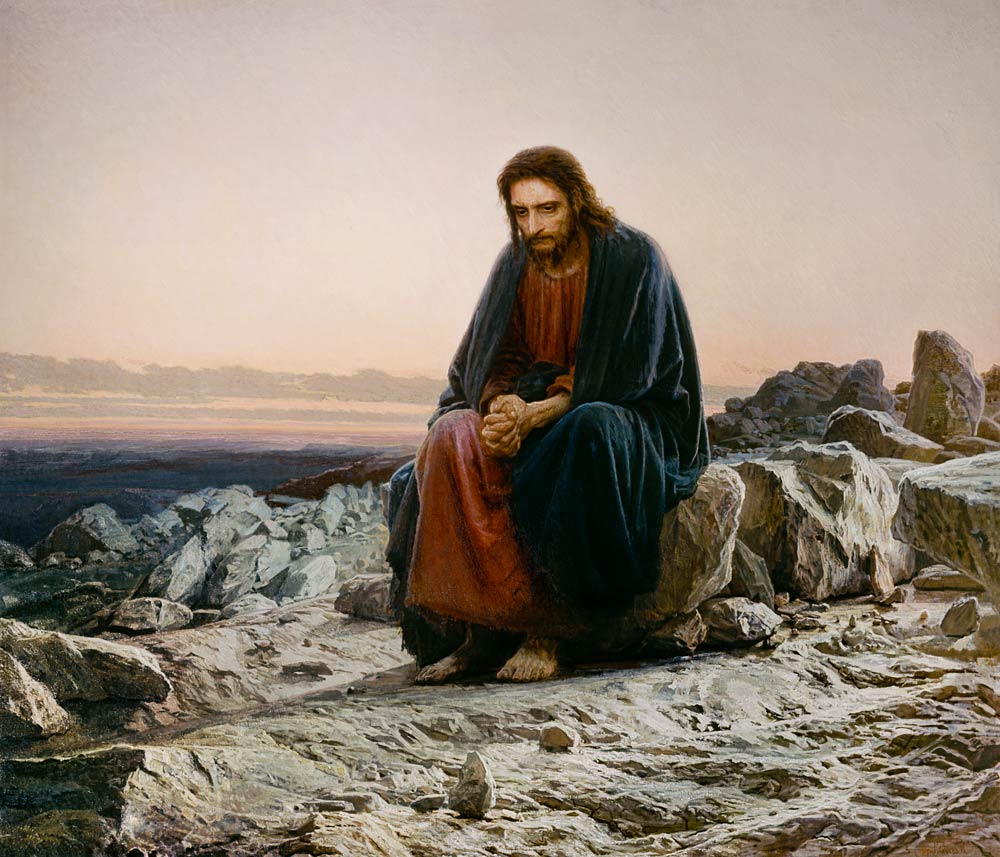
Christ in the Desert
Ivan Kramskoi (1837 - 1887)
7
posted on
09/30/2026 1:19:41 PM PDT
by
annalex
(fear them not)
To: annalex
Saint of the Day for September 30
(345 – 420)
Saint Jerome’s Story
Most of the saints are remembered for some outstanding virtue or devotion which they practiced, but Jerome is frequently remembered for his bad temper! It is true that he had a very bad temper and could use a vitriolic pen, but his love for God and his son Jesus Christ was extraordinarily intense; anyone who taught error was an enemy of God and truth, and Saint Jerome went after him or her with his mighty and sometimes sarcastic pen.
He was above all a Scripture scholar, translating most of the Old Testament from the Hebrew. Jerome also wrote commentaries which are a great source of scriptural inspiration for us today. He was an avid student, a thorough scholar, a prodigious letter-writer and a consultant to monk, bishop, and pope. Saint Augustine said of him, “What Jerome is ignorant of, no mortal has ever known.”
Saint Jerome is particularly important for having made a translation of the Bible which came to be called the Vulgate. It is not the most critical edition of the Bible, but its acceptance by the Church was fortunate. As a modern scholar says, “No man before Jerome or among his contemporaries and very few men for many centuries afterwards were so well qualified to do the work.” The Council of Trent called for a new and corrected edition of the Vulgate, and declared it the authentic text to be used in the Church.
In order to be able to do such work, Saint Jerome prepared himself well. He was a master of Latin, Greek, Hebrew, and Chaldaic. He began his studies at his birthplace, Stridon in Dalmatia. After his preliminary education, he went to Rome, the center of learning at that time, and thence to Trier, Germany, where the scholar was very much in evidence. He spent several years in each place, always trying to find the very best teachers. He once served as private secretary to Pope Damasus.
After these preparatory studies, he traveled extensively in Palestine, marking each spot of Christ’s life with an outpouring of devotion. Mystic that he was, he spent five years in the desert of Chalcis so that he might give himself up to prayer, penance, and study. Finally, he settled in Bethlehem, where he lived in the cave believed to have been the birthplace of Christ. Jerome died in Bethlehem, and the remains of his body now lie buried in the Basilica of St. Mary Major in Rome.
Reflection
Saint Jerome was a strong, outspoken man. He had the virtues and the unpleasant fruits of being a fearless critic and all the usual moral problems of a man. He was, as someone has said, no admirer of moderation whether in virtue or against evil. He was swift to anger, but also swift to feel remorse, even more severe on his own shortcomings than on those of others. A pope is said to have remarked, on seeing a picture of Jerome striking his breast with a stone, “You do well to carry that stone, for without it the Church would never have canonized you” (Butler’s Lives of the Saints).
Saint Jerome is the Patron Saint of:
Librarians
Scholars
Translators
franciscanmedia.org
8
posted on
09/30/2026 1:23:08 PM PDT
by
annalex
(fear them not)
To: annalex

Saint Jerome, oil on canvas by José de Ribera
9
posted on
09/30/2026 1:26:07 PM PDT
by
annalex
(fear them not)
To: annalex
| Matthew |
| | English: Douay-Rheims | Latin: Vulgata Clementina | Greek NT: Byzantine/Majority Text (2000) |
| | Matthew 13
|
| 47. | Again the kingdom of heaven is like to a net cast into the sea, and gathering together of all kind of fishes. | Iterum simile est regnum cælorum sagenæ missæ in mare, et ex omni genere piscium congreganti. | παλιν ομοια εστιν η βασιλεια των ουρανων σαγηνη βληθειση εις την θαλασσαν και εκ παντος γενους συναγαγουση |
| 48. | Which, when it was filled, they drew out, and sitting by the shore, they chose out the good into vessels, but the bad they cast forth. | Quam, cum impleta esset, educentes, et secus littus sedentes, elegerunt bonis in vasa, malos autem foras miserunt. | ην οτε επληρωθη αναβιβασαντες επι τον αιγιαλον και καθισαντες συνελεξαν τα καλα εις αγγεια τα δε σαπρα εξω εβαλον |
| 49. | So shall it be at the end of the world. The angels shall go out, and shall separate the wicked from among the just. | Sic erit in consummatione sæculi : exibunt angeli, et separabunt malos de medio justorum, | ουτως εσται εν τη συντελεια του αιωνος εξελευσονται οι αγγελοι και αφοριουσιν τους πονηρους εκ μεσου των δικαιων |
| 50. | And shall cast them into the furnace of fire: there shall be weeping and gnashing of teeth. | et mittent eos in caminum ignis : ibi erit fletus, et stridor dentium. | και βαλουσιν αυτους εις την καμινον του πυρος εκει εσται ο κλαυθμος και ο βρυγμος των οδοντων |
| 51. | Have ye understood all these things? They say to him: Yes. | Intellexistis hæc omnia ? Dicunt ei : Etiam. | λεγει αυτοις ο ιησους συνηκατε ταυτα παντα λεγουσιν αυτω ναι κυριε |
| 52. | He said unto them: Therefore every scribe instructed in the kingdom of heaven, is like to a man that is a householder, who bringeth forth out of his treasure new things and old. | Ait illis : Ideo omnis scriba doctus in regno cælorum, similis est homini patrifamilias, qui profert de thesauro suo nova et vetera. | ο δε ειπεν αυτοις δια τουτο πας γραμματευς μαθητευθεις εις την βασιλειαν των ουρανων ομοιος εστιν ανθρωπω οικοδεσποτη οστις εκβαλλει εκ του θησαυρου αυτου καινα και παλαια |
| 53. | And it came to pass: when Jesus had finished these parables, he passed from thence. | Et factum est, cum consummasset Jesus parabolas istas, transiit inde. | και εγενετο οτε ετελεσεν ο ιησους τας παραβολας ταυτας μετηρεν εκειθεν |
10
posted on
09/30/2026 1:29:14 PM PDT
by
annalex
(fear them not)
To: annalex
Catena Aurea by St. Thomas Aguinas
13:47–50
47. Again, the kingdom of heaven is like unto a net, that was cast into the sea, and gathered of every kind:
48. Which, when it was full, they drew to shore, and sat down, and gathered the good into vessels, but cast the bad away.
49. So shall it be at the end of the world: the angels shall come forth, and sever the wicked from the just,
50. And shall cast them into the furnace of fire: there shall be wailing and gnashing of teeth.
CHRYSOSTOM. In the foregoing parables He has commended the Gospel preaching; now, that we may not trust in preaching only, nor think that faith alone is sufficient for our salvation, He adds another fearful parable, saying, Again, the kingdom of heaven is like unto a net cast into the sea.
JEROME. In fulfilment of that prophecy of Hieremias, who said, I will send unto you many fishers, (Jer. 6:16.) when Peter and Andrew, James and John, heard the words, Follow me, I will make you fishers of men, they put together a net for themselves formed of the Old and New Testaments, and cast it into the sea of this world, and that remains spread until this day, taking up out of the salt and bitter and whirlpools whatever falls into it, that is good men and bad; and this is that He adds, And gathered of every kind.
GREGORY. (Hom. in Ev. xi. 4.) Or otherwise; The Holy Church is likened to a net, because it is given into the hands of fishers, and by it each man is drawn into the heavenly kingdom out of the waves of this present world, that he should not be drowned in the depth of eternal death. This net gathers of every kind of fishes, because the wise and the foolish, the free and the slave, the rich and the poor, the strong and the weak, are called to forgiveness of sin; it is then fully filled when in the end of all things the sum of the human race is completed; as it follows, Which, when it was filled, they drew out, and sitting down on the shore gathered the good into vessels, but the bad they cast away. For as the sea signifies the world, so the sea shore signifies the end of the world; and as the good are gathered into vessels, but the bad cast away, so each man is received into eternal abodes, while the reprobate having lost the light of the inward kingdom are cast forth into outer darkness. But now the net of faith holds good and bad mingled together in one; but the shore shall discover what the net of the Church has brought to land.
JEROME. For when the net shall be drawn to the shore, then shall be shewn the true test for separating the fishes.
CHRYSOSTOM. Wherein does this parable differ from the parable of the tares? There, as here, some perish and some are saved; but there, because of their heresy of evil dogmas; in the first parable of the sower, because of their not attending to what was spoken; here, because of their evil life, because of which, though drawn by the net, that is, enjoying the knowledge of God, they cannot be saved. And when you hear that the wicked are cast away, that you may not suppose that this punishment may be risked, He adds an exposition shewing its severity, saying, Thus shall it be in the end of the world; the angels shall come forth and sever the wicked from among the just, and shall cast them into the furnace of fire, there shall be wailing and gnashing of teeth. Though He elsewhere declares, that He shall separate them as a shepherd separates the sheep from the goats; He here declares, that the Angels shall do it, as also in the parable of the tares.
GREGORY. (ubi sup.) To fear becomes us here, rather than to expound for the torments of sinners are pronounced in plain terms, that none might plead his ignorance, should eternal punishment be threatened in obscure sayings.
JEROME. For when the end of the world shall be come, then shall be shewn the true test of separating the fishes, and as in a sheltered harbour the good shall be sent into the vessels of heavenly abodes, but the flame of hell shall seize the wicked to be dried up and withered.
13:51–52
51. Jesus saith unto them, Have ye understood all these things? They say unto him, Yea, Lord.
52. Then said he unto them, Therefore every Scribe which is instructed unto the kingdom of heaven is like unto a man that is an householder, which bringeth forth out of his treasure things new and old.
GLOSS. (non occ.) When the multitude had departed, the Lord spoke to His disciples in parables, by which they were instructed only so far as they understood them; wherefore He asks them, Have ye understood all these things? They say unto him, Yea, Lord.
JEROME. For this is spoken especially to the Apostles, whom He would have not to hear only as the multitude, but to understand as having to teach others.
CHRYSOSTOM. Then He praises them because they had understood; He saith unto them; Therefore every Scribe instructed in the kingdom of heaven is like unto an householder who bringeth out of his treasure things new and old.
AUGUSTINE. (De Civ. Dei, xx. 4.) He said not ‘old and new,’ as He surely would have said had He not preferred to preserve the order of value rather than of time. But the Manichæans while they think they should keep only the new promises of God, remain in the old man of the flesh, and put on newness of error.
AUGUSTINE. (Quæst. in Matt. q. 16.) By this conclusion, whether did He desire to shew whom He intended by the treasure hid in the field—in which case we might understand the Holy Scriptures to be here meant, the two Testaments by the things new and old—or did He intend that he should be held learned in the Church who understood that the Old Scriptures were expounded in parables, taking rules from these new Scriptures, seeing that in them also the Lord proclaimed many things in parables. If He then, in whom all those old Scriptures have their fulfilment and manifestation, yet speaks in parables until His passion shall rend the vail, when there is nothing hid that shall not be revealed; much more those things which were written of Him so long time before we see to have been clothed in parables; which the Jews took literally, being unwilling to be learned in the kingdom of heaven.
GREGORY. (ubi sup.) But if by things new and old in this passage we understand the two Testaments, we deny Abraham to have been learned, who although he knew indeed some deeds of the Old Testament, yet had not read the words. Neither Moses may we compare to a learned householder, for although he composed the Old Testament, yet had he not the words of the New. But what is here said may be understood as meant not of those who had been, but of such as might hereafter be in the Church, who then bring forth things new and old when they speak the preachings of both Testaments, in their words and in their lives.
HILARY. Speaking to His disciples, He calls them Scribes on account of their knowledge, because they understood the things that He brought forward, both new and old, that is from the Law and from the Gospels; both being of the same householder, and both treasures of the same owner. He compares them to Himself under the figure of a householder, because they had received doctrine of things both new and old out of His treasury of the Holy Spirit.
JEROME. Or the Apostles are called Scribes instructed, as being the Saviour’s notaries who wrote His words and precepts on fleshly tables of the heart with the sacraments of the heavenly kingdom, and abounded in the wealth of a householder, bringing forth out of the stores of their doctrine things new and old; whatsoever they preached in the Gospels, that they proved by the words of the Law and the Prophets. Whence the Bride speaks in the Song of Songs; I have kept for thee my beloved the new with the old. (c. 7:13.)
GREGORY. (ubi sup.) Otherwise; The things old are, that the human race for its sin should suffer in eternal punishment; the things new, that they should be converted and live in the kingdom. First, He brought forward a comparison of the kingdom to a treasure found and a pearl of price; and after that, narrated the punishment of hell in the burning of the wicked, and then concluded with Therefore every Scribe, &c. as if He had said, He is a learned preacher in the Church who knows to bring forth things new concerning the sweetness of the kingdom, and to speak things old concerning the terror of punishment; that at least punishment may deter those whom rewards do not excite.
13:53–58
53. And it came to pass, that when Jesus had finished these parables, he departed thence.
54. And when he was come into his own country, he taught them in their synagogue, insomuch that they were astonished, and said, Whence hath this man this wisdom, and these mighty works?
55. Is not this the carpenter’s son? is not his mother called Mary? and his brethren, James, and Joses, and Simon, and Judas?
56. And his sisters, are they not all with us? Whence then hath this man all these things?
57. And they were offended in him. But Jesus said unto them, A prophet is not without honour, save in his own country, and in his own house.
58. And he did not many mighty works there because of their unbelief.
JEROME. After the parables which the Lord spake to the people, and which the Apostles only understand, He goes over into His own country that He may teach there also.
AUGUSTINE. (De Cons. Ev. ii. 42.) From the foregoing discourse consisting of these parables, He passes to what follows without any very evident connexion between them. Besides which, Mark passes from these parables to a different event from what Matthew here gives; and Luke agrees with him, so continuing the thread of the story as to make it much more probable that that which they relate followed here, namely, about the ship in which Jesus slept, and the miracle of the demons cast out; which Matthew has introduced above.
Catena Aurea Matthew 13
11
posted on
09/30/2026 1:32:20 PM PDT
by
annalex
(fear them not)
To: annalex

Orvieto, Duomo, facade; Last Judgment
14th century
12
posted on
09/30/2026 1:32:41 PM PDT
by
annalex
(fear them not)
NAVARRE BIBLE COMMENTARY(RSV)
Ad Majorem Dei Gloriam (To the Greater Glory of God)
Today’s First Reading
From: Job 9:1-12, 14-16
Man cannot defend himself against God
----------------------------------------------------------
[1] Then Job answered:
[2] Truly I know that it is so:
But how can a man be just before God?
[3] If one wished to contend with him,
one could not answer him once in a thousand times.
[4] He is wise in heart, and might in strength
—who has hardened himself against him, and succeeded?—
[5] he who removes mountains, and they know it not,
when he overturns them in his anger;
[6] who shakes the earth out of its place,
and its pillars tremble;
[7] who commands the sun, and it does not rise;
who seals up the stars;
[8] who alone stretched out the heavens,
and trampled the waves of the sea;
[9] who made the Bear and Orion,
the Pleiades and the chambers of the south;
[10] who does great things beyond understanding,
and marvellous things without number.
[11] Lo, he passes by me, and I see him not;
he moves on, hut I do not perceive him.
[12] Behold, he snatches away; who can hinder him?
Who will say to him, ‘What doest thou’?
[14] How then can I answer him,
choosing my words with him?
[15] Though I am innocent, I cannot answer him;
I must appeal for mercy to my accuser.
[16] If I summoned him and he answered me,
I would not believe that he was listening to my voice.
******************************************************
Commentary:
9:1-10:22. This new speech of Job’s takes up what Bildad has said about divine justice (cf. 8:3, 20) and is a sort of direct appeal to God to act as a judge between the two of them and to come down on Job’s side and vindicate him. Job makes no mention here of the three friends. However, he speaks boldly, almost irreverently, against God’s own way of operating, while staying within the bounds of orthodox teaching as regards the creative work and providence of the Lord – which he contrasts with the way God ill-treats the human being (9:11-24); he ends by lamenting the lowly position of man, who is quite unable to assess the probity of God’s actions (9:25-35). The second part of the speech is a supplication similar in content to that of his previous speech (cf. 7:16-21). Here Job complains that God is treating him too harshly (10:1-7) despite the care he took in creating him in the first place (10:8-12). He ends by begging God to leave him in peace and not to be constantly causing him to suffer (10:15-22).
The use of terminology to do with a legal trial serves to emphasize that God does not act in the way men do, and that human criteria cannot explain his actions. On the contrary, human standards should be set in accordance with God’s way of acting.
9:4. Wisdom and omnipotence are two divine attributes that are praised constantly in the Psalms and wisdom books (cf. Ps 115:3; 135:5-6; Prov 8:22-31) as guiding God’s actions both in creation and in salvation history. When discussing the justice of God, St Thomas Aquinas says: “Justice can be corrupted in two ways -- by the cunning of the wise or the violence of the powerful. But since in God is found perfect wisdom and omnipotence, his justice cannot he perverted by his wisdom since he acts without guile, nor can it he harmed by his omnipotence because he does not violently destroy what is just’’) Expositio super lob, 8, 3). But he goes on to say: “In both qualities God is greater than anyone else, for his wisdom surpasses all human knowledge, and his power all human strength” (ibid.>/i> 9, 4).
9:9. This reference to the constellations shows that God’s power embraces all created things that our senses can perceive, such as mountains, stars, the heavens, the seas, including those entities of a mythological type regarded by Israel’s neighbours as divinities.
The Fathers often stressed that this verse 9 and also 38:31-32 show that all things, even those which some people thought had power over men, were created by God and are subject to his rule. Thus, St Gregory of Nyssa, in his controversy against the Arians, taught that the names of the constellations do not imply that they have any power over human beings: “God has not only counted the number of the stars, he knows each one of them by name. This means that his knowledge extends even to the smallest of things, and he knows each thing as intimately as he does man” (Contra Eunomium, 2, 435-436). Quite clearly. God is above everything.
The names of the stars, the Bear, Orion and the Pleiades, which derive from Greek mythology, are used in the Greek version and in the Vulgate to translate the Ais, Quesil, Qimah of the Hebrew -- names that come from Babylonian mythology. The “chambers of the south” refer to another constellation not found in Greek mythology.
9:13. “Rahab” is a mythical figure of evil, connected with the sea (cf. 26:12) and sometimes used to symbolize Egypt (cf. Is 30:7).
13
posted on
09/30/2026 3:36:07 PM PDT
by
fidelis
(Ecce Crucem Domini! Fugite partes adversae! Vicit Leo de tribu Juda, Radix David! Alleluia!)
Today’s Gospel Reading From: Luke 9:57-62
The Calling of Three Disciples
------------------------------
[57] As they were going along the way, a man said to Him (Jesus), "I will follow you wherever You go." [58] And Jesus said to him, "Foxes have holes, and birds of the air have nests; but the Son of Man has nowhere to lay His head." [59] To another He said, "Follow Me." But he said, "Lord, let me first go and bury my father." [60] But He said to him, "Leave the dead to bury their own dead; but as for you, go and proclaim the Kingdom of God." [61] Another said, "I will follow You, Lord; but let me first say farewell to those at my home." [62] Jesus said to him, "No one who puts his hand to the plough and looks back is fit for the Kingdom of God."
***********************************************************************
Commentary:
57-62. Our Lord spells out very clearly what is involved in following Him. Being a Christian is not an easy or comfortable affair: it calls for self-denial and for putting God before everything else. See the notes on Matthew 8:18-22 and Matthew 8:22.
The notes on Matthew 8:18-22 states:18-22. From the very outset of His messianic preaching, Jesus rarely stays in the same place; He is always on the move. He "has nowhere to lay His head" (Matthew 8:20). Anyone who desires to be with him has to "follow Him". This phrase "following Jesus" has a very precise meaning: it means being His disciple (cf. Matthew 19:28). Sometimes the crowds "follow Him"; but Jesus' true disciples are those who "follow Him" in a permanent way, that is, who keep on following Him: being a "disciple of Jesus" and "following Him" amount to the same thing. After our Lord's ascension, "following Him" means being a Christian (cf. Acts 8:26). By the simple and sublime fact of Baptism, every Christian is called, by a divine vocation, to be a full disciple of our Lord, with all that that involves.
The evangelist here gives two specific cases of following Jesus. In the case of the scribe our Lord explains what faith requires of a person who realizes that he has been called; in the second case—that of the man who has already said "yes" to Jesus--He reminds him of what His commandment entails. The soldier who does not leave his position on the battlefront to bury his father, but instead leaves that to those in the rearguard, is doing his duty. If service to one's country makes demands like that on a person, all the more reason for it to happen in the service of Jesus Christ and His Church.
Following Christ, then, means we should make ourselves totally available to Him; whatever sacrifice He asks of us we should make: the call to follow Christ means staying up with Him, not falling behind; we either follow Him or lose Him. In the Sermon on the Mount (Matthew 5-7) Jesus explained what following Him involves--a teaching which we find summarized in even the most basic catechism of Christian doctrine: a Christian is a man who believes in Jesus Christ--a faith he receives at Baptism--and is duty bound to serve Him. Through prayer and friendship with the Lord every Christian should try to discover the demands which this service involves as far as he personally is concerned.]
[The notes on Matthew 8:22 states: 22. "Leave the dead to bury their own dead": although this sounds very harsh, it is a style of speaking which Jesus did sometimes use: here the "dead" clearly refers to those whose interest is limited to perishable things and who have no aspirations towards the things that last forever.
"If Jesus forbade him," St. John Chrysostom comments, "it was not to have us neglect the honor due to our parents, but to make us realize that nothing is more important than the things of Heaven and that we ought to cleave to these and not to put them off even for a little while, though our engagements be ever so indispensable and pressing" ("Hom. on St. Matthew", 27).]
We see here the case of the man who wanted to follow Christ, but on one condition--that he be allowed to say goodbye to his family. Our Lord, seeing that he is rather undecided, gives him an answer which applies to all of us, for we have all received a calling to follow Him and we have to try not to receive this grace in vain. "We receive the grace of God in vain, when we receive it at the gate of our heart, and do not let it enter our heart. We receive it without receiving it, that is, we receive it without fruit, since there is no advantage in feeling the inspiration if we do not accept it [...]. It sometimes happens that being inspired to do much we consent not to the whole inspiration but only to some part of it, as did those good people in the Gospel, who upon the inspiration which our Lord gave them to follow Him wished to make reservations, the one to go first and bury his father, the other to go to take leave of his people" (St. Francis de Sales, "Treatise on the Love of God", Book 2, Chapter 11).
Our loyalty and fidelity to the mission God has given us should equip us to deal with every obstacle we meet: "There is never reason to look back (cf. Luke 9:62). The Lord is at our side. We have to be faithful and loyal; we have to face up to our obligations and we will find in Jesus the love and the stimulus we need to understand other people's faults and overcome our own" (St J. Escriva, "Christ Is Passing By", 160).
14
posted on
09/30/2026 3:37:38 PM PDT
by
fidelis
(Ecce Crucem Domini! Fugite partes adversae! Vicit Leo de tribu Juda, Radix David! Alleluia!)
15
posted on
09/30/2026 3:38:52 PM PDT
by
fidelis
(Ecce Crucem Domini! Fugite partes adversae! Vicit Leo de tribu Juda, Radix David! Alleluia!)
Disclaimer:
Opinions posted on Free Republic are those of the individual
posters and do not necessarily represent the opinion of Free Republic or its
management. All materials posted herein are protected by copyright law and the
exemption for fair use of copyrighted works.
FreeRepublic.com is powered by software copyright 2000-2008 John Robinson
