Skip to comments.
Catholic Caucus: Daily Mass Readings 27-August-2026
Universalis/Jerusalem Bible ^
Posted on 08/27/2026 5:23:54 AM PDT by annalex
27 August 2026
Saint Monica
on Thursday of week 21 in Ordinary Time

St. Monica Catholic Church, Moraga, CAReadings at MassLiturgical Colour: White. Year: A(II). Readings for the feria Readings for the memorial These are the readings for the feria
| First reading |
|---|
| 1 Corinthians 1:1-9 |
|---|
You have been enriched in many ways in ChristI, Paul, appointed by God to be an apostle, together with brother Sosthenes, send greetings to the church of God in Corinth, to the holy people of Jesus Christ, who are called to take their place among all the saints everywhere who pray to our Lord Jesus Christ; for he is their Lord no less than ours. May God our Father and the Lord Jesus Christ send you grace and peace. I never stop thanking God for all the graces you have received through Jesus Christ. I thank him that you have been enriched in so many ways, especially in your teachers and preachers; the witness to Christ has indeed been strong among you so that you will not be without any of the gifts of the Spirit while you are waiting for our Lord Jesus Christ to be revealed; and he will keep you steady and without blame until the last day, the day of our Lord Jesus Christ, because God by calling you has joined you to his Son, Jesus Christ; and God is faithful.
| Responsorial Psalm |
|---|
| Psalm 144(145):2-7 |
|---|
I will bless your name for ever, O Lord. I will bless you day after day and praise your name for ever. The Lord is great, highly to be praised, his greatness cannot be measured. I will bless your name for ever, O Lord. Age to age shall proclaim your works, shall declare your mighty deeds, shall speak of your splendour and glory, tell the tale of your wonderful works. I will bless your name for ever, O Lord. They will speak of your terrible deeds, recount your greatness and might. They will recall your abundant goodness; age to age shall ring out your justice. I will bless your name for ever, O Lord.
| Gospel Acclamation | Jn15:15 |
|---|
Alleluia, alleluia! I call you friends, says the Lord, because I have made known to you everything I have learnt from my Father. Alleluia! Alleluia, alleluia! Stay awake and stand ready, because you do not know the hour when the Son of Man is coming. Alleluia!
He is coming at an hour you do not expectJesus said to his disciples: ‘Stay awake, because you do not know the day when your master is coming. You may be quite sure of this, that if the householder had known at what time of the night the burglar would come, he would have stayed awake and would not have allowed anyone to break through the wall of his house. Therefore, you too must stand ready because the Son of Man is coming at an hour you do not expect. ‘What sort of servant, then, is faithful and wise enough for the master to place him over his household to give them their food at the proper time? Happy that servant if his master’s arrival finds him at this employment. I tell you solemnly, he will place him over everything he owns. But as for the dishonest servant who says to himself, “My master is taking his time,” and sets about beating his fellow servants and eating and drinking with drunkards, his master will come on a day he does not expect and at an hour he does not know. The master will cut him off and send him to the same fate as the hypocrites, where there will be weeping and grinding of teeth.’ Continue These are the readings for the memorial
| First reading |
|---|
| Ecclesiasticus 26:1-4,13-16 |
|---|
A perfect wife is the joy of her husbandHappy the husband of a really good wife; the number of her days will be doubled. A perfect wife is the joy of her husband, he will live out his years in peace. A good wife is the best of portions, reserved for those who fear the Lord: rich or poor, they will be glad of heart, cheerful of face, whatever the season. The grace of a wife will charm her husband, her accomplishments will make him the stronger. A silent wife is a gift from the Lord, no price can be put on a well-trained character. A modest wife is a boon twice over, a chaste character cannot be weighed on scales. Like the sun rising over the mountains of the Lord is the beauty of a good wife in a well-kept house.
| Responsorial Psalm | Psalm 130(131) |
|---|
Keep my soul in peace before you, O Lord. O Lord, my heart is not proud nor haughty my eyes. I have not gone after things too great nor marvels beyond me. Keep my soul in peace before you, O Lord. Truly I have set my soul in silence and peace. A weaned child on its mother’s breast, even so is my soul. Keep my soul in peace before you, O Lord. O Israel, hope in the Lord both now and forever. Keep my soul in peace before you, O Lord.
Alleluia, alleluia! I am the light of the world, says the Lord; anyone who follows me will have the light of life. Alleluia!
The only son of his mother, and she a widowJesus went to a town called Nain, accompanied by his disciples and a great number of people. When he was near the gate of the town it happened that a dead man was being carried out for burial, the only son of his mother, and she was a widow. And a considerable number of the townspeople were with her. When the Lord saw her he felt sorry for her. ‘Do not cry’ he said. Then he went up and put his hand on the bier and the bearers stood still, and he said, ‘Young man, I tell you to get up.’ And the dead man sat up and began to talk, and Jesus gave him to his mother. Everyone was filled with awe and praised God saying, ‘A great prophet has appeared among us; God has visited his people.’ And this opinion of him spread throughout Judaea and all over the countryside. Continue Christian Art Each day, The Christian Art website gives a picture and reflection on the Gospel of the day. The readings on this page are from the Jerusalem Bible, which is used at Mass in most of the English-speaking world. The New American Bible readings, which are used at Mass in the United States, are available in the Universalis apps, programs and downloads.
You can also view this page with the Gospel in Greek and English. |
TOPICS: Catholic; General Discusssion; Prayer; Worship
KEYWORDS: catholic; lk7; mt24; ordinarytime; prayer
For your reading, reflection, faith-sharing, comments, questions, discussion.
1
posted on
08/27/2026 5:23:54 AM PDT
by
annalex
To: nickcarraway; NYer; ELS; Pyro7480; livius; ArrogantBustard; Catholicguy; RobbyS; marshmallow; ...

Alleluia Ping Please FReepmail me to get on/off the Alleluia Ping List.
2
posted on
08/27/2026 5:26:36 AM PDT
by
annalex
(fear them not)
To: annalex
3
posted on
08/27/2026 5:27:04 AM PDT
by
annalex
(fear them not)
To: annalex
| Matthew |
| | English: Douay-Rheims | Latin: Vulgata Clementina | Greek NT: Byzantine/Majority Text (2000) |
| | Matthew 24
|
| 42. | Watch ye therefore, because ye know not what hour your Lord will come. | Vigilate ergo, quia nescitis qua hora Dominus vester venturus sit. | γρηγορειτε ουν οτι ουκ οιδατε ποια ωρα ο κυριος υμων ερχεται |
| 43. | But know this ye, that if the goodman of the house knew at what hour the thief would come, he would certainly watch, and would not suffer his house to be broken open. | Illud autem scitote, quoniam si sciret paterfamilias qua hora fur venturus esset, vigilaret utique, et non sineret perfodi domum suam. | εκεινο δε γινωσκετε οτι ει ηδει ο οικοδεσποτης ποια φυλακη ο κλεπτης ερχεται εγρηγορησεν αν και ουκ αν ειασεν διορυγηναι την οικιαν αυτου |
| 44. | Wherefore be you also ready, because at what hour you know not the Son of man will come. | Ideo et vos estote parati : quia qua nescitis hora Filius hominis venturus est. | δια τουτο και υμεις γινεσθε ετοιμοι οτι η ωρα ου δοκειτε ο υιος του ανθρωπου ερχεται |
| 45. | Who, thinkest thou, is a faithful and wise servant, whom his lord hath appointed over his family, to give them meat in season. | Quis, putas, est fidelis servus, et prudens, quem constituit dominus suus super familiam suam ut det illis cibum in tempore ? | τις αρα εστιν ο πιστος δουλος και φρονιμος ον κατεστησεν ο κυριος αυτου επι της θεραπειας αυτου του διδοναι αυτοις την τροφην εν καιρω |
| 46. | Blessed is that servant, whom when his lord shall come he shall find so doing. | Beatus ille servus, quem cum venerit dominus ejus, invenerit sic facientem. | μακαριος ο δουλος εκεινος ον ελθων ο κυριος αυτου ευρησει ποιουντα ουτως |
| 47. | Amen I say to you, he shall place him over all his goods. | Amen dico vobis, quoniam super omnia bona sua constituet eum. | αμην λεγω υμιν οτι επι πασιν τοις υπαρχουσιν αυτου καταστησει αυτον |
| 48. | But if that evil servant shall say in his heart: My lord is long a coming: | Si autem dixerit malus servus ille in corde suo : Moram fecit dominus meus venire : | εαν δε ειπη ο κακος δουλος εκεινος εν τη καρδια αυτου χρονιζει ο κυριος μου ελθειν |
| 49. | And shall begin to strike his fellow servants, and shall eat and drink with drunkards: | et cœperit percutere conservos suos, manducet autem et bibat cum ebriosis : | και αρξηται τυπτειν τους συνδουλους εσθιειν δε και πινειν μετα των μεθυοντων |
| 50. | The lord of that servant shall come in a day that he hopeth not, and at an hour that he knoweth not: | veniet dominus servi illius in die qua non sperat, et hora qua ignorat : | ηξει ο κυριος του δουλου εκεινου εν ημερα η ου προσδοκα και εν ωρα η ου γινωσκει |
| 51. | And shall separate him, and appoint his portion with the hypocrites. There shall be weeping and gnashing of teeth. | et dividet eum, partemque ejus ponet cum hypocritis : illic erit fletus et stridor dentium. | και διχοτομησει αυτον και το μερος αυτου μετα των υποκριτων θησει εκει εσται ο κλαυθμος και ο βρυγμος των οδοντων |
4
posted on
08/27/2026 5:30:09 AM PDT
by
annalex
(fear them not)
To: annalex

Catena Aurea by St. Thomas Aguinas
24:42–44
42. Watch therefore: for ye know not what hour your Lord doth come.
43. But know this, that if the goodman of the house had known in what watch the thief would come, he would have watched, and would not have suffered his house to be broken up.
44. Therefore be ye also ready: for in such an hour as ye think not the Son of Man cometh.
JEROME. Having declared that of that hour knoweth no man, but the Father only, He shews that it was not expedient for the Apostles to know, that being ignorant they might live in perpetual expectation of His coming, and thus concluding the whole, He says, Watch therefore, &c. And He does not say, ‘Because we know not,’ but Because ye know not, shewing that He Himself is not ignorant of the day of judgment.
CHRYSOSTOM. He would have them ever ready, and therefore He says, Watch.
GREGORY. (Hom. in Ev. ii, 3.) To watch is to keep the eyes open, and looking out for the true light, to do and to observe that which one believes, to cast away the darkness of sloth and negligence.
ORIGEN. Those of more plain understanding say, that He spoke this of His second coming; but others would say that it applies to an intellectual coming of the word into the understanding of the disciples, for as yet He was not in their understanding as He was to be.
AUGUSTINE. (Ep. 199, 3.) He said this Watch, not to those only who heard Him speak at the time, but to those who came after them, and to us, and to all who shall be after us, until His second coming, for it touches all in a manner. That day comes to each one of us, when it comes to him to go out of the world, such as he shall be judged, and therefore ought every Christian to watch that the Lord’s coming may not find him unprepared; and he will be unprepared for the day of His coming, whom the last day of his life shall find unprepared.
AUGUSTINE. (non occ.) Foolish are all they, who either profess to know the day of the end of the world, when it is to come, or even the end of their own life, which no one can know unless he is illuminated by the Holy Spirit.
JEROME. And by the instance of the master of the household, He teaches more plainly why He keeps secret the day of the consummation.
ORIGEN. The master of the household is the understanding, the house is the soul, the thief is the Devil. The thief is also every contrary doctrine which enters the soul of the unwary by other than the natural entrance, breaking into the house, and pulling down the soul’s natural fences, that is, the natural powers of understanding, it enters the breach, and spoils the soul. Sometimes one takes the thief in the act of breaking in, and seizing him, stabs him with a word, and slays him. And the thief comes not in the day-time, when the soul of the thoughtful man is illuminated with the Sun of righteousness, but in the night, that is, in the time of prevailing wickedness; in which, when one is plunged, it is possible, though he have not the power of the sun, that he may be illuminated by some rays from the Word, as from a lamp; continuing still in evil, yet having a better purpose, and watchfulness, that this his purpose should not be broken through. Or in time of temptation, or of any calamities, is the time when the thief is most found to come, seeking to break through the house of the soul.
GREGORY. (Hom. in Ev. xiii. 5.) Or, the thief breaks into the house through the neglect of the master of the house, when the spirit has slept upon its post of guard, and death has come in unawares into the dwelling house of our flesh, and finding the lord of the house sleeping, slays him; that is, the spirit, little providing for coming evils, is taken off unprepared, to punishment, by death. But if he had watched he would have been secure from the thief; that is, looking forward to the coming of the Judge, who takes our lives unawares, he would meet Him with penitence, and not perish impenitent. And the Lord would therefore have the last hour unknown, that it might always be in suspense, and that being unable to foresee it, we might never be unprepared for it.
CHRYSOSTOM. In this He rebukes such as have less care for their souls, than they have of guarding their money against an expected thief.
24:45–51
45. Who then is a faithful and wise servant, whom his lord hath made ruler over his houshold, to give them meat in due season?
46. Blessed is that servant, whom his lord when he cometh shall find so doing.
47. Verily I say unto you, That he shall make him ruler over all his goods.
48. But and if that evil servant shall say in his heart, My lord delayeth his coming;
49. And shall begin to smite his fellowservants, and to eat and drink with the drunken;
50. The lord of that servant shall come in a day when he looketh not for him, and in an hour that he is not aware of,
51. And shall cut him asunder, and appoint him his portion with the hypocrites: there shall be weeping and gnashing of teeth.
HILARY. Though the Lord had given above a general exhortation to all in common to unwearied vigilance, yet He adds a special charge to the rulers of the people, that is, the Bishops, of watchfulness in looking for His coming. Such He calls a faithful servant, and wise master of the household, careful for the needs and interests of the people entrusted to Him.
CHRYSOSTOM. That He says, Whom think ye is that faithful and nine servant, does not imply ignorance, for even the Father we find asking a question, as that, Adam, where art thou? (Gen. 3:9.)
REMIGIUS. Nor yet does it imply the impossibility of attaining perfect virtue, but only the difficulty.
GLOSS. (ord.) For rare indeed is such faithful servant serving his Master for his Master’s sake, feeding Christ’s sheep not for lucre but for love of Christ, skilled to discern the abilities, the life, and the manner of those put under him, whom the Lord sets over, that is, who is called of God, and has not thrust himself in.
CHRYSOSTOM. He requires two things of such servant, fidelity and prudence; He calls him faithful, because he appropriates to himself none of his Lord’s goods, and wastes nought idly and unprofitably. He calls him prudent, as knowing on what he ought to lay out the things committed to him.
ORIGEN. Or, he that makes progress in the faith, though he is not yet perfect in it, is ordinarily called faithful, and he who has natural quickness of intellect is called prudent. And whoever observes will find many faithful, and zealous in their belief, but not at the same time prudent; for God hath chosen the foolish things of the world. (1 Cor. 1:27.) Others again he will see who are quick and prudent but of weak faith; for the union of faith and prudence in the same man is most rare. To give food in due season calls for prudence in a man; not to take away the food of the needy requires faithfulness. And this the literal sense obliges us to, that we be faithful in dispersing the revenues of the Church, that we devour not that which belongs to the widows, that we remember the poor, and that we do not take occasion from what is written, The Lord hath ordained, that they which preach the Gospel should live of the Gospel, (1 Cor. 9:14.) to seek more than plain food and necessary clothing, or to keep more for ourselves than we give to those who suffer want. And that we be prudent, to understand the cases of them that are in need, whence they come to be so, what has been the education and what are the necessities of each. It needs much prudence to distribute fairly the revenues of the Church. Also let the servant be faithful and prudent, that he lavish not the intellectual and spiritual food upon those whom he ought not, but dispense according as each has need; to one is more behoveful that word which shall edify his behaviour, and guide his practice, than that which sheds a ray of science; but to others who can pierce more deeply let him not fail to expound the deeper things, lest if he set before them common things only, he be despised by such as have naturally keener understandings, or have been sharpened by the discipline of worldly learning.
CHRYSOSTOM. This parable may be also fitted to the case of secular rulers; for each ought to employ the things he has to the common benefit, and not to the hurt of his fellow-servants, nor to his own ruin; whether it be wisdom or dominion, or whatever else he has.
RABANUS. The lord is Christ, the household over which He appoints is the Church Catholic. It is hard then to find one man who is both faithful and wise, but not impossible; for He would not pronounce a blessing on a character that could never be, as when He adds, Blessed is that servant whom his lord when he cometh shall find so doing.
HILARY. That is, obedient to his Lord’s command, by the seasonableness of his teaching dispensing the word of life to a household which is to be nourished for the food of eternity.
REMIGIUS. It should be observed, that as there is great difference of desert between good preachers and good hearers, so is there great difference between their rewards. The good hearers, if He finds them watching He will make to sit down to meat, as Luke speaks; but the good preachers He will set over all His goods.
ORIGEN. That he may reign with Christ, to whom the Father has committed all that is His. And as the son of a good father set over all that is his, He shall communicate of His dignity and glory to His faithful and wise stewards, that they also may be above the whole creation.
RABANUS. Not that they only, but that they before others, shall be rewarded as well for their own lives as for their superintendence of the flock.
HILARY. Or, shall set him over all his goods, that is, shall place him in the glory of God, because beyond this is nothing better.
CHRYSOSTOM. And He instructs His hearer not only by the honour which awaits the good, but by the punishment which threatens the wicked, adding, If that evil servant shall say in his heart, &c.
AUGUSTINE. (Ep. 199. 1.) The temper of this servant is shewn in his behaviour, which is thus expressed by his good Master; his tyranny, and shall begin to beat his fellow servants, his sensuality, and to eat and drink with the drunken. So that when he said, My Lord delayeth His coming, he is not to be supposed to speak from desire to see the Lord, such as was that of him who said, My soul is athirst for the living God; when shall I come? (Ps. 42:2.) This shews that he was grieved at the delay, seeing that what was hastening towards him seemed to his longing desires to be coming slowly.
ORIGEN. And every Bishop, who ministers not as a fellow servant, but rules by might as a master, and often an harsh one, sins against God; also if he does not cherish the needy, but feasts with the drunken, and is continually slumbering because his Lord cometh not till after long time.
RABANUS. Typically, we may understand his beating his fellow servants, of offending the consciences of the weak by word, or by evil example.
JEROME. The Lord of that servant shall come in a day when he looketh not for Him, is to rouse the stewards to watchfulness and carefulness. He shall cut him in sunder, is not to be understood of execution by the sword, but that he shall sever him from the company of the saints.
ORIGEN. Or, He shall cut him in sunder, when his spirit, that is, his spiritual gift, shall return to God who gave it; but his soul shall go with his body into hell. But the righteous man is not cut in sunder, but his soul, with his spirit, that is, with his gift, spiritual enters into the kingdom of heaven. They that are cut in sunder have in the in thenceforth no part of that spiritual gift which was from God, but there remains to them that part which was their own, that is, their soul, which shall be punished with their body.
JEROME. And shall appoint him his portion with the hypocrites, with those, namely, that were in the field, and grinding at the mill, and were nevertheless left. For as we often say that the hypocrite is one who is one thing, and passes himself for another; so in the field and at the mill he seemed to be doing the same as others, but the event proved that his purpose was different.
RABANUS. Or, appoints him his portion with the hypocrites, that is, a twofold share of punishment, that of fire and frost; to the fire belongs the weeping, to the frost the gnashing of teethk.
ORIGEN. Or, there shall be weeping for such as have laughed amiss in this world, gnashing of teeth for those who have enjoyed an irrational peace. For being unwilling to suffer bodily pain, now the torture forces their teeth to chatter, with which they have eaten the bitterness of wickedness. From this we may learn that the Lord sets over His household not the faithful and wise only, but the wicked also; and that it will not save them to have been set over His household, but only if they have given them their food in due season, and have abstained from beating and drunkenness.
AUGUSTINE. (Ep. 199 in fin.) Putting aside this wicked servant, who, there is no doubt, hates his Master’s coming, let us set before our eyes these good servants, who anxiously expect their Lord’s coming. One looks for His coming sooner, another later, the third confesses his ignorance of the matter. Let us see which is most agreeable to the Gospel. One says, Let us watch and pray, because the Lord will quickly come; another, Let us watch and pray, because this life is short and uncertain, though the Lord’s coming may be distant; and the third, Let us watch, because this life is short and uncertain, and we know not the time when the Lord will come. What else does this man say than what we hear the Gospel say, Watch, because ye know not the hour in which the Lord shall come? All indeed, through longing for the kingdom, desire that that should be true which the first thinks, and if it should so come to pass, the second and third would rejoice with him; but if it should not come to pass, it were to be feared that the belief of its supporters might be shaken by the delay, and they might begin to think that the Lord’s coming shall be, not remote, but never. He who believes with the second that the Lord’s coming is distant will not be shaken in faith, but will receive an unlooked for joy. He who confesses his ignorance which of these is true, wishes for the one, is resigned to the other, but errs in neither, because he neither affirms or denies either.
Catena Aurea Matthew 24
5
posted on
08/27/2026 5:31:31 AM PDT
by
annalex
(fear them not)
To: annalex

Last Judgement Triptych (central panel)
Hieronymus Bosch
1504-08
Mixed technique on panel, 163 x 128 cm
Akademie der bildenden Künste, Vienna
6
posted on
08/27/2026 5:32:03 AM PDT
by
annalex
(fear them not)
To: annalex
| Luke |
| | English: Douay-Rheims | Latin: Vulgata Clementina | Greek NT: Byzantine/Majority Text (2000) |
| | Luke 7
|
| 11. | And it came to pass afterwards, that he went into a city that is called Naim; and there went with him his disciples, and a great multitude. | Et factum est : deinceps ibat in civitatem quæ vocatur Naim : et ibant cum eo discipuli ejus et turba copiosa. | και εγενετο εν τω εξης επορευετο εις πολιν καλουμενην ναιν και συνεπορευοντο αυτω οι μαθηται αυτου ικανοι και οχλος πολυς |
| 12. | And when he came nigh to the gate of the city, behold a dead man was carried out, the only son of his mother; and she was a widow: and a great multitude of the city was with her. | Cum autem appropinquaret portæ civitatis, ecce defunctus efferebatur filius unicus matris suæ : et hæc vidua erat : et turba civitatis multa cum illa. | ως δε ηγγισεν τη πυλη της πολεως και ιδου εξεκομιζετο τεθνηκως υιος μονογενης τη μητρι αυτου και αυτη [ην] χηρα και οχλος της πολεως ικανος συν αυτη |
| 13. | Whom when the Lord had seen, being moved with mercy towards her, he said to her: Weep not. | Quam cum vidisset Dominus, misericordia motus super eam, dixit illi : Noli flere. | και ιδων αυτην ο κυριος εσπλαγχνισθη επ αυτη και ειπεν αυτη μη κλαιε |
| 14. | And he came near and touched the bier. And they that carried it, stood still. And he said: Young man, I say to thee, arise. | Et accessit, et tetigit loculum. (Hi autem qui portabant, steterunt.) Et ait : Adolescens, tibi dico, surge. | και προσελθων ηψατο της σορου οι δε βασταζοντες εστησαν και ειπεν νεανισκε σοι λεγω εγερθητι |
| 15. | And he that was dead, sat up, and began to speak. And he gave him to his mother. | Et resedit qui erat mortuus, et cœpit loqui. Et dedit illum matri suæ. | και ανεκαθισεν ο νεκρος και ηρξατο λαλειν και εδωκεν αυτον τη μητρι αυτου |
| 16. | And there came a fear on them all: and they glorified God, saying: A great prophet is risen up among us: and, God hath visited his people. | Accepit autem omnes timor : et magnificabant Deum, dicentes : Quia propheta magnus surrexit in nobis : et quia Deus visitavit plebem suam. | ελαβεν δε φοβος παντας και εδοξαζον τον θεον λεγοντες οτι προφητης μεγας εγηγερται εν ημιν και οτι επεσκεψατο ο θεος τον λαον αυτου |
| 17. | And this rumour of him went forth throughout all Judea, and throughout all the country round about. | Et exiit hic sermo in universam Judæam de eo, et in omnem circa regionem. | και εξηλθεν ο λογος ουτος εν ολη τη ιουδαια περι αυτου και εν παση τη περιχωρω |
7
posted on
08/27/2026 5:34:55 AM PDT
by
annalex
(fear them not)
To: annalex
Catena Aurea by St. Thomas Aguinas
7:11–17
11. And it came to pass the day after, that he went into a city called Nain; and many of his disciples went with him, and much people.
12. Now when he came nigh to the gate of the city, behold, there was a dead man carried out, the only son of his mother, and she was a widow: and much people of the city was with her.
13. And when the Lord saw her, he had compassion on her, and said unto her, Weep not.
14. And he came and touched the bier: and they that bare him stood still. And he said, Young man, I say unto thee, Arise.
15. And he that was dead sat up, and began to speak. And he delivered him to his mother.
16. And there came a fear on all: and they glorified God, saying, That a great prophet is risen up among us; and, That God hath visited his people.
17. And this rumour of him went forth throughout all Judæa, and throughout all the region round about.
CYRIL OF ALEXANDRIA. The Lord joins one miracle upon another. In the Former instance He came indeed when called for, but in this He came self-invited; as it is said, And it came to pass the day after that he went into a city called Nain.
BEDE. Nain is a city of Galilee, within two miles of mount Tabor. But by the divine counsel there were large multitudes accompanying the Lord, that there might be many witnesses of so great a miracle. Hence it follows, And his disciples went with him, and much people.
GREGORY OF NYSSA. (Tract. de Anima et Res. Post med.) Now the proof of the resurrection we learn not so much from the words as from the works of our Saviour, who, beginning His miracles with the less wonderful, reconciled our faith to far greater. First indeed in the grievous sickness of the centurion’s servant, He verged upon the power of resurrection; afterwards with a higher power he led men to the belief in a resurrection, when He raised the widow’s son, who was carried out to be buried; as it is said, Now when he came nigh to the gate of the city, behold, there was a dead man carried out, the only son of his mother.
TITUS BOSTRENSIS. But some one will say of the centurion’s servant, that he was not going to die. That such an one might restrain his rash tongue, the Evangelist explains that the young man whom Christ came upon was already dead, the only son of a widow. For it follows, And she was a widow, and much people of the city was. with her.
GREGORY OF NYSSA. (de hom. Opif. c. 25.) He has told us the sum of misery in a few words. The mother was a widow, and had no further hope of having children, she had no one upon whom she might look in the place of him that was dead. To him alone she had given suck, he alone made her home cheerful. All that is sweet and precious to a mother, was he alone to her.
CYRIL OF ALEXANDRIA. These were sufferings to excite compassion, and which might well affect to mourning and tears, as it follows, And when the Lord saw her, he had compassion on her, saying, Weep not.
BEDE. As if He said, Cease to weep for one as dead, whom you shall soon see rise again alive.
CHRYSOSTOM. (Tit. Bost.) But when He bids us cease from weeping Who consoles the sorrowful, He tells us to receive consolation from those who are now dead, hoping for their resurrection. But life meeting death stops the bier, as it follows, And he came.
CYRIL OF ALEXANDRIA. He performs the miracle not only in word, but also touches the bier, to the end that you might know that the sacred body of Christ is powerful to the saving of man. For it is the body of Life and the flesh of the Omnipotent Word, whose power it possesses. For as iron applied to fire does the work of fire, so the flesh, when it is united to the Word, which quickens all things, becomes itself also quickening, and the banisher of death.
TITUS BOSTRENSIS. (non occ.) But the Saviour is not like to Elias mourning over the son of the widow of Sarepta, (1 Kings 17) nor as Elisha who laid his own body upon the body of the dead, (2 Kings 4) nor as Peter who prayed for Tabitha, (Acts 9:40) but is none other than He who calls those things which be not, as though they were, who can speak to the dead as to the living, (Rom. 4:17) as it follows, And he said, Young man
GREGORY OF NYSSA. (ubi sup.) When He said, Young man, He signified that he was in the flower of his age, just ripening into manhood, who but a little while before was the sight of his mother’s eyes, just entering upon the time of marriage, the scion of her race, the branch of succession, the staff of her old age.
TITUS BOSTRENSIS. But straightway he arose to whom the command was made. For the Divine power is irresistible; there is no delay, no urgency of prayer, as it follows, And he that was dead sat up, and began to speak, and he gave him to his mother. These are the signs. of a true resurrection, for the lifeless body cannot speak, nor would the mother have carried back to her house her dead and lifeless son.
BEDE. But well does the Evangelist testify that the Lord is first moved with compassion for the mother, and then raises her son, that in the one case He might set before us for our imitation an example of piety, in the other He might build up our belief in His wonderful power. Hence it follows. And there came a fear upon all, and they glorified God, &c.
CYRIL OF ALEXANDRIA. This was a great thing in an insensible and ungrateful people. For in a short time afterward they would neither esteem Him as a prophet, nor allow that He did aught for the public good. But none of those that dwelt in Judæa were ignorant of this miracle, as it follows, And this rumour of him went forth throughout all Judæa.
MAXIMUS. (non occ.) But it is worthy of remark, that seven resurrections are related before our Lord’s, of which the first was that of the son of the widow of Sarepta, (1 Kings 17) the second of the Shunamite’s son, (2 Kings 4) the third which was caused by the remains of Elisha, (2 Kings 13) the fourth which took place at Nain, as is here related, the fifth of the ruler of the Synagogue’s daughter, (Mark 5) the sixth of Lazarus, (John 11) the seventh at Christ’s passion, for many bodies of the saints arose. (Mat. 27.) The eighth is that of Christ, who being free from death remained beyond for a sign that the general resurrection which is to come in the eighth age shall not be dissolved by death, but shall abide never to pass away.
BEDE. But the dead man who was carried without the gate of the city in the sight of many, signifies a man rendered senseless by the deadening power of mortal sin, and no longer concealing his soul’s death within the folds of his heart, but proclaiming it to the knowledge of the world, through the evidence of words or deeds as through the gate of the city. For the gate of the city, I suppose, is some one of the bodily senses. And he is well said to be the only son of his mother, for there is one mother composed of many individuals, the Church, but every soul that remembers that it is redeemed by the death of the Lord, knows the Church to be a widow.
AMBROSE. For this widow surrounded by a great multitude of people seems to be more than the woman who was thought worthy by her tears to obtain the resurrection of her only son, because the Church recalls the younger people from the funeral procession to life by the contemplation of her tears, who is forbid to weep for him to whom resurrection was promised.
BEDE. Or the dogma of Novatus is crushedb, who endeavouring to do away with the purifying of the penitent, denies that the mother Church, weeping for the spiritual extinction of her sons, ought to be consoled by the hope of their restoration to life.
AMBROSE. This dead man was borne on the bier by the four material elements to the grave, but there was a hope of his rising again because he was borne on wood, which though before it did not benefit us, yet after Christ had touched it, began to profit unto life, that it might be a sign that salvation was to be extended to the people by the wood of the cross. For we lie lifeless on the bier when either the fire of immoderate desire bursts forth, or the cold moisture breaks out, and through the sluggish state of our earthly body the vigour of our minds waxes dull.
BEDE. Or the coffin on which the dead is carried is the ill at ease conscience of a desperate sinner. But they who carry him to be buried are either unclean desires, or the allurements of companions, who stood when our Lord touched the bier, because the conscience, when touched by dread of the judgment from on high, often checking its carnal lusts, and those who unjustly praise, returns to itself, and answers its Saviour’s call to life.
AMBROSE. If then thy sin is so heavy that by thy penitential tears thou canst not thyself wash it out, let the mother Church weep for thee, the multitude standing by; soon shalt thou rise from the dead and begin to speak the words of life; they all shall fear, (for by the example of one all are corrected;) they shall also praise God who has given us such great remedies for escaping death.
BEDE. But God has visited His people not only by the one incarnation of His Word, but by ever sending It into our hearts.
THEOPHYLACT. By the widow also you may understand a soul that has lost her husband in the divine word. Her son is the understanding, which is carried out beyond the city of the living. Its coffin is the body, which some indeed have called the tomb. But the Lord touching him raises him up, causing him to become young, and rising from sin he begins to speak and teach others. For before he would not have been believed.
Catena Aurea Luke 7
8
posted on
08/27/2026 5:36:06 AM PDT
by
annalex
(fear them not)
To: annalex
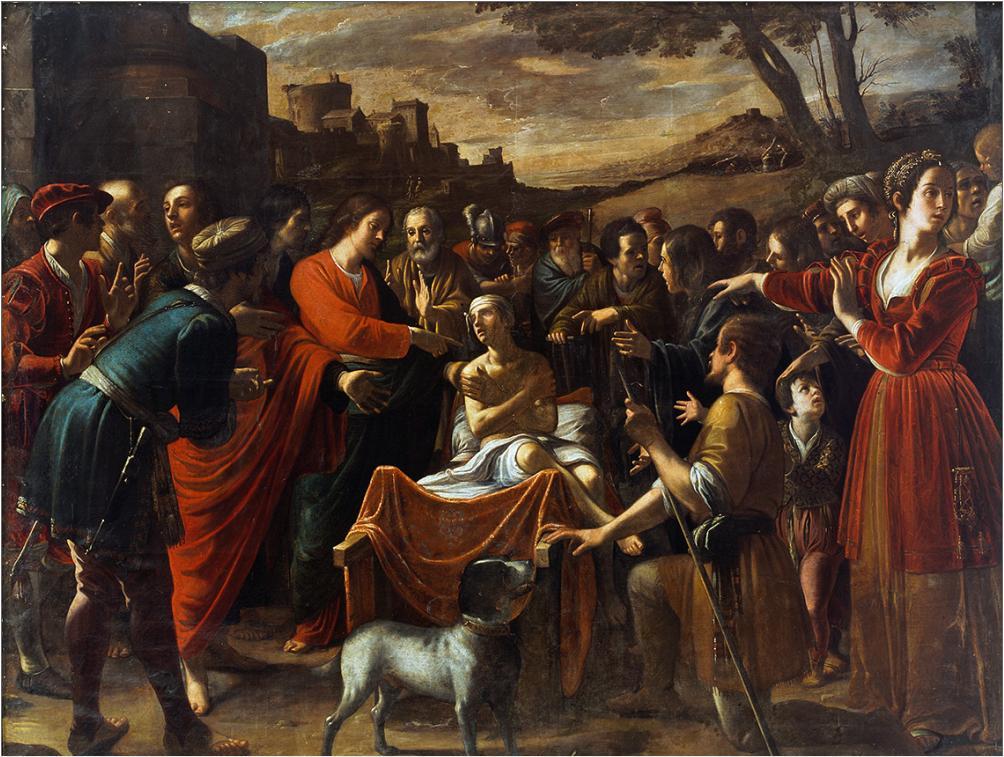
Miracle at Nain
Mario Minniti
1620
9
posted on
08/27/2026 5:36:57 AM PDT
by
annalex
(fear them not)
To: annalex
Saint of the Day for August 27
(c. 330 – 387)
Saint Monica’s Story
The circumstances of Saint Monica’s life could have made her a nagging wife, a bitter daughter-in-law, and a despairing parent, yet she did not give way to any of these temptations. Although she was a Christian, her parents gave her in marriage to a pagan, Patricius, who lived in her hometown of Tagaste in North Africa. Patricius had some redeeming features, but he had a violent temper and was licentious.
Monica also had to bear with a cantankerous mother-in-law who lived in her home. Patricius criticized his wife because of her charity and piety, but always respected her. Monica’s prayers and example finally won her husband and mother-in-law to Christianity. Her husband died in 371, one year after his baptism.
Monica had at least three children who survived infancy. The oldest, Augustine, is the most famous. At the time of his father’s death, Augustine was 17 and a rhetoric student in Carthage. Saint Monica was distressed to learn that her son had accepted the Manichean heresy—”all flesh is evil”—and was living an immoral life. For a while, she refused to let him eat or sleep in her house.
Then one night she had a vision that assured her Augustine would return to the faith. From that time on, she stayed close to her son, praying and fasting for him. In fact she often stayed much closer than Augustine wanted.
When he was 29, Augustine decided to go to Rome to teach rhetoric. Saint Monica was determined to go along. One night he told his mother that he was going to the dock to say goodbye to a friend. Instead he set sail for Rome. Monica was heartbroken when she learned of Augustine’s trick, but she still followed him. She arrived in Rome only to find that he had left for Milan. Although travel was difficult, Monica pursued him to Milan.
In Milan, Augustine came under the influence of the bishop, Saint Ambrose, who also became Monica’s spiritual director. She accepted his advice in everything and had the humility to give up some practices that had become second nature to her. Saint Monica became a leader of the devout women in Milan as she had been in Tagaste.
She continued her prayers for Augustine during his years of instruction. At Easter 387, Saint Ambrose baptized Augustine and several of his friends. Soon after, his party left for Africa. Although no one else was aware of it, Saint Monica knew her life was near the end. She told Augustine, “Son, nothing in this world now affords me delight. I do not know what there is now left for me to do or why I am still here, all my hopes in this world being now fulfilled.” She became ill shortly after and suffered severely for nine days before her death.
Almost all we know about Saint Monica is in the writings of Saint Augustine, especially his Confessions.
Reflection
Today, with Google searches, online shopping, text messages, tweets, and instant credit, we have little patience for things that take time. Likewise, we want instant answers to our prayers. Monica is a model of patience. Her long years of prayer, coupled with a strong, well-disciplined character, finally led to the conversion of her hot-tempered husband, her cantankerous mother-in-law and her brilliant but wayward son, Augustine.
Saint Monica is the Patron Saint of:
Alcoholics
Conversion
Mothers
Wives
10
posted on
08/27/2026 5:39:54 AM PDT
by
annalex
(fear them not)
To: annalex
11
posted on
08/27/2026 5:41:25 AM PDT
by
annalex
(fear them not)
To: annalex
12
posted on
08/27/2026 5:45:45 AM PDT
by
annalex
(fear them not)
To: All
NAVARRE BIBLE COMMENTARY(RSV)
Ad Majorem Dei Gloriam (To the Greater Glory of God)
Today’s First Reading
From: 1 Corinthians 1:1-9
Greeting
----------
[1] Paul, called by the will of God to be an apostle of Christ Jesus, and our brother Sosthenes,
[2] To the church of God which is at Corinth, to those sanctified in Christ Jesus, called to be saints together with all those who in every place call on the name of the Lord Jesus Christ, both their Lord and ours:
[3] Grace to you and peace from God our Father and the Lord Jesus Christ.
Thanksgiving
----------------
[4] I give thanks to God always for you because of the grace of God which was given you in Christ Jesus, [5] that in every way you were enriched in him with all speech and all knowledge [6] even as the testimony to Christ was confirmed among you--[7] so that you are not lacking in any spiritual gift, as you wait for the revealing of our Lord Jesus Christ; [8] who will sustain you to the end, guiltless in the day of our Lord Jesus Christ. [9] God is faithful, by whom you were called into the fellowship of his Son, Jesus Christ our Lord.
***********************************************************************
Commentary:
1-9. With slight variations almost all St Paul's letters begin in the same kind of way: there is a greeting (vv. 1-3), which carries the name of the writer, information on the addressee(s), and the conventional phrase; and an act of thanksgiving to God (vv. 4-9), in which the Apostle refers to the main qualities and endowments of the Christians to whom he is writing. By comparing his letters with other letters that have come down to us from the same period, it is quite apparent that St Paul usually begins his letters in the style of the time. yet he does not entirely follow this rigid pattern: he changes the usual opening--"Greeting!" (cf. Acts 15:23; 23:26)—to this more personal one, which has a pronounced Christian stamp: "Grace to you and peace." Also, the way in which he introduces himself and describes those he is addressing tells much more than a simple "Paul to the Corinthians: greeting!" Even his words of thanksgiving convey tenderness and warmth--and their tone is not merely human, for he attributes to God the virtues he praises in the faithful.
The Fathers of the Church have drawn attention to this characteristic of Paul's letters--the way he manages to convey a deep doctrinal message in a familiar style, nicely suited to whomever he happens to be addressing: "A doctor", St John Chrysostom explains, "does not treat the patient in the same way at the start of his illness as when he is recovering; nor does a teacher use the same method with children as with those who need more advanced tuition. That is how the Apostle acts: he writes as suits the needs and the times" ("Hom. On Rom", Prologue).
1. St Paul attaches to his name three features which identify him—his divine calling; his office as Apostle of Jesus Christ; and the will of God, the source of his apostolic vocation.
"Called": this is a carefully chosen word designed to convey the vigorous and personal way God called him. He calls all men to faith, to grace, to holiness, and to heaven (cf., e.g. Rom 1:7; 1 Cor 1:2; 1:26; 7:20; Eph 1:18). By defining himself as "called" (cf. Rom 1:1), St Paul is very probably referring to the episode on the road to Damascus (cf. Acts 9:1-19), when Christ changed his life, as he had earlier changed the lives of the Twelve.
"Apostle of Christ Jesus": Paul can find no stronger expression than this to describe his mission: he is forever applying this title to himself--thirty-five times by our reckoning. This fact of his apostleship is the basis of his authority—authority to praise, teach, admonish and correct orally and in writing. He is so totally identified with this mission that he has no other purpose than to pursue it; his life is dedicated to this end; all his thoughts, words and actions are aimed at achieving it. Humbly (because he once persecuted the Church: 1 Cor 15:9) and yet forthrightly (cf. 1 Cor 9:1-2) he puts himself on the same level as the Twelve as far as vocation and apostleship are concerned.
"By the will of God": the Apostle's energy and vitality are ascribable not to himself but to God, who had plans for Paul ever since he was in his mother's womb (Gal 1: 15); so much so that later in this letter he actually says, "If I preach the Gospel, that gives me no ground for boasting. For necessity is laid upon me. Woe to me if I do not preach the Gospel" (1 Cor 9:16).
"Our brother, Sosthenes": it is uncertain whether this was the same person as the ruler of the synagogue in Corinth mentioned in Acts (18:17). The prominent position given him here suggests that he was someone well-known to the community at Corinth, either for his ministry among them or because he often accompanied St Paul; he may have been the secretary, or scribe, who actually wrote the letter down (cf. 16:21).
2. "The church of God at Corinth": the addressee of the letter. The very grammar of the phrase emphasizes the fact that the Church is not the totality of the local communities: rather, each local community--here, the Christians of Corinth--represents the whole Church, which is one and indivisible: "The Apostle calls it [the community] 'the church of God' in order to show that unity is one of its essential and necessary characteristics. The Church of God is one in its members and forms nothing but a single Church with all the communities spread throughout the world, for the word 'church' does not mean schism: it means unity, harmony, concord" (St John Chrysostom, "Hom on 1 Cor", 1, "ad loc".).
In another three brush-strokes St Paul here describes those who make up the Church--those sanctified in Jesus Christ, those called to be saints, those who invoke the name of our Lord Jesus Christ.
"Those sanctified in Christ Jesus": the faithful receive at Baptism the grace which makes them a holy people (cf. Ex 19:6; 1 Pet 2:9); the participle "sanctified" implies something stable, such as is the intimate union between the individual Christian and Jesus. The formula "in Christ Jesus" here refers to the fact that the baptized are grafted on to Christ like branches attached to a wine (cf. Jn l5:1ff); this link with Christ is what makes them saints, that is, sharers in God's own holiness; and it involves a duty to strive for moral perfection. "As those who profess any art, even though they depart from its rules, are still called artists, so in like manner the faithful, although offending in many things and violating the engagements to which they had pledged themselves, are still called holy, because they have been made the people of God and have consecrated themselves to Christ by faith and Baptism. Hence, St Paul calls the Corinthians sanctified and holy, although it is certain that among them there were some whom he severely rebuked as carnal, and charged with grosser crimes" ("St Pius V Catechism", I, 10, 15).
"Called to be saints": through faith and Baptism "all Christians in any state or walk of life are called to the fullness of Christian life and to the perfection of love" (Vatican II, "Lumen Gentium", 40).
"Those who in every place call on the name of our Lord Jesus Christ": this circumlocution describes Christian believers (cf. Acts 9:14, 21; 22:16; Rom 10:12); what makes them different from others is that they worship Jesus Christ as Lord and God, in the same way as the faithful of the Old Covenant invoked the name of Yahweh. To be a member of the Church of God, therefore, it is essential that a person believe that Christ is God. "We believe in our Lord Jesus Christ, who is the Son of God. He is the eternal Word of the Father before time began, one in substance with the Father, "homoousios to Patri", through whom all things were made. He was incarnate of the Virgin Mary by the power of the Holy Spirit and was made man. 'Equal, therefore, to the Father according to his divinity, less than the Father according to his humanity, his unity deriving not from some impossible confusion of substance but from his Person"' (Paul Vl, "Creed of the People of God", 11).
3. Peace of soul, that "serenity of mind, tranquillity of soul, simplicity of heart, bond of love, union of charity" of which St Augustine spoke ("De Verb. Dom. Serm.", 58), originates in the friendship with God which grace brings with it; it is one of the fruits of the Holy Spirit (cf. Gal 5:22-23). This is the only true kind of peace: "There is no true peace, just as there is no true grace, other than the grace and peace which come from God," St John Chrysostom teaches, "Possess this divine peace and you will have nothing to fear, even if you be threatened by the direct danger, whether from men or even from the demons themselves; whereas see how everything is a cause of fear for the man who is at war with God through sin" ("Hom. on 1 Cor", 1, "ad loc".).
4-9. After the greeting, words of thanksgiving conclude the introduction to the letter, before St Paul begins the doctrinal part. He reminds the Corinthians that they owe their privileged position to God. They, like all Christians, received God's grace in Christ, and that grace has enriched them in every way, for it causes man to share in God's very nature (cf. 2 Pet 1:4), raising him to an entirely new level of existence. This transfiguration enables a person, even here, to know the perfections of God's inner life and to partake of that life--albeit in a limited, imperfect way--through the theological virtues of faith, hope and charity, which grace brings and which elevate the mind and will to know and love God, One and Three.
St Paul teaches the need to give thanks to God and he sets us an example in this regard. Obdurate sinners fail to acknowledge the benefits God gives them (cf. Rom 1:21), but Christians should always base their prayer on gratitude to God (cf. Phil 4:6). "Nothing charms God more than a heart that is grateful either on its own account or on account of others" (Chrysostom, "Hom. on 1 Cor", 2, "ad loc".).
5-6. The grace of God, mentioned in the previous verse, embraces gifts, including those to do with eloquence and knowledge. So richly does God endow the Christian that St Alphonsus exclaims: "Our wretchedness should not make us uneasy, for in Jesus crucified we shall find all richness and all grace (cf. 1 Cor 1:5, 7). The merits of Jesus Christ have enriched us with all the wealth of God and there is no grace we might desire that we cannot obtain by asking for it" ("The Love of God Reduced to Practice", chap. 3). The Fathers interpret these gifts as meaning that the Corinthians had such a good grasp of Christian teaching that they were able to express it clearly: "There are those who have the gift of knowledge but not that of speech; and there are others who have the gift of speech but not knowledge. The faithful in general, who are uneducated, know these truths, but they cannot clearly explain what they have in their soul. You on the other hand, St Paul says, are different; you know these truths and you can speak about them; you are rich in the gift of speech and in that of knowledge" (Chrysostom, "Hom. on 1 Cor", 2, "ad loc".).
8-9. "The day of our Lord': in St Paul's writings and in the New Testament generally, this refers to the day of the General Judgment when Christ will appear as Judge, clothed in glory (cf. 2 Cor 1:14; 1 Thess 5:2).
Christians actively hope that that Day will find them "blameless" (cf. Phil 1:10; 1 Thess 3:13; 5:23); the basis for this hope is God's faithfulness--an attitude frequently applied to him in the Old Testament (cf. Deut 7:9; Is 49:7) and in St Paul's letters (cf. 1 Cor 10:13; 2 Cor 1:18; 1 Thess 5:24; 2 Thess 3:3; Heb 10:23): the Covenant which God made with the chosen people was primarily a gift and a grace, but it also was a legal commitment. The Covenant was grounded on God's fidelity, which was not merely a matter of legal obligation: it involved faithful, constant love. The God's fidelity will finds its fullest expression in the Redemption brought about by Jesus Christ: "If, in fact, the reality of the Redemption," Pope John Paul II says, "in its human dimension, reveals the unheard-of greatness of man, "qui talem ac tantum meruit habere Redemptorem", at the same time "the divine dimension of the Redemption" enables us [...] to uncover the depth of that love which does not recoil before the extraordinary sacrifice of the Son, in order to satisfy the fidelity of the Creator and Father towards human beings, created in his image" ("Dives In Misericordia", 7).
13
posted on
08/27/2026 8:57:19 AM PDT
by
fidelis
(Ecce Crucem Domini! Fugite partes adversae! Vicit Leo de tribu Juda, Radix David! Alleluia!)
Today’s Gospel Reading From: Matthew 24:42-51
Vigilance. The Faithful Servant
--------------------------------------
(Jesus said to his disciples,) [42] "Watch therefore, for you do not know on what day your Lord is coming. [43] But know this, that if the householder had known in what part of the night the thief was coming, he would have watched and would not have let his house be broken into. [44] Therefore you also must be ready; for the Son of man is coming at an hour you do not expect.
[45] "Who then is the faithful and wise servant, whom his master has set over his household, to give them their food at the proper time? [46] Blessed is that servant whom his master when he comes will find so doing. [47] Truly, I say to you, he will set him over all his possessions. [48] But if that wicked servant says to himself, 'My master is delayed,' [49] and begins to beat his fellow servants, and eats and drinks with the drunken, [50] the master of that servant will come on a day when he does not expect him and at an hour he does not know, [51] and will punish him, and put him with the hypocrites; there men will weep and gnash their teeth."
***********************************************************************
Commentary:
42. Jesus himself draws from this revelation about the future the practical moral that a Christian needs to be on the watch, living each day as if it were his last.
The important thing is not to be speculating about when these events will happen and what form they will take, but to live in such a way that they find us in the state of grace.
51. "And will punish him [or, cut him in pieces]": this can be understood as a metaphor for "will cast him away". "Weeping and gnashing of teeth": the pains of hell.
14
posted on
08/27/2026 8:57:40 AM PDT
by
fidelis
(Ecce Crucem Domini! Fugite partes adversae! Vicit Leo de tribu Juda, Radix David! Alleluia!)
15
posted on
08/27/2026 8:58:48 AM PDT
by
fidelis
(Ecce Crucem Domini! Fugite partes adversae! Vicit Leo de tribu Juda, Radix David! Alleluia!)
Disclaimer:
Opinions posted on Free Republic are those of the individual
posters and do not necessarily represent the opinion of Free Republic or its
management. All materials posted herein are protected by copyright law and the
exemption for fair use of copyrighted works.
FreeRepublic.com is powered by software copyright 2000-2008 John Robinson

