Skip to comments.
Catholic Caucus: Daily Mass Readings 20-August-2026
Universalis/Jerusalem Bible ^
Posted on 08/20/2026 5:13:50 AM PDT by annalex
20 August 2026
Saint Bernard, Abbot, Doctor
on Thursday of week 20 in Ordinary Time

St. Bernard Of Clairvaux Catholic church, Scottsdale, AZ Readings at MassLiturgical Colour: White. Year: A(II). Readings for the feria Readings for the memorial These are the readings for the feria
| First reading |
|---|
| Ezekiel 36:23-28 |
|---|
I will remove the heart of stone from your bodies and give you a heart of fleshThe word of the Lord was addressed to me as follows: ‘I mean to display the holiness of my great name, which has been profaned among the nations, which you have profaned among them. And the nations will learn that I am the Lord – it is the Lord who speaks – when I display my holiness for your sake before their eyes. Then I am going to take you from among the nations and gather you together from all the foreign countries, and bring you home to your own land. I shall pour clean water over you and you will be cleansed; I shall cleanse you of all your defilement and all your idols. I shall give you a new heart, and put a new spirit in you; I shall remove the heart of stone from your bodies and give you a heart of flesh instead. I shall put my spirit in you, and make you keep my laws and sincerely respect my observances. You will live in the land which I gave your ancestors. You shall be my people and I will be your God.’
| Responsorial Psalm |
|---|
| Psalm 50(51):12-15,18-19 |
|---|
I shall pour clean water over you and all your sins will be washed away. A pure heart create for me, O God, put a steadfast spirit within me. Do not cast me away from your presence, nor deprive me of your holy spirit. I shall pour clean water over you and all your sins will be washed away. Give me again the joy of your help; with a spirit of fervour sustain me, that I may teach transgressors your ways and sinners may return to you. I shall pour clean water over you and all your sins will be washed away. For in sacrifice you take no delight, burnt offering from me you would refuse, my sacrifice, a contrite spirit. A humbled, contrite heart you will not spurn. I shall pour clean water over you and all your sins will be washed away.
| Gospel Acclamation | Ps118:27 |
|---|
Alleluia, alleluia! Make me grasp the way of your precepts, and I will muse on your wonders. Alleluia! Alleluia, alleluia! Harden not your hearts today, but listen to the voice of the Lord. Alleluia!
Invite everyone you can to the weddingJesus began to speak to the chief priests and elders of the people in parables: ‘The kingdom of heaven may be compared to a king who gave a feast for his son’s wedding. He sent his servants to call those who had been invited, but they would not come. Next he sent some more servants. “Tell those who have been invited” he said “that I have my banquet all prepared, my oxen and fattened cattle have been slaughtered, everything is ready. Come to the wedding.” But they were not interested: one went off to his farm, another to his business, and the rest seized his servants, maltreated them and killed them. The king was furious. He despatched his troops, destroyed those murderers and burnt their town. Then he said to his servants, “The wedding is ready; but as those who were invited proved to be unworthy, go to the crossroads in the town and invite everyone you can find to the wedding.” So these servants went out on to the roads and collected together everyone they could find, bad and good alike; and the wedding hall was filled with guests. When the king came in to look at the guests he noticed one man who was not wearing a wedding garment, and said to him, “How did you get in here, my friend, without a wedding garment?” And the man was silent. Then the king said to the attendants, “Bind him hand and foot and throw him out into the dark, where there will be weeping and grinding of teeth.” For many are called, but few are chosen.’ Continue These are the readings for the memorial
| First reading |
|---|
| Ecclesiasticus 15:1-6 |
|---|
Whoever grasps the Law will obtain wisdomWhoever fears the Lord will act like this, and whoever grasps the Law will obtain wisdom. She will come to meet him like a mother, and receive him like a virgin bride. He will lean on her and will not fall, he will rely on her and not be put to shame. She will raise him high above his neighbours, and in full assembly she will open his mouth. He will find happiness and a crown of joy, he will inherit an everlasting name.
| Responsorial Psalm |
|---|
| Psalm 118(119):9-14 |
|---|
Lord, teach me your statutes. How shall the young remain sinless? By obeying your word. I have sought you with all my heart; let me not stray from your commands. Lord, teach me your statutes. I treasure your promise in my heart lest I sin against you. Blessed are you, O Lord; teach me your statutes. Lord, teach me your statutes. With my tongue I have recounted the decrees of your lips. I rejoiced to do your will as though all riches were mine. Lord, teach me your statutes.
| Gospel Acclamation | Jn15:9,5 |
|---|
Alleluia, alleluia! Remain in my love, says the Lord; whoever remains in me, with me in him, bears fruit in plenty. Alleluia!
Father, may they be completely oneJesus raised his eyes to heaven and said: ‘Holy Father, I pray not only for these, but for those also who through their words will believe in me. May they all be one. Father, may they be one in us, as you are in me and I am in you, so that the world may believe it was you who sent me. I have given them the glory you gave to me, that they may be one as we are one. With me in them and you in me, may they be so completely one that the world will realise that it was you who sent me and that I have loved them as much as you loved me. Father, I want those you have given me to be with me where I am, so that they may always see the glory you have given me because you loved me before the foundation of the world. Father, Righteous One, the world has not known you, but I have known you, and these have known that you have sent me. I have made your name known to them and will continue to make it known, so that the love with which you loved me may be in them, and so that I may be in them.’ Continue Christian Art Each day, The Christian Art website gives a picture and reflection on the Gospel of the day. The readings on this page are from the Jerusalem Bible, which is used at Mass in most of the English-speaking world. The New American Bible readings, which are used at Mass in the United States, are available in the Universalis apps, programs and downloads.
You can also view this page with the Gospel in Greek and English. |
TOPICS: Catholic; General Discusssion; Prayer; Worship
KEYWORDS: catholic; jn17; mt22; ordinarytime; prayer
For your reading, reflection, faith-sharing, comments, questions, discussion.
1
posted on
08/20/2026 5:13:50 AM PDT
by
annalex
To: All
KEYWORDS: catholic; jn17; mt22; ordinarytime; prayer
2
posted on
08/20/2026 5:15:54 AM PDT
by
annalex
(fear them not)
To: nickcarraway; NYer; ELS; Pyro7480; livius; ArrogantBustard; Catholicguy; RobbyS; marshmallow; ...

Alleluia Ping Please FReepmail me to get on/off the Alleluia Ping List.
3
posted on
08/20/2026 5:18:36 AM PDT
by
annalex
(fear them not)
To: annalex
4
posted on
08/20/2026 5:19:09 AM PDT
by
annalex
(fear them not)
To: annalex
| Matthew |
| | English: Douay-Rheims | Latin: Vulgata Clementina | Greek NT: Byzantine/Majority Text (2000) |
| | Matthew 22
|
| 1. | AND Jesus answering, spoke again in parables to them, saying: | Et respondens Jesus, dixit iterum in parabolis eis, dicens : | και αποκριθεις ο ιησους παλιν ειπεν αυτοις εν παραβολαις λεγων |
| 2. | The kingdom of heaven is likened to a king, who made a marriage for his son. | Simile factum est regnum cælorum homini regi, qui fecit nuptias filio suo. | ωμοιωθη η βασιλεια των ουρανων ανθρωπω βασιλει οστις εποιησεν γαμους τω υιω αυτου |
| 3. | And he sent his servants, to call them that were invited to the marriage; and they would not come. | Et misit servos suos vocare invitatos ad nuptias, et nolebant venire. | και απεστειλεν τους δουλους αυτου καλεσαι τους κεκλημενους εις τους γαμους και ουκ ηθελον ελθειν |
| 4. | Again he sent other servants, saying: Tell them that were invited, Behold, I have prepared my dinner; my beeves and fatlings are killed, and all things are ready: come ye to the marriage. | Iterum misit alios servos, dicens : Dicite invitatis : Ecce prandium meum paravi, tauri mei et altilia occisa sunt, et omnia parata : venite ad nuptias. | παλιν απεστειλεν αλλους δουλους λεγων ειπατε τοις κεκλημενοις ιδου το αριστον μου ητοιμασα οι ταυροι μου και τα σιτιστα τεθυμενα και παντα ετοιμα δευτε εις τους γαμους |
| 5. | But they neglected, and went their own ways, one to his farm, and another to his merchandise. | Illi autem neglexerunt : et abierunt, alius in villam suam, alius vero ad negotiationem suam : | οι δε αμελησαντες απηλθον ο μεν εις τον ιδιον αγρον ο δε εις την εμποριαν αυτου |
| 6. | And the rest laid hands on his servants, and having treated them contumeliously, put them to death. | reliqui vero tenuerunt servos ejus, et contumeliis affectos occiderunt. | οι δε λοιποι κρατησαντες τους δουλους αυτου υβρισαν και απεκτειναν |
| 7. | But when the king had heard of it, he was angry, and sending his armies, he destroyed those murderers, and burnt their city. | Rex autem cum audisset, iratus est : et missis exercitibus suis, perdidit homicidas illos, et civitatem illorum succendit. | και ακουσας ο βασιλευς εκεινος ωργισθη και πεμψας τα στρατευματα αυτου απωλεσεν τους φονεις εκεινους και την πολιν αυτων ενεπρησεν |
| 8. | Then he saith to his servants: The marriage indeed is ready; but they that were invited were not worthy. | Tunc ait servis suis : Nuptiæ quidem paratæ sunt, sed qui invitati erant, non fuerunt digni : | τοτε λεγει τοις δουλοις αυτου ο μεν γαμος ετοιμος εστιν οι δε κεκλημενοι ουκ ησαν αξιοι |
| 9. | Go ye therefore into the highways; and as many as you shall find, call to the marriage. | ite ergo ad exitus viarum, et quoscumque inveneritis, vocate ad nuptias. | πορευεσθε ουν επι τας διεξοδους των οδων και οσους αν ευρητε καλεσατε εις τους γαμους |
| 10. | And his servants going forth into the ways, gathered together all that they found, both bad and good: and the marriage was filled with guests. | Et egressi servi ejus in vias, congregaverunt omnes quos invenerunt, malos et bonos : et impletæ sunt nuptiæ discumbentium. | και εξελθοντες οι δουλοι εκεινοι εις τας οδους συνηγαγον παντας οσους ευρον πονηρους τε και αγαθους και επλησθη ο γαμος ανακειμενων |
| 11. | And the king went in to see the guests: and he saw there a man who had not on a wedding garment. | Intravit autem rex ut viderent discumbentes, et vidit ibi hominem non vestitum veste nuptiali. | εισελθων δε ο βασιλευς θεασασθαι τους ανακειμενους ειδεν εκει ανθρωπον ουκ ενδεδυμενον ενδυμα γαμου |
| 12. | And he saith to him: Friend, how camest thou in hither not having a wedding garment? But he was silent. | Et ait illi : Amice, quomodo huc intrasti non habens vestem nuptialem ? At ille obmutavit. | και λεγει αυτω εταιρε πως εισηλθες ωδε μη εχων ενδυμα γαμου ο δε εφιμωθη |
| 13. | Then the king said to the waiters: Bind his hands and feet, and cast him into the exterior darkness: there shall be weeping and gnashing of teeth. | Tunc dicit rex ministris : Ligatis manibus et pedibus ejus, mittite eum in tenebras exteriores : ibi erit fletus et stridor dentium. | τοτε ειπεν ο βασιλευς τοις διακονοις δησαντες αυτου ποδας και χειρας αρατε αυτον και εκβαλετε εις το σκοτος το εξωτερον εκει εσται ο κλαυθμος και ο βρυγμος των οδοντων |
| 14. | For many are called, but few are chosen. | Multi enim sunt vocati, pauci vero electi. | πολλοι γαρ εισιν κλητοι ολιγοι δε εκλεκτοι |
5
posted on
08/20/2026 5:19:55 AM PDT
by
annalex
(fear them not)
To: annalex

Catena Aurea by St. Thomas Aguinas
CHAP. 22
22:114
1. And Jesus answered and spake unto them again by parables, and said,
2. The kingdom of heaven is like unto a certain king, which made a marriage for his son,
3. And sent forth his servants to call them that were bidden to the wedding: and they would not come.
4. Again, he sent forth other servants, saying, Tell them which are bidden, Behold, I have prepared my dinner: my oxen and my fatlings are killed, and all things are ready: come unto the marriage.
5. But they made light of it, and went their ways, one to his farm, another to his merchandise:
6. And the remnant took his servants, and entreated them spitefully, and slew them.
7. But when the king heard thereof, he was wroth: and he sent forth his armies, and destroyed those murderers, and burned up their city.
8. Then saith he to his servants, The wedding is ready, but they which were bidden were not worthy.
9. Go ye therefore into the highways, and as many as ye shall find, bid to the marriage.
10. So those servants went out into the highways, and gathered together all as many as they found, both bad and good: and the wedding was furnished with guests.
11. And when the king came in to see the guests, he saw there a man which had not on a wedding garment:
12. And he saith unto him, Friend, how camest thou in hither not having a wedding garment? And he was speechless.
13. Then said the king to the servants, Bind him hand and foot, and take him away, and cast him into outer darkness; there shall be weeping and gnashing of teeth.
14. For many are called, but few are chosen.
CHRYSOSTOM. (Hom. lxix.) Forasmuch as He had said, And it shall be given to a nation bringing forth the fruits thereof, He now proceeds to shew what nation that is.
GLOSS. (interlin.) Answered, that is, meeting their evil thoughts of putting Him to death.
AUGUSTINE. (de Cons. Ev. ii. 71.) This parable is related only by Matthew. Luke gives one like it, but it is not the same, as the order shews.
GREGORY. (Hom. in Ev. xxxviii. 2.) Here, by the wedding-feast is denoted the present Church; there, by the supper, the last and eternal feast. For into this enter some who shall perish; into that whosoever has once entered in shall never be put forth. But if any should maintain that these are the same lessons, we may perhaps explain that that part concerning the guest who had come in without a wedding garment, which Luke has not mentioned, Matthew has related. That the one calls it supper, the other dinner, makes no difference; for with the ancients the dinner was at the ninth hour, and was therefore often called supper.
ORIGEN. The kingdom of heaven, in respect of Him who reigns there, is like a king; in respect of Him who shares the kingdom, it is like a kings son; in respect of those things which are in the kingdom, it is like servants and guests, and among them the kings armies. It is specified, A man that is a king, that what is spoken may be as by a man to men, and that a man may regulate men unwilling to be regulated by God. But the kingdom of heaven will then cease to be like a man, when zeal and contention and all other passions and sins having ceased, we shall cease to walk after men, and shall see Him as He is. For now we see Him not as He is, but as He has been made for us in our dispensation.
GREGORY. (ubi sup.) G marriage feast for God the Son, when He joined Him to human nature in the womb of the Virgin. But far be it from us to conclude, that because marriage takes place between two separate persons, that therefore the person of our Redeemer was made up of two separate persons. We say indeed that He exists of two natures, and in two natures, but we hold it unlawful to believe that He was compounded of two persons. It is safer therefore to say, that the marriage feast was made by the King the Father for the King the Son when He joined to Him the Holy Church in the mystery of His incarnation. The womb of the Virgin Mother was the bride-chamber of this Bridegroom.
PSEUDO-CHRYSOSTOM. Otherwise; When the resurrection of the saints shall be, then the life, which is Christ, shall revive man, swallowing up his mortality in its own immortality. For now we receive the Holy Spirit as a pledge of the future union, but then we shall have Christ Himself more fully in us.
ORIGEN. Or, by the marriage of Bridegroom with Bride, that is, of Christ with the soul, understand the Assumption of the Word, the produce whereof is good works.
HILARY. Rightly has the Father already made this wedding, because this eternal union and espousal of the new body is already perfect in Christ.
PSEUDO-CHRYSOSTOM. When the servants were sent to call them, they must have been invited before. Men have been invited from the time of Abraham, to whom was promised Christs incarnation.
JEROME. He sent his servant, without doubt Moses, by whom I le gave the Law, to those who had been invited. But if you read servants as most copies have, it must be referred to the Prophets, by whom they were invited, but neglected to come. By the servants who were sent the second time, we may better understand the Prophets than the Apostles; that is to say, if servant is read in the first place; but if servants, then by the second servants are to be understood the Apostles;
PSEUDO-CHRYSOSTOM. whom He sent when He said unto them, Go not into the way of the Gentiles, but rather go to the lost sheep of the house of Israel. (Mat. 10:5.)
ORIGEN. Or; The servants who were first sent to call them that were bidden to the wedding, are to be taken as the Prophets converting the people by their prophecy to the festival of the restoration of the Church to Christ. They who would not come at the first message are they who refused to hear the words of the Prophets. The others who were sent a second time were another assembly of Prophets.
HILARY. Or; The servants who were first sent to call them that were bidden, are the Apostles; they who, being before bidden, are now invited to come in, are the people of Israel, who had before been bidden through the Law to the glories of eternity. To the Apostles therefore it belonged to remind those whom the Prophets had invited. Those sent with the second injunction are the Apostolic men their successors.
GREGORY. (ubi sup.) But because these who were first invited would not come to the feast, the second summons says, Behold, I have prepared my dinner.
JEROME. The dinner that is prepared, the oxen and the fatlings that are killed, is either a description of regal magnificence by the way of metaphor, that by carnal things spiritual may be understood; or the greatness of the doctrines, and the manifold teaching of God in His law, may be understood.
PSEUDO-CHRYSOSTOM. When therefore the Lord bade the Apostles, Go ye and preach, saying, The kingdom of heaven is at hand, it was the same message as is here given, I have prepared my dinner; i. e. I have set out the table of Scripture out of the Law and the Prophets.
GREGORY. (ubi sup.) By the oxen are signified the Fathers of the Old Testament; who by sufferance of the Law gored their enemies with the horn of bodily strength. By fatlings are meant fatted animals, for from alere, comes altilia, as it were alitilia or alita. By the fatlings are intended the Fathers of the New Testament; who while they receive sweet grace of inward fattening, are raised by the wing of contemplation from earthly desires to things above. He says therefore, My oxen and my fallings are killed; as much as to say, Look to the deaths of the Fathers who have been before you, and desire some amendment of your lives.
PSEUDO-CHRYSOSTOM. Otherwise; He says oxen and fatlings, not as though the oxen were not fatted, but because all the oxen were not fat. Therefore the fatlings denote the Prophets who were filled with the Holy Spirit; the oxen those who were both Priests and Prophets, as Jeremiah and Ezekiel; for as the oxen are the leaders of the herd, so also the Priests are leaders of the people.
HILARY. Or otherwise; The oxen are the glorious army of Martyrs, offered, like choice victims, for the confession of God; the fatlings are spiritual men, as birds fed for flight upon heavenly food, that they may fill others with the abundance of the food they have eaten.
GREGORY. (ubi sup.) It is to be observed, that in the first invitation nothing was said of the oxen or fatlings, but in the second it is announced that they are already killed, because Almighty God when we will not hear His words gives examples, that what we suppose impossible may become easy to us to surmount, when we hear that others have passed through it before us.
ORIGEN. Or; The dinner which is prepared is the oracle of God; and so the more mighty of the oracles of God are the oxen; the sweet and pleasant are the fatlings. For if any one bring forward feeble words, without power, and not having strong force of reason, these are the lean things; the fatlings are when to the establishment of each proposition many examples are brought forward backed by reasonable proofs. For example, supposing one holding discourse of chastity, it might well be represented by the turtle-dove; but should he bring forward the same holy discourse full of reasonable proof out of Scripture, so as to delight and strengthen the mind of his hearer, then he brings the dove fatted.
PSEUDO-CHRYSOSTOM. That He says, And all things are now ready, means, that all that is required to salvation is already filled up in the Scriptures; there the ignorant may find instruction; the self-willed may read of terrors; he who is in difficulty may there find promises to rouse him to activity.
GLOSS. (interlin.) Or, All things are now ready, i. e. The entrance into the kingdom, which had been hitherto closed, is now ready through faith in My incarnation.
PSEUDO-CHRYSOSTOM. (non occ. sed vid. Gloss. ord.) Or He says, All things are now ready which belong to the mystery of the Lords Passion, and our redemption. He says, Come to the marriage, not with your feet, but with faith, and good conduct. But they made light of it; why they did so He shews when He adds, And they went their way, one to his farm, another to his merchandize.
CHRYSOSTOM. These occupations seem to be entirely reasonable; but we learn hence, that however necessary the things that take up our time, we ought to prefer spiritual things to every thing beside. But it seems to me that they only pretended these engagements as a cloak for their disregard of the invitation.
HILARY. For men are taken up with worldly ambition as with a farm; and many through covetousness are engrossed with trafficking.
PSEUDO-CHRYSOSTOM. Or otherwise; When we work with the labour of our hands, for example, cultivating our field or our vineyard, or any manufacture of wood or iron, we seem to be occupied with our farm; any other mode of getting money unattended with manual labour is here called merchandize. O most miserable world! and miserable ye that follow it! The pursuits of this world have ever shut men out of life.
GREGORY. Whosoever then intent upon earthly business, or devoted to the actions of this world, feigns to be meditating upon the mystery of the Lords Passion, and to be living accordingly, is he that refuses to come to the Kings wedding on pretext of going to his farm or his merchandize. Nay often, which is worse, some who are called not only reject the grace, but become persecutors, And the remnant took his servants, and entreated them despitefully, and slew them.
PSEUDO-CHRYSOSTOM. Or, by the business of a farm, He denotes the Jewish populace, whom the delights of this world separated from-Christ; by the excuse of merchandize, the Priests and other ministers of the Temple, who, coming to the service of the Law and the Temple through greediness of gain, have been shut out of the faith by covetousness. Of these He said not, They were filled with envy, but They made light of it. For they who through hate and spite crucified Christ, are they who were filled with envy; but they who being entangled in business did not believe on Him, are not said to have been filled with envy, but to have made light of it. The Lord is silent respecting His own death, because He had spoken of it in the foregoing parable, but He shews forth the death of His disciples, whom after His ascension the Jews put to death, stoning Stephen and executing James the son of Alphæus, for which things Jerusalem was destroyed by the Romans. And it is to be observed, that anger is attributed to God figuratively and not properly; He is then said to be angry when He punishes.
JEROME. When He was doing works of mercy, and bidding to His marriage-feast, He was called a man; (homini regi) now when He comes to vengeance, the man is dropped, and He is called only a King.
ORIGEN. Let those who sin against the God of the Law, and the Prophets, and the whole creation, declare whether He who is here called man, and is said to be angry, is indeed the Father Himself. If they allow this, they will be forced to own that many things are said of Him applicable to the passible nature of man; not for that He has passions, but because He is represented to us after the manner of passible human nature. In this way we take Gods anger, repentance, and the other things of the like sort in the Prophets.
JEROME. By His armies we understand the Romans under Vespasian and Titus, who having slaughtered the inhabitants of Judæa, laid in ashes the faithless city.
PSEUDO-CHRYSOSTOM. The Roman army is called Gods army; because The earth is the Lords, and the fulness thereof; (Ps. 24:1.) nor would the Romans have come to Jerusalem, had not the Lord stirred them thither.
GREGORY. (ubi sup.) Or, The armies of our King are the legions of His Angels. He is said therefore to have sent His armies, and to have destroyed those murderers, because all judgment is executed upon men by the Angels. He destroys those murderers, when He cuts off persecutors; and burns up their city, because not only their souls, but the body of flesh they had tenanted, is tormented in the everlasting fire of hell.
ORIGEN. Or, the city of those wicked men is in each doctrine the assembly of those who meet in the wisdom of the rulers of this world; which the King sets fire to and destroys, as consisting of evil buildings.
GREGORY. (ubi sup.) But when He sees that His invitation is spurned at, He will not have His Sons marriage-feast empty; the word of God will find where it may stay itself.
ORIGEN. He saith to His servants, that is, to the Apostles; or to the Angels, who were set over the calling of the Gentiles, The wedding is ready.
REMIGIUS. That is, the whole sacrament of the human dispensation is completed and closed. But they which, were bidden, (Rom. 10:3.) that is, the Jews, were not worthy, because, ignorant of the righteousness of God, and going about to establish their own righteousness, they have not submitted themselves to the righteousness of God. The Jewish nation then being rejected, the Gentile people were taken in to the marriage-feast; whence it follows, Go ye out into the crossings of the streets, and as many as ye shall find, bid to the wedding.
JEROME. For the Gentile nation was not in the streets, but in the crossings of the streets.
REMIGIUS. These are the errors of the Gentiles.
PSEUDO-CHRYSOSTOM. Or; The streets are all the professions of this world, as philosophy, soldiery, and the like. And therefore He says, Go out into the crossings of the streets, that they may call to the faith men of every condition. Moreover, as chastity is the way that leads to God, so fornication is the way that leads to the Devil; and so it is in the other virtues and vices. Thus He bids them invite to the faith men of every profession or condition.
HILARY. By the street also is to be understood the time of this world, and they are therefore bid to go to the crossings of the streets, because the past is remitted to all.
GREGORY. (ubi sup.) Or otherwise; In holy Scripture, way is taken to mean actions; so that the crossings of the ways we understand as failure in action, for they usually come to God readily, who have had little prosperity in worldly actions.
ORIGEN. Or otherwise; I suppose this first bidding to the wedding to have been a bidding of some of the more noble minds. For God would have those before all come to the feast of the divine oracles who are of the more ready wit to understand them; and forasmuch as they who are such are loth to come to that kind of summons, other servants are sent to move them to come, and to promise that they shall find the dinner prepared. For as in the things of the body, one is the bride, others the inviters to the feast, and they that are bidden are others again; so God knows the various ranks of souls, and their powers, and the reasons why these are taken into the condition of the Bride, others in the rank of the servants that call, and others among the number of those that are bidden as guests. But they who had been thus especially invited contemned the first inviters as poor in understanding, and went their way, following their own devices, as more delighting in them than in those things which the King by his servants promised. Yet are these more venial than they who ill-treat and put to death the servants sent unto them; those, that is, who daringly assail with weapons of contentious words the servants sent, who are unequal to solve their subtle difficulties, and those are illtreated or put to death by them. The servants going forth are either Christs Apostles going from Judæa and Jerusalem, or the Holy Angels from the inner worlds, and going to the various ways of various manners, gathered together whomsoever they found, not caring whether before their calling they had been good or bad. By the good here we may understand simply the more humble and upright of those who come to the worship of God, to whom agreed what the Apostle says, When the Gentiles which have not the Law do by nature the things contained in the Law, they are a law unto themselves. (Rom. 2:14.)
JEROME. For there is an infinite difference among the Gentiles themselves; some are more prone to vice, others are endowed with more incorrupt and virtuous manners.
GREGORY. (ubi sup.) Or; He means that in this present Church there cannot be bad without good, nor good without bad. He is not good who refuses to endure the bad.
ORIGEN. The marriage-feast of Christ and the Church is filled, when they who were found by the Apostles, being restored to God, sat down to the feast. But since it behoved that both bad and good should be called, not that the bad should continue bad, but that they should put off the garments unmeet for the wedding, and should put on the marriage garments, to wit, bowels of mercy and kindness, for this cause the King goes out, that He may see them set down before the supper is set before them, that they may be detained who have the wedding garment in which He is delighted, and that he may condemn the opposite.
PSEUDO-CHRYSOSTOM. The King came in to see the guests; not as though there was any place where He is not; but where He will look to give judgment, there He is said to be present; where He will not, there He seems to be absent. The day of His coming to behold is the day of judgment, when He will visit Christians seated at the board of the Scriptures.
ORIGEN. But when He was come in, He found there one who had not put off his old behaviour; He saw there a man which had not on a wedding garment. He speaks of one only, because all, who after faith continue to serve that wickedness which they had before the faith, are but of one kind.
GREGORY. (ubi sup.) What ought we to understand by the wedding garment, but charity? For this the Lord had upon Him, when He came to espouse the Church to Himself. He then enters in to the wedding feast, but without the wedding garment, who has faith in the Church, but not charity.
AUGUSTINE. (cont. Faust. xxii. 19.) Or, he goes to the feast without a garment, who goes seeking his own, and not the Bridegrooms honour.
HILARY. Or; The wedding garment is the grace of the Holy Spirit, and the purity of that heavenly temper, which taken up on the confession of a good enquiry is to be preserved pure and unspotted for the company of the kingdom of heaven.
JEROME. Or; The marriage garment is the commandments of the Lord, and the works which are done under the Law and the Gospel, and form the clothing of the new man. Whoso among the Christian body shall be found in the day of judgment not to have these, is straightway condemned. He saith unto him, Friend, how camest thou in hither, not having a wedding garment? He calls him friend, because he was invited to the wedding as being a friend by faith; but He charges him with want of manners in polluting by his filthy dress the elegance of the wedding entertainment.
ORIGEN. And forasmuch as he who is in sin, and puts not on the Lord Jesus Christ, has no excuse, it follows, But he was speechless.
JEROME. For in that day there will be no room for blustering manner1, nor power of denial, when all the Angels and the world itself are witnesses against the sinner.
ORIGEN. He who has thus insulted the marriage feast is not only cast out therefrom, but besides by the Kings officers, who are set over his prisons, is chained up from that power of walking which he employed not to walk to any good thing, and that power of reaching forth his hand, wherewith he had fulfilled no work for any good; and is sentenced to a place whence all light is banished, which is called outer darkness.
GREGORY. (ubi sup.) The hands and feet are then bound by a severe sentence of judgment, which before refused to be bound from wicked actions by amendment of life. Or punishment binds them, whom sin had before bound from good works.
AUGUSTINE. (de Trin. xi. 6.) The bonds of wicked and depraved desires are the chains which bind him who deserves to be cast out into outer darkness.
GREGORY. (ubi sup.) By inward darkness we express blindness, of heart; outer darkness signifies the everlasting night of damnation.
PSEUDO-CHRYSOSTOM. Or, it points to the difference of punishment inflicted on sinners. Outer darkness being the deepest, inward darkness the lesser, as it were the outskirts of the place.
JEROME. By a metaphor taken from the body, there shall be weeping and gnashing of teeth, is shewn the greatness of the torments. The binding of the hands and feet also, and the weeping of eyes, and the gnashing of teeth, understand as proving the truth of the resurrection of the body.
GREGORY. (ubi sup.) There shall gnash those teeth which here delighted in gluttony; there shall weep those eyes which here roamed in illicit desire; every member shall there have its peculiar punishment, which here was a slave to its peculiar vice.
JEROME. And because in the marriage and supper the chief thing is the end and not the beginning, therefore He adds, For many are called, but few chosen.
HILARY. For to invite all without exception is a courtesy of public benevolence; but out of the invited or called, the election will be of worth, by distinction of merit.
GREGORY. (ubi sup.) For some never begin a good course, and some never continue in that good course which they have begun. Let each ones care about himself be in proportion to his ignorance of what is yet to come.
PSEUDO-CHRYSOSTOM. Or otherwise; Whenever God will try His Church, He enters into it that He may see the guests; and if He finds any one not having on the wedding garment, He enquires of him, How then were you made a Christian, if you neglect these works? Such a one Christ gives over to His ministers, that is, to seducing leaders, who bind his hands, that is, his works, and his feet, that is, the motions of his mind, and cast him into darkness, that is, into the errors of the Gentiles or the Jews, or into heresy. The nigher darkness is that of the Gentiles, for they have never heard the truth which they despise; the outer darkness is that of the Jews, who have heard but do not believe; the outermost is that of the heretics, who have heard and have learned.
Catena Aurea Matthew 22
6
posted on
08/20/2026 5:20:45 AM PDT
by
annalex
(fear them not)
To: annalex
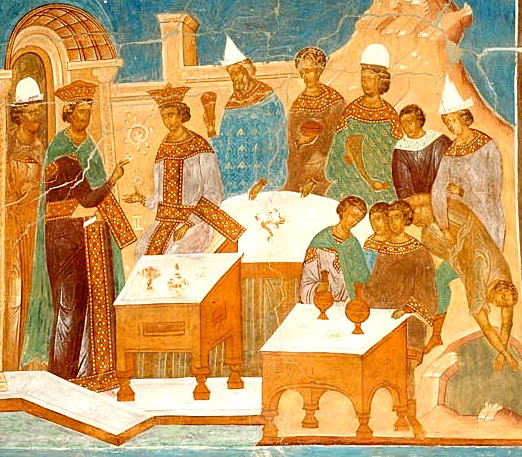
Parable of the Guests at the Wedding
Dionisiy
14c
7
posted on
08/20/2026 5:24:30 AM PDT
by
annalex
(fear them not)
To: annalex
| John |
| | English: Douay-Rheims | Latin: Vulgata Clementina | Greek NT: Byzantine/Majority Text (2000) |
| | John 17
|
| 20. | And not for them only do I pray, but for them also who through their word shall believe in me; | Non pro eis rogo tantum, sed et pro eis qui credituri sunt per verbum eorum in me : | ου περι τουτων δε ερωτω μονον αλλα και περι των πιστευοντων δια του λογου αυτων εις εμε |
| 21. | That they all may be one, as thou, Father, in me, and I in thee; that they also may be one in us; that the world may believe that thou hast sent me. | ut omnes unum sint, sicut tu Pater in me, et ego in te, ut et ipsi in nobis unum sint : ut credat mundus, quia tu me misisti. | ινα παντες εν ωσιν καθως συ πατερ εν εμοι καγω εν σοι ινα και αυτοι εν ημιν εν ωσιν ινα ο κοσμος πιστευση οτι συ με απεστειλας |
| 22. | And the glory which thou hast given me, I have given to them; that they may be one, as we also are one: | Et ego claritatem, quam dedisti mihi, dedi eis : ut sint unum, sicut et nos unum sumus. | και εγω την δοξαν ην δεδωκας μοι δεδωκα αυτοις ινα ωσιν εν καθως ημεις εν εσμεν |
| 23. | I in them, and thou in me; that they may be made perfect in one: and the world may know that thou hast sent me, and hast loved them, as thou hast also loved me. | Ego in eis, et tu in me : ut sint consummati in unum : et cognoscat mundus quia tu me misisti, et dilexisti eos, sicut et me dilexisti. | εγω εν αυτοις και συ εν εμοι ινα ωσιν τετελειωμενοι εις εν και ινα γινωσκη ο κοσμος οτι συ με απεστειλας και ηγαπησας αυτους καθως εμε ηγαπησας |
| 24. | Father, I will that where I am, they also whom thou hast given me may be with me; that they may see my glory which thou hast given me, because thou hast loved me before the creation of the world. | Pater, quos dedisti mihi, volo ut ubi sum ego, et illi sint mecum : ut videant claritatem meam, quam dedisti mihi : quia dilexisti me ante constitutionem mundi. | πατερ ους δεδωκας μοι θελω ινα οπου ειμι εγω κακεινοι ωσιν μετ εμου ινα θεωρωσιν την δοξαν την εμην ην εδωκας μοι οτι ηγαπησας με προ καταβολης κοσμου |
| 25. | Just Father, the world hath not known thee; but I have known thee: and these have known that thou hast sent me. | Pater juste, mundus te non cognovit, ego autem te cognovi : et hi cognoverunt, quia tu me misisti. | πατερ δικαιε και ο κοσμος σε ουκ εγνω εγω δε σε εγνων και ουτοι εγνωσαν οτι συ με απεστειλας |
| 26. | And I have made known thy name to them, and will make it known; that the love wherewith thou hast loved me, may be in them, and I in them. | Et notum feci eis nomen tuum, et notum faciam : ut dilectio, qua dilexisti me, in ipsis sit, et ego in ipsis. | και εγνωρισα αυτοις το ονομα σου και γνωρισω ινα η αγαπη ην ηγαπησας με εν αυτοις η καγω εν αυτοις |
8
posted on
08/20/2026 5:26:36 AM PDT
by
annalex
(fear them not)
To: annalex
Catena Aurea by St. Thomas Aguinas
17:20–23
20. Neither pray I for these alone, but for them also which shall believe on me through their word;
21. That they all may be one; as thou, Father, art in me, and I in thee, that they also may be one in us: that the world may believe that thou hast sent me.
22. And the glory which thou gavest me I have given them; that they may be one, even as we are one:
23. I in them, and thou in me, that they may be made perfect in one: and that the world may know that thou hast sent me, and hast loved them, as thou hast loved me.
AUGUSTINE. (Tr. cix) When our Lord had prayed for His disciples, whom He named also Apostles, He added a prayer for all others who should believe on Him; Neither pray I for these alone, but for all others who shall believe on Me through their word.
CHRYSOSTOM. (Hom. lxxxii) Another ground of consolation to them, that they were to be the cause of the salvation of others.
AUGUSTINE. (Tr. cix) All, i. e. not only those who were then alive, but those who were to be born; not those only who heard the Apostles themselves, but us who were born long after their death. We have all believed in Christ through their word: for they first heard that word from Christ, and then preached it to others, and so it has come down, and will go down to all posterity. We may see that in this prayer there are some disciples whom He does not pray for; for those, i. e. who were neither with Him at the time, nor were about to believe on Him afterwards through the Apostles’ word, but believed already. Was Nathanael with Him then, or Joseph of Arimathea, and many others, who, John says, believed on Him? I do not mention old Simeon, or Anna the prophetess, Zacharias, Elisabeth, or John the Baptist; for it might be answered that it was not necessary to pray for dead persons, such as these who departed with such rich merits. With respect to the former then we must understand that they did not yet believe in Him, as He wished, but that after His resurrection, when the Apostles were taught and strengthened by the Holy Spirit, they attained to a right faith. The case of Paul however still remains, An Apostle not of men, or by men; (Gal. 1:1) and that of the robber, who believed when even the teachers themselves of the faith fell away. We must understand then, their word, to mean the word of faith itself which they preached to the world; it being called their word, because it was preached in the first instance and principally by them; for it was being preached by them, when Paul received it by revelation from Jesus Christ Himself. And in this sense the robber too believed their word. Wherefore in this prayer the Redeemer prays for all whom He redeemed, both present and to come. And then follows the thing itself which He prays for, That they all may be one. He asks that for all, which he asked above for the disciples; that all both we and they may be one.
CHRYSOSTOM. (Hom. lxxxii) And with this prayer for unanimity, He concludes His prayer; and then begins a discourse on the same subject: A new commandment I give unto you, that ye love one another.
HILARY. (vii de Trin) And this unity is recommended by the great example of unity: As Thou, Father, art in Me, and I in Thee, that they also may be one in Us, i. e. that as the Father is in the Son, and the Son in the Father, so, after the likeness of this unity, all may be one in the Father and in the Son.
CHRYSOSTOM. (Hom. lxxxii) This as again does not express perfect likeness, but only likeness as far as it was possible in men; as when He saith, Be ye merciful, even as your Father, which is in heaven, is merciful. (Luke 6:36)
AUGUSTINE. (Tr. cx) We must particularly observe here, that our Lord did not say, that we may be all one, but that they may be all one, as Thou, Father, in Me, and I in Thee, are one, understood. For the Father is so in the Son, that They are one, because They are of one substance; but we can be one in Them, but not with Them; because we and They are not of one substance. They are in us, and we in Them, so as that They are one in Their nature, we one in ours. They are in us, as God is in the temple; we in Them, as the creature is in its Creator. Wherefore He adds, in Us, to shew, that our being made one by charity, is to be attributed to the grace of God, not to ourselves.
AUGUSTINE. (iv. de. Trin. c. ix) Or that in ourselves we cannot be one, severed from each other by diverse pleasures, and lusts, and the pollution of sin, from which we must be cleansed by a Mediator, in order to be one in Him.
HILARY. (viii. de Trin) Heretics endeavouring to get over the words, I and My Father are one, as a proving unity of nature, and to reduce them to mean a unity simply of natural love, and agreement of will, bring forwards these words of our Lord’s as an example of this kind of unity: That they may be all one, as Thou, Father, art in Me, and I in Thee. But though impiety can cheat its own understanding, it cannot alter the meaning1 of the words themselves. For they who are born again of a nature that gives unity in life eternal, they cease to be one in will merely, acquiring the same nature by their regeneration: but the Father and Son alone are properly one, because God, only-begotten of God, can only exist in that nature from which He is derived.
AUGUSTINE. (Tr. cx) But why does He say, That the world may believe that Thou hast sent Me? Will the world believe when we shall all be one in the Father and the Son? Is not this unity that peace eternal, which is the reward of faith, rather than faith itself? For though in this life all of us who hold in the same common faith are one, yet even this unity is not a means to belief, but the consequence of it. What means then, That all may be one, that the world may believe? He prays for the world when He says, Neither pray I for these alone, but for all those who shall believe on Me through their word. Whereby it appears that He does not make this unity the cause of the world believing, but prays that the world may believe, as He prays that they all may be one. The meaning will be clearer if we always put in the word ask; I ask that they all may be one; I ask that they may be one in Us; I ask that the world may believe that Thou hast sent Me.
HILARY. (viii. de Trin) Or, the world will believe that the Son is sent from the Father, for that reason, viz. because all who believe in Him are one in the Father and the Son.
CHRYSOSTOM. (Hom. lxxxii) For there is no scandal so great as division, whereas unity amongst believers is a great argument for believing; as He said at the beginning of His discourse, By this shall all men know that ye are My disciples, if ye have love one to another. For if they quarrel, they will not be looked on as the disciples of a peacemaking Master. And I, He saith, not being a peacemaker, they will not acknowledge Me as sent from God.
AUGUSTINE. (Tr. cx) Then our Saviour, Who, by praying to the Father, shewed Himself to be man, now shews that, being God with the Father, He doth what He prays for: And the glory which Thou gavest Me, I have given them. What glory, but immortality, which human nature was about to receive in Him? For that which was to be by unchangeable predestination, though future, He expresses by the past tense. That glory of immortality, which He says was given Him by the Father, we must understand He gave Himself also. For when the Son is silent of His own cooperation in the Father’s work, He shews His humility: when He is silent of the Father’s cooperation in His work, He shews His equality. In this way here He neither disconnects Himself with the Father’s work, when He says, The glory which Thou gavest Me, nor the Father with His work, when He says, I have given them. But as He was pleased by prayer to the Father to obtain that all might be one, so now He is pleased to effect the same by His own gift; for He continues, That all may be one, even as We are one.
CHRYSOSTOM. (Hom. lxxxii. 2) By glory, He means miracles, and doctrines, and unity; which latter is the greater glory. For all who believed through the Apostles are one. If any separated, it was owing to men’s own carelessness; not but that our Lord anticipates this happening.
HILARY. (viii. de Trin) By this giving and receiving of honour, then, all are one. But I do not yet apprehend in what way this makes all one. Our Lord, however, explains the gradation and order in the consummating of this unity, when He adds, I in them, and Thou in Me; so that inasmuch as He was in the Father by His divine nature, we in Him by His incarnation, and He again in us by the mystery of the sacrament, a perfect union by means of a Mediator was established.
CHRYSOSTOM. (Hom. lxxxii) Elsewhere1 He says of Himself and the Father, We will come and make Our abode with Him; by the mention of two persons, stopping the mouths of the Sabellians. Here by saying that the Father comes to the disciples through Him, He refutes the notion of the Arians.
AUGUSTINE. (Tr. cx. 4) Nor is this said, however, as if to mean that the Father was not in us, or we in the Father. He only means to say, that He is Mediator between God and man. And what He adds, That they may be made perfect in one, shews that the reconciliation made by this Mediator, was carried on even to the enjoyment of everlasting blessedness. So what follows, That the world may know that Thou hast sent Me, must not be taken to mean the same as the words just above, That the world may believe. For as long as we believe what we do not see, we are not yet made perfect, as we shall be when we have merited to see what we believe. So that when He speaks of their being made perfect, we are to understand such a knowledge as shall be by sight, not such as is by faith. These that believe are the world, not a permanent enemy, but changed from an enemy to a friend; as it follows: And hast loved them, as Thou hast loved Me. The Father loves us in the Son, because He elected us in Him. These words do not prove that we are equal to the Only Begotten Son; for this mode of expression, as one thing so another, does not always signify equality. It sometimes only means, because one thing, therefore another. And this is its meaning here: Thou hast loved them, as Thou hast loved Me, i. e. Thou hast loved them, because Thou hast loved Me. There is no reason for God loving His members, but that He loves him. But since He hateth nothing that He hath made, who can adequately express how much He loves the members of His Only Begotten Son, and still more the Only Begotten Himself.
17:24–26
24. Father, I will that they also, whom thou hast given me, be with me where I am; that they may behold my glory, which thou hast given me: for thou lovedst me before the foundation of the world.
25. O righteous Father, the world hath not known thee: but I have known thee, and these have known that thou hast sent me.
26. And I have declared unto them thy name, and will declare it: that the love wherewith thou hast loved me may be in them, and I in them.
CHRYSOSTOM. (Hom. lxxxii. 2) After He has said that many should believe on Him through them, and that they should obtain great glory, He then speaks of the crowns in store for them; Father, I will that they also whom Thou hast given Me, be with Me where I am.
AUGUSTINE. (Tr. cxi. 1) These are they whom He has received from the Father, whom He also chose out of the world; as He saith at the beginning of this prayer, Thou hast given Him power over all flesh, i. e. all mankind, That He should give eternal life to as many as Thou hast given Him. Wherein He shews that He had received power over all men, to deliver whom He would, and to condemn whom He would. Wherefore it is to all His members that He promises this reward, that where He is, they may be also. Nor can that but be done, which the Almighty Son saith that He wishes to the Almighty Father: for the Father and the Son have one will, which, if weakness prevent us from comprehending, piety must believe. Where I am: so far as pertains to the creature, He was made of the seed of David according to the flesh: He might say, Where I am, meaning where He was shortly to be, i. e. heaven. In heaven then, He promises us, we shall be. For thither was the form of a servant raised, which He had taken from the Virgin, and there placed on the right hand of God.
GREGORY. (Moral.) What means then what the Truth saith above, No man hath ascended into heaven, but He that came down from heaven, even the Son of man which is in heaven. (John 3:13) Yet here is no discrepancy, for our Lord being the Head of His members, the reprobates excluded, He is alone with us. And therefore, we making one with Him, whence He came alone in Himself, thither He returns alone in us.
AUGUSTINE. (Tr. cxi) But as respects the form of God, wherein He is equal to the Father, if we understand these words, that they may be with Me where I am, with reference to that, then away with all bodily ideas, and enquire not where the Son, Who is equal to the Father, is: for no one hath discovered where He is not. Wherefore it was not enough for Him to say, I will that they may be where I am, but He adds, with Me. For to be with Him is the great good: even the miserable can be where He is, but only the happy can be with Him. And as in the ease of the visible, though very different be whatever example we take, a blind man will serve for one, as a blind man though He is where the light is, yet is not himself with the light, but is absent from it in its presence, so not only the unbelieving, but the believing, though they cannot be where Christ is not, yet are not themselves with Christ by sight: by faith we cannot doubt but that a believer is with Christ. But here He is speaking of that sight wherein we shall see Him as He is; as He adds, That they may behold My glory, which Thou hast given Me. That they may behold, He says, not, that they may believe. It is the reward of faith which He speaks of, not faith itself.
CHRYSOSTOM. (Hom. lxxxii) He saith not, that they may partake of My glory, but, that they may behold, intimating that the rest there is to see the Son of God. The Father gave Him glory, when He begat Him.
AUGUSTINE. (Tr. cxi. 3) When then we shall have seen the glory which the Father gave the Son, though by this glory we do not understand here, that which He gave to the equal Son when He begat Him, but that which He gave to the Son of man, after His crucifixion; then shall the judgment be, then shall the wicked be taken away, that he see not the glory of the Lord: what glory but that whereby He is God? If then we take their words, That they may be with Me where I am, to be spoken by Him as Son of God, in that case they must have a higher meaning, viz. that we shall be in the Father with Christ. As He immediately adds, That they may see My glory which Thou hast given Me; and then, Which Thou gavest Me before the foundation of the world. For in Him He loved us before the foundation of the world, and then predestined what He should do at the end of the world.
BEDE. That which He calls glory then is the love wherewith He was loved with the Father before the foundation of the world. And in that glory He loved us too before the foundation of the world.
THEOPHYLACT. After then that He had prayed for believers, and promised them so many good things, another prayer follows worthy of His mercy and benignity: O righteous Father, the world hath not known Thee; as if to say, I would wish that all men obtained these good things, which I have asked for the believing. But inasmuch as they have not known Thee, they shall not obtain the glory and crown.
CHRYSOSTOM. (Hom. lxxxii) He says this as if He were troubled at the thought, that they should be unwilling to know One so just and good. And whereas the Jews had said, that they knew God, and He knew Him not: He on the contrary says, But I have known Thee, and these have known that Thou hast sent Me, and I have declared unto them Thy name, and will declare1 it, by giving them perfect knowledge through the Holy Ghost. When they have learned what Thou art, they will know that I am not separate from Thee, but Thine own Son greatly beloved, and joined to Thee. This I have told them, that I might receive them, and that they who believe this aright, shall preserve their faith and love toward Me entire; and I will abide in them: That the love wherewith Thou hast loved Me may be in them, and I in them.
AUGUSTINE. (Tr. cxi. 5) Or thus; What is to know Him, but eternal life, which He gave not to a condemned but to a reconciled world? For this reason the world hath not known Thee; because Thou art just, and hast punished them with this ignorance of Thee, in reward for their misdeeds. And for this reason the reconciled world knows Thee, because Thou art merciful, and hast vouchsafed this knowledge, not in consequence of their merits, but of thy grace. It follows: But I have known Thee. He is God the fountain of grace by nature, man of the Holy Ghost and Virgin by grace ineffable. Then because the grace of God is through Jesus Christ, He says, And they have known Me, i. e. the reconciled world have known Me, by grace, forasmuch as Thou hast sent Me. And I have made known Thy name to them by faith, and will make it known by sight: that the love wherewith Thou hast loved Me may be in them. (2 Tim. 4:7) The Apostle uses a like phrase, I have fought a good fight, by a good fight being the more common form. The love wherewith the Father loveth the Son in us, can only be in us because we are His members, and we are loved in Him when He is loved wholly, i. e. both head and body. And therefore He adds, And I in them; He is in us, as in His temple, we in Him as our Head.
Catena Aurea John 17
9
posted on
08/20/2026 5:28:23 AM PDT
by
annalex
(fear them not)
To: annalex

The Communion of All Saints
Saints Peter & Paul Ukrainian Greek Catholic Church,
Wilkes-Barre, PA
10
posted on
08/20/2026 5:29:11 AM PDT
by
annalex
(fear them not)
To: annalex
Saint of the Day for August 20
(1090 – August 20, 1153)
Saint Bernard of Clairvaux’s Story
Man of the century! Woman of the century! You see such terms applied to so many today—“golfer of the century,” “composer of the century,” “right tackle of the century”—that the line no longer has any punch. But Western Europe’s “man of the twelfth century,” without doubt or controversy, had to be Bernard of Clairvaux. Adviser of popes, preacher of the Second Crusade, defender of the faith, healer of a schism, reformer of a monastic Order, Scripture scholar, theologian, and eloquent preacher: any one of these titles would distinguish an ordinary man. Yet Bernard was all of these—and he still retained a burning desire to return to the hidden monastic life of his younger days.
In the year 1111, at the age of 20, Bernard left his home to join the monastic community of Citeaux. His five brothers, two uncles, and some 30 young friends followed him into the monastery. Within four years, a dying community had recovered enough vitality to establish a new house in the nearby valley of Wormwoods, with Bernard as abbot. The zealous young man was quite demanding, though more on himself than others. A slight breakdown of health taught him to be more patient and understanding. The valley was soon renamed Clairvaux, the valley of light.
His ability as arbitrator and counselor became widely known. More and more he was lured away from the monastery to settle long-standing disputes. On several of these occasions, he apparently stepped on some sensitive toes in Rome. Bernard was completely dedicated to the primacy of the Roman See. But to a letter of warning from Rome, he replied that the good fathers in Rome had enough to do to keep the Church in one piece. If any matters arose that warranted their interest, he would be the first to let them know.
Shortly thereafter it was Bernard of Clairvaux who intervened in a full-blown schism and settled it in favor of the Roman pontiff against the antipope.
The Holy See prevailed on Bernard of Clairvaux to preach the Second Crusade throughout Europe. His eloquence was so overwhelming that a great army was assembled and the success of the crusade seemed assured. The ideals of the men and their leaders, however, were not those of Abbot Bernard, and the project ended as a complete military and moral disaster.
Bernard of Clairvaux felt responsible in some way for the degenerative effects of the crusade. This heavy burden possibly hastened his death, which came August 20, 1153.
Reflection
Bernard’s life in the Church was more active than we can imagine possible today. His efforts produced far-reaching results. But he knew that they would have availed little without the many hours of prayer and contemplation that brought him strength and heavenly direction. His life was characterized by a deep devotion to the Blessed Mother. His sermons and books about Mary are still the standard of Marian theology.
franciscanmedia.org
11
posted on
08/20/2026 5:31:57 AM PDT
by
annalex
(fear them not)
To: annalex

Saint Bernard of Clairvaux
Niccolo di Pietro Gerini
Florence, c.1390-95, tempera and gold leaf on wood panel
Blanton Museum of Art - Austin, Texas.
12
posted on
08/20/2026 5:36:12 AM PDT
by
annalex
(fear them not)
To: All
NAVARRE BIBLE COMMENTARY(RSV)
Ad Majorem Dei Gloriam (To the Greater Glory of God)
Today’s First Reading
From: Ezekiel 36:23-28
Restoration; return from exile
------------------------------------------
[23] And I will vindicate the holiness of my great name, which has been profaned among the nations, and which you have profaned among them; and the nations will know that I am the Lord, says the Lord God, when through you I vindicate my holiness before their eyes. [24] For I will take you from the nations, and gather you from all the countries, and bring you into your own land.
Inner renewal
-------------------
[25] I will sprinkle clean water upon you, and you shall be clean from all your uncleannesses, and from all your idols I will cleanse you. [26] A new heart I will give you, and a new spirit I will put within you; and I will take out of your flesh the heart of stone and give you a heart of flesh. [27] And I will put my spirit within you, and cause you to walk in my statutes and be careful to observe my ordinances. [28] You shall dwell in the land which I gave to your fathers; and you shall be my people, and I will be your God.
**************************************************************************
Commentary:
36:16-39:29. In this second last section of the book, the prophet uses a series of metaphors to paint the scene of a restored Israel. The oracles have an eschatological dimension to them, particularly the latter ones (38:1-39:29).
Overall, what we are given here is a song celebrating hope; nothing is impossible to the Lord: he is able to renew Israel (36:16-38), by giving her a new heart and a new spirit (v. 25); he can make the people come back to life (37:1-14); and the unity between this new people and their Lord will he almost like the way things were in Eden (37:15-28) -- so wonderful that it will astonish the nations (37:28). The final oracles (38:1-39:29) are a dramatic climax that convey an idea of the vicissitudes of the chosen people up to when their fortunes will be permanently restored. The empires seem to be those determining the course of events, but that is not the case: the Lord is always in control and, when the end comes, his victory will be so amazing that not only Israel but all other nations, too, will know that he truly is the Lord.
36:16-38. In these oracles, which continue the proclamation of Israel’s restoration-purification, we can see the core of Ezekiel’s teaching, namely, that the Lord, who is above all things, is the one who determines the election, punishment and restoration of his people. People have an obligation to accept the gifts that God offers; they must acknowledge that the Lord is sovereign and free, and render him due worship. This teaching can be seen in the announcement about restoration and a return to the promised land (vv. 16—24) and in the Lord’s promise of inner renewal (vv. 25-38).
“They defiled it by their ways” (v. 17): the people’s straying, their sins, defiled the promised land, the most precious of all the gifts God had given them. As Ezekiel explains it, their exile was a necessary punishment (v. 19), but it is also a condition for restoring to the land its lost honour.
“The holiness of my great name, which has been profaned among the nations” (v. 22): when the pagan nations saw the Israelites being deported, they thought that the God of Israel had been defeated or, at least, that he had failed to protect his people. In this sense the exile caused the name of the Lord to he profaned among the nations. The return of the people to the promised land was a necessary part of their deliverance (v. 24). but it was also needed to vindicate the name of the Lord (v. 22). This “theology” of the Name of God carries over into the New Testament, where we find it as a petition in the Our Father (cf. Mt 6:9; Lk 11:2, and from there it becomes part of the whole Christian tradition. The Catechism of the Council of Trent has this to say about these verses of Ezekiel: “Many people judge the truth of religion and of its Author by the deeds and lives of Christians. Those who truly profess their faith and put it into practice in their lives carry out the most valuable apostolate, provoking in others the desire to glorify the name of the heavenly Father” (Roman Catechism, 4, 10, 9).
“You shall be clean[sed]” (v. 25): Ezekiel views the renewal of Israel from the perspective of divine worship -- sprinkling with water and other purification rites being a sign of inner change. This passage can be read as an announcement of the effects of Baptism: “Baptism, by the power of God, remits and pardons all sin -- the original sin that we inherited from our first parents, and all our personal sins, no matter how grave and terrible they may seem to us, no matter how grave and terrible they were. This truth was foretold long ago by the prophet Ezekiel, through whom the Lord God spoke: I will sprinkle clean water upon you, and you shall be clean from all your uncleannesses (Ezek 36:25)” (ibid., 2, 2, 42).
“A new heart” and “a new spirit” (v. 26): renewal affects a person’s disposition (heart) and motivation (spirit). The Israelites will have a completely new life-force: as a result, their conduct will be perfect (v. 27), the Covenant will never again be broken (v. 28), and the land, also cleansed of defilement, will he abundant in the fruit it yields (v. 30).
God’s patent initiative in repatriating and renewing Israel is a proof of his disinterested love for his people. Jesus makes this very clear, for example, in his discourse on the bread of life: “No one can come to me unless the Father who sent me draws him” (Jn 6:44). “Our salvation flows from God’s initiative of love for us, because ‘he loved us and sent his Son to be the expiation for our sins’ (Jn 4:10)’’ (Catechism of the Catholic Church, 620).
13
posted on
08/20/2026 7:24:09 AM PDT
by
fidelis
(Ecce Crucem Domini! Fugite partes adversae! Vicit Leo de tribu Juda, Radix David! Alleluia!)
Today’s Gospel Reading From: Matthew 22:1-14
The Parable of the Marriage Feast
---------------------------------
[1] And again Jesus spoke to them in parables, saying, [2] "The kingdom of heaven may be compared to a king who gave a marriage feast for his son, [3] and sent his servants to call those who were invited to the marriage feast; but they would not come. [4] Again he sent other servants, saying, 'Tell those who are invited, Behold, I have made ready my dinner, my oxen and my fat calves are killed, and everything is ready; come to the marriage feast.' [5] But they made light of it and went off, one to his farm, another to his business, [6] while the rest seized his servants, treated them shamefully, and killed them. [7] The king was angry, and he sent his troops and destroyed those murderers and burned their city. [8] Then he said to his servants, "The wedding is ready, but those invited were not worthy. [9] Go therefore to the thoroughfares, and invite to the marriage feast as many as you find.' [10] And those servants went out into the streets and gathered all whom they found, both bad and good; so the wedding hall was filled with guests.
[11] "But when the king came in to look at the guests, he saw there a man who had no wedding garment; [12] and he said to him, 'Friend, how did you get in here without a wedding garment?' And he was speechless. [13] Then the king said to the attendants, 'Bind him hand and foot, and cast him into the outer darkness; there men will weep and gnash their teeth.' [14] For many are called, but few are chosen." ***********************************************************************
Commentary:
1-14. In this parable Jesus reveals how intensely God the Father desires the salvation of all men--the banquet is the Kingdom of heaven --and the mysterious malice that lies in willingly rejecting the invitation to attend, a malice so vicious that it merits eternal punishment. No human arguments make any sense that go against God's call to conversion and acceptance of faith and its consequences.
The Fathers see in the first invitees the Jewish people: in salvation history God addresses himself first to the Israelites and then to all the Gentiles (Acts 13:46).
Indifference and hostility cause the Israelites to reject God's loving call and therefore to suffer condemnation. But the Gentiles also need to respond faithfully to the call they have received; otherwise they will suffer the fate of being cast "into outer darkness".
"The marriage", says St Gregory the Great ("In Evangelia Homiliae", 36) "is the wedding of Christ and his Church, and the garment is the virtue of charity: a person who goes into the feast without a wedding garment is someone who believes in the Church but does not have charity."
The wedding garment signifies the dispositions a person needs for entering the Kingdom of heaven. Even though he belongs to the Church, if he does not have these dispositions he will be condemned on the day when God judges all mankind. These dispositions essentially mean responding to grace.
13. The Second Vatican Council reminds us of the doctrine of the "last things", one aspect of which is covered in this verse. Referring to the eschatological dimension of the Church, the Council recalls our Lord's warning about being on the watch against the wiles of the devil, in order to resist in the evil day (cf. Eph 6:13). "Since we know neither the day nor the hour, we should follow the advice of the Lord and watch constantly so that, when the single course of our earthly life is completed (cf. Heb 9:27), we may merit to enter with him into the marriage feast and be numbered among the blessed (cf. Mt 25:31-46) and not, like the wicked and slothful servants (cf. Mt 25:26), be ordered to depart into the eternal fire (cf. Mt 25:41), into the outer darkness where "men will weep and gnash their teeth'" ("Lumen Gentium", 48).
14. These words in no way conflict with God's will that all should be saved (cf. 1 Tim 2:4). In his love for men, Christ patiently seeks the conversion of every single soul, going as far as to die on the cross (cf. Mt 23:37; Lk 15:4-7). St Paul teaches this when he says that Christ loved us and "gave himself up for us, a fragrant offering and sacrifice to God" (Eph 5:2). Each of us can assert with the Apostle that Christ "loved me and gave himself for me" (Gal 2:20). However, God in his infinite wisdom respects man's freedom: man is free to reject grace (cf. Mt 7:13-14).
14
posted on
08/20/2026 7:24:44 AM PDT
by
fidelis
(Ecce Crucem Domini! Fugite partes adversae! Vicit Leo de tribu Juda, Radix David! Alleluia!)
15
posted on
08/20/2026 7:25:26 AM PDT
by
fidelis
(Ecce Crucem Domini! Fugite partes adversae! Vicit Leo de tribu Juda, Radix David! Alleluia!)
Disclaimer:
Opinions posted on Free Republic are those of the individual
posters and do not necessarily represent the opinion of Free Republic or its
management. All materials posted herein are protected by copyright law and the
exemption for fair use of copyrighted works.
FreeRepublic.com is powered by software copyright 2000-2008 John Robinson
