Free Republic
Browse · Search
Religion
Topics · Post Article

Skip to comments.

Catholic Caucus: Daily Mass Readings 17-August-2026
Universalis/Jerusalem Bible ^

Posted on 08/17/2026 5:10:17 AM PDT by annalex

17 August 2026

Monday of week 20 in Ordinary Time


St. Hyacinth Church, Detroit , MI

Readings at Mass

Liturgical Colour: Green. Year: A(II).


First reading
Ezekiel 24:15-24

The Lord will profane his sanctuary

The word of the Lord was addressed to me as follows, ‘Son of man, I am about to deprive you suddenly of the delight of your eyes. But you are not to lament, not to weep, not to let your tears run down. Groan in silence, do not go into mourning for the dead, knot your turban round your head, put your sandals on your feet, do not cover your beard, do not eat common bread.’ I told this to the people in the morning, and my wife died in the evening, and the next morning I did as I had been ordered.
  The people then said to me, ‘Are you not going to explain what meaning these actions have for us?’
  I replied, ‘The word of the Lord has been addressed to me as follows, “Say to the House of Israel: The Lord says this. I am about to profane my sanctuary, the pride of your strength, the delight of your eyes, the passion of your souls. Those of your sons and daughters whom you have left behind will fall by the sword. And you are to do as I have done; you must not cover your beards or eat common bread; you must keep your turbans on your heads and your sandals on your feet; you must not lament or weep. You shall waste away owing to your sins and groan among yourselves. Ezekiel is to be a sign for you. You are to do just as he has done. And when this happens, you will learn that I am the Lord.”’


Responsorial Psalm
Deuteronomy 32:18-21
You forget the God who fathered you.
You forget the Rock who begot you,
  unmindful now of the God who fathered you.
The Lord has seen this, and in his anger
  cast off his sons and his daughters.
You forget the God who fathered you.
‘I shall hide my face from them,’ he says
  ‘and see what becomes of them.
For they are a deceitful brood,
  children with no loyalty in them.
You forget the God who fathered you.
‘They have roused me to jealousy with what is no god,
  they have angered me with their beings of nothing;
I, then, will rouse them to jealousy with what is no people,
  I will anger them with an empty-headed nation.’
You forget the God who fathered you.

Gospel AcclamationPs118:34
Alleluia, alleluia!
Train me, Lord, to observe your law,
to keep it with my heart.
Alleluia!
Or:Mt5:3
Alleluia, alleluia!
How happy are the poor in spirit:
theirs is the kingdom of heaven.
Alleluia!

Gospel
Matthew 19:16-22

If you wish to be perfect, go and sell what you own

There was a man who came to Jesus and asked, ‘Master, what good deed must I do to possess eternal life?’ Jesus said to him, ‘Why do you ask me about what is good? There is one alone who is good. But if you wish to enter into life, keep the commandments.’ He said, ‘Which?’ ‘These:’ Jesus replied ‘You must not kill. You must not commit adultery. You must not bring false witness. Honour your father and mother, and: you must love your neighbour as yourself.’ The young man said to him, ‘I have kept all these. What more do I need to do?’ Jesus said, ‘If you wish to be perfect, go and sell what you own and give the money to the poor, and you will have treasure in heaven; then come, follow me.’ But when the young man heard these words he went away sad, for he was a man of great wealth.

Christian Art

Illustration

Each day, The Christian Art website gives a picture and reflection on the Gospel of the day.

The readings on this page are from the Jerusalem Bible, which is used at Mass in most of the English-speaking world. The New American Bible readings, which are used at Mass in the United States, are available in the Universalis apps, programs and downloads.

You can also view this page with the Gospel in Greek and English.


TOPICS: Catholic; General Discusssion; Prayer; Worship
KEYWORDS: catholic; mt19; ordinarytime; prayer

Click here: to donate by Credit Card

Or here: to donate by PayPal

Or by mail to: Free Republic, LLC - PO Box 9771 - Fresno, CA 93794

Thank you very much and God bless you.

For your reading, reflection, faith-sharing, comments, questions, discussion.

1 posted on 08/17/2026 5:10:17 AM PDT by annalex
[ Post Reply | Private Reply | View Replies]

To: All

KEYWORDS: catholic; mt19; ordinarytime; prayer;


2 posted on 08/17/2026 5:10:47 AM PDT by annalex (fear them not)
[ Post Reply | Private Reply | To 1 | View Replies]

To: nickcarraway; NYer; ELS; Pyro7480; livius; ArrogantBustard; Catholicguy; RobbyS; marshmallow; ...


Alleluia Ping

Please FReepmail me to get on/off the Alleluia Ping List.


3 posted on 08/17/2026 5:11:54 AM PDT by annalex (fear them not)
[ Post Reply | Private Reply | To 2 | View Replies]

To: annalex
Chris Robinson: My Dad [our Jim Robinson] Passed Away Peacefully Monday Night (October 27th) In Our Home.
Jim still needs our prayers. Thread 2
Prayer thread for Salvation's recovery
Pray for Ukraine
Prayer thread for Fidelis' recovery
Update on Jim Robinson's health issues
4 posted on 08/17/2026 5:12:46 AM PDT by annalex (fear them not)
[ Post Reply | Private Reply | To 3 | View Replies]

To: annalex
Matthew
 English: Douay-RheimsLatin: Vulgata ClementinaGreek NT: Byzantine/Majority Text (2000)
 Matthew 19
16And behold one came and said to him: Good master, what good shall I do that I may have life everlasting? Et ecce unus accedens, ait illi : Magister bone, quid boni faciam ut habeam vitam æternam ?και ιδου εις προσελθων ειπεν αυτω διδασκαλε αγαθε τι αγαθον ποιησω ινα εχω ζωην αιωνιον
17Who said to him: Why asketh thou me concerning good? One is good, God. But if thou wilt enter into life, keep the commandments. Qui dixit ei : Quid me interrogas de bono ? Unus est bonus, Deus. Si autem vis ad vitam ingredi, serva mandata.ο δε ειπεν αυτω τι με λεγεις αγαθον ουδεις αγαθος ει μη εις ο θεος ει δε θελεις εισελθειν εις την ζωην τηρησον τας εντολας
18He said to him: Which? And Jesus said: Thou shalt do no murder, Thou shalt not commit adultery, Thou shalt not steal, Thou shalt not bear false witness. Dicit illi : Quæ ? Jesus autem dixit : Non homicidium facies ; non adulterabis ; non facies furtum ; non falsum testimonium dices ;λεγει αυτω ποιας ο δε ιησους ειπεν το ου φονευσεις ου μοιχευσεις ου κλεψεις ου ψευδομαρτυρησεις
19Honour thy father and thy mother: and, Thou shalt love thy neighbor as thyself. honora patrem tuum, et matrem tuam, et diliges proximum tuum sicut teipsum.τιμα τον πατερα και την μητερα και αγαπησεις τον πλησιον σου ως σεαυτον
20The young man saith to him: All these I have kept from my youth, what is yet wanting to me? Dicit illi adolescens : Omnia hæc custodivi a juventute mea : quid adhuc mihi deest ?λεγει αυτω ο νεανισκος παντα ταυτα εφυλαξαμην εκ νεοτητος μου τι ετι υστερω
21Jesus saith to him: If thou wilt be perfect, go sell what thou hast, and give to the poor, and thou shalt have treasure in heaven: and come follow me. Ait illi Jesus : Si vis perfectus esse, vade, vende quæ habes, et da pauperibus, et habebis thesaurum in cælo : et veni, sequere me.εφη αυτω ο ιησους ει θελεις τελειος ειναι υπαγε πωλησον σου τα υπαρχοντα και δος πτωχοις και εξεις θησαυρον εν ουρανω και δευρο ακολουθει μοι
22And when the young man had heard this word, he went away sad: for he had great possessions. Cum audisset autem adolescens verbum, abiit tristis : erat enim habens multas possessiones.ακουσας δε ο νεανισκος τον λογον απηλθεν λυπουμενος ην γαρ εχων κτηματα πολλα

5 posted on 08/17/2026 5:19:20 AM PDT by annalex (fear them not)
[ Post Reply | Private Reply | To 4 | View Replies]

To: annalex

Catena Aurea by St. Thomas Aguinas

19:16–22

16. And, behold, one came and said unto him, Good Master, what good thing shall I do, that I may have eternal life?

17. And he said unto him, Why callest thou me good? there is none good but one, that is, God: but if thou wilt enter into life, keep the commandments.

18. He saith unto him, Which? Jesus said, Thou shalt do no murder, Thou shalt not commit adultery, Thou shalt not steal, Thou shalt not bear false witness,

19. Honour thy father and thy mother: and, Thou shalt love thy neighbour as thyself.

20. The young man saith unto him, All these things have I kept from my youth up: what lack I yet?

21. Jesus said unto him, If thou wilt be perfect, go and sell that thou hast, and give to the poor, and thou shalt have treasure in heaven: and come and follow me.

22. But when the young man heard that saying, he went away sorrowful: for he had great possessions.

RABANUS. (e Bed. in Luc. Mat. 18:3.) This man had, it may be, heard of the Lord, that only they who were like to little children were worthy to enter into the heavenly kingdom; but desiring to know more certainly, he asks to have it declared to him not in parables, but expressly, by what merits he might attain eternal life. Therefore it is said And, behold, one came and said unto him, Good Master, what good thing shall I do that I may have eternal life?

JEROME. He that asks this question is both young, rich, and proud, and he asks not as one that desires to learn, but as tempting Him. This we can prove by this, that when the Lord had said unto him, If thou wilt enter into life, keep the commandments, he further insidiously asks, which are the commandments? as if he could not read them for himself, or as if the Lord could command any thing contrary to them.

CHRYSOSTOM. (Hom. lxiii.) But I for my part, though I deny not that he was a lover of money, because Christ convicts him as such, cannot consider him to have been a hypocrite, because it is unsafe to decide in uncertain cases, and especially in making charges against any. Moreover Mark removes all suspicion of this kind, for he says that he came to Him, and knelt before Him; (Mark 10:17.) and that Jesus when He looked on him, loved him. And if he had come to tempt Him, the Evangelist would have signified as much, as he has done in other places. Or if he had said nothing thereof, Christ would not have suffered him to be hid, but would either have convicted him openly, or have covertly suggested it. But He does not this; for it follows, He saith unto him, Why askest thou me concerning good?

AUGUSTINE. (de Cons. Ev. ii. 63.) This may seem a discrepancy, that Matthew here gives it, Why askest thou me concerning good? whereas Mark and Luke have, Why callest thou me good? For this, Why askest thou me concerning good? may seem rather to be referred to his question, What good thing shall I do? for in that he both mentioned good, and asked a question. But this, Good Master, is not yet a question. Either sentence may be understood thus very appropriately to the passage.

JEROME. But because he had styled Him Good Master, and had not confessed Him as God, or as the Son of God, He tells him, that in comparison of God there is no saint to be called good, of whom it is said, Confess unto the Lord, for he is good; (Ps. 118:1.) and therefore He says, There is one good, that is, God. But that none should suppose that by this the Son of God is excluded from being good, we read in another place, The good Shepherd layeth down his life for his sheep. (John 10:11.)

AUGUSTINE. (de Trin. i. 13.) Or, because he sought eternal life, (and eternal life consists in such contemplation in which God is beheld not for punishment, but for everlasting joy,) and knew not with whom he spake, but thought Him only a Son of Man, therefore He says, Why askest thou me concerning good, calling me in respect of what you see in me, Good Master? This form of the Son of Man shall appear in the judgment, not to the righteous only, but to the wicked, and the very sight shall be to them an evil, and their punishment. But there is a sight of My form, in which I am equal to God. That one God therefore, Father, Son, and Holy Spirit, is alone good, because none see Him to mourning and sorrow, but only to salvation and true joy.

JEROME. For Our Saviour does not reject this witness to His goodness, but corrected the error of calling Him Good Master apart from God.

CHRYSOSTOM. Wherein then was the profit that He answered thus? He leads him by degrees, and teaches him to lay aside false flattery, and rising above the things which are upon earth to cleave to God, to seek things to come, and to know Him that is truly good, the root and source of every good.

ORIGEN. Christ also answers thus, because of that He said, What good thing shall I do? For when we depart from evil and do good, that which we do is called good by comparison with what other men do. But when compared with absolute good, in the sense in which it is here said, There is one good, our good is not good. But some one may say, that because the Lord knew that the purpose of him who thus asked Him was not even to do such good as man can do, that therefore He said, Why askest thou me concerning good? as much as to say, Why do you ask me concerning good, seeing you are not prepared to do what is good. But after this He says, If thou wilt enter into life, keep the commandments. Where note, that He speaks to him as yet standing without life; for that man is in one sense without life, who is without Him who said, I am the life. Otherwise, every man upon earth may be, not in life itself, but only in its shadow, while he is clad in a body of death. But any man shall enter into life, if he keep himself from dead works, and seek living works. But there are dead words and living words, also dead thoughts and living thoughts, and therefore He says, If thou wilt enter into life, keep the commandments.

AUGUSTINE. (Serm. 84, 1.) And He said not, If thou desirest life eternal; but, If thou wilt enter into life, calling that simply life, which shall be everlasting. Here we should consider how eternal life should be loved, when this miserable and finite life is so loved.

REMIGIUS. These words prove that the Law gave to such as kept it not only temporal promises, but also life eternal. And because the hearing these things made him thoughtful, He saith unto him, Which?

CHRYSOSTOM. This he said not to tempt Him, but because he supposed that they were other than the commandments of the Law, which should be the means of life to him.

REMIGIUS. And Jesus, condescending as to a weak one, most graciously set out to him the precepts of the Law; Jesus said, Thou shalt do no murder; and of all these precepts follows the exposition, And thou shalt love thy neighbour as thyself. For the Apostle says, Whoso loveth his neighbour has fulfilled the Law? (Prov. 13:10.) But it should be enquired, why the Lord has enumerated only the precepts of the Second Table? Perhaps because this young man was zealous in the love of God, or because love of our neighbour is the step by which we ascend to the love of God.

ORIGEN. Or perhaps these precepts are enough to introduce one, if I may say so, to the entrance of life; but neither these, nor any like them, are enough to conduct one to the more inward parts of life. But whoso transgresses one of these commandments, shall not even come to the entrance in unto life.

CHRYSOSTOM. But because all the commandments that the Lord had recounted were contained in the Law, The young man saith unto him. All these have I kept from my youth up. And did not even rest there, but asked further, What lack I yet? which alone is a mark of his intense desire.

REMIGIUS. But to those who would be perfect in grace, He shews how they may come to perfection, Jesus saith unto him, If thou wilt be perfect, go, and sell all that thou hast, and give to the poor. Mark the words; He said not, Go, and consume all thou hast; but Go, and sell; and not some, as did Ananias and Sapphira, but All. And well He added, that thou hast, for what we have are our lawful possessions. Those therefore that he justly possessed were to be sold; what had been gained unjustly were to be restored to those from whom they had been taken. And He said not, Give to thy neighbours, nor to the rich, but to the poor.

AUGUSTINE. (de. Op. Monach. 25.) Nor need it be made a scruple in what monasteries, or to the indigent brethren of what place, any one gives those things that he has, for there is but one commonwealth of all Christians. Therefore wheresoever any Christian has laid out his goods, in all places alike he shall receive what is necessary for himself, shall receive it of that which is Christ’s.

RABANUS. See two kinds of life which we have heard set before men; the Active, to which pertains, Thou shalt not kill, and the rest of the Law; and the Contemplative, to which pertains this, If thou wilt be perfect. The active pertains to the Law, the contemplative to the Gospel; for as the Old Testament went before the New, so good action goes before contemplation.

AUGUSTINE. (cont. Faust. v. 9.) Nor are such only partakers in the kingdom of heaven, who, to the end they may be perfect, sell or part with all that they have; but in these Christian ranks are numbered by reason of a certain communication of their charity a multitude of hired troops; those to whom it shall be said in the end, I was hungry, and ye gave me to eat; (Mat. 25:35.) whom be it far from us to consider excluded from life eternal, as they who obey not the commands of the Gospel.

JEROME. (cont. Vigilant. 15.) That Vigilantius asserts that they who retain the use of their property, and from time to time divide their incomes among the poor, do better than they who sell their possessions and lavish them in one act of charity, to him, not I, but God shall make answer, If thou wilt be perfect, Go and sell. That which you so extol, is but the second or third grade; which we indeed admit, only remembering that what is first is to be set before what is third or second.

PSEUDO-AUGUSTINE. (Gennadius, de Eccles. Dogm. 36.) It is good to distribute with discrimination to the poor; it is better, with resolve of following the Lord, to strip one’s self of all at once, and freed from anxiety to suffer want with Christ.

CHRYSOSTOM. And because He spake of riches warning us to strip ourselves of them, He promises to repay things greater, by how much heaven is greater than earth, and therefore He says, And thou shalt have treasure in heaven. By the word treasure He denotes the abundance and endurance of the reward.

ORIGEN. If every commandment is fulfilled in this one word, Thou shalt love thy neighbour as thyself, and if he is perfect who has fulfilled every command, how is it that the Lord said to the young man, If thou wilt be perfect, when he had declared, All these have I kept from my youth up. Perhaps that he says, Thou shalt love thy neighbour as thyself, was not said by the Lord, but added by some one, for neither Mark nor Luke have given it in this place. Or otherwise; It is written in the Gospela according to the Hebrews, that, when the Lord said, Go, and sell all that thou hast, the rich man began to scratch his head, being displeased with the saying. Then the Lord said unto him, How sayest thou, I have kept the Law, and the Prophets, since it is written in the Law, Thou shalt love thy neighbour as thyself? For how many of thy brethren sons of Abraham, clothed in filth, perish for hunger? Thy house is full of many good things, and nothing goes thereout to them. The Lord then, desiring to convict this rich man, says to him, If thou will be perfect, go and sell all that thou hast, and give to the poor; for so it will be seen if thou dost indeed love thy neighbour as thyself. But if he is perfect who has all the virtues, how does he become perfect who sells all that he has and gives to the poor? For suppose one to have done this, will he thereby become forthwith free from anger, desire, having every virtue, and abandoning all vice? Perhaps wisdom may suggest, that he that has given his goods to the poor, is aided by their prayers, receiving of their spiritual abundance to his want, and is made in this way perfect, though he may have some human passions. Or thus; He that thus exchanged his riches for poverty, in order that he might become perfect, shall have assistance to become wise in Christ, just, chaste also, and devoid of all passion; but not so as that in the moment when he gave up all his goods, he should forthwith become perfect; but only that from that day forward the contemplation of God will begin to bring him to all virtues. Or again, it will pass into a moral exposition, and say, that the possessions of a man are the acts of his mind. Christ then bids a man to sell all his evil possessions, and as it were to give them over to the virtues which should work the same, which were poor in all that is good. For as the peace of the Apostles returns to them again, (Mat. 10:13.) unless there be a son of peace, so all sins return upon their actors, when one will no longer indulge his evil propensities; and thus there can be no doubt that he will straightway become perfect who in this sense sells all his possessions. It is manifest that he that does these things, has treasure in heaven, and is himself become of heaven; and he will have in heaven treasure of God’s glory, and riches in all God’s wisdom. Such an one will be able to follow Christ, for he has no evil possession to draw him off from so following

JEROME. For many who leave their riches do not therefore follow the Lord; and it is not sufficient for perfection that they despise money, unless they also follow the Saviour, that unless having forsaken evil, they also do what is good. For it is easier to contemn the hoard than quit the propensityb; therefore it follows, And come and follow me; for he follows the Lord who is his imitator, and who walks in his steps. It follows, And when the young man had heard these words, he went away sorrowful. This is the sorrow that leads to death. And the cause of his sorrow is added, for he had great possessions, thorns, that is, and briars, which choked the holy leaven.

CHRYSOSTOM. For they that have little, and they that abound, are not in like measure encumbered. For the acquisition of riches raises a greater flame, and desire is more violently kindled.

AUGUSTINE. (Ep. 31, 5.) I know not how, but in the love of worldly superfluities, it is what we have already got, rather than what we desire to get, that most strictly enthrals us. For whence went this young man away sorrowful, but that he had great possessions? It is one thing to lay aside thoughts of further acquisition, and another to strip ourselves of what we have already made our own; one is only rejecting what is not ours, the other is like parting with one of our own limbs.

ORIGEN. But historically, the young man is to be praised for that he did not kill, did not commit adultery; but is to be blamed for that he sorrowed at Christ’s words calling him to perfection. He was young indeed in soul, and therefore leaving Christ, he went his way.

Catena Aurea Matthew 19

6 posted on 08/17/2026 5:22:44 AM PDT by annalex (fear them not)
[ Post Reply | Private Reply | To 5 | View Replies]

To: annalex


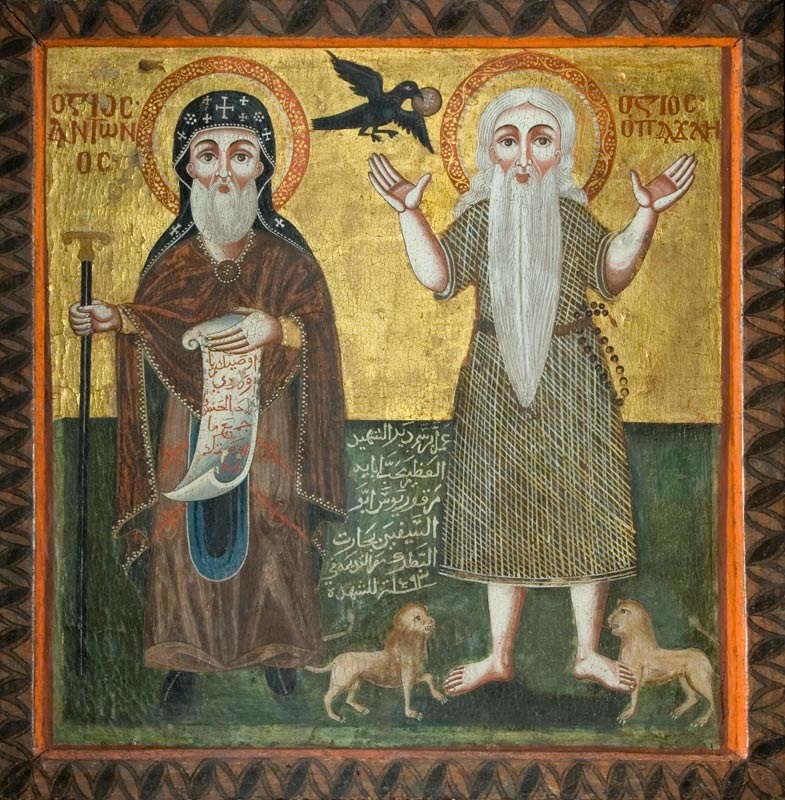
St Anthony the Great and St. Paul of Thebes


7 posted on 08/17/2026 5:24:11 AM PDT by annalex (fear them not)
[ Post Reply | Private Reply | To 6 | View Replies]

To: annalex

Saint Hyacinth

A Short Account of the Life of Our Patron Saint

Saint Hyacinth was born into nobility in 1185 at the castle of Lanka at Kamień Śląski near Opole in Poland. Almost from the cradle, Hyacinth seemed predisposed to virtue. God blessed him with a splendid mind. His parents not only fostered his cheerful disposition, but also used great care in selecting the teachers that would protect this innocence. Because he was so well grounded in his religious duties, Hyacinth passed through his higher studies at Kraków, Prague, and Bologna without tarnish to his pure soul. Without a doubt, his model life had much to do in helping him to win the admiration of both his professors and fellow students. Upon completion of his studies at Bologna, Hyacinth earned the title of Doctor of Canon Law and Divinity before traveling to Rome with his uncle, Iwo Odrowąż, the Bishop of Kraków.

On his trip to Rome, Hyacinth met St. Dominic, from whom both he and his cousin, Czesław, received the habit of the newly established Order of Friars Preachers in 1220. Within a few months of receiving the habit, Hyacinth embarked on his first mission. St. Dominic sent him to preach and establish the Dominican Order in Poland.

On his way, Hyacinth established a Dominican priory in Friesach in Carinthia. In Poland, the new preachers were favorably received and their sermons produced a deep conversion in the people. Hyacinth founded communities at Sandomir, Kraków and at Plocko on the Vistula in Moravia. He extended his missionary work through Prussia, Pomerania, and Lithuania. Then, crossing the Baltic Sea, he preached in Denmark, Sweden, Norway, and Russia, reaching the shores of the Black Sea. It was through these apostolic travels that Hyacinth earned the title "The Apostle of the North."

Despite his many duties, Hyacinth did not allow them to interfere with his good works or dampen his spirit of prayer. He regularly visited hospitals and was a sympathetic comforter to the sick. He was a friend to the poor and distributed his income among them. He felt that money received through the Church could not be devoted to a better or more advantageous cause.

Saint Hyacinth is known to have performed numerous miracles. One miracle that has been associated with him occurred during the Tatar’s siege of the city of Kiev. Hyacinth went to the chapel to remove the Blessed Sacrament from the tabernacle and save it from sacrilegious attack and profanation. When he was about to leave the altar, hugging Jesus in the Eucharist close to his breast, he heard a voice coming from the statue of the Blessed Virgin asking him why he takes her Son, but he leaves her. Hyacinth was worried because the statue was very heavy, but Mary promised to make it very light so Hyacinth could carry it. Although the statue was made of heavy alabaster, Hyacinth took it in his arms and carried it away along with the ciborium with the Holy Eucharist. It is for this miraculous moment that Saint Hyacinth is most often depicted.

The story continues that Hyacinth and the community that accompanied him came to the river Dnieper. There, he urged them to follow him across the river. Hyacinth led the way, and they all walked dry shod across the waters of the deep river, which then protected them from the fury of the Tatars. A circumstance, which is recorded in connection with this miracle, renders it even more remarkable. It is said that the footprints of St. Hyacinth remained on the water, even after he had crossed the river; and that, when the stream was calm, they could be seen for centuries afterwards.

After unceasing labors and vast journeys, Hyacinth spent his last few months of life in a monastery that he had founded in Kraków. There, on the Feast of Saint Dominic in 1257, he fell sick with a fever that would lead to his death. Although worn out and weakened by illness and fever, he kept watch in the service of God by celebrating Mass on the Feast of the Assumption until his death. He was anointed at the foot of the altar on August 15, 1257, and died the same day.

St. Hyacinth was canonized in 1594 by Pope Clement VIII. His feast day is celebrated on August 17th.


sainthyacinth.com

8 posted on 08/17/2026 5:28:28 AM PDT by annalex (fear them not)
[ Post Reply | Private Reply | To 7 | View Replies]

To: annalex

9 posted on 08/17/2026 5:31:47 AM PDT by annalex (fear them not)
[ Post Reply | Private Reply | To 8 | View Replies]

To: annalex

NAVARRE BIBLE COMMENTARY(RSV)

Ad Majorem Dei Gloriam (To the Greater Glory of God)

Today’s First Reading

From: Ezekiel 24:15-23

Death of Ezekiel’s wife
----------------------------
[15] Also the word of the Lord came to me: [16] Son of man, behold, I am about to take the delight of your eyes away from you at a stroke; yet you shall not mourn or weep nor shall your tears run down. [17] Sigh, but not aloud; make no mourning for the dead. Bind on your turban, and put your shoes on your feet; do not cover your lips, nor eat the bread of mourners.” [18] So I spoke to the people in the morning, and at evening my wife died. And on the next morning I did as I was commanded.

[19] And the people said to me. “Will you not tell us what these things mean for us, that you are acting thus?” [20] Then I said to them, “The word of the Lord came to me: [21] ’Say to the house of Israel, Thus says the Lord God: Behold, I will profane my sanctuary, the pride of your power, the delight of your eyes, and the desire of your soul; and your sons and your daughters whom you left behind shall fall by the sword. [22] And you shall do as I have done; you shall not cover your lips, nor eat the bread of mourners. [23] Your turbans shall be on your heads and your shoes on your feet; you shall not mourn or weep, but you shall pine away in your iniquities and groan to one another.

********************************************
Commentary:

24:15-27. The first part of the book ends here with this moving passage revealing the prophet’s feelings about the death of his wife. All this -- the sudden death of his wife, the fact that he does not publicly mourn her, his profound, silent grief – is the supreme symbol of what the siege of Jerusalem involved. Ezekiel’s wife must have been still quite young, “the delight of your eyes” (v. 16; cf. Lam 2:4), and she must have died suddenly. She is a symbol of the temple, of which the people were so proud; no one could have imagined it would he destroyed. Mourning was a function of the person’s social status and the regard in which he or she was held (cf. 2 Sam 1:2; 3:31; 14:2; 15:30, 32), but even the humblest in society would put on a veil and wear that sign of mourning at funeral meals, at the “bread of mourners” (v. 17). However, Ezekiel was not to weep for his wife; nor should the exiles show any public sign of grief; this would show that the misfortunes that befell Jerusalem were a private affair between themselves and God.

The mention of the prophet’s name (v. 24), which has not appeared since the title of the book (1:3), gives these verses the stamp of his authority. The same is true of vv. 25-27 which tell the prophet that on the very day of his wife’s death the fugitive will arrive reporting the destruction of Jerusalem, and Ezekiel will recover his power of speech (cf. 3:25-27 and 33:21-22).

10 posted on 08/17/2026 8:33:08 AM PDT by fidelis (Ecce Crucem Domini! Fugite partes adversae! Vicit Leo de tribu Juda, Radix David! Alleluia!)
[ Post Reply | Private Reply | To 9 | View Replies]

Today’s Gospel Reading

From: Matthew 19:16-22

The Rich Young Man
------------------
[16] And behold, one man came up to Him (Jesus), saying, "Teacher, what good deed must I do, to have eternal life?" [17] And He said to him, "Why do you ask Me about what is good? One there is who is good. If you would enter life, keep the commandments." [18] He said to Him, "Which?" And Jesus said, "You shall not kill, You shall not commit adultery, You shall not steal, You shall not bear false witness, [19] Honor your father and mother, and, You shall love your neighbor as yourself." [20] The young man said to Him, "All these I have observed; what do I still lack?" [21] Jesus said to him, "If you would be perfect, go, sell what you possess and give to the poor, and you will have treasure in Heaven; and come, follow Me." [22] When the young man heard this he went away sorrowful; for he had great possessions.

***********************************************************************
Commentary:

17. The Vulgate and other translations, supported by a good many Greek codexes, fill this verse out by saying, "One alone is good, God."

20-22. "What do I still lack?" The young man kept the commandments that were necessary for salvation. But there is more. This is why our Lord replies, "if you would be perfect..." that is to say, if you want to acquire what is still lacking to you. Jesus is giving him an additional calling, "Come, follow Me": He is showing that He wants him to follow Him more closely, and therefore He requires, as He does others (cf. Matthew 4:19-22), to give up anything that might hinder his full dedication to the Kingdom of God.

The scene ends rather pathetically: the young man goes away sad. His attachment to his property prevails over Jesus' affectionate invitation. Here is sadness of the kind that stems from cowardice, from failure to respond to God's calling with personal commitment.

In reporting this episode, the evangelists are actually giving us a case-study which describes a situation and formulates a law, a case-study of specific divine vocation to devote oneself to God's service and the service of all men.

This young man has become a symbol of the kind of Christian whose mediocrity and shortsightedness prevent him from turning his life into a generous, fruitful self-giving to the service of God and neighbor.

What would this young man have become, had be been generous enough to respond to God's call? A great apostle, surely.

11 posted on 08/17/2026 8:33:27 AM PDT by fidelis (Ecce Crucem Domini! Fugite partes adversae! Vicit Leo de tribu Juda, Radix David! Alleluia!)
[ Post Reply | Private Reply | To 10 | View Replies]

Click here to go to the My Catholic Life! Devotional thread for a meditation on today’s Gospel Reading.

12 posted on 08/17/2026 8:34:15 AM PDT by fidelis (Ecce Crucem Domini! Fugite partes adversae! Vicit Leo de tribu Juda, Radix David! Alleluia!)
[ Post Reply | Private Reply | To 11 | View Replies]

Disclaimer: Opinions posted on Free Republic are those of the individual posters and do not necessarily represent the opinion of Free Republic or its management. All materials posted herein are protected by copyright law and the exemption for fair use of copyrighted works.

Free Republic
Browse · Search
Religion
Topics · Post Article

FreeRepublic, LLC, PO BOX 9771, FRESNO, CA 93794
FreeRepublic.com is powered by software copyright 2000-2008 John Robinson