Free Republic
Browse · Search
Religion
Topics · Post Article

Skip to comments.

Catholic Caucus: Daily Mass Readings 14-August-2026
Universalis/Jerusalem Bible ^

Posted on 08/14/2026 7:12:26 AM PDT by annalex

14 August 2026

Saint Maximilian Kolbe, Priest, Martyr on Friday of week 19 in Ordinary Time


Saint Maximilian Kolbe Church, Toms River, NJ

Readings at Mass

Liturgical Colour: Red. Year: A(II).

Readings for the feria

Readings for the memorial

These are the readings for the feria


First reading
Ezekiel 16:1-15,60,63

I clothed you with my own splendour but you made yourself a prostitute

The word of the Lord was addressed to me as follows, ‘Son of man, confront Jerusalem with her filthy crimes. Say, “The Lord says this: By origin and birth you belong to the land of Canaan. Your father was an Amorite and your mother a Hittite. At birth, the very day you were born, there was no one to cut your navel-string, or wash you in cleansing water, or rub you with salt, or wrap you in napkins. No one leaned kindly over you to do anything like that for you. You were exposed in the open fields; you were as unloved as that on the day you were born.
  ‘“I saw you struggling in your blood as I was passing, and I said to you as you lay in your blood: Live, and grow like the grass of the fields. You developed, you grew, you reached marriageable age. Your breasts and your hair both grew, but you were quite naked. Then I saw you as I was passing. Your time had come, the time for love. I spread part of my cloak over you and covered your nakedness; I bound myself by oath, I made a covenant with you – it is the Lord who speaks – and you became mine. I bathed you in water, I washed the blood off you, I anointed you with oil. I gave you embroidered dresses, fine leather shoes, a linen headband and a cloak of silk. I loaded you with jewels, gave you bracelets for your wrists and a necklace for your throat. I gave you nose-ring and earrings; I put a beautiful diadem on your head. You were loaded with gold and silver, and dressed in fine linen and embroidered silks. Your food was the finest flour, honey and oil. You grew more and more beautiful; and you rose to be queen. The fame of your beauty spread through the nations, since it was perfect, because I had clothed you with my own splendour – it is the Lord who speaks.
  ‘“You have become infatuated with your own beauty; you have used your fame to make yourself a prostitute; you have offered your services to all comers. But I will remember the covenant that I made with you when you were a girl, and I will conclude a covenant with you that shall last for ever. And so remember and be covered with shame, and in your confusion be reduced to silence, when I have pardoned you for all that you have done – it is the Lord who speaks.”’


Responsorial PsalmIsaiah 12

The rejoicing of a redeemed people

Your anger has passed, O Lord, and you give me comfort.
Truly, God is my salvation,
  I trust, I shall not fear.
For the Lord is my strength, my song,
  he became my saviour.
With joy you will draw water
  from the wells of salvation.
Your anger has passed, O Lord, and you give me comfort.
Give thanks to the Lord, give praise to his name!
  Make his mighty deeds known to the peoples!
  Declare the greatness of his name.
Your anger has passed, O Lord, and you give me comfort.
Sing a psalm to the Lord
  for he has done glorious deeds;
  make them known to all the earth!
People of Zion, sing and shout for joy,
  for great in your midst is the Holy One of Israel.
Your anger has passed, O Lord, and you give me comfort.

Gospel AcclamationPs110:7,8
Alleluia, alleluia!
Your precepts, O Lord, are all of them sure;
they stand firm for ever and ever.
Alleluia!
Or:cf.1Th2:13
Alleluia, alleluia!
Accept God’s message for what it really is:
God’s message, and not some human thinking.
Alleluia!

GospelMatthew 19:3-12

Husband and wife are no longer two, but one body

Some Pharisees approached Jesus, and to test him they said, ‘Is it against the Law for a man to divorce his wife on any pretext whatever?’ He answered, ‘Have you not read that the creator from the beginning made them male and female and that he said: This is why a man must leave father and mother, and cling to his wife, and the two become one body? They are no longer two, therefore, but one body. So then, what God has united, man must not divide.’
  They said to him, ‘Then why did Moses command that a writ of dismissal should be given in cases of divorce?’ ‘It was because you were so unteachable’ he said ‘that Moses allowed you to divorce your wives, but it was not like this from the beginning. Now I say this to you: the man who divorces his wife – I am not speaking of fornication – and marries another, is guilty of adultery.’
  The disciples said to him, ‘If that is how things are between husband and wife, it is not advisable to marry.’ But he replied, ‘It is not everyone who can accept what I have said, but only those to whom it is granted. There are eunuchs born that way from their mother’s womb, there are eunuchs made so by men and there are eunuchs who have made themselves that way for the sake of the kingdom of heaven. Let anyone accept this who can.’

Continue

These are the readings for the memorial


First readingWisdom 3:1-9

The souls of the virtuous are in the hands of God

The souls of the virtuous are in the hands of God,
no torment shall ever touch them.
In the eyes of the unwise, they did appear to die,
their going looked like a disaster,
their leaving us, like annihilation;
but they are in peace.
If they experienced punishment as men see it,
their hope was rich with immortality;
slight was their affliction, great will their blessings be.
God has put them to the test
and proved them worthy to be with him;
he has tested them like gold in a furnace,
and accepted them as a holocaust.
When the time comes for his visitation they will shine out;
as sparks run through the stubble, so will they.
They shall judge nations, rule over peoples,
and the Lord will be their king for ever.
They who trust in him will understand the truth,
those who are faithful will live with him in love;
for grace and mercy await those he has chosen.


Responsorial Psalm
Psalm 115(116):10-13,16-17
Precious in the eyes of the Lord is the death of his faithful.
I trusted, even when I said:
  ‘I am sorely afflicted,’
and when I said in my alarm:
  ‘No man can be trusted.’
Precious in the eyes of the Lord is the death of his faithful.
How can I repay the Lord
  for his goodness to me?
The cup of salvation I will raise;
  I will call on the Lord’s name.
Precious in the eyes of the Lord is the death of his faithful.
Your servant, Lord, your servant am I;
  you have loosened my bonds.
A thanksgiving sacrifice I make;
  I will call on the Lord’s name.
Precious in the eyes of the Lord is the death of his faithful.

Gospel AcclamationJn12:25
Alleluia, alleluia!
Anyone who hates his life in this world
will keep it for the eternal life.
Alleluia!

GospelJohn 15:12-16

Go out and bear fruit, fruit that will last

Jesus said to his disciples:
‘This is my commandment:
love one another,
as I have loved you.
A man can have no greater love
than to lay down his life for his friends.
You are my friends,
if you do what I command you.
I shall not call you servants any more,
because a servant does not know
his master’s business;
I call you friends,
because I have made known to you
everything I have learnt from my Father.
You did not choose me:
no, I chose you;
and I commissioned you
to go out and to bear fruit,
fruit that will last;
and then the Father will give you
anything you ask him in my name.’

Continue


Universalis podcast: The week ahead – from 16 to 22 August

The Seven Deadly Sins in Dante: 1. Pride. (23 minutes)
Episode notes.Play

Christian Art

Illustration

Each day, The Christian Art website gives a picture and reflection on the Gospel of the day.

The readings on this page are from the Jerusalem Bible, which is used at Mass in most of the English-speaking world. The New American Bible readings, which are used at Mass in the United States, are available in the Universalis apps, programs and downloads.

You can also view this page with the Gospel in Greek and English.


TOPICS: Catholic; General Discusssion; Prayer; Worship
KEYWORDS: catholic; jn15; mt19; ordinarytime; prayer
Message from Jim Robinson:

Dear FRiends,

We need your continuing support to keep FR funded. Your donations are our sole source of funding. No sugar daddies, no advertisers, no paid memberships, no commercial sales, no gimmicks, no tax subsidies. No spam, no pop-ups, no ad trackers.

If you enjoy using FR and agree it's a worthwhile endeavor, please consider making a contribution today:

Click here: to donate by Credit Card

Or here: to donate by PayPal

Or by mail to: Free Republic, LLC - PO Box 9771 - Fresno, CA 93794

Thank you very much and God bless you,

Jim

For your reading, reflection, faith-sharing, comments, questions, discussion.

1 posted on 08/14/2026 7:12:26 AM PDT by annalex
[ Post Reply | Private Reply | View Replies]

To: everyone

KEYWORDS: catholic; jn15; mt19; ordinarytime; prayer


2 posted on 08/14/2026 7:13:22 AM PDT by annalex (fear them not)
[ Post Reply | Private Reply | To 1 | View Replies]

To: nickcarraway; NYer; ELS; Pyro7480; livius; ArrogantBustard; Catholicguy; RobbyS; marshmallow; ...


Alleluia Ping

Please FReepmail me to get on/off the Alleluia Ping List.


3 posted on 08/14/2026 7:14:19 AM PDT by annalex (fear them not)
[ Post Reply | Private Reply | To 2 | View Replies]

To: annalex
Chris Robinson: My Dad [our Jim Robinson] Passed Away Peacefully Monday Night (October 27th) In Our Home.
Jim still needs our prayers. Thread 2
Prayer thread for Salvation's recovery
Pray for Ukraine
Prayer thread for Fidelis' recovery
Update on Jim Robinson's health issues
4 posted on 08/14/2026 7:14:48 AM PDT by annalex (fear them not)
[ Post Reply | Private Reply | To 3 | View Replies]

To: annalex
Matthew
 English: Douay-RheimsLatin: Vulgata ClementinaGreek NT: Byzantine/Majority Text (2000)
 Matthew 19
3And there came to him the Pharisees tempting him, and saying: Is it lawful for a man to put away his wife for every cause? Et accesserunt ad eum pharisæi tentantes eum, et dicentes : Si licet homini dimittere uxorem suam, quacumque ex causa ?και προσηλθον αυτω οι φαρισαιοι πειραζοντες αυτον και λεγοντες αυτω ει εξεστιν ανθρωπω απολυσαι την γυναικα αυτου κατα πασαν αιτιαν
4Who answering, said to them: Have ye not read, that he who made man from the beginning, Made them male and female? And he said: Qui respondens, ait eis : Non legistis, quia qui fecit hominem ab initio, masculum et feminam fecit eos ? Et dixit :ο δε αποκριθεις ειπεν αυτοις ουκ ανεγνωτε οτι ο ποιησας απ αρχης αρσεν και θηλυ εποιησεν αυτους
5For this cause shall a man leave father and mother, and shall cleave to his wife, and they two shall be in one flesh. Propter hoc dimittet homo patrem, et matrem, et adhærebit uxori suæ, et erunt duo in carne una.και ειπεν ενεκεν τουτου καταλειψει ανθρωπος τον πατερα [αυτου] και την μητερα και προσκολληθησεται τη γυναικι αυτου και εσονται οι δυο εις σαρκα μιαν
6Therefore now they are not two, but one flesh. What therefore God hath joined together, let no man put asunder. Itaque jam non sunt duo, sed una caro. Quod ergo Deus conjunxit, homo non separet.ωστε ουκετι εισιν δυο αλλα σαρξ μια ο ουν ο θεος συνεζευξεν ανθρωπος μη χωριζετω
7They say to him: Why then did Moses command to give a bill of divorce, and to put away? Dicunt illi : Quid ergo Moyses mandavit dare libellum repudii, et dimittere ?λεγουσιν αυτω τι ουν μωσης ενετειλατο δουναι βιβλιον αποστασιου και απολυσαι αυτην
8He saith to them: Because Moses by reason of the hardness of your heart permitted you to put away your wives: but from the beginning it was not so. Ait illis : Quoniam Moyses ad duritiam cordis vestri permisit vobis dimittere uxores vestras : ab initio autem non fuit sic.λεγει αυτοις οτι μωσης προς την σκληροκαρδιαν υμων επετρεψεν υμιν απολυσαι τας γυναικας υμων απ αρχης δε ου γεγονεν ουτως
9And I say to you, that whosoever shall put away his wife, except it be for fornication, and shall marry another, committeth adultery: and he that shall marry her that is put away, committeth adultery. Dico autem vobis, quia quicumque dimiserit uxorem suam, nisi ob fornicationem, et aliam duxerit, mœchatur : et qui dimissam duxerit, mœchatur.λεγω δε υμιν οτι ος αν απολυση την γυναικα αυτου μη επι πορνεια και γαμηση αλλην μοιχαται και ο απολελυμενην γαμησας μοιχαται
10His disciples say unto him: If the case of a man with his wife be so, it is not expedient to marry. Dicunt ei discipuli ejus : Si ita est causa hominis cum uxore, non expedit nubere.λεγουσιν αυτω οι μαθηται αυτου ει ουτως εστιν η αιτια του ανθρωπου μετα της γυναικος ου συμφερει γαμησαι
11Who said to them: All men take not this word, but they to whom it is given. Qui dixit illis : Non omnes capiunt verbum istud, sed quibus datum est.ο δε ειπεν αυτοις ου παντες χωρουσιν τον λογον τουτον αλλ οις δεδοται
12For there are eunuchs, who were born so from their mother's womb: and there are eunuchs, who were made so by men: and there are eunuchs, who have made themselves eunuchs for the kingdom of heaven. He that can take, let him take it. Sunt enim eunuchi, qui de matris utero sic nati sunt : et sunt eunuchi, qui facti sunt ab hominibus : et sunt eunuchi, qui seipsos castraverunt propter regnum cælorum. Qui potest capere capiat.εισιν γαρ ευνουχοι οιτινες εκ κοιλιας μητρος εγεννηθησαν ουτως και εισιν ευνουχοι οιτινες ευνουχισθησαν υπο των ανθρωπων και εισιν ευνουχοι οιτινες ευνουχισαν εαυτους δια την βασιλειαν των ουρανων ο δυναμενος χωρειν χωρειτω

5 posted on 08/14/2026 7:18:21 AM PDT by annalex (fear them not)
[ Post Reply | Private Reply | To 4 | View Replies]

To: annalex

Catena Aurea by St. Thomas Aguinas

19:1–8

1. And it came to pass, that when Jesus had finished these sayings, he departed from Galilee, and came into the coasts of Judæa beyond Jordan;

2. And great multitudes followed him; and he healed them there.

3. The Pharisees also came unto him, tempting him, and saying unto him, Is it lawful for a man to put away his wife for every cause?

4. And he answered and said unto them, Have ye not read, that he which made them at the beginning made them male and female,

5. And said, For this cause shall a man leave father and mother, and shall cleave to his wife: and they twain shall be one flesh?

6. Wherefore they are no more twain, but one flesh. What therefore God hath joined together, let not man put asunder.

7. They say unto him, Why did Moses then command to give a writing of divorcement, and to put her away?

8. He said unto them, Moses because of the hardness of your hearts suffered you to put away your wives: but from the beginning it was not so.

CHRYSOSTOM. (Hom. lxii.) The Lord had before left Judæa because of their jealousy, but now He keeps Himself more to it, because His passion was near at hand. Yet does He not go up to Judæa itself, but into the borders of Judæa; whence it is said, And it came to pass when Jesus had ended all these sayings, he departed from Galilee.

RABANUS. Here then He begins to relate what He did, taught, or suffered in Judæa. At first beyond Jordan eastward, afterwards on this side Jordan when He came to Jericho, Bethphage, and Jerusalem; whence it follows, And He came into the coasts of Judæa beyond Jordan.

PSEUDO-CHRYSOSTOM.e. As the righteous Lord of all, who loves these servants so as not to despise those.

RABANUS. It should be known, that the whole territory of the Israelites was called Judæa, to distinguish it from other nations. But its southern portion, inhabited by the tribes of Judah and Benjamin, was called Judæa proper, to distinguish it from other districts in the same province as Samaria, Galilee, Decapolis, and the rest. It follows, And great multitudes followed him.

PSEUDO-CHRYSOSTOM. They were conducting Him forth, as the young children of a father going on a far journey. And He setting forth as a father, left them as pledges of His love the healing of their diseases, as it is said, And he healed them.

CHRYSOSTOM. It should be also observed, that the Lord is not either ever delivering doctrine, or ever working miracles, but one while does this, and again turns to that; that by His miracles faith might be given to what He said, and by His teaching might be shewed the profit of those things which He wrought.

ORIGEN. The Lord healed the multitudes beyond Jordan, where baptism was given. For all are truly healed from spiritual sickness in baptism; and many follow Christ as did these multitudes, but not rising up as Matthew, who arose and followed the Lord,

HILARY. Also He cures the Galileans on the borders of Judæa, that He might admit the sins of the Gentiles to that pardon which was prepared for the Jews.

CHRYSOSTOM. For indeed Christ so healed men, as to do good both to themselves, and through them to many other. For these men’s healing was to others the occasion of their knowledge of God; but not to the Pharisees, who were only hardened by the miracles; whence it follows; And the Pharisees came to him, tempting him,, and saying, Is it lawful for a man to put away his wife for every cause?

JEROME. That they might have Him as it were between the horns of a syllogism, so that, whatever answer He should make, it would lie open to cavil. Should He allow a wife to be put away for any cause, and the marriage of another, he would seem to contradict Himself as a preacher of chastity. Should He answer that she may not be put away for any cause whatsoever, He will be judged to have spoken impiously, and to make against the teaching of Moses and of God.

CHRYSOSTOM. Observe their wickedness even in the way of putting their question. The Lord had above disputed concerning thus law, but they now ask Him as though He had spoken nothing thereof, supposing He had forgot what He had before delivered in this matter.

PSEUDO-CHRYSOSTOM. But, as when you see one much pursuing the acquaintance of physicians, you know that he is sick, so, when you see either man or woman enquiring concerning divorce, know that that man is lustful and that woman unchaste. For chastity has pleasure in wedlock, but desire is tormented as though under a slavish bondage therein. And knowing that they had no sufficient cause to allege for their putting away their wives, save their own lewdness, they feigned many divers causes. They feared to ask Him for what cause, lest they should be tied down within the limits of fixed and certain causes; and therefore they asked if it were lawful for every cause; for they knew that appetite knows no limits, and cannot hold itself within the bounds of one marriage, but the more it is indulged the more it is kindled.

ORIGEN. Seeing the Lord thus tempted, let none of His disciples who is set to teach think it hard if he also be by some tempted. Howbeit, He replies to His tempters with the doctrines of piety.

JEROME. But He so frames His answer as to evade their snare. He brings in the testimony of Holy Writ, and the law of nature, and opposing God’s first sentence to this second, He answered and said unto them, Have ye not read, that he which made them at the beginning made them male and female? This is written in the beginning of Genesis. This teaches that second marriages are to be avoided, for He said not male and females, which was what was sought by the putting away of the first, but, male and female, implying only one tie of wedlock.

RABANUS. For by the wholesome design of God it was ordained that a man should have in the woman a part of his own body, and should not look upon as separate from himself that which he knew was formed out of himself.

PSEUDO-CHRYSOSTOM. If then God created the male and female out of one, to this end that they should be one, why then henceforth were not they born man and wife at one birth, as it is with certain insects? Because God created male and female for the continuance of the species, yet is He ever a lover of chastity, and promoter of continence. Therefore did He not follow this pattern in all kinds, to the end that, if any man choose to marry, he may know what is, according to the first disposition of the creation, the condition of man and wife; but if he choose not to marry, he shall not be under necessity to marry by the circumstances of his birth, lest he should by his continence be the destruction of the other who was not willing to be continent; for which same cause God forbids that after being joined in wedlock one should separate if the other be unwilling.

CHRYSOSTOM. But not by the law of creation only, but also by the practice of the law, He shews that they ought to be joined one and one, and never put asunder, And he said, For this cause shall a man leave his father and his mother, and shall cleave to his wife.

JEROME. In like manner He says his wife, and not wives, and adds expressly, and they twain shall be one flesh. For it is the reward of marriage that one flesh, namely in the offspring, is made of two.

GLOSS. (interlin.) Or, one flesh, that is in carnal connexion.

PSEUDO-CHRYSOSTOM. If then because the wife is made of the man, and both one of one flesh, a man shall leave his father and his mother, then there should be yet greater affection between brothers and sisters, for these come of the same parents, but man and wife of different. But this is saying too much, because the ordinance of God is of more force than the law of nature. For God’s precepts are not subject to the law of nature, but nature bends to the precepts of God. Also brethren are born of one, that they should seek out different roads; but the man and the wife are born of different persons, that they should coalesce in one. The order of nature also follows the appointment of God. For as is the sap in trees, so is affection in man. The sap ascends from the roots into the leaves, and passes forth into the seed. Therefore parents love their children, but are not so loved of them, for the desire of a man is not towards his parents, but towards the sons whom he has begot; and this is what is said, Therefore shall a man leave his father and his mother, and shall cleave unto his wife.

CHRYSOSTOM. See the wisdom of the Teacher. Being asked, Is it lawful, He said not straight, It is not lawful, lest they should be troubled, but establishes it through a proof. For God made them from the beginning male and female, and not merely joined them together, but bade them quit father and mother; and not bade the husband merely approach his wife, but be joined to her, shewing by this manner of speaking the inseparable bond. He even added a still closer union, saying, And they twain shall be one flesh.

AUGUSTINE. (Gen. ad lit. ix. 19.) Whereas Scripture witnesses that these words were said by the first man, and the Lord here declares that God spake them, hence we should understand that by reason of the ecstasy which had passed upon Adam, he was enabled to speak this as a prophecy.

REMIGIUS. The Apostle says that this is a mystery in Christ and the Church (Eph. 5:32.); for the Lord Jesus Christ left His Father when He came down from heaven to earth; and He left His mother, that is, the synagogue, because of its unbelief, and clave unto His wife, that is, the Holy Church, and they two are one flesh, that is, Christ and the Church are one body.

CHRYSOSTOM. When He had brought forward the words and facts of the old law, He then interprets it with authority, and lays down a law, saying, Therefore they are no more twain, but one flesh. For as those who love one another spiritually are said to be one soul, And all they that believed had one heart and one soul, (Acts 4:32.) so husband and wife who love each other after the flesh, are said to be one flesh. And as it is a wretched thing to cut the flesh, so is it an unjust thing to put away a wife.

AUGUSTINE. (Civ. Dei, xiv. 22.) For they are called one, either from their union, or from the derivation of the woman, who was taken out of the side of the man.

CHRYSOSTOM. He brings in God yet again, saying, What God has joined, let no man put asunder, shewing that it is against both nature and God’s law to put away a wife; against nature, because one flesh is therein divided; against law, because God has joined and forbidden to sunder them.

JEROME. God has joined by making man and woman one flesh; this then man may not put asunder, but God only. Man puts asunder, when from desire of a second wife the first is put away; God puts asunder, who also had joined, when by consent for the service of God we so have our wives as though we had them not. (1 Cor. 7:29.)

AUGUSTINE. (Cont. Faust. xix. 29.) Behold now out of the books of Moses it is proved to the Jews that a wife may not be put away. For they thought that they were doing according to the purport of Moses’ law when they did put them away. This also we learn hence by the testimony of Christ Himself, that it was God who made it thus, and joined them male and female; which when the Manichæans deny, they are condemned, resisting the Gospel of Christ.

PSEUDO-CHRYSOSTOM. This sentence of chastity seemed hard to these adulterers; but they could not make answer to the argument. Howbeit, they will not submit to the truth, but betake themselves for shelter to Moses, as men having a bad cause fly to some powerful personage, that where justice is not, his countenance may prevail; They say unto him, Why did Moses then command to give a writing of divorcement, and to put her away?

JEROME. Here they reveal the cavil which they had prepared; albeit the Lord had not given sentence of Himself, but had recalled to their minds ancient history, and the commands of God.

CHRYSOSTOM. Had the Lord been opposed to the Old Testament, He would not thus have contended in Moses’ behalf, nor have gone about to shew that what was his was in agreement with the things of old. But the unspeakable wisdom of Christ made answer and excuse for these in this manner, He saith unto them, Moses for the hardness of your hearts suffered you to put away your wives. By this He clears Moses from their charge, and retorts it all upon their own head.

AUGUSTINE. (ubi sup.) For how great was that hardness! When not even the intervention of a bill of divorce, which gave room for just and prudent men to endeavour to dissuade, could move them to renew the conjugal affection. And with what wit do the Manichæans blame Moses, as severing wedlock by a bill of divorce, and commend Christ as, on the contrary, confirming its force? Whereas according to their impious science they should have praised Moses for putting asunder what the devil had joined, and found fault with Christ who riveted the bonds of the devil.

CHRYSOSTOM. At last, because what He had said was severe, He goes back to the old law, saying, From the beginning it was not so.

JEROME. What He says is to this purpose. Is it possible that God should so contradict Himself, as to command one thing at first, and after defeat His own ordinance by a new statute? Think not so; but, whereas Moses saw that through desire of second wives who should be richer, younger, or fairer, that the first were put to death, or treated ill, he chose rather to suffer separation, than the continuance of hatred and assassination. Observe moreover that He said not God suffered you, but, Moses; shewing that it was, as the Apostle speaks, a counsel of man, not a command of God. (1 Cor. 7:12.)

PSEUDO-CHRYSOSTOM. Therefore said He well, Moses suffered, not commanded. For what we command, that we ever wish; but when we suffer, we yield against our will, because we have not the power to put full restraint upon the evil wills of men. He therefore suffered you to do evil that you might not do worse; thus in suffering this he was not enforcing the righteousness of God, but taking away its sinfulness from a sin; that while you did it according to His law, your sin should not appear sin.

19:9

9. And I say unto you, Whosoever shall put away his wife, except it be for fornication, and shall marry another, committeth adultery: and whoso marrieth her which is put away doth commit adultery.

CHRYSOSTOM. Having stopped their mouths, He now set forth the Law with authority, saying, But I say unto you, that whosoever shall put away his wife, except for fornication, and marrieth another, committeth adultery.

ORIGEN. Perhaps some one will say, that Jesus in thus speaking, suffered wives to be put away for the same cause that Moses suffered them, which He says was for the hardness of the hearts of the Jews. But to this it is to be answered, that if by the Law an adulteress is stoned, that sin is not to be understood as the shameful thing for which Moses suffers a writing of divorcement; (Deut. 24:1.) for in a cause of adultery it was not lawful to give a writing of divorcement. But Moses perhaps calls every sin in a woman a shameful thing, which if it be found in her, a bill of divorcement is written against her. But we should enquire, If it is lawful to put away a wife for the cause of fornication only, what is it if a woman be not an adulteress, but have done any other heinous crime; have been found a poisoner, or to have murdered her children? The Lord has explained this matter in another place, saying, Whoso putteth her away, except for the cause of fornication, maketh her to commit adultery, (Mat. 5:32.) giving her an opportunity of a second marriage.

JEROME. It is fornication alone which destroys the relationship of the wife; for when she has divided one flesh into two, and has separated herself by fornication from her husband, she is not to be retained, lest she should bring her husband also under the curse, which Scripture has spoken, He that keepeth an adulteress is a fool and wicked. (Prov. 18:23.)

PSEUDO-CHRYSOSTOM. For as he is cruel and unjust that puts away a chaste wife, so is he a fool and unjust that retains an unchaste; for in that he hides the guilt of his wife, he is an encourager of foulness.

AUGUSTINE. (De Conjug. Adult. ii. 9.) For a reunion of the wedlock, even after actual commission of adultery, is neither shameful nor difficult, where there is an undoubted remission of sin through the keys of the kingdom of heaven; not that after being divorced from her husband an adulteress should be called back again, but that after her union with Christ she should no longer be called an adulteress.

PSEUDO-CHRYSOSTOM. For every thing by whatsoever causes it is created, by the same is it destroyed. It is not matrimony but the will that makes the union; and therefore it is not a separation of bodies but a separation of wills that dissolves it. He then who puts away his wife and does not take another is still her husband; for though their bodies be not united, their wills are united. But when he takes another, then he manifestly puts his wife away; wherefore the Lord says not, Whoso putteth away his wife, but, Whoso marrieth another, committeth adultery.

RABANUS. There is then but one carnal cause why a wife should be put away, that is, fornication, and but one spiritual, that is, the fear of God. But there is no cause why while she who has been put away is alive, another should be married.

JEROME. For it might be that a man might falsely charge an innocent wife, and for the sake of another woman might fasten an accusation upon her. Therefore it is commanded so to put away the first, that a second be not married while the first is yet alive. Also because it might happen that by the same law a wife would divorce her husband, it is also provided that she take not another husband; and because one who had become an adulteress would have no further fear of disgrace, it is commanded that she many not another husband. But if she do marry another, she is in the guilt of adultery; wherefore it follows, And whoso marrieth her that is put away, committeth adultery.

GLOSS. (ord.) He says this to the terror of him that would take her to wife, for the adulteress would have no fear of disgrace.

19:10–12

10. His disciples say unto him, If the case of the man be so with his wife, it is not good to marry.

11. But he said unto them, All men cannot receive this saying, save they to whom it is given.

12. For there are some eunuchs, which were so born from their mother’s womb: and there are some eunuchs, which were made eunuchs of men: and there be eunuchs, which have made themselves eunuchs for the kingdom of heaven’s sake. He that is able to receive it, let him receive it.

JEROME. A wife is a grievous burden, if it is not permitted to put her away except for the cause of fornication. For what if she be a drunkard, an evil temper, or of evil habits, is she to be kept? The Apostles, perceiving this burden someness, express what they feel; His disciples say unto him, If the case of the man be so with his wife, it is not good to marry.

CHRYSOSTOM. For it is a lighter thing to contend with himself, and his own lust, than with an evil woman.

PSEUDO-CHRYSOSTOM. And the Lord said not, It is good, but rather assented that it is not good. However, He considered the weakness of the flesh; But he said unto them, All cannot receive this saying; that is, All are not able to do this.

JEROME. But let none think, that wherein He adds, save they to whom it is given, that either fate or fortune is implied, as though they were virgins only whom chance has led to such a fortune. For that is given to those who have sought it of God, who have longed for it, who have striven that they might obtain it.

PSEUDO-CHRYSOSTOM. But all cannot obtain it, because all do not desire to obtain it. The prize is before them; he who desires the honour will not consider the toil. None would ever vanquish, if all shunned the struggle. Because then some have fallen from their purpose of continence, we ought not therefore to faint from that virtue; for they that fall in the battle do not slay the rest. That He says therefore, Save they to whom it is given, shews that unless we receive the aid of grace, we have not strength. But this aid of grace is not denied to such as seek it, for the Lord says above, Ask, and ye shall receive.

CHRYSOSTOM. Then to shew that this is possible, He says, For there are some eunuchs, which were made eunuchs of men; as much as to say, Consider, had you been so made of others, you would have lost the pleasure without gaining the reward.

PSEUDO-CHRYSOSTOM. For as the deed without the will does not constitute a sin; so a righteous act is not in the deed unless the will go with it. That therefore is honourable continence, not which mutilation of body of necessity enforces, but which the will of holy purpose embraces.

JEROME. He speaks of three kinds of eunuchs, of whom two are carnal, and one spiritual. One, those who are so born of their mother’s womb; another, those whom enemies or courtly luxury has made so; a third, those who have made themselves so for the kingdom of heaven, and who might have been men, but become eunuchs for Christ. To them the reward is promised, for to the others whose continence was involuntary, nothing is due.

HILARY. The cause in one item he assigns nature; in the next violence, and in the last his own choice, in him, namely, that determined to be so from hope of the kingdom of heaven.

PSEUDO-CHRYSOSTOM. For they are born such, just as others are born having six or four fingers. For if God according as He formed our bodies in the beginning, had continued the same order unchangeably, the working of God would have been brought into oblivion among men. The order of nature is therefore changed at times from its nature, that God the framer of nature may be had in remembrance.

JEROME. (cf. Orig. in loc.) Or we may say otherwise. The eunuchs from their mothers’ wombs are they whose nature is colder, and not prone to lust. And they that are made so of men are they whom physicians made so, or they whom worship of idols has made effeminate, or who from the influence of heretical teaching pretend to chastity, that they may thereupon claim truth for their tenets. But none of them obtain the kingdom of heaven, save he only who has become a eunuch for Christ’s sake. Whence it follows, He that is able to receive it, let him receive it; let each calculate his own strength, whether he is able to fulfil the rules of virginity and abstinence. For in itself continence is sweet and alluring, but each man must consider his strength, that he only that is able may receive it. This is the voice of the Lord exhorting and encouraging on His soldiers to the reward of chastity, that he who can fight might fight and conquer and triumph.

CHRYSOSTOM. When he says, Who have made themselves eunuchs, He does not mean cutting off of members, but a putting away of evil thoughts. For he that cuts off a limb is under a curse, for such an one undertakes the deeds of murderers, and opens a door to Manicheans who depreciate the creature, and cut off the same members as do the Gentiles. For to cut off members is of the temptation of dæmons. But by the means of which we have spoken desire is not diminished but made more urgent; for it has its source elsewhere, and chiefly in a weak purpose and an unguarded heart, For if the heart be well governed, there is no danger from the natural motions; nor does the amputation of a member bring such peacefulness and immunity from temptation as does a bridle upon the thoughts.

Catena Aurea Matthew 19


6 posted on 08/14/2026 7:20:33 AM PDT by annalex (fear them not)
[ Post Reply | Private Reply | To 5 | View Replies]

To: annalex


A Woman and a Kneeling Monk

Fra Carnevale

1440s
Pen, with brown and white wash, on reddish-coloured paper, 163 x 139 mm
Galleria degli Uffizi, Florence

7 posted on 08/14/2026 7:22:16 AM PDT by annalex (fear them not)
[ Post Reply | Private Reply | To 6 | View Replies]

To: annalex
John
 English: Douay-RheimsLatin: Vulgata ClementinaGreek NT: Byzantine/Majority Text (2000)
 John 15
12This is my commandment, that you love one another, as I have loved you. Hoc est præceptum meum, ut diligatis invicem, sicut dilexi vos.αυτη εστιν η εντολη η εμη ινα αγαπατε αλληλους καθως ηγαπησα υμας
13Greater love than this no man hath, that a man lay down his life for his friends. Majorem hac dilectionem nemo habet, ut animam suam ponat qui pro amicis suis.μειζονα ταυτης αγαπην ουδεις εχει ινα τις την ψυχην αυτου θη υπερ των φιλων αυτου
14You are my friends, if you do the things that I command you. Vos amici mei estis, si feceritis quæ ego præcipio vobis.υμεις φιλοι μου εστε εαν ποιητε οσα εγω εντελλομαι υμιν
15I will not now call you servants: for the servant knoweth not what his lord doth. But I have called you friends: because all things whatsoever I have heard of my Father, I have made known to you. Jam non dicam vos servos : quia servus nescit quid faciat dominus ejus. Vos autem dixi amicos : quia omnia quæcumque audivi a Patre meo, nota feci vobis.ουκετι υμας λεγω δουλους οτι ο δουλος ουκ οιδεν τι ποιει αυτου ο κυριος υμας δε ειρηκα φιλους οτι παντα α ηκουσα παρα του πατρος μου εγνωρισα υμιν
16You have not chosen me: but I have chosen you; and have appointed you, that you should go, and should bring forth fruit; and your fruit should remain: that whatsoever you shall ask of the Father in my name, he may give it you. Non vos me elegistis, sed ego elegi vos, et posui vos ut eatis, et fructum afferatis, et fructus vester maneat : ut quodcumque petieritis Patrem in nomine meo, det vobis.ουχ υμεις με εξελεξασθε αλλ εγω εξελεξαμην υμας και εθηκα υμας ινα υμεις υπαγητε και καρπον φερητε και ο καρπος υμων μενη ινα ο τι αν αιτησητε τον πατερα εν τω ονοματι μου δω υμιν
17These things I command you, that you love one another. Hæc mando vobis : ut diligatis invicem.ταυτα εντελλομαι υμιν ινα αγαπατε αλληλους

8 posted on 08/14/2026 7:24:05 AM PDT by annalex (fear them not)
[ Post Reply | Private Reply | To 7 | View Replies]

To: annalex

Catena Aurea by St. Thomas Aguinas

15:12–16

12. This is my commandment, That ye love one another, as I have loved you.

13. Greater love hath no man than this, that a man lay down his life for his friends.

14. Ye are my friends, if ye do whatsoever I command you.

15. Henceforth I call you not servants; for the servant knoweth not what his Lord doeth: but I have called you friends; for all things that I have heard of my Father I have made known unto you.

16. Ye have not chosen me, but I have chosen you, and ordained you, that ye should go and bring forth fruit, and that your fruit should remain: that whatsoever ye shall ask of the Father in my name, he may give it you.

THEOPHYLACT. Having said, If ye keep My commandments, ye shall abide in My love, He shews what commandments they are to keep: This is My commandment, That ye love one another.

GREGORY. (Hom. xxvii. in Evang.) But when all our Lord’s sacred discourses are full of His commandments, why does He give this special commandment respecting love, if it is not that every commandment teaches love, and all precepts are one? Love and love only is the fulfilment of every thing that is enjoined. As all the boughs of a tree proceed from one root, so all the virtues are produced from one love: nor hath the branch, i. e. the good work, any life, except it abide in the root of love.

AUGUSTINE. (Tract. lxxxiii. 3) Where then love is, what can be wanting? where it is not, what can profit? But this love is distinguished from men’s love to each other as men, by adding, As I have loved you. To what end did Christ love us, but that we should reign with Him? Let us therefore so love one another, as that our love be different from that of other men; who do not love one another, to the end that God may be loved, because they do not really love at all. They who love one another for the sake of having God within them, they truly love one another.

GREGORY. (Hom. xxvii.) The highest, the only proof of love, is to love our adversary; as did the Truth Himself, who while He suffered on the cross, shewed His love for His persecutors: Father, forgive them, for they know not what they do. (Luke 23:34) Of which love the consummation is given in the next words: Greater love hath no man than this, that a man lay down his life for his friends. Our Lord came to die for His enemies, but He says that He is going to lay down His life for His friends, to shew us that by loving, we are able to 1 gain over our enemies, so that they who persecute us are by anticipation our friends.

AUGUSTINE. (Tract. lxxxvi. 1) Having said, This is My commandment, that ye love one another, even as I have loved you, it follows, as John saith in his Epistle, that as Christ laid down His life for us, so we should lay down our lives for the brethren. (1 John 3) This the martyrs have done with ardent love. And therefore in commemorating them at Christ’s table, we do not pray for them, as we do for others, but we rather pray that we may follow their steps. For they have shewn the same love for their brother, that has been shewn them at the Lord’s table.

GREGORY. (Hom. xxvii.) But whoso in time of tranquillity will not give up his time to God, how in persecution will he give up his soul? Let the virtue of love then, that it may be victorious in tribulation, be nourished in tranquillity by deeds of mercy.

AUGUSTINE. (viii. de Trin. c. viii) From one and the same love, we love God and our neighbour; but God for His own sake, our neighbour for God’s. So that, there being two precepts of love, on which hang all the Law and the Prophets, to love God, and to love our neighbour, Scripture often unites them into one precept. For if a man love God, it follows that he does what God commands, and if so, that he loves his neighbour, God having commanded this. Wherefore He proceeds: Ye are My friends, if ye do whatsoever I command you.

GREGORY. (xxvii. Moral.) A friend is as it were a keeper of the soul. He who keeps God’s commandments, is rightly called His friend.

AUGUSTINE. (Tract. lxxxv. 2) Great condescension! Though to keep his Lord’s commandments, is only what a good servant is obliged to do, yet, if they do so, He calls them His friends. The good servant is both the servant, and the friend. But how is this? He tells us: Henceforth I call you not servants, for the servant knoweth not what his Lord doeth. Shall we therefore cease to be servants, as soon as ever we are good servants? And is not a good and tried servant sometimes entrusted with his master’s secrets, still remaining a servant? (c. 3.). We must understand then that there are two kinds of servitude, as there are two kinds of fear. There is a fear which perfect love casteth out; which also hath in it a servitude, which will be cast out together with the fear. And there is another, a pure (castus) fear, which remaineth for ever. It is the former state of servitude, which our Lord refers to, when He says, Henceforth I call you not servants, for the servant knoweth not what his Lord doeth; not the state of that servant to whom it is said, Well done, thou good servant, enter thou into the joy of thy Lord: (Matt. 25:21) but of him of whom it was said below, The servant abideth not in the house for ever, but the Son abideth ever. Forasmuch then as God hath given us power to become the sons of God, so that in a wonderful way, we are servants, and yet not servants, we know that it is the Lord who doth this. This that servant is ignorant of, who knoweth not what his Lord doeth, and when he doeth any good thing, is exalted in his own conceit, as if he himself did it, and not his Lord; and boasts of himself, not of his Lord.

But I have called you friends, for all things that I have heard of My Father, I have made known unto you.

THEOPHYLACT. As if He said, The servant knoweth not the counsels of his lord; but since I esteem you friends, I have communicated my secrets to you.

AUGUSTINE. (Tract. lxxxvi. 1) But how did He make known to His disciples all things that He had heard from the Father, when He forebore saying many things, because He knew they as yet could not bear them? He made all things known to His disciples, i. e. He knew that He should make them known to them in that fulness of which the Apostle saith, Then we shall know, even as we are known. (1 Cor. 13:12) For as we look for the death of the flesh, and the salvation of the soul; so should we look for that knowledge of all things, which the Only-Begotten heard from the Father.

GREGORY. (Hom. xxvii.) Or all things which He heard from the Father, which He wished to be made known to His servants; the joys of spiritual love, the pleasures of our heavenly country, which He impresses daily on our minds by the inspiration of His love. For while we love the heavenly things we hear, we know them by loving, because love is itself knowledge. He had made all things known to them then, because being withdrawn from earthly desires, they burned with the fire of divine love.

CHRYSOSTOM. (Hom. lxxvii. 1) All things, i. e. all things that they ought to hear. I have heard, shews that what He had taught was no strange doctrine, but received from the Father.

GREGORY. (Hom. in Evang. xxvii.) But let no one who has attained to this dignity of being called the friend of God, attribute this superhuman gift1 to his own merits: Ye have not chosen Me, but I have chosen you.

AUGUSTINE. (Tract. lxxxvi. 3) Ineffable grace! For what were we before Christ had chosen us, but wicked, and lost? We did not believe in Him, so as to be chosen by Him: for had He chosen us believing, He would have chosen us choosing. This passage refutes the vain opinion of those who say that we were chosen before the foundation of the world, because God foreknew that we should be good, not that He Himself would make us good. For had He chosen us, because He foreknew that we should be good, He would have foreknown also that we should first choose Him, for without choosing Him we cannot be good; unless indeed he can be called good, who hath not chosen good. What then hath He chosen in them who are not good? Thou canst not say, I am chosen because I believed; for hadst thou believed in Him, thou hadst chosen Him. Nor canst thou say, Before I believed I did good works, and therefore was chosen. For what good work is there before faith? What is there for us to say then, but that we were wicked, and were chosen, that by the grace of the chosen we might become good?

AUGUSTINE. (de Prad. Sanct. c. xvii.) They are chosen then before the foundation of the world, according to that predestination by which God foreknew His future acts. They are chosen out of the world by that call whereby God fulfills what He has predestined: whom He did predestinate, them He also called. (Rom. 8:30)

AUGUSTINE. (Tract. lxxxvi. 3) Observe, He does not choose the good; but those, whom He hath chosen, He makes good: And I have ordained you that ye should go, and bring forth fruit. This is the fruit which He meant, when He said, Without Me ye can do nothing. He Himself is the way in which He hath set (ἔθηκα, posui) us to go.

GREGORY. (Hom. xxvii.) I have set you,i. e. have planted you by grace, that ye should go by will (volendo not in Vulg.); to will being to go in mind, and bring forth fruit, by works. What kind of fruit they should bring forth He then shews: And that your fruit may remain: for worldly labour hardly produces fruit to last our life: and if it does, death comes at last, and deprives us of it all. But the fruit of our spiritual labours endures even after death; and begins to be seen at the very time that the results of our carnal labour begin to disappear. Let us then produce such fruits as may remain, and of which death, which destroys every thing, will be the commencement.

AUGUSTINE. (Tract. lxxxvi. 3) Love then is one fruit, now existing in desire only, not yet in fulness. Yet even with this desire whatever we ask in the name of the Only-Begotten Son, the Father giveth us: That whatsoever ye shall ask the Father in My name, He may give it you. We ask in the Saviour’s name, whatever we ask, that will be profitable to our salvation.

15:17–21

17. These things I command you, that ye love one another.

AUGUSTINE. (Tract. lxxxvii. 1) Our Lord had said, I have ordained that ye should walk, and bring forth fruit. Love is this fruit. Wherefore He proceeds: These things I command you, that ye love one another. (Gal. 5:22) Hence the Apostle saith: The fruit of the Spirit is love; and enumerates all other graces as springing from this source. Well then doth our Lord commend love, as if it were the only thing commanded: seeing that without it nothing can profit, with it nothing be wanting, whereby a man is made good.

CHRYSOSTOM. (Hom. lxxvii. 2) Or thus: I have said that I lay down My life for you, and that I first chose you. I have said this not by way of reproach, but to induce you to love one another. Then as they were about to suffer persecution and reproach, He bids them not to grieve, but rejoice on that account: If the world hate you, ye know that it hated Me before it hated you: as if to say, I know it is a hard trial, but ye will endure it for My sake.

Catena Aurea John 15

9 posted on 08/14/2026 7:25:41 AM PDT by annalex (fear them not)
[ Post Reply | Private Reply | To 8 | View Replies]

To: annalex


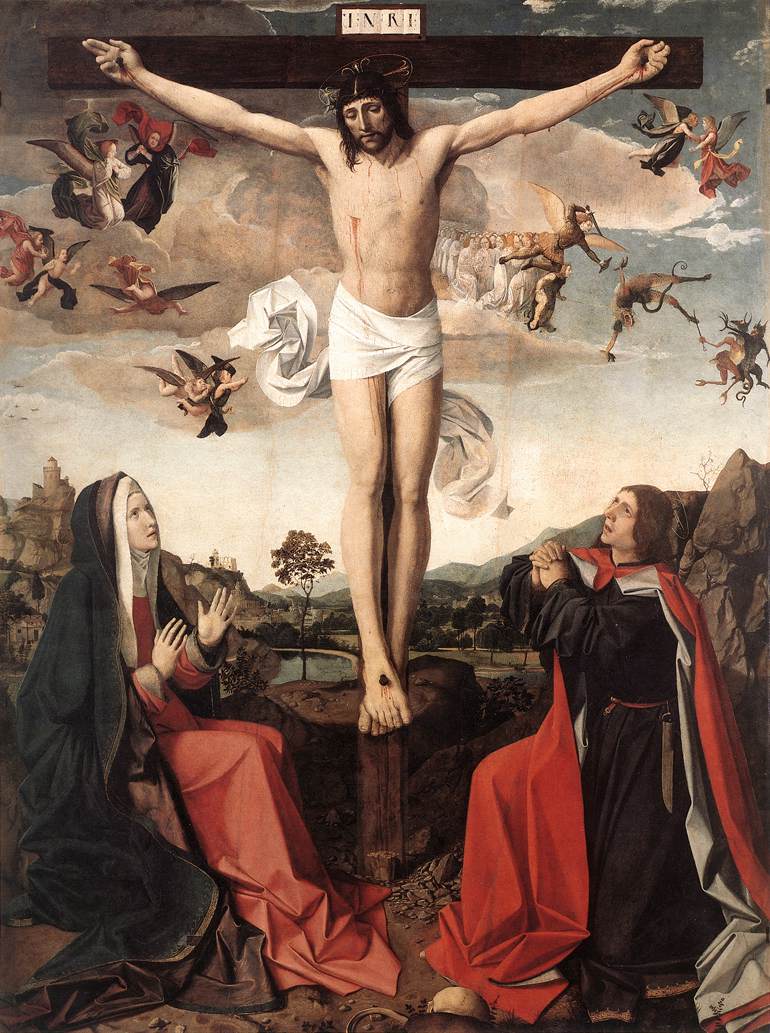
Crucifixion

Josse Lieferinxe

1500-05
Oil on panel, 170 x 126 cm
Musée du Louvre, Paris

10 posted on 08/14/2026 7:27:24 AM PDT by annalex (fear them not)
[ Post Reply | Private Reply | To 9 | View Replies]

To: annalex

Saint of the Day for August 14

(January 8, 1894 – August 14, 1941)


Saint Maximilian Mary Kolbe’s Story

“I don’t know what’s going to become of you!” How many parents have said that? Maximilian Mary Kolbe’s reaction was, “I prayed very hard to Our Lady to tell me what would happen to me. She appeared, holding in her hands two crowns, one white, one red. She asked if I would like to have them—one was for purity, the other for martyrdom. I said, ‘I choose both.’ She smiled and disappeared.” After that he was not the same.

He entered the minor seminary of the Conventual Franciscans in Lvív–then Poland, now Ukraine—near his birthplace, and at 16 became a novice. Though Maximilian later achieved doctorates in philosophy and theology, he was deeply interested in science, even drawing plans for rocket ships.

Ordained at 24, Maximilian Mary Kolbe saw religious indifference as the deadliest poison of the day. His mission was to combat it. He had already founded the Militia of the Immaculata, whose aim was to fight evil with the witness of the good life, prayer, work, and suffering. He dreamed of and then founded Knight of the Immaculata, a religious magazine under Mary’s protection to preach the Good News to all nations.

For the work of publication he established a “City of the Immaculata”—Niepokalanow—which housed 700 of his Franciscan brothers. He later founded another one in Nagasaki, Japan. Both the Militia and the magazine ultimately reached the one-million mark in members and subscribers. His love of God was daily filtered through devotion to Mary.

In 1939, the Nazi panzers overran Poland with deadly speed. Niepokalanow was severely bombed. Kolbe and his friars were arrested, then released in less than three months, on the feast of the Immaculate Conception.

In 1941, Maximilian Mary Kolbe was arrested again. The Nazis’ purpose was to liquidate the select ones, the leaders. The end came quickly, three months later in Auschwitz, after terrible beatings and humiliations.

A prisoner had escaped. The commandant announced that 10 men would die. He relished walking along the ranks. “This one. That one.”

As they were being marched away to the starvation bunkers, Number 16670 dared to step from the line.

“I would like to take that man’s place. He has a wife and children.”
“Who are you?”
“A priest.”

No name, no mention of fame. Silence. The commandant, dumbfounded, perhaps with a fleeting thought of history, kicked Sergeant Francis Gajowniczek out of line and ordered Fr. Kolbe to go with the nine. In the “block of death” they were ordered to strip naked, and their slow starvation began in darkness. But there was no screaming—the prisoners sang. By the eve of the Assumption, four were left alive.

The jailer came to finish Kolbe off as he sat in a corner praying. He lifted his fleshless arm to receive the bite of the hypodermic needle. It was filled with carbolic acid. They burned his body with all the others. Maximilian Mary Kolbe was beatified in 1971 and canonized in 1982.


Reflection

Maximilian Mary Kolbe’s death was not a sudden, last-minute act of heroism. His whole life had been a preparation. His holiness was a limitless, passionate desire to convert the whole world to God. And his beloved Immaculata was his inspiration. May we mirror his bravery and his unblemished love for God as we navigate our own faith journeys.


Saint Maximilian Mary Kolbe is a Patron Saint of:

Addicts
Recovery from drug addiction


franciscanmedia.org
11 posted on 08/14/2026 7:32:49 AM PDT by annalex (fear them not)
[ Post Reply | Private Reply | To 10 | View Replies]

To: annalex

12 posted on 08/14/2026 7:33:48 AM PDT by annalex (fear them not)
[ Post Reply | Private Reply | To 11 | View Replies]

To: All

NAVARRE BIBLE COMMENTARY(RSV)

Ad Majorem Dei Gloriam (To the Greater Glory of God)

Today’s First Reading

Ezekiel 16:1-15, 60, 63

Jerusalem, the unfaithful wife
-----------------------------------
[1] Again the word of the LORD came to me: [2] "Son of man, make known to Jerusalem her abominations, [3] and say, Thus says the Lord GOD to Jerusalem: Your origin and your birth are of the land of the Canaanites; your father was an Amorite, and your mother a Hittite. [4] And as for your birth, on the day you were born your navel string was not cut, nor were you washed with water to cleanse you, nor rubbed with salt, nor swathed with bands. [5] No eye pitied you, to do any of these things to you out of compassion for you; but you were cast out on the open field, for you were abhorred, on the day that you were born.

[6] "And when I passed by you, and saw you weltering in your blood, I said to you in your blood, 'Live, [7] and grow up like a plant of the field.' And you grew up and became tall and arrived at full maidenhood; your breasts were formed, and your hair had grown; yet you were naked and bare.

[8] "When I passed by you again and looked upon you, behold, you were at the age for love; and I spread my skirt over you, and covered your nakedness: yea, I plighted my troth to you and entered into a covenant with you, says the Lord GOD, and you became mine. [9] Then I bathed you with water and washed off your blood from you, and anointed you with oil. [10] I clothed you also with embroidered cloth and shod you with leather, I swathed you in fine linen and covered you with silk. [11] And I decked you with ornaments, and put bracelets on your arms, and a chain on your neck. [12] And I put a ring on your nose, and earrings in your ears, and a beautiful crown upon your head. [13] Thus you were decked with gold and silver; and your raiment was of fine linen, and silk, and embroidered cloth; you ate fine flour and honey and oil. You grew exceedingly beautiful, and came to regal estate. [14] And your renown went forth among the nations because of your beauty, for it was perfect through the splendor which I had bestowed upon you, says the Lord GOD.

[15] "But you trusted in your beauty, and played the harlot because of your renown, and lavished your harlotries on any passer-by. [60] yet I will remember my covenant with you in the days of your youth, and I will establish with you an everlasting covenant. [63] that you may remember and be confounded, and never open your mouth again because of your shame, when I forgive you all that you have done, says the Lord GOD."

********************************************************************
Commentary:

16:1-19:14. In these chapters Ezekiel announces the sentence passed on Israel and Judah on account of the transgressions and sins they have been piling up. He does this by imagining a formal trial (rib) in which the charges are described by a series of allegories. First there is the story of the unfaithful and evil wife, who stands for Israel (chap. 16); then comes the allegory of the eagles, symbolizing the deportation: Nebuchadnezzar seems to destroy everything before him, but the Lord comes on the scene and sets about reassembling the broken pieces (chap. 17); thirdly, the metaphor of the father and son is used to reiterate teaching about personal responsibility (chap. 18); thirdly, the metaphor of the father and son is used to reiterate teaching about personal responsibility (chap. 18); and finally, comes the allegory of the lioness and her cubs -- a lament over the plight of the Exiles in Babylon (chap. 19).

16:1-43. The prophet Hosea was the first to use the metaphor of the wanton wife to charge Israel with her infidelity (Hos 1-3); Jeremiah uses the imagery of marriage to describe the Covenant and how Israel came to break it (Jer 2:2). Ezekiel, here and in chapters 20 and 23, is the one who develops the metaphor most. The wife is Jerusalem, depicted with negative features from her birth onwards (vv. 1-5) and then completely transformed into the most beautiful of princesses (vv. 6-14). However, she proved unfaithful and committed the most vile sins of adultery with the empires round about (vv. 15-34). All this, a mixture of fact and metaphor, paves the way for the sentence that must be passed: "I will judge you as women who break wedlock" (v. 38); she will become the prey of the nations that she adulated (vv. 35-41). But the end is not destruction (vv. 42-43), as one would have expected; it is the start of a new phase (cf. 16:59-63). Ezekiel, who is addressing the exiles, once again opens the door to hope in an ultimate restoration (vv. 42-43).

16:1-5. "Your father was an Amorite, and your mother a Hittite" (v. 3). Jerusalem had, in fact, belonged to the Canaanites until David conquered it; these would have included the Amorites, a Semitic people (cf. Num 21:13), and the Hittites, who had come from Asia Minor (cf. Gen 23:16). Ezekiel is not so much concerned about historical accuracy (cf. Deut 7:1 and par.) as in pointing out the pagan origins of the holy city, to make it clear that all its qualities and all its dignity derive solely from the Lord. The practices mentioned in v. 4 were ancient customs to do with the care of newborn babies. The point being made is that in addition to having an obscure origin, Jerusalem began life utterly alone.

16:6-34. The charge of infidelity against Jerusalem lies in the endowments it received from God (vv. 6-14) and its history of wickedness -- evidence of the fact that it has persistently abused God's gifts (vv. 15-34). Although the charge has historical basis, the passage is not meant to be a detailed catalogue; the point being made is that the city had a history of sin and infidelity.

"I passed by you" (v. 6): when God passes by, he brings salvation; here he turns an abandoned child into the most beautiful of women, the envy of all her peers. St John of the Cross will apply this to what happens when the Lord passes by the soul ("Spiritual Canticle", 23, 6) and the things said here help us to see the relationship between the soul and God as a love story. St Thérèse of Lisieux mentions Ezekiel in this connexion: "I was at the most troubling age for girls. But the Lord passed by, and did for me as he said he would do, in the words of the prophet Ezekiel: 'When he passed by me, Jesus saw that I was at the age for love. He pledged his troth to me, and I became his … He wrapped his cloak about me, and anointed me with perfume; he dressed me in embroidered cloth and silk, and gave me gold and silver and precious jewels to wear ... He gave me fine flour and honey and oil to eat ... and I grew more and more beautiful, until I was like a queen ...' (cf. Ezek 16:6-13). Jesus did all these things for me. I could repeat, again, all the words that I have just written, and show how he has fulfilled each, one by one, in me. But all the graces that I have referred to elsewhere are proof enough" ("Autobiographical Writings", 5, 47, r).

"You trusted in your beauty, and played the harlot" (v. 15): breaking away from God, particularly the sin of idolatry, was called prostitution by the prophets who used marriage as a metaphor for the Covenant (cf. Hos 2:18-25; Jer 2:2-3). Ezekiel accentuates the features of this sin by pointing out that, instead of being paid for her harlotry, Jerusalem took the initiative: she gave herself over to her lovers, that is, other gods, and, worse still, presented to them the finery that the Lord had bestowed on her (v. 33): that was how Jerusalem behaved towards Egypt (v. 26), Assyria (v. 28) and Babylon (v. 29). The prophet shows that, since Jerusalem's history could not have been worse, it would be difficult to devise a punishment fitted to such a crime. However, while spelling out the whole charge, Ezekiel is able to see the wonderful rehabilitation that will take place once her punishment is over.

Some of the things he says have been read as a prophecy about Christ: "The Daughter of Sion did not repay the Lord for the gifts she received from his bounty. The Father washed her clean with his blood; she covered his son with spittle. He dressed her in the purple robes of kings; she wrapped him in a rag woven from jibes and jeers. He crowned her with glory; she crowned him with thorns. He gave her milk and honey to eat; she gave him gall to drink. He poured out pure wine for her; she handed him a sponge dipped in vinegar. He made her welcome in his cities; she cast him out into the wilderness. He clothed her feet in sandals; she made him limp barefoot to Golgotha. He gave her a sapphire brooch to wear on her breast; she pierced his side with a spear. When she committed outrages against the servants of God and killed the prophets, and endured exile in Babylon as a punishment, he led her home to freedom when the day of her chastisement was ended" (St Ephraem of Nisibi, "Commentarii in Diatessaron", 18, 1).

Pseudo-Macanus, for his part, applies this text of Ezekiel to every Christian soul that has been unfaithful to divine grace. After quoting and making a précis of 16:6-15, he exclaims: "Thus does the Spirit reprove the soul who, by his grace, had come to know God; the soul who had been forgiven all his past sins, and adorned with the precious gifts of the Holy Spirit, and given divine and heavenly food to eat; the soul who, in spite of his knowledge of the Lord, turned his back on righteous living, and was cast out of the life in which he had once rejoiced because his deeds were not just, and he was judged lacking in love for Christ, his heavenly spouse" ("Homiliae spirituals", 15, 4).

13 posted on 08/14/2026 8:11:11 AM PDT by fidelis (Ecce Crucem Domini! Fugite partes adversae! Vicit Leo de tribu Juda, Radix David! Alleluia!)
[ Post Reply | Private Reply | To 12 | View Replies]

Today’s Gospel Reading

From: Matthew 19:3-12

Marriage and Virginity
---------------------------
[3] And Pharisees came up to Him (Jesus) and tested Him by asking, "Is it lawful to divorce one's wife for any cause?" [4] He answered, "Have you not read that He who made them from the beginning made them male and female, [5] and said, `For this reason a man shall leave his father and mother and be joined to his wife, and the two shall become one'? [6] So they are no longer two but one. What therefore God has joined together, let no man put asunder." [7] They said to Him, "Why then did Moses command one to give a certificate of divorce, and to put her away?" [8] He said to them, "For your hardness of heart Moses allowed you to divorce your wives, but from the beginning it was not so. [9] And I say to you: whoever divorces his wife, except for unchastity, and marries another, commits adultery; and he who marries a divorced woman commits adultery."

[10] The disciples said to Him, "If such is the case of a man with his wife, it is not expedient to marry." [11] But He said to them, "Not all men can receive this precept, but only those to whom it is given. [12] For there are eunuchs who have been so from birth, and there are eunuchs who have been made eunuchs by men, and there are eunuchs who have made themselves eunuchs for the sake of the Kingdom of Heaven. He who is able to receive this, let him receive it."

***********************************************************************
Commentary:

4-5. "Marriage and married love are by nature ordered to the procreation and education of children. Indeed children are the supreme gift of marriage and greatly contribute to the good of the parents themselves. God Himself said: `It is not good that man should be alone' (Genesis 2:18), and `from the beginning (He) made them male and female' (Matthew 19:4); wishing to associate them in a special way with his own creative work, God blessed man and woman with the words: `Be fruitful and multiply' (Genesis 1:28). Without intending to underestimate the other ends of marriage, it must be said that true married life and the whole structure of family life which results from it is directed to disposing the spouses to cooperate valiantly with the love of the Creator and Savior, who through them will increase and enrich His family from day to day" (Vatican II, "Gaudium Et Spes", 50).

9. Our Lord's teaching on the unity and indissolubility of marriage is the main theme of this passage, apropos of which St. John Chrysostom comments that marriage is a lifelong union of man and woman (cf. "Hom. on St. Matthew", 62). On the meaning of "except for unchastity", see the note on Matthew 5:31-32).

11. "Not all men can receive this precept": our Lord is fully aware that the demands involved in His teaching on marriage and His recommendation of celibacy practised out of love of God run counter to human selfishness. That is why He says that acceptance of this teaching is a gift from God.

12. Our Lord speaks figuratively here, referring to those who, out of love for Him, renounce marriage and offer their lives completely to Him. Virginity embraced for the love of God is one of the Church's most precious charisms (cf. 1 Corinthians 7); the lives of those who practise virginity evoke the state of the blessed in Heaven, who are like the angels (cf. Matthew 22:30). This is why the Church's Magisterium teaches that the state of virginity for the sake of the Kingdom of Heaven is higher than the married state (cf. Council of Trent, "De Sacram. Matr.", can. 10; cf. also Pius XII, "Sacra Virginitas"). On virginity and celibacy the Second Vatican Council teaches: "The Church's holiness is also fostered in a special way by the manifold counsels which the Lord proposes to His disciples in the Gospel for them to observe. Towering among these counsels is that precious gift of divine grace given to some by the Father (cf. Matthew 19:11; 1 Corinthians 7:7) to devote themselves to God alone more easily in virginity or celibacy [...]. This perfect continence for love of the Kingdom of Heaven has always been held in high esteem by the Church as a sign and stimulus of love, and as a singular source of spiritual fertility in the world" ("Lumen Gentium", 42; cf. "Perfectae Caritatis", 12). And, on celibacy specifically, see Vatican II's "Presbyterorum Ordinis", 16 and "Optatam Totius", 10.

However, both virginity and marriage are necessary for the growth of the Church, and both imply a specific calling from God: "Celibacy is precisely a gift of the Spirit. A similar though different gift is contained in the vocation to true and faithful married love, directed towards procreation according to the flesh, in the very lofty context of the sacrament of Matrimony. It is obvious that this gift is fundamental for the building up of the great community of the Church, the people of God. But if this community wishes to respond fully to its vocation in Jesus Christ, there will also have to be realized in it, in the correct proportion, that other gift, the gift of celibacy `for the sake of the Kingdom of Heaven'" (St. Pope John Paul II, "Letter To All Priests", 1979).

14 posted on 08/14/2026 8:11:31 AM PDT by fidelis (Ecce Crucem Domini! Fugite partes adversae! Vicit Leo de tribu Juda, Radix David! Alleluia!)
[ Post Reply | Private Reply | To 13 | View Replies]

Click here to go to the My Catholic Life! Devotional thread for a meditation on today’s Gospel Reading.

15 posted on 08/14/2026 8:12:50 AM PDT by fidelis (Ecce Crucem Domini! Fugite partes adversae! Vicit Leo de tribu Juda, Radix David! Alleluia!)
[ Post Reply | Private Reply | To 14 | View Replies]

Disclaimer: Opinions posted on Free Republic are those of the individual posters and do not necessarily represent the opinion of Free Republic or its management. All materials posted herein are protected by copyright law and the exemption for fair use of copyrighted works.

Free Republic
Browse · Search
Religion
Topics · Post Article

FreeRepublic, LLC, PO BOX 9771, FRESNO, CA 93794
FreeRepublic.com is powered by software copyright 2000-2008 John Robinson