Skip to comments.
Catholic Caucus: Daily Mass Readings 11-August-2026
https://universalis.com/usa/20260811/mass.htm ^
Posted on 08/11/2026 5:16:28 AM PDT by annalex
11 August 2026
Saint Clare, Virgin
on Tuesday of week 19 in Ordinary Time

Daniel Island (Charleston), South Carolina: Saint Clare of Assisi Catholic ChurchReadings at MassLiturgical Colour: White. Year: A(II). Readings for the feria Readings for the memorial These are the readings for the feria
| First reading | Ezekiel 2:8-3:4 |
|---|
He gave me the scroll to eat and it was as sweet as honeyI, Ezekiel, heard a voice speaking. It said, ‘You, son of man, listen to the words I say; do not be a rebel like that rebellious set. Open your mouth and eat what I am about to give you.’ I looked. A hand was there, stretching out to me and holding a scroll. He unrolled it in front of me; it was written on back and front; on it was written ‘lamentations, wailings, moanings.’ He said, ‘Son of man, eat what is given to you; eat this scroll, then go and speak to the House of Israel.’ I opened my mouth; he gave me the scroll to eat and said, ‘Son of man, feed and be satisfied by the scroll I am giving you.’ I ate it, and it tasted sweet as honey. Then he said, ‘Son of man, go to the House of Israel and tell them what I have said.’
| Responsorial Psalm |
|---|
| Psalm 118(119):14,24,72,103,111,131 |
|---|
Your promise is sweet to my taste, O Lord. I rejoiced to do your will as though all riches were mine. Your will is my delight; your statutes are my counsellors. Your promise is sweet to my taste, O Lord. The law from your mouth means more to me than silver and gold. Your promise is sweeter to my taste than honey in the mouth. Your promise is sweet to my taste, O Lord. Your will is my heritage for ever, the joy of my heart. I open my mouth and I sigh as I yearn for your commands. Your promise is sweet to my taste, O Lord.
| Gospel Acclamation | Mt11:25 |
|---|
Alleluia, alleluia! Blessed are you, Father, Lord of heaven and earth, for revealing the mysteries of the kingdom to mere children. Alleluia! Alleluia, alleluia! Shoulder my yoke and learn from me, says the Lord, for I am gentle and humble in heart. Alleluia!
| Gospel |
|---|
| Matthew 18:1-5,10,12-14 |
|---|
Anyone who welcomes a little child in my name welcomes meThe disciples came to Jesus and said, ‘Who is the greatest in the kingdom of heaven?’ So he called a little child to him and set the child in front of them. Then he said, ‘I tell you solemnly, unless you change and become like little children you will never enter the kingdom of heaven. And so, the one who makes himself as little as this little child is the greatest in the kingdom of heaven. ‘Anyone who welcomes a little child like this in my name welcomes me. ‘See that you never despise any of these little ones, for I tell you that their angels in heaven are continually in the presence of my Father in heaven. ‘Tell me. Suppose a man has a hundred sheep and one of them strays; will he not leave the ninety-nine on the hillside and go in search of the stray? I tell you solemnly, if he finds it, it gives him more joy than do the ninety-nine that did not stray at all. Similarly, it is never the will of your Father in heaven that one of these little ones should be lost.’ Continue These are the readings for the memorial
| First reading |
|---|
| Philippians 3:8-14 |
|---|
I look on everything as so much rubbish if only I can have ChristI believe nothing can happen that will outweigh the supreme advantage of knowing Christ Jesus my Lord. For him I have accepted the loss of everything, and I look on everything as so much rubbish if only I can have Christ and be given a place in him. I am no longer trying for perfection by my own efforts, the perfection that comes from the Law, but I want only the perfection that comes through faith in Christ, and is from God and based on faith. All I want is to know Christ and the power of his resurrection and to share his sufferings by reproducing the pattern of his death. That is the way I can hope to take my place in the resurrection of the dead. Not that I have become perfect yet: I have not yet won, but I am still running, trying to capture the prize for which Christ Jesus captured me. I can assure you my brothers, I am far from thinking that I have already won. All I can say is that I forget the past and I strain ahead for what is still to come; I am racing for the finish, for the prize to which God calls us upwards to receive in Christ Jesus.
| Responsorial Psalm |
|---|
| Psalm 15(16):1-2,5,7-8,11 |
|---|
You are my inheritance, O Lord. Preserve me, God, I take refuge in you. I say to the Lord: ‘You are my God.’ O Lord, it is you who are my portion and cup; it is you yourself who are my prize. You are my inheritance, O Lord. I will bless the Lord who gives me counsel, who even at night directs my heart. I keep the Lord ever in my sight: since he is at my right hand, I shall stand firm. You are my inheritance, O Lord. You will show me the path of life, the fullness of joy in your presence, at your right hand happiness for ever. You are my inheritance, O Lord.
Alleluia, alleluia! How happy are the poor in spirit: theirs is the kingdom of heaven. Alleluia!
They will be repaid a hundred times over and inherit eternal lifePeter spoke to Jesus. ‘What about us?’ he said. ‘We have left everything and followed you. What are we to have, then?’ Jesus said to him, ‘I tell you solemnly, when all is made new and the Son of Man sits on his throne of glory, you will yourselves sit on twelve thrones to judge the twelve tribes of Israel. And everyone who has left houses, brothers, sisters, father, mother, children or land for the sake of my name will be repaid a hundred times over, and also inherit eternal life.’ Continue Christian Art Each day, The Christian Art website gives a picture and reflection on the Gospel of the day. The readings on this page are from the Jerusalem Bible, which is used at Mass in most of the English-speaking world. The New American Bible readings, which are used at Mass in the United States, are available in the Universalis apps, programs and downloads.
You can also view this page with the Gospel in Greek and English. |
TOPICS: Catholic; General Discusssion; Prayer; Worship
KEYWORDS: catholic; mt18; mt19; ordinarytime; prayer
For your reading, reflection, faith-sharing, comments, questions, discussion.
1
posted on
08/11/2026 5:16:28 AM PDT
by
annalex
To: nickcarraway; NYer; ELS; Pyro7480; livius; ArrogantBustard; Catholicguy; RobbyS; marshmallow; ...

Alleluia Ping Please FReepmail me to get on/off the Alleluia Ping List.
2
posted on
08/11/2026 5:18:30 AM PDT
by
annalex
(fear them not)
To: annalex
3
posted on
08/11/2026 5:18:54 AM PDT
by
annalex
(fear them not)
To: annalex
| Matthew |
| | English: Douay-Rheims | Latin: Vulgata Clementina | Greek NT: Byzantine/Majority Text (2000) |
| | Matthew 18
|
| 1. | AT that hour the disciples came to Jesus, saying: Who thinkest thou is the greater in the kingdom of heaven? | In illa hora accesserunt discipuli ad Jesum, dicentes : Quis, putas, major est in regno cælorum ? | εν εκεινη τη ωρα προσηλθον οι μαθηται τω ιησου λεγοντες τις αρα μειζων εστιν εν τη βασιλεια των ουρανων |
| 2. | And Jesus calling unto him a little child, set him in the midst of them, | Et advocans Jesus parvulum, statuit eum in medio eorum, | και προσκαλεσαμενος ο ιησους παιδιον εστησεν αυτο εν μεσω αυτων |
| 3. | And said: Amen I say to you, unless you be converted, and become as little children, you shall not enter into the kingdom of heaven. | et dixit : Amen dico vobis, nisi conversi fueritis, et efficiamini sicut parvuli, non intrabitis in regnum cælorum. | και ειπεν αμην λεγω υμιν εαν μη στραφητε και γενησθε ως τα παιδια ου μη εισελθητε εις την βασιλειαν των ουρανων |
| 4. | Whosoever therefore shall humble himself as this little child, he is the greater in the kingdom of heaven. | Quicumque ergo humiliaverit se sicut parvulus iste, hic est major in regno cælorum. | οστις ουν ταπεινωσει εαυτον ως το παιδιον τουτο ουτος εστιν ο μειζων εν τη βασιλεια των ουρανων |
| 5. | And he that shall receive one such little child in my name, receiveth me. | Et qui susceperit unum parvulum talem in nomine meo, me suscipit : | και ος εαν δεξηται παιδιον τοιουτον εν επι τω ονοματι μου εμε δεχεται |
| [...] |
| 10. | See that you despise not one of these little ones: for I say to you, that their angels in heaven always see the face of my Father who is in heaven. | Videte ne contemnatis unum ex his pusillis : dico enim vobis, quia angeli eorum in cælis semper vident faciem Patris mei, qui in cælis est. | ορατε μη καταφρονησητε ενος των μικρων τουτων λεγω γαρ υμιν οτι οι αγγελοι αυτων εν ουρανοις δια παντος βλεπουσιν το προσωπον του πατρος μου του εν ουρανοις |
| [...] |
| 12. | What think you? If a man have an hundred sheep, and one of them should go astray: doth he not leave the ninety-nine in the mountains, and go to seek that which is gone astray? | Quid vobis videtur ? si fuerint alicui centum oves, et erravit una ex eis : nonne relinquit nonaginta novem in montibus, et vadit quærere eam quæ erravit ? | τι υμιν δοκει εαν γενηται τινι ανθρωπω εκατον προβατα και πλανηθη εν εξ αυτων ουχι αφεις τα ενενηκοντα εννεα επι τα ορη πορευθεις ζητει το πλανωμενον |
| 13. | And if it so be that he find it: Amen I say to you, he rejoiceth more for that, than for the ninety-nine that went not astray. | Et si contigerit ut inveniat eam : amen dico vobis, quia gaudet super eam magis quam super nonaginta novem, quæ non erraverunt. | και εαν γενηται ευρειν αυτο αμην λεγω υμιν οτι χαιρει επ αυτω μαλλον η επι τοις ενενηκοντα εννεα τοις μη πεπλανημενοις |
| 14. | Even so it is not the will of your Father, who is in heaven, that one of these little ones should perish. | Sic non est voluntas ante Patrem vestrum, qui in cælis est, ut pereat unus de pusillis istis. | ουτως ουκ εστιν θελημα εμπροσθεν του πατρος υμων του εν ουρανοις ινα αποληται εις των μικρων τουτων |
4
posted on
08/11/2026 5:22:31 AM PDT
by
annalex
(fear them not)
To: annalex

Catena Aurea by St. Thomas Aguinas
18:1–6
1. At the same time came the disciples unto Jesus, saying, Who is the greatest in the kingdom of heaven?
2. And Jesus called a little child unto him, and set him in the midst of them,
3. And said, Verily I say unto you, Except ye be converted, and become as little children, ye shall not enter into the kingdom of heaven.
4. Whosoever therefore shall humble himself as this little child, the same is greatest in the kingdom of heaven.
5. And whoso shall receive one such little child in my name receiveth me.
6. But whoso shall offend one of these little ones which believe in me, it were better for him that a millstone were hanged about his neck, and that he were drowned in the depth of the sea.
JEROME. The disciples seeing one piece of money paid both for Peter and the Lord, conceived from this equality of ransom that Peter was preferred before all the rest of the Apostles.
CHRYSOSTOM. Thus they suffered a human passion, which the Evangelist denotes by saying, At the same time come the disciples to Jesus, saying, Who, we pray thee, is the greatest in the kingdom of heaven? Ashamed to shew the feeling which was working within, they do not say openly, Why have you honoured Peter above us? but they ask in general, Who is the greatest? When in the transfiguration they saw three distinguished, namely, Peter, James, and John, they had no such feeling, but now that one is singled out for especial honour, then they are grieved. But do you remember, first, that it was nothing in this world that they sought; and, secondly, that they afterwards laid aside this feeling? Even their failings are above us, whose enquiry is not, Who is the greatest in the kingdom of heaven? but, Who is greatest in the kingdom of the world?
ORIGEN. Herein we ought to be imitators of the disciples, that when any question of doubt arises among us, and we find not how to settle it, We should with one consent go to Jesus, Who is able to enlighten the hearts of men to the explication of every perplexity. We shall also consult some of the doctors, who are thought most eminent in the Churches. But in that they asked this question, the disciples knew that there was not an equality among the saints in the kingdom of heaven; what they yet sought to learn was, how they were so, and lived as greater and less. Or, from what the Lord had said above, they knew Who was the best and who was great; but out of many great, who was the greatest, this Was not clear to them.
JEROME. Jesus seeing their thoughts would heal their ambitious strivings, by arousing an emulation in lowliness; whence it follows, And Jesus calling a little child, set him in the midst of them.
CHRYSOSTOM. He chose, I suppose, quite an infant, devoid of any of the passions.
JEROME. One whose tender age should express to them the innocence which they should have. But truly He set Himself in the midst of them, a little one who had come not to be ministered unto, but to minister; (Mat. 20:28.) that He might be a pattern of holiness. Others interpret the little one of the Holy Spirit, whom He set in the hearts of His disciples, to change their pride into humility. (Vid. Origen. in loc.) And he said. Verily I say unto you, Except ye be converted, and become as little children, ye shall not enter into the kingdom of heaven. He does not enjoin on the Apostles the age, but the innocence of infants, which they have by virtue of their years, but to which these might attain by striving; that they should be children in malice, not in understanding. As though He had said, As this child, whom I set before you as a pattern, is not obstinate in anger, when injured does not bear it in mind, has no emotion at the sight of a fair woman, does not think one thing while he speaks another; so ye, unless ye have the like innocence and purity of mind, shall not be able to enter into the kingdom of heaven.
HILARY. He calls infants all who believe through the hearing of faith; for such follow their father, love their mother, know not to will that which is evil, do not bear hate, or speak lies, trust what is told them, and believe what they hear to be true. But the letter is thus interpreted.
GLOSS. (interlin.) Except ye be converted from this ambition and jealousy in which you are at present, and become all of you as innocent and humble in disposition as you are weak, in your years, ye shall not enter into the kingdom of heaven; and since there is none other road to enter in, whoso shall humble himself as this little child, the same is greatest in the kingdom of heaven; for by how much a man is humble now, by so much shall he be exalted in the kingdom of heaven.
REMIGIUS. In the understanding of grace, or in ecclesiastical dignity, or at least in everlasting blessedness.
JEROME. Or otherwise; Whoso shall humble himself as this little child, that is, whoso shall humble himself after My example, he shall enter into the kingdom of heaven. It follows, And whoso receiveth one such little one in my name, receiveth me.
CHRYSOSTOM. Not only if ye become such yourselves, but also if for My sake you shall pay honour to other such, ye receive reward; and as the return for the honour you pay them, I entail upon you the kingdom. He puts indeed what is far greater, Receiveth me.
JEROME. For whoever is such that he imitates Christ’s humility and innocence, Christ is received by him; and by way of caution, that the Apostles should not think, when such are come to them, that it is to themselves that the honour is paid, He adds, that they are to be received not for their own desert, but in honour of their Master.
CHRYSOSTOM. And to make this word the rather received. He subjoins a penalty in what follows, Whoso offendeth one of these little ones, & c. as though he had said, As those who for My sake honour one of these, have their reward, so they who dishonour shall undergo the extreme punishment. And marvel not that He calls an evil word an offence, for many of feeble spirit are offended by only being despised,
JEROME. Observe that he who is offended is a little one, for the greater hearts do not take offences. And though it may be a general declaration against all who scandalize any, yet from the connection of the discourse it may be said specially to the Apostles; for in asking who should be greatest in the kingdom of heaven, they seemed to be contending for preeminence among themselves; and if they had persisted in this fault, they might have scandalized those whom they called to the faith, seeing the Apostles contending among themselves for the preference.
ORIGEN. But how can he who has been converted, and become as a little child, be yet liable to be scandalized? This may be thus explained. Every one who believes on the Son of God, and walks after evangelic acts, is converted and walks as a little child; but he who is not converted that he may become as a child, it is impossible that he should enter into the kingdom of heaven. But in every congregation of believers, there are some only newly converted that they may become as little children, but not yet made such; these are the little ones in Christ, and these are they that receive offence.
JEROME. When it is said, It is better for him that a mill-stone be hanged about his neck, He speaks according to the custom of the province; for among the Jews this was the punishment of the greater criminals, to drown them by a stone tied to them. It is better for him, because it is far better to receive a brief punishment for a fault, than to be reserved for eternal torments.
CHRYSOSTOM. To correspond with the foregoing, He should have said here, Receiveth not Me, which were bitterer than any punishment; but because they were dull, and the before-named punishment did not move them, by a familiar instance He shews that punishment awaited them; for He therefore says, it were better for him, because another more grievous punishment awaits him.
HILARY. Mystically; The work of the mill is a toil of blindness, for the beasts having their eyes closed are driven round in a circle, and under the type of an ass we often find the Gentiles figured, who are held in the ignorance of blind labour; while the Jews have the path of knowledge set before them in the Law, who if they offend Christ’s Apostles it were better for them, that having their necks made fast to a mill-stone, they should be drowned in the sea, that is, kept under labour and in the depths of ignorance, as the Gentiles; for it were better for them that they should have never known Christ, than not to have received the Lord of the Prophets.
GREGORY. (Mor. vi. 37.) Otherwise; What is denoted by the sea, but the world, and what by the mill-stone, but earthly action? which, when it binds the neck in the yoke of vain desires, sends it to a dull round of toil. There arc some who leave earthly action, and bond themselves to aims of contemplation beyond the reach of intellect, laying aside humility, and so not only throw themselves into error, but also cast many weak ones out of the bosom of truth. Whoso then offends one of the least of mine, it were better for him that a mill-stone be tied about his neck, and he be cast into the sea; that is, it were better for a perverted heart to be entirely occupied with worldly business, than to be at leisure for contemplative studies to the hurt of many.
AUGUSTINE. (Quæst. Ev. i. 24) Otherwise; Whoso offendeth one of these little ones, that is so humble as He would have his disciples to be, by not obeying, or by opposing, (as the Apostle says of Alexander,) it were better for him, that a millstone should be hanged about his neck, and he be drowned in the depths of the sea, (2 Tim. 4:15.) that is, it were better for him that desire of the things of the world, to which the blind and foolish are tied down, should sink him by its load to destruction.
[...]
18:10–14
10. Take heed that ye despise not one of these little ones; for I say unto you, That in heaven their angels do always behold the face of my Father which is in heaven.
11. For the Son of man is come to save that which was lost.
12. How think ye? if a man have an hundred sheep, and one of them be gone astray, doth he not leave the ninety and nine, and goeth into the mountains, and seeketh that which is gone astray?
13. And if so be that he find it, verily I say unto you, he rejoiceth more of that sheep, than of the ninety and nine which went not astray.
14. Even so it is not the will of your Father which is in heaven, that one of these little ones should perish.
JEROME. The Lord had said, under the type of hand, foot, and eye, that all kin and connection which could afford scandal must be cut off. The harshness of this declaration He accordingly tempers with the following precept, saying, Take heed that ye despise not one of these little ones; i. e. As far as you may avoid despising them, but next to your own salvation seek also to heal them. But if ye see that they hold to their sins, it is better that ye be saved, than that ye perish in much company.
CHRYSOSTOM. Or otherwise; As to shun the evil, so to honour the good, has great recompense. Above then He had bid them to cut off the friendships of those that gave offence, here He teaches them to shew honour and service to the saints.
GLOSS. (ap. Anselm.) Or otherwise; Because so great evils come of brethren being scandalized, Take heed that ye despise not one of these little ones.
ORIGEN. The little ones are those that are but lately born in Christ, or those who abide without advance, as though lately born. But Christ judged it needless to give command concerning not despising the more perfect believers, but concerning the little ones, as He had said above, If any man shall offend one of these little ones. A man may perhaps say that a little one here means a perfect Christian, according to that He says elsewhere, Whoso is least among you, he shall be great. (Luke 9:48.)
CHRYSOSTOM. Or because the perfect are esteemed of many as little ones, as poor, namely, and despicable.
ORIGEN. But this exposition does not seem to agree with that which was said, If any one scandalizes one of these little ones; for the perfect man is not scandalized, nor does he perish. But he who thinks this the true exposition, says, that the mind of a righteous man is variable, and is sometimes offended, but not easily.
GLOSS. (ap. Anselm.) Therefore are they not to be despised for that they are so dear to God, that Angels are deputed to be their guardians; For I say unto you, that in heaven their Angels do always behold the face of my Father which is in heaven.
ORIGEN. Some will have it that an Angel is given as an attendant minister from the time when in the laver of regeneration the infant is born in Christ; for, say they, it is incredible that a holy Angel watches over those who are unbelieving and in error, but in his time of unbelief and sin man is under the Angels of Satan. Others will have it, that those who are foreknown of God, have straightway from their very birth a guardian Angel.
JEROME. High dignity of souls, that each from its birth has an Angel set in charge over it!
CHRYSOSTOM. Here He is speaking not of any Angels, but of the higher sort; for when He says, Behold the face of my Father, He shews that their presence before God is free and open, and their honour great.
GREGORY. (Hom. in Ev. 34. 12) But Dionysius says, that it is from the ranks of the lesser Angels that these are sent to perform this ministry, either visibly or invisibly, for that those higher ranks have not the employment of an outward ministry.
GREGORY. (Mor. ii. 3.) And therefore the Angels always behold the face of the Father, and yet they come to us, for by a spiritual presence they come forth to us, and yet by internal contemplation keep themselves there whence they come forth; for they come not so forth from the divine vision, as to hinder the joys of inward contemplation.
HILARY. The Angels offer daily to God the prayers of those that are to be saved by Christ; it is therefore perilous to despise him whose desires and requests are conveyed to the eternal and invisible God, by the service and ministry of Angels.
AUGUSTINE. (de Civ. Dei, xxii. 29.) Or; They are called our Angels who are indeed the Angels of God. they are Gods because they have not forsaken Him; they are ours because they have begun to have us for their fellow-citizens. As they now behold God, so shall we also behold Him face to face, of which vision John speaks, We shall see him as he is. (1 John 3:2.) For by the face of God is to be understood the manifestation of Himself, not a member or feature of the body, such as we call by that name.
CHRYSOSTOM. He gives yet another reason weightier than the foregoing, why the little ones are not to be despised, For the Son of Man is come to save that which was lost.
REMIGIUS. As much as to say, Despise not little ones, for I also for men condescended to become man. By that which was lost, understand the human race; for all the elements have kept their place, but man was lost, because he has broken his ordained place.
CHRYSOSTOM. And to this reasoning He adds a parable, in which He sets forth the Father as seeking the salvation of men, and saying, What think you, If a man have a hundred sheep.
GREGORY. (Hom. in Ev. xxxiv. 3.) This refers to the Creator of man Himself; for a hundred is a perfect number, and He had a hundred sheep when He created the substance of Angels and men.
HILARY. But by the one sheep is to be understood one man, and under this one man is comprehended the whole human race. He that seeks man is Christ, and the ninety and nine are the host of the heavenly glory which He left.
GREGORY. (ubi sup.) The Evangelist says they were left on the mountains, to signify that the sheep which were not lost abode on high.
BEDE. (ap. Anselm.) The Lord found the sheep when He restored man, and over that sheep that is found there is more joy in heaven than over the ninety and nine, because there is a greater matter for thanksgiving to God in the restoration of man than in the creation of the Angels. Wonderfully are the Angels made, but more wonderfully man restored.
RABANUS. Note, that nine wants only one to make it ten, and ninety and nine the same to be a hundred. Thus members which want one only to be perfect, may be larger or smaller, but yet the unit remaining invariable, when it is added makes the rest perfect. And that the number of sheep might be made up perfect in heaven, lost man was sought on earth.
JEROME. Others think that by the ninety and nine sheep are understood the number of the righteous, and by the one sheep the sinners, according to that said in another place, I am not come to call the righteous but sinners to repentance. (Matt. 9:13.)
GREGORY. (ubi sup.) We must consider whence it is that the Lord declares that He has joy rather over the converted sinners, than over the righteous that stand. Because these last are often slothful and slack to practise the greater good works, as being very secure within themselves, for that they have committed none of the heavier sins. While on the other hand those who have their wicked deeds to remember, do often through the compunction of sorrow glow with the more heat in their love of God, and when they think how they have strayed from Him, they replace their former losses by gains following. So the general in a battle loves best that soldier who turns in his flight and courageously presses the enemy, than him who never turned his back, yet never did any valorous deed. Yet there be some righteous over whom is joy so great, that no penitent can be preferred before them, those, who though not conscious to themselves of sins, yet reject things lawful, and humble themselves in all things. How great is the joy when the righteous mourns, and humbles himself, if there be joy when the unrighteous condemns himself wherein he has done amiss?
BEDE. (ap. Anselm.)f; Or, By the ninety-nine sheep, which He left on the mountains, are signified the proud to whom a unit is still wanting for perfection. When then He has found the sinner, He rejoices over him, that is, He makes his own to rejoice over him, rather than over the false righteous.
JEROME. What follows, Even so it is not the will, &c. is to be referred to what was said above, Take heed that ye despise not one of these little ones; and so He shews that this parable was set forth to enforce that same saying. Also in saying, It is not the will of my Father which is in heaven that one of these little ones should perish, He shews that so oft as one of these little ones does perish, it is not by the Father’s will that it perishes.
Catena Aurea Matthew 18
5
posted on
08/11/2026 5:24:09 AM PDT
by
annalex
(fear them not)
To: annalex

Christ the Good Shepherd
Bartolomé Esteban Murillo
c. 1660
Oil on canvas, 161 x 123 cm
Museo del Prado, Madrid
6
posted on
08/11/2026 5:24:40 AM PDT
by
annalex
(fear them not)
To: annalex
| Matthew |
| | English: Douay-Rheims | Latin: Vulgata Clementina | Greek NT: Byzantine/Majority Text (2000) |
| | Matthew 19
|
| 27. | Then Peter answering, said to him: Behold we have left all things, and have followed thee: what therefore shall we have? | Tunc respondens Petrus, dixit ei : Ecce nos reliquimus omnia, et secuti sumus te : quid ergo erit nobis ? | τοτε αποκριθεις ο πετρος ειπεν αυτω ιδου ημεις αφηκαμεν παντα και ηκολουθησαμεν σοι τι αρα εσται ημιν |
| 28. | And Jesus said to them: Amen, I say to you, that you, who have followed me, in the regeneration, when the Son of man shall sit on the seat of his majesty, you also shall sit on twelve seats judging the twelve tribes of Israel. | Jesus autem dixit illis : Amen dico vobis, quod vos, qui secuti estis me, in regeneratione cum sederit Filius hominis in sede majestatis suæ, sedebitis et vos super sedes duodecim, judicantes duodecim tribus Israël. | ο δε ιησους ειπεν αυτοις αμην λεγω υμιν οτι υμεις οι ακολουθησαντες μοι εν τη παλιγγενεσια οταν καθιση ο υιος του ανθρωπου επι θρονου δοξης αυτου καθισεσθε και υμεις επι δωδεκα θρονους κρινοντες τας δωδεκα φυλας του ισραηλ |
| 29. | And every one that hath left house, or brethren, or sisters, or father, or mother, or wife, or children, or lands for my name's sake, shall receive an hundredfold, and shall possess life everlasting. | Et omnis qui reliquerit domum, vel fratres, aut sorores, aut patrem, aut matrem, aut uxorem, aut filios, aut agros propter nomen meum, centuplum accipiet, et vitam æternam possidebit. | και πας ος αφηκεν οικιας η αδελφους η αδελφας η πατερα η μητερα η γυναικα η τεκνα η αγρους ενεκεν του ονοματος μου εκατονταπλασιονα ληψεται και ζωην αιωνιον κληρονομησει |
7
posted on
08/11/2026 5:26:39 AM PDT
by
annalex
(fear them not)
To: annalex
Catena Aurea by St. Thomas Aguinas
19:27–30
27. Then answered Peter and said unto him, Behold, we have forsaken all, and followed thee; what shall we have therefore?
28. And Jesus said unto them, Verily I say unto you, That ye which have followed me, in the regeneration when the Son of man shall sit in the throne of his glory, ye also shall sit upon twelve thrones, judging the twelve tribes of Israel.
29. And every one that hath forsaken houses, or brethren, or sisters, or father, or mother, or wife, or children, or lands, for my name’s sake, shall receive an hundred fold, and shall inherit everlasting life.
30. But many that are first shall be last; and the last shall be first.
ORIGEN. Peter had heard the word of Christ when He said, If thou wilt be perfect, go and sell all that thou hast. Then he observed that the young man had departed sorrowful, and considered the difficulty of riches entering into the kingdom of heaven; and thereupon he put this question confidently as one who had achieved no easy matter. For though what he with his brother had left behind them were but little things, yet were they not esteemed as little with God, who considered that out of the fulness of their love they had so forsaken those least things, as they would have forsaken the greatest things if they had had them. So Peter, thinking rather of his will than of the intrinsic value of the sacrifice, asked Him confidently, Behold, we have left all.
CHRYSOSTOM. (Hom. lxiv.) What was this all, O blessed Peter? The reeds, your net, and boat. But this he says, not to call to mind his own magnanimity, but in order to propose the case of the multitude of poor. A poor man might have said, If I have nought, I cannot become perfect. Peter therefore puts this question that you, poor man, may learn that you are in nothing behind. For he had already received the kingdom of heaven, and therefore secure of what was already there, he now asks for the whole world. And see how carefully he frames his question after Christ’s requirements: Christ required two things of a rich man, to give what he had to the poor, and to follow Him; wherefore he adds, and have followed thee.
ORIGEN. It may be said, In all things which the Father revealed to Peter that the Son was, righteousness, sanctification, and the like, in all we have followed Thee. Therefore as a victorious athlete, he now asks what are the prizes of his contest.
JEROME. Because to forsake is not enough, he adds that which makes perfection, and have followed thee. We have done what thou commandedst us, what reward wilt thou then give us? What shall we have?
JEROME. He said not only, Ye who have left all, for this did the philosopher Cratesh, and many other who have despised riches, but added, and have followed me, which is peculiar to the Apostles and believers.
HILARY. The disciples had followed Christ in the regeneration, that is, in the laver of baptism, in the sanctification of faith, for this is that regeneration which the Apostles followed, and which the Law could not bestow.
JEROME. Or it may be constructed thus, Ye which have followed me, shall in the regeneration sit, &c.; that is, when the dead shall rise from corruption incorrupt, you also shall sit on thrones of judges, condemning the twelve tribes of Israel, for that they would not believe when you believed.
AUGUSTINE. (de Civ. Dei, xx. 5.) Thus our flesh will be regenerated by incorruption, as our soul also shall be regenerated by faith.
PSEUDO-CHRYSOSTOM. For it would come to pass, that in the day of judgment the Jews would allege, Lord, we knew Thee not to be the Son of God when Thou wast in the flesh. For who can discern a treasure buried in the ground, or the sun when obscured by a cloud? The disciples therefore will then answer, We also were men, and peasants, obscure among the multitude, but you priests and scribes; but in us a right will became as it were a lamp of our ignorance, but your evil will became to you a blinding of your science.
CHRYSOSTOM. He therefore said not the Gentiles and the whole world, but, the tribes of Israel, because the Apostles and the Jews had been brought up under the same laws and customs. So that when the Jews should plead that they could not believe in Christ, because they were hindered by their Law, the disciples will be brought forward, who had the same Law. But some one may say, What great thing is this, when both the Ninevites and the Queen of the South will have the same? He had before and will again promise them the highest rewards; and even now He tacitly conveys something of the same. For of those others He had only said, that they shall sit, and shall condemn this generation; but He now says to the disciples, When the Son of Man shall sit, ye also shall sit. It is clear then that they shall reign with Him, and shall share in that glory; for it is such honour and glory unspeakable that He intends by the thrones. How is this promise fulfilled? Shall Judas sit among them? By no means. For the law was thus ordained of the Lord by Jeremiah the Prophet, I will speak it upon my people, and upon the kingdom, that I may build, and plant it. Bui if it do evil in my sight, then will I repent we of the good which I said I would do to them; (Jer. 18:9.) as much as to say, If they make themselves unworthy of the promise, I will no more perform that I promised. But Judas shewed himself unworthy of the preeminence; wherefore when He gave this promise to His disciples, He did not promise it absolutely, for He said not, Ye shall sit, but, Ye which, have followed me shall sit; at once excluding Judas, and admitting such as should be in after time; for neither was the promise confined to them only, nor yet did it include Judas who had already shewn himself undeserving.
HILARY. Their following Christ in thus exalting the Apostles to twelve thrones to judge the twelve tribes of Israel, associated them in the glory of the twelve Patriarchs.
AUGUSTINE. (ubi sup.) From this passage we learn that Jesus will judge with His disciples; whence He says in another place to the Jews, Therefore shall they be your judges. (Mat. 12:27.) And whereas He says they shall sit upon twelve thrones, we need not think that twelve persons only shall judge with Him. For by the number twelve is signified the whole number of those that shall judge; and that because the number seven which generally represents completeness contains the two numbers four and three, which multiplied together make twelve. For if it were not so, as Matthias was elected into the place of the traitor Judas, the Apostle Paul who laboured more than they all should not have place to sit to judge; but he shews that he with the rest of the saints pertains to the number of judges, when he says, Know ye not that we shall judge Angels? (1 Cor. 6:3.)
AUGUSTINE. (Serm. 351. 8.) In the number of judges therefore are included all that have left their all and followed the Lord;
GREGORY. (Mor. x. 31.) For whosoever, urged by the spur of divine lore, shall forsake what he possesses here, shall without doubt gain there the eminence of judicial authority; and shall appear as judge with the Judge, for that he now in consideration of the judgment chastens himself by a voluntary poverty.
AUGUSTINE. (de Civ. Dei, xx. 5.) The same holds good, by reason of this number twelve, of those that are to be judged. For when it is said, Judging the twelve tribes, yet is not the tribe of Levi, which is the thirteenth, to be exempt from being judged by them; nor shall they judge this nation alone, and not also other nations.
PSEUDO-CHRYSOSTOM. Or, by that, In the regeneration, Christ designs the period of Christianity that should be after His ascension, in which men were regenerated by baptism; and that is the time in which Christ sate on the throne of His glory. And hereby you may see that He spake not of the time of the judgment to come, but of the calling of the Gentiles, in that He said not, When the Son of Man shall come sitting upon the throne of his majesty; but only, In the regeneration when he shall sit, which was from the time that the Gentiles began to believe on Christ; according to that, God shall reign over the heathen; God sitteth upon his holy throne. (Ps. 47:8.) From that time also the Apostles have sat upon twelve thrones, that is, over all Christians; for every Christian who receives the word of Peter, becomes Peter’s throne, and so of the rest of the Apostles. On these thrones then the Apostles sit, parcelled into twelve divisions, after the variety of minds and hearts, known to God only. For as the Jewish nation was split into twelve tribes, so is the whole Christian people divided into twelve, so as that some souls are numbered with the tribe of Reuben, and so of the rest, according to their several qualities. For all have not all graces alike, one is excellent in this, another in that. And so the Apostles will judge the twelve tribes of Israel, that is, all the Jews, by this, that the Gentiles received the Apostles’ word. The whole body of Christians are indeed twelve thrones for the Apostles, but one throne for Christ. For all excellencies are but one throne for Christ, for He alone is equally perfect in all virtues. But of the Apostles each one is more perfect in some one particuar excellence, as Peter in faith; so Peter tests upon his faith, John on his innocence, and so of the rest. And that Christ spake of reward to be given to the Apostles in this world, is shewn by what follows, And every one that hath forsaken houses, or brethren, or sisters, &c. For if these shall receive an hundred fold in this life, without doubt to the Apostles also was promised a reward in this present life.
CHRYSOSTOM. Or; He holds out rewards in the future life to the Apostles, because they were already looking above, and desired nothing of things present; but to others. He promises things present.
ORIGEN. Or otherwise; Whosoever shall leave all and follow Christ, he also shall receive those things that were promised to Peter. But if he has not left all, but only those things in special here enumerated, he shall receive manifold, and shall possess eternal life.
JEROME. There are that take occasion from this passage to bring forward the thousand years after the resurrection, and say that then we shall have a hundred fold of the things we have given up, and moreover life eternal. But though the promise be in other things worthy, in the matter of wives it seems to have somewhat shameful, if he who has forsaken one wife for the Lord’s sake, shall receive a hundred in the world to come. The meaning is therefore, that he that has forsaken earnal things for the Saviour’s sake, shall receive spiritual things, which in a comparison of value are as a hundred to a small number.
ORIGEN. And in this world, because for his brethren after the flesh he shall find many brethren in the faith; for parents, all the Bishops and Presbyters; for sons, all that have the age of sons. The Angels also are brethren, and all they are sisters that have offered themselves chaste virgins to Christ, as well they that still continue on earth, as they that now live in heaven. The houses and lands manifold more suppose in the repose of Paradise, and the city of God. And besides all these things they shall possess eternal life.
AUGUSTINE. (De Civ. Dei, xx. 7.) That He says, An hundred fold, is explained by the Apostle, when he says, As having nothing, and yet possessing all things. (2 Cor. 6:10.) For a hundred is sometimes put for the whole universe.
JEROME. And that, And every one that hath forsaken brethren, agrees with that He had said before, I am come to set a man at variance with his father. (Mat. 10:35.) For they who for the faith of Christ and the preaching of the Gospel shall despise all the ties, the riches, and pleasures of this world, they shall receive an hundred fold, and shall possess eternal life.
CHRYSOSTOM. But when He says, He that has forsaken wife, it is not to be taken of actual severing of the marriage tie, but that we should hold the ties of the faith dearer than any other. And here is, I think, a covert allusion to times of persecution; for because there should be many who would draw away their sons to heathenism, when that should happen, they should be held neither as fathers, nor husbands.
RABANUS. But because many with what zeal they take up the pursuit of virtue, do not with the same complete it; but either grow cool, or fall away rapidly; it follows, But many that are first shall be last, and the last first.
ORIGEN. By this He exhorts those that come late to the heavenly word, to haste to ascend to perfection before many whom they see to have grown old in the faith. This sense may also overthrow those that boast to have been educated in Christianity by Christian parents, especially if those parents have filled the Episcopal see, or the office of Priests or Deacons in the Church; and hinder them from desponding who have entertained the Christian doctrines more newly. It has also another meaning, the first, are the Israelites, who become last because of their unbelief; and the Gentiles who were last become first. He is careful to say, Many; for not all who are first shall be last, nor all last first. For before this have many of mankind, who by nature are the last, been made by an angelic life above the Angels; and some Angels who were first have been made last through their sin.
REMIGIUS. It may also be referred in particular to the rich man, who seemed to be first, by his fulfilment of the precepts of the Law, but was made last by his preferring his worldly substance to God. The holy Apostles seemed to be last, but by leaving all they were made first by the grace of humility. There are many who having entered upon good works, fall therefrom, and from having been first, become last.
Catena Aurea Matthew 19
8
posted on
08/11/2026 5:28:02 AM PDT
by
annalex
(fear them not)
To: annalex
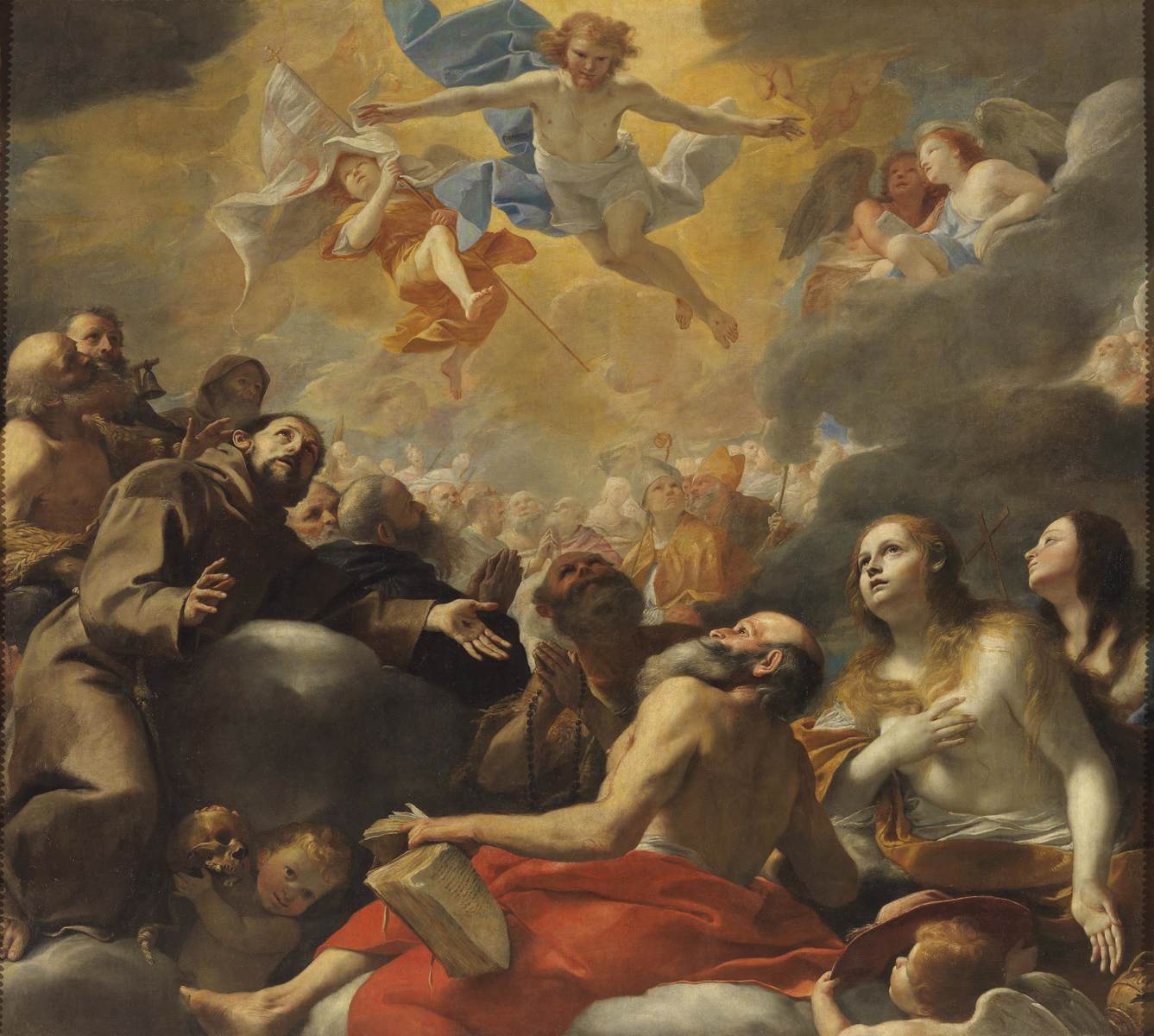
Christ in Glory
Mattia Preti
c. 1660
Oil on canvas, 220 x 253 cm
Museo del Prado, Madrid
9
posted on
08/11/2026 5:28:21 AM PDT
by
annalex
(fear them not)
To: annalex
Saint of the Day for August 11
(July 16, 1194 – August 11, 1253)
Saint Clare of Assisi’s Story
One of the more sugary movies made about Francis of Assisi pictures Clare as a golden-haired beauty floating through sun-drenched fields, a sort of one-woman counterpart to the new Franciscan Order.
The beginning of her religious life was indeed movie material. Having refused to marry at 15, Clare of Assisi was moved by the dynamic preaching of Francis. He became her lifelong friend and spiritual guide.
At 18, Clare of Assisi escaped from her father’s home one night, was met on the road by friars carrying torches, and in the poor little chapel called the Portiuncula received a rough woolen habit, exchanged her jeweled belt for a common rope with knots in it, and sacrificed her long tresses to Francis’ scissors. He placed her in a Benedictine convent, which her father and uncles immediately stormed in rage. Clare clung to the altar of the church, threw aside her veil to show her cropped hair, and remained adamant.
Sixteen days later her sister Agnes joined her. Others came. They lived a simple life of great poverty, austerity, and complete seclusion from the world, according to a Rule which Francis gave them as a Second Order. At age 21, Francis obliged Clare under obedience to accept the office of abbess, one she exercised until her death.
The Poor Ladies went barefoot, slept on the ground, ate no meat, and observed almost complete silence. Later Clare, like Francis, persuaded her sisters to moderate this rigor: “Our bodies are not made of brass.” The greatest emphasis, of course, was on gospel poverty. They possessed no property, even in common, subsisting on daily contributions. When even the pope tried to persuade Clare to mitigate this practice, she showed her characteristic firmness: “I need to be absolved from my sins, but I do not wish to be absolved from the obligation of following Jesus Christ.”
Contemporary accounts glow with admiration of Saint Clare of Assisi’s life in the convent of San Damiano in Assisi. She served the sick and washed the feet of the begging nuns. She came from prayer, it was said, with her face so shining it dazzled those about her. She suffered serious illness for the last 27 years of her life. Her influence was such that popes, cardinals, and bishops often came to consult her—Clare herself never left the walls of San Damiano.
Francis always remained her great friend and inspiration. Saint Clare of Assisi was always obedient to his will and to the great ideal of gospel life which he was making real.
A well-known story concerns her prayer and trust. Saint Clare of Assisi had the Blessed Sacrament placed on the walls of the convent when it faced attack by invading Saracens. “Does it please you, O God, to deliver into the hands of these beasts the defenseless children I have nourished with your love? I beseech you, dear Lord, protect these whom I am now unable to protect.” To her sisters she said, “Don’t be afraid. Trust in Jesus.” The Saracens fled.
Reflection
The 41 years of Clare’s religious life are scenarios of sanctity: an indomitable resolve to lead the simple, literal gospel life as Francis taught her; courageous resistance to the ever-present pressure to dilute the ideal; a passion for poverty and humility; an ardent life of prayer; and a generous concern for her sisters.
Saint Clare is the Patron Saint of:
Protection from eye disorders
Television
franciscanmedia.org
10
posted on
08/11/2026 5:33:10 AM PDT
by
annalex
(fear them not)
To: annalex
11
posted on
08/11/2026 5:35:30 AM PDT
by
annalex
(fear them not)
To: annalex
NAVARRE BIBLE COMMENTARY(RSV)
Ad Majorem Dei Gloriam (To the Greater Glory of God)
Today’s First Reading
From: Ezekiel 2:8—3:4
The Prophet’s mission
---------------------------
[2:8] “But you, son of man, hear what I say to you: be not rebellious like that rebellious house; open your mouth, and eat what I give you.” [9] And when I looked, behold, a hand was stretched out to me, and, lo, a written scroll was in it; [10] and he spread it before me; and it had writing on the front and on the back, and there were written on it words of lamentation and mourning and woe.
[3:1] And he said to me, “Son of man, eat what is offered to you; eat this scroll, and go, speak to the house of Israel.” So I opened my mouth, and he gave me the scroll to eat. [3] And he said to me. “Son of man, eat this scroll that I give you and fill your stomach with it.” Then I ate it; and it was in my mouth as sweet as honey.
[4] And he said to me, “Son of man, go, get you to the house of Israel, and speak with my words to them.
****************************************************************************
Commentary:
2:1-3:3. The vision by the river Chebar is all about the grandeur and glory of God, who is sovereign over all things; whereas the account given of the call of Ezekiel tells us about the prophet and about the people of Israel, for whom the message is meant. The prophet is described as a son of man, whom the Spirit moves, a prophet among the people; and they are a rebellious people. The account takes the form of an address by the Lord containing a command to pass his word on to the people (2: 1-7) and a symbolic action in which Ezekiel eats the scroll given to him by God (2:8-3:3).
2:8-3:3. The action of eating the scroll symbolizes to the people that the prophet is faithfully passing on the word of God, and therefore that they should not neglect to take on board anything he says or try to tone it down. It also shows the positive attitude of the prophet himself: he eagerly “fills his stomach” with the words of the Lord even though they are severe. Commenting on this passage, Pope St Gregory the Great points out: “The Holy Scriptures are food and drink to nourish us [....]. The obscure pages, which cannot he understood unless further explanation be provided, are food, because everything must be explained in order to be properly understood, just as everything must be chewed in order to be swallowed. We do not chew what we drink: when the teaching is clear, we swallow it whole, because we are in need of no further explanation. The prophet Ezekiel will hear difficult and obscure words, so he is told to eat the scroll, not to drink it, as if to say, ‘Meditate on this teaching and understand it well’’’ (“Homiliae in Ezechielem prophetam”, 1,10, 3).
A “written scroll” (2:9): in ancient times books were written on rolls of parchment or on papyrus (see also Jer 36:4).
12
posted on
08/11/2026 8:27:10 AM PDT
by
fidelis
(Ecce Crucem Domini! Fugite partes adversae! Vicit Leo de tribu Juda, Radix David! Alleluia!)
Today’s Gospel Reading From: Matthew 18:1-5, 10, 12-14
The "Little Ones" and the Kingdom. The Lost Sheep
----------------------------------------------------------------
[1] At that time, the disciples came to Jesus, saying, "Who is the greatest in the Kingdom of Heaven?" [2] And calling to Him a child, He put him in the midst of them, [3] and said, "Truly, I say to you, unless you turn and become like children, you will never enter the Kingdom of Heaven. [4] Whoever humbles himself like this child, he is the greatest in the Kingdom of Heaven. [5] "Whoever receives one such child in My name receives Me.
[10] "See that you do not despise one of these little ones; for I tell you that in Heaven their angels always behold the face of My Father who is in Heaven.
[12] "What do you think? If a man has a hundred sheep, and one of them has gone astray, does he not leave the ninety-nine on the hills and go in search of the one that went astray? [13] And if he finds it, truly, I say to you, he rejoices over it more than over the ninety-nine that never went astray. [14] So it is not the will of My Father who is in Heaven that one of these little ones should perish."
***********************************************************************
Commentary:
1-35. The teachings of Jesus recorded in chapter 18 of St. Matthew are often called the "discourse on the Church" or "ecclesiastical discourse" because they are a series of instructions on the way in which His Church is to be administered.
The first passage (Matthew 18:1-5), addressed to leaders, that is, the future hierarchy of the Church, warns them against natural tendencies to pride and ambition: even though they have positions of government, they must act with humility. In verses 6-10 Jesus emphasizes the fatherly care which pastors of the Church should have for the "little ones"--a term which covers everyone in need of special care for whatever reason (because they are recent converts, or are not well grounded in Church teaching, or are not yet adults, etc.) ...God takes special care of the weak and will punish those who harm them.
Our Lord shows similar concern for those who are experiencing spiritual difficulties. Every effort, even an heroic effort, must be made to seek out the "lost sheep" (verses 12-14). If the Church in general and each Christian in particular should be concerned to spread the Gospel, all the more reason for them to try and see that those who already embraced the faith do not go astray...
Thus, the whole of Chapter 18, the "discourse of the Church", is a survey of the future history of the Church during its earthly stage, and a series of practical rules for conduct for Christians--a kind of complement to the Sermon on the Mount, (Chapters 5-7), which is a "magna carta" for the new Kingdom established by Christ.
1-6. Clearly the disciples still suffer from human ambition: they want to occupy key positions when Jesus comes to establish the Kingdom on earth (cf. Acts 1:6). To correct their pride, our Lord shows them a child and tells them that if they want to enter the Kingdom of Heaven, they must decide to be like children: children are incapable of hating anyone and are totally innocent of vice, particularly of pride, the worst vice of all. They are simple and full of trust.
Humility is one of the main pillars of the Christian life. "If you ask me", St. Augustine says, "what is the essential thing in the religion and discipline of Jesus Christ, I shall reply: first humility, second humility and third humility" ("Letter 118").
3-4. Applying these words to our Lord's virtues, Fray Luis de Granada makes the point that humility is superior to virginity: "If you cannot imitate the virginity of the humble, then imitate the humility of the virgin. Virginity is praiseworthy, but humility is more necessary. The former is recommended to us, the latter is an obligation for us; to the former we are invited, to the latter we are obliged [...]. And so we see that the former is celebrated as voluntary sacrifice, the latter required as an obligatory sacrifice. Lastly, you can be saved without virginity, but not without humility" ("Summa De La Vida Cristiana", Book 3, Part 2, Chapter 10).
5. Receiving a child in Jesus' name is the same as receiving Jesus Himself. Because children reflect the innocence, purity, simplicity and tenderness of our Lord, "In children and in the sick a soul in love sees Him" (St J. Escriva, "The Way", 419).
10. Jesus warns that giving scandal to little children is a very serious matter, for they have angels who guard them, who will plead a case before God against those who led them to commit sin.
In this context He speaks of children having guardian angels. However, everyone, adult or child, has a guardian angel. "By God's providence angels have been entrusted with the office of guarding the human race and of accompanying every human being so as to preserve him from any serious dangers [...]. Our Heavenly Father has placed over each of us an angel under whose protection and vigilance we are" ("St. Pius V Catechism", IV, 9, 4).
This means that we should have a trusting relationship with our guardian angel. "Have confidence in your guardian Angel. Treat him as a lifelong friend--that is what he is--and he will render you a thousand services in the ordinary affairs of each day" (St J. Escriva, "The Way", 562).
12-14. This parable clearly shows our Lord's loving concern for sinners. It expresses in human terms the joy God feels when a wayward child comes back to Him.
Seeing so many souls living away from God, Pope John Paul II comments: "Unfortunately we witness the moral pollution which is devastating humanity, disregarding especially those very little ones about whom Jesus speaks."
"What must we do? We must imitate the Good Shepherd and give ourselves without rest for the salvation of souls. Without forgetting material charity and social justice, we must be convinced that the most sublime charity is spiritual charity, that is, the commitment for the salvation of souls. And souls are saved with prayer and sacrifice. This is the mission of the Church!" ("Homily to the Poor Clares of Albano," 14 August 1979).
As the RSV points out, "other ancient authorities add verse 11, "For the Son of Man came to save the lost"--apparently taken from Luke 19:10.
13
posted on
08/11/2026 8:27:32 AM PDT
by
fidelis
(Ecce Crucem Domini! Fugite partes adversae! Vicit Leo de tribu Juda, Radix David! Alleluia!)
14
posted on
08/11/2026 8:28:37 AM PDT
by
fidelis
(Ecce Crucem Domini! Fugite partes adversae! Vicit Leo de tribu Juda, Radix David! Alleluia!)
Disclaimer:
Opinions posted on Free Republic are those of the individual
posters and do not necessarily represent the opinion of Free Republic or its
management. All materials posted herein are protected by copyright law and the
exemption for fair use of copyrighted works.
FreeRepublic.com is powered by software copyright 2000-2008 John Robinson
