Catena Aurea by St. Thomas Aguinas
13:24–30
24. Another parable put he forth unto them, saying, The kingdom of heaven is likened unto a man which sowed good seed in his field:
25. But while men slept, his enemy came and sowed tares among the wheat, and went his way.
26. But when the blade was sprung up, and brought forth fruit, then appeared the tares also.
27. So the servants of the householder came and said unto him, Sir, didst not thou sow good seed in thy field; from whence then hath it tares?
28. He said unto them, An enemy hath done this. The servants said unto him, Wilt thou then that we go and gather them up?
29. But he said, Nay; lest while ye gather up the tares, ye root up also the wheat with them.
30. Let both grow together until the harvest: and in the time of harvest I will say to the reapers, Gather ye together first the tares, and bind them in bundles to burn them: but gather the wheat into my barn.
CHRYSOSTOM. (Hom. xlvi.) In the foregoing parable the Lord spoke to such as do not receive the word of God; here of those who receive a corrupting seed. This is the contrivance of the Devil, ever to mix error with truth.
JEROME. He set forth also this other parable, as it were a rich householder refreshing his guests with various meats, that each one according to the nature of his stomach might find some food adapted to him. He said not ‘a second parable,’ but another; for had He said ‘a second,’ we could not have looked for a third; but another prepares us for many more.
REMIGIUS. Here He calls the Son of God Himself the kingdom of heaven; for He saith, The kingdom of heaven is like unto a man that sowed good seed in his field.
CHRYSOSTOM. He then points out the manner of the Devil’s snares, saying, While men slept, his enemy came and sowed tares in the midst of the wheat, and departed. He here shews that error arose after truth, as indeed the course of events testifies; for the false prophets came after the Prophets, the false apostles after the Apostles, and Antichrist after Christ. For unless the Devil sees somewhat to imitate, and some to lay in wait against, he does not attempt any thing. Therefore because he saw that this man bears fruit an hundred, this sixty, and this thirty-fold, and that he was not able to carry off or to choke that which had. taken root, he turns to other insidious practices, mixing up his own seed, which is a counterfeit of the true, and thereby imposes upon such as are prone to be deceived. So the parable speaks, not of another seed, but of tares which bear a great likeness to wheat com. Further, the malignity of the Devil is shewn in this, that he sowed when all else was completed, that he might do the greater hurt to the husbandman.
AUGUSTINE. (Quæst. in Matt. q. 11.) He says, While men slept, for while the heads of the Church were abiding in supineness, and after the Apostles had received the sleep of death, then came the Devil and sowed upon the rest those whom the Lord in His interpretation calls evil children. But we do well to enquire whether by such are meant heretics, or Catholics who lead evil lives. That He says, that they were sown among the wheat, seems to point out that they were all of one communion. But forasmuch as He interprets the field to mean not the Church, but the world, we may well understand it of the heretics, who in this world are mingled with the good; for they who live amiss in the same faith may better be taken of the chaff than of the tares, for the chaff has a stem and a root in common with the grain. While schismatics again may more fitly be likened to ears that have rotted, or to straws that are broken, crushed down, and cast forth of the field. Indeed it is not necessary that every heretic or schismatic should be corporally severed from the Church; for the Church bears many who do not so publicly defend their false opinions as to attract the attention of the multitude, which when they do, then are they expelled. When then the Devil had sown upon the true Church divers evil errors and false opinions; that is to say, where Christ’s name had gone before, there he scattered errors, himself was the rather hidden and unknown; for He says, And went his way. Though indeed in this parable, as we learn from His own interpretation, the Lord may be understood to have signified under the name of tares all stumbling-blocks and such as work iniquity.
CHRYSOSTOM. In what follows He more particularly draws the picture of an heretic, in the words, When the blade grew, and put forth fruit, then appeared the tares also. For heretics at first keep themselves in the shade; but when they have had long license, and when men have held communication with them in discourse, then they pour forth their venom.
AUGUSTINE. (Quæst. in Matt. q. 12.) Or otherwise; When a man begins to be spiritual, discerning between things, then he begins to see errors; for he judges concerning whatsoever he hears or reads, whether it departs from the rule of truth; but until he is perfected in the same spiritual things, he might be disturbed at so many false heresies having existed under the Christian name, whence it follows, And the servants of the householder coming to him said unto him, Didst thou not sow good seed in thy field? whence then hath it tares? Are these servants then the same as those whom He afterwards calls reapers? Because in His exposition of the parable, He expounds the reapers to be the Angels, and none would dare to say that the Angels were ignorant who had sowed tares, we should the rather understand that the faithful are here intended by the servants. And no wonder if they are also signified by the good seed; for the same thing admits of different likenesses according to its different significations; as speaking of Himself He says that He is the door, he is the shepherd.
REMIGIUS. They came to the Lord not with the body, but with the heart and desire of the soul; and from Him they gather that this was done by the craft of the Devil, whence it follows, And he saith unto them, An enemy hath done this.
JEROME. The Devil is called a man that is an enemy because he has ceased to be God; and in the ninth Psalm it is written of him, Up, Lord, and let not man have the upper hand. (ver. 19) Wherefore let not him sleep that is set over the Church, lest through his carelessness the enemy should sow therein tares, that is, the dogmas of the heretics.
CHRYSOSTOM. He is called the enemy on account of the losses he inflicts on men; for the assaults of the Devil are made upon us, though their origin is not in his enmity towards us, but in his enmity towards God.
AUGUSTINE. (ubi sup) And when the servants of God knew that it was the Devil who had contrived this fraud, whereby when he found that he had no power in open warfare against a Master of such great name, he had introduced his fallacies under cover of that name itself, the desire might readily arise in them to remove such men from out of human affairs if opportunity should be given them; but they first appeal to God’s justice whether they should so do; The servants said, Wilt thou that we go and gather them out?
CHRYSOSTOM. Wherein observe the thoughtfulness and affection of the servants; they hasten to root up the tares, thus shewing their anxiety about the good seed; for this is all to which they look, not that any should be punished, but that that which is sown should not perish. The Lord’s answer follows, And he saith unto them, Nay.
JEROME. For room for repentance is left, and we are warned that we should not hastily cut off a brother, since one who is to-day corrupted with an erroneous dogma, may grow wiser tomorrow, and begin to defend the truth; wherefore it is added, Lest in gathering together the tares ye root out the wheat also.
AUGUSTINE. (Quæst. in Matt. q. 12.) Wherein He renders them more patient and tranquil. For this He says, because good men while yet weak, have need in some things of being mixed up with bad, either that they may be proved by their means, or that by comparison with them they may be greatly stimulated and drawn to a better course. Or perhaps the wheat is declared to be rooted up if the tares should be gathered out of it, on account of many who though at first tares would, after become wheat; yet they would never attain to this commendable change were they not patiently endured while they were evil. Thus were they rooted up, that wheat which they would become in time if spared, would be rooted up in them. It is then therefore He forbids that such should be taken away out of this life, lest in the endeavour to destroy the wicked, those of them should be destroyed among the rest who would turn out good; and lest also that benefit should be lost to the good which would accrue to them even against their will from mixing with the wicked. But this may be done seasonably when, in the end of all, there remains no more time for a change of life, or of advancing to the truth by taking opportunity and comparison of others’ faults; therefore He adds, Let both grow together until the harvest, that is, until the judgment.
JEROME. But this seems to contradict that command, Put away the evil from among you. (1 Cor. 5:13) For if the rooting up be forbidden, and we are to abide in patience till the harvest-time, how are we to cast forth any from among us? But between wheat and tares (which in Latin we call ‘lolium’) so long as it is only in blade, before the stalk has put forth an ear, there is very great resemblance, and none or little difference to distinguish them by. The Lord then warns us not to pass a hasty sentence on an ambiguous word, but to reserve it for His judgment, that when the day of judgment shall come, He may cast forth from the assembly of the saints no longer on suspicion but on manifest guilt.
AUGUSTINE. (Cont. Ep. Parm. iii. 2.) For when any one of the number of Christians included in the Church is found in such sin as to incur an anathema, this is done, where danger of schism is not apprehended, with tenderness, not for his rooting out, but for his correction. But if he be not conscious of his sin, nor correct it by penitence, he will of his own choice go forth of the Church and be separated from her communion; whence when the Lord commanded, Suffer both to grow together till the harvest, He added the reason, saying, Lest when ye would gather out the tares ye root up the wheat also. This sufficiently shews, that when that fear has ceased, and when the safety of the crop is certain, that is, when the crime is known to all, and is acknowledged as so execrable as to have no defenders, or not such as might cause any fear of a schism, then severity of discipline does not sleep, and its correction of error is so much the more efficacious as the observance of love had been more careful. But when the same infection has spread to a large number at once, nothing remains but sorrow and groans. Therefore let a man gently reprove whatever is in his power; what is not so let him bear with patience, and mourn over with affection, until He from above shall correct and heal, and let him defer till harvest-time to root out the tares and winnow the chaff. But the multitude of the unrighteous is to be struck at with a general reproof, whenever there is opportunity of saying aught among the people; and above all when any scourge of the Lord from above gives opportunity, when they feel that they are scourged for their deserts; for then the calamity of the hearers opens their ears submissively to the words of their reprover, seeing the heart in affliction is ever more prone to the groans of confession than to the murmurs of resistance. And even when no tribulation lays upon them, should occasion serve, a word of reproof is usefully spent upon the multitude; for when separated it is wont to be fierce, when in a body it is wont to mourn.
CHRYSOSTOM. This the Lord spake to forbid any putting to death. For we ought not to kill an heretic, seeing that so a never-ending war would be introduced into the world; and therefore He says, Lest ye root out with them the wheat also; that is, if you draw the sword and put the heretic to death, it must needs be that many of the saints will fall with them. Hereby He does not indeed forbid all restraint upon heretics, that their freedom of speech should be cut off, that their synods and their confessions should be broken up—but only forbids that they should be put to death.
AUGUSTINE. (Ep. 93. 17.) This indeed was at first my own opinion, that no man was to be driven by force into the unity of Christ; but he was to be led by discourse, contended with in controversy, and overcome by argument, that we might not have men feigning themselves to be Catholics whom we knew to be declared heretics. But this opinion of mine was overcome not by the authority of those who contradicted me, but by the examples of those that shewed it in fact; for the tenor of those laws in enacting which Princes serve the Lord in fear, has had such good effect, that already some say, This we desired long ago; but now thanks be to God who has made the occasion for us, and has cut off our pleas of delay. Others say, This we have long known to be the truth; but we were held by a kind of old habit, thanks be to God who has broken our chains. Others again; We knew not that this was true, and had no desire to learn it, but fear has driven us to give our attention to it, thanks be to the Lord who has banished our carelessness by the spur of terror. Others, We were deterred from entering in by false rumours, which we should not have known to be false had we not entered in, and we should not have entered in had we not been compelled; thanks be to God who has broken up our preaching by the scourge of persecution, and has taught us by experience how empty and false things lying fame had reported concerning His Church. Others say, We thought indeed that it was of no importance in what place we held the faith of Christ; but thanks be to the Lord who has gathered us together out of our division, and has shewn us that it is consonant to the unity of God that He should be worshipped in unity. Let then the Kings of the earth shew themselves the servants of Christ by publishing laws in Christ’s behalf.
AUGUSTINE. (Ep. 185. 32 et 22.) But who is there of you who has any wish that a heretic should perish, nay, that he should so much as lose aught? Yet could the house of David have had peace in no other way, but by the death of Absalom in that war which he waged against his father; notwithstanding his father gave strict commands to his servants that they should save him alive and unhurt, that on his repentance there might be room for fatherly affection to pardon; what then remained for him but to mourn over him when lost, and to console his domestic affliction by the peace which it had brought to his kingdom. Thus our Catholic mother the Church, when by the loss of a few she gains many, soothes the sorrow of her motherly heart, healing it by the deliverance of so much people. Where then is that which those are accustomed to cry out, That it is free to all to believe? Whom hath Christ done violence to? Whom hath He compelled? Let them take the Apostle Paul; let them acknowledge in him Christ first compelling and afterwards teaching, first smiting and afterwards comforting. And it is wonderful to see him who entered into the Gospel by the force of a bodily infliction labouring therein more than all those who are called by word only. (1 Cor. 15:10.) Why then should not the Church constrain her lost sons to return to her, when her lost sons constrained others to perish?
REMIGIUS. It follows, And in the time of harvest I will say to the reapers, Gather together first the tares, and bind them in bundles to burn them. The harvest is the season of reaping which here designates the day of judgment, in which the good are to be separated from the bad.
CHRYSOSTOM. But why does He say, Gather first the tares? That the good should hare no fears lest the wheat should be rooted up with them:
JEROME. In that He says that the bundles of tares are to be cast into the fire, and the wheat gathered into barns, it is clear that heretics also and hypocrites are to be consumed in the fires of hell, while the saints who are here represented by the wheat are received into the barns, that is into heavenly mansions.
AUGUSTINE. (Quæst. in Matt. q. 12.) It may be asked why He commands more than one bundle or heap of tares to be formed? Perhaps because of the variety of heretics differing not only from the wheat, but also among themselves, each several heresy, separated from communion with all the others, is designated as a bundle; and perhaps they may even then begin to be bound together for burning, when they first sever themselves from the Catholic communion, and begin to have their independent church, so that it is the burning and not the binding into bundles that will take place at the end of the world. But were this so, there would not be so many who would become wise again, and return from error into the Catholic Church. Wherefore we must understand the binding into bundles to be what shall come to pass in the end, that punishment should fall on them not promiscuously, but in due proportion to the obstinacy and wilfulness of each separate error.
RABANUS. And it should be noted that, when He says, Sowed good seed, He intends that good will which is in the elect; when He adds, An enemy came, He intimates that watch should be kept against him; when as the tares grow up, He suffers it patiently, saying, An enemy hath done this, He recommends to us patience; when He says, Lest haply in gathering the tares, &c. He sets us an example of discretion; when He says, Suffer both to grow together till the harvest, He teaches us long-suffering; and, lastly, He inculcates justice, when He says, Bind them into bundles to burn.
13:31–32
31. Another parable put he forth unto them, saying, The kingdom of heaven is like to a grain of mustard seed, which, a man took, and sowed in his field:
32. Which indeed is the least of all seeds: but when it is grown, it is the greatest among herbs, and becometh a tree, so that the birds of the air come and lodge in the branches thereof.
CHRYSOSTOM. Seeing the Lord had said above that three parts of the seed perish, and one only is preserved, and of that one part there is much loss by reason of the tares that are sown upon it; that none might say, Who then and how many shall they be that believe; He removes this cause of fear by the parable of the mustard seed: therefore it is said, Another parable put he forth unto them, saying, The kingdom of heaven is like unto a grain of mustard seed.
JEROME. The kingdom of heaven is the preaching of the Gospel, and the knowledge of the Scriptures which leads to life, concerning which it is said to the Jews, The kingdom of God shall be taken from you. (Mat. 21:43.) It is the kingdom of heaven thus understood which is likened to a grain of mustard seed.
AUGUSTINE. (Quæst. in Ev. i. 11.) A grain of mustard seed may allude to the warmth of faith, or to its property as antidote to poison. It follows; Which a man took and sowed in his field.
JEROME. The man who sows is by most understood to be the Saviour, who sows the seed in the minds of believers; by others the man himself, who sows in his field, that is, in his own heart. Who indeed is he that soweth, but our own mind and understanding, which receiving the grain of preaching, and nurturing it by the dew of faith, makes it to spring up in the field of our own breast? Which is the least of all seeds. The Gospel preaching is the least of all the systems of the schools; at first view it has not even the appearance of truth, announcing a man as God, God put to death, and proclaiming the offence of the cross. Compare this teaching with the dogmas of the Philosophers, with their books, the splendour of their eloquence, the polish of their style, and you will see how the seed of the Gospel is the least of all seeds.
CHRYSOSTOM. Or; The seed of the Gospel is the least of seeds, because the disciples were weaker than the whole of mankind; yet forasmuch as there was great might in them, their preaching spread throughout the whole world, and therefore it follows, But when it is grown it is the greatest among herbs, that is among dogmas.
AUGUSTINE. (ubi sup.) Dogmas are the decisions of sects,1 the points, that is, that they have determined.
JEROME. For the dogmas of Philosophers when they have grown up, shew nothing of life or strength, but watery and insipid they grow into grasses and other greens, which quickly dry up and wither away. Brit the Gospel preaching; though it seem small in its beginning, when sown in the mind of the hearer, or upon the world, comes up not a garden herb, but a tree, so that the birds of the air (which we must suppose to be either the souls of believers or the Powers of God set free from slavery) come and abide in its branches. The branches of the Gospel tree which have grown of the grain of mustard seed, I suppose to signify the various dogmas in which each of the birds (as explained above) takes his rest. Let us then take the wings of the dove, that flying aloft we may dwell in the branches of this tree, and may make ourselves nests of doctrines, and soaring above earthly things may hasten towards heavenly. (Ps. 55:6.)
HILARY. Or; The Lord compares Himself to a grain of mustard seed, sharp to the taste, and the least of all seeds, whose strength is extracted by bruising.
GREGORY. (Mor. xix. 1.) Christ Himself is the grain of mustard seed, who, planted in the garden of the sepulchre, grew up a great tree; He was a grain of seed when He died, and a tree when He rose again; a grain of seed in the humiliation of the flesh, a tree in the power of His majesty.
HILARY. This grain then when sown in the field, that is, when seized by the people and delivered to death, and as it were buried in the ground by a sowing of the body, grew up beyond the size of all herbs, and exceeded all the glory of the Prophets. For the preaching of the Prophets was allowed as it were herbs to a sick man; but now the birds of the air lodge in the branches of the tree. By which we understand the Apostles, who put forth of Christ’s might, and overshadowing the world with their boughs, are a tree to which the Gentiles flee in hope of life, and having been long tossed by the winds, that is by the spirits of the Devil, may have rest in its branches.
GREGORY. (ubi sup.) The birds lodge in its branches, when holy souls that raise themselves aloft from thoughts of earth on the wings of the virtues, breathe again from the troubles of this life in their words and comfortings.
13:33
33. Another parable spake he unto them; The kingdom of heaven is like unto leaven, which a woman took, and hid in three measures of meal, till the whole was leavened.
CHRYSOSTOM. The same thing the Lord sets forth in this parable of the leaven, as much as to say to His disciples, As leaven changes into its own kind much wheat-flour, so shall ye change the whole world. Note here the wisdom of the Saviour; He first brings instances from nature, proving that as the one is possible so is the other. And He says not simply ‘put,’ but hid; as much as to say, So ye, when ye shall be cast down by your enemies, then ye shall overcome them. And so leaven is kneaded in, without being destroyed, but gradually changes all things into its own nature; so shall it come to pass with your preaching. Fear ye not then because I said that many tribulations shall come upon you, for so shall ye shine forth, and shall overcome them all. He says, three measures, to signity a great abundance; that definite number standing for an indefinite quantity.
JEROME. The ‘satum’ is a kind of measure in use in Palestine containing one modius and a half.
AUGUSTINE. (Quæst. Ev. i. 12.) Or, The leaven signifies love, because it causes activity and fermentation; by the woman He means wisdom. By the three measures He intends either those three things in man, with the whole heart, with the whole soul, with the whole mind; or the three degrees of fruitfulness, the hundred-fold, the sixty-fold, the thirty-fold, or those three kinds of men, Noe, Daniel, and Job.
RABANUS. He says, Until the whole was leavened, because that love implanted in our mind ought to grow until it changes the whole soul into its own perfection; which is begun here, but is completed hereafter.
JEROME. Or otherwise; The woman who takes the leaven and hides it, seems to me to be the Apostolic preaching, or the Church gathered out of divers nations. She takes the leaven, that is, the understanding of the Scriptures, and hides it in three measures of meal, that the three, spirit, soul, and body, may be brought into one, and may not differ among themselves. Or otherwise; We read in Plato that there are three parts in the soul, reason, anger, and desire; (R. P. iv. 439. λογιστιχὸν, ἐχιδνμπτιχὸυ, θνμοειδὲς) so we also if we have received the evangelic leaven of Holy Scripture, may possess in our reason prudence, in our anger hatred against vice, in our desire love of the virtues, and this will all come to pass by the Evangelic teaching which our mother Church has held out to us. I will further mention an interpretation of some; that the woman is the Church, who has mingled the faith of man in three measures of meal, namely, belief in the Father, the Son, and the Holy Spirit; which when it has fermented into one lump, brings us not to a threefold God, but to the knowledge of one Divinity. This is a pious interpretation; but parables and doubtful solutions of dark things, can never bestow authority on dogmas.
HILARY. Or otherwise; The Lord compares Himself to leaven; for leaven is produced from meal, and communicates the power that it has received to a heap of its own kind. The woman, that is the Synagogue, taking this leaven hides it, that is by the sentence of death; but it working in the three measures of meal, that is equally in the Law, the Prophets, and the Gospels, makes all one; so that what the Law ordains, that the Prophets announce, that is fulfilled in the developements of the Gospels. But many, as I remember, have thought that the three measures refer to the calling of the three nations, out of Shem, Ham, and Japhet. But I hardly think that the reason of the thing will allow this interpretation; for though these three nations have indeed been called, yet in them Christ is shewn and not hidden, and in so great a multitude of unbelievers the whole cannot be said to be leavened.
13:34–35
34. All these things spake Jesus unto the multitude in parables; and without a parable spake he not unto them.
35. That it might be fulfilled which was spoken by the prophet, saying, I will open my mouth in parables; I will utter things which have been kept secret from the foundation of the world.
CHRYSOSTOM. (Hom. xlvii.) After the foregoing parables, that none might think that Christ was bringing forward any thing new, the Evangelist quotes the Prophet, foretelling even this His manner of preaching: Mark’s words are, And with many such parables spake he the word unto them, as they were able to hear it. (Mark 4:33.) So marvel not that, in speaking of the kingdom, He uses the similitudes of a seed, and of leaven; for He was discoursing to common men, and who needed to be led forward by such aids.
REMIGIUS. The Greek word ‘Parable,’ is rendered in Latin ‘Similitude,’ by which truth is explained; and an image or representation of the reality is set forth.
JEROME. Yet He spoke not in parables to the disciples, but to the multitude; and even to this day the multitude hears in parables; and therefore it is said, And without a parable spake he not unto them.
CHRYSOSTOM. For though He had spoken many things not in parables, when not speaking before the multitudes, yet at this time spake He nothing without a parable.
AUGUSTINE. (Quæst. in Matt. q. 15.) Or, this is said, not that He uttered nothing in plain words; but that He concluded no one discourse without introducing a parable in the course of it, though the chief part of the discourse might consist of matter not figurative. And we may indeed find discourses of His parabolical throughout, but none direct throughout. And by a complete discourse, I mean, the whole of what He says on any topic that may be brought before Him by circumstances, before He leaves it, and passes to a new subject. For sometimes one Evangelist connects what another gives as spoken at different times; the writer having in such a case followed not the order of events, but the order of connexion in his own memory. The reason why He spake in parables the Evangelist subjoins, saying, That it might be fulfilled that was spoken by the Prophet, saying, I will open my mouth in parables, I will utter things kept secret from the foundation of the world. (Ps. 78:2.)
JEROME. This passage is taken from the seventy-seventh Psalm. I have seen copies which read, ‘by Esaias the Prophet,’ instead of what we have adopted, and what the common text has by the Prophet.
REMIGIUS. From which reading Porphyry took an objection to the believers; Such was your Evangelist’s ignorance, that he imputed to Isaiah what is indeed found in the Psalms.
JEROME. But because the text was not found in Isaiah, his name was, I suppose, therefore erased by such as had observed that. But it seems to me that it was first written thus, ‘As was written by Asaph the Prophet, saying;’ for the seventy-seventh Psalm out of which this text is taken is ascribed to Asaph the Prophet; and that the copyist not understanding Asaph, and imputing it to error in the transcription, substituted the better known name Isaiah. For it should be known that not David only, but those others also whose names are set before the Psalms, and hymns, and songs of God, are to be considered prophets, namely, Asaph, Idithum, and Heman the Esraite, and the rest who are named in Scripture. And so that which is spoken in the Lord’s person, I will open my mouth in parables, if considered attentively, will be found to be a description of the departure of Israel out of Egypt, and a relation of all the wonders contained in the history of Exodus. By which we learn, that all that is there written may be taken in a figurative way, and contains hidden sacraments; for this is what the Saviour is there made to preface by the words, I will open my mouth in parables.
GLOSS. (ap. Anselm.) As though He had said, I who spoke before by the Prophets, now in My own person will open My mouth in parables, and will bring forth out of My secret store mysteries which have been hidden ever since the foundation of the world.
13:36–43
36. Then Jesus sent the multitude away, and went into the house: and his disciples came unto him, saying, Declare unto us the parable of the tares of the field.
37. He answered and said unto them, He that soweth the good seed is the Son of man;
38. The field is the world; the good seed are the children of the kingdom; but the tares are the children of the wicked one;
39. The enemy that sowed them is the devil; the harvest is the end of the world; and the reapers are the angels.
40. As therefore the tares are gathered and burned in the fire; so shall it be in the end of this world.
41. The Son of man shall send forth his angels, and they shall gather out of his kingdom all things that offend, and them which do iniquity;
42. And shall cast them into a furnace of fire: there shall be wailing and gnashing of teeth.
43. Then shall the righteous shine forth as the sun in the kingdom of their Father. Who hath ears to hear, let him hear.
CHRYSOSTOM. The Lord had spoken to the multitude in parables, that He might induce them to ask Him of their meaning; yet, though He had spoken so many things in parables, no man had yet asked Him aught, and therefore He sends them away; Then Jesus sent the multitude away, and went into the house. None of the Scribes followed Him here, from which it is clear that they followed Him for no other purpose than that they might catch Him in His discourse.
JEROME. The Lord sends away the multitude, and enters the house that His disciples might come to Him and ask Him privately of those things which the people neither deserved to hear, nor were able.
RABANUS. Figuratively; Having sent away the multitude of unquiet Jews, He enters the Church of the Gentiles, and there expounds to believers heavenly sacraments, whence it follows, And his disciples came to him, saying, Explain to us the parable of the tares of the field.
CHRYSOSTOM. Before, though desirous to learn, they had feared to ask; but now they ask freely and confidently because they had heard, To you it is given to know the mystery of the kingdom of heaven; and therefore they ask when alone, not envying the multitude to whom it was not so given. They pass over the parables of the leaven and the mustard-seed as plain; and ask concerning the parable of the tares, which has some agreement with the foregoing parable concerning the seed, and shews somewhat more than that. And accordingly the Lord expounds it to them, as it follows, He answered and said unto them, He that sows the good seed is the Son of man.
REMIGIUS. The Lord styles Himself the Son of Man, that in that title He might set an example of humility; or perhaps because it was to come to pass that certain heretics would deny Him to be really man; or that through belief in His Humanity we might ascend to knowledge of His Divinity.
CHRYSOSTOM. The field is the world. Seeing it is He that sows His own field, it is plain that this present world is His. It follows, The good seed are the children of the kingdom.
REMIGIUS. That is, the saints, and elect men, who are counted as sons.
AUGUSTINE. (cont. Faust. xviii. 7.) The tares the Lord expounds to mean, not as Manichæus interprets, certain spurious parts inserted among the true Scriptures, but all the children of the Evil one, that is, the imitators of the fraud of the Devil. As it follows, The tares are the children of the evil one, by whom He would have us understand all the wicked and impious.
AUGUSTINE. (Quæst. Ev. i. 10.) For all weeds among corn are called tares. It follows, The enemy who sowed this is the Devil.
CHRYSOSTOM. For this is part of the wiles of the Devil, to be ever mixing up truth with error. The harvest is the end of the world. In another place He says, speaking of the Samaritans, Lift up your eyes, and consider the fields that they are already white for the harvest; (John 4:35.) and again, The harvest truly is great, but the labourers are few, (Luke 10:2.) in which words He speaks of the harvest as being already present. How then does He here speak of it as something yet to come? Because He has used the figure of the harvest in two significations as He says there that it is one that soweth, and another that reapeth; but here it is the same who both sows and reaps; indeed there He brings forward the Prophets, not to distinguish them from Himself, but from the Apostles, for Christ Himself by His Prophets sowed among the Jews and Samaritans. The figure of harvest is thus applied to two different things. Speaking of first conviction and turning to the faith, He calls that the harvest, as that in which the whole is accomplished; but when He enquires into the fruits ensuing upon the hearing the word of God, then He calls the end of the world the harvest, as here.
REMIGIUS. By the harvest is denoted the day of judgment, in which the good are to be separated from the evil; which will be done by the ministry of Angels, as it is said below, that the Son of Man shall come to judgment with His Angels. As then the tares are gathered and burned in the fire, so shall it be in the end of this world. The Son of man shall send forth his Angels, and they shall gather out of his kingdom all offences, and them which do iniquity.
AUGUSTINE. (De Civ. Dei. xx. 9.) Out of that kingdom in which are no offences? The kingdom then is His kingdom which is here, namely, the Church.
AUGUSTINE. (Quæst. Ev. i. 10.) That the tares are first separated, signifies that by tribulation the wicked shall be separated from the righteous; and this is understood to be performed by good Angels, because the good can discharge duties of punishment with a good spirit, as a judge, or as the Law, but the wicked cannot fulfil offices of mercy.
CHRYSOSTOM. Or we may understand it of the kingdom of the heavenly Church; and then there will be held out here a two-fold punishment; first that they fall from glory as that is said, And they shall gather out of his kingdom all offences, to the end, that no offences should be seen in His kingdom; and then that they are burned. And they shall cast them into a furnace of fire.
JEROME. The offences are to be referred to the tares.
GLOSS. (non occ.) The offences, and, them that do iniquity, are to be distinguished as heretics and schismatics; the offences referring to heretics; while by them that do iniquity are to be understood schismatics. Otherwise; By offences may be understood those that give their neighbour an occasion of falling, by those that do iniquity all other sinners.
RABANUS. Observe, He says, Those that do iniquity, not, those who have done; because not they who have turned to penitence, but they only that abide in their sins are to be delivered to eternal torments.
CHRYSOSTOM. Behold the unspeakable love of God towards men! He is ready to shew mercy, slow to punish; when He sows, He sows Himself; when He punishes, He punishes by others, sending His Angels to that. It follows, There shall be weeping and gnashing of teeth.
REMIGIUS. In these words is shewn the reality of the resurrection of the body; and further, the twofold pains of hell, extreme heat, and extreme cold. And as the offences are referred to the tares, so the righteous are reckoned among the children of the kingdom; concerning whom it follows, Then the righteous shall shine as the sun in the kingdom of their Father. For in the present world the light of the saints shines before men, but after the consummation of all things, the righteous themselves shall shine as the sun in the kingdom of their Father.
CHRYSOSTOM. Not that they shall not shine with higher brightness, but because we know no degree of brightness that surpasses that of the sun, therefore He uses an example adapted to our understanding.
REMIGIUS. That He says, Then shall they shine, implies that they now shine for an example to others, but they shall then shine as the sun to the praise of God. He that hath ears to hear, let him hear.
RABANUS. That is, Let him understand who has understanding, because all these things are to be understood mystically, and not literally.
Catena Aurea Matthew 13
Macrina the Younger: Theologian, Church Mother (July 19)
Much is said of the church fathers, but little of the church mothers. An oft-forgotten mother of the church, and one of the most remarkable women in church history, is Macrina the Younger (c. 327–379), sister of Basil the Great and Gregory of Nyssa. Though Macrina vowed celibacy at twelve years old and spent her life caring for her mother and contemplating divine things in a remote monastery, she left a lasting impact on her brothers and all who knew her. When Macrina died, the nuns in her convent erupted into wailing so great that Gregory had to shout over them to make himself heard, and crowds flooded in from neighboring districts to share their grief. Gregory’s words still ring true: “she who had raised herself through philosophy to the highest limit of human virtue should not pass along this way veiled and in silence.” The Feast Day of Macrina the Younger is celebrated on July 19.
The Fourth Cappadocian
Macrina’s brothers Basil of Caesarea (ca. 329–379) and Gregory of Nyssa (ca. 335–394), along with their friend Gregory of Nazianzus (ca. 330–390), are known as the Cappadocian Fathers, after their home region of Cappadocia in modern-day Turkey. The Three Cappadocians are renowned among the Greek or Eastern Fathers and celebrated as saints in both the East and the West. Though born after the Council of Nicaea (325), they defended Nicene orthodoxy and had a formative influence on the enlargement of the Nicene Creed at the Council of Constantinople in 381.
The inestimable influence of the Cappadocian brothers is owed in part to their older sister and teacher, Macrina.
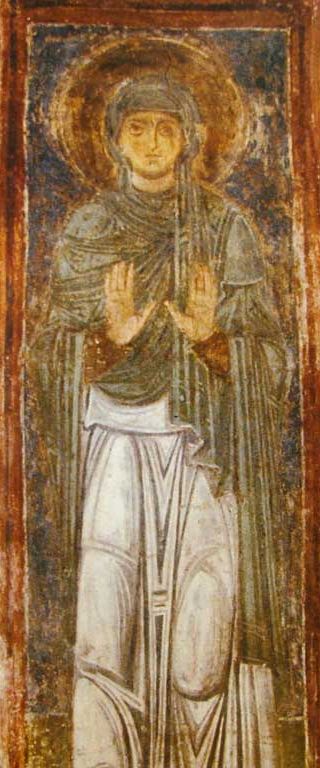
The inestimable influence of the Cappadocian brothers is owed in part to their older sister and teacher, Macrina. Historian Justo González notes that when speaking of the Cappadocians, “justice requires that we deal with another person just as worthy, although often forgotten by historians who tend to ignore the work of women.” Macrina deserves to be called the Fourth Cappadocian, as she is depicted in the icon that hangs in my office (see the header image).
Much of what we know about Macrina is recorded in the Life of Saint Macrina, a biographical letter written by her brother Gregory between 380 and 383. Nearly two-thirds of the narrative describes Gregory’s final visit to Macrina and the events surrounding her saintly death. Gregory’s work On the Soul and the Resurrection is a dialogue with Macrina based on their conversations at that time. She appears as “the teacher,” a theologian in her own right, with insights so deep, clear, and uplifting that she speaks, by his estimation, “as if she were inspired by the Holy Spirit.”
The Early Life of Macrina
Macrina was born around 327 to a wealthy Cappadocian family with an inspiring Christian heritage. Her grandmother and namesake, Macrina the Elder, had “suffered bravely” in the Great Persecution under Diocletian (303–313). When she was being born, Gregory claims that their mother Emmelia had a vision of an angelic visitor who called the child Thekla (or Thecla), after the legendary virgin in the apocryphal Acts of Paul and Thecla. Whatever the case, Macrina was an extraordinary child, excelling in all her studies, steeped in the Scriptures, and devoted to reciting the Psalms from morning to night.
At twelve years of age, Macrina’s “famed” and “blessed beauty” attracted “a great swarm of suitors.” Her father, Basil the Elder, arranged for Marcina to marry a young lawyer, but when he died unexpectedly, Macrina determined never to marry another. She reasoned that her “husband” was not really dead, but “living in God because of the hope of the resurrection,” and since he was “simply away from home on a journey and not a dead body,” “it was improper not to keep faith with a husband who was away on a journey”! Though a peculiar thing for anyone to think, let alone a girl of twelve, Macrina’s decision “was more firmly rooted than one might have expected in one of her age,” and within God’s providence, it would shape the future of one of history’s most important families.
Within God’s providence, Macrina’s determination not to marry would shape the future of one of history’s most important families.
Freed from the concern of marriage, Marcina became wholly devoted to her mother Emmelia, who soon faced the death of Macrina’s father. The young Macrina “took an active part helping her mother in all her pressing concerns,” including the instruction of her siblings, “taking an equal share in her worries and alleviating the burden of her sufferings.” When Marcina’s brother Naucratius died in a hunting accident, Emmelia was overcome with grief, and “then above all,” Gregory thought, “the sublime and exalted soul of the young girl made itself manifest.” Despite her own suffering, she lifted her mother up and held the family together.
Towards Monasticism
The family’s wealth made it possible for Macrina’s brother Basil to receive a superb education abroad, but when he returned home from Athens, Basil was puffed up with his new knowledge. “It was then,” writes González, “that Macrina intervened. She bluntly told her brother that he had become vain, acting as if he were the best inhabitant of the city, and that he would do well in quoting fewer pagan authors and following more of the advice of Christian ones.” Basil shrugged her off until the death of Naucratius, which shook him so badly that “he resigned his teaching position and all other honors, and he asked Macrina to teach him the secrets of religious life.” González explains that “Macrina sought to console her family by leading their thoughts to the joys of religious life. Why not withdraw to their holdings in nearby Annesi, and live there in renunciation and contemplation?”
Macrina, her mother, and several other women withdrew to Annesi while Basil, following the desires of his sister, left for Egypt in order to learn more about the monastic life. Since Basil eventually became the great teacher of monasticism in the Greek-speaking church, and since it was Macrina who awakened his interest in it, it could be said that she was the founder of Greek monasticism.
Macrina’s simple, prayerful way of life seemed to transcend description, and Macrina herself, Gregory thought, seemed to “rise above human nature.” She made her maids into “sisters and equals instead of slaves and servants,” and gave away all that she owned, including her share of the inheritance, which she committed to the priest to distribute as he saw fit. In famine, she took those “who had been left prostrate along the roadways” and “she picked them up, nursed them, brought them back to health and guided them personally to the pure, uncorrupted life.” Her deeds were the fruit of her all-consuming philosophy, or love of wisdom, which meant a mind and heart consumed with divine realities, free of worldly fetters.
Contemplating Divine Things to the End
Gregory’s duties as a bishop kept him away from his sister for many years, but at last he determined to visit “the great Macrina” at the “the remote spot in which she spent her angelic, heavenly life.” To his dismay, he found that Macrina was “caught in the grip of a grievous sickness.” Though racked with pain, Macrina did not want to trouble her younger brother, and “tried to stifle her groans and forced herself somehow to hide her tortured gasping for breath.” Determined “to create a more cheerful mood,” Macrina turned the conversation to divine things.
Macrina’s deeds were the fruit of her all-consuming philosophy, or love of wisdom, which meant a mind and heart consumed with divine realities, free of worldly fetters.
Macrina “kept her mind unhindered in the contemplation of divine things,” and spoke of everything from divine providence to the afterlife, “her philosophy of the soul,” the reason for man’s existence, and the resurrection of the dead. Gregory was mesmerized by his sister’s teachings, “uplifted as it was by her words and set down inside the heavenly sanctuaries by the guidance of her discourse.” Twice he notes that she spoke “as if she were inspired by the Holy Spirit.”
The time came when Macrina stopped speaking to those gathered at her bedside and fixed her attention on God alone. Gregory wrote down her beautiful final prayer:
You have released us, O Lord, from the fear of death.
You have made the end of life here on earth
a beginning of true life for us.
You let our bodies rest in sleep in due season
and you awaken them again
at the sound of the last trumpet.
You entrust to the earth our bodies of earth
which you fashioned with your own hands
and you restore again what you have given,
transforming with incorruptibility and grace
what is mortal and deformed in us.
You redeemed us from the curse and from sin,
having become both on our behalf.
You have crushed the heads of the serpent
Who had seized the man in his jaws
because of the abyss of our disobedience.
You have opened up for us a path
to the resurrection,
having broken down the gates of hell
and reduced to impotence
the one who had power over death.
You have given to those who fear you
a visible token, the sign of the holy cross,
for the destruction of the Adversary
and for the protection of our life.
God Eternal,
Upon whom I have cast myself from my mother’s womb,
Whom my soul has loved with all its strength,
To whom I have consecrated flesh and soul
from my infancy up to this moment,
Put down beside me a shining angel
to lead me by the hand to the place of refreshment
where is the water of repose near the lap of the holy fathers.
You who have cut through the flame
of the fiery sword and brought to paradise
the man who was crucified with you,
who entreated your pity,
remember me also in your kingdom,
for I too have been crucified with you,
for I have nailed my flesh out of reverence for you
and have feared your judgments.
Let not the dreadful abyss separate me
from your chosen ones.
Let not the Slanderer stand against me on my journey.
Let not my sin be discovered before your eyes
if I have been overcome in any way
because of our nature’s weakness
and have sinned in word or deed or thought.
You who have on earth the power to forgive sins,
forgive me, so that I may draw breath again
and may be found before you
in the stripping off of my body
without stain or blemish in the beauty of my soul,
but may my soul be received
blameless and immaculate into your hands
as an incense offering before your face.
The other Gregory, Nazianzen, would eulogize Macrina:
The dust holds the illustrious virgin Macrina, if you have heard something of her,
the first born of the great Emmelia.
But who kept herself from the eyes of all men,
is now on the tongues of all and has a greater glory than any.
The Miracles of Macrina
After her death, Gregory heard more stories of Macrina’s faith and piety. “Do not let the greatest wonder accomplished by this holy lady pass by unrecorded,” said Vetiana, a woman from the monastery. She recounted how a painful, life-threatening growth had miraculously disappeared from Macrina’s breast after she went to the sanctuary, spent “all night long prostrate before the God of healing,” and asked her mother to make the sign of the cross over the tumor. Sebastopolis, a distinguished military man, reported that he and his wife visited the monastery, “that powerhouse of virtue,” and when they left, their daughter’s severe eye disease was cured by Macrina’s prayers, “the true medicine with which she heals diseases.”
Gregory also reports that in a time of famine, “grain was distributed according to need and showed no sign of diminishing.” But Gregory refuses to name the “other miracles still more extraordinary, the cure of sicknesses, the casting out of demons, true prophecies of things to come,” because he believes that many will consider them “outside the realm of what can be accepted.”
Macrina was a true saint and lover of Christ, venerated for her piety and intellect by all who knew her.
While some think that Gregory’s account is idealistic and embellished, Natalie Carnes notes that “he takes pains to assure the reader that the Macrina she meets in his text is, indeed, Macrina the Younger of Annisa. All the stories in his text come from personal experience, and he insists he delivers them in an unstudied and unstylized manner.” There can be no doubt that Macrina was a true saint and lover of Christ, venerated for her piety and intellect by all who knew her. In death as in life, “it was really towards her beloved that she ran, and no other of life’s pleasures turned her eye to itself away from her beloved.”
Chronology
- 303–313: Diocletianic Persecution; Macrina the Elder suffers bravely
- 325: Council of Nicaea condemns Arianism
- c. 327: Macrina the Younger is born in Caesarea, Cappadocia
- 328: Athanasius succeeds Alexander as bishop of Alexandria
- c. 329: Macrina’s brother Basil is born
- 340: Macrina’s father, Basil the Elder, dies
- c. 335: Macrina’s brother Gregory is born
- 341: Macrina’s brother Peter is born
- 352: Macrina founds the monastery at Annisa by the Iris River
- 370: Macrina’s mother, Emmelia, dies
- c. 379: Macrina dies at Annisa
- c. 380/383: Gregory writes Life of Saint Macrina, a biography of Macrina
- 381: Gregory writes On the Soul and the Resurrection, a dialogue with Macrina
holyjoys.org