Catena Aurea by St. Thomas Aguinas
13:1–9
1. The same day went Jesus out of the house, and sat by the sea side.
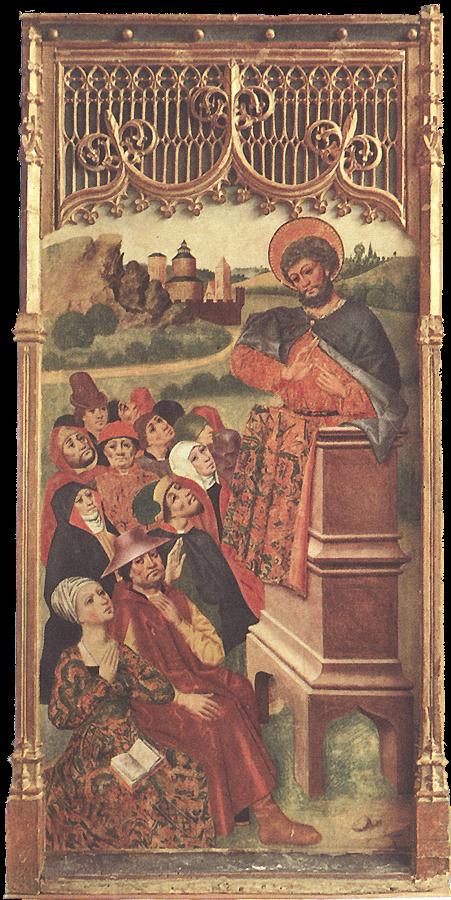
2. And great multitudes were gathered together unto him, so that he went into a ship, and sat; and the whole multitude stood on the shore.
3. And he spake many things unto them in parables, saying, Behold, a sower went forth to sow;
4. And when he sowed, some seeds fell by the way side, and the fowls came and devoured them up:
5. Some fell upon stony places, where they had not much earth: and forthwith they sprung up, because they had no deepness of earth:
6. And when the sun was up, they were scorched; and because they had no root, they withered away.
7. And some fell among thorns; and the thorns sprung up, and choked them:
8. But other fell into good ground, and brought forth fruit, some an hundredfold, some sixtyfold, some thirtyfold.
9. Who hath ears to hear, let him hear.
CHRYSOSTOM. When He had rebuked him that told Him of His mother and His brethren, He then did according to their request; He departed out of the house, having first corrected His brethren for their weak desire of vainglory; He then paid the honour due to His mother, as it is said, The same day Jesus went forth out of the house, and sat down by the sea side.
AUGUSTINE. (De Cons. Ev. ii. 41.) By the words, The same day, he sufficiently shews that these things either followed immediately upon what had gone before, or that many things could not have intervened; unless indeed ‘day’ here after the Scripture manner signifies a period.
RABANUS. For not only the Lord’s words and actions, but His journeyings also, and the places in which He works His mighty works and preaches, are full of heavenly sacraments. After the discourse held in the house, wherein with wicked blasphemy He had been said to have a dæmon, He went out and taught by the sea, to signify that having left Judæa because of their sinful unbelief, He would pass to the salvation of the Gentiles. For the hearts of the Gentiles, long proud and unbelieving, are rightly likened to the swelling and bitter waves of the sea. And who knows not that Judæa was by faith the house of the Lord.
JEROME. For it must be considered, that the multitude could not enter into the house to Jesus, nor be there where the Apostles heard mysteries; therefore the Lord in mercy to them departed out of the house, and sat near the sea of this world, that great numbers might be gathered to Him, and that they might hear on the sea shore what they were not worthy to hear within; And great multitudes were gathered unto him, so that he went into a ship, and sat down, and all the people stood on the shore.
CHRYSOSTOM. The Evangelist did not relate this without a purpose, but that he might shew the Lord’s will therein, who desired so to place the people that He should have none behind Him, but all should be before His face.
HILARY. There is moreover a reason in the subject of His discourse why the Lord should sit in the ship, and the multitude stand on the shore. For He was about to speak in parables, and by this action signifies that they who were without the Church could have no understanding of the Divine Word. The ship offers a type of the Church, within which the word of life is placed, and is preached to those without, and who as being barren sand cannot understand it.
JEROME. Jesus is in the midst of the waves; He is beaten to and fro by the waves, and, secure in His majesty, causes His vessel to come nigh the land, that the people not being in danger, not being surrounded by temptations which they could not endure, might stand on the shore with a firm step, to hear what was said.
RABANUS. Or, that He went into a ship and sat on the sea, signifies that Christ by faith should enter into the hearts of the Gentiles, and should gather together the Church in the sea, that is in the midst of the nations that spake against Him. And the crowd that stood on the sea shore, neither in the ship nor in the sea, offers a figure of those that receive the word of God, and are by faith separated from the sea, that is from the reprobate, but are not yet imbued with heavenly mysteries. It follows; And he spake many things unto them in parables.
CHRYSOSTOM. He had not done thus on the mount; He had not framed His discourse by parables. For there were the multitudes only, and a mixed crowd, but here the Scribes and Pharisees. But He speaks in parables not for this reason only, but to make His sayings plainer, and fix them more fully in the memory, by bringing things before the eyes.
JEROME. And it is to be noted, that He spake not all things to them in parables, but many things, for had He spoken all things in parables, the people would have departed without benefit. He mingles things plain with things dark, that by those things which they understand they may be incited to get knowledge of the things they understand not. The multitude also is not of one opinion, but of divers wills in divers matters, whence He speaks to them in many parables, that each according to their several dispositions may receive some portion of His teaching.
CHRYSOSTOM. He first sets forth a parable to make His hearers more attentive, and because He was about to speak enigmatically, He attracts the attention by this first parable, saying, Behold, a sower went forth to sow his seed.
JEROME. By this sower is typified the Son of God, who sows among the people the word of the Father.
CHRYSOSTOM. Whence then went out He who is every where present, and how went He out? Not in place; but by His incarnation being brought nearer to us by the garb of the flesh. Forasmuch as we because of our sins could not enter in unto Him, He therefore came forth to us.
RABANUS. Or, He went forth, when having left Judea, He passed by the Apostles to the Gentiles.
JEROME. Or, He was within while He was yet in the house, and spake sacraments to His disciples. He went therefore forth from the house, that He might sow seed among the multitudes.
CHRYSOSTOM. When you hear the words, the sower went out to sow, do not suppose that is a tautology. For the sower goes out oftentimes for other ends; as, to break up the ground, to pluck up noxious weeds, to root up thorns, or perform any other species of industry, but this man went forth to sow. What then becomes of that seed? three parts of it perish, and one is preserved; but not all in the same manner, but with a certain difference, as it follows, And as he sowed, some fell by the wayside.
JEROME. This parable Valentinus lays hold of to establish his heresy, bringing in three different natures; the spiritual, the natural or the animal, and the earthly. But there are here four named, one by the wayside, one stony, one thorny, and a fourth the good ground.
CHRYSOSTOM. Next, how is it according to reason to sow seed among thorns, or on stony ground, or by the wayside? Indeed in the material seed and soil of this world it would not be reasonable; for it is impossible that rock should become soil, or that the way should not be the way, or that thorns should not be thorns. But with minds and doctrines it is otherwise; there it is possible that the rock be made rich soil, that the way should be no more trodden upon, and that the thorns should be extirpated. That the most part of the seed then perished, came not of him that sowed, but of the soil that received it, that is the mind. For He that sowed put no difference between rich and poor, wise or foolish, but spoke to all alike; filling up his own part, though foreseeing all things that should come to pass, so that He might say, What ought I to have done that I have not done? (Is. 5:4) He does not pronounce sentence upon them openly and say, this the indolent received and have lost it, this the rich and have choked it, this the careless and have lost it, because He would not harshly reprove them, that He might not alienate them altogether. By this parable also He instructs His disciples, that though the greater part of those that heard them were such as perished, yet that they should not therefore be remiss; for the Lord Himself who foresaw all things, did not on this account desist from sowing.
JEROME. Note that this is the first parable that has been given with its interpretation, and we must beware where the Lord expounds His own teachings, that we do not presume to understand any thing either more or less, or any way otherwise than as so expounded by Him.
RABANUS. But those things which He silently left to our understanding, should be shortly noticed. The wayside is the mind trodden and hardened by the continual passage of evil thoughts; the rock, the hardness of the self-willed mind; the good soil, the gentleness of the obedient mind, the sun, the heat of a raging persecution. The depth of soil, is the honesty of a mind trained by heavenly discipline. But in thus expounding them we should add, that the same things are not always put in one and the same allegorical signification.
JEROME. And we are excited to the understanding of His words, by the advice which follows, He that hath ears to hear, let him hear.
REMIGIUS. These ears to hear, are ears of the mind, to understand namely and do those things which are commanded.
13:10–17
10. And the disciples came, and said unto him, Why speakest thou unto them in parables?
11. He answered and said unto them, Because it is given unto you to know the mysteries of the kingdom of heaven, but to them it is not given.
12. For whosoever hath, to him shall be given, and he shall have more abundance: but whosoever hath not, from him shall be taken away even that he hath.
13. Therefore speak I to them in parables: because they seeing see not; and hearing they hear not, neither do they understand.
14. And in them is fulfilled the prophecy of Esaias, which saith, By hearing ye shall hear, and shall not understand; and seeing ye shall see, and shall not perceive:
15. For this people’s heart is waxed gross, and their ears are dull of hearing, and their eyes they have closed: lest at any time they should see with their eyes, and hear with their ears, and should understand with their heart, and should be converted, and I should heal them.
16. But blessed are your eyes, for they see: and your ears, for they hear.
17. For verily I say unto you, That many prophets and righteous men have desired to see those things which ye see, and have not seen them; and to hear those things which ye hear, and have not heard them.
GLOSS. (ap. Anselm.) The disciples understanding that the things which were spoken by the Lord to the people were obscure, desired to hint to Him that He should not speak in parables to them. And his disciples came to him, and said, Why speakest thou to them in parables?
CHRYSOSTOM. (Hom, xlv.) Wherein it is worthy admiration, that the disciples who desire to learn of Him, know when they ought to ask Him, for they do not this before the multitude. This Matthew declares, when he says, And they came to him; (Mark 4:10) and Mark more expressly says, that they came to him when he was alone.
JEROME. We must enquire how they could come to Him at that time when Jesus was sitting in the ship; we may understand that they had at the first entered into the ship, and standing there, made this enquiry of Him.
REMIGIUS. The Evangelist therefore says, came to him, to express that they eagerly enquired of Him; or they might indeed approach Him bodily, though the space between them was small.
CHRYSOSTOM. And observe moreover their goodness, how great their thought for others, that they enquire about what concerns others, before what relates to themselves. For they say not, ‘Why speakest thou to us in parables?’ but to them. And he answered and said unto them, Because it is given to you to know the mystery of the kingdom of heaven.
REMIGIUS. To you, I say, who adhere to Me, and believe in Me. By the mystery of the kingdom of heaven, He intends the Gospel doctrine. To them, that is, to them that are without, and who would not believe on Him, the Scribes namely and Pharisees, and to the rest who continue in unbelief, it is not given. Let us then, with the disciples, come unto the Lord with a pure heart, that He may think us worthy to interpret to us the evangelic teaching; according to that, They who draw near to his feet, shall receive of his doctrine. (Deut. 33:3)
CHRYSOSTOM. In saying this, He does not imply any necessity or fate, but shews at once, that they, to whom it is not given, are the cause of all their own miseries, and yet that the knowledge of the Divine mysteries is the gift of God, and a grace given from above. Yet this does not destroy free will, as is manifest from what follows, for to prevent that either these should despair, or those be remiss, when they hear that to you it is given, He shews that the beginning of all lays with ourselves, and then He adds, For whoso hath, to him shall be given, and he shall abound; and whoso hath not, from him shall be taken what he hath. As much as to say, Whoso has the desire and the zeal, to him shall be given all those things which are of God; but whoso lacketh these, and does not contribute that part that pertains to him, to him neither are the things which are of God given, but even those things that he hath are taken from him; not because God takes them away, but because he hath made himself unworthy of those that he has. Wherefore we also, if we see any hearkening carelessly, and having exhorted him to attend, he do not heed us, let us be silent; for should we persevere in urging him, his sloth-fulness will be the more charged against him. But him that is zealous to learn, we draw onwards, pouring forth many things. And He well said according to another Evangelist, That which he seemeth to have; (Luke 8:18.) for, in truth, he has not even that he has.
REMIGIUS. He that has a desire to read, shall have given to him power to understand, and whoso has not desire to read, that understanding which by the bounty of nature he seems to have, even that shall be taken from him. Or, whoso has charity, to him shall be given the other virtues also; and from him who has not charity, the other virtues likewise shall be taken away, for without charity there can be nothing good.
JEROME. Or, To the Apostles who believe in Christ there is given, but from the Jews who believed not on the Son of God there is taken away, even whatever good they might seem to have by nature. For they cannot understand any thing with wisdom, seeing they have not the head of wisdom.
HILARY. For the Jews not having faith, have lost also the Law which they had; and Gospel faith has the perfect gift, inasmuch as if received it enriches with new fruit, if rejected it subtracts from the riches of ancient possession.
CHRYSOSTOM. But that what He had said might be made more manifest He adds, Therefore speak I unto them in parables, because seeing they see not, and hearing they hear not, neither do they understand. Had this been a natural blindness, He ought to have opened their eyes; but forasmuch as it is voluntary, therefore He said not simply, ‘They see not,’ but, Seeing they see not. For they had seen the dæmons going out, and they said, He casts out dæmons by Beelzebub; they heard that He drew all men to God, and they say, This man is not of God. (John 9:16) Therefore because they spake the very contrary to what they saw and heard, to see and to hear is taken from them; for they profit nothing, but rather fall under judgment. For this reason He spake to them at first not in parables, but with much clearness; but because they perverted all they saw and heard, He now speaks in parables.
REMIGIUS. And it should be noted, that not only what He spake, but also what He did, were parables, that is, signs of things spiritual, which He clearly shews when He says, That seeing they may not see; but words are heard and not seen.
JEROME. This He says of those who were standing on the shore, and separated from Jesus, and who because of the dashing of the waves heard not distinctly what was said.
CHRYSOSTOM. And that they should not say, He slanders us as an enemy, He brings forward the Prophet declaring the same opinion, as it follows, That there might be fulfilled in them the prophecy of Isaiah, who said, With the hearing ye shall hear and shall not understand, and seeing ye shall see and shall not behold. (Is. 6:9)
GLOSS. (non occ.) That is; With the hearing ye shall hear words, but shall not understand the hidden meaning of those words; seeing ye shall see My flesh indeed, but shall not discern the divinity.
CHRYSOSTOM. This He said because they had taken away their own sight and hearing, shutting their eyes, and hardening their hearts. For not only did they not hear at all, but they heard obtusely, as it follows, The heart of this people is waxed gross, and they have heard hardly with their ears.
RABANUS. The heart of the Jews is made gross with the grossness of wickedness, and through the abundance of their sins they hear hardly the Lord’s words, because they have received them ungratefully.
JEROME. And that we should not suppose that this grossness of the heart and heaviness of the ears is of nature, and not of choice, He adds the fruit of their own wilfulness, For they have shut their eyes.
CHRYSOSTOM. Herein He points out how extreme their wickedness, how determined their aversion. Again to draw them towards Him, He adds, And be converted, and I should heal them; which shews that if they would be converted, they should be healed. As if one should say, If he would ask me I would immediately forgive him, this would point out how he might be reconciled; so here when He says, Lest they should he converted and I should heal them, He, shews that it was possible they should be converted, and having done penitence should be saved.
AUGUSTINE. (Quæst. in Matt. q. 14.) Otherwise; They have shut their eyes lest they should see with their eyes, that is, themselves were the cause that God shut their eyes. For another Evangelist says, We hath blinded their eyes. But is this to the end that they should never see? Or that they should not see so much as this, that becoming discontent with their own blindness and bewailing themselves, should so be humbled, and moved to confession of their sins and pious seeking after God. For Mark thus expresses the same thing, Lest they should be converted, and their sins should be forgiven them. From which we learn, that by their sins they deserved not to understand; and that yet this was allowed them in mercy that they should confess their sins, and should turn, and so merit to be forgiven. But when John relating this expresses it thus, Therefore they could not believe because Esaias said again, He hath blinded their eyes and hardened their heart, that they should not see with their eyes, and understand with their heart, and be converted, and I should heal them, (John 12:39) this seems to be opposed to this interpretation, and to compel us to take what is here said, Lest they should see with their eyes, not as though they might come to see after this fashion, but that they should never see at all; for he says it plainly, That they should not see with their eyes. And that he says, Therefore they could not believe, sufficiently shows that the blindness was not inflicted, to the end that moved thereby, and grieving that they understood not, they should be converted through penitence; for that they could not, unless they had first believed, and by believing had been converted, and by conversion had been healed, and having been healed understood; but it rather shews that they were therefore blinded that they should not believe. For he speaks most clearly, Therefore they could not believe. But if it be so, who would not rise up in defence of the Jews, and pronounce them to be free from all blame for their unbelief? For, Therefore they could not believe, because he hath blinded their eyes. But because we must rather believe God to be without fault, we are driven to confess that by some other sins they had thus deserved to be blinded, and that indeed this blinding prevented them from believing; for the words of John are these, They could not believe, because that Esaias said again, He hath blinded their eyes. It is in vain then to endeavour to understand it that they were therefore blinded that they should be converted; seeing they could not be converted because they believed not; and they could not believe because they were blinded. Or perhaps we should not say amiss thus—that some of the Jews were capable of being healed, but that being puffed up with so great swelling pride, it was good for them at first that they should not believe, that they might understand the Lord speaking in parables, which if they did not understand they would not believe; and thus not believing on Him, they together with the rest who were past hope crucified Him; and at length after His resurrection, they were converted, when humbled by the guilt of His death they loved Him the more because of the heavy guilt which had been forgiven them; for their so great pride needed such an humiliation to overcome it. This might indeed be thought an inconsistent explanation, did we not plainly read in the Acts of the Apostles that thus it was. This then that John says, Therefore they could not believe, because he hath blinded their eyes that they should not see, (Acts 2:37) is not repugnant to our holding that they were therefore blinded that they should be converted; that is to say, that the Lord’s meaning was therefore purposely clothed in the obscurities of parables, that after His resurrection they might turn them to wisdom with a more healthy penitence. For by reason of the darkness of His discourse, they being blinded did not understand the Lord’s sayings, and not understanding them, they did not believe on Him, and not believing on Him they crucified Him; thus after His resurrection, terrified by the miracles that were wrought in His name, they had the greater compunction for their great sin, and were more prostrated in penitence; and accordingly after indulgence granted they turned to obedience with a more ardent affection. Notwithstanding, some there were to whom this blinding profited not to conversion.
REMIGIUS. In all the clauses the word ‘not’ must be understood; thus; That they should not see with their eyes, and should not hear with their ears, and should not understand with their heart, and should not be converted, and I should heal them.
GLOSS. (ap. Anselm.) so then the eyes of them that see, and will not believe, are miserable, but your eyes are blessed; whence it follows; Blessed are your eyes, for they see, and your ears, for they hear.
JEROME. If we had not read above that invitation to his hearers to understand, when the Saviour said, He that hath, ears to hear let him hear, we might here suppose that the eyes and ears which are now blessed are those of the body. But I think that those eyes are blessed which can discern Christ’s sacraments, and those ears of which Isaiah speaks, The Lord hath given me an ear. (Is. 50:4)
GLOSS. (ord.) The mind is called an eye, because it is intently directed upon what is set before it to understand it; and an ear, because it learns from the teaching of another.
HILARY. Or, He is speaking of the blessedness of the Apostolic times, to whose eyes and ears it was permitted to see and to hear the salvation of God, many Prophets and just men having desired to see and to hear that which was destined to be in the fulness of times; whence it follows; Verily I say unto you, that many Prophets and just men have desired to see the things that ye see, and to hear the things that ye hear, and have not heard them.
JEROME. This place seems to be contradicted by what is said elsewhere. Abraham rejoiced to see my day, and he saw it, and was glad. (John 8:56)
RABANUS. Also Isaiah and Micah, and many other Prophets, saw the glory of the Lord; and were thence called ‘seers.’
JEROME. But He said not, ‘The Prophets and the just men,’ but many; for out of the whole number, it may be that some saw, and others saw not. But as this is a perilous interpretation, that we should seem to be making a distinction between the merits of the saints, at least as far as the degree of their faith in Christ, therefore we may suppose that Abraham saw in enigma, and not in substance. But ye have truly present with you, and hold, your Lord, enquiring of Him at your will, and eating with Him.1
CHRYSOSTOM. These things then which the Apostles saw and heard, are such as His presence, His voice, His teaching. And in this He sets them before not the evil only, but even before the good, pronouncing them more blessed than even the righteous men of old. For they saw not only what the Jews saw not, but also what the righteous men and Prophets desired to see, and had not seen. For they had beheld these things only by faith, but these by sight, and even yet more clearly. You see how He identifies the Old Testament with the New, for had the Prophets been the servants of any strange or hostile Deity, they would not have desired to see Christ.
13:18–23
18. Hear ye therefore the parable of the sower.
19. When any one heareth the word of the kingdom, and understandeth it not, then cometh the wicked one, and catcheth away that which was sown in his heart. This is he which received seed by the way side.
20. But he that received the seed into stony places, the same is he that heareth the word, and anon with joy receiveth it;
21. Yet hath he not root in himself, but dureth for a while: for when tribulation or persecution ariseth because of the word, by and by he is offended.
22. He also that received seed among the thorns is he that heareth the word; and the care of this world, and the deceitfulness of riches, choke the word, and he becometh unfruitful.
23. But he that received seed into the good ground is he that heareth the word, and understandeth it; which also beareth fruit, and bringeth forth, some an hundredfold, some sixty, some thirty.
GLOSS. (ap. Anselm.) He had said above, that it was not given to the Jews to know the kingdom of God, but to the Apostles, and therefore He now concludes, saying, Hear ye therefore the parable of the sower, ye to whom are committed the mysteries of heaven.
AUGUSTINE. (De Gen. ad lit. viii. 4.) It is certain that the Lord spoke the things which the Evangelist has recorded; but what the Lord spake was a parable, in which it is never required that the things contained should have actually taken place.
GLOSS. (ap. Anselm.) He proceeds then expounding the parable; Every man who hears the word of the kingdom, that is, My preaching which avails to the acquiring the kingdom of heaven, and understandeth it not; how he understands it not, is explained by, for the evil one—that is the Devil—cometh and taketh away that which is sown in his heart; every such man is that which is sown by the way side. And note that that which is sown, is taken in different senses; for the seed is that which is sown, and the field is that which is sown, both of which are found here. For where He says carrieth away that which is sown, we must understand it of the seed; that which follows, is sown by the way side, is to be understood not of the seed, but of the place of the seed, that is, of the man, who is as it were the field sown by the seed of the Divine word.
REMIGIUS. In these words the Lord explains what the seed is, to wit, the word of the kingdom, that is of the Gospel teaching. For there are some that receive the word of the Lord with no devotion of heart, and so that seed of God’s word which is sown in their heart, is by dæmons straightway carried off, as it were the seed dropped by the way side. It follows, That which is sown upon the rock, is he that heareth the word, &c. For the seed or word of God, which is sown in the rock, that is, in the hard and untamed heart, can bring forth no fruit, inasmuch as its hardness is great, and its desire of heavenly things small; and because of this great hardness, it has no root in itself.
JEROME. Note that which is said, is straightway offended. There is then some difference between him who, by many tribulations and torments, is driven to deny Christ, and him who at the first persecution is offended, and falls away, of which He proceeds to speak, That which is sown among thorns. To me He seems here to express figuratively that which was said literally to Adam; Amidst briers and thorns thou shalt eat thy bread, (Gen. 3:18) that he that has given himself up to the delights and the cares of this world, eats heavenly bread and the true food among thorns.
RABANUS. Rightly are they called thorns, because they lacerate the soul by the prickings of thought, and do not suffer it to bring forth the spiritual fruit of virtue.
JEROME. And it is elegantly added, The deceitfulness of riches choke the word; for riches are treacherous, promising one thing and doing another. The tenure of them is slippery as they are borne hither and thither, and with uncertain step forsake those that have them, or revive those that have them not. Whence the Lord asserts, that rich men hardly enter into the kingdom of heaven, because their riches choke the word of God, and relax the strength of their virtues.
REMIGIUS. And it should be known, that in these three sorts of bad soil are comprehended all who can hear the word of God, and yet have not strength to bring it forth unto salvation. The Gentiles are excepted, who were not worthy even to hear it. It follows, That which is sown on the good ground. The good ground is the faithful conscience of the elect, or the spirit of the saints which receives the word of God with joy and desire and devotion of heart, and manfully retains it amid prosperous and adverse circumstances, and brings it forth in fruit; as it follows, And brings forth fruit, some a hundred-fold, some sixty-fold, some thirty-fold.
JEROME. And it is to be noted, that as in the bad ground there were three degrees of difference, to wit, that by the way side, the stony and the thorny ground; so in the good soil there is a three-fold difference, the hundred-fold, the sixty-fold, and the thirty-fold. And in this as in that, not the substance but the will is changed, and the hearts as well of the unbelieving as the believing receive seed; as in the first case He said, Then cometh the wicked one, and carrieth off that which is sown in the heart; and in the second and third case of the bad soil He said, This is he that heareth the word. So also in the exposition of the good soil, This is he that heareth the word. Therefore we ought first to hear, then to understand, and after understanding to bring forth the fruits of teaching, either an hundred-fold, or sixty, or thirty.
AUGUSTINE. (De Civ. Dei, xxi. 27.) Some think that this is to be understood as though the saints according to the degree of their merits delivered some thirty, some sixty, some an hundred persons; and this they usually suppose will happen on the day of judgment, not after the judgment. But when this opinion was observed to encourage men in promising themselves impunity, because that by this means all might attain to deliverance, it was answered, that men ought the rather to live well, that each might be found among those who were to intercede for the liberation of others, lest these should be found to be I so few that they should soon have exhausted the number allotted to them, and thus there would remain many unrescued from torment, among whom might be found all such as in most vain rashness had promised themselves to reap the fruits of others.
REMIGIUS. The thirty-fold then is borne of him who teaches faith in the Holy Trinity; the sixty-fold of him who enforces the perfection of good works; (for in the number six this world was completed with all its equipments;) (Gen. 2:1) while he bears the hundred-fold who promises eternal life. For the number one hundred passes from the left hand to the right; and by the left hand the present life is denoted, by the right hand the life to come. Otherwise, the seed of the word of God brings forth fruit thirty-fold when it begets good thoughts, sixty-fold when good speech, and an hundred-fold when it brings to the fruit of good works.
AUGUSTINE. (Quæst. Ev. i. 9.) Otherwise; There is fruit an hundred-fold of the martyrs because of their satiety of life or contempt of death; a sixty-fold fruit of virgins, because they rest not warring against the use of the flesh; for retirement is allowed to those of sixty years’ age after service in war or in public business; and there is a thirty-fold fruit of the wedded, because theirs is the age of warfare, and their struggle is the more arduous that they should not be vanquished by their lusts. Or otherwise; We must struggle with our love of temporal goods that reason may be master; it should either be so overcome and subject to us, that when it begins to rise it may be easily repressed, or so extinguished that it never arises in us at all. Whence it comes to pass, that death itself is despised for truth’s sake, by some with brave endurance, by others with content, and by others with gladness—which three degrees are the three degrees of fruits of the earth—thirty-fold, sixty-fold, and an hundred-fold. And in one of these degrees must one be found at the time of his death, if any desires to depart well out of this life.
JEROME. (vid. Cyp. Tr. iv. 12.) Or, The hundred-fold fruit is to be ascribed to virgins, the sixty-fold to widows and continent persons, the thirty-fold to chaste wedlock.
JEROME. (Ep. 48. 2.) For the joining together of the hands, as it were in the soft embrace of a kiss, represents husband and wife. The sixty-fold refers to widows, who as being set in narrow circumstances and affliction are denoted by the depression of the finger; for by how much greater is the difficulty of abstaining from the allurements of pleasure once known, so much greater is the reward. The hundredth number passes from the left to the right, and by its turning round with the same fingers, not on the same hand, it expresses the crown of virginitya.
Catena Aurea Matthew 13
Gospel Reading:From: Matthew 13:1-23
Parable of the Sower
--------------------
[1] That same day Jesus went out of the house and sat beside the sea. [2] And great crowds gathered about Him, so that He got into a boat and sat there; and the whole crowd stood on the beach. [3] And He told them many things in parables, saying: "A sower went out to sow. [4] And as he sowed, some seeds fell along the path, and the birds came and devoured them. [5] Other seeds fell on rocky ground, where they had not much soil, and immediately they sprang up, since they had no depth of soil, [6] but when the sun rose they were scorched; and since they had no root they withered away. [7] Other seeds fell upon thorns, and the thorns grew up and choked them. [8] Other seeds fell on good soil and brought forth grain, some a hundredfold, some sixty, some thirty. [9] He who has ears, let him hear."
[10] Then the disciples came and said to Him (Jesus), "Why do You speak to them in parables?" [11] And He answered them, "To you it has been given to know the secrets of the Kingdom of Heaven, but to them it has not been given. [12] For to him who has will more be given, and he will have abundance; but from him who has not, even what he has will be taken away. [13] This is why I speak to them in parables, because seeing they do not see, and hearing they do not hear, nor do they understand. [14] With them indeed is fulfilled the prophecy of Isaiah which says: `You shall indeed hear but never understand, and you shall indeed see but never perceive. [15] For this people's heart has grown dull, and their ears are heavy of hearing, and their eyes they have closed, lest they should perceive with their eyes, and hear with their ears, and understand with their heart, and turn for me to heal them.'
[16] But blessed are your eyes, for they see, and your ears, for they hear. [17] Truly, I say to you, many prophets and righteous men longed to see what you see, and did not see it, and to hear what you hear, and did not hear it."
[18] "Hear then the parable of the sower. [19] When any one hears the Word of the Kingdom and does not understand it, the evil one comes and snatches away what is sown in his heart; this is what was sown along the path. [20] As for what was sown on rocky ground, this is he who hears the Word and immediately receives it with joy; [21] yet he has no root in himself, but endures for a while, and when tribulation or persecution arises on account of the Word, immediately he falls away. [22] As for what was sown among thorns, this is he who hears the Word, but the cares of the world and the delight in riches choke the Word, and it proves unfruitful. [23] As for what was sown on good soil, this is he who hears the Word and understands it; he indeed bears fruit, and yields, in one case a hundredfold, in another sixty, and in another thirty."
***********************************************************************
Commentary:
3. Chapter 13 of St. Matthew includes as many as seven of Jesus' parables, which is the reason why it is usually called "the parable discourse" or the "parabolic discourse". Because of their similarity of content and setting these parables are often called the "Kingdom parables", and also the "parables of the Lake", because Jesus taught them on the shore of Lake Gennesaret. Jesus uses these elaborate comparisons (parables) to explain certain features of the Kingdom of God which He has come to establish (cf. Matthew 3:2)--its tiny, humble origins; its steady growth; its worldwide scope; its salvific force. God calls everyone to salvation but only those attain it who receive God's call with good dispositions and who do not change their attitude; the value of the spiritual benefits the Kingdom brings--so valuable that one should give up everything to obtain them; the fact that good and bad are all mixed together until the harvest time, or the time of God's judgment; the intimate connection between earthly and heavenly aspects of the Kingdom, until it reaches its point of full development at the end of time.
On Jesus' lips, parables are exceptionally effective. By using parables He keeps His listeners' attention, whether they are uneducated or not, and by means of the most ordinary things of daily life He sheds light on the deepest supernatural mysteries. He used the parable device in a masterly way; His parables are quite unique; they carry the seal of His personality; through them He has graphically shown us the riches of grace, the life of the Church, the demands of the faith and even the mystery of God's own inner life.
Jesus' teaching continues to provide every generation with light and guidance on moral conduct. By reading and reflecting on His parables one can savor the adorable humanity of the Savior, who showed such kindness to the people who crowded around to hear Him--and who shows the same readiness to listen to our prayers, despite our dullness, and to reply to our healthy curiosity when we try to make out His meaning.
3-8. Anyone who has visited the fertile plain to the west of the Lake of Gennesaret will appreciate Jesus' touching description in the parable of the sower. The plain is crisscrossed by paths; it is streaked with rocky ground, often with the rocks lying just beneath the surface, and with the courses of rivulets, dry for most of the year but still retaining some moisture. Here and there are clumps of large thorn bushes. When the agricultural worker sows seed in this mixed kind of land, he knows that some seed will fare better than others.
9. Jesus did not explain this parable there and then. It was quite usual for parables to be presented in the first instance as a kind of puzzle to gain the listener's attention, excite his curiosity and fix the parable in his memory. It may well be that Jesus wanted to allow his more interested listeners to identify themselves by coming back to hear Him again--as happened with His disciples. The rest--who listened out of idle curiosity or for too human reasons (to see Him work miracles)--would not benefit from hearing a more detailed and deeper explanation of the parable.
10-13. The kind of Kingdom Jesus was going to establish did not suit the Judaism of His time, largely because of the Jew's nationalistic, earthbound idea of the Messiah to come. In His preaching Jesus takes account of the different outlooks of His listeners, as can be seen in the attitudes described in the parable of the sower. If people were well disposed to Him, the enigmatic nature of the parable would stimulate their interest; and Jesus later did give His many disciples a fuller explanation of its meaning; but there was no point in doing this if people were not ready to listen.
Besides, parables--as indeed any type of comparison or analogy—are used to reveal or explain something which is not easy to understand, as was the case with the supernatural things Jesus was explaining. One has to shade one's eyes to see things if the sun is too bright; otherwise, one is blinded and sees nothing. Similarly, parables help to shade supernatural brightness to allow the listener to grasp meaning without being blinded by it.
These verses also raise a very interesting question: how can divine revelation and grace produce such widely differing responses in people? What is at work here is the mystery of divine grace--which is an unmerited gift--and of man's response to this grace. What Jesus says here underlines man's responsibility to be ready to accept God's grace and to respond to it. Jesus' reference to Isaiah (Matthew 13:14-15) is a prophecy of that hardness of heart which is a punishment meted out to those who resist grace.
These verses need to be interpreted in the light of three points: 1) Jesus Christ loved everyone, including people of His own home town: He gave His life in order to save all men; 2) the parable is a literary form designed to get ideas across clearly: its ultimate aim is to teach, not to mislead or obscure; 3) lack of appreciation for divine grace is something blameworthy, which does merit punishment; however, Jesus did not come directly to punish anyone, but rather to save everyone.
12. Jesus is addressing His disciples and explaining to them that, precisely because they have faith in Him and want to have a good grasp of His teaching, they will be given a deeper understanding of divine truths. But those who do not "follow Him" (cf. note on Matthew 4:18-22) will later lose interest in the things of God and will grow ever blinder: it is as if the little they have is being taken away from them.
This verse also helps us understand the meaning of the parable of the sower, a parable which gives a wonderful explanation of the supernatural economy of divine grace: God gives grace, and man freely responds to that grace. The result is that those who respond to grace generously receive additional grace and so grow steadily in grace and holiness; whereas those who reject God's gifts become closed up within themselves; through their selfishness and attachment to sin they eventually lose God's grace entirely. In this verse, then, our Lord gives a clear warning: with the full weight of His divine authority He exhorts us--without taking away our freedom--to act responsibly: the gifts God keeps sending us should yield fruit; we should make good use of the opportunities for Christian sanctification which are offered us in the course of our lives.
14-15. Only well-disposed people grasp the meaning of God's words. It is not enough just to hear them physically. In the course of Jesus' preaching the prophetic words of Isaiah come true once again.
However, we should not think that not wanting to hear or to understand was something exclusive to certain contemporaries of Jesus; each one of us is at times hard of hearing, hard-hearted and dull-minded in the presence of God's grace and saving word. Moreover, it is not enough to be familiar with the teaching of the Church: it is absolutely necessary to put the faith into practice, with all that that implies, morally and ascetically. Jesus was fixed to the wood of the Cross not only by nails and by the sins of certain Jews but also by our sins—sins committed centuries later but which afflicted the Sacred Humanity of Jesus Christ, who bore the burden of our sins. See the note on Mark 4:11-12.
16-17. In contrast with the closed attitude of many Jews who witnessed Jesus' life but did not believe in Him, the disciples are praised by our Lord for their docility to grace, their openness to recognizing Him as the Messiah and to accepting His teaching.
He calls His disciples blessed, happy. As He says, the prophets and just men and women of the Old Testament had for centuries lived in hope of enjoying one day the peace the future Messiah would bring, but they had died without experiencing this good fortune. Simeon, towards the end of his long life, was filled with joy on seeing the infant Jesus when He was presented in the temple: "He took Him up in his arms and blessed God and said, `Lord now lettest Thou Thy servant depart in peace, according to Thy word; for mine eyes have seen Thy salvation'" (Luke 2:28-30). During our Lord's public life, His disciples were fortunate enough to see and be on close terms with Him; later they would recall that incomparable gift, and one of them would begin his first letter in these words: "That which was from the beginning, which we have heard, which we have seen with our own eyes, which we have looked upon and touched with our hands, concerning the word of life; [...] that which we have seen and heard we proclaim also to you, so that you may have fellowship with us; and our fellowship is with the Father and with His Son Jesus Christ. And we are writing this that our [or: your] joy may be complete (1 John 1:1-4).
This exceptional good fortune was, obviously, not theirs but of special merit: God planned it; it was He who decided that the time had come for the Old Testament prophecies to be fulfilled. In any event, God gives every soul opportunity to meet Him: each of us has to be sensitive enough to grasp them and not let them pass. There were many men and women in Palestine who saw and heard the incarnate Son of God but did not have the spiritual sensitivity to see in Him what the Apostles and disciples saw.
19. He does not understand because he does not love--not because he is not clever enough: lack of love opens the door of the soul to the devil.