Posted on 06/28/2026 8:41:46 AM PDT by annalex
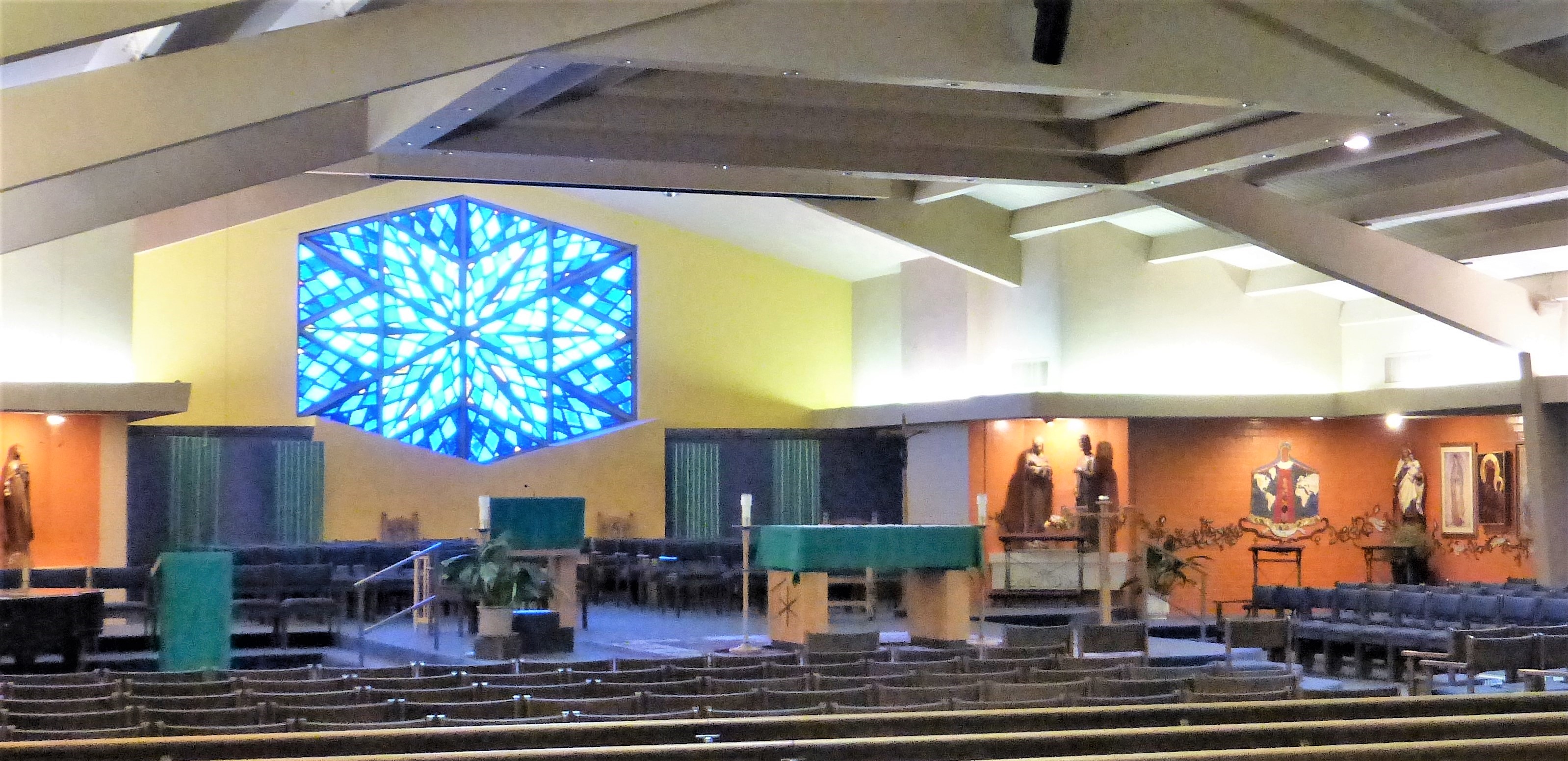
Saturday of week 12 in Ordinary Time ![]() St. Cyril of Alexandria Church, Tucson, Arizona Readings at MassLiturgical Colour: Green. Year: A(II).
Cry aloud to the Lord, daughter of ZionThe Lord has pitilessly destroyed all the homes of Jacob; in his displeasure he has shattered the strongholds of the daughter of Judah; he has thrown to the ground, he has left accursed the kingdom and its rulers. Mutely they sit on the ground, the elders of the daughter of Zion; they have put dust on their heads, and wrapped themselves in sackcloth. The virgins of Jerusalem hang their heads down to the ground. My eyes wasted away with weeping, my entrails shuddered, my liver spilled on the ground at the ruin of the daughters of my people, as children, mere infants, fainted in the squares of the Citadel. They kept saying to their mothers, ‘Where is the bread?’ as they fainted like wounded men in the squares of the City, as they poured out their souls on their mothers’ breasts. How can I describe you, to what compare you, daughter of Jerusalem? Who can rescue and comfort you, virgin daughter of Zion? For huge as the sea is your affliction; who can possibly cure you? The visions your prophets had on your behalf were delusive, tinsel things, they never pointed out your sin, to ward off your exile. The visions they proffered you were false, fallacious, misleading. Cry aloud, then, to the Lord, groan, daughter of Zion; let your tears flow like a torrent, day and night; give yourself no relief, grant your eyes no rest. Up, cry out in the night-time, in the early hours of darkness; pour your heart out like water before the Lord. Stretch out your hands to him for the lives of your children who faint with hunger at the entrance to every street.
Do not forget your poor servants for ever. Why, O God, have you cast us off for ever? Why blaze with anger at the sheep of your pasture? Remember your people whom you chose long ago, the tribe you redeemed to be your own possession, the mountain of Zion where you made your dwelling. Do not forget your poor servants for ever. Turn your steps to these places that are utterly ruined! The enemy has laid waste the whole of the sanctuary. Your foes have made uproar in your house of prayer: they have set up their emblems, their foreign emblems, high above the entrance to the sanctuary. Do not forget your poor servants for ever. Their axes have battered the wood of its doors. They have struck together with hatchet and pickaxe. O God, they have set your sanctuary on fire: they have razed and profaned the place where you dwell. Do not forget your poor servants for ever. Remember your covenant; every cave in the land is a place where violence makes its home. Do not let the oppressed return disappointed; let the poor and the needy bless your name. Do not forget your poor servants for ever.
Alleluia, alleluia! Our Saviour Jesus Christ abolished death and he has proclaimed life through the Good News. Alleluia!
Alleluia, alleluia! He took our sicknesses away, and carried our diseases for us. Alleluia!
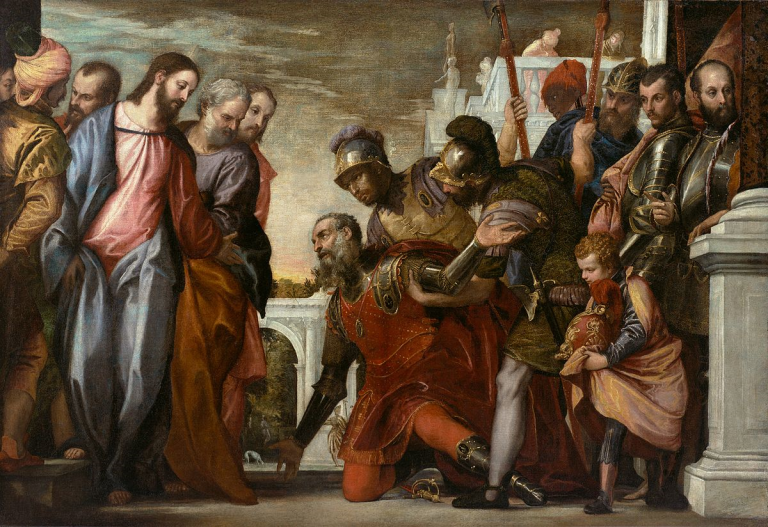
'I am not worthy to have you under my roof: give the word, and my servant will be healed'When Jesus went into Capernaum a centurion came up and pleaded with him. ‘Sir,’ he said ‘my servant is lying at home paralysed, and in great pain.’ ‘I will come myself and cure him’ said Jesus. The centurion replied, ‘Sir, I am not worthy to have you under my roof; just give the word and my servant will be cured. For I am under authority myself, and have soldiers under me; and I say to one man: Go, and he goes; to another: Come here, and he comes; to my servant: Do this, and he does it.’ When Jesus heard this he was astonished and said to those following him, ‘I tell you solemnly, nowhere in Israel have I found faith like this. And I tell you that many will come from east and west to take their places with Abraham and Isaac and Jacob at the feast in the kingdom of heaven; but the subjects of the kingdom will be turned out into the dark, where there will be weeping and grinding of teeth.’ And to the centurion Jesus said, ‘Go back, then; you have believed, so let this be done for you.’ And the servant was cured at that moment. And going into Peter’s house Jesus found Peter’s mother-in-law in bed with fever. He touched her hand and the fever left her, and she got up and began to wait on him. That evening they brought him many who were possessed by devils. He cast out the spirits with a word and cured all who were sick. This was to fulfil the prophecy of Isaiah: He took our sicknesses away and carried our diseases for us. The readings on this page are from the Jerusalem Bible, which is used at Mass in most of the English-speaking world. The New American Bible readings, which are used at Mass in the United States, are available in the Universalis apps, programs and downloads. |
Dear FRiends,
We need your continuing support to keep FR funded. Your donations are our sole source of funding. No sugar daddies, no advertisers, no paid memberships, no commercial sales, no gimmicks, no tax subsidies. No spam, no pop-ups, no ad trackers.
If you enjoy using FR and agree it's a worthwhile endeavor, please consider making a contribution today:
Click here: to donate by Credit Card
Or here: to donate by PayPal
Or by mail to: Free Republic, LLC - PO Box 9771 - Fresno, CA 93794
Thank you very much and God bless you,
Jim
KEYWORDS: catholic; mt8; ordinarytime; prayer

Please FReepmail me to get on/off the Alleluia Ping List.
| Matthew | |||
| English: Douay-Rheims | Latin: Nova Vulgata | Greek NT: Byzantine/Majority Text (2000) | |
| Matthew 8 | |||
| 5. | And when he had entered into Capharnaum, there came to him a centurion, beseeching him, | Cum autem introisset Capharnaum, accessit ad eum centurio rogans eum | εισελθοντι δε αυτω εις καπερναουμ προσηλθεν αυτω εκατονταρχος παρακαλων αυτον |
| 6. | And saying, Lord, my servant lieth at home sick of the palsy, and is grieviously tormented. | et dicens: “ Domine, puer meus iacet in domo paralyticus et male torquetur ”. | και λεγων κυριε ο παις μου βεβληται εν τη οικια παραλυτικος δεινως βασανιζομενος |
| 7. | And Jesus saith to him: I will come and heal him. | Et ait illi: “ Ego veniam et curabo eum ”. | και λεγει αυτω ο ιησους εγω ελθων θεραπευσω αυτον |
| 8. | And the centurion making answer, said: Lord, I am not worthy that thou shouldst enter under my roof: but only say the word, and my servant shall be healed. | Et respondens centurio ait: “ Domine, non sum dignus, ut intres sub tectum meum, sed tantum dic verbo, et sanabitur puer meus. | και αποκριθεις ο εκατονταρχος εφη κυριε ουκ ειμι ικανος ινα μου υπο την στεγην εισελθης αλλα μονον ειπε λογω και ιαθησεται ο παις μου |
| 9. | For I also am a man subject to authority, having under me soldiers; and I say to this, Go, and he goeth, and to another, Come, and he cometh, and to my servant, Do this, and he doeth it. | Nam et ego homo sum sub potestate, habens sub me milites, et dico huic: “Vade”, et vadit; et alii: “Veni”, et venit; et servo meo: “Fac hoc”, et facit”. | και γαρ εγω ανθρωπος ειμι υπο εξουσιαν εχων υπ εμαυτον στρατιωτας και λεγω τουτω πορευθητι και πορευεται και αλλω ερχου και ερχεται και τω δουλω μου ποιησον τουτο και ποιει |
| 10. | And Jesus hearing this, marvelled; and said to them that followed him: Amen I say to you, I have not found so great faith in Israel. | Audiens autem Iesus, miratus est et sequentibus se dixit: “Amen dico vobis: Apud nullum inveni tantam fidem in Israel! | ακουσας δε ο ιησους εθαυμασεν και ειπεν τοις ακολουθουσιν αμην λεγω υμιν ουδε εν τω ισραηλ τοσαυτην πιστιν ευρον |
| 11. | And I say to you that many shall come from the east and the west, and shall sit down with Abraham, and Isaac, and Jacob in the kingdom of heaven: | Dico autem vobis quod multi ab oriente et occidente venient et recumbent cum Abraham et Isaac et Iacob in regno caelorum; | λεγω δε υμιν οτι πολλοι απο ανατολων και δυσμων ηξουσιν και ανακλιθησονται μετα αβρααμ και ισαακ και ιακωβ εν τη βασιλεια των ουρανων |
| 12. | But the children of the kingdom shall be cast out into the exterior darkness: there shall be weeping and gnashing of teeth. | filii autem regni eicientur in tenebras exteriores: ibi erit fletus et stridor dentium ”. | οι δε υιοι της βασιλειας εκβληθησονται εις το σκοτος το εξωτερον εκει εσται ο κλαυθμος και ο βρυγμος των οδοντων |
| 13. | And Jesus said to the centurion: Go, and as thou hast believed, so be it done to thee. And the servant was healed at the same hour. | Et dixit Iesus centurioni: “ Vade; sicut credidisti, fiat tibi ”. Et sanatus est puer in hora illa. | και ειπεν ο ιησους τω εκατονταρχη υπαγε και ως επιστευσας γενηθητω σοι και ιαθη ο παις αυτου εν τη ωρα εκεινη |
| 14. | And when Jesus was come into Peter's house, he saw his wife's mother lying, and sick of a fever: | Et cum venisset Iesus in domum Petri, vidit socrum eius iacentem et febricitantem; | και ελθων ο ιησους εις την οικιαν πετρου ειδεν την πενθεραν αυτου βεβλημενην και πυρεσσουσαν |
| 15. | And he touched her hand, and the fever left her, and she arose and ministered to them. | et tetigit manum eius, et dimisit eam febris; et surrexit et ministrabat ei. | και ηψατο της χειρος αυτης και αφηκεν αυτην ο πυρετος και ηγερθη και διηκονει αυτω |
| 16. | And when evening was come, they brought to him many that were possessed with devils: and he cast out the spirits with his word: and all that were sick he healed: | Vespere autem facto, obtulerunt ei multos daemonia habentes; et eiciebat spiritus verbo et omnes male habentes curavit, | οψιας δε γενομενης προσηνεγκαν αυτω δαιμονιζομενους πολλους και εξεβαλεν τα πνευματα λογω και παντας τους κακως εχοντας εθεραπευσεν |
| 17. | That it might be fulfilled, which was spoken by the prophet Isaias, saying: He took our infirmities, and bore our diseases. | ut adimpleretur, quod dictum est per Isaiam prophetam dicentem: “ Ipse infirmitates nostras accepit et aegrotationes portavit ”. | οπως πληρωθη το ρηθεν δια ησαιου του προφητου λεγοντος αυτος τας ασθενειας ημων ελαβεν και τας νοσους εβαστασεν |

8:5–9
5. And when Jesus was entered into Capernaum, there came unto him a centurion, beseeching him,
6. And saying, Lord, my servant lieth at home sick of the palsy, grievously tormented.
7. And Jesus saith unto him, I will come and heal him.
8. The centurion answered and said, Lord, I am not worthy that thou shouldest come under my roof: but speak the word only, and my servant shall be healed.
9. For I am a man under authority, having soldiers under me: and I say to this man, Go, and he goeth; and to another, Come, and he cometh; and to my servant, Do this, and he doeth it.
PSEUDO-CHRYSOSTOM. The Lord having taught His disciples on the mount, and healed the leper at the foot of the mount, came to Capharnaum. This is a mystery, signifying that after the purification of the Jews He went to the Gentiles.
HAYMO. For Capharnaum, which is interpreted, The town of fatness, or, The field of consolation, signifies the Church, which was gathered out of the Gentiles, which is replenished with spiritual fatness, according to that, That my soul may be filled with marrow and fatness, (Ps. 63:5.) and under the troubles of the world is comforted concerning heavenly things, according to that, Thy consolations hare rejoiced my soul. (Ps. 94:19.) Hence it is said, When he had entered into Capharnaum the centurion came to him.
AUGUSTINE. (Serm. 62, 4.) This centurion was of the Gentiles, for Judæa had already soldiers of the Roman empire.
PSEUDO-CHRYSOSTOM. This centurion was the first-fruits of the Gentiles, and in comparison of his faith, all the faith of the Jews was unbelief; he neither heard Christ teaching, nor saw the leper when he was cleansed, but from hearing only that he had been healed, he believed more than he heard; and so he mystically typified the Gentiles that should come, who had neither read the Law nor the Prophets concerning Christ, nor had seen Christ Himself work His miracles. He came to Him and besought Him, saying, Lord, my servant lieth at home sick of the palsy, and is grievously afflicted. Mark the goodness of the centurion, who for the health of his servant was in so great haste and anxiety, as though by his death he should suffer loss, not of money, but of his well being. For he reckoned no difference between the servant and the master; their place in this world may be different, but their nature is one. Mark also his faith, in that he said not, Come and heal him, because that Christ who stood there was present in every place; and his wisdom, in that he said not, Heal him here on this spot, for he knew that He was mighty to do, wise to understand, and merciful to hearken, therefore he did but declare the sickness, leaving it to the Lord, by His merciful power to heal. And he is grievously afflicted; this shews how he loved him, for when any that we love is pained or tormented, though it be but slightly, yet we think him more afflicted than he really is.
RABANUS. All these things he recounts with grief, that he is sick, that it is with palsy; that he is grievously afflicted therewith, the more to shew the sorrow of his own heart, and to move the Lord to have mercy. In like manner ought all to feel for their servants, and to take thought for them.
CHRYSOSTOM. (Hom. xxvi.) But some say that he says these things in excuse of himself, as reasons why he did not bring the sick man himself. For it was impossible to bring one in a palsy, in great torment, and at the point to die. But I rather think it a mark of his great faith; inasmuch as he knew that a word alone was enough to restore the sick man, he deemed it superfluous to bring him.
HILARY. Spiritually interpreted, the Gentiles are the sick in this world, and afflicted with the diseases of sin, all their limbs being altogether unnerved, and unfit for their duties of standing and walking. The sacrament of their salvation is fulfilled in this centurion’s servant, of whom it is sufficiently declared that he was the head of the Gentiles that should believe. What sort of head this is, the song of Moses in Deuteronomy teaches, He set the bounds of the people according to the number of the Angels. (Deut. 32:8.)
REMIGIUS. Or, in the centurion are figured those of the Gentiles who first believed, and were perfect in virtue. For a centurion is one who commands a hundred soldiers; and a hundred is a perfect number. Rightly, therefore, the centurion prays for his servant, because the first-fruits of the Gentiles prayed to God for the salvation of the whole Gentile world.
JEROME. The Lord seeing the centurion’s faith, humbleness, and thoughtfulness, straightway promises to go and heal him; Jesus saith unto him, I will come and heal him.
CHRYSOSTOM. Jesus here does what He never did; He always follows the wish of the supplicant, but here He goes before it, and not only promises to heal him, but to go to his house. This He does, that we may learn the worthiness of the centurion.
PSEUDO-CHRYSOSTOM. Had not He said, I will come and heal him, the other would never have answered, I am not worthy. It was because it was a servant for whom he made petition, that Christ promised to go, in order to teach us not to have respect to the great, and overlook the little, but to honour poor and rich alike.
JEROME. As we commend the centurion’s faith in that he believed that the Saviour was able to heal the paralytic; so his humility is seen in his professing himself unworthy that the Lord should come under his roof; as it follows, And the centurion answered and said into him, Lord, I am not worthy that thou shouldest come under my roof.
RABANUS. (e Beda.) Conscious of his gentile life, he thought he should be more burdened than profited by this act of condescension from Him with whose faith he was indeed endued, but with whose sacraments he was not yet initiated.
AUGUSTINE. (ubi sup.) By declaring himself unworthy, he shewed himself worthy, not indeed into whose house, but into whose heart, Christ the Word of God should enter. Nor could he have said this with so much faith and humility, had he not borne in his heart Him whom he feared to have in his house. And indeed it would have been no great blessedness that Jesus should enter within his walls, if He had not already entered into his heart.
CHRYSOLOGUS. (Serm. 102.) Mystically, his house was the body which contained his soul, which contains within it the freedom of the mind by a heavenly vision. But God disdains neither to inhabit flesh, nor to enter the roof of our body.
PSEUDO-ORIGEN. (Hom. in div. 5.) And now also when the heads of Churches, holy men and acceptable to God, enter your roof, then in them the Lord also enters, and do you think of yourself as receiving the Lord. And when you eat and drink the Lord’s Bodya, then the Lord enters under your roof, and you then should humble yourself, saying, Lord, I am not worthy. For where He enters unworthily, there He enters to the condemnation of him who receives Him.
JEROME. The thoughtfulness of the centurion appears herein, that he saw the Divinity hidden beneath the covering of body; wherefore he adds, But speak the word only, and my servant will be healed.
PSEUDO-CHRYSOSTOM. He knew that Angels stood by unseen to minister to Him, who turn every word of his into act; yea and should Angels fail, yet diseases are healed by His life-giving command.
HILARY. Also he therefore says that it needed only a word to heal his son, because all the salvation of the Gentiles is of faith, and the life of them all is in the precepts of the Lord; therefore he continues saying, For I am a man set under authority, having soldiers under me; and I say to this man, Go, and he goeth; to another, Come, and he cometh; and to my servant, Do this, and he doeth it.
PSEUDO-CHRYSOSTOM. He has here developed the mystery of the Father and the Son, by the secret suggestion of the Holy Spirit; as much as to say, Though I am under the command of another, yet have I power to command those who are under me; so also Thou, though under the command of the Father, in so far as Thou art Man, yet hast Thou power over the Angels. But Sabellius perhaps affirms, seeking to prove that the Son is the same as the Father, that it is to be understood thus; ‘If I who am set under authority have yet power to command, how much more Thou who art under the authority of none.’ But the words will not bear this exposition; for he said not, ‘If I being a man under authority,’ but, ‘For I also am a man set under authority;’ clearly not drawing a distinction, but pointing to a resemblance in this respect between himself and Christ.
AUGUSTINE. (ubi sup.) If I who am under command have yet power to command others, how much more Thou whom all powers serve!
GLOSS. (ord.) Thou art able without Thy bodily presence, by the ministry of Thy Angels, to say to this disease, Go, and it will leave him; and to say to health, Come, and it shall come to him.
HAYMO. Or, we may understand by those that are set under the centurion, the natural virtues in which many of the Gentiles were mighty, or even thoughts good and bad. Let us say to the bad, Depart, and they will depart; let us call the good, and they shall come; and our servant, that is, our body, let us bid that it submit itself to the Divine will.
AUGUSTINE. (Cons. Evan. ii. 20.) What is here said seems to disagree with Luke’s account, When the centurion heard concerning Jesus, he sent unto him elders of the Jews, beseeching him that he would come and heal his servant. (Luke 7:3.) And again, When he was come nigh to the house, the centurion sent friends unto him, saying, Lord, trouble not thyself, for I am not worthy that thou shouldest enter under my roof.
CHRYSOSTOM. But some say that these are two different occurrences; an opinion which has much to support it. Of Him in Luke it is said, He loveth our nation, and has built us a synagogue; but of this one Jesus says, I have not found so great faith in Israel; whence it might seem that the other was a Jew. But in my opinion they are both the same person. What Luke relates that he sent to Jesus to come to him, betrays the friendly services of the Jews. We may suppose that when the centurion sought to go to Jesus, he was prevented by the Jews, who offered to go themselves for the purpose of bringing him. But as soon as he was delivered from their importunity, then he sent to say, Do not think that it was from want of respect that I did not come, but because I thought myself unworthy to receive you into my house. When then Matthew relates, that he spoke thus not through friends, but in his own person, it does not contradict Luke’s account; for both have only represented the centurion’s anxiety, and that he had a right opinion of Christ. And we may suppose that he first sent this message to Him by friends as He approached, and after, when He was come thither, repeated it Himself. But if they are relating different stories, then they do not contradict each other, but supply mutual deficiencies.
AUGUSTINE. (ubi sup.) Matthew therefore intended to state summarily all that passed between the centurion and the Lord, which was indeed done through others, with the view of commending his faith; as the Lord spoke, I have not found so great faith in Israel. Luke, on the other hand, has narrated the whole as it was done, that so we might be obliged to understand in what sense Matthew, who could not err, meant that the centurion himself came to Christ, namely, in a figurative sense through faith.
CHRYSOSTOM. For indeed there is no necessary contradiction between Luke’s statement, that he had built a synagogue, and this, that he was not an Israelite; for it was quite possible, that one who was not a Jew should have built a synagogue, and should love the nation.
8:10–13
10. When Jesus heard it, he marvelled, and said to them that followed, Verily I say unto you, I have not found so great faith, no, not in Israel.
11. And I say unto you, That many shall come from the east and west, and shall sit down with Abraham, and Isaac, and Jacob, in the kingdom of Heaven.
12. But the children of the kingdom shall be cast out into outer darkness: there shall be weeping and gnashing of teeth.
13. And Jesus said unto the centurion, Go thy way; and as thou hast believed, so be it done unto thee. And his servant was healed in the selfsame hour.
CHRYSOSTOM. As what the leper had affirmed concerning Christ’s power, If thou will, thou canst cleanse me, was confirmed by the mouth of Christ, saying, I will, be thou clean; so here He did not blame the centurion for bearing testimony to Christ’s authority, but even commended him. Nay more; it is something greater than commendation that the Evangelist signifies in the words, But Jesus hearing marvelled.
PSEUDO-ORIGEN. (Hom. in Div. 5.) Observe how great and what that is at which God the Only-begotten marvels! Gold, riches, principalities, are in His sight as the shadow or the flower that fadeth; in the sight of God none of these things is wonderful, as though it were great or precious, but faith only; this He wonders at, and pays honour to, this He esteems acceptable to Himself.
AUGUSTINE. (super Gen. c. Man. i. 8.) But who was He that had created this faith in him, but only He who now marvelled at it? But even had it come from any other, how should He marvel who knew all things future? When the Lord marvels, it is only to teach us what we ought to wonder at; for all these emotions in Him are not signs of passion, but examples of a teacher.
CHRYSOSTOM. Wherefore He is said to have thus wondered in the presence of all the people, giving them an example that they also should wonder at Him; for it follows, And he said to them that followed, I have not found so great faith in Israel.
AUGUSTINE. (cont. Faust. xxii. 74.) He praises his faith, but gives no command to quit his profession of a soldier.
JEROME. This He speaks of the present generation, not of all the Patriarchs and Prophets of past ages.
PSEUDO-CHRYSOSTOM. Andrew believed, but it was after John had said, Behold the Lamb of God; (John 1:36.) Peter believed, but it was at the preaching of Andrew; Philip believed, but it was by reading the Scriptures; and Nathanael first received a proof of His Divinity, and then spoke forth his confession of faith.
PSEUDO-ORIGEN. (ubi sup.) Jairus a prince in Israel, making request for his daughter, said not, ‘speak the word,’ but, ‘Come quickly.’ Nicodemus, hearing of the sacrament of faith, asks, How can these things be? (John 3:9.) Mary and Martha say, Lord, if thou hadst been here, my brother had not died; (John 11:21.) as though distrusting that God’s power could be in all places at the same time.
PSEUDO-CHRYSOSTOM. Or, if we would supposeb that his faith was greater than even that of the Apostles, Christ’s testimony to it must be understood as though every good in a man should be commended relatively to his character; as it were a great thing in a countryman to speak with wisdom, but in a philosopher the same would be nothing wonderful. In this way it may be said of the centurion, In none other have I found so great faith in Israel.
CHRYSOSTOM. For it is a different thing for a Jew to believe and for a Gentile.
JEROME. Or perhaps in the person of the centurion the faith of the Gentiles is preferred to that of Israel; whence He proceeds, But I say unto you, Many shall come from the east and from the west.
AUGUSTINE. (Serm. 62. 3.) He says, not ‘all,’ I but many; yet these from the east and west; for by these two quarters the whole world is intended.
HAYMO. Or; From the east shall come they, who pass into the kingdom as soon as they are enlightened; from the west they who have suffered persecution for the faith even unto death. Or, he comes from the east, who has served God from a child; he from the west who in decrepit age has turned to God.
PSEUDO-ORIGEN. (ubi sup.) How then does He say in another place, that the chosen are few? Because in each generation there are few that are chosen, but when all are gathered together in the day of visitation they shall be found many. They shall sit down, not the bodily posture, but the spiritual rest, not with human food, but with an eternal feast, teeth Abraham, Isaac, and Jacob, in the kingdom of heaven, where is light, joy, glory, and eternal length of days.
JEROME. Because the God of Abraham, the Maker of heaven, is the Father of Christ, therefore also is Abraham in the kingdom of heaven, and with him will sit down the nations who have believed in Christ the Son of the Creator.
AUGUSTINE. (ubi sup.) As we see Christians called to the heavenly feast, where is the bread of righteousness, the drink of wisdom; so we see the Jews in reprobation. The children of the kingdom shall be cast into outer darkness, that is, the Jews, who have received the Law, who observe the types of all things that were to be, yet did not acknowledge the realities when present.
JEROME. Or the Jews may be called the children of the kingdom, because God reigned among them heretofore.
CHRYSOSTOM. Or, He calls them the children of the kingdom, because the kingdom was prepared for them, which was the greater grief to them.
AUGUSTINE. (cont. Faust. xvi. 24.) Moses set before the people of Israel no other God than the God of Abraham, Isaac, and Jacob, and Christ sets forth the very same God. So that so far was He from seeking to turn that people away from their own God, that He therefore threatened them with the outer darkness, because He saw them turned away from their own God. And in this kingdom He tells them the Gentiles shall sit down with Abraham, Isaac, and Jacob, for no other reason than that they held the faith of Abraham, Isaac, and Jacob. To these Fathers Christ gives His testimony, not as though they had been converted after death, or had received justification after His passion.
JEROME. It is called outer darkness, because he whom the Lord casts out leaves the light.
HAYMO. What they should suffer there, He shews when He adds, There shall be weeping and gnashing of teeth. Thus in metaphor He describes the sufferings of the tormented limbs; the eyes shed tears when filled with smoke, and the teeth chatter together from cold. This shews that the wicked in hell shall endure both extreme cold and extreme heat: according to that in Job, They shall pass from rivers of snow to the scorching heat. (Job 24:19.)
JEROME. Weeping and gnashing of teeth are a proof of bones and body; truly then is there a resurrection of the same limbs, that sank into the grave.
RABANUS. Or; The gnashing of teeth expresses the passion of remorse; repentance coming too late and self-accusation that he has sinned with such obstinate wickedness.
REMIGIUS. Otherwise; By outer darkness, He means foreign nations; for these words of the Lord are a historical prediction of the destruction of the Jews, that they were to be led into captivity for their unbelief, and to be scattered over the earth; for tears are usually caused by heat, gnashing of teeth by cold. Weeping then is ascribed to those who should be dispersed into the warmer climates of India and Ethiopia, gnashing of teeth to those who should dwell in the colder regions, as Hyrcania and Seythia.
CHRYSOSTOM. But that none might suppose that these were nothing more than fair words, He makes them credible by the miracles following, And Jesus said to the centurion, Go, and be it done to thee as thou hast believed.
RABANUS. As though He had said, According to the measure of thy faith, so be thy grace. For the merit of the Lord may be communicated even to servants not only through the merit of their faith, but through their obedience to rule. It follows, And his servant was healed in the self-same hour.
CHRYSOSTOM. Wherein admire the speediness, shewing Christ’s power, not only to heal, but to do it in a moment of time.
AUGUSTINE. (Serm. 62. 2.) As the Lord did not enter the centurion’s house with His body, but healed the servant, present in majesty, but absent in body; so He went among the Jews only in the body, but among other nations He was neither born of a Virgin, nor suffered, nor endured human sufferings, nor did divine wonders; and yet was fulfilled that which was spoken, A people that I have not known hath served me, and hath obeyed me by the hearing of the ear. (Ps. 18:43.) The Jews beheld, yet crucified Him; the world heard, and believed.
8:14–15
14. And when Jesus was come into Peter’s house, he saw his wife’s mother laid, and siek of a fever.
15. And he touched her hand, and the fever left her: and she arose, and ministered unto them.
ANSELM. Matthew having in the leper shewn the healing of the whole human race, and in the centurion’s servant that of the Gentiles, now figures the healing of the synagogue in Peter’s mother-in-law. He relates the case of the servant, first, because it was the greater miracle, and the grace was greater in the conversion of the Gentile; or because the synagogue should not be fully converted till the end of the age when the fulness of the Gentiles should have entered in. Peter’s house was in Bethsaida.
CHRYSOSTOM. (Hom. xxvii.) Why did He enter into Peter’s house? I think to take food; for it follows, And she arose, and ministered to them. For He abode with His disciples to do them honour, and to make them more zealous. Observe Peter’s reverence towards Christ; though his mother-in-law lay at home sick of a fever, yet he did not force Him thither at once, but waited till His teaching should be completed, and others healed. For from the beginning he was instructed to prefer others to himself. Wherefore he did not even bring Him thither, but Christ went in of Himself; purposing, because the centurion had said, I am not worthy that thou shouldest come under my roof, to shew what He granted to a disciple. And He did not scorn to enter the humble hut of a fisherman, instructing us in every thing to trample upon human pride. Sometimes He heals by a word, sometimes He reaches forth His hand; as here, He touched her hand, and the fever left her. For He would not always work miracles with display of surpassing power, but would sometimes be hid. By touching her body He not only banished the fever, but restored her to perfect health. Because her sickness was such as art could cure, He shewed his power to heal, in doing what medicine could not do, giving her back perfect health and strength at once; which is intimated in what the Evangelist adds, And she arose, and ministered to them.
JEROME. For naturally the greatest weakness follows fever, and the evils of sickness begin to be felt as the patient begins to recover; but that health which is given by the Lord’s power is complete at once.
GLOSS. (non occ.) And it is not enough that she is cured, but strength is given her besides, for she arose and ministered unto them.
CHRYSOSTOM. This, she arose and ministered unto them, shews at once the Lord’s power, and the woman’s feeling towards Christ.
BEDE. (in loc.) Figuratively; Peter’s house is the Law, or the circumcision, his mother-in-law the synagogue, which is as it were the mother of the Church committed to Peter. She is in a fever, that is, she is sick of zealous hate, and persecutes the Church. The Lord touches her hand, when He turns her carnal works to spiritual uses.
REMIGIUS. Or by Peter’s mother-in-law may be understood the Law, which according to the Apostle was made weak through the flesh, i. e. the carnal understanding. But when the Lord through the mystery of the Incarnation appeared visibly in the synagogue, and fulfilled the Law in action, and taught that it was to be understood spiritually; straightway it thus allied with the grace of the Gospel received such strength, that what had been the minister of death and punishment, became the minister of life and glory.
RABANUS. (e Bed.) Or, every soul that struggles with fleshly lusts is sick of a fever, but touched with the hand of Divine mercy, it recovers health, and restrains the concupiscence of the flesh by the bridle of continence, and with those limbs with which it had served uncleanness, it now ministers to righteousness.
HILARY. Or; In Peter’s wife’s mother is shewn the sickly condition of infidelity, to which freedom of will is near akin, being united by the bonds as it were of wedlock. By the Lord’s entrance into Peter’s house, that is into the body, unbelief is cured, which was before sick of the fever of sin, and ministers in duties of righteousness to the Saviour.
AUGUSTINE. (De Cons. Ev. ii. 21.) When this miracle was done, that is, after what, or before what, Matthew has not said. For we need not understand that it took place just after that which it follows in the relation; he may be returning here to what he had omitted above. For Mark relates this after the cleansing of the leper, (Mark 1:30.) which should seem to follow the sermon on the mount, concerning which Mark is silent. Luke also follows the same order in relating this concerning Peter’s mother-in-law as Mark; also inserting it before that long sermon which seems to be the same with Matthew’s sermon on the mount. But what matters it in what order the events are told, whether something omitted before is brought in after, or what was done after is told earlier, so long as in the same story he does not contradict either another or himself? For as it is in no man’s power to choose in what order he shall recollect the things he has once known, it is likely enough that each of the Evangelists thought himself obliged to relate all in that order in which it pleased God to bring to his memory the various events. Therefore when the order of time is not clear, it cannot import to us what order of relation any one of them may have followed.
8:16–17
16. When the even was come, they brought unto him many that were possessed with devils: and he cast out the spirits with his word, and healed all that were sick:
17. That it might be fulfilled which was spoken by Esaias the prophet, saying, Himself took our infirmities, and bare our sicknesses.
CHRYSOSTOM. Because the multitude of believers was now very great, they would not depart from Christ, though time pressed; but in the evening they bring unto Him the sick. When it was evening, they brought unto him many that had dœmons.
AUGUSTINE. (Cons. Ev. ii. 22.) The words, Now when it was evening, shew that the evening of the same day is meant. This would not have been implied, had it been only when it was evening.
REMIGIUS. Christ the Son of God, the Author of human salvation, the fount and source of all goodness, furnished heavenly medicine, He cast out the spirits with a word, and healed all that were sick. Dæmons and diseases He sent away with a word, that by these signs, and mighty works, He might shew that He was come for the salvation of the human race.
CHRYSOSTOM. Observe how great a multitude of cured the Evangelist here runs through, not relating the case of each, but in one word introducing an innumerable flood of miracles. That the greatness of the miracle should not raise unbelief that so much people and so various diseases could be healed in so short a space, he brings forward the Prophet to bear witness to the things that were done, That it might be fulfilled which was spoken by Esaias the Prophet, saying, Himself took our infirmities.
RABANUS. Took them not that He should have them Himself, but that He should take them away from us; and bare our sicknesses, in that what we were too weak to bear. He should bear for us.
REMIGIUS. He took the infirmity of human nature so as to make us strong who had before been weak.
HILARY. And by the passion of His body, according to the words of the Prophet, He absorbed all the infirmities of human weakness.
CHRYSOSTOM. The Prophet seems to have meant this of sins; how then does the Evangelist explain it of bodily diseases? It should be understood, that either he cites the text literally, or he intends to inculcate that most of our bodily diseases have their origin in sins of the soul; for death itself has its root in sin.
JEROME. It should be noted, that all the sick were healed not in the morning nor at noon, but rather about sunset; as a corn of wheat dies in the ground that it may bring forth much fruit.
RABANUS. Sunset shadows forth the passion and death of Him Who said, While I am in the world, I am the light of the world. (John 9:5.) Who while He lived temporally in the flesh, taught only a few of the Jews; but having trodden under foot the kingdom of death, promised the gifts of faith to all the Gentiles throughout the world.
Catena Aurea Matthew 8
Doctor of the Church. St. Cyril has his feast in the Western Church on the 28th of January; in the Greek Menaea it is found on the 9th of June, and (together with St. Athanasius) on the 18th of January.
He seems to have been of an Alexandrian family and was the son of the brother of Theophilus, Patriarch of Alexandria; if he is the Cyril addressed by Isidore of Pelusium in Ep. xxv of Bk. I, he was for a time a monk. He accompanied Theophilus to Constantinople when that bishop held the "Synod of the Oak" in 402 and deposed St. John Chrysostom. Theophilus died 15 Oct., 412, and on the 18th Cyril was consecrated his uncle's successor, but only after a riot between his supporters and those of his rival Timotheus. Socrates complains bitterly that one of his first acts was to plunder and shut the churches of the Novatians. He also drove out of Alexandria the Jews, who had formed a flourishing community there since Alexander the Great. But they had caused tumults and had massacred the Christians, to defend whom Cyril himself assembled a mob. This may have been the only possible defence, since the Prefect of Egypt, Orestes, who was very angry at the expulsion of the Jews was also jealous of the power of Cyril, which certainly rivaled his own. Five hundred monks came down from Nitria to defend the patriarch. In a disturbance which arose, Orestes was wounded in the head by a stone thrown by a monk named Ammonius. The prefect had Ammonius tortured to death, and the young and fiery patriarch honoured his remains for a time as those of a martyr. The Alexandians were always riotous as we learn from Socrates (VII, vii) and from St. Cyril himself (Hom. for Easter, 419). In one of these riots, in 422, the prefect Callistus was killed, and in another was committed the murder of a female philosopher Hypatia, a highly-respected teacher of neo-Platoism, of advanced age and (it is said) many virtues. She was a friend of Orestes, and many believed that she prevented a reconciliation between the prefect and patriarch. A mob led by a lector, named Peter, dragged her to a church and tore her flesh with potsherds till she died. This brought great disgrace, says Socrates, on the Church of Alexandria and on its bishop; but a lector at Alexandria was not a cleric (Scr., V, xxii), and Socrates does not suggest that Cyril himself was to blame. Damascius, indeed, accuses him, but he is a late authority and a hater of Christians.
Theophilus, the persecutor of Chrysostom, had not the privilege of communion with Rome from that saint's death, in 406, until his own. For some years Cyril also refused to insert the name of St. Chrysostom in the diptychs of his Church, in spite of the requests of Chrysostom's supplanter, Atticus. Later he seems to have yielded to the representations of his spiritual father, Isisdore of Pelusium (Isid., Ep. I, 370). Yet even after the Council of Ephesus that saint still found something to rebuke in him on this matter (Ep. I, 310). But at last Cyril seems to have long since been trusted by Rome.
It was in the winter of 427-28 that the Antiochene Nestorius became Patriarch of Constantinople. His heretical teaching soon became known to Cyril. Against him Cyril taught the use of the term Theotokus in his Paschal letter for 429 and in a letter to the monks of Egypt. A correspondence with Nestorius followed, in a more moderate tone than might have been expected. Nestorius sent his sermons to Pope Celestine, but he received no reply, for the latter wrote to St. Cyril for further information. Rome had taken the side of St. John Chrysostom against Theophilus, but had neither censured the orthodoxy of the latter, nor consented to the patriarchal powers exercised by the bishops of Constantinople. To St. Celestine Cyril was not only the first prelate of the East, he was also the inheritor of the traditions of Athanasius and Peter. The pope's confidence was not misplaced. Cyril had learnt prudence. Peter had attempted unsuccessfully to appoint a Bishop of Constantinople; Theophilus had deposed another. Cyril, though in this case Alexandria was in the right, does not act in his own name, but denounces Nestorius to St. Celestine, since ancient custom, he says, persuaded him to bring the matter before the pope. He relates all that had occurred, and begs Celestine to decree what he sees fit (typosai to dokoun--a phrase which Dr. Bright chooses to weaken into "formulate his opinion"), and communicate it also to the Bishops of Macedonia and of the East (i.e. the Antiochene Patriarchate).
The pope's reply was of astonishing severity. He had already commissioned Cassian to write his well known treatise on the Incarnation. He now summoned a council (such Roman councils had somewhat the office of the modern Roman Congregations), and dispatched a letter to Alexandria with enclosures to Constantinople, Philippi, Jerusalem, and Antioch. Cyril is to take to himself the authority of the Roman See and to admonish Nestorius that unless he recants within ten days from the receipt of this ultimatum, he is separated from "our body" (the popes of the day had the habit of speaking of the other churches as the members, of which they are the head; the body is, of course the Catholic Church). If Nestorius does not submit, Cyril is to "provide for" the Church of Constantinople. Such a sentence of excommunication and deposition is not to be confounded with the mere withdrawal of actual communion by the popes from Cyril himself at an earlier date, from Theophilus, or, in Antioch, from Flavian or Meletius. It was the decree Cyril has asked for. As Cyril had twice written to Nestorius, his citation in the name of the pope is to be counted as a third warning, after which no grace is to be given.
St. Cyril summoned a council of his suffragans, and composed a letter which were appended twelve propositions for Nestorius to anathematize. The epistle was not conciliatory, and Nestorius may well have been taken aback. The twelve propositions did not emanate from Rome, and were not equally clear; one or two of them were later among the authorities invoked by the Monophysite heretics in their own favour. Cyril was the head of the rival theological school to that of Antioch, where Nestorius had studied, and was the hereditary rival of the Constantinopolitan would-be patriarch. Cyril wrote also to John, Patriarch of Antioch, informing him of the facts, and insinuating that if John should support his old friend Nestorius, he would find himself isolated over against Rome, Macedonia, and Egypt. John took the hint and urged Nestorius to yield. Meanwhile, in Constantinople itself large numbers of the people held aloof from Nestorius, and the Emperor Theodosius II had been persuaded to summon a general council to meet at Ephesus. The imperial letters were dispatched 19 November, whereas the bishops sent by Cyril arrived at Constantinople only on 7 December. Nestorius, somewhat naturally, refused to accept the message sent by his rival, and on the 13th and 14th of December preached publicly against Cyril as a calumniator, and as having used bribes (which was probably as true as it was usual); but he declared himself willing to use the word Theotokos. These sermons he sent to John of Antioch, who preferred them to the anathematizations of Cyril. Nestorius, however, issued twelve propositions with appended anathemas. If Cyril's propositions might be might be taken to deny the two natures in Christ, those of Nestorius hardly veiled his belief in two distinct persons. Theodoret urged John yet further, and wrote a treatise against Cyril, to which the latter replied with some warmth. He also wrote an "Answer" in five books to the sermons of Nestorius.
As the fifteenth-century idea of an oecumenical council superior to the pope had yet to be invented, and there was but one precedent for such an assembly, we need not be surprised that St. Celestine welcomed the initiative of the emperor, and hoped for peace through the assembly. (See EPHESUS, COUNCIL OF.) Nestorius found the churches of Ephesus closed to him, when he arrived with the imperial commissioner, Count Candidian, and his own friend, Count Irenaeus. Cyril came with fifty of his bishops. Palestine, Crete, Asia Minor, and Greece added their quotient. But John of Antioch and his suffragans were delayed. Cyril may have believed, rightly or wrongly, that John did not wish to be present at the trial of his friend Nestorius, or that he wished to gain time for him, and he opened the council without John, on 22 June, in spite of the request of sixty-eight bishops for a delay. This was an initial error, which had disastrous results.
The legates from Rome had not arrived, so that Cyril had no answer to the letter he had written to Celestine asking "whether the holy synod should receive a man who condemned what it preached, or, because the time of delay had elapsed, whether the sentence was still in force". Cyril might have presumed that the pope, in agreeing to send legates to the council, intended Nestorius to have a complete trial, but it was more convenient to assume that the Roman ultimatum had not been suspended, and that the council was bound by it. He therefore took the place of president, not only as the highest of rank, but also as still holding the place of Celestine, though he cannot have received any fresh commission from the pope. Nestorius was summoned, in order that he might explain his neglect of Cyril's former monition in the name of the pope. He refused to receive the four bishops whom the council sent to him. Consequently nothing remained but formal procedure. For the council was bound by the canons to depose Nestorius for contumacy, as he would not appear, and by the letter of Celestine to condemn him for heresy, as he had not recanted. The correspondence between Rome, Alexandria, and Constantinople was read, some testimonies where read from earlier writers show the errors of Nestorius. The second letter of Cyril to Nestorius was approved by all the bishops. The reply of Nestorius was condemned. No discussion took place. The letter of Cyril and the ten anathemaizations raised no comment. All was concluded at one sitting. The council declared that it was "of necessity impelled" by the canons and by the letter of Celestine to declare Nestorius deposed and excommunicated. The papal legates, who had been detained by bad weather, arrived on the 10th of July, and they solemnly confirmed the sentence by the authority of St. Peter, for the refusal of Nestorius to appear had made useless the permission which they brought from the pope to grant him forgiveness if he should repent. But meanwhile John of Antioch and his party had arrived on the 26th and 27th of June. They formed themselves into a rival council of forty-three bishops, and deposed Memnon, Bishop of Ephesus, and St. Cyril, accusing the latter of Apollinarianism and even of Eunomianism. Both parties now appealed to the emperor, who took the amazing decision of sending a count to treat Nestorius, Cyril, and Memnon as being all three lawfully deposed. They were kept in close custody; but eventually the emperor took the orthodox view, though he dissolved the council; Cyril was allowed to return to his diocese, and Nestorius went into retirement at Antioch. Later he was banished to the Great Oasis of Egypt.
Meanwhile Pope Celestine was dead. His successor, St. Sixtus III, confirmed the council and attempted to get John of Antioch to anathematize Nestorius. For some time the strongest opponent of Cyril was Theodoret, but eventually he approved a letter of Cyril to Acacius of Berhoea. John sent Paul, Bishop of Emesa, as his plenipotentiary to Alexandria, and he patched up reconciliation with Cyril. Though Theodoret still refused to denounce the defence of Nestorius, John did so, and Cyril declared his joy in a letter to John. Isidore of Pelusium was now afraid that the impulsive Cyril might have yielded too much (Ep. i, 334). The great patriarch composed many further treatises, dogmatic letters, and sermons. He died on the 9th or the 27th of June, 444, after an episcopate of nearly thirty-two years.
(Taken from Catholic Encyclopedia)


Today’s First Reading
From: Lamentations 2:2, 10-14, 18-19
Second lament: Zion's misfortunes and their causes
------------------------------------------------------------------
[2] The Lord has destroyed without mercy all the habitations of Jacob; in his wrath he has broken down the strongholds of the daughter of Judah: he has brought down to the ground in dishonour the kingdom and its rulers.
[10] The elders of the daughter of Zion sit on the ground in silence; they have cast dust on their heads and put on sackcloth; the maidens of Jerusalem have bowed their heads to the ground.
[11] My eyes are spent with weeping; my soul is in tumult: my heart is poured out in grief because of the destruction of the daughter of my people, because infants and babes faint in the streets of the city.
[12] They cry to their mothers. "Where is bread and wine?" as they faint like wounded men in the streets of the city. as their life is poured out on their mothers' bosom.
[13] What can I say for you, to what compare you, O daughter of Jerusalem? What can I liken to you, that I may comfort you, O virgin daughter of Zion? For vast as the sea is your ruin; who can restore you?
[14] Your prophets have seen for you false and deceptive visions; they have not exposed your iniquity to restore your fortunes, but have seen for you oracles false and misleading.
[18] Cry aloud to the Lord! O daughter of Zion! Let tears stream down like a torrent day and night! Give yourself no rest, your eyes no respite!
[19] Arise, cry out in the night, at the beginning of the watches! Pour out your heart like water before the presence of the Lord! Lift your hands to him for the lives of your children, who faint for hunger at the head of every street.
**********************************************
Commentary:
2:1-22. The second lamentation begins and ends with explicit references to the main reason for all Zion's misfortunes -- the anger of God (vv 1 and 22), that is, his just indignation at the sins of the people. However, the main body of the poem is a meditation containing reflections on the prospects of conversion. St Thomas points out that there are two parts to the poem: "In the first part of the poem, the disgrace of the destruction is lamented (vv. 1-7); in the second part, the grace of God's mercy is implored" (“Postilla super Threnos”, 2).
The poem begins by describing the fall of Jerusalem (vv. 1-9). Using bold imagery, the author describes the defeat of the Jews and the destruction of the temple as something done not so much by the Chaldeans as by the Lord himself, who became "like an enemy" to Israel (v. 5), rejected the temple and its rites (vv. 6-7), and deprived the city of its defences (vv. 8-9). It then goes on to show the reader just how things were in the city at the time -- no law, no princes, no prophets (v. 9), no food (vv. 11-12), nothing but silence and weeping (vv. 10-11). Such being the scene, the inspired writer reproaches Jerusalem on a number of counts (vv. 13-19) -- the apathy of its prophets (v. 14), the city's failure to turn back to God; it has become the object of jeers and mockery. But it must not stay like that; it must be converted to the Lord, by making anguished prayer (vv. 18-19) – prayer like that of the sacred writer (vv. 20-22) which stresses that Israel is still the Lord's chosen people.
Jerusalem's plight, then, is a punishment from God. Still, the severest reproach of all is that addressed to the prophets. The false prophets lulled the people into a false sense of security instead of calling them to conversion (v. 14); as Olympiodorus glosses the text, "they do not tell you the truth by which you would recognize your sins and repent [...]. On the contrary, they read you false prophecies and use vain arguments to drive you further from God" (“Fragmenta in Lamentationes”, 2, 14). On the other hand, the true word of God has been borne out: it is not surprising that v. 17 should be quoted when reminding Church pastors of their responsibilities: "The good pastor should know when to keep silent through discretion and when it is important to speak, so that he will never speak of what should not be said nor fail to speak when it must be said. As indiscreet speech can lead to sin; imprudent silence can leave those who were in need of teaching to wallow in their sin. It often happens that imprudent pastors are afraid to tell the truth openly because they fear that they will lose the respect of their people. The pastor who is afraid to tell his people the truth turns his back on them by his silence. He builds a wall for the house of Israel, to keep out those who would destroy the flock; but when the people have sinned, as is said elsewhere in Scripture: Your prophets have seen for you false and deceptive visions; they have not exposed your iniquity to restore your fortunes (Lam 2:14)" (St Gregory the Great, “Regula pastoralis”, 2, 4).
From: Matthew 8:5-17
The Centurion's Faith
---------------------------
[5] As He (Jesus) entered Capernaum, a centurion came forward to Him, beseeching Him [6] and saying, "Lord, my servant is lying paralyzed at home, in terrible distress." [7] And He said to him, "I will come and heal him." [8] But the centurion answered Him, "Lord, I am not worthy to have You come under my roof; but only say the word, and my servant will be healed. [9] For I am a man under authority, with soldiers under me; and I say to one, `Go,' and he goes, and to another, `Come,' and he comes, and to my slave, `Do this,' and he does it." [10] When Jesus heard him, He marvelled, and said to those who followed Him, "Truly, I say to you, not even in Israel have I found such faith. [11] I tell you, many will come from east and west and sit at table with Abraham, Isaac, and Jacob in the Kingdom of Heaven, [12] while the sons of the kingdom will be thrown into the outer darkness; there men will weep and gnash their teeth." [13] And to the centurion Jesus said, "Go; be it done for you as you have believed." And the servant was healed at that very moment.
A Number of Cures
-----------------
[14] And when Jesus entered Peter's house, He saw his mother-in-law lying sick with fever; [15] He touched her hand, and the fever left her, and she rose and served Him. [16] That evening they brought to Him many who were possessed with demons; and He cast out the spirits with a word, and healed all who were sick. [17] This was to fulfill what was spoken by the prophet Isaiah, "He took our infirmities and bore our diseases."
***********************************************************************
Commentary:
5-11. "Centurion": an officer of the Roman army in control of one hundred men. This man's faith is still an example to us. At the solemn moment when a Christian is about to receive Jesus in the Blessed Sacrament, the Church's liturgy places on his lips and in his heart these words of the centurion, to enliven his faith: Lord, I am not worthy...".
The Jews of this time regarded any Jew who entered a Gentile's house as contracting legal impurity (cf. John 19:28; Acts 11:2-3). This centurion has the deference not to place Jesus in an embarrassing position in the eyes of His fellow Israelites. He shows that he is convinced that Jesus has the power over disease and illness; he suggests that if Jesus just says the word, He will do what is needed without having actually to visit the house; he is reasoning, in a simple, logical way, on the basis of his own professional experience. Jesus avails of this meeting with a Gentile believer to make a solemn prophecy to the effect that His Gospel is addressed to the world at large; all men, of every nation and race, of every age and condition, are called to follow Christ.
14-15. After his body--or soul--is healed, everyone is called to "rise up" from his previous position, to serve Jesus Christ. No laments, no delays; instead one should make oneself immediately available to the Lord.
16-17. The expulsion of evil spirits is one of the main signs of the establishment of the Kingdom of God (cf. Matthew 12:8). Similarly, the healing of diseases, which ultimately are the result of sin, is one of the signs of the "works of the Messiah" proclaimed by the prophets (cf. Isaiah 29:18; 35:5-6).
Disclaimer: Opinions posted on Free Republic are those of the individual posters and do not necessarily represent the opinion of Free Republic or its management. All materials posted herein are protected by copyright law and the exemption for fair use of copyrighted works.