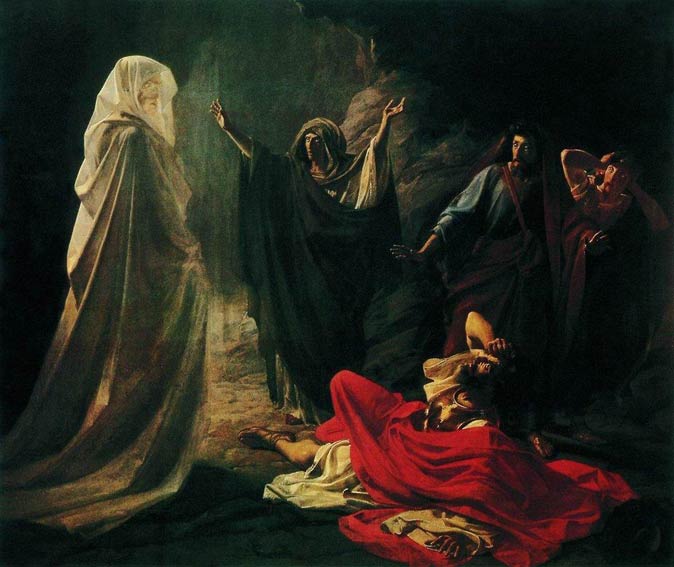
The spirit of Samuel appears to Saul in the "Witch of Endor," an 1857 painting by Nikolai Ge.
Posted on 06/20/2026 9:38:45 PM PDT by SeekAndFind
A Latin scholar in Germany recently discovered two lost sermons written by fourth-century church father Augustine of Hippo about the mysterious Witch of Endor from 1 Samuel 28.
Professor Christian Tornau, a Latin scholar at the University of Würzburg, made the discovery after receiving a phone call in 2024 from an employee of the Bad Doberan Monastery Association in northeastern Germany, according to a press release from the university earlier this month.
The employee asked Tornau for his help in deciphering a 12th-century manuscript that contains six sermons by Augustine and is housed at a monastery in Pelplin, Poland.
Tornau ultimately discovered that the medieval manuscript contained work by the influential philosopher and church father that had been lost.
"Two of the six sermons are previously undiscovered writings by Augustine," he said.
Both of the newly-discovered sermons address the story of the Witch of Endor recounted in 1 Samuel 28. According to the biblical text, a desperate King Saul, facing a looming battle with the Philistines and hearing no answer from God, disobeys his own edicts against witchcraft by consulting a medium in Endor to conjure the spirit of the dead prophet Samuel.
The spirit of Samuel appears to Saul in the "Witch of Endor," an 1857 painting by Nikolai Ge.
When Samuel's supposed spirit appears in response to the witch's necromancy, which apparently terrifies her, he rebukes Saul and prophesies that he and his sons would die in battle the next day, an event recounted in 1 Samuel 31.
The story has prompted debate over whether the incident was a demonic deception or divine judgment, and Tornau explained that Augustine addressed such questions in the unearthed sermons.
"Why can a necromancer summon the spirit of a prophet? This in turn opens up the theodicy problem: how can an omnipotent God allow this or is he not really omnipotent?" he said.
"The first [sermon] was preached during the Sunday service and ends with the theodicy question and the interpretations," Tornau said. "It was not until the second sermon on the following Wednesday that the options were weighed up."
Tornau said the open-ended nature of the sermons, which offered competing interpretations without forcing a conclusion, was typical of Augustine.
"The style, humor and content also clearly indicate that the sermons in the manuscripts were actually written by Augustine," he said.
Because of past alleged Augustine writings that have turned out to be forgeries, Tornau and 20 other Latin scholars convened in Vienna last fall to assess and verify the text, and all agreed the sermons are authentic.
A 12th-century copy is relatively late for such material, and scholars believe it likely derives from an earlier manuscript from Amelungsborn Abbey in Lower Saxony, whose original library was destroyed during the Thirty Years' War in the 17th century.
"This is not a sensational find like the 30 writings of St. Augustine that were discovered in Mainz in 1990. But we are supplementing Augustine's extensive body of writings with two further exciting texts in a critical edition," Tornau said. The university noted that the edition is expected to be published by the end of the year.
Augustine of Hippo is one of the most influential figures in the history of Western Christianity, famous for his classic works such as "The Confessions of St. Augustine" and his magnum opus "The City of God." He lived during a tumultuous time in world history, which included the sack of Rome by the Visigoths in A.D. 410, and much of his work is addressed to Christians amid a crumbling civilization.
Google says:
St. Augustine rejected literal, earthly interpretations of end-times prophecies. In his masterwork City of God, he argued that the "millennium" (1,000-year reign) is a spiritual reality happening now within the Church rather than a future political kingdom. He viewed "Israel" as a spiritual, symbolic entity rather than an exclusively physical nation.
RE: In his masterwork City of God, he argued that the “millennium” (1,000-year reign) is a spiritual reality happening now within the Church rather than a future political kingdom.
Well, to make a long story short, Augustine would be what modern day eschatologists call — An Amillenialist.
This question is a false dilemma because it is a false dichotomy based on a faulty premise. It presumes that God could have only allowed the witch of Endor to conjure up the ghost of Samuel because He (God) was powerless to prevent it. It leaves out the possible option that God might have allowed her to call forth the ghost of Samuel because it fit into His own plans to announce Saul's doom. It would not be a case of her having the power to do it, but God's option to work through her. Just because God forbids us to do certain things, for His own purposes He can do anything He wants, how he wants.
I don't believe He ever contradicts Himself/lies.
Took me WAY back to when I first discovered Science Fiction with Andre Norton’s, “The Witches of Endor” - I think I was 11 and trying to find books that seemed interesting at the library.
Neither do I. But I don't see a contradiction here. God can tell us not to do something because it is harmful for us and turns us away from him, but he can do that same thing for his own purposes and not be harmed by it. We all know that God can even make good out of evil.
Did he mention the Ewoks? JK.
Haven’t been able to get that outta my head since it cropped up in SW RotJ.
No, but He very often contradicts bogus human myths about Himself.
Reagan quipped, concerning the left, “It’s not that they’re wrong; it’s just that they believe so many things that aren’t so.”
I’ve been a churchman in various congregations of differing doctrinal positions going on seven decades. But the most new-minted Believer can attest as well as I that Reagan couple have, as easily, been talking about folks in the church.
And it’s not that they’re 180-degrees out of line, but very often 3-degrees is the difference between what they think and what the text says. It remains a pernicious truth, that people too often gloss over or breeze through a text they think is familiar, and only catch a missed point at a later reading.
The Serpent’s question in The Garden has two edges:
The fatal one of questioning what God did, indeed, say is what brought us into need of a Redeemer.
But the other edge — questioning what we might only THINK God has said, when He has NOT, in fact said it — divides between bone and marrow to expose Truth, Wisdom and to bring Life.
So, as to God: no, he NEVER contradicts Himself, but He OFTEN contradicts those who misunderstand Him.
Jesus exemplified this time after time in his interactions with experts in the Law of Moses in his day. They often believed one thing, while Jesus did another, and then had to explain where their thinking had veered off the mark.
Same thing today, both in and out of the church.
What is the example?
"But as for you, ye thought evil against me; but God meant it unto good, to bring to pass, as it is this day, to save much people alive"
“The...” singular?
I think people believe God has said many things He has not said. I suppose The Classic example would have to be, “Money is the root of all evil,” when, in fact, what God said by the hand of His Apostle was “The love of money is the root of all evil” (ref. I Tim. 6:10).
There’s a group that see the I Thess. 5:2 “thief in the night” text as a warning to believers. Nevermind, of course that v.4 clearly dispels that notion of being caught by surprise saying, “But you, Brothers, are not in the dark that The Day should come upon you like a thief.”
I’ve heard verse 2 preached in a doctrinal framework that admits to the the possibility that Jesus might pop outta the sky any old moment now, and some poor Believer could be caught out of the faith in the wake of some sin and having not yet repented, and they’d be eternally lost. The doctrinal stance taken together with v.2 in isolation creates great inward spiritual unrest incoherent with Jesus’ role as The Prince of Peace and The Rock of Our Salvation.
I’m aware of some who think the 24 Elders in Revelation 4:4 must be the Twelve Sons of Jacob and The Twelve Apostles. Now, it’s fine to have one’s suppositions on a wait-and-see basis, but a little sketchy to call them conclusive with no directly supporting texts. And it’s far too easy to incidentally pass these sorts of surmises on to others who may mistake them for scripturally established fact.
We’ve got a whole, vast swathe of Christendom out there thinking God has said that Israel is now entirely Replaced by the church. THAT’S a huge problem.
Obviously, there’s variance in how bad the implications are in every instance, and these are just a very few examples, still the dynamic is in play and the call is continual for gentle mature correction.
Heard this in our worship this morning: "Ye shall not add unto the word which I command you, neither shall ye diminish ought from it, that ye may keep the commandments of the Lord your God which I command you."
Disclaimer: Opinions posted on Free Republic are those of the individual posters and do not necessarily represent the opinion of Free Republic or its management. All materials posted herein are protected by copyright law and the exemption for fair use of copyrighted works.