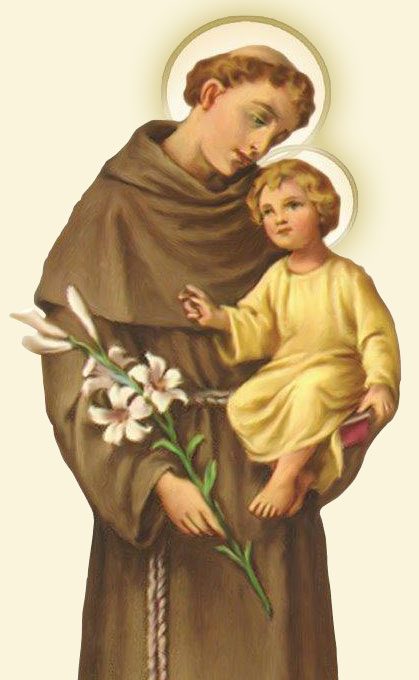
Known as the patron saint of the poor, of sailors and fishermen, of priests and travelers, a protector and guardian of the mails, and wonder-worker, the story of St. Anthony of Padua is very special.
Posted on 06/13/2026 5:14:55 PM PDT by annalex
Saturday of week 10 in Ordinary Time ![]() Saint Anthony of Padua Church in Saint Louis, Missouri Readings at MassLiturgical Colour: White. Year: A(II). These are the readings for the feria
Elisha leaves the plough to follow ElijahLeaving Mount Horeb, Elijah came on Elisha son of Shaphat as he was ploughing behind twelve yoke of oxen, he himself being with the twelfth. Elijah passed near to him and threw his cloak over him. Elisha left his oxen and ran after Elijah. ‘Let me kiss my father and mother, then I will follow you’ he said. Elijah answered, ‘Go, go back; for have I done anything to you?’ Elisha turned away, took the pair of oxen and slaughtered them. He used the plough for cooking the oxen, then gave to his men, who ate. He then rose, and followed Elijah and became his servant.
You are my inheritance, O Lord. Preserve me, God, I take refuge in you. I say to the Lord: ‘You are my God.’ O Lord, it is you who are my portion and cup; it is you yourself who are my prize. You are my inheritance, O Lord. I will bless the Lord who gives me counsel, who even at night directs my heart. I keep the Lord ever in my sight: since he is at my right hand, I shall stand firm. You are my inheritance, O Lord. And so my heart rejoices, my soul is glad; even my body shall rest in safety. For you will not leave my soul among the dead, nor let your beloved know decay. You are my inheritance, O Lord.
Alleluia, alleluia! Open my eyes, O Lord, that I may consider the wonders of your law. Alleluia!
Alleluia, alleluia! Bend my heart to your will, O Lord, and teach me your law. Alleluia!
Do not swear: say 'Yes' if you mean Yes, 'No' if you mean NoJesus said to his disciples: ‘You have learnt how it was said to our ancestors: You must not break your oath, but must fulfil your oaths to the Lord. But I say this to you: do not swear at all, either by heaven, since that is God’s throne; or by the earth, since that is his footstool; or by Jerusalem, since that is the city of the great king. Do not swear by your own head either, since you cannot turn a single hair white or black. All you need say is “Yes” if you mean yes, “No” if you mean no; anything more than this comes from the evil one.’ These are the readings for the memorial
He has sent me to proclaim a year of favour from the LordThe spirit of the Lord has been given to me, for the Lord has anointed me. He has sent me to bring good news to the poor, to bind up hearts that are broken; to proclaim liberty to captives, freedom to those in prison; to proclaim a year of favour from the Lord, a day of vengeance for our God, to comfort all those who mourn and to give them for ashes a garland; for mourning robe the oil of gladness, for despondency, praise.
I will sing for ever of your love, O Lord. I will sing for ever of your love, O Lord; through all ages my mouth will proclaim your truth. Of this I am sure, that your love lasts for ever, that your truth is firmly established as the heavens. I will sing for ever of your love, O Lord. ‘I have made a covenant with my chosen one; I have sworn to David my servant: I will establish your dynasty for ever and set up your throne through all ages. I will sing for ever of your love, O Lord. ‘I have found David my servant and with my holy oil anointed him. My hand shall always be with him and my arm shall make him strong. I will sing for ever of your love, O Lord. ‘My truth and my love shall be with him; by my name his might shall be exalted. He will say to me: “You are my father, my God, the rock who saves me.”’ I will sing for ever of your love, O Lord.
Alleluia, alleluia! The Lord has sent me to bring the good news to the poor, to proclaim liberty to captives. Alleluia!
Your peace will rest on that manThe Lord appointed seventy-two others and sent them out ahead of him, in pairs, to all the towns and places he himself was to visit. He said to them, ‘The harvest is rich but the labourers are few, so ask the Lord of the harvest to send labourers to his harvest. Start off now, but remember, I am sending you out like lambs among wolves. Carry no purse, no haversack, no sandals. Salute no one on the road. Whatever house you go into, let your first words be, “Peace to this house!” And if a man of peace lives there, your peace will go and rest on him; if not, it will come back to you. Stay in the same house, taking what food and drink they have to offer, for the labourer deserves his wages; do not move from house to house. Whenever you go into a town where they make you welcome, eat what is set before you. Cure those in it who are sick, and say, “The kingdom of God is very near to you.”’ The readings on this page are from the Jerusalem Bible, which is used at Mass in most of the English-speaking world. The New American Bible readings, which are used at Mass in the United States, are available in the Universalis apps, programs and downloads. |
|
Click here: to donate by Credit Card Or here: to donate by PayPal Or by mail to: Free Republic, LLC - PO Box 9771 - Fresno, CA 93794 Thank you very much and God bless you. |
KEYWORDS: catholic; lk10; mt5; ordinarytime; prayer;

Please FReepmail me to get on/off the Alleluia Ping List.
| Matthew | |||
| English: Douay-Rheims | Latin: Vulgata Clementina | Greek NT: Byzantine/Majority Text (2000) | |
| Matthew 5 | |||
| 33. | Again you have heard that it was said to them of old, Thou shalt not forswear thyself: but thou shalt perform thy oaths to the Lord. | Iterum audistis quia dictum est antiquis : Non perjurabis : reddes autem Domino juramenta tua. | παλιν ηκουσατε οτι ερρεθη τοις αρχαιοις ουκ επιορκησεις αποδωσεις δε τω κυριω τους ορκους σου |
| 34. | But I say to you not to swear at all, neither by heaven, for it is the throne of God: | Ego autem dico vobis, non jurare omnino, neque per cælum, quia thronus Dei est : | εγω δε λεγω υμιν μη ομοσαι ολως μητε εν τω ουρανω οτι θρονος εστιν του θεου |
| 35. | Nor by the earth, for it is his footstool: nor by Jerusalem, for it is the city of the great king: | neque per terram, quia scabellum est pedum ejus : neque per Jerosolymam, quia civitas est magni regis : | μητε εν τη γη οτι υποποδιον εστιν των ποδων αυτου μητε εις ιεροσολυμα οτι πολις εστιν του μεγαλου βασιλεως |
| 36. | Neither shalt thou swear by thy head, because thou canst not make one hair white or black. | neque per caput tuum juraveris, quia non potes unum capillum album facere, aut nigrum. | μητε εν τη κεφαλη σου ομοσης οτι ου δυνασαι μιαν τριχα λευκην η μελαιναν ποιησαι |
| 37. | But let your speech be yea, yea: no, no: and that which is over and above these, is of evil. | Sit autem sermo vester, est, est : non, non : quod autem his abundantius est, a malo est. | εστω δε ο λογος υμων ναι ναι ου ου το δε περισσον τουτων εκ του πονηρου εστιν |

5:33–37
33. Again, ye have heard that it hath been said by them of old time, Thou shalt not forswear thyself, but shalt perform unto the Lord thine oaths:
34. But I say unto you, Swear not at all; neither by Heaven; for it is God’s throne;
35. Nor by the earth; for it is His footstool: neither by Jerusalem; for it is the city of the great King.
36. Neither shalt thou swear by thy head, because thou canst not make one hair white or black.
37. But let your communication be, Yea, yea; Nay, nay: for whatsoever is more than these cometh of evil.
GLOSS. (non occ.) The Lord has hitherto taught to abstain from injuring our neighbour, forbidding anger with murder, lust with adultery, and the putting away a wife with a bill of divorce. He now proceeds to teach to abstain from injury to God, forbidding not only perjury as an evil in itself, but even all oaths as the cause of evil, saying, Ye have heard it said by them of old, Thou shall not forswear thyself. It is written in Leviticus, Thou shalt not forswear thyself in my name; (c. 19:12.) and that they should not make gods of the creature, they are commanded to render to God their oaths, and not to swear by any creature, Render to the Lord thy oaths; that is, if you shall have occasion to swear, you shall swear by the Creator and not by the creature. As it is written in Deuteronomy, Thou shall fear the Lord thy God, and shall swear by his name. (c. 6:13.)
JEROME. This was allowed under the Law, as to children; as they offered sacrifice to God, that they might not do it to idols, so they were permitted to swear by God; not that the thing was right, but that it were better done to God than to dæmons.
PSEUDO-CHRYSOSTOM. For no man can swear often, but he must sometimes forswear himself; as he who has a custom of much speaking will sometimes speak foolishly.
AUGUSTINE. (cont. Faust. xix. 23.) Inasmuch as the sin of perjury is a grievous sin, he must be further removed from it who uses no oath, than he who is ready to swear on every occasion, and the Lord would rather that we should not swear and keep close to the truth, than that swearing we should come near to perjury.
AUGUSTINE. (Serm. in Mont. i. 17.) This precept also confirms the righteousness of the Pharisees, not to forswear; inasmuch as he who swears not at all cannot forswear himself. But as to call God to witness is to swear, does not the Apostle break this commandment when he says several times to the Galatians, The things which I write unto you, behold, before God, I lie not. (Gal. 1:20.) So the Romans, God is my witness, whom I serve in my spirit. (Rom. 1:9) Unless perhaps some one may say, it is no oath unless I use the form of swearing by some object; and that the Apostle did not swear in saying, God is my witness. It is ridiculous to make such a distinction; yet the Apostle has used even this form, I die daily, by your boasting. (1 Cor. 15:31.) That this does not mean, your boasting has caused my dying daily, but is an oath, is clear from the Greek, which is νὴ τὴν ὑμετέραν καύχησιν.
AUGUSTINE. (de Mendac. 15.) But what we could not understand by mere words, from the conduct of the saints we may gather in what sense should be understood what might easily be drawn the contrary way, unless explained by example. The Apostle has used oaths in his Epistles, and by this shews us how that ought to be taken, I say unto you, Swear not at all, namely, lest by allowing ourselves to swear at all we come to readiness in swearing, from readiness we come to a habit of swearing, and from a habit of swearing we fall into perjury. And so the Apostle is not found to have used an oath but only in writing, the greater thought and caution which that requires not allowing of slip of the tongue. Yet is the Lord’s command so universal, Swear not at all, that He would seem to have forbidden it even in writing. But since it would be an impiety to accuse Paul of having violated this precept, especially in his Epistles, we must understand the word at all as implying that, as far as lays in your power, you should not make a practice of swearing, not aim at it as a good thing in which you should take delight.
AUGUSTINE. (cont. Faust. xix. 23.) Therefore in his writings, as writing allows of greater circumspection, the Apostle is found to have used an oath in several places, that none might suppose that there is any direct sin in swearing what is true; but only that our weak hearts are better preserved from perjury by abstaining from all swearing whatever.
JEROME. Lastly, consider that the Saviour does not here forbid to swear by God, but by the Heaven, the Earth, by Jerusalem, by a man’s head. For this evil practice of swearing by the elements the Jews had always, and are thereof often accused in the prophetic writing’s. For he who swears, shews either reverence or love for that by which he swears. Thus when the Jews swore by the Angels, by the city of Jerusalem, by the temple and the elements, they paid to the creature the honour and worship belonging to God; for it is commanded in the Law that we should not swear but by the Lord our God.
AUGUSTINE. (Serm. in Mont. i. 17.) Or; It is added, By the Heaven, &c. because the Jews did not consider themselves bound when they swore by such things. As if He had said, When you swear by the Heaven and the Earth, think not that you do not owe your oath to the Lord your God, for you are proved to have sworn by Him whose throne the heaven is, and the earth His footstool; which is not meant as though God had such limbs set upon the heaven and the earth, after the manner of a man who is sitting; but that seat signifies God’s judgment of us. And since in the whole extent of this universe it is the heaven that has the highest beauty, God is said to sit upon the heavens as shewing divine power to be more excellent than the most surpassing show of beauty; and He is said to stand upon the earth, as putting to lowest use a lesser beauty. Spiritually by the heavens are denoted holy souls, by the earth the sinful, seeing He that is spiritual judgeth all things. (1 Cor. 2:15.) But to the sinner it is said, Earth thou art, and unto earth thou shalt return. (Gen. 3:19.) And he who would abide under a law, is put under a law, and therefore He adds, it is the footstool of His feet. Neither by Jerusalem, for it is the city of the Great King; this is better said than ‘it is mine;’ though it is understood to mean the same. And because He is also truly Lord, whoso swears by Jerusalem, owes his oath to the Lord. Neither by thy head. What could any think more entirely his own property than his own head? But how is it ours when we have not power to make one hair black or white? Whoso then swears by his own head also owes his vows to the Lord; and by this the rest may be understood.
CHRYSOSTOM. Note how He exalts the elements of the world, not from their own nature, but from the respect which they have to God, so that there is opened no occasion of idolatry.
RABANUS. Having forbidden swearing, He instructs us how we ought to speak, Let your speech be yea, yea; nay, nay. That is, to affirm any thing it is sufficient to say, ‘It is so:’ to deny, to say, ‘It is not so.’ Or, yea, yea; nay, nay, are therefore twice repeated, that what you affirm with the mouth you should prove in deed, and what you deny in word, you should not establish by your conduct.
HILARY. Otherwise; They who live in the simplicity of the faith have not need to swear, with them ever, what is is, what is not is not; by this their life and their conversation are ever preserved in truth.
JEROME. Therefore Evangelic verity does not admit an oath, since the whole discourse of the faithful is instead of an oath.
AUGUSTINE. (ubi sup.) And he who has learned that an oath is to be reckoned not among things good, but among things necessary, will restrain himself as much as he may, not to use an oath without necessity, unless he sees men loth to believe what it is for their good they should believe, without the confirmation of an oath. This then is good and to be desired, that our conversation be only, yea, yea; nay, nay; for what is more than this cometh of evil. That is, if you are compelled to swear, you know that it is by the necessity of their weakness to whom you would persuade any thing; which weakness is surely an evil. What is more than this is thus evil; not that you do evil in this just use of an oath to persuade another to something beneficial for him; but it is an evil in him whose weakness thus obliges you to use an oath.
CHRYSOSTOM. Or; of evil, that is, from their weakness to whom the Law permitted the use of an oath. Not that by this the old Law is signified to be from the Devil, but He leads us from the old imperfection to the new abundance.
Catena Aurea Matthew 5

| Luke | |||
| English: Douay-Rheims | Latin: Vulgata Clementina | Greek NT: Byzantine/Majority Text (2000) | |
| Luke 10 | |||
| 1. | AND after these things the Lord appointed also other seventy-two: and he sent them two and two before his face into every city and place whither he himself was to come. | Post hæc autem designavit Dominus et alios septuaginta duos : et misit illos binos ante faciem suam in omnem civitatem et locum, quo erat ipse venturus. | μετα δε ταυτα ανεδειξεν ο κυριος και ετερους εβδομηκοντα και απεστειλεν αυτους ανα δυο προ προσωπου αυτου εις πασαν πολιν και τοπον ου εμελλεν αυτος ερχεσθαι |
| 2. | And he said to them: The harvest indeed is great, but the labourers are few. Pray ye therefore the Lord of the harvest, that he send labourers into his harvest. | Et dicebat illis : Messis quidem multa, operarii autem pauci. Rogate ergo dominum messis ut mittat operarios in messem suam. | ελεγεν ουν προς αυτους ο μεν θερισμος πολυς οι δε εργαται ολιγοι δεηθητε ουν του κυριου του θερισμου οπως εκβαλη εργατας εις τον θερισμον αυτου |
| 3. | Go: Behold I send you as lambs among wolves. | Ite : ecce ego mitto vos sicut agnos inter lupos. | υπαγετε ιδου εγω αποστελλω υμας ως αρνας εν μεσω λυκων |
| 4. | Carry neither purse, nor scrip, nor shoes; and salute no man by the way. | Nolite portare sacculum, neque peram, neque calceamenta, et neminem per viam salutaveritis. | μη βασταζετε βαλαντιον μη πηραν μηδε υποδηματα και μηδενα κατα την οδον ασπασησθε |
| 5. | Into whatsoever house you enter, first say: Peace be to this house. | In quamcumque domum intraveritis, primum dicite : Pax huic domui : | εις ην δ αν οικιαν εισερχησθε πρωτον λεγετε ειρηνη τω οικω τουτω |
| 6. | And if the son of peace be there, your peace shall rest upon him; but if not, it shall return to you. | et si ibi fuerit filius pacis, requiescet super illum pax vestra : sin autem, ad vos revertetur. | και εαν η εκει υιος ειρηνης επαναπαυσεται επ αυτον η ειρηνη υμων ει δε μηγε εφ υμας ανακαμψει |
| 7. | And in the same house, remain, eating and drinking such things as they have: for the labourer is worthy of his hire. Remove not from house to house. | In eadem autem domo manete, edentes et bibentes quæ apud illos sunt : dignus est enim operarius mercede sua. Nolite transire de domo in domum. | εν αυτη δε τη οικια μενετε εσθιοντες και πινοντες τα παρ αυτων αξιος γαρ ο εργατης του μισθου αυτου εστιν μη μεταβαινετε εξ οικιας εις οικιαν |
| 8. | And into what city soever you enter, and they receive you, eat such things as are set before you. | Et in quamcumque civitatem intraveritis, et susceperint vos, manducate quæ apponuntur vobis : | και εις ην αν πολιν εισερχησθε και δεχωνται υμας εσθιετε τα παρατιθεμενα υμιν |
| 9. | And heal the sick that are therein, and say to them: The kingdom of God is come nigh unto you. | et curate infirmos, qui in illa sunt, et dicite illis : Appropinquavit in vos regnum Dei. | και θεραπευετε τους εν αυτη ασθενεις και λεγετε αυτοις ηγγικεν εφ υμας η βασιλεια του θεου |

1. After these things the Lord appointed other seventy also, and sent them two and two before his face into every city and place, whither he himself would come.
2. Therefore said he unto them, The harvest truly is great, but the labourers are few: pray ye therefore the Lord of the harvest, that he would send forth labourers into his harvest.
CYRIL OF ALEXANDRIA. God had made known by the Prophets that the preaching of the Gospel of salvation was to embrace not only Israel, but also the Gentile nations; and therefore after the twelve Apostles, there were other seventy-two (Vulg. septuaginta duos.) also appointed by Christ, as it is said, After these things the Lord appointed other seventy-two also.
BEDE. Rightly are seventy-two sent, for to so many nations of the world was the Gospel to be preached, that as at first twelve were appointed because of the twelve tribes of Israel, so, these also were ordained as teachers for the instruction of the foreign nations.
AUGUSTINE. (de Quæst. Ev. 1. ii. q. 14.) As also in twenty-four hours the whole world moves round and receives light, so the mystery of enlightening the world by the Gospel of the Trinity, is hinted at in the seventy-two disciples. For three times twenty-four makes seventy-two. Now as no one doubts that the twelve Apostles foreshadowed the order of Bishops, so also we must know that these seventy-two represented the presbytery, (that is, the second order of priests.) Nevertheless, in the earliest times of the Church, as the Apostolical writings bear witness, both were called presbyters, both also called bishops, the former of these signifying “ripeness of wisdom,” the latter, “diligence in the pastoral care.”
CYRIL OF ALEXANDRIA. An outline of this ordinance also was set forth in the words of Moses, who at the command of God chose out seventy, upon whom God poured out His Spirit. In the book of Numbers also it was written of the children of Israel, that they came to Elim, which is by interpretation “ascent,” and there were there twelve fountains of water, and seventy palm trees. (Numb. 33:9.) For when we fly to spiritual refreshment, we shall find twelve fountains, namely, the holy Apostles, from whom we imbibe the knowledge of salvation as from the well-springs of the Saviour; (Isai. 12:3.) and seventy palms, that is, those who were now appointed by Christ. For the palm is a tree of sound core, striking deep root and fruitful, always growing by the water side, yet at the same time putting forth its leaves upwards.
It follows, And he sent them two and two.
GREGORY. (Hom. 17. in Ev.) He sends the disciples to preach two and two, because there are two commands of charity, the love of God, and love of our neighbour; (and charity cannot exist without at least two;) thereby silently suggesting to us, that he who has not love to another, ought not to undertake the office of preaching.
ORIGEN. Likewise also the twelve were reckoned by two and two, as Matthew shews in his enumeration of them. (Matt. 10:2.) For that two should be joined in service, seems from the word of God to be an ancient custom. For God led Israel out of Egypt by the hands of Moses and Aaron. Joshua and Caleb also, united together, appeased the people who had been provoked by the twelve spies. (Numb. 13, 14. Ex. 12.) Hence it is said, A brother assisted by a brother is as a fortified city. (Prov. 18:19. Vulg.)
BASIL. At the same time it is implied by this, that if any are equal in spiritual gifts, they should not suffer a fondness for their own opinion to get the better of them.
GREGORY. (ubi sup.) It is rightly added, before his face into every city and place, whither he himself would come. For the Lord follows His preachers, since the preaching comes first, and then the Lord enters into the tabernacle of our heart; seeing that through the words of exhortation going before, truth is received into the mind. Hence Esaias says to the preachers, Prepare ye the way of the Lord, make straight a highway for our God. (Isa. 40:3.)
THEOPHYLACT. The Lord had appointed the disciples for the sake of the multitude, who were in want of teachers. For as our corn fields require many reapers, so the innumerable company of those who are to believe need many teachers, as it follows, The harvest truly is great.
CHRYSOSTOM. But how does He give the name of harvest to a work only just now at its beginning? the plough not yet put down, nor the furrows turned, He yet speaks of harvests, for His disciples might waver and say, How can we so small a number convert the whole world, how can foolish men reform the wise, naked men those that are armed, subjects their rulers? Lest they should be disturbed then by such thoughts, He calls the Gospel a harvest; as if He says, All things are ready, I send you to a gathering of fruits already prepared. Ye can sow and reap the same day. As then the husbandman goes out to harvest rejoicing, much more also and with greater cheerfulness must you go out into the world. For this is the true harvest, which shews the fields all prepared for you.
GREGORY. (ubi sup.) But not without deep sorrow can we add, but the labourers are few. For although there are who would hear good things, they are wanting who should spread them. Behold the world is full of priests, but seldom is there found a labourer in God’s harvest, because we undertake indeed the priestly office, but we perform not its works.
BEDE. Now as the great harvest is this whole multitude of believers, so the few labourers are the Apostles, and their followers who are sent to this harvest.
CYRIL OF ALEXANDRIA. (non occ. v. Tit. Bost.) As the large fields require many reapers, so also do the multitude of believers in Christ. Hence He adds, Pray ye therefore the Lord of the harvest, that he would send forth labourers into his harvest. Now mark that when He said, Pray ye therefore the Lord of the harvest, that he would send forth labourers into the harvest, He afterwards Himself performed it. He then is the Lord of the harvest, and by Him, and together with Him, God the Father rules over all.
CHRYSOSTOM. (Hom. 32. in Matt.) But he afterwards increased them greatly, not by adding to their number, but awarding to them power. He implies that it is a great gift to send labourers into the divine harvest, by His saying that the Lord of the harvest must be prayed to upon this account.
GREGORY. (ubi sup.) Hereby also the people must be induced to pray for their pastors, that they may he able to work what is good for them, and that their tongue grow not lifeless in exhortation. For often for their own wickedness their tongue is tied. But often for the fault of the people it comes to pass that the word of preaching is withdrawn from their rulers.
10:3–4
3. Go your ways: behold, I send you forth as lambs among wolves.
4. Carry neither purse, nor scrip, nor shoes: and salute no man by the way.
CYRIL OF ALEXANDRIA. Luke next relates, that the seventy disciples obtained for themselves from Christ apostolical learning, lowliness, innocency, justice, and to prefer no worldly things to holy preachings, but to aspire to such fortitude of mind as to be afraid of no terrors, not even death itself. He adds therefore, Go.
CHRYSOSTOM. (Hom. 33. in Matt.) For their comfort amid every danger was the power of Him who sent them. And therefore saith He, Behold, I send you; as if he said, This will suffice for your consolation, this will be enough to make you hope, instead of fearing the coming evils which He signifies, adding, as lambs among wolves.
ISIDORE OF PELEUSIUM. (l. i. ep. 438.) Denoting the simplicity and innocence in His disciples. For those who were riotous, and by their enormities did despite to their nature, He calls not lambs, but goats.
AMBROSE. Now these animals are at variance among themselves, so that the one is devoured by the other, the lambs by the wolves; but the good Shepherd has no fear of wolves for His flock. And therefore the disciples are appointed not to make prey, but to impart grace. For the watchfulness of the good Shepherd causes the wolves to attempt nothing against the lambs; He sends them as lambs amid wolves that that prophecy might be fulfilled, The wolf and the lamb shall feed together. (Isaiah 65:25.)
CHRYSOSTOM. (Hom. 33 in Matt.) For this was a clear announcement of glorious triumph, that the disciples of Christ, when surrounded by their enemies as lambs among wolves, should still convert them.
BEDE. Or He especially gives the name of wolves to the Scribes and Pharisees, who are the Jewish clergy.
AMBROSE. Or the heretics are compared to wolves. For wolves are beasts who lay in wait near the sheep folds, and prowl about the shepherds’ cottages. They dare not enter the abodes of men, they pry out sleeping dogs, absent or slothful shepherds; they seize the sheep by the throat, that they may quickly strangle them; ravenous beasts, with bodies so stiff that they cannot easily turn themselves, but are carried along by their own impetus, and so are often deceived. If they are the first to see a man, it is said, they by a certain natural impulse, tear out his voice; but if a man first sees them, they quake with fear. In like manner the heretics lurk about Christ’s sheep folds, howl near the cottages at night time. For night is the time for the treacherous who obscure the light of Christ with the mists of false interpretation. The inns of Christ, however, they dare not enter, and therefore are not healed, as he was in an inn who fell among thieves. They look out for the shepherds’ absence, for they can not attack the sheep when the shepherds are by. Owing also to the inflexibility of a hard and obstinate mind, they seldom if ever turn from their error, while Christ the true interpreter of Scripture mocks them, so that they vent forth their violence in vain, and are not able to hurt; and if they overtake any one by the subtle trickery of their disputations, they make him dumb. For he is dumb who confesses not the word of God with the glory which belongs to it. Beware then lest the heretic deprive you of your voice, and lest you detect him not first. For he is creeping on while his treachery is disguised. But if you have discovered his unholy desires, you can not fear the loss of a holy voice. They attack the throat, they wound the vitals while they seek the soul. If also you hear any one called a priest, and you know his robberies, outwardly he is a sheep, inwardly a wolf, who is longing to gratify his rage with the insatiable cruelty of human murder.
GREGORY. (Hom. 17. in Ev.) For many when they receive the right of rule, are vehement in persecuting their subjects, and manifesting the terrors of their power. And since they have no bowels of mercy, their desire is to seem to be masters, forgetting altogether that they are fathers, changing an occasion for humility, into an exaltation of power. We must on the other hand consider, that as lambs we are sent among wolves that preserving the feeling of innocence, so we should make no malicious attacks. For he who undertakes the office of preacher ought not to bring evils upon others, but to endure them; who although at times an upright zeal demands that he should deal harshly with his subjects, should still inwardly in his heart love with a fatherly feeling those whom outwardly he visits with censure. And that ruler gives a good example of this, who never submits the neck of his soul to the yoke of earthly desire. Hence it is added, Carry neither purse nor scrip.
GREGORY NAZIANZEN. (Orat. 2.) The sum of which is, that men ought to be so virtuous that the Gospel should make no less progress through their way of life than their preaching.
GREGORY. (Hom. 17. in Ev.) For the preacher (of the Gospel) ought to have such trust in God, that although he has provided not for the expenses of this present life, he should still be most certainly convinced that these will not fail him; lest while his mind is engaged in His temporal things, he should be less careful for the spiritual things of others.
CYRIL OF ALEXANDRIA. Thus He had already commanded them to have no care for these persons, when He said, I send you as lambs among wolves. And He also forbade all care about what is external to the body, by saying, Take neither purse nor scrip. Nor did He allow men to take with them any of those things which were not attached to the body. Hence He adds, Nor shoes. He not only forbade them to take purse and scrip, but He did not allow them to receive any distraction in their work, such as interruption by greetings on their way. Hence He adds, Salute no one by the way. Which had long ago been said by Elisha. (2 Kings. 4:29.) As if He said, Proceed straight on to your work without exchanging blessings with others. For it is a loss to waste the time which is fitter for preaching, in unnecessary things.
AMBROSE. Our Lord did not then forbid these things because the exercise of benevolence was displeasing to Him, but because the motive of following after devotedness was more pleasing.
GREGORY NAZIANZEN. (ubi sup.) The Lord gave them these commands also for the glory of the word, lest it should seem that enticements could more prevail over them. He wished them also not to be anxious to speak to others.
GREGORY. (ubi sup.) If any one would have these words taken also allegorically, the money shut up in a purse is the hidden wisdom. He then who has the word of wisdom, and neglects to employ it for his neighbour, is like one who keeps his money tied up in his purse. But by the scrip is meant the troubles of the world, by the shoes (made of the skins of dead animals) are signified the examples of dead works. He then who undertakes the office of preacher ought not to bear the burden of business, lest while this presses down his neck he should not rise to the preaching of heavenly things; nor ought he to behold the example of foolish works, lest he think to shield his own works as by dead skins, that is, lest because he observes that others have done these things, he imagine that he also is at liberty to do the same.
AMBROSE. Our Lord also would have nothing human in us. For Moses is bid to loose off the human and earthly shoe when he was sent to deliver the people. (Exod. 3:5) But if any one is perplexed why in Egypt we are ordered to eat the lamb with shoes on, (Exod. 12:11.) but the Apostles are appointed to preach the Gospel without shoes: he must consider, that one in Egypt ought still to beware of the serpent’s bite, for there were many poisonous creatures in Egypt. And he who celebrates the Passover in figure may be exposed to the wound, but the minister of truth fears no poison.
GREGORY. (ubi sup.) Now every one who salutes on the way does so from the accident of the journey, not for the sake of wishing health. He then who not from love of a heavenly country, but from seeking reward, preaches salvation to his hearers, does as it were salute on the journey, since accidentally, not from any fixed intention, he desires the salvation of his hearers.
10:5–12
5. And into whatever house ye enter, first say, Peace be to this house.
6. And if the son of peace be there, your peace shall rest upon it: if not, it shall turn to you again.
7. And in the same house remain, eating and drinking such things as they give; for the labourer s worthy of his hire. Go not from house to house.
8. And into whatsoever city ye enter, and they receive you, eat such things as are set before you:
9. And heal the sick that are therein, and say unto them, The kingdom of God is come nigh unto you.
10. But into whatsoever city ye enter, and they receive you not, go your ways out into the streets of the same, and say,
11. Even the very dust of your city, which cleaveth on us, we do wipe off against you: notwithstanding be ye sure of this, that the kingdom of God is come nigh unto you.
12. But I say unto you, that it shall be more tolerable in that day for Sodom, than for that city.
CHRYSOSTOM. (Hom. 35. in Matt.) Peace is the mother of all good things, without it all other things are vain. Our Lord therefore commanded His disciples on entering a house first to pronounce peace as a sign of good things, saying, Into whatever house ye enter, first say, Peace be to this house.
AMBROSE. That in truth we should convey the message of peace, and that our very first entrance be attended with the blessing of peace.
CHRYSOSTOM. (Hom. 32. in Matt. Orat. cont. Jud. 3.) And hence he who presides in the Church gives it, saying, Peace unto all. Now holy men ask for peace, not only that which dwells among men in mutual intercourse, but that which belongs to ourselves. For oftentimes we wage war in our hearts, and are disturbed even when no one troubles us; bad desires also frequently rise up against us.
TITUS BOSTRENSIS. But it is said, Peace he to this house, that is, to them that dwell in the house. As if he says, I speak unto all, both the greater and the less, yet should not your salutation be addressed to them that are unworthy of it. Hence it is added, And if the son of peace be there, your peace shall rest upon it. As if he says, You indeed shall utter the word, but the blessing of peace shall be applied wherever I shall deem men worthy of it. But if any one is not worthy, ye are not mocked, the grace of your word has not perished, but is returned unto you. And this is what is added, But if not, it shall return unto you again.
GREGORY. (Hom. 17. in Ev.) For the peace which is offered by the mouth of the preacher shall either rest on the house, if there be any one in it predestined to life, who follows the heavenly word which he hears; or if no one be willing indeed to hear, the preacher himself shall not be without fruit, for the peace returns to him, while the Lord gives him the recompense of reward for the labour of his work. But if our peace is received, it is meet that we should obtain earthly supplies from those to whom we offer the rewards of a heavenly country. Hence it follows: And in the same house remain, eating and drinking such things as they give. Mark, that He who forbade them to carry purse and scrip, allows them to be an expense to others, and to receive sustenance from preaching.
CHRYSOSTOM. (ubi sup.) But lest any one should say, I am spending my own property in preparing a table for strangers, He first makes them offer the gift of peace, to which nothing is equal, that you may know that you receive greater things than you give.
TITUS BOSTRENSIS. Or else; Since you are not appointed judges as to who are worthy and who are unworthy, eat and drink what things they offer to you. But leave to me the trial of those who receive you, unless you happen also to know that the son of peace is not there, for perhaps in that case you ought to depart.
THEOPHYLACT. See then how He taught His disciples to beg, and wished them to receive their nourishment as a reward. For it is added, For the labourer is worthy of his hire.
GREGORY. (ubi sup.) For now the very food which supports him is part of the wages of the labourer, as in this life the hire commences with the labour of preaching, which in the next is completed with the sight of truth. And here we must consider that two rewards are due to one work of ours, one on the journey, which supports us in labour, the other in our country, which recompenses us at the resurrection. Therefore the reward which we receive now ought so to work in us, that we the more vigorously strive to gain the succeeding reward. Every true preacher then ought not so to preach, that he may receive a reward at the present time, but so to receive a reward that he may have strength to preach. For whoever so preaches that here he may receive the reward of praise, or riches, deprives himself of an eternal reward.
AMBROSE. Another virtue is added, that we should not go about easily, changing from house to house. For it follows, Go not from house to house; that is, that we should preserve a consistency in our love towards our hosts, nor lightly loose any bond of friendship.
BEDE. Now having described the reception from different houses, he teaches them what they ought to do in the cities; namely, to have intercourse with the good in all, but to keep from the society of the wicked in every thing; as it follows, But into whatsoever city ye enter, and they receive you, eat such things as are set before you.
THEOPHYLACT. Although they be few and poor, ask for nothing more; He also tells them to work miracles, and their word shall draw men to their preaching. Hence he adds, And heal the sick that are therein, and say to them, The kingdom of God is come nigh unto you. For if you first heal and then teach, the word will prosper, and men believe that the kingdom of God is come nigh. For they would not be cured unless by the working of some divine power. But also when they are healed in their soul, the kingdom of God comes nigh unto them, for it is far off from him over whom sin has the dominion.
CHRYSOSTOM. (Hom. 32. in Matt.) Now mark the excellence of the Apostles. They are bid to utter nothing relating to sensible things, such as Moses and the Prophets spoke of, namely, earthly goods, but certain new and marvellous things, namely, the kingdom of God.
MAXIMUS. (Cap. Theol. 191.) Which it is said is come nigh, not to shew the shortness of time, for the kingdom of God cometh not with observation, but to mark the disposition of men towards the kingdom of God, which is indeed potentially in all believers, but actually in those who reject the life of the body, and choose only the spiritual life; who are able to say, Now I live, yet not I, but Christ liveth in me. (Gal. 2:20.)
AMBROSE. He next teaches them to shake off the dust from their feet when the men of a city have refused to entertain them, saying, Into whatsoever city ye enter, and they receive you not, shake off the dust.
BEDE. Either as a testimony to the earthly toil which they had in vain undergone for them, or to shew that so far from seeking any thing earthly from them, they suffer not even the dust from their land to cleave to them. Or by the feet is meant the very labour and walking to and fro of preaching; but the dust with which they are sprinkled is the lightness of worldly thoughts, from which even the greatest teachers cannot be free. Those then who have despised the teaching, turn the labours and dangers of the teachers into a testimony of their condemnation.
ORIGEN. By wiping off the dust of their feet against them, they in some sort say, The dust of your sins shall deservedly come upon you. And mark that the cities which receive not the Apostles and sound doctrine have streets, according to Matthew, Broad is the way which leadeth to destruction. (Matt. 7:13.)
THEOPHYLACT. And as they who receive the Apostles are said to have the kingdom of God come nigh unto them as a blessing, so those who do not receive them are said to have it nigh unto them as a curse. Hence He adds, Notwithstanding, be ye sure of this, that the kingdom of God is come nigh unto you, as the coming of a king is to some for punishment, but to some for honour. Hence it is added respecting their punishment, But I say unto you, It shall be more tolerable for Sodom, &c.
EUSEBIUS. For in the city of Sodom Angels were not without entertainment, but Lot was found worthy to receive them into his house. (Gen. 19.) If then at the coming of the disciples into a city there shall not be found one to receive them, will not that city be worse than Sodom? These words persuaded them to attempt boldly the rule of poverty. For there could not be a city or village without some inhabitants acceptable to God. For Sodom could not exist without a Lot found in it, at whose departure the whole was suddenly destroyed.
BEDE. The men of Sodom, although they were hospitable in the midst of all their wickedness of soul and body, yet were there no such guests found among them as the Apostles. Lot indeed was righteous both in seeing and hearing, yet he is not said to have taught or worked miracles.
Catena Aurea Luke 10


Known as the patron saint of the poor, of sailors and fishermen, of priests and travelers, a protector and guardian of the mails, and wonder-worker, the story of St. Anthony of Padua is very special.

St. Anthony was born in 1195 (13 years after St. Francis of Assisi) in Lisbon, which is now known as Portugal. Given the baptismal name of Fernando, his parents, Martin and Mary Bulhom, belonged to one of the most prominent families of the city.
At the age of 15 Fernando entered the religious order of St. Augustine. Monastery life was hardly peaceful for the youth, nor conducive to prayer and study, since his old friends came to visit frequently and engaged in vehement political discussions. After two years, at his request he was sent to Coimbra (cornbrow). There he began nine years of intense study learning the Augustinian theology that he would later combine with Franciscan vision. Fernando was most likely ordained a priest during this time.
The life of the young priest took a crucial turn when the bodies of the first five Franciscan martyrs were returned from Morocco. The Franciscans had been preaching Christ at a mosque in Seville. They were in danger of being martyred at the outset, but the sultan allowed them to pass on to Morocco, where, after continuing to preach about Christ — despite repeated warnings, they were tortured and beheaded.
In the presence of a huge crowd, including the queen, their remains were carried in solemn procession to the very monastery where Fernando lived.
This event, while viewed by many as tragic and sad, was deemed glorious, and in fact was an inspiration to young Fernando. So much so, that it inspired him to make a momentous decision, one that would change his life and the lives of many to come. He decided that he too would become a Franciscan!
From the beginning, he shared his feelings with the Franciscan brothers saying, “i would gladly put on the habit of your order if you would promise to send me as soon as possible to the land of the Saracens, that I may gain the crown of the Holy Martyrs.” to accomplish this he asked permission to leave the order of St. Augustine. After some challenges from the prior of the Augustinians, he was allowed to leave that priory.
The young Augustinian monk called Fernando went to the convent of St. Anthony, where he took vows of the Franciscan order and assumed the name of Anthony in honor of the patriarch of hermits.
True to their promise, the Franciscans allowed Anthony to go to Morocco, to pursue what he felt was his calling – to be a witness for Christ, and a martyr as well, if God asked.
But, as often happens, the gift Anthony wanted to give was not the gift that was to be asked of him. While in Morocco, he became seriously ill, and after several months realized he had to go home.
During the journey home, his ship ran into storms and high winds and was blown east across the Mediterranean. Eventually his ship made land on the east coast of Sicily. The friars at nearby messina, though they didn’t know him, welcomed him and began nursing him back to health. Still ailing, Anthony wanted to attend the great Pentecost chapter of mats (so called because the 3,000 friars could not be housed and slept on mats). Francis of Assisi was there and was also sick.
Since Anthony was essentially a visitor from “out of town” at the friary in Sicily, he received no assignment during the chapter of mats, so he asked to go and be with a provincial superior from northern Italy. “Instruct me in the Franciscan life,” he asked, not mentioning his prior theological training.
When the provincial superior agreed, Anthony was overjoyed. Now, like Francis, he had his first choice — a life of seclusion and contemplation in a hermitage.
Anthony was first recognized for his great gift of preaching at a gathering for the ordination of Dominicans and Franciscans in 1222. After they finished their meal, the provincial suggested that one of the friars give a short sermon. There were no immediate volunteers among the group, so Anthony was asked to give “just something simple,” since he presumably had no education and at the time was only 27 years old.
Anthony, while resisting the offer at first, finally began to speak in a simple, artless way. The “fire” within him became evident. His knowledge was unmistakable, but it was the passionate manner in which he spoke that truly impressed everyone in attendance.
Once his talents and knowledge were exposed, his quiet life of prayer and penance at the hermitage was exchanged for that of a public preacher. Francis heard of Anthony’s skills as a preacher, and re-assigned the young priest to preach in northern Italy.
We know that not everyone was impressed by his preaching. Legend has it that one day, faced with deaf ears, Anthony went to the river and preached to the fish. That, reads the traditional tale, got everyone’s attention.
Anthony traveled tirelessly in both northern Italy and southern France—perhaps 400 trips—choosing to enter the cities where the heretics were strongeSt. Yet the sermons he has left behind rarely show him taking direct issue with them. As church historians interpret it, Anthony preferred to present the grandeur of Christianity in positive ways. It was no good to prove people wrong: Anthony wanted to win them to the right, the healthiness of real sorrow and conversion as well as the wonder of reconciliation with a loving father.
Anthony’s superior, St. Francis, continued to hear glowing reports of Anthony’s sermons, knowledge of scripture and devotion to Mary. In 1224 he wrote to Anthony asking him to teach his brother Franciscans. Anthony became the first teacher of the Franciscan order to be given special approval and blessings of St. Francis.
Anthony continued to preach as he taught the friars and assumed more responsibility within the order. In 1226 he was appointed provincial superior of northern Italy, but still found time for contemplative prayer in a small hermitage.
Around Easter in 1228, at the age of 33, he met Pope Gregory IX in Rome. The Pope had been a faithful friend and adviser of St. Francis. Naturally, the famous preacher Anthony was invited to speak. He did it humbly, as always. The response was so great that people later said that it seemed the miracle of Pentecost was repeated.
Back in Padua in 1231, Anthony preached his last and most famous Lenten sermons. The crowds were so great—sometimes 30,000—that the churches could not hold them, so he went into the piazzas or the open fields. People waited all night to hear him. A bodyguard was needed to protect him from the people armed with scissors who wanted to snip off a piece of his habit as a relic. After his morning mass and sermon, Anthony would hear confessions. This sometimes lasted all day—as did his fasting and constant prayer.
The great energy he had expended during the Lenten season left him exhausted. He went to a little town near Padua to rest and recover, but he soon realized death was coming close and he wanted to return to Padua, the city that he loved. The journey in a wagon weakened him so much, however, that he had to stop at Arcella. In the end, he had to bless Padua from a distance, as Francis had blessed Assisi from a distance.
At Arcella, he received the last sacraments, sang and prayed with the friars there. When one of them asked Anthony what he was staring at so intently, he answered, “I see my lord!” he died in peace a short time after that. He was only 36 and had been a Franciscan for only 10 years.
The story and tradition of devotion to St. Anthony of Padua began almost immediately upon his death on June 13, 1231. Thousands came to view the body of Anthony and attend his burial. His grave at once became a place of extraordinary devotion and numerous miracles. The following year, his friend, Pope Gregory IX, moved by the many miracles attributed to him during his life and that occurred at his tomb, declared him a saint. In 1946, Pope Pius XII officially declared St. Anthony a doctor of the church.
God alone knows which are true and which are folk legend, but in telling the story of St. Anthony of Padua, one must include some mention of the commonly-heard stories attributed to him both during and after his life on earth:
The first is the story of St. Anthony’s bread. Many people give donations to help the poor in thanksgiving for gifts they’ve attributed to St. Anthony’s intercession. They call this St. Anthony’s bread. The story of St. Anthony’s bread is said to have began in 1263, when a beloved child drowned near the basilica of St. Anthony. The child’s mother prayed for St. Anthony’s intercession and promised that if the child was restored to her, she would give the child’s weight in grain to the poor in order that they could make bread – a very great gift in a time of widespread poverty and hunger.
When the child was miraculously restored to life, the woman was true to her word and the tradition of giving alms to the poor in St. Anthony’s name was begun. It is a beautiful tradition of generosity and charity to the poor. And it is fitting that it is done in St. Anthony’s name, since he is the patron saint of the poor.
Many people think of St. Anthony as the “finder of lost items”. The reason for invoking St. Anthony’s help in finding lost or stolen items is traced back to an incident in his own life. As the story goes, he had a favorite book of psalms that was very valuable to him. As this was before the invention of printing, the book was a hand-printed book – but of even more value were his personal notes and the comments he had made in the Psalter to assist with teaching students in the Franciscan order. It was suspected that a novice leaving the community had stolen the Psalter. Anthony prayed for the return of his beloved possession. Shortly after, the novice returned the book and sought Anthony’s forgiveness, which was given.
St. Anthony is also known as the guardian of the mail as a result of another incident in his life. Although he always sought solitude and time for reflection, Anthony was so popular a preacher that he rarely got time to rest. He dutifully wrote to his superior for permission for a respite and time to travel some distance away for reflection. However, as the story goes, when the messenger arrived for the letter, it was no where to be found. Anthony took this as a sign that he was not to go and forgot about the trip. Shortly after, he received permission from his superior to take the trip. Another legend of 1792, tells of a heart-broken wife seeking news of her husband who had traveled from Spain to Peru. Despite writing many times there was no answer. In desperation she went to the chapel and placed a letter in the hands of the statue of St. Anthony and prayed he would intercede on her behalf and assist with delivery of the letter. The next day when she returned to the chapel, she was disappointed that the letter was still there. Upon removing the letter, she realized her letter had been replaced by a letter from her husband. He wrote that her last letter had been delivered by a Franciscan priest, and that he was overjoyed to receive her letter as he had thought her dead since not hearing from her for so long.
Novenas to St. Anthony are celebrated in many churches and shrines around the world. Many begin on Tuesdays as Tuesday was the day Anthony was buried and the miracles at his tomb began. The beginning of novenas is linked to a story of a childless couple. After many, many years of longing for a child, the wife took her troubles to St. Anthony. He is said to have appeared to her in a dream, telling her, “for nine Tuesdays, one after the other, make visits to the Franciscan chapel and approach the holy sacraments of penance and the altar, then pray, and what you ask, you shall obtain.” the couple soon had a child. Whatever fact may or may not be behind the legend, in 1898 Pope Leo XIII encouraged the devotion by granting a plenary indulgence to those spending time in devout prayer in honor of St. Anthony with the intention of doing so for consecutive Tuesdays.
Many images of St. Anthony picture him with lilies and the Christ child. In many places lilies are blessed and distributed on the feast of St. Anthony. The lily is meant to remind us of St. Anthony’s purity and our own need to pray for the grace of purity in times of temptation. There are many versions of the legend of St. Anthony cradling the Christ child. In most, St. Anthony had traveled to a local hermitage to spend time in prayer. One night, while deep in prayer, Jesus appeared to him as a child. The room filled with light and laughter as St. Anthony held the Christ child in his arms. As the story is told, the owner of the hermitage, upon seeing the light, came to investigate only to behold St. Anthony and the Christ child. When the vision ended, St. Anthony realized the owner was kneeling at the door and begged him not to share the story until after Anthony’s death.
Anthony was a simple and humble friar who preached the good news lovingly and with fearless courage. The youth whom his fellow friars thought was uneducated became one of the great preachers and theologians of his day. He was a man of great penance and apostolic zeal. But he was primarily a saint of the people. His effectiveness in calling people back to the faith through his preaching was just as important as his peacemaking and calls for justice.
To this day, St. Anthony of Padua is one of the Catholic Church’s most revered and popular saints. One of the reasons for this is likely that his life was what every Christian’s life is meant to be — a steady courage to face the ups and downs of life, the call to love and forgive, to be concerned for the needs of others, to deal with crisis, both great and small, and to have our feet solidly on the ground of total trusting love and dependence upon God.
In the spirit of our fellow Franciscan, St. Anthony of Padua, may God bless you.

Thank you for this.

Today’s First Reading
From: 1 Kings 18:20-39
The sacrifice on Mount Carmel
--------------------------------------
[20] So Ahab sent to all the people of Israel, and gathered the prophets together at Mount Carmel. [21] And Elijah came near to all the people, and said, "How long will you go limping with two different opinions? If the LORD is God, follow him; but if Baal, then follow him." And the people did not answer him a word. [22] Then Elijah said to the people, "I, even I only, am left a prophet of the LORD; but Baal's prophets are four hundred and fifty men. [23] Let two bulls be given to us; and let them choose one bull for themselves, and cut it in pieces and lay it on the wood, but put no fire to it; and I will prepare the other bull and lay it on the wood, and put no fire to it. [24] And you call on the name of your god and I will call on the name of the LORD; and the God who answers by fire, he is God." And all the people answered, "It is well spoken."
[25] Then Elijah said to the prophets of Baal, "Choose for yourselves one bull and prepare it first, for you are many; and call on the name of your god, but put no fire to it." [26] And they took the bull which was given them, and they prepared it, and called on the name of Baal from morning until noon, saying, "O Baal, answer us!" But there was no voice, and no one answered. And they limped about the altar which they had made. [27] And at noon Elijah mocked them, saying, "Cry aloud, for he is a god; either he is musing, or he has gone aside, or he is on a journey, or perhaps he is asleep and must be awakened." [28] And they cried aloud, and cut themselves after their custom with swords and lances, until the blood gushed out upon them. [29] And as midday passed, they raved on until the time of the offering of the oblation, but there was no voice; no one answered, no one heeded.
[30] Then Elijah said to all the people, "Come near to me"; and all the people came near to him. And he repaired the altar of the LORD that had been thrown down; [31] Elijah took twelve stones, according to the number of the tribes of the sons of Jacob, to whom the word of the LORD came, saying, "Israel shall be your name"; [32] and with the stones he built an altar in the name of the LORD. And he made a trench about the altar, as great as would contain two measures of seed. [33] And he put the wood in order, and cut the bull in pieces and laid it on the wood. And he said, "Fill four jars with water, and pour it on the burnt offering, and on the wood." [34] And he said, "Do it a second time"; and they did it a second time. And he said, "Do it a third time"; and they did it a third time. [35] And the water ran round about the altar, and filled the trench also with water.
[36] And at the time of the offering of the oblation, Elijah the prophet came near and said, "O LORD, God of Abraham, Isaac, and Israel, let it be known this day that thou art God in Israel, and that I am thy servant, and that I have done all these things at thy word. [37] Answer me, O LORD, answer me, that this people may know that thou, O LORD, art God, and that thou hast turned their hearts back." [38] Then the fire of the LORD fell, and consumed the burnt offering, and the wood, and the stones, and the dust, and licked up the water that was in the trench. [39] And when all the people saw it, they fell on their faces; and they said, "The LORD, he is God; the LORD, he is God."
**************************************************************
Commentary:
18:20-40. "Carmel" is a chain of mountains that starts near the port of Haifa and runs some 30 km. (18.5 miles) south-east. Its height (almost 600 m. or 1800 ft.) and its lush vegetation made it particularly suitable as a place of religious cult (at that time, the local people worshipped Baal). There, the one, true God will make himself manifest in the sacrificial fire. To begin with, the people have nothing to say when Elijah upbraids them, but at the end of the episode (v. 38) they make a profession of faith which echoes in a way the faith of the prophet, who bears witness to the living God. The name of Elijah, "The Lord is my God', foretells the people's cry in response to his prayer on Mount Carmel" ("Catechism of the Catholic Church", 2582).
The fire which consumes the offering is a figure of the Holy Spirit: "While water signifies birth and the fruitfulness of life given in the Holy Spirit, fire symbolizes the transforming energy of the Holy Spirit's actions. The prayer of the prophet Elijah, who 'arose like fire' and whose 'word burned like a torch' (Sir 48:1), brought down fire from heaven on the sacrifice on Mount Carmel (cf. 1 Kings 18:38-39). This event was a 'figure' of the fire of the Holy Spirit, who transforms what he touches. John the Baptist, who goes 'before [the Lord] in the spirit and power of Elijah' (Lk 1:17), proclaims Christ as the one who 'who will baptize you with Holy Spirit and with fire' (Lk 3:16). Jesus will say of the Spirit: 'I came to cast fire upon the earth; and would that it were already kindled!' (Lk 12:49). In the form of tongues 'as of fire', the Holy Spirit rests on the disciples on the morning of Pentecost and fills them with himself (Acts 2:3-4). The spiritual tradition has retained this symbolism of fire as one of the most expressive images of the Holy Spirit's actions (cf. St John of the Cross, "The Living Flame of Love"). 'Do not quench the Spirit' (1 Thess 5:19)" ("Catechism of the Catholic Church", 696).
The similarity between the fire of Elijah's offering and the action of the Holy Spirit in the eucharistic sacrifice was noted by the Fathers. But the typology can be extended further: "The sacrifice on Mount Carmel is a decisive test for the faith of the People of God. The Lord's fire consumes the holocaust, at the time of the evening oblation. The Eastern liturgies repeat Elijah's plea in the Eucharistic epiclesis" ("Catechism of the Catholic Church", 2583).
Elijah's action at the end -- killing the false prophets -- needs to be understood in the light of his zeal for the Lord and of the mentality of the time, for the Mosaic Law prescribed exactly such treatment for prophets of pagan divinities in order to safeguard the religious purity of the people (cf. Deut 13:13-19).
From: Matthew 5:17-19
Jesus and His Teaching, the Fulfillment of the Law
----------------------------------------------------------------
(Jesus said to His disciples,) [17] "Think not that I have come to abolish the law and the prophets; I have come not to abolish them but to fulfill them. [18] For truly I say to you, till Heaven and earth pass away, not an iota, not a dot, will pass from the law until all is accomplished. [19] Whoever then relaxes one of the least of these commandments and teaches men so, shall be called least in the Kingdom of Heaven; but he who does them and teaches them shall be called great in the Kingdom of Heaven."
***********************************************************************
Commentary:
17-19. In this passage Jesus stresses the perennial value of the Old Testament. It is the word of God; because it has a divine authority it deserves total respect. The Old Law enjoined precepts of a moral, legal and liturgical type. Its moral precepts still hold good in the New Testament because they are for the most part specific divine-positive promulgations of the natural law. However, our Lord gives them greater weight and meaning. But the legal and liturgical precepts of the Old Law were laid down by God for a specific stage in salvation history, that is, up to the coming of Christ; Christians are not obliged to observe them (cf. "Summa Theologiae", I-II, q. 108, a. 3 ad 3).
The law promulgated through Moses and explained by the prophets was God's gift to His people, a kind of anticipation of the definitive Law which the Christ or Messiah would lay down. Thus, as the Council of Trent defined, Jesus not only "was given to men as a redeemer in whom they are to trust, but also as a lawgiver whom they are to obey" ("De Iustificatione", can. 21).
Disclaimer: Opinions posted on Free Republic are those of the individual posters and do not necessarily represent the opinion of Free Republic or its management. All materials posted herein are protected by copyright law and the exemption for fair use of copyrighted works.