Catena Aurea by St. Thomas Aguinas
10:32–34
32. And they were in the way going up to Jerusalem; and Jesus went before them: and they were amazed; and as they followed, they were afraid. And he took again the twelve, and began to tell them what things should happen unto him,
33. Saying, Behold, we go up to Jerusalem; and the Son of man shall be delivered unto the chief priests, and unto the scribes; and they shall condemn him to death, and shall deliver him to the Gentiles:
34. And they shall mock him, and shall scourge him, and shall spit upon him, and shall kill him: and the third day he shall rise again.
BEDE. (ubi sup.) The disciples remembered the discourse in which the Lord had foretold that He was about to suffer many things from the chief priests and scribes, and therefore in going up to Jerusalem, they were amazed. And this is what is meant, when it is said, And they were in the way going up to Jerusalem, and Jesus went before them.
THEOPHYLACT. To shew that He runs to meet His Passion, and that He does not refuse death, for the sake of our salvation; and they were amazed, and as they followed, they were afraid.
BEDE. (ubi sup.) Either lest they themselves should perish with Him, or at all events lest He, whose life and ministry was their joy, should fall under the hand of His enemies. But the Lord, foreseeing that the minds of His disciples would be troubled by His Passion, foretels to them both the pain of His Passion, and the glory of His resurrection; wherefore there follows, And he took again the twelve, and began to tell them what things should happen unto him.
THEOPHYLACT. He did this to confirm the hearts of the disciples, that from hearing these things beforehand, they might the better bear them afterwards, and might not be alarmed at their suddenness, and also in order to shew them that He suffered voluntarily; for he who foreknows a danger, and flies not, though flight is in his power, evidently of his own will gives himself up to suffering. But He takes His disciples apart, because it was fitting that He should reveal the mystery of His Passion to those who were more closely connected with Him.
CHRYSOSTOM. (Vict. Ant. e Cat. in Marc. sed v. Chrys. Hom. 65) And He enumerates each thing that was to happen to Him; lest if He should pass any thing over, they should be troubled afterwards at suddenly seing it; wherefore he adds, Behold, we go up to Jerusalem, and the Son of Man.
GLOSS. (interlin.) That is, He to whom suffering belongs; for the Godhead cannot suffer. Shall be delivered, that is, by Judas, unto the Chief Priests, and unto the Scribes, and they shall condemn him to death; judging Him to be guilty of death; and shall deliver him to the Gentiles, that is, to Pilate the Gentile; and his soldiers shall mock him, and shall spit upon him, and scourge him, and put him to death.
CHRYSOSTOM. (Hom. in Matt. 65) But that when they were saddened on account of His Passion and death, they should then also look for His resurrection, He adds, And the third day he shall rise again; for since He had not hid from them the sorrows and insults which happened, it was fitting that they should believe Him on other points.
10:35–40
35. And James and John, the sons of Zebedee, come unto him, saying, Master, we would that thou shouldest do for us whatsoever we shall desire.
36. And he said unto them, What would ye that I should do for you?
37. They said unto him, Grant unto us that we may sit, one on thy right hand, and the other on thy left hand, in thy glory.
38. But Jesus said unto them, Ye know not what ye ask: can ye drink of the cup that I drink of? and be baptized with the baptism that I am baptized with?
39. And they said unto him, We can. And Jesus said unto them, Ye shall indeed drink of the cup that I drink of; and with the baptism that I am baptized withal shall ye be baptized:
40. But to sit on my right hand and on my left hand is not mine to give; but it shall be given to them for whom it is prepared.
CHRYSOSTOM. (v. Chrys. ubi sup.) The disciples hearing Christ oftentimes speaking of His kingdom, thought that this kingdom was to be before His death, and therefore now that His death was foretold to them, they came to Him, that they might immediately be made worthy of the honours of the kingdom: wherefore it is said, And James and John, the sons of Zebedee, came unto him, saying, Master, we would that thou shouldest do for us whatsoever we shall desire. For ashamed of the human weakness which they felt, they came to Christ, taking Him apart from the disciples; but our Saviour, not from ignorance of what they wanted to ask, but from a wish of making them answer Him, puts this question to them; And he said unto them, What would ye that I should do for you?
THEOPHYLACT. Now the abovementioned disciples thought that He was going up to Jerusalem, to reign there, and then to suffer what He had foretold. And with these thoughts, they desired to sit on the right and the left hand; wherefore there follows, They said unto him, Grant unto us that we may sit, one on thy right hand, the other on thy left hand, in thy glory.
AUGUSTINE. (de Con. Evan. ii. 64) Matthew has expressed that this was said not by themselves, but by their mother, since she brought their wishes to the Lord; wherefore Mark briefly implies rather that they themselves, than that their mother, had used the words.
CHRYSOSTOM. (ubi sup.) Or we may fitly say that both took place; for seeing themselves honoured above the rest, they thought that they could easily obtain the foregoing petition; and that they might the more easily succeed in their request, they took their mother with them, that they might pray unto Christ together with her.
AUGUSTINE. (ubi sup.) Then the Lord both according to Mark, and to Matthew, answered them rather than their mother. For it goes on, But Jesus said unto them, Ye know not what ye ask.
THEOPHYLACT. It will not be as ye think, that I am to reign as a temporal king in Jerusalem, but all these things, that is, these which belong to My kingdom, are beyond your understanding; for to sit on My right hand is so great a thing that it surpasses the Angelic orders.
BEDE. (ubi sup.) Or else, they know not what they ask, who seek from the Lord a seat of glory, which they do not yet merit.
CHRYSOSTOM. (ubi sup.) Or else He says, Ye know not what ye ask; as if He said, Ye speak of honours, but I am discoursing of wrestlings and toil; for this is not a time of rewards, but of blood, of battles, and dangers. Wherefore He adds, Can ye drink of the cup that I drink of, and be baptized with the baptism that I am baptized withal? He draws them on by way of question, that by communication with Himself, their eagerness might increase.
THEOPHYLACT. But by the cup and baptism, He means the cross; the cup, that is, as being a potion by Him sweetly received, but baptism as the cause of the cleansing of our sins. And they answer Him, without understanding what He had said; wherefore it goes on: And they said unto him, We can; for they thought that He spoke of a visible cup, and of the baptism of which the Jews made use, that is, the washings before their meals.
CHRYSOSTOM. (ubi sup.) And they answered thus quickly, because they expected that what they had asked would be listened to; it goes on: And Jesus said unto them, Ye shall indeed drink of the cup that I drink of, and with the baptism that I am baptized withal shall ye be baptized; t at is, ye shall be worthy of martyrdom, and suffer even as I.
BEDE. (ubi sup.) A question is raised, however, how James and John drank the cup of martyrdom, or how they were baptized with the baptism of the Lord, when the Scripture relates, that only James the Apostle was beheaded by Herod whilst John finished his life by a natural death. But if we read ecclesiastical histories, in which it is related, that he also on account of the witness which he bore was cast into a cauldron of burning oil, and was immediately sent away to the island of Patmos, we shall then see that the spirit of martyrdom was in him, and that John drank the cup of confession, which the Three Children also drank in the furnace of fire, though the persecutor did not spill their blood. It goes on: But to sit on my right hand and on my left hand is not mine to give, but it shall be given to them for whom it is prepared.
CHRYSOSTOM. (ubi sup.) Where two questions are raised, one is, whether a seat on His right hand is prepared for any one; the other, whether the Lord of all has it not in His power to give it to those for whom it is prepared. To the first then we say, that no one sits on His right hand or on His left, for that throne is inaccessible to a creature. How then did He say, To sit on my right hand or on my left is not mine to give you, as though it belonged to some who were to sit there? He however answers the thoughts of those who asked Him, condescending to their meaning; for they did not know that lofty throne and seat, which is on the right hand of the Father, but sought one thing alone, that is, to possess the chief place, and to be set over others. And since they had heard it said of the Apostles, that they were to sit on twelve thrones, they begged for a place higher than all the rest, not knowing what was said. To the second question we must say, that such a gift does not transcend the power of the Son of God, but what is said by Matthew (Matt. 20:23), it is prepared by My Father, is the same as if it were said, “by Me,” wherefore also Mark did not say here, by My Father. What therefore Christ says here is this, Ye shall die, He says, for Me, but this is not enough to enable you to obtain the highest place, for if another person comes possessing besides martyrdom all other virtues, he will possess much more than you; for the chief place is prepared for those, who by works are enabled to become the first. Thus then the Lord instructed them not to trouble themselves vainly and absurdly for high places; at the same time He would not have them made sad.
BEDE. (ubi sup.) Or else, it is not mine to give to you, that is, to proud persons, for such as yet they were. It is prepared for other persons, and be ye other, that is, lowly, and it is prepared for you.
10:41–45
41. And when the ten heard it, they began to be much displeased with James and John.
42. But Jesus called them to him, and saith unto them, Ye know that they which are accounted to rule over the Gentiles exercise lordship over them; and their great ones exercise authority upon them.
43. But so shall it not be among you: but whosoever will be great among you, shall be your minister:
44. And whosoever of you will be the chiefest, shall be servant of all.
45. For even the Son of man came not to be ministered unto, but to minister, and to give his life a ransom for many.
THEOPHYLACT. The other Apostles are indignant at seeing James and John seeking for honour; wherefore it is said, And when the ten heard it, they began to be much displeased with James and John. For being influenced by human feelings, they were moved with envy; and their first displeasure arose from their seeing that they were not taken up by the Lord; before that time they were not displeased because they saw that they themselves were honoured before other men. At this time the Apostles were thus imperfect, but afterwards they yielded the chief place one to another. Christ however cures them; first indeed by drawing them to Himself in order to comfort them; and this is meant, when it is said, But Jesus called them to him; then by shewing them that to usurp honour, and to desire the chief place, belongs to Gentiles. Wherefore there follows: And saith unto them, Ye know that they which are accounted to rule over the Gentiles exercise lordship; and their great ones exercise authority over them. The great ones of the Gentiles thrust themselves into the chief place tyrannically and as lords. It goes on: But so shall it not be among you.
BEDE. (ubi sup.) In which He teaches, that he is the greater, who is the less, and that he becomes the lord, who is servant of all: vain, therefore, was it both for the one party to seek for immoderate things, aud the other to be annoyed at their desiring greater things, since we are to arrive at the height of virtue not by power but by humility. Then He proposes an example, that if they lightly regarded His words, His deeds might make them ashamed, saying, For even the Son of man came not to be ministered unto, but to minister, and to give his life a ransom for many.
THEOPHYLACT. Which is a greater thing than to minister. For what can be greater or more wonderful than that a man should die for him to whom he ministers? Nevertheless, this serving and condescension of humility was His glory, and that of all; for before He was made man, He was known only to the Angels; but now that He has become man and has been crucified, He not only has glory Himself, but also has taken up others to a participation in His glory, and ruled by faith over the whole world.
BEDE. (ubi sup.) He did not say, however, that He gave His life a ransom for all, but for many, that is, for those who would believe on Him.
Catena Aurea Mark 10
NAVARRE BIBLE COMMENTARY(RSV)
Ad Majorem Dei Gloriam (To the Greater Glory of God)
Today’s First Reading
From: 1 Peter 1:18-25
The Blood of Christ Is Our Ransom
---------------------------------
[18] You know that you were ransomed from the futile ways inherited from your fathers, not with perishable things such as silver or gold, [19] but with the precious blood of Christ, like that of a lamb without blemish or spot. [20] He was destined before the foundation of the world but was made manifest at the end of the times for your sake. [21] Through Him you have confidence in God, who raised Him from the dead and gave Him glory, so that your faith and hope are in God.
Brotherly Love
---------------------
[22] Having purified your souls by your obedience to the truth for a sincere love of the brethren, love one another earnestly from the heart. [23] You have been born anew, not of perishable seed but of imperishable, through the living and abiding word of God; [24] for "All flesh is like grass and all its glory like the flower of grass. The grass withers, and the flower falls, [25] but the word of the Lord abides for ever." That word is the good news which was preached to you.
************************************************************************
Commentary:
17-21. The Christian has attained the honor of being a son or daughter of God. The sacred writer summarizes God's plan for man's salvation, which comes about in Christ: from all eternity, it was God's design to save men through Christ; this design was made manifest "at the end of the times", when our Lord offered Himself as an expiation for the sins of men, and then rose from the dead and was glorified. This is a further reason why Christians should grow in their desire for holiness.
"You were ransomed" (verse 18): the image of ransoming used here to explain Redemption is probably taken from sacred manumission (common at the time in Asia Minor and Greece) whereby slaves were set free through a sum of money being deposited in the temple. When exhorting Christians not to return to their former sins, St. Paul also stresses the great size of the ransom (cf. 1 Corinthians 6:20 and note). The amount of the ransom, St. Ambrose points out, "was not reckoned in terms of money but in terms of blood, for Christ died for us; He has set us free with His precious blood, as St. Peter also reminds us in his letter [...]; precious because it is the blood of a spotless Lamb, the blood of the Son of God, who has ransomed us not only from the curse of the Law, but also from that never-ending death which impiety implies" ("Expositio Evangelii Sec. Lucam", 7, 117).
"The blood of Christ, like that of a lamb without blemish or spot" (verse 19): in the sacrifice of Jesus was fulfilled the prophecy of Isaiah about the Messiah's expiatory suffering; and it also finally completed the liberation of the Israelite first-born in Egypt though the blood of the paschal lamb (Exodus 12; cf. Introduction to this letter). So, when in the New Testament the figure of the Lamb is applied to Christ, this is a way of referring to the atoning sacrifice of the Cross and, also, the spotless innocence of the Redeemer (cf. note on John 1:29).
17. "If you invoke as Father": this may be a reference to the saying of the Our Father, which Christians may have recited at the Baptism ceremony from the very beginning. We do know (cf. the "Didache", or "Teaching of the Twelve Apostles", an anonymous text of the apostolic era) that Christians used to pray the Our Father three times a day (cf. 8, 3). Frequent reflection on the fact that God is our Father fills us with peace and joy and stirs us to act as befits children of such a Father, knowing that God sees us and judges our actions. Therefore, divine filiation can never be taken as a kind of safe-conduct which allows us to be casual about our duties: "Worldly souls are very fond of thinking of God's mercy. And so they are encouraged to persist in their follies.
"It is true that God our Lord is infinitely merciful, but He is also infinitely just: and there is a judgment, and He is the Judge" (St. J. Escriva, "The Way", 747).
21. The resurrection of Jesus is the basis of Christian faith and hope and is the main proof of Jesus' divinity and His divine mission (cf., e.g., 1 Corinthians 15 and notes on same). The Apostles were, first and foremost, witnesses of our Lord's resurrection (cf. Acts 1:22; 2:32; etc.), and the proclamation of the Resurrection was the core of apostolic catechesis (cf. the discourses of St. Peter and St. Paul in the Acts of the Apostles).
Jesus Christ rose from the dead by His own power, the power of His divine person (cf. "Creed of the People of God", 12); the "St. Pius V Catechism" points out that "we sometimes, it is true, read in Scripture that He was raised by the Father; but this refers to Him as man, just as those passages, on the other hand, which say that He rose by His own power relate to Him as God" (I, 6, 8).
22-25. Fraternal love is one of the main signs of holiness. Jesus said that this love would be the distinguishing mark of Christians, and the Apostles often repeat this teaching in the instruction they impart (cf., e.g., 1 Cor 13; Jas 2:8; 1 Jn). The new people of God, Vatican II says, "are reborn, not from a corruptible seed, but from an incorruptible one through the word of the living God (cf. 1 Pet 1:23); the law of this people is the new commandment to love as Christ loved us (cf. Jn 13:34)" ("Lumen Gentium", 9).
Today’s Gospel Reading From: Mark 10:32-45
Third Prophecy of the Passion
-----------------------------
[32] And they (the disciples) were on the road, going up to Jerusalem, and Jesus was walking ahead of them; and they were amazed, and those who followed were afraid. And taking the Twelve again, He began to tell them what was to happen to Him, [33] saying, "Behold, we are going up to Jerusalem; and the Son of Man will be delivered to the chief priests and the scribes, and they will condemn Him to death, and deliver Him to the Gentiles; [34] and they will mock Him, and spit upon Him, and scourge Him, and kill Him; and after three days He will rise."
The Sons of Zebedee Make Their Request
--------------------------------------
[35] And James and John, the sons of Zebedee, came forward to Him, and said to Him, "Teacher, we want You to do for us whatever we ask of You." [36] And He said to them, "What do you want Me to do for you?" [37] And they said to Him, "Grant us to sit, one at your right hand and one at your left, in your glory." [38] But Jesus said to them, "You do not know what you are asking. Are you able to drink the cup that I drink, or to be baptized with the baptism with which I am baptized?" [39] And they said to Him, "We are able." And Jesus said to them, "The cup that I drink you will drink; and with the baptism with which I am baptized, you will be baptized; [40] but to sit at My right hand or at My left is not Mine to grant, but it is for those for whom it has been prepared." [41] And when the ten heard it, they began to be indignant at James and John. [42] And Jesus called them to Him and said to them, "You know that those who are supposed to rule over the Gentiles lord it over them, and their great men exercise authority over them. [43] But it shall not be so among you; but whoever would be great among you must be your servant, [44] and whoever would be first among you must be slave of all. [45] For the Son of Man also came not to be served but to serve, and to give His life as a ransom of many."
***********************************************************************
Commentary:
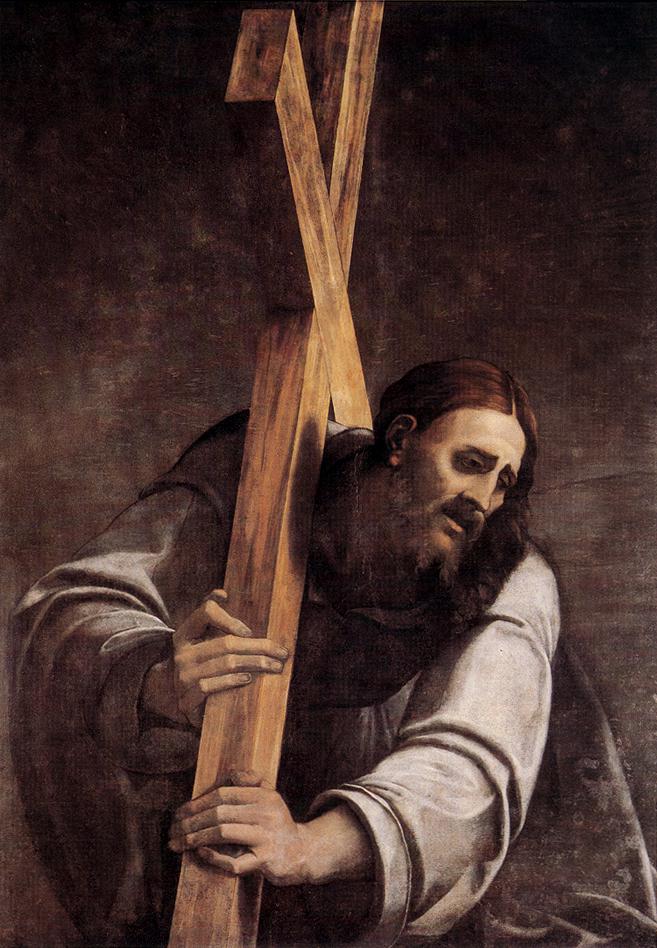
32. Jesus was making His way to Jerusalem with a burning desire to see fulfilled everything that He had foretold about His passion and death. He had already told His disciples that He would suffer there, which is why they cannot understand His eagerness. By His own example He is teaching us to carry the cross gladly, not to try to avoid it.
35-44. We can admire the Apostles' humility: they do not disguise their earlier weakness and shortcomings from the first Christians. God also has wanted the Holy Gospel to record the earlier weaknesses of those who will become the unshakeable pillars of the Church. The grace of God works wonders in people's souls: so we should never be pessimistic in the face of our own wretchedness: "I can do all things in Him who strengthens me" (Philippians 4:13).
38. When we ask for anything in prayer, we should be ready, always, to accept God's will, even if it does not coincide with our own: "His Majesty knows best what is suitable for us; it is not for us to advise Him what to give us, for He can rightly reply that we know not what we ask" (St. Teresa, "Mansions", II, 8).
43-45. Our Lord's word and example encourage in us a genuine spirit of Christian service. Only the Son of God who came down from Heaven and freely submitted to humiliation (at Bethlehem, Nazareth, Calvary, and in the Sacred Host) can ask a person to make himself last, if he wishes to be first.
The Church, right through history, continues Christ's mission of service to mankind: "Experienced in human affairs, the Church, without attempting to interfere in any way in the politics of States, `seeks but a solitary goal: to carry forward the work of Christ Himself under the lead of the befriending Spirit. And Christ entered this world to give witness to the truth, to rescue and not to sit in judgment, to serve and not to be served' (Vatican II, "Gaudium Et Spes", 3). Sharing the noblest aspirations of men and suffering when she sees them not satisfied, she wishes to help them attain their full flowering, and that is why she offers men what she possesses as her characteristic attribute: a global vision of man and of the human race" (Paul VI, "Populorum Progressio", 13).
Our attitude should be that of our Lord: we should seek to serve God and men with a truly supernatural outlook, not expecting any return; we should serve even those who do not appreciate the service we do them. This undoubtedly does not make sense, judged by human standards. However, the Christian identified with Christ takes "pride" precisely in serving others; by so doing he shares in Christ's mission and thereby attains his true dignity: "This dignity is expressed in readiness to serve, in keeping with the example of Christ, who `came not to be served but to serve.' If, in the light of this attitude of Christ's, `being a king' is truly possible only by `being a servant', then `being a servant' also demands so much spiritual maturity that it must really be described as `being a king.' In order to be able to serve others worthily and effectively we must be able to master ourselves, possess the virtues that make this mastery possible" (John Paul II, "Redemptor Hominis", 21). Cf. note on Matthew 20:27-28.