Skip to comments.
Catholic Caucus: Daily Mass Readings 29-April-2026
Universalis/Jerusalem Bible ^
Posted on 04/29/2026 5:10:10 AM PDT by annalex
29 April 2026
Saint Catherine of Siena, Virgin, Doctor
on Wednesday of the 4th week of Eastertide
.png&ehk=YLItoqZDkljkn5E%2fFi%2f1hPzNQl%2fLrDLvxv0EY7%2bvB4U%3d&risl=&pid=ImgRaw&r=0)
Saint Catherine of Siena Church, Phoenix Readings at MassLiturgical Colour: White. Year: A(II). Readings for the feria Readings for the memorial These are the readings for the feria
| First reading | Acts 12:24-13:5 |
|---|
'I want Barnabas and Saul set apart'The word of God continued to spread and to gain followers. Barnabas and Saul completed their task and came back from Jerusalem, bringing John Mark with them. In the church at Antioch the following were prophets and teachers: Barnabas, Simeon called Niger, and Lucius of Cyrene, Manaen, who had been brought up with Herod the tetrarch, and Saul. One day while they were offering worship to the Lord and keeping a fast, the Holy Spirit said, ‘I want Barnabas and Saul set apart for the work to which I have called them.’ So it was that after fasting and prayer they laid their hands on them and sent them off. So these two, sent on their mission by the Holy Spirit, went down to Seleucia and from there sailed to Cyprus. They landed at Salamis and proclaimed the word of God in the synagogues of the Jews; John acted as their assistant.
| Responsorial Psalm |
|---|
| Psalm 66(67):2-3,5-6,8 |
|---|
Let the peoples praise you, O God; let all the peoples praise you. or Alleluia! O God, be gracious and bless us and let your face shed its light upon us. So will your ways be known upon earth and all nations learn your saving help. Let the peoples praise you, O God; let all the peoples praise you. or Alleluia! Let the nations be glad and exult for you rule the world with justice. With fairness you rule the peoples, you guide the nations on earth. Let the peoples praise you, O God; let all the peoples praise you. or Alleluia! Let the peoples praise you, O God; let all the peoples praise you. May God still give us his blessing till the ends of the earth revere him. Let the peoples praise you, O God; let all the peoples praise you. or Alleluia!
| Gospel Acclamation | Jn20:29 |
|---|
Alleluia, alleluia! ‘You believe, Thomas, because you can see me. Happy are those who have not seen and yet believe. Alleluia! Alleluia, alleluia! I am the light of the world, says the Lord; anyone who follows me will have the light of life. Alleluia!
I, the light, have come into the worldJesus declared publicly: ‘Whoever believes in me believes not in me but in the one who sent me, and whoever sees me, sees the one who sent me. I, the light, have come into the world, so that whoever believes in me need not stay in the dark any more. If anyone hears my words and does not keep them faithfully, it is not I who shall condemn him, since I have come not to condemn the world, but to save the world. He who rejects me and refuses my words has his judge already: the word itself that I have spoken will be his judge on the last day. For what I have spoken does not come from myself; no, what I was to say, what I had to speak, was commanded by the Father who sent me, and I know that his commands mean eternal life. And therefore what the Father has told me is what I speak.’ Continue These are the readings for the memorial
| First reading | 1 John 1:5-2:2 |
|---|
The blood of Jesus Christ purifies us all from sinThis is what we have heard from Jesus Christ, and the message that we are announcing to you: God is light; there is no darkness in him at all. If we say that we are in union with God while we are living in darkness, we are lying because we are not living the truth. But if we live our lives in the light, as he is in the light, we are in union with one another, and the blood of Jesus, his Son, purifies us from all sin. If we say we have no sin in us, we are deceiving ourselves and refusing to admit the truth; but if we acknowledge our sins, then God who is faithful and just will forgive our sins and purify us from everything that is wrong. To say that we have never sinned is to call God a liar and to show that his word is not in us. I am writing this, my children, to stop you sinning; but if anyone should sin, we have our advocate with the Father, Jesus Christ, who is just; he is the sacrifice that takes our sins away, and not only ours, but the whole world’s.
| Responsorial Psalm |
|---|
| Psalm 102(103):1-4,8-9,13-14,17-18 |
|---|
My soul, give thanks to the Lord. My soul, give thanks to the Lord all my being, bless his holy name. My soul, give thanks to the Lord and never forget all his blessings. My soul, give thanks to the Lord. It is he who forgives all your guilt, who heals every one of your ills, who redeems your life from the grave, who crowns you with love and compassion. My soul, give thanks to the Lord. The Lord is compassion and love, slow to anger and rich in mercy. His wrath will come to an end; he will not be angry for ever. My soul, give thanks to the Lord. As a father has compassion on his sons, the Lord has pity on those who fear him; for he knows of what we are made, he remembers that we are dust. My soul, give thanks to the Lord. But the love of the Lord is everlasting upon those who hold him in fear; his justice reaches out to children’s children when they keep his covenant in truth, when they keep his will in their mind. My soul, give thanks to the Lord.
| Gospel Acclamation | Mt11:25 |
|---|
Alleluia, alleluia! Blessed are you, Father, Lord of heaven and earth, for revealing the mysteries of the kingdom to mere children. Alleluia!
You have hidden these things from the wise and revealed them to little childrenJesus exclaimed, ‘I bless you, Father, Lord of heaven and of earth, for hiding these things from the learned and the clever and revealing them to mere children. Yes, Father, for that is what it pleased you to do. Everything has been entrusted to me by my Father; and no one knows the Son except the Father, just as no one knows the Father except the Son and those to whom the Son chooses to reveal him. ‘Come to me, all you who labour and are overburdened, and I will give you rest. Shoulder my yoke and learn from me, for I am gentle and humble in heart, and you will find rest for your souls. Yes, my yoke is easy and my burden light.’ Continue Christian Art Each day, The Christian Art website gives a picture and reflection on the Gospel of the day. The readings on this page are from the Jerusalem Bible, which is used at Mass in most of the English-speaking world. The New American Bible readings, which are used at Mass in the United States, are available in the Universalis apps, programs and downloads.
You can also view this page with the Gospel in Greek and English. |
TOPICS: Catholic; General Discusssion; Prayer; Worship
KEYWORDS: catholic; easter; jn12; prayer
For your reading, reflection, faith-sharing, comments, questions, discussion.
1
posted on
04/29/2026 5:10:10 AM PDT
by
annalex
To: All
KEYWORDS: catholic; easter; jn12; prayer
2
posted on
04/29/2026 5:10:42 AM PDT
by
annalex
(fear them not)
To: nickcarraway; NYer; ELS; Pyro7480; livius; ArrogantBustard; Catholicguy; RobbyS; marshmallow; ...

Alleluia Ping Please FReepmail me to get on/off the Alleluia Ping List.
3
posted on
04/29/2026 5:12:06 AM PDT
by
annalex
(fear them not)
To: annalex
4
posted on
04/29/2026 5:12:33 AM PDT
by
annalex
(fear them not)
To: annalex
| John |
| | English: Douay-Rheims | Latin: Vulgata Clementina | Greek NT: Byzantine/Majority Text (2000) |
| | John 12
|
| 44. | But Jesus cried, and said: He that believeth in me, doth not believe in me, but in him that sent me. | Jesus autem clamavit, et dixit : Qui credit in me, non credit in me, sed in eum qui misit me. | ιησους δε εκραξεν και ειπεν ο πιστευων εις εμε ου πιστευει εις εμε αλλ εις τον πεμψαντα με |
| 45. | And he that seeth me, seeth him that sent me. | Et qui videt me, videt eum qui misit me. | και ο θεωρων εμε θεωρει τον πεμψαντα με |
| 46. | I am come a light into the world; that whosoever believeth in me, may not remain in darkness. | Ego lux in mundum veni, ut omnis qui credit in me, in tenebris non maneat. | εγω φως εις τον κοσμον εληλυθα ινα πας ο πιστευων εις εμε εν τη σκοτια μη μεινη |
| 47. | And if any man hear my words, and keep them not, I do not judge him: for I came not to judge the world, but to save the world. | Et si quis audierit verba mea, et non custodierit, ego non judico eum ; non enim veni ut judicem mundum, sed ut salvificem mundum. | και εαν τις μου ακουση των ρηματων και μη πιστευση εγω ου κρινω αυτον ου γαρ ηλθον ινα κρινω τον κοσμον αλλ ινα σωσω τον κοσμον |
| 48. | He that despiseth me, and receiveth not my words, hath one that judgeth him; the word that I have spoken, the same shall judge him in the last day. | Qui spernit me et non accipit verba mea, habet qui judicet eum. Sermo quem locutus sum, ille judicabit eum in novissimo die. | ο αθετων εμε και μη λαμβανων τα ρηματα μου εχει τον κρινοντα αυτον ο λογος ον ελαλησα εκεινος κρινει αυτον εν τη εσχατη ημερα |
| 49. | For I have not spoken of myself; but the Father who sent me, he gave me commandment what I should say, and what I should speak. | Quia ego ex meipso non sum locutus, sed qui misit me, Pater, ipse mihi mandatum dedit quid dicam et quid loquar. | οτι εγω εξ εμαυτου ουκ ελαλησα αλλ ο πεμψας με πατηρ αυτος μοι εντολην εδωκεν τι ειπω και τι λαλησω |
| 50. | And I know that his commandment is life everlasting. The things therefore that I speak, even as the Father said unto me, so do I speak. | Et scio quia mandatum ejus vita æterna est : quæ ergo ego loquor, sicut dixit mihi Pater, sic loquor. | και οιδα οτι η εντολη αυτου ζωη αιωνιος εστιν α ουν λαλω εγω καθως ειρηκεν μοι ο πατηρ ουτως λαλω |
5
posted on
04/29/2026 5:15:49 AM PDT
by
annalex
(fear them not)
To: annalex
Catena Aurea by St. Thomas Aguinas
12:44–50
44. Jesus cried and said, He that believeth on me, believeth not on me, but on him that sent me.
45. And he that seeth me seeth him that sent me.
46. I am come a light into the world, that whosoever believeth on me should not abide in darkness.
47. And if any man hear my words, and believe not, I judge him not: for I came not to judge the world, but to save the world.
48. He that rejecteth me, and receiveth not my words, hath one that judgeth him: the word that I have spoken, the same shall judge him in the last day.
49. For I have not spoken of myself; but the Father which sent me, he gave me a commandment, what I should say, and what I should speak.
50. And I know that His commandment is life everlasting: whatsoever I speak therefore, even as the Father said unto me, so I speak.
CHRYSOSTOM. (Hom. lxviii. 1) Because the love of human praise prevented the chief rulers from believing, Jesus cried and said, He that believeth on Me, believeth not on Me, but on Him that sent Me: as if to say, Why are ye afraid to believe on Me? Your faith through Me passes to God.
AUGUSTINE. (Tr. liv. 2) He signifies to them that He is more than He appears to be, (for to men He appeared but a man; His Godhead was hid.) Such as the Father is, such am I in nature and in dignity; He that believeth on Me, believeth not on Me, i. e. on that which He sees, but on Him that sent Me, i. e. on the Father. [1He that believes in the Father must believe in Him as the Father, i. e. must believe that He has a Son; and reversely, he who believes in the Son thereby believes in the Father.] And again, if any one thinks that God has sons by grace, but not a Son equal and coeternal with Himself, neither does he believe 2on the Father, who sent the Son; because what he believes on is not the Father who sent Him. (c. 3.). And to shew that He is not the Son, in the sense of one out of many, a son by grace, but the Only Son equal to the Father, He adds, And He that seeth Me, seeth Him that sent Me; so little difference is there between Me and Him that sent Me, that He that seeth Me, seeth Him. Our Lord sent His Apostles, yet none of them dared to say, He that believeth on Me. We believe an Apostle, but we do not believe on an Apostle. Whereas the Only Begotten says, He that believeth on Me, doth not believe on Me, but on Him that sent Me. Wherein He does not withdraw the believer’s faith from Himself, but gives him a higher object than the form of a servant, for that faith.
CHRYSOSTOM. (Hom. lxix. 1) He that believeth on Me, believeth not on Me, but on Him that sent Me: as if He said, He that taketh water from a stream, taketh the water not of the stream, but of the fountain. Then to shew that it is not possible to believe on the Father, if we do not believe on Him, He says, He that seeth Me, seeth Him that sent Me. What then? Is God a body? By no means; seeing here is the mind’s vision. What follows still further shews His union with the Father. I am come a light into the world. This is what the Father is called in many places. He calls Himself the light, because he delivers from error, and disperses the darkness of the understanding; that whosoever believeth in Me should not abide in darkness.
AUGUSTINE. (Tr. liv. 4) Whereby it is evident, that He found all in darkness. In which darkness if they wish not to remain, they must believe in the light which is come into the world. He says in one place to His disciples, Ye are the light of the world; but He did not say to them, Ye are come a light into the world, that whosoever believeth on you should not abide in darkness. All saints are lights, but they are so by faith, because they are enlightened by Him, from Whom to withdraw is darkness.
CHRYSOSTOM. (Hom. lxix. 1) And to shew that He does not let His despisers go unpunished, from want of power, He adds, And if any man hear My words and believe not, I judge him not.
AUGUSTINE. (Tr. liv. 5, 6) i. e. I judge him not now. He does not say, I judge him not at the last day, for that would be contrary to the sentence above, The Father hath committed all judgment unto the Son. (5:22) And the reason follows, why He does not judge now; For I came not to judge the world, but to save the world. Now is the time of mercy, afterward will be the time of judgment.
CHRYSOSTOM. (Hom. lxix. 2) But that this might not serve to encourage sloth, He warns men of a terrible judgment coming; He that rejecteth Me, and heareth not My words, hath one that judgeth him.
AUGUSTINE. (Tr. liv. 6) Mean time they waited to know who this one was; so He proceeds: The word that I have spoken, the same shall judge him at the last day. He makes it sufficiently clear that He Himself will judge at the last day. For the word that He speaks, is Himself. He speaks Himself, announces Himself. We gather too from these words that those who have not heard, will be judged differently from those who have heard and despised.
AUGUSTINE. (i. de Trin. c. xii. [26.]) I judge him not; the word that I have spoken shall judge him: for I have not spoken of Myself. The word which the Son speaks judges, because the Son did not speak of Himself: for I have nut spoken of Myself: i. e. I was not born of Myself.
AUGUSTINE.e I ask then how we shall understand this, I will not judge, but the word which I have spoken will judge? Yet He Himself is the Word of the Father which speaketh. Is it thus? I will not judge by My human power, as the Son of man, but as the word of God, because I am the Son of God.
CHRYSOSTOM. (Hom. lxviii. 2) Or, I judge him not, i. e. I am not the cause of his destruction, but he is himself, by despising my words. The words that I have just said, shall be his accusers, and deprive him of all excuse; the word that I have spoken, the same shall judge him. And what word? This, viz. thatf I have not spoken of Myself, but the Father which sent Me gave Me a commandment what I should say, and what I should speak. All these things were said on their account, that they might have no excuse.
AUGUSTINE. (Tr. liv. 7) When the Father gave the Son a commandment, He did not give Him what He had not: for in the Wisdom of the Father, i. e. in the Word, are all the commandments of the Father. The commandment is said to be given, because it is not from him to whom it is said to be given. But to give the Son that which He never was without, is the same as to beget the Son who never was not.
THEOPHYLACT. Since the Son is the Word of the Father, and reveals completely what is in the mind of the Father, He says He receives a commandment what He should say, and what He should speak: just as our word, if we say what we think, brings out what is in our minds.
And I know that His commandment is life everlasting.
AUGUSTINE. (Tr. liv) If life everlasting is the Son Himself, and the commandment is life everlasting, what is this but saying, I am the commandment of the Father? And in the same way in the following; Whatsoever I speak therefore, even as the Father said unto Me, so I speak, we must not understand, said unto Me, as if words were spoken to the Only Word. The Father spoke to the Son, as He gave life to the Son; not that the Son knew not, or had not, but that He was the Son. What is meant by, as He said unto Me, so I speak, but that I am the Word who speaks. The Father is true, the Son is truth: the True, begat the Truth. What then could He say to the Truth, if the Truth was perfect from the beginning, and no new truth could be added to Him? That He spake to the Truth then, means that He begat the Truth.
Catena Aurea John 12
6
posted on
04/29/2026 5:17:31 AM PDT
by
annalex
(fear them not)
To: annalex

Laudario of the Compagnia di Sant'Agnese
Pacino di Bonaguida
1320s
Tempera and gold on parchment, 450 x 333 mm
Pierpont Morgan Library, New York
This leaf is dominated by the figure of Christ in Majesty framed within a circle and attended by angels holding liturgical implements and playing musical instruments. In oculi at the corners are representations of the Trinity. In an oculus at the centre of the lower margin is the profile figure of a layperson in prayer, apparently a member of the Compagnia di Sant'Agnese, for which the laudario was made. He gazes up toward the opening words of the hymn, "Alta trinita beata" (Highest blessed Trinity), which begins with a decorated letter A and continues in gilt capitals
Source
7
posted on
04/29/2026 5:18:19 AM PDT
by
annalex
(fear them not)
To: annalex
8 Things to Know and Share About St. Catherine of Siena

Giovanni Battista Tiepolo, “St. Catherine of Siena,” 1746 (photo: Register Files)
St. Catherine of Siena is a saint, mystic and doctor of the Church. Here are 8 things about her to know and share.
Jimmy Akin, April 29, 2020 – National Catholic Register
April 29 is the memorial of St. Catherine of Siena.
She is a saint, a mystic and a doctor of the Church, as well as a patroness of Italy and of Europe.
Who was she, and why is her life so significant?
Here are 8 things to know and share…
1. Who is St. Catherine of Siena?
In 2010, Pope Benedict gave an audience in which he discussed the basic facts of her life:
Born in Siena [Italy] in 1347, into a very large family, she died in Rome in 1380.
When Catherine was 16 years old, motivated by a vision of St. Dominic, she entered the Third Order of the Dominicans, the female branch known as the Mantellate.
While living at home, she confirmed her vow of virginity made privately when she was still an adolescent and dedicated herself to prayer, penance and works of charity, especially for the benefit of the sick.
Note from her birth and death dates that she only lived to be 33 years old. Nevertheless, a lot happened during her life!
2. What happened after St. Catherine entered religious life?
Quite a number of things. St. Catherine was sought out as a spiritual director, and she played a role in ending the Avignon papacy (when the pope, though still the bishop of Rome, actually lived in Avignon, France).
Pope Benedict explains:
When the fame of her holiness spread, she became the protagonist of an intense activity of spiritual guidance for people from every walk of life: nobles and politicians, artists and ordinary people, consecrated men and women and religious, including Pope Gregory XI who was living at Avignon in that period and whom she energetically and effectively urged to return to Rome.
She traveled widely to press for the internal reform of the Church and to foster peace among the States.
It was also for this reason that Venerable Pope John Paul II chose to declare her Co-Patroness of Europe: may the Old Continent never forget the Christian roots that are at the origin of its progress and continue to draw from the Gospel the fundamental values that assure justice and harmony.
3. Did she face opposition in her lifetime?
Pope Benedict explains:
Like many of the saints, Catherine knew great suffering.
Some even thought that they should not trust her, to the point that in 1374, six years before her death, the General Chapter of the Dominicans summoned her to Florence to interrogate her.
They appointed Raymund of Capua, a learned and humble Friar and a future Master General of the Order, as her spiritual guide.
Having become her confessor and also her “spiritual son”, he wrote a first complete biography of the Saint.
4. How has her legacy developed over time?
Pope Benedict explains:
She was canonized in 1461.
The teaching of Catherine, who learned to read with difficulty and learned to write in adulthood, is contained in the Dialogue of Divine Providence or Libro della Divina Dottrina, a masterpiece of spiritual literature, in her Epistolario and in the collection of her Prayers.
Her teaching is endowed with such excellence that in 1970 the Servant of God Paul VI declared her a Doctor of the Church, a title that was added to those of Co-Patroness of the City of Rome — at the wish of Bl. Pius IX — and of Patroness of Italy — in accordance with the decision of Venerable Pius XII.
5. St. Catherine reported experiencing a “mystical marriage” with Jesus. What was this?
Pope Benedict explains:
In a vision that was ever present in Catherine’s heart and mind Our Lady presented her to Jesus who gave her a splendid ring, saying to her, ‘I, your Creator and Saviour, espouse you in the faith, that you will keep ever pure until you celebrate your eternal nuptials with me in Heaven’ (Bl. Raimondo da Capua, S. Caterina da Siena, Legenda maior, n. 115, Siena 1998).
This ring was visible to her alone.
In this extraordinary episode we see the vital centre of Catherine’s religious sense, and of all authentic spirituality: Christocentrism.
For her Christ was like the spouse with whom a relationship of intimacy, communion and faithfulness exists; he was the best beloved whom she loved above any other good.
This profound union with the Lord is illustrated by another episode in the life of this outstanding mystic: the exchange of hearts.
According to Raymond of Capua who passed on the confidences Catherine received, the Lord Jesus appeared to her “holding in his holy hands a human heart, bright red and shining”. He opened her side and put the heart within her saying, ‘Dearest daughter, as I took your heart away from you the other day, now, you see, I am giving you mine, so that you can go on living with it for ever’ (ibid.).
Catherine truly lived St. Paul’s words, ‘It is no longer I who live, but Christ who lives in me’ (Galatians 2:20).
6. What can we learn from this that we can apply in our own lives?
Pope Benedict explains:
Like the Sienese saint, every believer feels the need to be conformed with the sentiments of the heart of Christ to love God and his neighbour as Christ himself loves.
And we can all let our hearts be transformed and learn to love like Christ in a familiarity with him that is nourished by prayer, by meditation on the Word of God and by the sacraments, above all by receiving Holy Communion frequently and with devotion.
Catherine also belongs to the throng of Saints devoted to the Eucharist with which I concluded my Apostolic Exhortation Sacramentum Caritatis (cf. n. 94).
Dear brothers and sisters, the Eucharist is an extraordinary gift of love that God continually renews to nourish our journey of faith, to strengthen our hope and to inflame our charity, to make us more and more like him.
7. St. Catherine experienced a “gift of tears.” What was this?
Pope Benedict explains:
Another trait of Catherine’s spirituality is linked to the gift of tears.
They express an exquisite, profound sensitivity, a capacity for being moved and for tenderness.
Many Saints have had the gift of tears, renewing the emotion of Jesus himself who did not hold back or hide his tears at the tomb of his friend Lazarus and at the grief of Mary and Martha or at the sight of Jerusalem during his last days on this earth.
According to Catherine, the tears of saints are mingled with the blood of Christ, of which she spoke in vibrant tones and with symbolic images that were very effective.
8. St. Catherine at one point uses a symbolic image of Christ as a bridge. What is the significance of this image?
Pope Benedict explains:
In the Dialogue of Divine Providence, she describes Christ, with an unusual image, as a bridge flung between Heaven and earth.
This bridge consists of three great stairways constituted by the feet, the side, and the mouth of Jesus.
Rising by these stairways the soul passes through the three stages of every path to sanctification: detachment from sin, the practice of the virtues, and of love, sweet and loving union with God.
Dear brothers and sisters, let us learn from St Catherine to love Christ and the Church with courage, intensely and sincerely.
Therefore let us make our own St Catherine’s words that we read in the Dialogue of Divine Providence at the end of the chapter that speaks of Christ as a bridge: ‘Out of mercy you have washed us in his Blood, out of mercy you have wished to converse with creatures. O crazed with love! It did not suffice for you to take flesh, but you also wished to die!… O mercy! My heart drowns in thinking of you: for no matter where I turn to think, I find only mercy’ (chapter 30, pp. 79-80)
This article originally appeared April 27, 2013, at the Register.
8
posted on
04/29/2026 5:24:02 AM PDT
by
annalex
(fear them not)
To: annalex
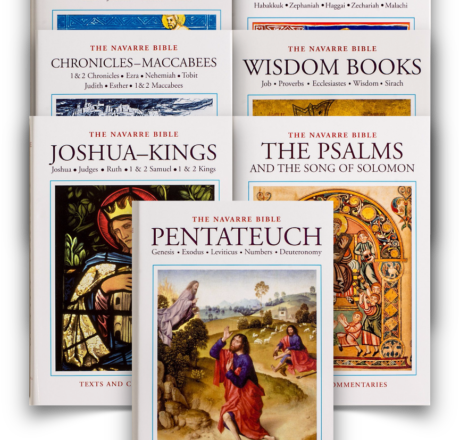
NAVARRE BIBLE COMMENTARY(RSV)
Ad Majorem Dei Gloriam (To the Greater Glory of God)
Today’s First Reading
From: Acts 12:24-13:5a
Barnabas and Saul Return to Antioch
-----------------------------------
[25] And Barnabas and Saul returned from Jerusalem when they had fulfilled their mission, bringing with them John whose other name was Mark.
The Mission of Barnabas and Paul
--------------------------------
[1] Now in the Church at Antioch there were prophets and teachers, Barnabas, Symeon who was called Niger, Lucius of Cyrene, Manaen, a member of the court of Herod the Tetrarch, and Saul. [2] While they were worshipping the Lord and fasting, the Holy Spirit said, "Set apart for Me Barnabas and Saul for the work to which I have called them." [3] Then after fasting and praying they laid their hands on them and sent them off.
They Arrive in Cyprus
---------------------
[4] So, being sent out by the Holy Spirit, they went down to Seleucia; and from there they sailed to Cyprus. [5a] When they arrived at Salamis, they proclaimed the Word of God in the synagogues of the Jews.
***********************************************************************
Commentary:
24. St Luke contrasts the failure and downfall of the Church's persecutors with the irresistible progress of the Word of God.
25. They "returned from Jerusalem": following the best Greek manuscripts, the reading accepted by the New Vulgate is "returned to Jerusalem" (cf. RSV note). However, it does not seem to fit in with the end of Chapter 11 and the beginning of Chapter 13. Therefore, from very early on many Greek manuscripts and translations (including the Sixto-Clementine edition of the Vulgate) read "returned from Jerusalem". It is not clear which is correct; the Navarre Spanish follows the New Vulgate.
1. From this point onwards Luke's account centers on the Church of Antioch. This was a flourishing community, with members drawn from all sectors of society. In some respects its organization structure was like that of the Jerusalem Church; in others, not. It clearly had ordained ministers who were responsible for its government, who preached and administered the Sacraments; along these we find prophets (cf. 11:28) and teachers, specially trained members of the community.
In the early Church "teachers" were disciples well versed in Sacred Scripture who were given charge of catechesis. They instructed the catechumens and other Christians in the basic teaching of the Gospel as passed on by the Apostles, and some of them had a capacity for acquiring and communicating to others an extensive and profound knowledge of the faith.
Teachers do not necessarily have to be priests or preachers. Preaching was usually reserved to ordained ministers; teachers had an important position in the Church: they were responsible for on-going doctrinal and moral education and were expected faithfully to hand on the same teaching as they themselves had received. A virtuous life and due learning would have protected them against any temptation to invent new teachings or go in for mere speculation not based on the Gospel (cf. 1 Timothy 4:7; 6:20; Titus 2:1).
The "Letter to Diognetus" describes the ideal Christian teacher: "I do not speak of passing things nor do I go in search of new things, but, like the disciple of the Apostles that I am, I become a teacher of peoples. I do nothing but hand on what was given me by those who made themselves worthy disciples of the truth" (XI, 1).
2-3. "Worship" of the Lord includes prayer, but it refers primarily to the celebration of the Blessed Eucharist, which is at the center of all Christian ritual. This text indirectly establishes a parallel between the Mass and the sacrificial rite of the Mosaic Law. The Eucharist provides a Christian with the nourishment he needs, and its celebration "causes the Church of God to be built up and grow in stature" (Vatican II, "Unitatis Redintegratio", 15). Significantly, the Eucharist is associated with the start of this new stage in the expansion of the Church.
Paul and Barnabas receive a missionary task directly from the Holy Spirit, and by an external sign--the laying on of hands--the Antiochene community prays to God to go with them and bless them. In His promotion of the spread of the Church the Holy Spirit does not act at a distance, so to speak. Every step in the progress of the Church in the world is rightly attributed to the initiative of the Paraclete. It is as if God were repeatedly ratifying His salvific plans to make it perfectly plain that He is ever-faithful to His promises. "The mission of the Church is carried out by means of that activity through which, in obedience to Christ's command and moved by the grace and love of the Holy Spirit, the Church makes itself fully present to all men and people" (Vatican II, "Ad Gentes", 5).
The dispatch of Paul and Barnabas is inspired by the Holy Spirit, but it is also an ecclesial act: the Church gives them this charge, specifying God's plans and activating the personal vocation of the two envoys.
The Lord, "who had set me apart before I was born and had called me by his grace [sent me] in order that I might preach Him among the Gentiles" (Galatians 1:15-16), now arranges, through the Church, for this mission to begin.
Fasting and prayer are the best preparation for the spiritual enterprise on which Paul and Barnabas are about to embark. "First, prayer; then, atonement; in the third place, very much 'in the third place', action" (St. J. Escriva, "The Way", 82). They know very well that their mission is not man-made and that it will produce results only with God's help. The prayer and penance which accompany apostolate are not just aimed at obtaining graces from God for others: the purpose of this prayer and fasting is to purify hearts and lips, so that the Lord will be at their side and ensure that none of their words "fall to the ground" (1 Samuel 3:19).
13:4-14:28. This first missionary journey took Paul, accompanied by Barnabas, to Cyprus and central Galatia, in Asia Minor. He left Antioch in the spring of 45 and returned almost four years later, after preaching Christ to both Jews and Gentiles wherever he went.
St. Luke's account, which covers Chapters 13 and 14, is sketchy but accurate. At Seleucia (the port of Antioch, about 35 kilometers or 22 miles from the city) they embarked for Cyprus, the largest island in the eastern Mediterranean, where Barnabas came from. They disembarked at Salamis, the island's main city and port. There they went to the Jewish synagogues on a series of sabbaths.
In verse 6 it says that they crossed to the island to Paphos, which is on the extreme west. This would have taken them several months because, although it is only 150 kilometers as the crow flies, there were many towns with Jewish communities, and since they had to stay in each for a number of sabbaths their progress would have been slow. We are told nothing about the result of this work of evangelizing en route from Salamis to Paphos, but the indications are that it was fruitful, because Barnabas will later go back to Cyprus, accompanied by Mark (cf. 15:39), to consolidate the work done on this first mission. New Paphos was where the proconsul resided.
From there they went on board ship again and travelled north, probably disembarking, after a short crossing, at Attalia. After a few miles they reached Perga in Pamphylia, a barren, inhospitable region at the base of the Taurus mountains, where Mark took leave of his companions.
Going from Perga to Pisidian Antioch (verse 14) meant a difficult journey of about 160 kilometers over mountain roads. This other Antioch was 1,200 meters above sea level and would have had a sizeable Jewish community, connected with the trade in hides. The busy commercial life of the region helped the spread of the Christian message (verse 49). Paul addressed his preaching to the Gentiles because of the hospitality of many Jews.
The Apostles were expelled and they headed for Iconium, about 130 kilometers south east, where they stayed some months and then left because of disturbances created by both Gentiles and Jews: they had to flee to the region of Lycaonia, to two minor cities, Lystra and Derbe. There were very few Jews in Lystra, and no synagogue, and therefore Paul preached to the local people, in the open air; but some Jews, who had arrived from Antioch and Iconium, stoned him and left him for dead. Possibly with the help of Timothy (cf. 16:1) they managed to reach Derbe, where they made many disciples, and then set out on the journey home, retracing their steps through Lystra, Iconium and Pisidian Antioch. Things had quieted down, the local magistrates were new, and with a little prudence everything worked out quite well. The new disciples were confirmed in the faith, and priest, elders, were appointed to each local church. Paul and Barnabas then went back to Pamphylia and Attalia, where they took ship for Antioch, arriving probably well into the year 49.
5. In each city he visits, Paul usually begins his preaching of the Gospel in the local synagogue. This is not simply a tactic: it is in line with what he knows is God's plan for salvation. Like Jesus, he feels obliged to proclaim the Kingdom first to "Israelites [for] to them belong the sonship, the glory, the covenants, the giving of the Law, the worship, and the promises; to them belong the patriarchs, and of their race, according to the flesh, is the Christ" (Romans 9:4-5). The Jews have a right to be the first to have the Gospel preached to them, for they were the first to receive the divine promises (cf. 13:46).
Although many Jews choose not to listen to or understand the Word of God, there are many who do accept the Gospel for what it is—the fullness of the Old Testament. All over the Diaspora thousands of men and women like Simeon and Anna, who were awaiting the Kingdom and serving the God of their forefathers with fasting and prayer (cf. Luke 2:25, 367), will receive the light of the Holy Spirit enabling them to recognize and accept Paul's preaching as coming from God.
It is true that the many Jewish communities established in the main cities of the Roman empire often hindered the spread of the Gospel; yet their very existence played a providential part in its progress.
9
posted on
04/29/2026 8:38:16 AM PDT
by
fidelis
(Ecce Crucem Domini! Fugite partes adversae! Vicit Leo de tribu Juda, Radix David! Alleluia!)
Today’s Gospel Reading From: John 12:44-50
The Unbelief of the Jews
------------------------
[44] And Jesus cried out and said, "He who believes in Me, believes not in Me, but in Him who sent Me. [45] And he who sees Me sees Him who sent Me. [46] I have come as light into the world, that whoever believes in Me may not remain in darkness. [47] If any one hears My sayings and does not keep them, I do not judge him; for I did not come to judge the world but to save the world. [48] He who rejects Me and does not receive My sayings has a judge; the word that I have spoken will be His judge on the last day. [49] For I have not spoken on My own authority; the Father who sent Me has Himself given Me commandment what to say and what to speak. [50] And I know that His commandment is eternal life. What I say, therefore, I say as the Father has bidden Me."
***********************************************************************
Commentary:
44-50. With these verses St. John brings to an end his account of our Lord's public ministry. He brings together certain fundamental themes developed in previous chapters--the need for faith in Christ (verse 44); the Father and the Son are one yet distinct (cf. 45); Jesus is Light and Life of the world (verses 46, 50); men will be judged in accordance with whether they accept or reject the Son of God (verses 47-49). The chapters which follow contain Jesus' teaching to His Apostles at the Last Supper, and the accounts of the Passion and Resurrection.
45. Christ, the Word Incarnate, is one with the Father (cf. John 10:30); "He reflects the glory of God" (Hebrews 1:3); "He is the image of the invisible God" (Colossians 1:15). In John 14:9 Jesus expresses Himself in almost the same words: "He who has seen Me has seen the Father". At the same time as He speaks of His oneness with the Father, we are clearly shown the distinction of persons--the Father who sends, and the Son who is sent.
In Christ's holy human nature His divinity is, as it were, hidden, that divinity which He possesses with the Father in the unity of the Holy Spirit (cf. John 14:7-11). In theology "circumincession" is the word usually used for the fact that, by virtue of the unity among the three Persons of the Blessed Trinity, "the Father is wholly in the Son and wholly in the Holy Spirit; the Son wholly in the Father and wholly in the Holy Spirit; the Holy Spirit wholly in the Father and wholly in the Son" (Council of Florence, "Decree Pro Jacobitis, Dz-Sch", 1331).
47. Christ has come to save the world by offering Himself in sacrifice for our sins and bringing us supernatural life (cf. John 3:17). But He has also been made Judge of the living and the dead (cf. Acts 10:42): He passes sentence at the Particular Judgment which happens immediately after death, and at the end of the world, at His Second Coming or Parousia, at the universal judgment (cf. John 5:22; 8:15-16).
10
posted on
04/29/2026 8:39:12 AM PDT
by
fidelis
(Ecce Crucem Domini! Fugite partes adversae! Vicit Leo de tribu Juda, Radix David! Alleluia!)
11
posted on
04/29/2026 8:40:07 AM PDT
by
fidelis
(Ecce Crucem Domini! Fugite partes adversae! Vicit Leo de tribu Juda, Radix David! Alleluia!)
Disclaimer:
Opinions posted on Free Republic are those of the individual
posters and do not necessarily represent the opinion of Free Republic or its
management. All materials posted herein are protected by copyright law and the
exemption for fair use of copyrighted works.
FreeRepublic.com is powered by software copyright 2000-2008 John Robinson

