Posted on 03/21/2026 9:54:37 AM PDT by ebb tide
Some weeks in the postconciliar Church are useful because they strip away the incense, the bureaucratic fog, and the pious throat-clearing. This was one of them. In Bonn, Jean-Claude Hollerich said the question of women in ordained ministry remains open. In Antwerp, Johan Bonny said he wants married men ordained for his diocese by 2028 and wants a church office “equally accessible” to men and women. And in OALA material, the old Augustinian revolutionary catechism appears in black and white, complete with the line, “We believe in God Father and Mother of Life.” None of this is random. It is one pattern, one program, one religion of managed mutation.
The revolution has stopped whispering
Hollerich’s Bonn remarks were revealing for what they assumed. Instead of speaking as though the Church had received a divine constitution that man must obey, he spoke as though the Church were a body negotiating access, grievances, and institutional inclusion. He said he cannot imagine how a church can endure if half the “people of God” suffer because they lack access to ordained ministry, and he added that women in his parishes overwhelmingly want the same thing. That fits neatly with what he had already been saying for years: in 2023 he said the ban on women’s ordination was “probably” not infallible, and in 2024 he urged patience only because one must move step by step and avoid backlash. The point was never to close the question. The point was to keep it alive until resistance softened.
Now the wider apparatus is helping him. The Synod’s Study Group 5 final report, published this month on the official synod site, calls the “question of women” a “sign of the times,” warns that many women no longer feel at home in the Church, and explicitly presents the decisions of Francis and Leo XIV to place women in governance roles as a model for the whole Church. That is the real method. First, call the discontent urgent. Then call it the Spirit. Then reframe authority as exclusion. Then insist that structures must adapt. By the time the old doctrine is finally contradicted in practice, the contradiction will be sold as pastoral maturity.
Antwerp moves from complaint to implementation
Johan Bonny, a Belgian bishop, is simply doing in Antwerp what Hollerich is doing in language. He published a pastoral plan saying he will do everything possible to ordain married men by 2028, personally identify candidates, and prepare them outside the media spotlight. He also said the question is no longer whether the Church can ordain married men, but when, and who will do it. Instead of doing a bishop’s job and guarding a received discipline, Bonny speaks the language of a manager preparing rollout. He is moving the matter from theory to pilot program.
More telling still, Bonny couples the married-priest proposal with a drive toward offices more equally open to men and women. So the old progressive package remains intact. Clerical celibacy is too rigid. Male priesthood is too restrictive. Synodality must now produce “concrete” results. The line from Francis to Leo is not a mystery here. Bonny himself frames his plan as implementation of the synodal process. This is what the conservative instinct keeps refusing to grasp. The crisis no longer lives only in fringe theologians and German position papers. It has diocesan calendars, staffing plans, and target dates.
Conocoto was the Augustinian workshop for this new religion
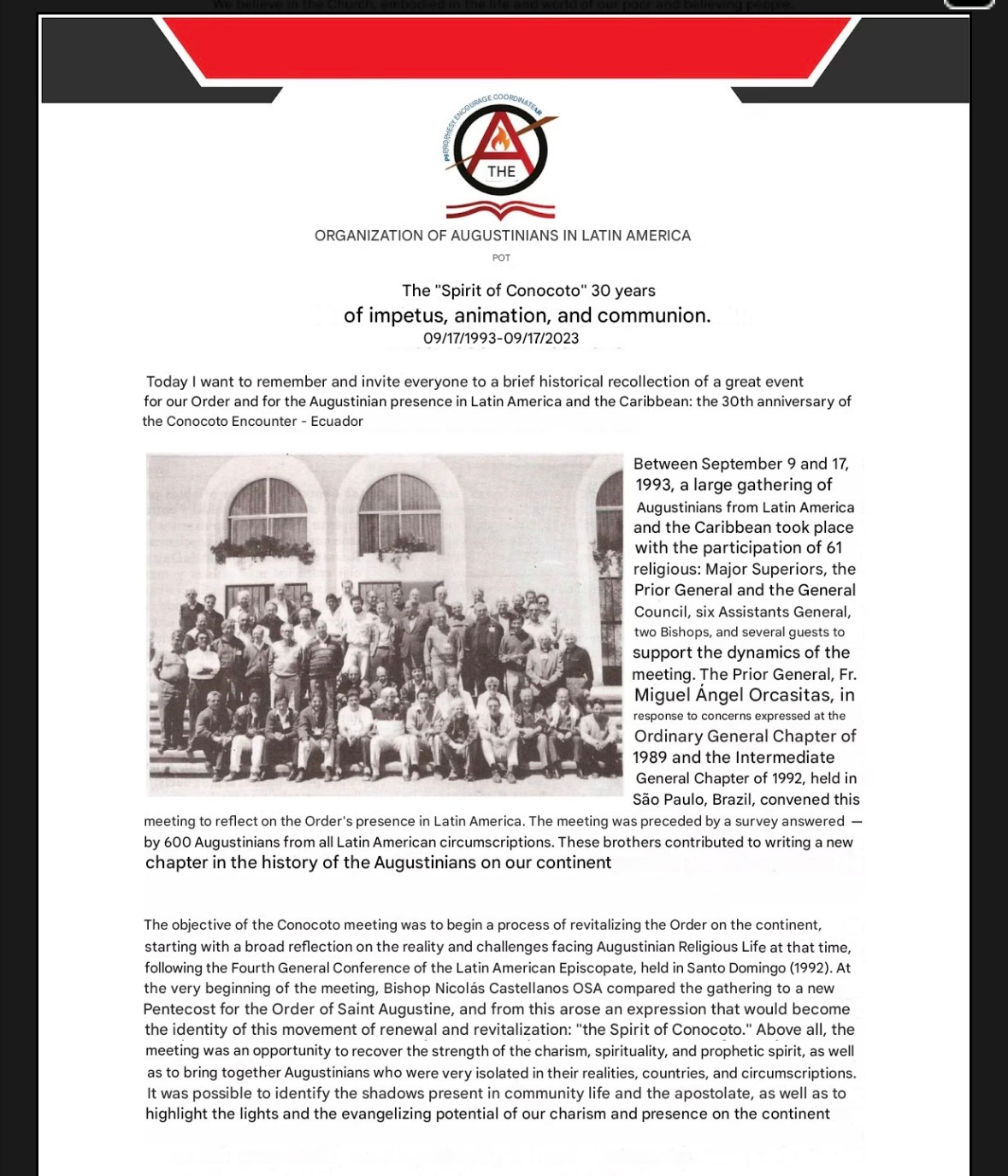
Conocoto was a 1993 gathering of Augustinians in Ecuador under the umbrella of the Organization of Augustinians in Latin America, or OALA. It was presented as a moment of renewal for the order in Latin America and the Caribbean. Its organizers spoke of the “Spirit of Conocoto” as a new model of Augustinian life marked by participation, synodality, liberationist concerns, and social transformation. In plain English, it was one of those postconciliar workshops where Catholic language remained on the surface while the underlying framework shifted toward process, activism, and ideological reconstruction.
The photos from Catholic Conclave show this was not some obscure footnote or one-off experiment. The movement generated texts, slogans, follow-up meetings, and even its own creed.
The first two images match an official OALA anniversary document marking thirty years since Conocoto. That document describes the 1993 meeting as shaped by “Augustinian synodality” and says the “Spirit of Conocoto” was a spirit of reflection, conversion, reconciliation, prophecy, communion, and participation. Then it reproduces the young Augustinians’ creed, including the astonishing line, “We believe in God Father and Mother of Life.”
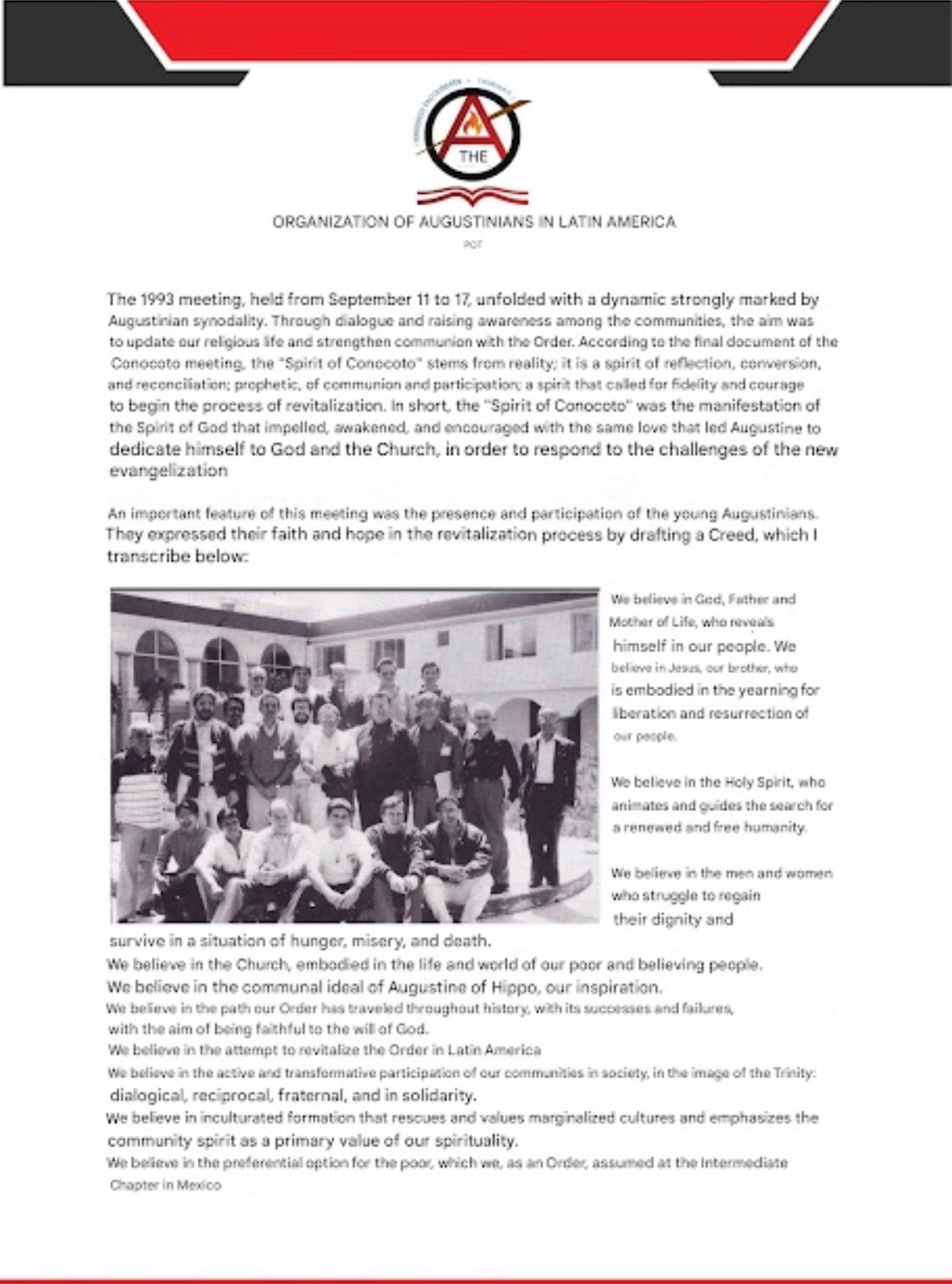
And the creed does not stop there. It goes on with formulas about Jesus incarnating himself in the liberation-longings of peoples, the Church embodied in the life and world of the poor, active and transformative participation in society, and the priority of human promotion. One does not need much commentary at that point. The text is already doing the work. This is a window into the theological atmosphere in which this network was being formed.
Nor was this some embarrassing leaflet later shoved into a drawer and forgotten. OALA’s current materials still reflect the same ecosystem of themes. Its “Justicia y Paz” page continues to foreground ecotheology, indigenous spirituality, political activism, and Amazonian rhetoric. The vocabulary has aged a little, but the instinct has not. It is still the same postconciliar habit of translating the faith into process, activism, ecology, migration, dialogue, and social accompaniment until dogma itself begins to sound like an intrusive foreign body.
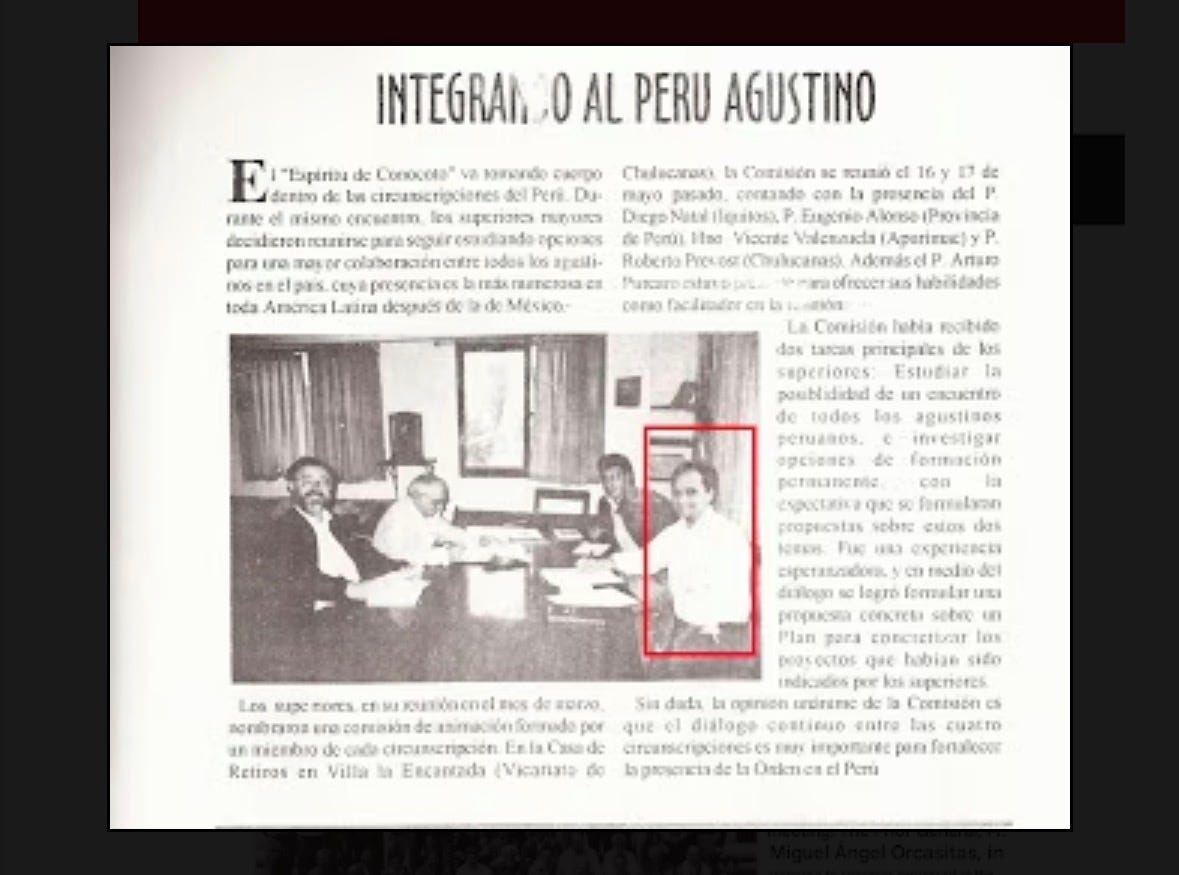
The third image is especially important because it localizes the story and ties Roberto Prevost directly to that orbit. The clipping on “Integrando al Perú Agustino” speaks of the “Spirit of Conocoto” entering Peru, and the highlighted name identifies Prevost of Chulucanas within that milieu. That turns the whole debate away from the lazy defense that Leo’s later synodal instincts are merely the normal prudence of a churchman formed by generic postconciliar Catholicism. No. The attached material places him inside a very specific formation stream, one that had already baptized synodality, liberationist language, anthropological uplift, and ecotheological imagination long before those slogans were packaged for the universal Church.
That is why the later evidence feels less like a surprise than a continuation. National Catholic Reporter, writing sympathetically last year, described Chulucanas as a “Vatican II laboratory of church renewal” and presented that history almost as a badge of honor. But read against these OALA materials, it lands very differently. The men now trying to stabilize the revolution are the very men whom the revolution formed. Conocoto was not some distant Latin American curiosity. It was part of the workshop in which this new ecclesial language, this new set of instincts, and this new model of authority were cultivated. That is why these photos matter. They do not merely embarrass Leo XIV by association. They help explain him.
The Brazil photographs and the larger point
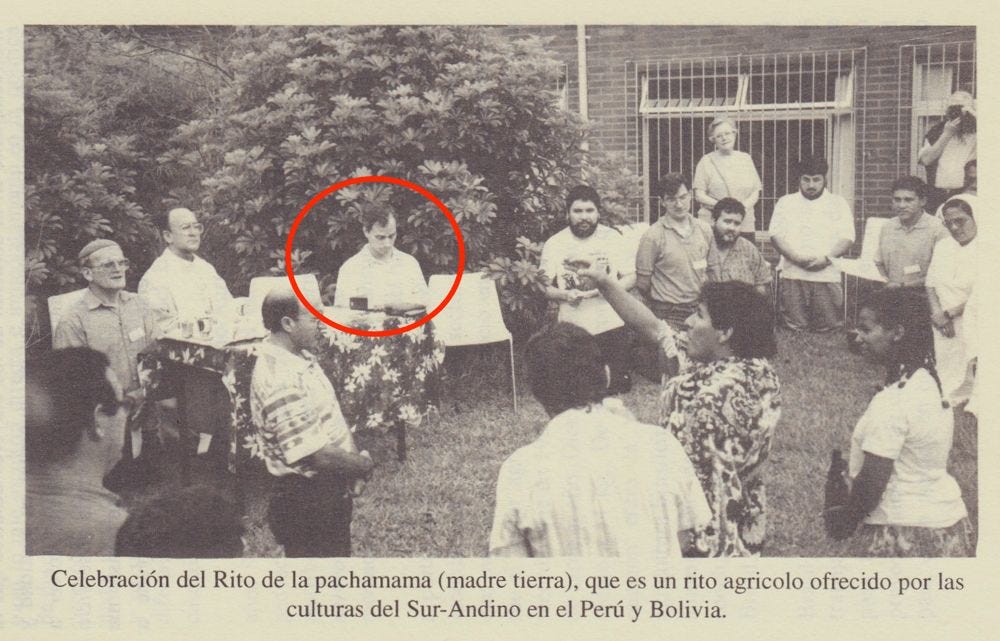
The newly circulated Brazil photographs fit that larger pattern. Public reporting this week says they come from the proceedings of a 1995 Augustinian symposium in São Paulo, later published by OALA in 1996 as Ecoteología: Una Perspectiva desde San Agustín. Independent recent reporting from confessional outlets says the published caption identifies one ceremony as a “Rite of Pachamama,” and a library bibliography confirms that the 1996 OALA volume exists, corresponds to that 1995 symposium, and included illustrations. Thus, the documentary frame itself is real, and the attached Conocoto material already shows the theological world in which such a rite would not appear as an alien invasion but as an organic outgrowth.
That is the key point. The scandal is larger than one photograph, larger even than one act of kneeling or one disputed gesture. A creed that calls God “Father and Mother of Life,” an ecclesiology that treats the Church as the historical embodiment of a people’s struggle, an Augustinian apostolate steeped in Medellín, participation, and ecotheology, a synodal bureaucracy now describing the “question of women” as a sign of the times, a Belgian bishop openly preparing married priests as a matter of diocesan planning. This is one continuum. The language changes. The substance does not.
What conservatives still refuse to admit
The conservative defense of Leo keeps collapsing because it keeps misdiagnosing the problem. It imagines a basically Catholic institution that occasionally overreaches, phrases things badly, appoints the wrong men, or indulges bad optics. That framework is far too small. What sits before us is a rival theology of authority. In that theology, revelation yields to process, hierarchy yields to participation, sacramental form yields to representation, and doctrine yields to managed adaptation under the flattering title of listening.
That is why Hollerich can talk this way without shame. That is why Bonny can schedule the next breach instead of merely lobbying for it. That is why the Conocoto text can speak of synodality, communion, human promotion, and a feminized God-language while still presenting itself as an Augustinian renewal. The old Catholic categories have been retained as décor. The animating logic has moved elsewhere.
A real Catholic bishop begins with what has been handed down and asks how to preserve it intact under pressure. These men begin with the pressure and ask how the inheritance can be revised without provoking too much resistance. That difference changes everything. It changes how they speak about priesthood, how they speak about women, how they speak about governance, how they speak about mission, how they speak about the poor, and eventually how they speak about God Himself.
From symptom to judgment
Traditional Catholics should stop treating each of these stories as though it were a separate outrage needing its own isolated reaction. Hollerich on women’s ordination. Bonny on married priests. OALA on Conocoto. Prevost in Peru. The Brazil photographs. They belong to the same rosary of revolution.
The practical conclusion is severe. Once a cleric publicly joins false worship, publicly teaches against the received faith, or publicly governs as though sacramental and doctrinal boundaries are raw material for synodal experimentation, the old canonical questions about profession of faith and loss of office stop being abstract hobbyhorses. They become unavoidable. Even readers not yet prepared to draw sedevacantist conclusions should at least stop pretending that this is a healthy Catholic authority structure suffering from a few regrettable excesses. A structure producing Hollerich, Bonny, and Conocoto on schedule has already told you what spirit moves it.
And that spirit does not come from Pentecost.
That document describes the 1993 meeting as shaped by “Augustinian synodality” and says the “Spirit of Conocoto” was a spirit of reflection, conversion, reconciliation, prophecy, communion, and participation. Then it reproduces the young Augustinians’ creed, including the astonishing line, “We believe in God Father and Mother of Life.”
The price to pay is coming!
AFAIK, God is Our Father, not our mother.
God is revealed in the Bible as our Heavenly Father, not mother.
More confusion for the laity!
Holy Spirit touch Pope Leo’s heart and mind!
The "Synodality" word-game is just another Commie psyop to tenderize everyone into gay marriage, female ordination, etc.
I just wish they would leave the Catholic conservatives and traditionalists and Latin Mass people alone.
So the headline is a truncated quote, and it was from a seminary Prevost attended and not a quote from him.
We need protection from Robert the Apostate’s heart and mind.
Not every bishop or parish is contaminated which is why I remain Catholic.
Prophecies predicted this by the way
I have heard of another Mother =
MOAB, Mother Of All Bombs.
Disclaimer: Opinions posted on Free Republic are those of the individual posters and do not necessarily represent the opinion of Free Republic or its management. All materials posted herein are protected by copyright law and the exemption for fair use of copyrighted works.