Posted on 01/27/2026 5:05:38 PM PST by annalex
Tuesday of week 3 in Ordinary Time Basilica of St. Ursula, Cologne Readings at MassLiturgical Colour: Green. Year: A(II).
David dances before the ark of the LordDavid went and brought the ark of God up from Obed-edom’s house to the Citadel of David with great rejoicing. When the bearers of the ark of the Lord had gone six paces, he sacrificed an ox and a fat sheep. And David danced whirling round before the Lord with all his might, wearing a linen loincloth round him. Thus David and all the House of Israel brought up the ark of the Lord with acclaim and the sound of the horn. They brought the ark of the Lord in and put it in position inside the tent that David had pitched for it; and David offered holocausts before the Lord, and communion sacrifices. And when David had finished offering holocausts and communion sacrifices, he blessed the people in the name of the Lord of Hosts. He then distributed among all the people, among the whole multitude of Israelites, men and women, a roll of bread to each, a portion of dates, and a raisin cake. Then they all went away, each to his own house.
Who is the king of glory? He, the Lord, he is the king of glory. O gates, lift high your heads; grow higher, ancient doors. Let him enter, the king of glory! Who is the king of glory? He, the Lord, he is the king of glory. Who is the king of glory? The Lord, the mighty, the valiant, the Lord, the valiant in war. Who is the king of glory? He, the Lord, he is the king of glory. O gates, lift high your heads; grow higher, ancient doors. Let him enter, the king of glory! Who is the king of glory? He, the Lord, he is the king of glory. Who is he, the king of glory? He, the Lord of armies, he is the king of glory. Who is the king of glory? He, the Lord, he is the king of glory.
Alleluia, alleluia! Let your face shine on your servant, and teach me your decrees. Alleluia!
Alleluia, alleluia! Blessed are you, Father, Lord of heaven and earth, for revealing the mysteries of the kingdom to mere children. Alleluia!
Who are my mother and my brothers? Those that do the will of GodThe mother and brothers of Jesus arrived and, standing outside, sent in a message asking for him. A crowd was sitting round him at the time the message was passed to him, ‘Your mother and brothers and sisters are outside asking for you.’ He replied, ‘Who are my mother and my brothers?’ And looking round at those sitting in a circle about him, he said, ‘Here are my mother and my brothers. Anyone who does the will of God, that person is my brother and sister and mother.’ The readings on this page are from the Jerusalem Bible, which is used at Mass in most of the English-speaking world. The New American Bible readings, which are used at Mass in the United States, are available in the Universalis apps, programs and downloads. |
|
Click here: to donate by Credit Card Or here: to donate by PayPal Or by mail to: Free Republic, LLC - PO Box 9771 - Fresno, CA 93794 Thank you very much and God bless you. |
KEYWORDS: catholic; mk3; ordinarytime; prayer;

Please FReepmail me to get on/off the Alleluia Ping List.
| Mark | |||
| English: Douay-Rheims | Latin: Vulgata Clementina | Greek NT: Byzantine/Majority Text (2000) | |
| Mark 3 | |||
| 31. | And his mother and his bretheren came; and standing without, sent unto him, calling him. | Et veniunt mater ejus et fratres : et foris stantes miserunt ad eum vocantes eum, | ερχονται ουν οι αδελφοι και η μητηρ αυτου και εξω εστωτες απεστειλαν προς αυτον φωνουντες αυτον |
| 32. | And the multitude sat about him; and they say to him: Behold thy mother and thy brethren without seek for thee. | et sedebat circa eum turba : et dicunt ei : Ecce mater tua et fratres tui foris quærunt te. | και εκαθητο οχλος περι αυτον ειπον δε αυτω ιδου η μητηρ σου και οι αδελφοι σου και αι αδελφαι σου εξω ζητουσιν σε |
| 33. | And answering them, he said: Who is my mother and my brethren? | Et respondens eis, ait : Quæ est mater mea et fratres mei ? | και απεκριθη αυτοις λεγων τις εστιν η μητηρ μου η οι αδελφοι μου |
| 34. | And looking round about on them who sat about him, he saith: Behold my mother and my brethren. | Et circumspiciens eos, qui in circuitu ejus sedebant, ait : Ecce mater mea et fratres mei. | και περιβλεψαμενος κυκλω τους περι αυτον καθημενους λεγει ιδε η μητηρ μου και οι αδελφοι μου |
| 35. | For whosoever shall do the will of God, he is my brother, and my sister, and mother. | Qui enim fecerit voluntatem Dei, hic frater meus, et soror mea, et mater est. | ος γαρ αν ποιηση το θελημα του θεου ουτος αδελφος μου και αδελφη μου και μητηρ εστιν |

3:31–35
31. There came then his brethren and his mother, and, standing without, sent unto him, calling him.
32. And the multitude sat about him, and they said unto him, Behold, thy mother and thy brethren without seek for thee.
33. And he answered them, saying, Who is my mother, or my brethren?
34. And he looked round about on them which sat about him, and said, Behold my mother and my brethren!
35. For whosoever shall do the will of God, the same is my brother, and my sister, and mother.
THEOPHYLACT. Because the relations of the Lord had come to seize upon Him, as if beside Himself, His mother, urged by the sympathy of her love, came to Him; wherefore it is said, And there came unto him his mother, and, standing without, sent unto him, calling him.
CHRYSOSTOM. (non occ.) From this it is manifest that His brethren and His mother were not always with Him; but because He was beloved by them, they come from reverence and affection, waiting without. Wherefore it goes on, And the multitude sat about him, &c.
BEDE. (ubi sup.) The brothers of the Lord must not be thought to be the sons of the ever-virgin Mary, as Helvidius sayp, nor the sons of Joseph by a former marriage, as some think, but rather they must be understood to be His relations.
PSEUDO-CHRYSOSTOM. (Vict. Ant. e Cat. in Marc.) But another Evangelist says, that His brethren did not believe on Him. With which this agrees, which says, that they sought Him, waiting without, and with this meaning the Lord does not mention them as relations. Wherefore it follows, And he answered them, saying, Who is my mother or my brethren? (John 7:5) But He does not here mention His mother and His brethren altogether with reproof, but to shew that a man must honour his own soul above all earthly kindred; wherefore this is fitly said to those who called Him to speak with His mother and relations, as if it were a more useful task than the teaching of salvation.
BEDE. (Ambr in Luc. 6, 36. Bede ubi sup.) Being asked therefore by a message to go out, He declines, not as though He refused the dutiful service of His mother, but to shew that He owes more to His Father’s mysteries than to His mother’s feelings. Nor does He rudely despise His brothers, but, preferring His spiritual work to fleshly relationship, He teaches us that religion is the bond of the heart rather than that of the body. Wherefore it goes on, And looking round about on them which sat about him, he said, Behold my mother and my brethren.
CHRYSOSTOM. (non occ.) By this, the Lord shews that we should honour those who are relations by faith rather than those who are relations by blood. A man indeed is made the mother of Jesus by preaching Himq; for He, as it were, brings forth the Lord, when he pours Him into the heart of his hearers.
PSEUDO-JEROME. But let us be assured that we are His brethren and His sisters, if we do the will of the Father; that we may be joint-heirs with Him, for He discerns us not by sex but by our deeds. Wherefore it goes on: Whosoever shall do the will of God, &c.
THEOPHYLACT. He does not therefore say this, as denying His mother, but as shewing that He is worthy of honour, not only because she bore Christ, but on account of her possessing every other virtue.
BEDE. (ubi sup.) But mystically, the mother and brother of Jesus means the synagogue, (from which according to the flesh He sprung,) and the Jewish people who, while the Saviour is teaching within, come to Him, and are not able to enter, because they cannot understand spiritual things. But the crowd eagerly enter, because when the Jews delayed, the Gentiles flocked to Christ; but His kindred, who stand without wishing to see the Lord, are the Jews who obstinately remained without, guarding the letter, and would rather compel the Lord to go forth to them to teach carnal things, than consent to enter in to learn spiritual things of Him. (Ambr in Luc. 6, 37.). If therefore not even His parents when standing without are acknowledged, how shall we be acknowledged, if we stand without? For the word is within and the light within.

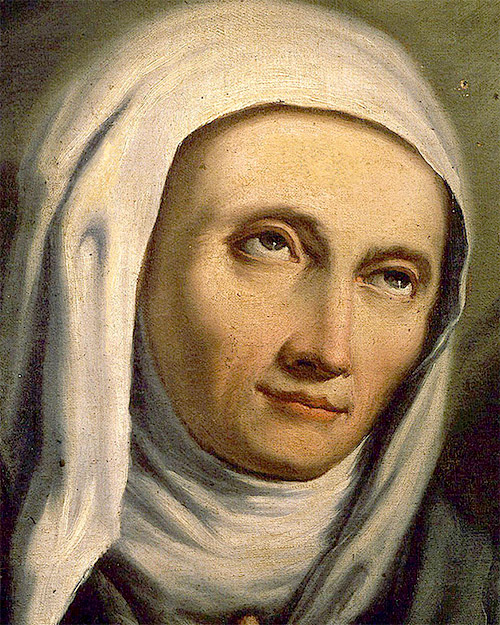
Saint Angela Merici has the double distinction of founding the first of what are now called “secular institutes” and the first teaching order of women in the Church.
Born in Desenzano, Italy, Saint Angela Merici was orphaned in her teens. As a young woman, with her heart centered on Christ, Angela joined the Third Order of St. Francis and embraced austerity. In a visionary experience, she felt called to found a “company” of women.
Angela was invited to become a live-in companion for a widow in the nearby town of Brescia. There she became the spiritual advisor of a group of men and women with ideals of spiritual renewal and service to those in need. While on a pilgrimage to the Holy Land in 1524, Angela was struck with blindness. She proceeded to visit the sacred shrines, seeing them with her spirit. On the way back while praying before a crucifix, Angela’s sight was restored.
At age 60, Angela and 12 other women began the Company of St. Ursula, named for a patroness of medieval universities and venerated as a leader of women. This constituted a new way of life: single women consecrated to Christ and living in the world rather than in a monastery. With Angela as their “mother and mistress,” Company members did not live in community, wore no special clothing, and made no formal vows.
Angela Merici died in Brescia, Italy, in 1540. Clothed in the habit of a Franciscan tertiary, her body was interred in Brescia’s Church of Saint’ Afra. Four years later the Company’s Rule that Angela had composed, prescribing the practices of chastity, poverty and obedience, was approved by the pope.
In the early 1600s, Companies that had expanded into France were re-organized into the religious Order of St. Ursula, to teach girls. Angela’s words continue to inspire the Ursuline nuns’ mission of education, a mission that spread worldwide. The Company of St. Ursula also continued to exist and is federated worldwide today with members in 30 countries. Angela Merici was canonized by Pope Pius VII in 1807.
As with so many saints, history is mostly concerned with their activities. But deep Christian faith and love sustain one whose courage lasts a lifetime, and who can take bold new steps when human need demands.


Click here for the Navarre Bible Commentary on today’s Mass readings.
Disclaimer: Opinions posted on Free Republic are those of the individual posters and do not necessarily represent the opinion of Free Republic or its management. All materials posted herein are protected by copyright law and the exemption for fair use of copyrighted works.