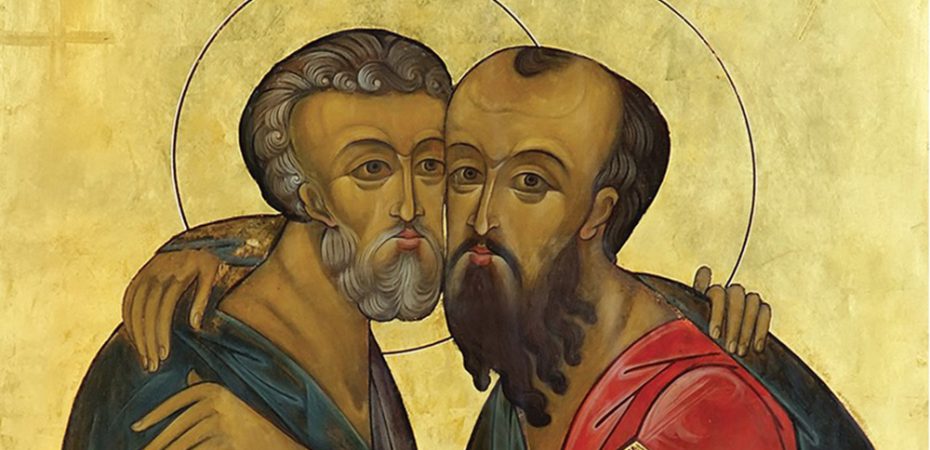
Catena Aurea by St. Thomas Aguinas
Mark CHAP. 3
3:23–30
23. And he called them unto him, and said unto them in parables, How can Satan cast out Satan?
24. And if a kingdom be divided against itself, that kingdom cannot stand.
25. And if a house be divided against itself, that house cannot stand.
26. And if Satan rise up against himself, and be divided, he cannot stand, but hath an end.
27. No man can enter into a strong man’s house, and spoil his goods, except he will first bind the strong man; and then he will spoil his house.
28. Verily I say unto you, All sins shall be forgiven unto the sons of men, and blasphemies wherewith soever they shall blaspheme:
29. But he that shall blaspheme against the Holy Ghost hath never forgiveness, but is in danger of eternal damnation:
30. Because they said, He hath an unclean spirit.
PSEUDO-CHRYSOSTOM. (Vict. Ant. e Cat. in Marc.) The blasphemy of the Scribes having been detailed, our Lord shews that what they said was impossible, confirming His proof by an example. Wherefore it says, And having called them together unto him, he said unto them in parables. How can Satan cast out Satan? As if He had said, A kingdom divided against itself by civil war must be desolated, which is exemplified both in a house and in a city. Wherefore also if Satan’s kingdom be divided against itself, so that Satan expels Satan from men, the desolation of the kingdom of the devils is at hand. But their kingdom consists in keeping men under their dominion. If therefore they are driven away from men, it amounts to nothing less than the dissolution of their kingdom. But if they still hold their power over men, it is manifest that the kingdom of evil is still standing, and Satan is not divided against himself.
GLOSS. (non occ.) And because He has already shewn by an example that a devil cannot cast out a devil, He shews how he can be expelled, saying, No man can enter into a strong man’s house, &c.
THEOPHYLACT. The meaning of the example is this: The devil is the strong man; his goods are the men into whom he is received; unless therefore a man first conquers the devil, how can he deprive him of his goods, that is, of the men whom he has possessed? So also I who spoil his goods, that is, free men from suffering by his possession, first spoil the devils and vanquish them, and am their enemy. How then can ye say that I have Beelzebub, and that being the friend of the devils, I cast them out?
BEDE. (in Marc. i. 17) The Lord has also bound the strong man, that is, the devil: which means, He has restrained him from seducing the elect, and entering into his house, the world; He has spoiled his house, and his goods, that is men, because He has snatched them from the snares of the devil, and has united them to His Church. Or, He has spoiled his house, because the four parts of the world, over which the old enemy had sway, He has distributed to the Apostles and their successors, that they may convert the people to the way of life. But the Lord shews that they committed a great sin, in crying out that that which they knew to be of God, was of the devil, when He subjoins, Verily I say unto you, All sins are forgiven, &c. All sins and blasphemies are not indeed remitted to all men, but to those who have gone through a repentance in this life sufficient for their sins; thus neither is Novatusm right, who denied that any pardon should be granted to penitents, who had lapsed in time of martyrdom; nor Origen, who asserts that after the general judgment, after the revolution of ages, all sinners will receive pardon for their sins, which error the following words of the Lord condemn, when He adds, But he that shall blaspheme against the Holy Ghost, &c.
PSEUDO-CHRYSOSTOM. (Vict. Ant. e Cat. in Marc.) He says indeed, that blasphemy concerning Himself was pardonable, because He then seemed to be a man despised and of the most lowly birth, but, that contumely against God has no remission. Now blasphemy against the Holy Ghost is against God, for the operation of the Holy Ghost is the kingdom of God; and for this reason, He says, that blasphemy against the Holy Ghost cannot be remitted. Instead, however, of what is here added, But will be in danger of eternal damnation, another Evangelist says, Neither in this world, nor in the world to come. By which is understood, the judgment which is according to the law, and that which is to come. For the law orders one who blasphemes God to be slain, and in the judgment of the second law he has no remission. nHowever, he who is baptized is taken out of this world; but the Jews were ignorant of the remission which takes place in baptism. He therefore who refers to the devil miracles, and the casting out of devils which belong to the Holy Ghost alone, has no room left him for remission of his blasphemy. Neither does it appear that such a blasphemy as this is remitted, since it is against the Holy Ghost. Wherefore he adds, explaining it, Because they said, He hath an unclean spirit.
THEOPHYLACT. We must however understand, that they will not obtain pardon unless they repent. But since it was at the flesh of Christ that they were offended, even though they did not repent, some excuse was allowed them, and they obtained some remission.
PSEUDO-JEROME. Or this is meant; that he will not deserve to work out repentance, so as to be accepted, who, understanding who Christ was, declared that He was the prince of the devils.
BEDE. (ubi sup.) Neither however are those, who do not believe the Holy Spirit to be God, guilty of an unpardonable blasphemy, because they were persuaded to do this by human ignorance, not by devilish malice.
AUGUSTINE. (Serm. 71, 12, 21) Or else impenitence itself is the blasphemy against the Holy Ghost which hath no remission. For either in his thought or by his tongue, he speaks a word against the Holy Ghost the forgiver of sins, who treasures up for himself an impenitent heart. But he subjoins, Because they said, He hath an unclean spirit, that he might shew that His reason for saying it, was their declaring that He cast out a devil by Beelzebub, not because there is a blasphemy, which cannot be remitted since even this might be remitted through a right repentance: but the cause why this sentence was put forth by the Lord, after mentioning the unclean spirit, (who as our Lord shews was divided against himself,) was, that the Holy Ghost even makes those whom He brings together undivided, by His remitting those sins, which divided them from Himself, which gift of remission is resisted by no one, but him who has the hardness of an impenitent heart. For in another place, the Jews said of the Lord, that He had a devil, (John 7:20.) without however His saying any thing there about the blasphemy against the Spirit; and the reason is, that they did not there cast in His teeth the unclean spirit, in such a way, that that spirit could by their own words be shewn to be divided against Himself, as Beelzebub was here shewn to be, by their saying, that it might be he who cast out devilso.
Catena Aurea Mark 3
Saints of the Day for January 26
(d. c. 95)
Saints Timothy and Titus’ Story
What we know from the New Testament of Timothy’s life makes it sound like that of a modern harried bishop. He had the honor of being a fellow apostle with Paul, both sharing the privilege of preaching the gospel and suffering for it.
Timothy had a Greek father and a Jewish mother named Eunice. Being the product of a “mixed” marriage, he was considered illegitimate by the Jews. It was his grandmother, Lois, who first became Christian. Timothy was a convert of Paul around the year 47 and later joined him in his apostolic work. He was with Paul at the founding of the Church in Corinth. During the 15 years he worked with Paul, he became one of his most faithful and trusted friends. He was sent on difficult missions by Paul—often in the face of great disturbance in local churches which Paul had founded.
Timothy was with Paul in Rome during the latter’s house arrest. At some period Timothy himself was in prison (Hebrews 13:23). Paul installed him as his representative at the Church of Ephesus.
Timothy was comparatively young for the work he was doing. Several references seem to indicate that he was timid. And one of Paul’s most frequently quoted lines was addressed to him: “Stop drinking only water, but have a little wine for the sake of your stomach and your frequent illnesses” (1 Timothy 5:23).
Titus has the distinction of being a close friend and disciple of Paul as well as a fellow missionary. He was Greek, apparently from Antioch. Even though Titus was a Gentile, Paul would not let him be forced to undergo circumcision at Jerusalem. Titus is seen as a peacemaker, administrator, great friend. Paul’s second letter to Corinth affords an insight into the depth of his friendship with Titus, and the great fellowship they had in preaching the gospel.
When Paul was having trouble with the community at Corinth, Titus was the bearer of Paul’s severe letter and was successful in smoothing things out. Paul writes he was strengthened not only by the arrival of Titus but also “by the encouragement with which he was encouraged in regard to you, as he told us of your yearning, your lament, your zeal for me, so that I rejoiced even more…. And his heart goes out to you all the more, as he remembers the obedience of all of you, when you received him with fear and trembling” (2 Corinthians 7:7a, 15).
The “Letter to Titus” addresses him as the administrator of the Christian community on the island of Crete, charged with organizing it, correcting abuses, and appointing presbyter-bishops.
Reflection
In Titus we get another glimpse of life in the early Church: great zeal in the apostolate, great communion in Christ, great friendship. Yet always there is the problem of human nature and the unglamorous details of daily life: the need for charity and patience in “quarrels with others, fears within myself,” as Paul says. Through it all, the love of Christ sustained them. At the end of the Letter to Titus, Paul says that when the temporary substitute comes, “hurry to me.” The early Church fathers were working to build its reach and its influence over believers. And while their lives often came to a violent and abrupt end, the seeds they sowed flourished the world over and continues to deepen the the faith lives of millions of people. Saints Timothy and Titus: Pray for us!
Saints Timothy and Titus are the Patron Saints of:
Relief from Stomach Disorders
franciscanmedia.org
NAVARRE BIBLE COMMENTARY(RSV)
Ad Majorem Dei Gloriam (To the Greater Glory of God)
Today’s First Reading
From: 2 Timothy 1:1-8
Greeting
--------
[1] Paul, an apostle of Christ Jesus by the will of God according to the promise of the life which is in Christ Jesus, [2] To Timothy, my beloved child: Grace, mercy, and peace from God the Father and Christ Jesus our Lord. [3] I thank God whom I serve with a clear conscience, as did my fathers, when I remember you constantly in my prayers. [4] As I remember your tears, I long night and day to see you, that I may be filled with joy. [5] I am reminded of your sincere faith, a faith that dwelt first in your grandmother Lois and your mother Eunice and now, I am sure, dwells in you.
Response to Grace
-----------------
[6] Hence I remind you to rekindle the gift of God that is within you through the laying on of my hands; [7] God did not give us a spirit of timidity but a spirit of power and love and self-control.
St Paul, Herald of the Gospel
-----------------------------
[8] Do not be ashamed then of testifying to our Lord, nor of me his prisoner, but take your share of suffering for the gospel in the power of God.
***********************************************************************
Commentary:
1-2. The greeting is like that of 1 Timothy, although now St Paul adds a specific reference to the purpose of his God-given call to the apostolate--"according to the promise of the life which is in Christ Jesus". Christ fulfills all the promises of happiness given to Abraham and the other Old Testament patriarchs. The purpose of the Gospel message is to let men know that they have been called to enjoy a new life in Christ, that is, the divine life whose germ we receive at Baptism. That sacrament initiates the life of grace in the soul, and ultimately that life will blossom into eternal life (cf. 1 Tim 1:16; 6:12; Tit 1:2; 3:9).
On the exact meaning of the expression "in Christ Jesus", see the note on1 Tim 1:14.
3. "I thank God": this is not a spontaneous expression of gratitude but rather a permanent disposition of Paul's soul.
St Paul makes the point that his attitude of service and worship is the same as that of his ancestors, the righteous of the Old Testament, for although the Gospel is something new it does not involve a break with the earlier revelation; rather it brings that revelation to fulfillment. The Apostle pays tribute to the chosen people, not hiding his satisfaction at being a Jew himself (cf. Rom 9:3; 11:1; Gal 2:15). "The Church of Christ acknowledges", Vatican II states, "that in God's plan of salvation the beginning of her faith and election is to be found in the patriarchs, Moses and the prophets [...]. The Church cannot forget that she received the revelation of the Old Testament by way of that people with whom God in his inexpressible mercy established the ancient covenant [...]. She is mindful, moreover, that the Apostles, the pillars on which the Church stands, were of Jewish descent, as were many of those early disciples who proclaimed the Gospel of Christ to the world" ("Nostra Aetate", 4).
6. "The gift of God" is the priestly character which Timothy received on the day of his ordination. St Paul is using very graphic and precise language: by the sacrament of Order a divine gift is conferred on the priest; it is like an ember which needs to be revived from time to time in order to make it glow and give forth the warmth it contains. St Thomas Aquinas comments that "the grace of God is like a fire. which does not flow when it is covered by ashes; the same thing happens when grace is covered over in a person by sluggishness or natural fear" ("Commentary on 2 Tim, ad loc.").
The gifts which God confers on the priest "are not transitory or temporary in him, but stable and permanent, attached as they are to an indelible character, impressed on his soul, by which he is made a priest forever (cf. Ps 109:4), in the likeness of Him in whose priesthood he has been made to share" (Pius XI, "Ad Catholici Sacerdotii", 17).
"The laying on of my hands": see the note on 1 Tim 4:14.
7. The gift of God, received in the sacrament of Order by the laying on of hands, includes sanctifying grace and sacramental grace, and the actual graces needed for performing ministerial functions in a worthy manner. The Council of Trent uses this text (vv. 6-7) when it solemnly defines that Priestly Order is a sacrament instituted by Jesus Christ (cf. "De Sacram. Ordinis", chap. 3).
The minister, then, must be courageous in performing his office: he should preach the truth unambiguously even if it clashes with the surroundings; he should do so with love, and be open to everyone despite their faults; with sobriety and moderation, always seeing the good of souls, not his own advantage. Since the days of the Fathers the Church has urged priests to develop these virtues: "Priests should be compassionate", St Polycarp warns; "they should show mercy to all; they should try to reclaim those who go astray, visit the sick, and care for the poor, the orphan and the widow. They should be concerned always to do what is honorable in the sight of God and men. They should avoid any show of anger, any partiality or trace of greed. They should not be over-ready to believe ill of anyone, not too severe in their censure, being well aware that we all owe the debt of sin" ("Letter to the Philippians", chap. 6).
Or:
From: Titus 1:1-9
Greeting
-----------
[1] Paul, a servant of God and an apostle of Jesus Christ, to further the faith of God's elect and their knowledge of the truth which accords with godliness, [2] in hope of eternal life which God, who never lies, promised ages ago [3] and at the proper time manifested in his word through the preaching with which I have been entrusted by command of God our Savior; [4] To Titus, my true child in a common faith: Grace and peace from God the Father and Christ Jesus our Savior.
Qualifications for Elders
--------------------------------
[5] This is why I left you in Crete, that you might amend what was defective, and appoint elders in every town as I directed you, [6] if any man is blameless, the husband of one wife, and his children are believers and not open to the charge of being profligate or insubordinate. [7] For a bishop, as God's steward, must be blameless; he must not be arrogant or quick-tempered or a drunkard or violent or greedy for gain, [8] but hospitable, a lover of goodness, master of himself, upright, holy, and self-controlled; [9] he must hold firm to the sure word as taught, so that he may be able to give instruction in sound doctrine and also to confute those who contradict it.
***********************************************************************
Commentary:
1-4. The heading is particularly long and formal. It contains, as usual (cf. Rom 1:1-2; 1 Cor 1:13; etc.), the sender's name--Paul; the addressee's--Titus; and the greeting--"Grace and peace". In this case, however, Paul's title (Apostle), and the prerogatives of his authority and his God-given mandate to preach are given special emphasis (v. 3). This has led some scholars to argue that the epistle was in fact written by a disciple of St Paul--who would have put in all this about the Apostle's authority in order to give the letter more weight. However, it is more reasonable to suppose that when St Paul was writing the letter he had Titus very much in mind and also the community in Crete, whom false teachers were beginning to unsettle; the solemn, official tone would be due to the serious nature of their doctrinal aberrations and to the need to ensure that the church in Crete was property organized.
These introductory verses provide a very succinct definition of the mission of an Apostle: it derives from God himself, the Savior of all (vv. 1, 3); the Apostle has a mandate from God, he is God's representative (v. 3); the purpose of his mission is to communicate the word of God, which is true, which "accord with godliness" and leads to eternal life (v. 2). His letter is addressed to the believers, who had been endowed with faith (v. 1) and whom he has to lead to heaven (v. 2).
1. "Servant of God": in the language of the Bible, serving God means rendering him the worship that is his due. While keeping this basic meaning, "servant of God" means one who fulfills the task his Lord gives him. Like the Old Testament prophets (who were conscious of having a sacred mission, which they could not avoid: cf. Amos 3:7; Jer 7:25), St Paul knows that he has a God-given mission which he has a duty to perform.
"To further the faith of God's elect": God sends his apostles to instruct people in the faith so that they know the truth that saves and view their lives and the world from a supernatural vantage-point. As the Church's Magisterium has reminded us, evangelization begins by teaching the essential revealed truths: "It is not superfluous to recall the following points: to evangelize is first of all to bear witness, in a simple and direct way, to God revealed by Jesus Christ, in the Holy Spirit; to bear witness that in his Son God has loved the world--that in his Incarnate Word he has given being to all things and has called men to eternal life" (Paul VI, "Evangelii Nuntiandi", 26).
"The truth that accords with godliness": The virtue of godliness or "piety" includes, particularly, openness to God, docility to his commandments and recognition of his divinity--in a word, religion. Godliness and truth are very closely connected: to acquire a solid, well-grounded piety one needs to have a good grasp of the truth. St Teresa of Avila explains this in her inimitable way: "I should prefer spirituality to be unaccompanied by prayer than not to be founded upon the truth. Learning is a great thing, for it instructs those of us who have little knowledge, and enlightens us, so that when we are faced with the truth of Holy Scripture, we act as we should. From foolish devotions may God deliver us!" ("Life", 13, 16).
2. In doing the work given him, the Apostle always keeps before his eyes the "hope of eternal life"; this determines the content and purpose of his preaching--eternal beatitude for himself and for all who accept the word of God, the attainment of the indescribable joy which is God's reward to those who love him: "What words can describe what is to come--the pleasure, the good fortune, the joy of being with Christ? It is impossible to explain the blessedness and the advantage the soul has when it is returned to its noble self and can from then on contemplate its Lord. And it is not only that he enjoys good things to hand: his joy is permanent because these good things will never cease to be his" (St John Chrysostom, "Ad Theod. Lapsum", 1, 13).
"In hope of eternal life": hope of eternal life should imbue our devout life, and it should also inspire the truth we teach, the faith we profess and the apostolic ministry itself.
Promised "ages ago": this ambiguous Semitic expression (it can also be translated as "from all eternity") refers to God's promise of salvation made in ancient times to the patriarchs and prophets of the Old Testament; but it refers mainly to God's eternal plan: from all eternity God decided to save men. This decision of his is the basis of the theological virtue of hope; we place our hope in God "who never lies", who cannot deceive or be deceived.
3-4. "At the proper time": salvation (God's plan for all eternity, communicated in a veiled way to the prophets) has been manifested in the fullness of time by the advent of the Son of God (cf. Heb 1:1); preaching concerns itself exclusively with this message of salvation. The Apostle preaches "by command of God our Savior", not on his personal initiative. It is worth pointing out that this whole passage is very dense and very typical of Paul's style: lots of ideas are crammed into very few words. The key factor is the divine plan of salvation; but the way that plan is communicated is also important, as is the way it is carried out; the word of God, in addition to making the plan of salvation known, is itself salvific, it is an effective instrument of salvation. The Apostle is very conscious that his mission is divine, for God keeps urging him on; he chose him for this very purpose and granted him the title of "servant of God" (cf. v. 1).
On the meaning of the greeting "Grace and peace", see the note on 1 Tim 1:2 and Rom 1:7.
5-9. The qualities of Church pastors described here agree with those recommended in the First Letter to Timothy (cf. 1 Tim 3:2-7 and note). In neither instance is St Paul trying to give a complete list; he is simply urging that ministers be a model for their flock. Emphasis is laid on four aspects which seem to be particularly important: a minister should be of irreproachable conduct (vv. 6-7); his family should be exemplary Christians (v. 6); he should be an upright and welcoming person (vv. 7-8); and finally, he should have a grasp of Christian doctrine (v. 9). The Church has always tried to have people of this caliber as ministers; the last ecumenical council, for example, reminded pastors that, in the pursuit of holiness, they have a special obligation to give good example to others: "they should abound in every spiritual good and bear a living witness of God to all" ("Lumen Gentium", 41).
5. St Paul seems to have given Titus two jobs to do. One, which is implied here, was to complete the catechetical instruction of the young community in Crete; there is a lot of emphasis throughout the letter on firmness in the truth, on counteracting false teachers, and on the need for all believers, particularly pastors, to have a well-grounded faith.
The second job is to complete the hierarchical structuring of the Church. The elders mentioned here perform the same role as that of the bishops in the First Letter to Timothy, and they are all required to have the same qualities (on the as yet unfixed bishop/priest terminology, see the note on 1 Tim 3:1). St Paul's insistence on appointing successors is a pointer to the Apostolicity of the Church: not only do bishops have the same mission as the Apostles; that mission comes to them from the Apostles: "In fact, not only had (the Apostles) various helpers in their ministry, but, in order that the mission entrusted to them might be continued after their death, they consigned, by will and testament, as it were, to their immediate collaborators the duty of completing and consolidating the work they had begun, urging them to tend to the whole flock, in which the Holy Spirit had appointed them to shepherd the Church of God (cf. Acts 20: 28)" ("Lumen Gentium", 20).
Very little information is available as to when St Paul visited Crete and evangelized it. When he was being brought as a prisoner to Rome in the autumn of the year 60, he probably evangelized some Cretans (cf. Acts 27:7-12); there may also have been some Christians there ever since St Peter preached for the first time in Jerusalem (cf. Acts 2:11). It could be that the Apostle spent a while on the island at some stage and established a Christian community there. Crete was fairly important, being a necessary port of call on the Greece-Asia Minor sea route.
Today’s Gospel Reading From: Mark 3:22-30
Allegations of the Scribes
--------------------------
[22] And the scribes who came down from Jerusalem said, "He (Jesus) is possessed by Beelzebul, and by the prince of demons He casts out the demons." [23] And He called them to Him, and said to them in parables, "How can Satan cast out Satan? [24] If a kingdom is divided against itself, that kingdom cannot stand. [25] And if a house is divided against itself, that house will not be able to stand. [26] And if Satan has risen up against himself and is divided, he cannot stand, but is coming to an end. [27] But no one can enter a strong man's house and plunder his goods, unless he first binds the strong man; then indeed he may plunder his house."
Sins Against the Holy Spirit
----------------------------
[28] "Truly, I say to you, all sins will be forgiven the sons of men, and whatever blasphemies they utter; [29] but whoever blasphemes against the Holy Spirit never has forgiveness, but is guilty of an eternal sin"--[30] for they had said, "He has an unclean spirit."
***********************************************************************
Commentary:
22-23. Even Jesus' miracles were misunderstood by these scribes, who accuse Him of being a tool of the prince of devils, Beelzebul. This name may be connected with Beelzebub (which spelling is given in some codexes), the name of a god of the Philistine city of Eqron (Accaron), which means "god of the flies." But it is more likely that the prince of devils is called Beelzebul, which means "god of excrement": "excrement" is the word Jews used to describe pagan sacrifices. Whether Beelzebub or Beelzebul, in the last analysis it refers to him to whom these sacrifices were offered, the devil (1 Corinthians 10:20). He is the same mysterious but real person whom Jesus calls Satan, which means "the enemy", whose dominion over the world Christ has come to wrest from him (1 Corinthians 15:24-28; Colossians 1:13f) in an unceasing struggle (Matthew 4:1-10; John 16:11). These names show us that the devil really exists: he is a real person who has at his beck and call others of his kind (Mark 5:9).
24-27. Our Lord invites the Pharisees, who are blind and obstinate, to think along these lines: if someone expels the devil this means he is stronger than the devil: once more we are exhorted to recognize in Jesus the God of strength, the God who uses His power to free man from enslavement to the devil. Satan's dominion has come to an end: the prince of this world is about to be cast out. Jesus' victory over the power of darkness, which is completed by His death and resurrection, shows that the light has already entered the world, as our Lord Himself told us: "Now is the judgment of this world, now shall the ruler of this world be cast out; and I, when I am lifted up from the earth, will draw all men to Myself" (John 12:31-32).
28-30. Jesus has just worked a miracle but the scribes refuse to recognize it "for they had said `He has an unclean spirit'" (verse 30). They do not want to admit that God is the author of the miracle. In this attitude lies the special gravity of blasphemy against the Holy Spirit--attributing to the prince of evil, to Satan, the good works performed by God Himself. Anyone acting in this way will become like the sick person who has so lost confidence in the doctor that he rejects him as if an enemy and regards as poison the medicine that can save his life. That is why our Lord says that he who blasphemes against the Holy Spirit will not forgiven: not because God cannot forgive all sins, but because that person, in his blindness towards God, rejects Jesus Christ, His teaching and His miracles, and despises the graces of the Holy Spirit as if they were designed to trap him (cf. "St. Pius V Catechism", II, 5, 19; St. Thomas Aquinas, "Summa theologiae", II-II, q. 14, a. 3).