Posted on 01/15/2026 9:38:59 AM PST by ebb tide
Every few months the postconciliar machine produces another document that pretends to be calm, pastoral, historically informed, even reverent toward “Tradition.” Then the mask slips. The target is always the same. The old Mass must not merely be regulated, not merely “balanced,” not merely “integrated.” It must be starved, shamed, and finally buried.
Cardinal Arthur Roche’s consistory report is that pattern distilled. It is written for cardinals, packaged as a neutral overview, and built around the same three moves the regime has used for decades. First, a selective timeline where “reform” is made to sound like nature itself. Second, a moralized definition of “unity” that treats uniformity as charity. Third, a loyalty test where affection for the Roman Rite is reclassified as an ecclesiological defect.
The result is a manifesto.
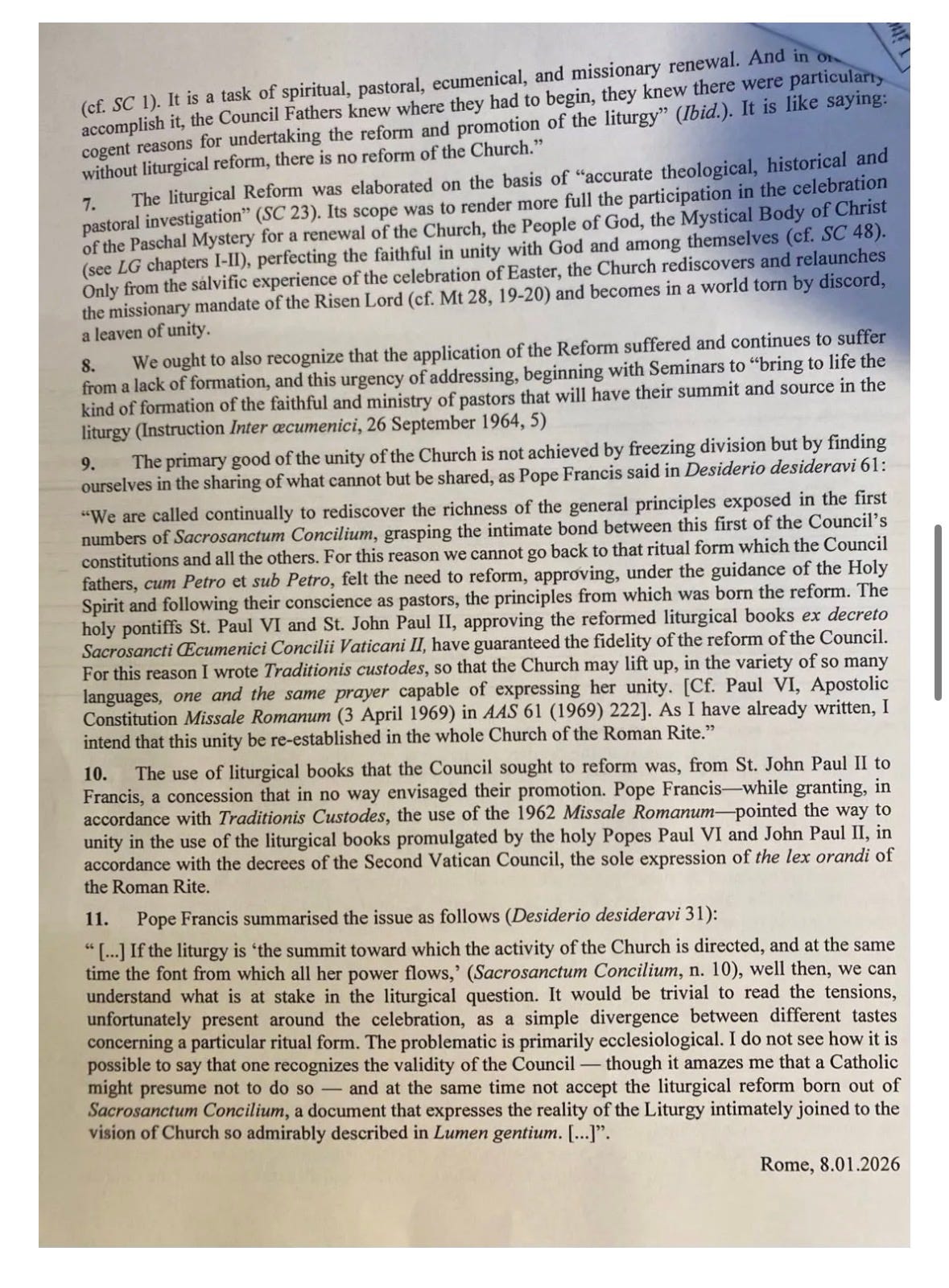
The Two Page Trick
The report wants to appear modest. It is short, bulletlike, “reasonable.” It is also heavily loaded. It smuggles in its conclusion at the start, then spends the rest of the text narrating the conclusion as inevitability.
The conclusion is simple. The old Mass is a tolerated anomaly. It exists by concession. It must not be promoted. The “sole expression” of the Roman Rite is the new liturgy. Returning to the older form is not a pastoral possibility. It is a breach of ecclesiology. A Catholic who resists the reform is resisting the Council. That Catholic becomes the problem.
That is the argument. It is not subtle. The only subtlety is how it is dressed.
Reform as Fate
Roche begins with the familiar story. The liturgy has “always undergone reforms.” Didaché, Traditio Apostolica, Greek to Latin, sacramentaries, pontificals, the Franco Germanic period, Tridentine reform, post Tridentine adjustments, then Vatican II. Look, change has always happened. Therefore this change is the same kind of change. That is rhetoric, not history.
The Church’s liturgical development was historically organic, slow, and conservative. It was the accumulation of sanctified habit and not the design of a committee. It was stability with occasional pruning. It was never a principle of permanent revolution.
When Roche lumps the Tridentine standardization together with the post Vatican II demolition, he is relying on an equivocation. “Reform” is being used as a single word to describe two very different realities.
A reform that codifies and protects an inherited rite is not the same thing as a reform that manufactures a new order and then treats the inherited rite as a tolerated relic.
The report depends on you not noticing the difference.
Quo Primum as a Stage Prop
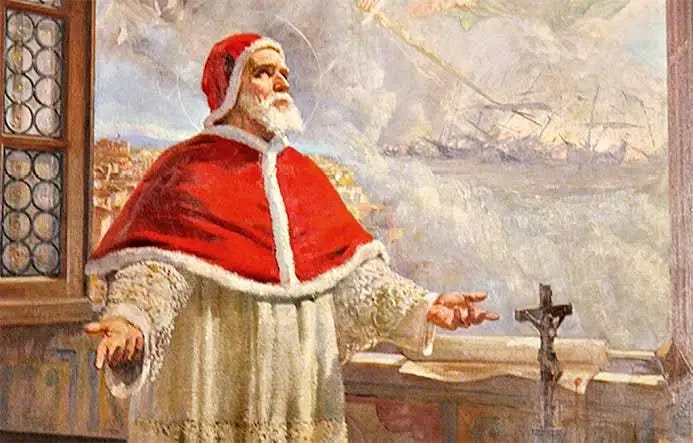
Roche cites St Pius V. He quotes the famous line about one rite for celebrating the Mass. He wants the weight of Quo Primum to fall on his side. It falls on the opposite side.
Pius V was not arguing that the Roman Rite can be redesigned whenever administrators desire “progress.” He was doing the opposite. He was consolidating, protecting, and stabilizing the Roman Missal after a doctrinal crisis, precisely so the Church’s worship would not become a playground for regional novelty and theological drift. His reform was a fence. Roche uses the fence as a battering ram.
This move also reveals what “unity” means in the report. Unity is not the Church’s unity of faith expressed through a shared sacrificial worship that admits legitimate variety. Unity is one state approved text, one regime approved ritual culture, one authorized identity. The old Mass becomes a rival flag.
So Quo Primum is invoked as if it justifies a universal monopoly, even though the historical record shows Pius V recognized older rites and did not treat uniformity as an absolute good divorced from tradition. Roche’s use of Pius V is a classic bureaucratic tactic. Quote the saint. Reverse the substance. Proceed as if the saint is now your mascot.
Unity Redefined into Uniformity
The report presents unity as the supreme good in the liturgical question. It quotes the new regime’s line that the Church must “lift up one and the same prayer” in “variety of languages” to express unity. Then it concludes that the reformed books are the sole lex orandi of the Roman Rite. It is a revolutionary claim.
The lex orandi of the Roman Church did not begin in 1969. The Roman Rite is not a product line that changes its branding and announces the previous model is now illegal to use. The ancient Mass is not a devotional preference. It is the historic public worship of the Latin Church, codified and protected, received and transmitted, stamped into the spiritual muscle memory of Catholic nations. If unity requires the destruction of continuity, it is not unity, but consolidation of power.
The report frames the old Mass as a threat to unity precisely because it is a living counterexample to the slogan that the reform is “the Council in prayer.” As long as the Roman Rite remains visible in its classical form, the claim that the revolution was inevitable looks less convincing. So the old Mass must become rare, stigmatized, quarantined, then functionally extinct. That is the logic. Unity becomes the moral excuse.
Organic Development vs Rupture
Roche insists the Vatican II reform is “in full synergy with the true meaning of Tradition.” It even borrows Benedict XVI’s image of Tradition as a “living river.” The report tries to place Benedict on the side of permanent change, as if Tradition means always leaving the older forms behind. This is another equivocation.
Tradition is living because it transmits life. It is not living because it sheds its skin every generation to satisfy fashionable theories. A living tradition is not a tradition that despises its own inheritance. A river that remains a river does not decide that its source was a mistake.
The postconciliar reform is not organic development in the normal sense Catholics have historically used that term. It is an imposed reconstruction. It changes the prayers, alters the sacrificial emphasis, moves the architecture, reorients the action, flattens the ceremonial language, and then insists the result is simply the same thing with modern packaging. Roche’s report avoids the concrete. It speaks in abstractions because the concrete is devastating.
The concrete is the difference between worship that looks like Calvary and worship that often looks like a community meeting with a meal motif. The concrete is the disappearance of silence, genuflection, sacred language, and the sense that the priest stands at the altar to offer a sacrifice to God. The concrete is the fact that Catholics who return to the old Mass after years away routinely describe the experience as recovery from liturgical amnesia.
A truly organic development does not require a war to enforce it.
The “Changed Theology” Reveal
The most revealing line in the broader Roche worldview, echoed in the logic of this report, is the claim that the Church’s theology “has changed,” particularly the relationship between priest and people in the liturgy. The report gestures toward this by presenting the reform as the necessary expression of a new ecclesial self understanding. This is the moment the whole project gives itself away.
Catholic doctrine does not evolve in the sense of contradicting itself. The Council of Trent did not teach a version of the Mass that became obsolete when academics rediscovered “participation.” Trent defined the Mass as a true propitiatory sacrifice offered by the priest acting in the person of Christ. That reality is Catholic dogma.
The faithful participate. They always did. The traditional rite presumes it, forms it, intensifies it. It demands interior union with the sacrifice, not merely external activity. It trains the soul to follow the action that matters.
The postconciliar rhetoric about participation often functions as camouflage for something else. It repositions the liturgy from Godward sacrifice to community centered expression. It treats priestly mediation as a barrier and then celebrates its reduction as progress.
So when Roche claims that the theology has changed, he is admitting what defenders of the reform usually deny. The reform embodies a different emphasis. Sometimes it carries a different spirit. Often it produces a different faith.
A changed theology is a confession of discontinuity.
The Loyalty Test
The report quotes the line that one cannot recognize the validity of the Council while rejecting the liturgical reform born out of Sacrosanctum Concilium. It frames the problem as “primarily ecclesiological.” The insinuation is blunt. Attachment to the old Mass means resistance to the Council. Resistance to the Council means disloyalty to the Church. That is coercion, not an argument.
It is also strategically useful, because it converts a liturgical dispute into a moral and ecclesial indictment. It makes criticism of the reform impossible without personal guilt. It shifts the debate from the content of the rites to the supposed pathology of the critics.
If you question the reform, you are not discerning prudence, but denying the Council. If you prefer the old Mass, you are not pursuing sanctification. You are expressing an ecclesiological deficiency.
This is the same method used across the postconciliar landscape. Define your opponent as a problem of attitude. Reduce substantive objections to psychological resistance. Then call the resulting submission “unity.”
The Abrogation Fiction
Roche’s circle has repeatedly floated the claim that the old Mass was “abrogated” by Paul VI and survived only by concession. The report’s language moves in that direction, treating the continued use of the 1962 Missal as something never meant for promotion.
This line runs headlong into an inconvenient fact. Benedict XVI stated that the older Missal was never abrogated. He acted on that premise. He legislated on that premise. He explicitly rejected the narrative Roche now revives.
So which is it? Either Benedict was correct and the old rite remains within the Church’s legal and liturgical life, or Roche is correct and Benedict’s settlement was a mistake that required correction by force.
Roche’s camp chooses the second option, then pretends the conflict does not exist by calling everything “continuity.” This is another example of the document’s method. It relies on institutional amnesia. It assumes most Catholics will not remember what was said fifteen years ago, even by one of their own post-conciliar popes, even in a major legislative act.
The old Mass becomes a “concession” because that is the only way to justify its suppression without admitting the truth. The truth is that it is not an indulgence. It is the Roman Rite as historically received. Treating it as a concession is already a revolutionary posture.
The River that Flows One Way
Roche’s rhetoric about tradition and progress is meant to sound balanced. “Sound tradition” must remain open to “legitimate progress.” Tradition without progress becomes dead. Progress without tradition becomes novelty.
The problem is that in this system “progress” always means moving away from the inherited rite, never returning to it, never correcting the damage, never admitting the reform itself might require reform. The river flows one way. It flows toward the liturgical anthropology of the 1970s. It does not flow back toward the sacrificial clarity that formed saints.
So the report’s “balance” is an illusion. It is not a dialogue between tradition and progress. It is progress declared normative, with tradition allowed to exist only as a museum exhibit.
That is why the traditional Mass must not be “promoted.” A thing that can grow is a thing that can win. A thing that can win is a thing that can expose the emptiness of the slogans.
So it must remain a tolerated minority, forever managed, forever described as a problem to be solved.
What Roche’s Letter Actually Says
Strip away the quotation marks and the historical montage, and the message is simple.
The Church of the past is to be treated as a prelude. The Roman Rite is to be treated as an adjustable product. The saints are to be treated as spiritually nourished by something the modern Church now regards as the wrong expression of itself. The Council is to function as the permanent veto against the past. This is not a Catholic instinct. It is a revolutionary instinct.
A Catholic looks at the inherited worship of the Church and sees a treasure. Roche looks at it and sees an obstacle to a project. That difference explains the last sixty years. It explains why the reform has had to be defended not by its fruits but by administrative pressure. It explains why the traditional Mass has had to be treated as dangerous.
Healthy things do not need a police state to survive.
Conclusion: The Revolution Still Needs a Scapegoat
Roche’s consistory paper is not chiefly about liturgy. It is about control and narrative. The revolution must remain the interpretive key for Catholic life, and the old Mass is the living contradiction of that claim. It proves that the Church can worship without the postconciliar program. It proves that Catholics can flourish without the manufactured rites. It proves that reverence, sacrifice, hierarchy, silence, and Godward orientation still convert souls.
So Roche does what every revolutionary bureaucracy eventually does. It rewrites history. It redefines unity. It weaponizes obedience. It pathologizes dissent. It frames the victims as the cause of the conflict.
Traditional Catholics are expected to accept their own dispossession as “communion.” They are expected to surrender their inheritance as “unity.” They are expected to applaud their own marginalization as “progress.”
A consistory letter will not make that credible. It only makes it clearer.
And for anyone still tempted to believe the official story, Roche’s own text provides the best correction. The reform is not a neutral adjustment. It is a program. The program remains at war with the Roman Rite. The war continues because the old Mass continues to live.
Strip away the quotation marks and the historical montage, and the message is simple.
The Church of the past is to be treated as a prelude. The Roman Rite is to be treated as an adjustable product. The saints are to be treated as spiritually nourished by something the modern Church now regards as the wrong expression of itself. The Council is to function as the permanent veto against the past. This is not a Catholic instinct. It is a revolutionary instinct.
A Catholic looks at the inherited worship of the Church and sees a treasure. Roche looks at it and sees an obstacle to a project. That difference explains the last sixty years. It explains why the reform has had to be defended not by its fruits but by administrative pressure. It explains why the traditional Mass has had to be treated as dangerous.
Healthy things do not need a police state to survive.
Pope St. Pius V also said any liturgical form more than 250 years old (e.g. Ambrosian, Dominican) was to be left alone. There are more differences between different Novus Ordo Masses (given all the options, and not even counting tolerated abuses) than there were between Pius V’s reforms and the various Masses said in his time, and during the Council of Trent.
Ping
Good point. See below:
This is Dr Joseph Shaw's 'Briefing' to supporters of the Latin Mass Society. You can join the email list for these occasional briefings here.
At the recent Consistory of Cardinals in Rome, Arthur, Cardinal Roche, distributed a short text on the liturgy to those assembled, which is critical of the Traditional Mass. Readers can see my analysis of the arguments employed there on the FIUV website here [reposted to Rorate Caeli below]. In this Bulletin I want to take a step back to consider its wider implications.
As I note in my analysis, this text does not respond to the criticisms that have been made of the official justification of Traditionis custodes, but simply reiterates this justification, at greater length. The argument is that liturgical pluralism undermines the unity of the Church. Critics have pointed out that the Church has always fostered a plurality of Rites and Usages, with Vatican II itself supporting this policy. Cardinal Roche’s text does nothing to address this. Is there a good kind of pluralism to be distinguished from a bad kind? Is there a difference between a pluralism of Rites (as in Eastern and Western) and pluralism within the Western Rite? Is there a difference between the pluralism represented by the Ordinariate or the (reformed) Ambrosian Rite of Milan, and the pluralism of Ordinary and Extraordinary Form, that we need to understand? There might be arguments along these lines, but no the defender of Traditionis custodes has made a serious attempt to set them out. They have just repeated the original claim, that pluralism is a problem, and in this text Cardinal Roche does so all over again.
What are we to make of this?
If you control the ‘information space’ sufficiently tightly, it can be rational to refuse to answer criticisms, because by answering you give publicity to criticisms which they would not otherwise have had. Now it is true that the Dicastery for Divine Worship doesn’t control social media, or books and articles, but a lot of people in important roles in the Church will never hear, or if they hear will not take seriously, voices dissenting from the official view.
Another explanation, which is not incompatible with the above, is of course that they simply have no arguments. I doubt that they believe this themselves, however. Perhaps what they would say is that the criticisms are obviously nonsense, but rebutting them would require too long a detour through basic principles to be worth doing. This comes back to the idea that the critics should not be dignified with a response.
What this amounts to is a resort to institutional power, rather than reasoned argument. There is an ecclesial establishment which is quite hostile to the Traditional Mass, and those members who are more open-minded are generally not inclined to take issue with the official position, while it remains official. There need therefore be no dialogue, no meeting of minds.
How different things were in the past. At the eve of the Council, and for a long time after, the ‘progressive’ position seemed to have the support of all the scholars and all the ‘forward thinking’ liturgists. They seemed to have all the energy and all the ideas. The opposition appeared to be limited to the most antiquated cardinals and old women with their rosaries. This was a somewhat misleading impression, in fact, but it did look that way.
Today, however, all the energy, all the new ideas, the young scholars, and even a great many of the priests engaged in exciting pastoral initiatives, are trying to recover Tradition, in one way or another. (The UK's liberal Tablet last week featured Abbot Hugh Allen of the Norbertines as someone leading such an initiative in south London; he is a well-known supporter of the TLM.) The establishment can ignore us, but increasingly progressive parishes are being kept afloat, if at all, by older women. Only these ones tend not to pray the rosary.
Tradition was overthrown in the 1960s because despite conservatives holding key positions – think of John XXIII on Latin, Archbishop Lefebvre organising preparatory schemas for Vatican II, or Cardinal Ottaviani running the Holy Office – they were perceived as having lost the argument, and the new generation with new ideas was carrying all before them.
Today the roles are reversed. We know what the outcome is going to be. We just don’t know how long it is going to take to get there.
Disclaimer: Opinions posted on Free Republic are those of the individual posters and do not necessarily represent the opinion of Free Republic or its management. All materials posted herein are protected by copyright law and the exemption for fair use of copyrighted works.