Catena Aurea by St. Thomas Aguinas
13:31–35
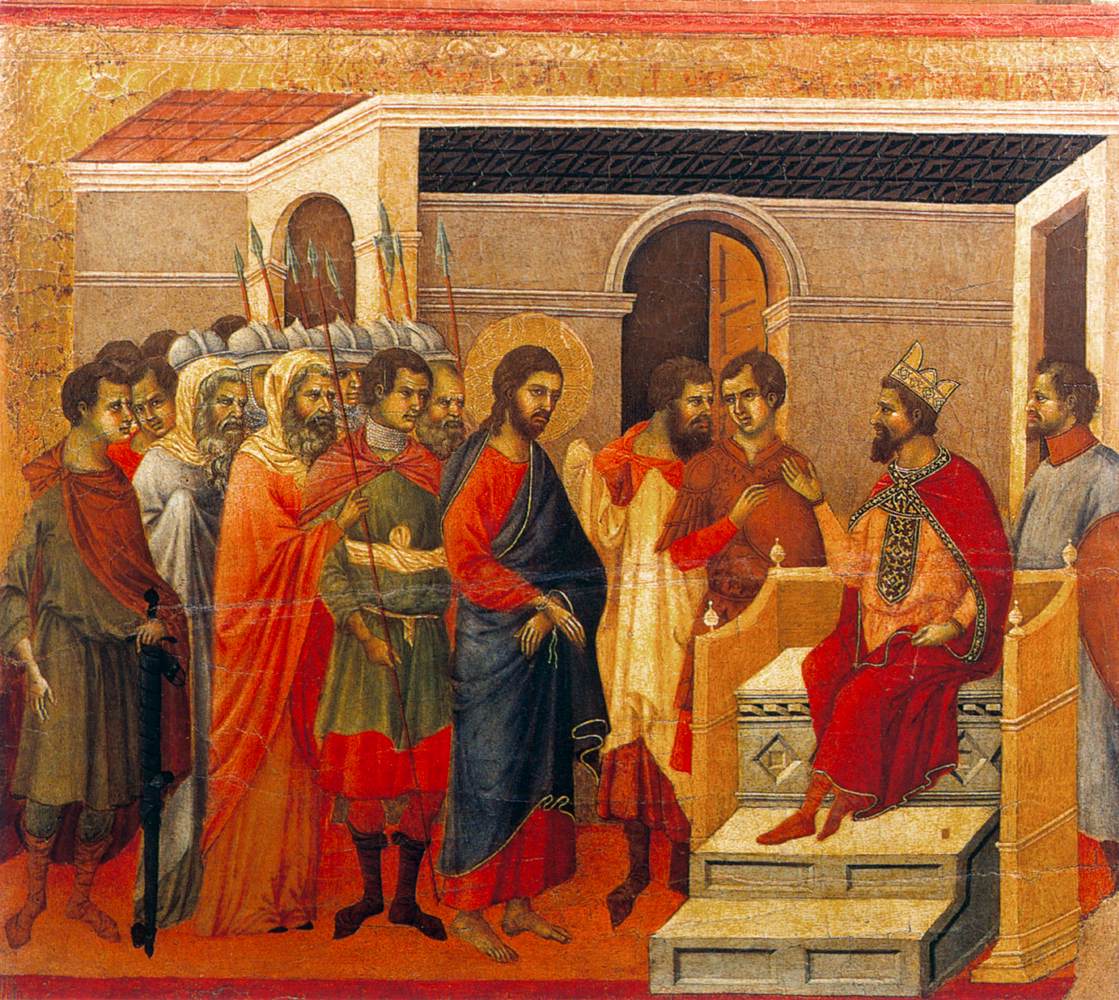
31. The same day there came certain of the Pharisees, saying unto him, Get thee out, and depart hence: for Herod will kill thee.
32. And he said unto them, Go ye, and tell that fox, Behold, I cast out devils, and I do cures to day and to morrow, and the third day I shall be perfected.
33. Nevertheless I must walk to day, and to morrow, and the day following: for it cannot be that a prophet perish out of Jerusalem.
34. O Jerusalem, Jerusalem, which killest the prophets, and stonest them that are sent unto thee; how often would I have gathered thy children together, as a hen doth gather her brood under her wings, and ye would not!
35. Behold, your house is left unto you desolate: and verily I say unto you, Ye shall not see me, until the time come when ye shall say, Blessed is he that cometh in the name of the Lord.
CYRIL OF ALEXANDRIA. The preceding words of our Lord roused the Pharisees to anger. For they perceived that the people were now smitten in their hearts, and eagerly receiving His faith. For fear then of losing their office as rulers of the people, and lacking their gains, with pretended love for Him, they persuade Him to depart from hence, as it is said, The same day there came certain of the Pharisees, saying unto him, Get thee out and depart hence, for Herod will kill thee: but Christ, who searcheth the heart and the reins, answers them meekly and under figure. Hence it follows, And he said unto them, Go ye and tell that fox.
BEDE. Because of his wiles and stratagems He calls Herod a fox, which is an animal full of craft, concealing itself in a ditch because of snares, having a noisome smell, never walking in straight paths, all which things belong to heretics, of whom Herod is a type, who endeavours to destroy Christ (that is, the humility of the Christian faith) in the hearts of believers.
CYRIL OF ALEXANDRIA. Or else the discourse seems to change here, and not to refer so much to the character of Herod as some think, as to the lies of the Pharisees. For He almost represents the Pharisees themselves to be standing near, when He said, Go tell this fox, as it is in the Greek. Therefore he commanded them to say that which might rouse the multitude of Pharisees. Behold, said He, I cast out devils, and I do cures to day and to morrow, and on the third day I shall be perfected. He promises to do what was displeasing to the Jews, namely, to command the evil spirits, and deliver the sick from disease, until in His own person He should undergo the suffering of the cross. But because the Pharisees thought that He who was the Lord of hosts, feared the hand of Herod. He refutes this, saying, Nevertheless I must walk to day and to morrow, and the day following. When He says must, He by no means implies a necessity imposed upon Him, but rather that He walked where He liked according to the inclination of His will, until He should come to the end of the dreadful cross, the time of which Christ shews to be now drawing near, when He says, To day and to morrow.
THEOPHYLACT. As if He says, What think ye of My death? Behold, a little while, and it will come to pass. But by the words, To day and to morrow, are signified many days; as we also are wont to say in common conversation, “To day and to morrow such a thing takes place,” not that it happens in that interval of time. And to explain more clearly the words of the Gospel, you must not understand them to be, I must walk to day and to morrow, but place a stop after to day and to morrow, then add, and walk on the day following, as frequently in reckoning we are accustomed to say, “The Lord’s day and the day after, and on the third I will go out,” as if by reckoning two, to denote the third. So also our Lord speaks as if calculating, I must do so to day, and so to morrow, and then afterward on the third day I must go to Jerusalem.
AUGUSTINE. (con. Julian. lib. 6. c. 19.) Or these things are understood to have been spoken mystically by Him, so as to refer to His body, which is the Church. For devils are cast out when the Gentiles having forsaken their superstition, believe in Him. And cures are perfected when according to His commands, after having renounced the devil and this world until the end of the resurrection, (by which as it were the third day will be completed,) the Church shall be perfected in angelical fulness by the immortality also of the body.
THEOPHYLACT. But because they said unto Him, Depart from hence, for Herod seeks to kill thee, speaking in Galilee where Herod reigned, He shews that not in Galilee, but in Jerusalem it had been fore-ordained that He should suffer. Hence it follows, For it can not be that a prophet perish out of Jerusalem. When thou hearest, It can not be (or it is not fitting) that a prophet should perish out of Jerusalem, think not that any violent constraint was imposed upon the Jews, but He says this seasonably with reference to their eager desire after blood; just as if any one seeing a most savage robber, should say, the road on which this robber lurks can not be without bloodshed to travellers. So also no where else but in the abode of robbers must the Lord of the prophets perish. For accustomed to the blood of His prophets, they will also kill the Lord; as it follows, O Jerusalem, Jerusalem, which killest the prophets.
BEDE. In calling upon Jerusalem, He addresses not the stones and buildings of the city, but the dwellers therein, and He weeps over it with the affection of a father.
CHRYSOSTOM. (Hom. 75. in Matt.) For the twice repeated word betokens compassion or very great love. For the Lord speaks, if we may say it, as a lover would to his mistress who despised him, and was therefore about to be punished.
GREEK EXPOSITOR. (Severus.) But the repetition of the name also shews the rebuke to be severe. For she who knew God, how does she persecute God’s ministers?
CYRIL OF ALEXANDRIA. Now that they were unmindful of the Divine blessings He proves as follows, How often would I have gathered thy children together as a hen doth gather her brood under her wings, and ye would not. He led them by the hand of Moses full of all wisdom. He warns them by His prophets, He wished to have them under His wings, (i. e. under the shelter of His power,) but they deprived themselves of these choice blessings, through their ingratitude.
AUGUSTINE. (Enchir. 97.) As many as I gathered together, it was done by my all prevailing will, yet thy unwillingness, for thou wert ever ungrateful.
BEDE. Now He who aptly had called Herod a fox, who was plotting His death, compares Himself to a bird, for foxes are ever lying in wait for birds.
BASIL. (in Esaiam c. 16. §. 301.) He compared also the sons of Jerusalem to birds in the net, as if He said, Birds who are used to fly in the air are caught by the treacherous devices of the catchers, but thou shalt be as a chicken in want of another’s protection; when thy mother then has fled away, thou art taken from thy nest as too weak to defend thyself, too feeble to fly; as it follows, Behold, your house is left unto you desolate.
BEDE. The city itself which He had called the nest, He now calls the house of the Jews; for when our Lord was slain, the Romans came, and plundering it as a deserted nest, took away both their place, nation, and kingdom.
THEOPHYLACT. Or your house, (that is, temple,) as if He says, As long as there was virtue in you, it was my temple, but after that you made it a den of thieves, it was no more my house but yours. Or by house He meant the whole Jewish nation, according to the Psalm, O house of Jacob, bless ye the Lord, (Psalm 135:20.) by which he shews that it was He Himself who governed them, and took them out of the hand of their enemies. It follows, And verily I say unto you, &c.
AUGUSTINE. (de Cons. Ev. lib. 2. c. 72.) There seems nothing opposed to St. Luke’s narrative, in what the multitudes said when our Lord came to Jerusalem, Blessed is he who cometh in the name of the Lord, (Mat. 21:9.) for He had not as yet come thither, nor had this yet been spoken.
CYRIL OF ALEXANDRIA. For our Lord had departed from Jerusalem, as it were abandoning those who were unworthy of His presence, and afterwards returned to Jerusalem, having performed many miracles, when that crowd meets Him, saying, Osanna to the Son of David, blessed is he that cometh in the name of the Lord.
AUGUSTINE. (de Cons. Ev. ubi sup.) But as Luke does not say to what place our Lord went from thence, so that He should not come except at that time, (for when this was spoken He was journeying onward until He should come to Jerusalem,) He means therefore to refer to that coming of His, when He should appear in glory.
THEOPHYLACT. For then also will they unwillingly confess Him to be their Lord and Saviour, when there shall be no departure hence. But in saying, Ye shall not see me until he shall come, &c. does not signify that present hour, but the time of His cross; as if He says, When ye have crucified Me, ye shall no more see Me until I come again.
AUGUSTINE. (ubi sup.) Luke must be understood then as wishing to anticipate here, before his narrative brought our Lord to Jerusalem, or to make Him when approaching the same city, give an answer to those who told Him to beware of Herod, like to that which Matthew says He gave when He had already reached Jerusalem.
BEDE. Ye shall not see, that is, unless ye have worked repentance, and confessed Me to be the Son of the Father Almighty, ye shall not see My face at the second coming.
Catena Aurea Luke 13
NAVARRE BIBLE COMMENTARY(RSV)
Ad Majorem Dei Gloriam (To the Greater Glory of God)
First Reading:
From: Romans 8:31b-34
Trust in God
------------
[31b] If God is for us, who is against us? [32] He who did not spare things with him? [33] Who shall bring any charge against God's elect? It is God who justifies; [34] who is to condemn? Is it Christ Jesus, who died, yes, who was raised from the dead, who is at the right hand of God, who indeed intercedes for us?
***********************************************************************
Commentary:
31-39. The elect will emerge unscathed and victorious from all attacks, dangers and sufferings and will do so not through their own efforts but by virtue of the all-powerful aid of him who has loved them from all eternity and who did not hesitate to have his own Son die for their salvation. It is true that as long as we are on this earth we cannot attain salvation, but we are assured that we will attain it precisely because God will not withhold all the graces we need to obtain this happy outcome: all that is needed is that we desire to receive this divine help. Nothing that happens to us can separate us from the Lord--not fear of death or love of life, not the bad angels or devils, not the princes or the powers of this world, nor the sufferings we undergo or which threaten us nor the worst that might befall us. "Paul himself", St John Chrysostom reminds us, "had to contend with numerous enemies. The barbarians attacked him; his custodians laid traps for him; even the faithful, sometimes in great numbers, rose against him; yet Paul always came out victorious. We should not forget that the Christian who is faithful to the laws of his God will defeat both men and Satan himself" ("Hom. on Rom.", 15).
This is the attitude which enables us to live as children of God, who fear neither life nor death: "Our Lord wants us to be in the world and to love the world but without being worldly. Our Lord wants us to remain in this world--which is now so mixed up and where the clamor of lust and disobedience and purposeless rebellion can be heard--to teach people to live with joy [...]. Don't be afraid of the paganized world: our Lord has in fact chosen us to be leaven, salt and light in this world. Don't be worried. The world won't harm you unless you want it to. No enemy of our soul can do anything if we don't consent. And we won't consent, with the grace of God and the protection of our Mother in heaven" (S. Bernal, "Monsignor Josemaria Escriva de Balaguer", p. 213).
31. This exclamation of the Apostle vividly reveals the full extent of the love of God the Father, who not only listens to our prayers but anticipates our needs. God is with us, he is always by our side. This is a cry expressing confidence and optimism, despite our personal wretchedness; it is firmly based on our sense of divine sonship. "Clothed in grace, we can cross mountains (cf. Ps 103:10), and climb the hill of our Christian duty, without halting on the way. If we use these resources with a firm purpose and beg our Lord to grant us an ever increasing hope, we shall possess the infectious joy of those who know they are children of God: 'If God is for us, who is against us?' (Rom 8:31) Let us be optimists. Moved by the power of hope, we shall fight to wipe away the trail of filth and slime left by the sowers of hatred. We shall find a new joyful perspective to the world, seeing that it has sprung forth beautiful and fair from the hands of God. We shall give it back to him with that same beauty" (St. J. Escriva, "Friends of God", 219).
Gospel Reading: From: Luke 13:31-35
Jesus' Reply to Herod
--------------------------------
[31] At that very hour some Pharisees came, and said to him (Jesus), "Get away from here, for Herod wants to kill you." [32] And he said to them, "Go and tell that fox, 'Behold, I cast out demons and perform cures today and tomorrow, and the third day I finish my course. [33] Nevertheless I must go on my way today and tomorrow and the day following; for it cannot be that a prophet should perish away from Jerusalem.'
Jerusalem Admonished
----------------------------------
[34] "O Jerusalem, Jerusalem, killing the prophets and stoning those who are sent to you! How often would I have gathered your children together as a hen gathers her brook under her wings, and you would not! [35] Behold, your house is forsaken. And I tell you, you will not see me until you say, 'Blessed is he who comes in the name of the Lord.'"
*********************************************************************
Commentary:
31-33. This episode apparently took place in the Perea region which, like Galilee, was under the jurisdiction of Herod Antipas (cf. Lk 3:1), a son of Herod the Great (cf. note on Mt 2:1). On other occasions St. Luke mentions that Herod was keen to meet Jesus and see him perform a miracle (cf. Lk 9:9; 23:8). These Pharisees may be giving Jesus the warning just to get him to go away. Jesus calls Herod--and indirectly his accomplices--a "fox", once again showing his rejection of duplicity and hypocrisy.
Jesus' answer shows them he is completely in command of his life and death: he is the Son of God and his Father's will is his only governor (cf. Jn 10:18).
34. Jesus here shows the infinite extent of his love. St Augustine explores the meaning of this touching simile: "You see, brethren, how a hen becomes weak with her chickens. No other bird, when it is a mother, shows its maternity so clearly. We see all kinds of sparrows building their nests before our eyes; we see swallows, storks, doves, every day building their nests; but we do not know them to be parents, except when we see them on their nests. But the hen is so enfeebled over her brood that even if the chickens are not following her, even if you do not see the young ones, you still know her at once to be a mother. With her wings drooping, her feathers ruffled, her note hoarse, in all her limbs she becomes so sunken and abject, that, as I have said, even though you cannot see her young, you can see she is a mother. That is the way Jesus feels" ("In Ioann. Evang.", 15, 7).
35. Jesus shows the deep sorrow he feels over Jerusalem's resistance to the love God had so often shown it. Later St Luke will record Jesus' weeping over Jerusalem (cf. Lk 19:41). See also the note on Mt 23:37-39.
[The note on Mt 23:37-39 states: Jesus' moving remarks seem almost to sum up the entire history of salvation and are a testimony to his divinity. Who if not God was the source of all these acts of mercy which marks the stages of the history of Israel? The image of being protected by wings, which occurs often in the Old Testament, refers to God's love and protection of his people. It is to be found in the prophets, in the canticles of Moses (cf. Deut 32:11), and in many psalms (cf. 17:8; 36:8; 57:2; 61:5; 63:8). "And you would not": the Kingdom of God has been preached to them unremittingly for centuries by the prophets; in these last few years by Jesus himself, the Word of God made man. But the "Holy City" has resisted all the unique graces offered it. Jerusalem should serve as a warning to every Christian: the freedom God has given us by creating us in his image and likeness means that we have this terrible capacity to reject him. A Christian's life is a continuous series of conversions--repeated instances of repentance, of turning to God, who, loving Father that he is, is every ready to forgive.]