
Posted on 10/27/2025 2:03:07 PM PDT by ebb tide
Above: Holy Mass at the High Altar in St. Peter’s (behind the main altar). All photos by Don Elvir unless noted.
“Ooh la, la!” In many ways the instinctive and sotto voce reaction of the parish priest of St. Peter’s Basilica to the immense crowd he saw on Saturday could be an apt representation of the response of many in the Catholic Church today, when faced with the vibrancy of the traditional movement.
Walking out into the crowds gathered at the Altar of the Chair in the Vatican, the Italian Franciscan who serves as the Basilica’s parish priest was met with the sight of around 3,000 people; over three times more than had been anticipated. Whether this pleased or irritated him, his amazement at the vibrancy of the crowd was visible.

After having processed in solemn pilgrimage from across the Tiber, the vastly international crowd of Latin Mass devotees were at that point reverently awaiting the much anticipated solemn Mass with Raymond Cardinal Burke. Seminarians and clergy – predominantly young – struggled to find spaces to accommodate their number, and space before the altar vanished.
“It is the source of deepest joy for me to offer the Pontifical Mass at the Altar of the Chair of Saint Peter as the culmination of the Summorum Pontificum Pilgrimage of 2025,” the cardinal opened his homily.
For those perhaps unfamiliar with the realities of daily life in and around the Vatican, some context is necessary to truly appreciate what took place at the site of St. Peter’s martyrdom this past weekend.
Saturday’s Mass marked a triumphant and very public return of the Mass for the annual Ad Petri Sedem pilgrimage, after the authorities refused permission for a Mass in the Vatican in both 2023 and 2024, following Traditionis Custodes.
Run since 2012, the pilgrimage has drawn devotees of the traditional Mass to Rome for a weekend of public prayer and witness to the beauty of the Church’s ancient liturgy. Beginning with solemn Vespers on Friday, the main highlight is the procession to the Vatican on Saturday morning, followed normally by Mass inside the basilica.
The persecution which this liturgy has undergone following Pope Francis’ 2021 restrictions is well known, and the sidelining of Catholics nourished by the Latin Mass has been seen in Rome also. Following Traditionis Custodes, no prelates were allowed to celebrate Mass for the 2021 and 2022 pilgrimages, and in 2023 and 2024 the Mass was then completely prohibited. Instead pilgrims had to content themselves with Eucharistic Benediction and the office of Sext.
As the attacks on traditional priests also increased and the climate of fear expanded, this too was reflected in the pilgrimage. Clergy attended, but avoided the cameras and instead mingled with the crowds, in order to avoid unwanted attention and subsequent retributions for their public display of loyalty to the Mass which was deemed out of step with the current ecclesial times.
During this period also, the manifold “crisis of confusion” in the Church spiraled, and Cardinal Burke was thrust ever more into the spotlight as the advocate of Catholic doctrine in the face of Vatican heterodoxy.
In was in these years also that Cardinal Mauro Gambetti – archpriest of the Vatican – ordered that all private Novus Ordo Masses be concelebrated rather than said by solo priests, and forced the daily private traditional Mass underground into the crypt. The basilica – once alive with the constant early morning hum of Masses at every altar – has long been turned more into a museum, with just delegated sections and times for prayer.
Hence, the import of Cardinal Burke – one of the most prominent and maligned prelates in the Church – celebrating a pontifical Mass in the Vatican, in the rite that has been so persecuted in recent years, for a record breaking crowd, cannot be underestimated.
Both the pilgrimage organizers and the Basilica staff appeared impressed at the size of the crowd. There was quite literally no room left in the area in front of the Altar of the Chair: every seat taken, and every marble floor tile occupied. Those unable to fit in thronged around the main high altar of the Basilica and down the central nave, before then also beginning to fill up the side aisles.
Around 200 clergy and seminarians were present, joined by two more cardinals and two superiors of traditional religious congregations. Interest among the secular press was also high, and a video report on the Mass was aired that evening during a primetime slot on Italian national television.
The optics were undeniable: despite the beatings, the insults and the persecutions, the traditional Mass and the Catholics it ever-increasingly nourishes, are not to be waived aside.


Catholics have long known that the blood of the martyrs is the seed of the Church. The annals of history document that every time a new dictatorship has risen up against the Bride of Christ in an attempt to purge Her members from the earth, those numbers flourish rather than diminish. No idol of any form can satisfy the inner longing of the soul for God and His kingdom, and hence such persecutions are always destined to fail.
Alluding to this, and to the 100th anniversary of Pope Pius XI’s institution of the feast of Christ the King, Cdl. Burke pointed to this “importance of our worship of Christ under His title of King of Heaven and Earth.”
“It is not the worship of an idea or an ideal,” he homilised.
It is communion with Christ the King, especially through the Most Holy Eucharist, by which our own royal mission in Him is understood, embraced, and lived. It is the reality in which we are called to live, the reality of obedience to the Law of God written upon our hearts and into the very nature of all things.
The Church thus calls upon Her members to “give witness to the truth that Our Lord Jesus Christ is the King of all hearts by means of the Mystery of the Cross and that His Virgin Mother is the mediatrix by which He brings our hearts to dwell ever more completely in His Most Sacred Heart.”
In these early months of Leo XIV’s papal reign, much has been said and done about the traditional Mass, albeit not by him. Given certain external prompts, many Vatican analysts have expressed hope that Leo will not continue the same divisive path of his predecessor in so brutally restricting the traditional Mass.
At the same time, certain U.S. bishops have continued to implement high-profile and crushing blows to the ancient liturgy, prompting concern and dismay from many Catholics.
So was Saturday’s Vatican liturgy a sign of the future under Leo?
Cdl. Burke has spoken to the Pope about the traditional Mass, and though no details are known about their conversation, Burke’s homily served as a tour de force regarding the benefits of the freedom afforded to the Latin Mass by Pope Benedict XVI.
Making no mention of Traditionis Custodes – indeed certain canonical questions have been raised about its legality – Burke praised the traditional liturgies:
The Church is celebrating the 18th Anniversary of the promulgation of the Motu Proprio Summorum Pontificum by which Pope Benedict XVI made possible the regular celebration of the Rite of the Mass according to this form used since the time of Pope Saint Gregory the Great. Privileged to participate in the Holy Sacrifice of the Mass today, we cannot help but think of the faithful who, throughout the Christian centuries, have encountered Our Lord and deepened their life in Him, through this venerable form of the Roman Rite. Many were inspired to practice heroic sanctity, even unto martyrdom. Those of us who are old enough to have grown up worshipping God according to the Usus Antiquior cannot help but consider how it inspired us to keep our gaze fixed upon Jesus, especially in responding to our vocation in life.
Lastly, we cannot fail to thank God for the way in which this venerable form of the Roman Rite has brought to the faith and deepened in the life of faith so many who have discovered its incomparable beauty, for the first time, thanks to the discipline set forth in Summorum Pontificum.
We thank God that, through Summorum Pontificum, the whole Church is coming to an ever-greater understanding and love of the great gift of the Sacred Liturgy as it has been transmitted to us, in an unbroken line, by Sacred Tradition, by the Apostles and their successors.
Against the backdrop of the last four years, it is immensely significant and moving to hear such words spoken inside the Vatican itself, and by a cardinal who has endured much public vitriol for his defence of the Church’s Tradition.
While Leo’s personal moves regarding the traditional Mass may have yet to be formed and finalized, his authorization of Burke’s Mass this past weekend should be seen as a “tell” of what might be in store.
The liturgy, said Burke, “is the most excellent expression of our life in Him.” Should Leo truly wish to be true to his office as the Vicar of Christ, then he would do well to listen to the advice of those who are urging him to liberate the traditional Mass once again, and to allow the Church to more freely nourish Her children.
 Photo by the author
But there was still also a final treat in store, for both fans and critics of the event. At the end of Mass, 97-year-old Cardinal Ernest Simoni stood at the pulpit and offered a prayer of deliverance to St. Michael.
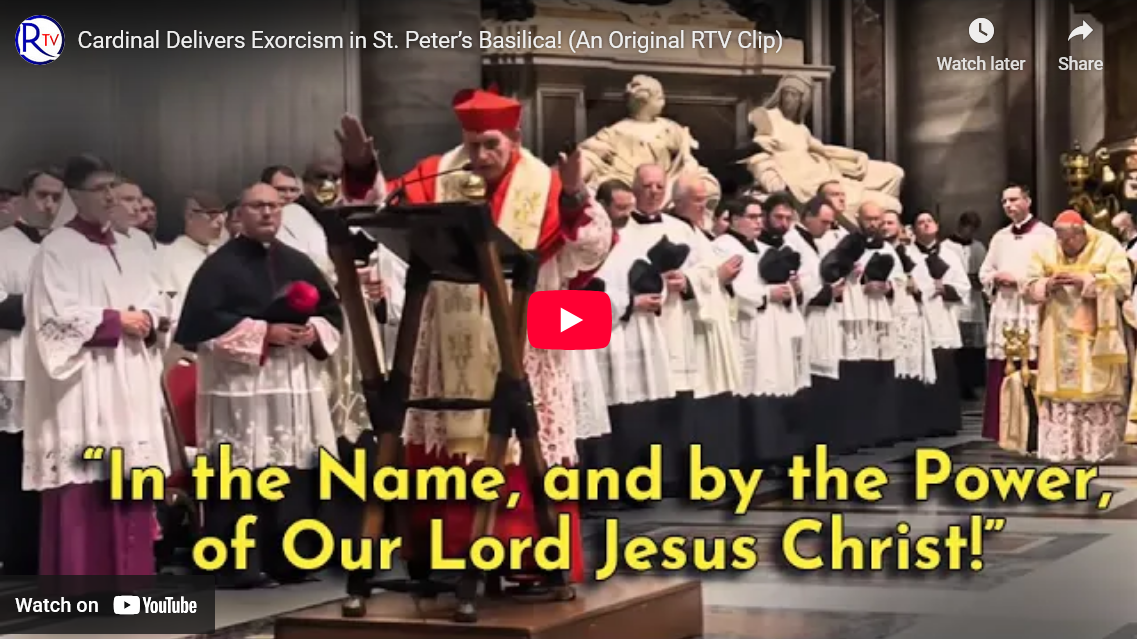
Editor’s note: this was not a formal exorcism but the general exorcism contained in the longer St. Michael prayer. For more on this prayer, see Mr. K. Symonds. Many thanks to our friends at The Remnant for this video.
Such activity has become one of the trademarks of the resolute cardinal, who has been an exorcist in active ministry for around 60 years. At the close of each event, Simoni will climb the pulpit an deliver his prayer, which is the longer, original prayer of St. Michael composed by Pope Leo XIII.
Simoni spent much of his life facing death at the hands of the Albanian Communist regime. Arrested in 1963, he was given two death sentences, but instead served around twenty years in prison camp labour, constantly persecuted for his Catholic priesthood.
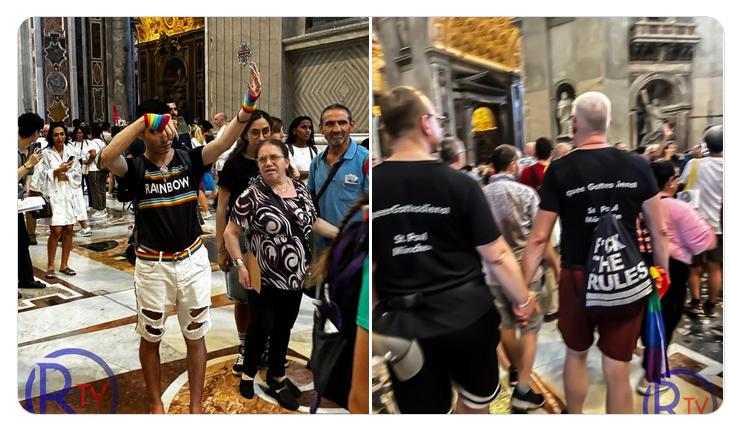
The cardinal’s ministry of deliverance and exorcism is thus a constant part of his life. But many Catholics will find something particularly poignant about the deliverance prayer he recited in the Vatican. In recent years St. Peter’s Basilica has seen the scandal of the Pachamama idolatry, increasing frequent vandalism of the high altar, and most recently the “LGBT” Jubilee parade through the Basilica’s Holy Door. This latter caused international outcry amongst many Catholics, and Cardinal Gerhard Müller termed it a desecration and a sacrilege. Cardinal Joseph Zen added that it “seriously insulted the Catholic faith and the dignity of St. Peter’s Basilica, which seriously offended God.”
Simoni’s prayer was not a formal rite of exorcism, but even though it forms a part of his regular ministry, the significance of his invocation of St. Michael in that manner in light of the “LGBT” parade marks a key moment of reparation.
Ping
Did Pope Leo’s head spin around?
He was arrested because he held a memorial mass for JFK after the assassination.
"In recent years St. Peter's Basilica has seen the scandal of the Pachamama idolatry, increasing frequent vandalism of the high altar, and most recently the 'LGBT' Jubilee parade through the Basilica's Holy Door. This latter caused international outcry amongst many Catholics, and Cardinal Gerhard Müller termed it a desecration and a sacrilege. Cardinal Joseph Zen added that it 'seriously insulted the Catholic faith and the dignity of St. Peter's Basilica, which seriously offended God'.”Though not a Catholic but with dear friends who are, I applaud the notion that this occurred. Traditional languages have value well beyond explication.
Given our Judeo-Christian world relies on the word, it would do us well to remember that Hebrew, Aramaic, koine Greek and then to Latin in terms of the early church, the old languages still echo.
Loudly enough to not be ignored.
During the Mass at San Pietro, I sat right behind Ernest Card. Simoni. 97 years old, Albanian, tortured, imprisoned to do forced labor, sentenced to death. At the end of Mass he went to the ambo and recited the long St. Michael Prayer as an exorcism Specifically… exorcism.
The only things that would have made it better would be a) had it been done before Mass and b) had it been done by every priest in the place.
Card. Simoni went straight at the devil.
The Basilica itself has needed rites of exorcism for a long time.
(As in Pachamama worship and sodomite parades?)


Disclaimer: Opinions posted on Free Republic are those of the individual posters and do not necessarily represent the opinion of Free Republic or its management. All materials posted herein are protected by copyright law and the exemption for fair use of copyrighted works.