Skip to comments.
Catholic Caucus: Daily Mass Readings 3-September-2025
Universalis/Jerusalem Bible ^
Posted on 09/03/2025 4:47:38 AM PDT by annalex
3 September 2025
Saint Gregory the Great, Pope, Doctor
on Wednesday of week 22 in Ordinary Time
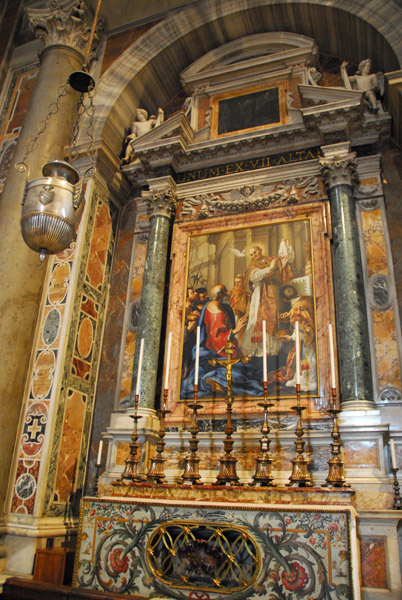
Altar of St. Gregory the Great (590-604) with a 1772 mosaic, St. Peter's, RomeReadings at MassLiturgical Colour: White. Year: C(I). Readings for the feria Readings for the memorial These are the readings for the feria
| First reading |
|---|
| Colossians 1:1-8 |
|---|
The message of the truth has reached you and is spreading all over the worldFrom Paul, appointed by God to be an apostle of Christ Jesus, and from our brother Timothy to the saints in Colossae, our faithful brothers in Christ: Grace and peace to you from God our Father. We have never failed to remember you in our prayers and to give thanks for you to God, the Father of our Lord Jesus Christ, ever since we heard about your faith in Christ Jesus and the love that you show towards all the saints because of the hope which is stored up for you in heaven. It is only recently that you heard of this, when it was announced in the message of the truth. The Good News which has reached you is spreading all over the world and producing the same results as it has among you ever since the day when you heard about God’s grace and understood what this really is. Epaphras, who taught you, is one of our closest fellow workers and a faithful deputy for us as Christ’s servant, and it was he who told us all about your love in the Spirit.
| Responsorial Psalm |
|---|
| Psalm 51(52):10-11 |
|---|
I trust in the goodness of God for ever and ever. I am like a growing olive tree in the house of God. I trust in the goodness of God for ever and ever. I trust in the goodness of God for ever and ever. I will thank you for evermore; for this is your doing. I will proclaim that your name is good, in the presence of your friends. I trust in the goodness of God for ever and ever.
Alleluia, alleluia! The word of the Lord remains for ever: What is this word? It is the Good News that has been brought to you. Alleluia! Alleluia, alleluia! The Lord has sent me to bring the good news to the poor, to proclaim liberty to captives. Alleluia!
He would not allow them to speak because they knew he was the ChristLeaving the synagogue, Jesus went to Simon’s house. Now Simon’s mother-in-law was suffering from a high fever and they asked him to do something for her. Leaning over her he rebuked the fever and it left her. And she immediately got up and began to wait on them. At sunset all those who had friends suffering from diseases of one kind or another brought them to him, and laying his hands on each he cured them. Devils too came out of many people, howling, ‘You are the Son of God.’ But he rebuked them and would not allow them to speak because they knew that he was the Christ. When daylight came he left the house and made his way to a lonely place. The crowds went to look for him, and when they had caught up with him they wanted to prevent him leaving them, but he answered, ‘I must proclaim the Good News of the kingdom of God to the other towns too, because that is what I was sent to do.’ And he continued his preaching in the synagogues of Judaea. Continue These are the readings for the memorial
| First reading |
|---|
| 2 Corinthians 4:1-2,5-7 |
|---|
God has shone in our minds to radiate the light of the knowledge of his glorySince we have by an act of mercy been entrusted with this work of administration, there is no weakening on our part. On the contrary, we will have none of the reticence of those who are ashamed, no deceitfulness or watering down the word of God; but the way we commend ourselves to every human being with a conscience is by stating the truth openly in the sight of God. For it is not ourselves that we are preaching, but Christ Jesus as the Lord, and ourselves as your servants for Jesus’ sake. It is the same God that said, ‘Let there be light shining out of darkness’, who has shone in our minds to radiate the light of the knowledge of God’s glory, the glory on the face of Christ. We are only the earthenware jars that hold this treasure, to make it clear that such an overwhelming power comes from God and not from us.
| Responsorial Psalm |
|---|
| Psalm 95(96):1-3,7-8,10 |
|---|
Proclaim the wonders of the Lord among all the peoples. O sing a new song to the Lord, sing to the Lord all the earth. O sing to the Lord, bless his name. Proclaim the wonders of the Lord among all the peoples. Proclaim his help day by day, tell among the nations his glory and his wonders among all the peoples. Proclaim the wonders of the Lord among all the peoples. Give the Lord, you families of peoples, give the Lord glory and power; give the Lord the glory of his name. Proclaim the wonders of the Lord among all the peoples. Proclaim to the nations: ‘God is king.’ The world he made firm in its place; he will judge the peoples in fairness. Proclaim the wonders of the Lord among all the peoples.
| Gospel Acclamation | Jn15:15 |
|---|
Alleluia, alleluia! I call you friends, says the Lord, because I have made known to you everything I have learnt from my Father. Alleluia!
I confer a kingdom on you, just as the Father conferred one on meA dispute arose between the disciples about which should be reckoned the greatest, but Jesus said to them: ‘Among pagans it is the kings who lord it over them, and those who have authority over them are given the title Benefactor. This must not happen with you. No; the greatest among you must behave as if he were the youngest, the leader as if he were the one who serves. For who is the greater: the one at table or the one who serves? The one at table, surely? Yet here am I among you as one who serves! ‘You are the men who have stood by me faithfully in my trials; and now I confer a kingdom on you, just as my Father conferred one on me: you will eat and drink at my table in my kingdom, and you will sit on thrones to judge the twelve tribes of Israel.’ Continue You can also view this page with the New Testament in Greek and English. Christian Art Each day, The Christian Art website gives a picture and reflection on the Gospel of the day. The readings on this page are from the Jerusalem Bible, which is used at Mass in most of the English-speaking world. The New American Bible readings, which are used at Mass in the United States, are available in the Universalis apps, programs and downloads.
You can also view this page with the Gospel in Greek and English. |
TOPICS: Catholic; General Discusssion; Prayer; Worship
KEYWORDS: catholic; lk22; lk4; ordinarytime; prayer
For your reading, reflection, faith-sharing, comments, questions, discussion.
1
posted on
09/03/2025 4:47:38 AM PDT
by
annalex
To: All
KEYWORDS: catholic; lk22; lk4; ordinarytime; prayer
2
posted on
09/03/2025 4:48:19 AM PDT
by
annalex
(fear them not)
To: nickcarraway; NYer; ELS; Pyro7480; livius; ArrogantBustard; Catholicguy; RobbyS; marshmallow; ...

Alleluia Ping Please FReepmail me to get on/off the Alleluia Ping List.
3
posted on
09/03/2025 4:49:14 AM PDT
by
annalex
(fear them not)
To: annalex
4
posted on
09/03/2025 4:49:44 AM PDT
by
annalex
(fear them not)
To: annalex
| Luke |
| | English: Douay-Rheims | Latin: Vulgata Clementina | Greek NT: Byzantine/Majority Text (2000) |
| | Luke 4
|
| 38. | And Jesus rising up out of the synagogue, went into Simon's house. And Simon's wife's mother was taken with a great fever, and they besought him for her. | Surgens autem Jesus de synagoga, introivit in domum Simonis. Socrus autem Simonis tenebatur magnis febribus : et rogaverunt illum pro ea. | αναστας δε εκ της συναγωγης εισηλθεν εις την οικιαν σιμωνος πενθερα δε του σιμωνος ην συνεχομενη πυρετω μεγαλω και ηρωτησαν αυτον περι αυτης |
| 39. | And standing over her, he commanded the fever, and it left her. And immediately rising, she ministered to them. | Et stans super illam imperavit febri : et dimisit illam. Et continuo surgens, ministrabat illis. | και επιστας επανω αυτης επετιμησεν τω πυρετω και αφηκεν αυτην παραχρημα δε αναστασα διηκονει αυτοις |
| 40. | And when the sun was down, all they that had any sick with divers diseases, brought them to him. But he laying his hands on every one of them, healed them. | Cum autem sol occidisset, omnes qui habebant infirmos variis languoribus, ducebant illos ad eum. At ille singulis manus imponens, curabat eos. | δυνοντος δε του ηλιου παντες οσοι ειχον ασθενουντας νοσοις ποικιλαις ηγαγον αυτους προς αυτον ο δε ενι εκαστω αυτων τας χειρας επιθεις εθεραπευσεν αυτους |
| 41. | And devils went out from many, crying out and saying: Thou art the Son of God. And rebuking them he suffered them not to speak, for they knew that he was Christ. | Exibant autem dæmonia a multis clamantia, et dicentia : Quia tu es Filius Dei : et increpans non sinebat ea loqui : quia sciebant ipsum esse Christum. | εξηρχετο δε και δαιμονια απο πολλων κραζοντα και λεγοντα οτι συ ει ο χριστος ο υιος του θεου και επιτιμων ουκ εια αυτα λαλειν οτι ηδεισαν τον χριστον αυτον ειναι |
| 42. | And when it was day, going out he went into a desert place, and the multitudes sought him, and came unto him: and they stayed him that he should not depart from them. | Facta autem die egressus ibat in desertum locum, et turbæ requirebant eum, et venerunt usque ad ipsum : et detinebant illum ne discederet ab eis. | γενομενης δε ημερας εξελθων επορευθη εις ερημον τοπον και οι οχλοι επεζητουν αυτον και ηλθον εως αυτου και κατειχον αυτον του μη πορευεσθαι απ αυτων |
| 43. | To whom he said: To other cities also I must preach the kingdom of God: for therefore am I sent. | Quibus ille ait : Quia et aliis civitatibus oportet me evangelizare regnum Dei : quia ideo missus sum. | ο δε ειπεν προς αυτους οτι και ταις ετεραις πολεσιν ευαγγελισασθαι με δει την βασιλειαν του θεου οτι εις τουτο απεσταλμαι |
| 44. | And he was preaching in the synagogues of Galilee. | Et erat prædicans in synagogis Galilææ. | και ην κηρυσσων εν ταις συναγωγαις της γαλιλαιας |
5
posted on
09/03/2025 4:52:16 AM PDT
by
annalex
(fear them not)
To: annalex

Catena Aurea by St. Thomas Aguinas
4:38–39
38. And he arose out of the synagogue, and entered into Simon’s house. And Simon’s wife’s mother was taken with a great fever: and they besought him for her.
39. And he stood over her, and rebuked the fever: and it left her: and immediately she arose and ministered unto them.
AMBROSE. Luke having first introduced a man delivered from an evil spirit, goes on to relate the healing of a woman. For our Lord had come to heal each sex, and he ought first to be healed who was first created. Hence it is said, And he arose out of the synagogue, and entered into Simon’s house.
CHRYSOSTOM. (Hom. 27. in Matt.) For He honoured His disciples by dwelling among them, and so making them the more zealous.
CYRIL OF ALEXANDRIA. Now see how Christ abides in the house of a poor man, suffering poverty of His own will for our sakes, that we might learn to visit the poor, and despise not the destitute and needy. It follows: And Simon’s wife’s mother was taken with a great fever: and they besought him for her.
BEDE. At one time at the request of others, at another of his own accord, our Saviour cures the sick, shewing that He is far aloof from the passions of sinners, and ever grants the prayer of the faithful, and what they in themselves little understand He either makes intelligible, or forgives their not understanding it. As, Who understands his errors? Lord, cleanse me from my secret faults. (Ps. 19:12.)
CHRYSOSTOM. (ut sup.) Because Matthew is silent on the point of asking Him, he does not differ from Luke, or it matters not, for one Gospel had brevity in view, the other accurate research. It follows: And he stood over her, &c.
ORIGEN. Here Luke speaks figuratively, as of a command given to a sensible being, saying, that the fever was commanded, and neglected not the work of Him who commanded it. Hence it follows: And she arose, and ministered unto them.
CHRYSOSTOM. (ut sup.) For since the disease was curable, He shewed His power by the manner of the cure, doing what art could never do. For after the allaying of the fever, the patient needs much time ere he be restored to his former health, but at this time all took place at once.
AMBROSE. But if we weigh these things with deeper thoughts, we shall consider the health of the mind as well as the body; that the mind which was assailed by the wiles of the devil may be released first. Eve was not a hungered before the serpent beguiled her, and therefore against the author of evil himself ought the medicine of salvation first to operate. Perhaps also in that woman as in a type our flesh languished under the various fevers of crimes, nor should I say that the fever of love was less than that of bodily heat.
BEDE. For if we say that a man released from the devil represents morally the mind cleansed from unclean thoughts, consequently a woman vexed by fever, but cured at our Lord’s command, represents the flesh controlled by the rules of continence in the fury of its own lust.
CYRIL OF ALEXANDRIA. Let us therefore receive Jesus. For when He has visited us, we carry Him in our heart and mind; He will then extinguish the flames of our unlicensed pleasures, and will make us whole, so that we minister unto Him, that is, do things well-pleasing to Him.
4:40–41
40. Now when the sun was setting, all they that had any sick with divers diseases brought them unto him; and he laid his hands on every one of them, and healed them.
41. And devils also came out of many, crying out, and saying, Thou art Christ the Son of God. And he rebuking them suffered them not to speak: for they knew that he was Christ.
THEOPHYLACT. We must observe the zeal of the multitude, who after the sun had set bring their sick unto Him, not deterred by the lateness of the day; as it is said, Now when the sun was setting, they brought their sick.
ORIGEN. It was ordered about sun-set, that is, when the day was gone, that they should bring them out, either because during the day they were employed about other things, or because they thought that it was not lawful to heal on the sabbath. But He healed them, as it follows, But he laid his hands upon every one of them.
CYRIL OF ALEXANDRIA. But although as God He was able to drive away diseases by His word, He nevertheless touches them, shewing that His flesh was powerful to apply remedies, since it was the flesh of God; for as fire, when applied to a brazen vessel, imprints on it the effect of its own heat, so the omnipotent Word of God, when He united to Himself in real assumption a living virgin temple, endued with understanding, implanted in it a participation of His own power. May He also touch us, nay rather may we touch Him, that He may deliver us from the infirmities of our souls as well as the assaults of the evil spirit and pride! For it follows, And devils also came out.
BEDE. The devils confess the Son of God, and as it is afterwards said, they knew him to be Christ; for when the devil saw Him distressed by fasting, he perceived Him to be truly man, but when he prevailed not in his trial he doubted whether or not He were the Son of God, but now by the power of Christ’s miracles he either perceived or suspected Him to be the Son of God. He did not then persuade the Jews to crucify Him because he thought Him not to be Christ or the Son of God, but because he did not foresee that by this death he himself would be condemned. Of this mystery hidden from the world the Apostle says, that none of the princes of this world knew, for if they had known they would never have crucified the Lord of Glory. (1 Cor. 2:8.)
CHRYSOSTOM. But in what follows, And he rebuking them suffered them not to speak, mark the humility of Christ, who would not let the unclean spirits make Him manifest. For it was not fit that they should usurp the glory of the Apostolical office, nor did it become the mysteries of Christ to be made public by impure tongues.
THEOPHYLACT. Because, “praise is not seemly in the mouth of a sinner.” Or, because He did not wish to inflame the envy of the Jews by being praised of all.
BEDE. But the Apostles themselves are commanded to be silent concerning Him, lest by proclaiming His divine Majesty, the dispensation of His Passion should be delayed.
4:42–44
42. And when it was day, he departed and went into a desert place: and the people sought him, and came unto him, and stayed him, that he should not depart from them.
43. And he said unto them, I must preach the kingdom of God to other cities also: for therefore am I sent.
44. And he preached in the synagogues of Galilee.
CHRYSOSTOM. When he had bestowed sufficient favour upon the people by miracles, it was necessary for Him to depart. For miracles are always thought greater when the worker is gone, since they themselves are then the more heeded, and have in their turn a voice; as it is said, But when it was day, he departed, and went.
GREEK EXPOSITOR. (Victor Antiochenus.) He went also into the desert, as Mark says, and prayed; not that he needed prayer, but as an example to us of good works.
CHRYSOSTOM. (Hom. 25. in Matt.) The Pharisees indeed, seeing how that the miracles themselves published His fame, were offended at His power. But the people hearing His words, assented and followed; as it is said, And the multitudes sought him, not indeed any of the chief priests, or scribes, but all those who had not been blackened with the dark stain of malice, and preserved their consciences unhurt.
GREEK EXPOSITOR. (ut sup.) Now when Mark says that the Apostles came to him, saying, All seek thee, but Luke, that the people came, there is no difference between them, for the people came to Him following in the footsteps of the Apostles. But the Lord rejoiced in being held back, yet bid them let Him go, that others also might partake of His teaching, as the time of His presence would not last long; as it follows, And he said unto them, I must preach the kingdom of God to other cities also, &c. Mark says, Unto this I came, shewing the loftiness of His divine nature, and His voluntary emptying Himself of it. But Luke says, Unto this am I sent, shewing His incarnation, and calling also the decree of the Father, a sending Him forth; and one simply says, To preach, the other added, the kingdom of God, which is Christ Himself.
CHRYSOSTOM. (Hom. 48. in Matt.) Observe also, that He might, by abiding in the same place, have drawn all men over to Himself. He did not however do so, giving us an example to go about and seek those who are perishing, as the shepherd his lost sheep, and as the physician the sick. For by recovering one soul, we may be able to blot out a thousand sins. Hence also it follows, And he was preaching in the synagogues of Galilee. He frequently indeed went to the synagogues, to shew them that He was no deceiver. For if He were constantly to dwell in the desolate places, they would spread abroad that He was concealing Himself.
BEDE. But if the sun-setting mystically expresses the death of our Lord, the returning day denotes His resurrection, (the light of which being made manifest, He is sought for by the multitudes of believers, and being found in the desert of the Gentiles He is held back by them, lest He should depart;) especially as this took place on the first day of the week, on which day the Resurrection was celebrated.
Catena Aurea Luke 4
6
posted on
09/03/2025 4:53:47 AM PDT
by
annalex
(fear them not)
To: annalex

Healing Peter's Mother-in-law
13th century manuscript from the Mount Athos
7
posted on
09/03/2025 4:54:03 AM PDT
by
annalex
(fear them not)
To: annalex
Beautiful;
For we do not preach ourselves but Jesus Christ as Lord,
and ourselves as your slaves for the sake of Jesus.
8
posted on
09/03/2025 4:55:35 AM PDT
by
af_vet_1981
( The bus came by and I got on, That's when it all began.)
To: annalex
| Luke |
| | English: Douay-Rheims | Latin: Vulgata Clementina | Greek NT: Byzantine/Majority Text (2000) |
| | Luke 22
|
| 24. | And there was also a strife amongst them, which of them should seem to be the greater. | Facta est autem et contentio inter eos, quis eorum videretur esse major. | εγενετο δε και φιλονεικια εν αυτοις το τις αυτων δοκει ειναι μειζων |
| 25. | And he said to them: The kings of the Gentiles lord it over them; and they that have power over them, are called beneficent. | Dixit autem eis : Reges gentium dominantur eorum : et qui potestatem habent super eos, benefici vocantur. | ο δε ειπεν αυτοις οι βασιλεις των εθνων κυριευουσιν αυτων και οι εξουσιαζοντες αυτων ευεργεται καλουνται |
| 26. | But you not so: but he that is the greater among you, let him become as the younger; and he that is the leader, as he that serveth. | Vos autem non sic : sed qui major est in vobis, fiat sicut minor : et qui præcessor est, sicut ministrator. | υμεις δε ουχ ουτως αλλ ο μειζων εν υμιν γενεσθω ως ο νεωτερος και ο ηγουμενος ως ο διακονων |
| 27. | For which is greater, he that sitteth at table, or he that serveth? Is it not he that sitteth at table? But I am in the midst of you, as he that serveth: | Nam quis major est, qui recumbit, an qui ministrat ? nonne qui recumbit ? Ego autem in medio vestrum sum, sicut qui ministrat : | τις γαρ μειζων ο ανακειμενος η ο διακονων ουχι ο ανακειμενος εγω δε ειμι εν μεσω υμων ως ο διακονων |
| 28. | And you are they who have continued with me in my temptations: | vos autem estis, qui permansistis mecum in tentationibus meis. | υμεις δε εστε οι διαμεμενηκοτες μετ εμου εν τοις πειρασμοις μου |
| 29. | And I dispose to you, as my Father hath disposed to me, a kingdom; | Et ego dispono vobis sicut disposuit mihi Pater meus regnum, | καγω διατιθεμαι υμιν καθως διεθετο μοι ο πατηρ μου βασιλειαν |
| 30. | That you may eat and drink at my table, in my kingdom: and may sit upon thrones, judging the twelve tribes of Israel. | ut edatis et bibatis super mensam meam in regno meo, et sedeatis super thronos judicantes duodecim tribus Israël. | ινα εσθιητε και πινητε επι της τραπεζης μου [εν τη βασιλεια μου] και καθισεσθε επι θρονων κρινοντες τας δωδεκα φυλας του ισραηλ |
9
posted on
09/03/2025 4:56:16 AM PDT
by
annalex
(fear them not)
To: annalex
24. And there was also a strife among them, which of them should be accounted the greatest.
25. And he said to them, The kings of the Gentiles exercise lordship over them; and they that exercise authority upon them are called benefactors.
26. But you shall not be so: but he that is greatest among you, let him be as the younger; and he that is chief, as he that does serve.
27. For whether is greater, he that sits at meat, or he that serves? is not be that sits at meat? but I am among you as he that serves.
THEOPHYL. While they were inquiring among themselves who should betray the Lord, they would naturally go on to say to one another, "You are the traitor," and so become impelled to say, "I am the best, I am the greatest." Hence it is said, And there was also a strife among them which should be accounted the greatest.
GREEK EX. Or the strife seems to have arisen from this, that when our Lord was departing from the world, it was thought that some one must become their head, as taking our Lord's place.
BEDE; As good men seek in the Scriptures the examples of their fathers, that they may thereby gain profit and be humbled, so the bad, if by, chance they have discovered any thing blamable in the elect, most gladly seize upon it, to shelter their own iniquities thereby. Many therefore most eagerly read, that a strife arose among the disciples of Christ.
AMBROSE; If the disciples did contend, it is not alleged as any excuse, but held out as a warning. Let us then beware lest any contentions among us for precedence be our ruin.
BEDE; Rather let us look not what carnal disciples did, but what their spiritual Master commanded; for it follows, And he said to them, The kings of the Gentiles, &c.
CHRYS. He mentions the Gentiles, to show thereby how faulty it was. For it is of the Gentiles to seek after precedence.
CYRIL; Soft words are also given them by their subjects, as it follows, And they that exercise authority upon them, are called benefactors.
Now they truly as alien from the sacred law are subject to these evils, but your preeminence is in humility, as it follows, But you shall not be so.
BASIL; Let not him that is chief be puffed up by his dignity, lest he fall away from the blessedness of humility, but let him know that true humility is the ministering to many. As then he who attends many wounded and wipes away the blood from their wounds, least of all men enters upon the service for his own exaltation, much more ought he to whom is committed the care of his sick brethren as the minister of all, about to render an account of all, to be thoughtful and anxious. And so let him that is greatest be as the younger. Again, it is meet that those who are in the chief places should be ready to offer also bodily service, after our Lord's example, who washed His disciples' feet. Hence it follows, And he that is chief as he that does serve. But we need not fear that the spirit of humility will be weakened in the inferior, while he is being served by his superior, for by imitation humility is extended.
AMBROSE; But it must be observed, that not every kind of respect and deference to others betokens humility, for you may defer to a person for the world's sake, for fear of his power, or regard to your own interest. In that case you seek to edify yourself, not to honor another. Therefore there is one form of the precept given to all men, namely, that they boast not about precedence, but strive earnestly for humility.
BEDE; In this rule however, given by our Lord, the great have need of no little judgment, that they do not indeed like the kings of the Gentiles delight to tyrannize over their subjects, and be puffed up with their praises, yet notwithstanding that they be provoked with a righteous zeal against the wickedness of offenders.
But to the words of the exhortation He subjoins His own example, as it follows, For which is greater, he who sits at meat, or he that serves? But I am among you, &c.
CHRYS. As if He says, Think not that your disciple needs you, but that you do not need him. For I who need no one whom all things in heaven and earth need, have condescended to the degree of a servant.
THEOPHYL. He shows Himself to be their servant, when He distributes the bread and the cup, of which service He makes mention, reminding them that if they have eaten of the same bread, and drunk of the same cup, if Christ Himself served all, they ought all to think the same things.
BEDE; Or He speaks of that service wherewith, according to John, He their Lord and Master washed their feet. Although by the word itself serving, all that He did in the flesh may be implied, but by serving He also signifies that He pours forth His blood for us.
28. You are they which have continued with me in my temptations.
29. And I appoint to you a kingdom, as my Father has appointed to me;
30. That you may eat and drink at my table in my kingdom, and sit on thrones judging the twelve tribes of Israel.
THEOPHYL. As the Lord had denounced woe to the traitor, so on the other hand to the rest of the disciples He promises blessings, saying, You are they which have continued with me, &c.
BEDE; For not the first effort of patience, but long-continued perseverance, is rewarded with the glory of the heavenly kingdom for perseverance, (which is called constancy or fortitude of mind,) is, so to say, the pillar and prop of all virtues. The Son of God then conducts those who abide with Him in His temptations to the everlasting kingdom. For if we have been planted together in the likeness of his death, we shall be also in the likeness of his resurrection. Hence it follows, And I give to you a kingdom , &c.
AMBROSE; The kingdom of God is not of this world. But it is not equality with God, but likeness to Him, to which man must aspire. For Christ alone is the full image of God, on account of the unity of His Father's glory expressed in Him. But the righteous man is after the image of God, if for the sake of imitating the likeness of the Divine conversation, He through the knowledge of God despises the world. Therefore also we eat the Body and Blood of Christ, that we may be partakers of eternal life. Whence it follows, That you may eat and drink at my table in my kingdom. For the reward promised to us is not food and drink, but the communication of heavenly grace and life.
BEDE; Or the table offered to all saints richly to enjoy is the glory of a heavenly life, w herewith they who hunger and thirst after righteousness shall be filled, resting in the long desired enjoyment of the true God.
THEOPHYL. He said this not as if they would have there bodily food, or as if His kingdom were to be a sensible one. For their life then shall be the life of angels, as He before told the Sadducees. But Paul also says that the kingdom of God is not meat and drink.
CYRIL; By means of the things of our present life He describes spiritual things. For they exercise a high privilege with earthly kings, who sit at their table as guests. So then by man's estimation He shows who shall be rewarded by Him with the greatest honors.
BEDE; This then is the exchange to the right hand of the Most High, that those who now in lowliness rejoice to minister to their fellow-servants. shall then at our Lord's table on high be fed with the banquet of everlasting life, and they who here in temptations abide with the Lord being unjustly judged, shall then come with Him as just judges upon their tempters. Hence it follows, And sit on thrones judging the twelve tribes of Israel.
THEOPHYL. That is, the unbelievers condemned out of the twelve tribes.
AMBROSE; But the twelve thrones are not as it were any resting-places for the bodily posture, but because since Christ judges after the Divine likeness by knowledge of the hearts, not by examination of the actions, rewarding virtue, condemning iniquity; so the Apostles are appointed to a spiritual judgment, for the rewarding of faith, the condemnation of unbelief, repelling error with virtue, inflicting vengeance on the sacrilegious.
CHRYS. What then will Judas also sit there? Observe what the lay, was which God gave by Jeremiah, If I have promised any good, and you are counted unworthy of it, I will punish you. Therefore speaking to His disciples He did not make a general promise, but added, You who have continued with me in my temptations.
BEDE; From the high excellence of this promise Judas is excluded. For before the Lord said this, Judas must be supposed to have gone out. They also are excluded whoever having heard the words of the incomprehensible Sacrament, have gone backwards.
Catena Aurea Luke 22
10
posted on
09/03/2025 4:57:27 AM PDT
by
annalex
(fear them not)
To: annalex
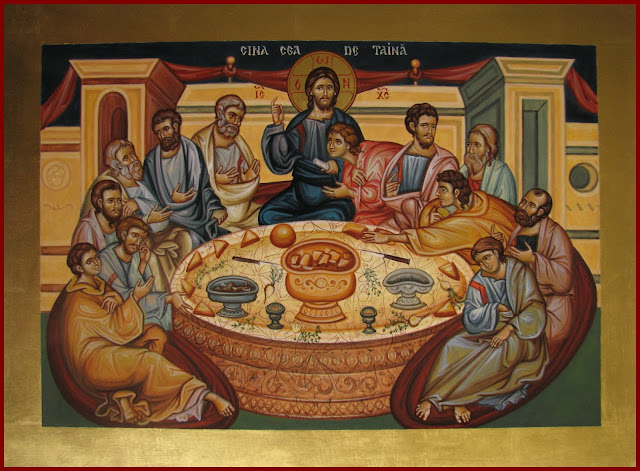
The Mystical Supper
(inscription in Romanian)
Casian Simona Cristina, iconographer
11
posted on
09/03/2025 4:58:04 AM PDT
by
annalex
(fear them not)
To: annalex
Saint of the Day for September 3
(c. 540 – March 12, 604)
Saint Gregory the Great’s Story
Saint Gregory the Great was the prefect of Rome before he was 30. After five years in office he resigned, founded six monasteries on his Sicilian estate, and became a Benedictine monk in his own home at Rome.
Ordained a priest, Gregory became one of the pope’s seven deacons, and also served six years in the East as papal representative in Constantinople. He was recalled to become abbot, but at the age of 50 was elected pope by the clergy and people of Rome.
Gregory was direct and firm. He removed unworthy priests from office, forbade taking money for many services, emptied the papal treasury to ransom prisoners of the Lombards and to care for persecuted Jews and the victims of plague and famine. He was very concerned about the conversion of England, sending 40 monks from his own monastery. He is known for his reform of the liturgy, and for strengthening respect for doctrine. Whether he was largely responsible for the revision of “Gregorian” chant is disputed.
Saint Gregory the Great lived in a time of perpetual strife with invading Lombards and difficult relations with the East. When Rome itself was under attack, he interviewed the Lombard king.
His book, Pastoral Care, on the duties and qualities of a bishop, was read for centuries after his death. He described bishops mainly as physicians whose main duties were preaching and the enforcement of discipline. In his own down-to-earth preaching, Gregory was skilled at applying the daily Gospel to the needs of his listeners. Called “the Great,” Gregory has been given a place with Augustine, Ambrose, and Jerome, as one of the four key doctors of the Western Church.
An Anglican historian has written: “It is impossible to conceive what would have been the confusion, the lawlessness, the chaotic state of the Middle Ages without the medieval papacy; and of the medieval papacy, the real father is Gregory the Great.”
Reflection
Gregory was content to be a monk, but he willingly served the Church in other ways when asked. He sacrificed his own preferences in many ways, especially when he was called to be Bishop of Rome. Once he was called to public service, Gregory gave his considerable energies completely to this work. Gregory’s description of bishops as physicians fits in well with Pope Francis’ description of the Church as a “field hospital.”
Saint Gregory the Great is the Patron Saint of:
England
Epilepsy
Musicians
Teachers
franciscanmedia.org
12
posted on
09/03/2025 5:00:40 AM PDT
by
annalex
(fear them not)
To: annalex

St. Gregory the Great - Jusepe de Ribera c. 1612-1
13
posted on
09/03/2025 5:02:35 AM PDT
by
annalex
(fear them not)
To: annalex
NAVARRE BIBLE COMMENTARY(RSV)
Ad Majorem Dei Gloriam (To the Greater Glory of God)
First Reading:
From: Colossians 1:1-8
Greeting
--------
[1] Paul, an apostle of Christ Jesus by the will of God, and Timothy our brother, [2] To the saints and faithful brethren in Christ at Colossae: Grace to you and peace from God our Father.
Thanksgiving for the Colossians' Response to the Gospel
----------------------------------------------------------------------
[3] We always thank God, the Father of our Lord Jesus Christ, when we pray for you, because we have read of your faith in Christ Jesus and of the love which you have for all the saints, [5] because of the hope laid up for you in heaven. Of this you have heard before in the word of the truth, the gospel [6] which has come to you, as indeed in the whole world it is bearing fruit and growing--so among yourselves, from the day you heard and understood the grace of God in truth, [7] as you learned it from Epaphras our beloved fellow servant. He is a faithful minister of Christ on our behalf [8] and has made known to us your love in the Spirit.
***********************************************************************
Commentary:
1-2. The city of Colossae, as has already been mentioned in the Introduction, lay in the valley of the Lycus river, in Phrygia, a region in the west central part of Anatolia (modern Turkey).
Timothy--whose mother was Jewish and whose father was Greek—was already a Christian when St Paul met him in Lystra (cf. Acts 16: 1-2). He readily agreed to go with Paul and Tom that point onwards he was one of the Apostle's most faithful co-workers. Sometimes we see him accompanying Paul (cf. Acts 20:4), and at other times Paul is sending him off on a special mission (cf. Acts 19:22). When St Paul is writing to the Colossians from his Roman prison, Timothy is by his side and joins him in sending greetings.
Later on, the Apostle will entrust Timothy with the overseeing of the church of Ephesus, and in that capacity he will send him two letters, which form part of the canon of the New Testament.
On the greeting "grace and peace", see the note on Eph 1:2.
3-16. Epaphras, who was probably born in Colossae, must have come to know St Paul during his stay in Ephesus and been converted after receiving instruction from the Apostle. After being baptized he preached the Gospel to his fellow-citizens. The combination of grace and his own effort make his preaching very effective. However, due to certain false apostles of a Judaizing tendency, errors of a pre-Gnostic and syncretist type began to gain ground among the Colossians, to the detriment of their faith (cf. p. 152 above).
St Paul writes the epistle after receiving a report from Epaphras on the Church in Colossae (v. 9). Although the news Epaphras brought was on the whole good (vv. 3-5), the Apostle feels that the false doctrines being spread among the Colossians are a danger to their faith: the faith that they hold, which they learned from Epaphras, a loyal minister of Jesus Christ, is the true one.
3-5. St Paul expresses his gratitude to God for all the graces and benefits he has given the Colossians and for the way they have responded to them. He picks out the three theological virtues--faith, charity, and hope and emphasizes the importance of hope as a support for faith and fraternal love. In this regard, Monsignor Escriva says in a homily, "I have seen many souls with such hope in God that they are aflame with love, with a fire that makes the heart beat strong and keeps it safe from discouragement and dejection, even though along the way they may suffer and at times suffer greatly" ("Friends of God", 205).
7. "On our behalf" (cf. RSV note): many important manuscripts read this as "on your behalf", but "on our behalf" parallels the "for us" of the New Vulgate, meaning that Epaphras is a minister of Christ who faithfully substitutes for Paul in his apostolic work among the Colossians.
8. "Your love in the Spirit": this may refer either to the theological virtue of charity or to the love which the faithful, under the influence of the Holy Spirit, have for the Apostle.
14
posted on
09/03/2025 8:59:50 AM PDT
by
fidelis
(Ecce Crucem Domini! Fugite partes adversae! Vicit Leo de tribu Juda, Radix David! Alleluia!)
Gospel Reading: From: Luke 4:38-44
The Cure of Peter's Mother-In-Law
---------------------------------
[38] And He (Jesus) arose and left the synagogue, and entered Simon's house. Now Simon's mother-in-law was ill with a high fever, and they besought Him for her. [39] And He stood over her and rebuked the fever, and it left her; and immediately she rose and served them.
Other Cures
-----------
[40] Now when the sun was setting, all those who had any that were sick with various diseases brought them to Him; and He laid His hands on every one of them and healed them. [41] And demons also came out of many, crying, "You are the Son of God!" But He rebuked them, and would not allow them to speak, because they knew that He was the Christ.
Jesus Preaches in Other Cities in Judea
---------------------------------------
[42] And when it was day He departed and went into a lonely place. And the people sought Him and came to Him, and would have kept Him from leaving them; [43] but He said to them, "I must preach the Good News of the Kingdom of God to the other cities also; for I was sent for this purpose." [44] And He was preaching in the synagogues of Judea.
***********************************************************************
Commentary:
38-39. In the public life of Jesus we find many touching episodes (cf. for example Luke 19:1; John 2:1) which show the high regard He had for everyday family life.
Here we can clearly see the effectiveness of prayer on behalf of other people: "No sooner did they pray to the Savior", St. Jerome says, "than He immediately healed the sick; from this we learn that He also listens to the prayers of the faithful for help against sinful passions" ("Expositio In Evangelium Sec. Lucam, in loc.").
St. John Chrysostom refers to this total, instantaneous cure: "Since this was a curable type of illness He displayed His power through the way He brought healing, doing what medicine could not do. Even after being cured of fever, patients need time to recover their former strength, but here the cure was instantaneous" ("Hom. on St. Matthew", 27).
The Fathers saw in this lady's fever a symbol of concupiscence: "Peter's mother-in-law's fever represents our flesh affected by various illnesses and concupiscences; our fever is passion, our fever is lust, our fever is anger--vices which, although they affect the body, perturb the soul, the mind and the feelings" (St. Ambrose, "Expositio Evangelii Sec. Lucam, in loc.").
On the practical consequences of this St. Cyril says: "Let us receive Jesus Christ, because when He visits us and we take Him into our minds and hearts, even our worst passions are extinguished and we are kept safe to serve Him, that is, to do what pleases Him" ("Hom. 28 In Mattheum").
43. Our Lord again stresses one of the reasons why He has come into the world. St. Thomas, when discussing the purpose of the Eucharist, says that Christ "came into the world, first, to make the truth known, as He Himself says: `for this I was born, and for this I have come into the world, to bear witness to the truth' (John 18:37). Hence it was not fitting that He should hide Himself by leading a solitary life, but rather that He should appear openly and preach in public. For this reason He tells those who wanted to detain Him, `I must preach the Good News of the Kingdom of God to the other cities also; for I was sent for this purpose.' Secondly, He came in order to free men from sin; as the Apostle says, `Christ Jesus came into the world to save sinners' (1 Timothy 1:15). This is why Chrysostom says, `Although Christ might, while staying in the same place, have drawn all men to Himself to hear His preaching, He did not do so--in order to give us the example to go out and seek the lost sheep, as the shepherd does, or as the doctor does, who visits the sick person.' Thirdly, He came so that `we might obtain access to God' (Romans 5:2)" ("Summa Theologiae", III, q. 40, a. 1, c.).
15
posted on
09/03/2025 9:00:12 AM PDT
by
fidelis
(Ecce Crucem Domini! Fugite partes adversae! Vicit Leo de tribu Juda, Radix David! Alleluia!)
16
posted on
09/03/2025 9:00:41 AM PDT
by
fidelis
(Ecce Crucem Domini! Fugite partes adversae! Vicit Leo de tribu Juda, Radix David! Alleluia!)
Disclaimer:
Opinions posted on Free Republic are those of the individual
posters and do not necessarily represent the opinion of Free Republic or its
management. All materials posted herein are protected by copyright law and the
exemption for fair use of copyrighted works.
FreeRepublic.com is powered by software copyright 2000-2008 John Robinson
