Skip to comments.
Catholic Caucus: Daily Mass Readings 11-July-2025
Universalis/Jerusalem Bible ^
Posted on 07/11/2025 4:47:26 AM PDT by annalex
11 July 2025
Saint Benedict, Abbot
on Friday of week 14 in Ordinary Time

Altar of Saint Benedict in the Church of the Blessed Virgin Mary in Jastrebarsko, CroatiaReadings at MassLiturgical Colour: White. Year: C(I). Readings for the feria Readings for the memorial These are the readings for the feria
| First reading |
|---|
| Genesis 46:1-7,28-30 |
|---|
'I can die, now that I have seen you alive'Israel left Canaan with his possessions, and reached Beersheba. There he offered sacrifices to the God of his father Isaac. God spoke to Israel in a vision at night, ‘Jacob, Jacob’, he said. ‘I am here’, he replied. ‘I am God, the God of your father’, he continued. ‘Do not be afraid of going down to Egypt, for I will make you a great nation there. I myself will go down to Egypt with you. I myself will bring you back again, and Joseph’s hand shall close your eyes.’ Then Jacob left Beersheba. Israel’s sons conveyed their father Jacob, their little children and their wives in the waggons Pharaoh had sent to fetch him. Taking their livestock and all that they had acquired in the land of Canaan, they went to Egypt, Jacob and all his family with him: his sons and his grandsons, his daughters and his grand-daughters, in a word, all his children he took with him to Egypt. Israel sent Judah ahead to Joseph, so that the latter might present himself to him in Goshen. When they arrived in the land of Goshen, Joseph had his chariot made ready and went up to meet his father Israel in Goshen. As soon as he appeared he threw his arms round his neck and for a long time wept on his shoulder. Israel said to Joseph, ‘Now I can die, now that I have seen you again, and seen you still alive.’
| Responsorial Psalm |
|---|
| Psalm 36(37):3-4,18-19,27-28,39-40 |
|---|
The salvation of the just comes from the Lord. If you trust in the Lord and do good, then you will live in the land and be secure. If you find your delight in the Lord, he will grant your heart’s desire. The salvation of the just comes from the Lord. He protects the lives of the upright, their heritage will last for ever. They shall not be put to shame in evil days, in time of famine their food shall not fail. The salvation of the just comes from the Lord. Then turn away from evil and do good and you shall have a home for ever; for the Lord loves justice and will never forsake his friends. The salvation of the just comes from the Lord. The salvation of the just comes from the Lord, their stronghold in time of distress. The Lord helps them and delivers them and saves them: for their refuge is in him. The salvation of the just comes from the Lord.
Alleluia, alleluia! The word of the Lord remains for ever: What is this word? It is the Good News that has been brought to you. Alleluia! Alleluia, alleluia! When the Spirit of truth comes he will lead you to the complete truth, and he will remind you of all I have said to you. Alleluia!
The Spirit of your Father will be speaking in youJesus instructed the Twelve as follows: ‘Remember, I am sending you out like sheep among wolves; so be cunning as serpents and yet as harmless as doves. ‘Beware of men: they will hand you over to sanhedrins and scourge you in their synagogues. You will be dragged before governors and kings for my sake, to bear witness before them and the pagans. But when they hand you over, do not worry about how to speak or what to say; what you are to say will be given to you when the time comes; because it is not you who will be speaking; the Spirit of your Father will be speaking in you. ‘Brother will betray brother to death, and the father his child; children will rise against their parents and have them put to death. You will be hated by all men on account of my name; but the man who stands firm to the end will be saved. If they persecute you in one town, take refuge in the next; and if they persecute you in that, take refuge in another. I tell you solemnly, you will not have gone the round of the towns of Israel before the Son of Man comes.’ Continue These are the readings for the memorial
| First reading | Proverbs 2:1-9 |
|---|
Apply your heart to truthMy son, if you take my words to heart, if you set store by my commandments, tuning your ear to wisdom, and applying your heart to truth: yes, if your plea is for clear perception, if you cry out for discernment, if you look for it as if it were silver, and search for it as for buried treasure, you will then understand what the fear of the Lord is, and discover the knowledge of God. For the Lord himself is giver of wisdom, from his mouth issue knowledge and discernment. He keeps his help for honest men, he is the shield of those whose ways are honourable; he stands guard over the paths of justice, he keeps watch on the way of his devoted ones. Then you will understand what virtue is, justice, and fair dealing, all paths that lead to happiness.
| Responsorial Psalm |
|---|
| Psalm 33(34):2-11 |
|---|
I will bless the Lord at all times. or Taste and see that the Lord is good. I will bless the Lord at all times, his praise always on my lips; in the Lord my soul shall make its boast. The humble shall hear and be glad. I will bless the Lord at all times. or Taste and see that the Lord is good. Glorify the Lord with me. Together let us praise his name. I sought the Lord and he answered me; from all my terrors he set me free. I will bless the Lord at all times. or Taste and see that the Lord is good. Look towards him and be radiant; let your faces not be abashed. This poor man called, the Lord heard him and rescued him from all his distress. I will bless the Lord at all times. or Taste and see that the Lord is good. The angel of the Lord is encamped around those who revere him, to rescue them. Taste and see that the Lord is good. He is happy who seeks refuge in him. I will bless the Lord at all times. or Taste and see that the Lord is good. Revere the Lord, you his saints. They lack nothing, those who revere him. Strong lions suffer want and go hungry but those who seek the Lord lack no blessing. I will bless the Lord at all times. or Taste and see that the Lord is good.
Alleluia, alleluia! How happy are the poor in spirit: theirs is the kingdom of heaven. Alleluia!
They will be repaid a hundred times over and inherit eternal lifePeter spoke to Jesus. ‘What about us?’ he said. ‘We have left everything and followed you. What are we to have, then?’ Jesus said to him, ‘I tell you solemnly, when all is made new and the Son of Man sits on his throne of glory, you will yourselves sit on twelve thrones to judge the twelve tribes of Israel. And everyone who has left houses, brothers, sisters, father, mother, children or land for the sake of my name will be repaid a hundred times over, and also inherit eternal life.’ Continue Christian Art Each day, The Christian Art website gives a picture and reflection on the Gospel of the day. The readings on this page are from the Jerusalem Bible, which is used at Mass in most of the English-speaking world. The New American Bible readings, which are used at Mass in the United States, are available in the Universalis apps, programs and downloads.
You can also view this page with the Gospel in Greek and English. |
TOPICS: Catholic; General Discusssion; Prayer; Worship
KEYWORDS: catholic; mt10; mt19; ordinarytime; prayer
For your reading, reflection, faith-sharing, comments, questions, discussion.
1
posted on
07/11/2025 4:47:26 AM PDT
by
annalex
To: All
KEYWORDS: catholic; mt10; mt19; ordinarytime; prayer
2
posted on
07/11/2025 4:48:26 AM PDT
by
annalex
(fear them not)
To: nickcarraway; NYer; ELS; Pyro7480; livius; ArrogantBustard; Catholicguy; RobbyS; marshmallow; ...

Alleluia Ping Please FReepmail me to get on/off the Alleluia Ping List.
3
posted on
07/11/2025 4:49:19 AM PDT
by
annalex
(fear them not)
To: annalex
| Matthew |
| | English: Douay-Rheims | Latin: Vulgata Clementina | Greek NT: Byzantine/Majority Text (2000) |
| | Matthew 10
|
| 16. | Behold I send you as sheep in the midst of wolves. Be ye therefore wise as serpents and simple as doves. | Ecce ego mitto vos sicut oves in medio luporum. Estote ergo prudentes sicut serpentes, et simplices sicut columbæ. | ιδου εγω αποστελλω υμας ως προβατα εν μεσω λυκων γινεσθε ουν φρονιμοι ως οι οφεις και ακεραιοι ως αι περιστεραι |
| 17. | But beware of men. For they will deliver you up in councils, and they will scourge you in their synagogues. | Cavete autem ab hominibus. Tradent enim vos in conciliis, et in synagogis suis flagellabunt vos : | προσεχετε δε απο των ανθρωπων παραδωσουσιν γαρ υμας εις συνεδρια και εν ταις συναγωγαις αυτων μαστιγωσουσιν υμας |
| 18. | And you shall be brought before governors, and before kings for my sake, for a testimony to them and to the Gentiles: | et ad præsides, et ad reges ducemini propter me in testimonium illis, et gentibus. | και επι ηγεμονας δε και βασιλεις αχθησεσθε ενεκεν εμου εις μαρτυριον αυτοις και τοις εθνεσιν |
| 19. | But when they shall deliver you up, take no thought how or what to speak: for it shall be given you in that hour what to speak. | Cum autem tradent vos, nolite cogitare quomodo, aut quid loquamini : dabitur enim vobis in illa hora, quid loquamini : | οταν δε παραδιδωσιν υμας μη μεριμνησητε πως η τι λαλησητε δοθησεται γαρ υμιν εν εκεινη τη ωρα τι λαλησετε |
| 20. | For it is not you that speak, but the Spirit of your Father that speaketh in you. | non enim vos estis qui loquimini, sed Spiritus Patris vestri, qui loquitur in vobis. | ου γαρ υμεις εστε οι λαλουντες αλλα το πνευμα του πατρος υμων το λαλουν εν υμιν |
| 21. | The brother also shall deliver up the brother to death, and the father the son: and the children shall rise up against their parents, and shall put them to death. | Tradet autem frater fratrem in mortem, et pater filium : et insurgent filii in parentes, et morte eos afficient : | παραδωσει δε αδελφος αδελφον εις θανατον και πατηρ τεκνον και επαναστησονται τεκνα επι γονεις και θανατωσουσιν αυτους |
| 22. | And you shall be hated by all men for my name's sake: but he that shall persevere unto the end, he shall be saved. | et eritis odio omnibus propter nomen meum : qui autem perseveraverit usque in finem, hic salvus erit. | και εσεσθε μισουμενοι υπο παντων δια το ονομα μου ο δε υπομεινας εις τελος ουτος σωθησεται |
| 23. | And when they shall persecute you in this city, flee into another. Amen I say to you, you shall not finish all the cities of Israel, till the Son of man come. | Cum autem persequentur vos in civitate ista, fugite in aliam. Amen dico vobis, non consummabitis civitates Israël, donec veniat Filius hominis. | οταν δε διωκωσιν υμας εν τη πολει ταυτη φευγετε εις την αλλην αμην γαρ λεγω υμιν ου μη τελεσητε τας πολεις του ισραηλ εως αν ελθη ο υιος του ανθρωπου |
4
posted on
07/11/2025 4:51:43 AM PDT
by
annalex
(fear them not)
To: annalex

Catena Aurea by St. Thomas Aguinas
10:16–18
16. Behold, I send you forth as sheep in the midst of wolves: be ye therefore wise as serpents, and harmless as doves.
17. But beware of men: for they will deliver you up to the councils, and they will scourge you in their synagogues;
18. And ye shall be brought before governors and kings for my sake, for a testimony against them and the Gentiles.
CHRYSOSTOM. (Hom. xxxiii.) Having removed all care and anxiety from the Apostles, and armed them with the miraculous powers, He proceeds to foretell the evils which should befal them. First, that they might know his knowledge of the future; secondly, that they should not think that these things befel them because of the want of power in their Master; thirdly, that they might not be amazed if these things had come upon them unexpectedly; fourthly, that after hearing these things, they might not be dismayed in the season of His cross; and lastly, that they might learn a new method of warfare. He sends them unprovided, bidding them look to those who should receive them for support; but rests not in that, but shews his power still further, Lo, I send you as sheep in the midst of wolves. Where observe that He does not say merely ‘to wolves,’ but in the midst of wolves, to shew His excellent might therein, that the sheep would overcome the wolves though they were in the midst of them; and though they received many bites from them, yet were they not destroyed, but rather convert them. And it is a much greater and a more wonderful power that can change their hearts than that can kill them. Among wolves He teaches them to shew the meekness of sheep.
GREGORY. (Hom. in Ev. xvii. 4.) For he who undertakes the office of preacher ought not to do evil, but to suffer it, and by his meekness to mollify the wrath of the angry, and by his wounds to heal the wounds of sinners in their affliction. And even should the zeal of right-doing ever require that He should be severe to those that are placed under Him, His very severity will be of love and not of cruelty, outwardly maintaining the rights of discipline, and inwardly loving those whom He corrects. Too many, when they are entrusted with the reins of government, burn to make the subjects feel them, display the terrors of authority, and forgetting that they are fathers, rather desire to be thought lords, changing a station of lowliness into that of lofty dominion, if they ever seem outwardly to fawn on any one, they inwardly hate him; of such He spoke above; They come to you in sheep’s clothing, but inwardly they are ravening wolves. (Mat. 7:15.) For prevention whereof we ought to consider that we are sent as sheep among wolves, whose innocence we ought to preserve, not having the tooth of malice.
JEROME. He calls the Scribes and Pharisees who are the clergy of the Jews, wolves.
HILARY. The wolves indeed are all such as should pursue the Apostles with mad fury.
CHRYSOSTOM. Their consolation under their hardships was the excellent power of Him who sent them; wherefore He puts that before all, Lo, I send you. Be not dismayed, though you be sent into the midst of wolves; for I am able to bring it to pass that you suffer no hurt, and that ye should not only prevail over the wolves, but be made more terrible than lions. But it is good that it should be thus; hereby your virtue is made brighter, and My power is more manifested. Also that somewhat should proceed from themselves, that they should not think themselves to be crowned without reason, He adds, Be ye therefore wise as serpents, simple as doves.
JEROME. Wise, that they might escape snares; simple, that they might not do evil to others. The craft of the serpent is set before them as an example, for he hides his head with all the rest of his body, that he may protect the part in which life is. So ought we to expose our whole body, that we may guard our head which is Christ; that is, that we study to keep the faith whole and uncorrupt.
RABANUS. The serpent moreover seeks out narrow chinks through which it crawls to draw off its old skin; so the preacher passing through the narrow way lays aside the old man.
REMIGIUS. Beautifully the Lord bids the preacher have the wisdom of the serpent; because the first man was beguiled by a serpent; as though He had said, The foe is subtle to deceive, be ye therefore wise to rescue; he commended the tree, do ye also commend the tree of the Cross.
HILARY. He first attempted the softer sex, allured her by hope, and promised a share of immortality. Do you in like manner seize every opportunity, look well into each man’s nature and inclination, use wisdom of speech, reveal hope of good things to come; that what he promised falsely we may preach truly according to God’s promise, that they that believe shall be like to the Angels.
CHRYSOSTOM. But as we ought to have the wisdom of the serpent, that we should not be hurt in any deadly part, so also we should have the simplicity of the dove, not to retaliate when we are hurt, nor to avenge ourselves on those who have designed aught against us.
REMIGIUS. The Lord unites these two things; because simplicity without wisdom might be easily deceived, and wisdom is dangerous unless it be tempered with simplicity that does no man hurt.
JEROME. The harmlessness of doves is shewn by the assumption of that form by the Holy Spirit; as the Apostle speaks, In malice be ye children.
CHRYSOSTOM. What is harder than these commands? It is not enough that we suffer ill, but we must not be angry thereat, as is the dove’s nature, for anger is extinguished not by anger, but by meekness.
RABANUS. That by the wolves above He intended men, He shews when He adds, Take heed of men.
GLOSS. (ap. Anselm.) Ye have indeed need to be wise as serpents, for, as they are wont to do, they will deliver you to councils, forbidding you to preach in My name; then if ye be not corrected, they will scourge you, and at length ye shall be brought before kings and governors.
HILARY. Who will endeavour to extort from you either to be silent or to temporize.
CHRYSOSTOM. How wonderful that men who had never been beyond the lake in which they fished, did not straightway depart from Him on hearing these things. It was not only of their goodness, but of the wisdom of their Teacher. For to each evil He attaches somewhat of alleviation; as here He adds, for my sake; for it is no light consolation to suffer for Christ’s sake, for they did not suffer as evil or wrong doers. Again He adds, for a testimony against them.
GREGORY. (Hom. in Ev. xxxv. 2.) Either that they had persecuted to the death, or that they had seen and were not changed. For the death of the saints is to the good an aid, to the bad a testimony; that thus the wicked may perish without excuse in that from which the elect take example and live.
CHRYSOSTOM. This was matter of consolation to them, not that they sought the punishment of others, but that they were confident that in all things they had One present with them, and all-knowing.
HILARY. And by this their testimony not only was all excuse of ignorance of His divinity taken away from their persecutors, but also to the Gentiles was opened the way of believing on Christ, who was thus devotedly preached by the voices of the confessors among the flames of persecution; and this is that He adds, and the Gentiles.
10:19–20
19. But when they deliver you up, take no thought how or what ye shall speak: for it shall be given you in that same hour what ye shall speak.
20. For it is not ye that speak, but the Spirit of your Father which speaketh in you.
CHRYSOSTOM. To the foregoing topics of consolation, He adds another not a little one; that they should not say, How shall we be able to persuade such men as these, when they shall persecute us? He bids them be of good courage respecting their answer, saying, When they shall deliver you up, take no thought how or what ye shall speak.
REMIGIUS. How or what, one refers to the substance, the other to the expression in words. And because both of these would be supplied by Him, there was no need for the holy preachers to be anxious about either.
JEROME. When then we are brought before judges for Christ’s sake, we ought to offer only our will for Christ. But Christ who dwelleth in us speaks for Himself, and the grace of the Holy Spirit will minister in our answer.
HILARY. For our faith, observing all the precepts of the Divine will, will be instructed with an answer according to knowledge, after the example of Abraham, to whom when he had given up Isaac, there was not wanting a ram for a victim. For it is not ye who speak, but the Spirit of your Father that speaketh in you.
REMIGIUS. (ap. Raban.) Meaning, Ye indeed go out to the battle, but it is I who fight; you utter the words, but it is I who speak. Hence Paul speaks, Seek ye a proof of Christ who speaketh in me? (2 Cor. 13:3.)
CHRYSOSTOM. Thus He raises them to the dignity of the Prophets, who have spoken by the Spirit of God. He who says here, Take no thought what ye shall speak, (1 Pet. 3:15.) has said in another place, Be ye always ready to give an answer to him that demandeth a reason of the hope that is in you. When it is a dispute among friends, we are commanded to be ready; but before the awful judgment, and the raging people, aid is ministered by Christ, that they may speak boldly and not be dismayed.
10:21–22
21. And the brother shall deliver up the brother to death, and the father the child; and the children shall rise up against their parents, and cause them to be put to death.
22. And ye shall be hated of all men for my name’s sake: but he that endureth to the end shall be saved.
GLOSS. (ap. Anselm.) Having placed the comfort first, He adds the more alarming perils; Brother shall deliver up brother to death, and the father the son; children shall rise against parents, to put them to death.
GREGORY. (Hom. in Ev. xxxv. 3.) Wrongs which we suffer from strangers, pain us less than those we suffer from men on whose affections we had counted; for besides the bodily affliction, there is then the pain of lost affection.
JEROME. This we see often happen in persecutions, nor is there any true affection between those whose faith is different.
CHRYSOSTOM. What follows is yet more dreadful, Ye shall be hated of all men; they sought to exterminate them as common enemies of all the world. To this again is added the consolation, For my name’s sake; and yet further to cheer them, Whosoever shall endure to the end, he shall be saved. For many are hot and zealous in the beginning, but afterwards grow cool, for these, He says, I look at the end. For where is the profit of seeds that only sprout at first? wherefore He requires a sufficient endurance from them.
JEROME. For virtue is not to begin but to complete.
REMIGIUS. And the reward is not for those that begin, but for those that bring to an end.
CHRYSOSTOM. But that no man should say, that Christ wrought all things in His Apostles, and therefore it is nothing wonderful that they were made such as they were, since they did not bear the burden of these things, therefore He says, that perseverance was their work. For though they were rescued from their first perils; they are preserved for still harder trials, which again shall be followed by others, and they shall be in danger of snares as long as they live. This He covertly intimates when he says, Whosoever shall endure to the end, he shall be saved.
REMIGIUS. That is, He who shall not let go the commands of the faith, nor fall away in persecution, shall be saved; he shall receive the reward of the heavenly kingdom for his earthly persecutions. And note that ‘the end’ does not always mean destruction, but sometimes perfection, as in that, Christ is the end of the Law. (Rom. 10:4.) So the sense here may be, Whosoever shall endure to the end, that is, in Christ.
AUGUSTINE. (De Civ. Dei, xxi. 25.) To endure in Christ, is to abide in His faith which worketh by love.
10:23
23. But when they persecute you in this city, flee ye into another: for verily I say unto you, Ye shall not have gone over the cities of Israel, till the Son of man be come.
CHRYSOSTOM. (Hom. xxxiv.) Having foretold the fearful things which should come upon them after His Cross, resurrection, and ascension, He leads them to gentler prospects; He does not bid them presumptuously to offer themselves for persecution, but to fly from it; When they persecute you in this city, flee ye to another. For because this was the first beginning of their conversion, He adapts His words to their state.
JEROME. This must be referred to the time when the Apostles were sent to preach, when it was said to them, Go not into the way of the Gentiles; they should not fear, but may shun persecution. This we see the believers did in the beginning, when on a persecution arising in Jerusalem they were scattered throughout all Judea, and thus the season of tribulation was made the seedtime of the Gospel.
AUGUSTINE. (cont. Faust. xxii. 36.) Not that the Saviour was unable to protect His disciples, does He here bid them fly, and Himself give them an example of it, but He instructed man’s weakness, that he should not presume to tempt God, when he has any thing that he can do for himself, but should shun all evils.
AUGUSTINE. (De Civ. Dei, i. 22.) He might have suffered them to lay violent hands upon themselves, that they might not fall into the hands of their persecutors. Therefore if He neither commanded nor allowed this mode of departure from this world to His own, for whom He Himself had promised that He would prepare an eternal mansion; whatever instances may be brought by the Gentiles who know not God, it is clear that this is not lawful for those who believe one true God.
CHRYSOSTOM. But that they should not say, What then if we fly from persecution, and again they cast us out thence whither we have fled? To remove this fear, He says, Verily I say unto you, ye shall not have completed, &c. that is, ye shall not have made the circuit of Palestine and return to Me, before I shall take you to Me.
RABANUS. Or; He foretels that they shall not have brought all the cities of Israel to the faith by their preaching, before the Lord’s resurrection be accomplished, and a commission given them to preach the Gospel throughout the world.
HILARY. Otherwise; He exhorts to fly from place to place; for His preaching driven from Judæa, first passed into Greece; then, wearied with divers sufferings of the Apostles up and down the cities of Greece, it takes an abiding refuge in the rest of the Gentile world. But to shew that the Gentiles would believe the preaching of the Apostles, but that the remnant of Israel should only believe at His second coming, He adds, Ye shall not have completed the cities of Israel; i. e. After the fulness of the Gentiles is brought in, that which remains of Israel to fill up the number of the Saints shall be called into the Church in Christ’s future coming to glory.
AUGUSTINE. (Ep. 228.) Let the servants of Christ then do as He commanded, or permitted them; as He fled into Egypt, let them fly from city to city, whenever any one of them is marked out for persecution; that the Church be not deserted, it will be filled by those who are not so sought after; and let these give sustenance to their fellow-servants whom they know cannot live by any other means. But when the threatening danger is common to all, Bishops, clergy, and laity, let not those who have need of aid be deserted by those whose aid they require. Either therefore let them all pass to some stronghold, or let those who are obliged to remain, not be deserted by those whose province it is to supply their ecclesiastical needs; that they may either all live, or all suffer whatever their Master will have them to suffer.
REMIGIUS. Be it known moreover, that as this precept respecting endurance under persecution specially belongs to the Apostles and their successors, men of fortitude, so the permission to fly is sufficiently proper for the weak in the faith, to whom the tender Master condescends, lest if they should offer themselves for martyrdom, under the pain they should deny the faith; and the sin of flight is lighter than that of denial. But though by their flight they shewed that they had not the constancy of perfect faith, yet their desert was great, seeing they were ready to leave all for Christ. So that if He had not given them permission to fly, some would have said that they were aliens from the glory of the heavenly kingdom.
JEROME. Spiritually we may say; When they shall persecute you in one book or one passage of Scripture, let us flee to other volumes, for however contentious the adversary may be, protection will come from the Saviour before the victory is yielded to the enemy.
Catena Aurea Matthew 10
5
posted on
07/11/2025 4:53:48 AM PDT
by
annalex
(fear them not)
To: annalex

Apostle Peter Preaching
Lorenzo Veneziano
c. 1370
Poplar panel, 24 x 33 cm
Staatliche Museen, Berlin
6
posted on
07/11/2025 4:54:27 AM PDT
by
annalex
(fear them not)
To: annalex
Amen I say to you, you shall not finish all the cities of Israel, till the Son of man come.
7
posted on
07/11/2025 4:54:55 AM PDT
by
af_vet_1981
( The bus came by and I got on, That's when it all began.=)
To: annalex
| Matthew |
| | English: Douay-Rheims | Latin: Vulgata Clementina | Greek NT: Byzantine/Majority Text (2000) |
| | Matthew 19
|
| 27. | Then Peter answering, said to him: Behold we have left all things, and have followed thee: what therefore shall we have? | Tunc respondens Petrus, dixit ei : Ecce nos reliquimus omnia, et secuti sumus te : quid ergo erit nobis ? | τοτε αποκριθεις ο πετρος ειπεν αυτω ιδου ημεις αφηκαμεν παντα και ηκολουθησαμεν σοι τι αρα εσται ημιν |
| 28. | And Jesus said to them: Amen, I say to you, that you, who have followed me, in the regeneration, when the Son of man shall sit on the seat of his majesty, you also shall sit on twelve seats judging the twelve tribes of Israel. | Jesus autem dixit illis : Amen dico vobis, quod vos, qui secuti estis me, in regeneratione cum sederit Filius hominis in sede majestatis suæ, sedebitis et vos super sedes duodecim, judicantes duodecim tribus Israël. | ο δε ιησους ειπεν αυτοις αμην λεγω υμιν οτι υμεις οι ακολουθησαντες μοι εν τη παλιγγενεσια οταν καθιση ο υιος του ανθρωπου επι θρονου δοξης αυτου καθισεσθε και υμεις επι δωδεκα θρονους κρινοντες τας δωδεκα φυλας του ισραηλ |
| 29. | And every one that hath left house, or brethren, or sisters, or father, or mother, or wife, or children, or lands for my name's sake, shall receive an hundredfold, and shall possess life everlasting. | Et omnis qui reliquerit domum, vel fratres, aut sorores, aut patrem, aut matrem, aut uxorem, aut filios, aut agros propter nomen meum, centuplum accipiet, et vitam æternam possidebit. | και πας ος αφηκεν οικιας η αδελφους η αδελφας η πατερα η μητερα η γυναικα η τεκνα η αγρους ενεκεν του ονοματος μου εκατονταπλασιονα ληψεται και ζωην αιωνιον κληρονομησει |
8
posted on
07/11/2025 4:56:29 AM PDT
by
annalex
(fear them not)
To: annalex
Catena Aurea by St. Thomas Aguinas
19:27–30
27. Then answered Peter and said unto him, Behold, we have forsaken all, and followed thee; what shall we have therefore?
28. And Jesus said unto them, Verily I say unto you, That ye which have followed me, in the regeneration when the Son of man shall sit in the throne of his glory, ye also shall sit upon twelve thrones, judging the twelve tribes of Israel.
29. And every one that hath forsaken houses, or brethren, or sisters, or father, or mother, or wife, or children, or lands, for my name’s sake, shall receive an hundred fold, and shall inherit everlasting life.
30. But many that are first shall be last; and the last shall be first.
ORIGEN. Peter had heard the word of Christ when He said, If thou wilt be perfect, go and sell all that thou hast. Then he observed that the young man had departed sorrowful, and considered the difficulty of riches entering into the kingdom of heaven; and thereupon he put this question confidently as one who had achieved no easy matter. For though what he with his brother had left behind them were but little things, yet were they not esteemed as little with God, who considered that out of the fulness of their love they had so forsaken those least things, as they would have forsaken the greatest things if they had had them. So Peter, thinking rather of his will than of the intrinsic value of the sacrifice, asked Him confidently, Behold, we have left all.
CHRYSOSTOM. (Hom. lxiv.) What was this all, O blessed Peter? The reeds, your net, and boat. But this he says, not to call to mind his own magnanimity, but in order to propose the case of the multitude of poor. A poor man might have said, If I have nought, I cannot become perfect. Peter therefore puts this question that you, poor man, may learn that you are in nothing behind. For he had already received the kingdom of heaven, and therefore secure of what was already there, he now asks for the whole world. And see how carefully he frames his question after Christ’s requirements: Christ required two things of a rich man, to give what he had to the poor, and to follow Him; wherefore he adds, and have followed thee.
ORIGEN. It may be said, In all things which the Father revealed to Peter that the Son was, righteousness, sanctification, and the like, in all we have followed Thee. Therefore as a victorious athlete, he now asks what are the prizes of his contest.
JEROME. Because to forsake is not enough, he adds that which makes perfection, and have followed thee. We have done what thou commandedst us, what reward wilt thou then give us? What shall we have?
JEROME. He said not only, Ye who have left all, for this did the philosopher Cratesh, and many other who have despised riches, but added, and have followed me, which is peculiar to the Apostles and believers.
HILARY. The disciples had followed Christ in the regeneration, that is, in the laver of baptism, in the sanctification of faith, for this is that regeneration which the Apostles followed, and which the Law could not bestow.
JEROME. Or it may be constructed thus, Ye which have followed me, shall in the regeneration sit, &c.; that is, when the dead shall rise from corruption incorrupt, you also shall sit on thrones of judges, condemning the twelve tribes of Israel, for that they would not believe when you believed.
AUGUSTINE. (de Civ. Dei, xx. 5.) Thus our flesh will be regenerated by incorruption, as our soul also shall be regenerated by faith.
PSEUDO-CHRYSOSTOM. For it would come to pass, that in the day of judgment the Jews would allege, Lord, we knew Thee not to be the Son of God when Thou wast in the flesh. For who can discern a treasure buried in the ground, or the sun when obscured by a cloud? The disciples therefore will then answer, We also were men, and peasants, obscure among the multitude, but you priests and scribes; but in us a right will became as it were a lamp of our ignorance, but your evil will became to you a blinding of your science.
CHRYSOSTOM. He therefore said not the Gentiles and the whole world, but, the tribes of Israel, because the Apostles and the Jews had been brought up under the same laws and customs. So that when the Jews should plead that they could not believe in Christ, because they were hindered by their Law, the disciples will be brought forward, who had the same Law. But some one may say, What great thing is this, when both the Ninevites and the Queen of the South will have the same? He had before and will again promise them the highest rewards; and even now He tacitly conveys something of the same. For of those others He had only said, that they shall sit, and shall condemn this generation; but He now says to the disciples, When the Son of Man shall sit, ye also shall sit. It is clear then that they shall reign with Him, and shall share in that glory; for it is such honour and glory unspeakable that He intends by the thrones. How is this promise fulfilled? Shall Judas sit among them? By no means. For the law was thus ordained of the Lord by Jeremiah the Prophet, I will speak it upon my people, and upon the kingdom, that I may build, and plant it. Bui if it do evil in my sight, then will I repent we of the good which I said I would do to them; (Jer. 18:9.) as much as to say, If they make themselves unworthy of the promise, I will no more perform that I promised. But Judas shewed himself unworthy of the preeminence; wherefore when He gave this promise to His disciples, He did not promise it absolutely, for He said not, Ye shall sit, but, Ye which, have followed me shall sit; at once excluding Judas, and admitting such as should be in after time; for neither was the promise confined to them only, nor yet did it include Judas who had already shewn himself undeserving.
HILARY. Their following Christ in thus exalting the Apostles to twelve thrones to judge the twelve tribes of Israel, associated them in the glory of the twelve Patriarchs.
AUGUSTINE. (ubi sup.) From this passage we learn that Jesus will judge with His disciples; whence He says in another place to the Jews, Therefore shall they be your judges. (Mat. 12:27.) And whereas He says they shall sit upon twelve thrones, we need not think that twelve persons only shall judge with Him. For by the number twelve is signified the whole number of those that shall judge; and that because the number seven which generally represents completeness contains the two numbers four and three, which multiplied together make twelve. For if it were not so, as Matthias was elected into the place of the traitor Judas, the Apostle Paul who laboured more than they all should not have place to sit to judge; but he shews that he with the rest of the saints pertains to the number of judges, when he says, Know ye not that we shall judge Angels? (1 Cor. 6:3.)
AUGUSTINE. (Serm. 351. 8.) In the number of judges therefore are included all that have left their all and followed the Lord;
GREGORY. (Mor. x. 31.) For whosoever, urged by the spur of divine lore, shall forsake what he possesses here, shall without doubt gain there the eminence of judicial authority; and shall appear as judge with the Judge, for that he now in consideration of the judgment chastens himself by a voluntary poverty.
AUGUSTINE. (de Civ. Dei, xx. 5.) The same holds good, by reason of this number twelve, of those that are to be judged. For when it is said, Judging the twelve tribes, yet is not the tribe of Levi, which is the thirteenth, to be exempt from being judged by them; nor shall they judge this nation alone, and not also other nations.
PSEUDO-CHRYSOSTOM. Or, by that, In the regeneration, Christ designs the period of Christianity that should be after His ascension, in which men were regenerated by baptism; and that is the time in which Christ sate on the throne of His glory. And hereby you may see that He spake not of the time of the judgment to come, but of the calling of the Gentiles, in that He said not, When the Son of Man shall come sitting upon the throne of his majesty; but only, In the regeneration when he shall sit, which was from the time that the Gentiles began to believe on Christ; according to that, God shall reign over the heathen; God sitteth upon his holy throne. (Ps. 47:8.) From that time also the Apostles have sat upon twelve thrones, that is, over all Christians; for every Christian who receives the word of Peter, becomes Peter’s throne, and so of the rest of the Apostles. On these thrones then the Apostles sit, parcelled into twelve divisions, after the variety of minds and hearts, known to God only. For as the Jewish nation was split into twelve tribes, so is the whole Christian people divided into twelve, so as that some souls are numbered with the tribe of Reuben, and so of the rest, according to their several qualities. For all have not all graces alike, one is excellent in this, another in that. And so the Apostles will judge the twelve tribes of Israel, that is, all the Jews, by this, that the Gentiles received the Apostles’ word. The whole body of Christians are indeed twelve thrones for the Apostles, but one throne for Christ. For all excellencies are but one throne for Christ, for He alone is equally perfect in all virtues. But of the Apostles each one is more perfect in some one particuar excellence, as Peter in faith; so Peter tests upon his faith, John on his innocence, and so of the rest. And that Christ spake of reward to be given to the Apostles in this world, is shewn by what follows, And every one that hath forsaken houses, or brethren, or sisters, &c. For if these shall receive an hundred fold in this life, without doubt to the Apostles also was promised a reward in this present life.
CHRYSOSTOM. Or; He holds out rewards in the future life to the Apostles, because they were already looking above, and desired nothing of things present; but to others. He promises things present.
ORIGEN. Or otherwise; Whosoever shall leave all and follow Christ, he also shall receive those things that were promised to Peter. But if he has not left all, but only those things in special here enumerated, he shall receive manifold, and shall possess eternal life.
JEROME. There are that take occasion from this passage to bring forward the thousand years after the resurrection, and say that then we shall have a hundred fold of the things we have given up, and moreover life eternal. But though the promise be in other things worthy, in the matter of wives it seems to have somewhat shameful, if he who has forsaken one wife for the Lord’s sake, shall receive a hundred in the world to come. The meaning is therefore, that he that has forsaken earnal things for the Saviour’s sake, shall receive spiritual things, which in a comparison of value are as a hundred to a small number.
ORIGEN. And in this world, because for his brethren after the flesh he shall find many brethren in the faith; for parents, all the Bishops and Presbyters; for sons, all that have the age of sons. The Angels also are brethren, and all they are sisters that have offered themselves chaste virgins to Christ, as well they that still continue on earth, as they that now live in heaven. The houses and lands manifold more suppose in the repose of Paradise, and the city of God. And besides all these things they shall possess eternal life.
AUGUSTINE. (De Civ. Dei, xx. 7.) That He says, An hundred fold, is explained by the Apostle, when he says, As having nothing, and yet possessing all things. (2 Cor. 6:10.) For a hundred is sometimes put for the whole universe.
JEROME. And that, And every one that hath forsaken brethren, agrees with that He had said before, I am come to set a man at variance with his father. (Mat. 10:35.) For they who for the faith of Christ and the preaching of the Gospel shall despise all the ties, the riches, and pleasures of this world, they shall receive an hundred fold, and shall possess eternal life.
CHRYSOSTOM. But when He says, He that has forsaken wife, it is not to be taken of actual severing of the marriage tie, but that we should hold the ties of the faith dearer than any other. And here is, I think, a covert allusion to times of persecution; for because there should be many who would draw away their sons to heathenism, when that should happen, they should be held neither as fathers, nor husbands.
RABANUS. But because many with what zeal they take up the pursuit of virtue, do not with the same complete it; but either grow cool, or fall away rapidly; it follows, But many that are first shall be last, and the last first.
ORIGEN. By this He exhorts those that come late to the heavenly word, to haste to ascend to perfection before many whom they see to have grown old in the faith. This sense may also overthrow those that boast to have been educated in Christianity by Christian parents, especially if those parents have filled the Episcopal see, or the office of Priests or Deacons in the Church; and hinder them from desponding who have entertained the Christian doctrines more newly. It has also another meaning, the first, are the Israelites, who become last because of their unbelief; and the Gentiles who were last become first. He is careful to say, Many; for not all who are first shall be last, nor all last first. For before this have many of mankind, who by nature are the last, been made by an angelic life above the Angels; and some Angels who were first have been made last through their sin.
REMIGIUS. It may also be referred in particular to the rich man, who seemed to be first, by his fulfilment of the precepts of the Law, but was made last by his preferring his worldly substance to God. The holy Apostles seemed to be last, but by leaving all they were made first by the grace of humility. There are many who having entered upon good works, fall therefrom, and from having been first, become last.
Catena Aurea Matthew 19
9
posted on
07/11/2025 4:57:35 AM PDT
by
annalex
(fear them not)
To: annalex
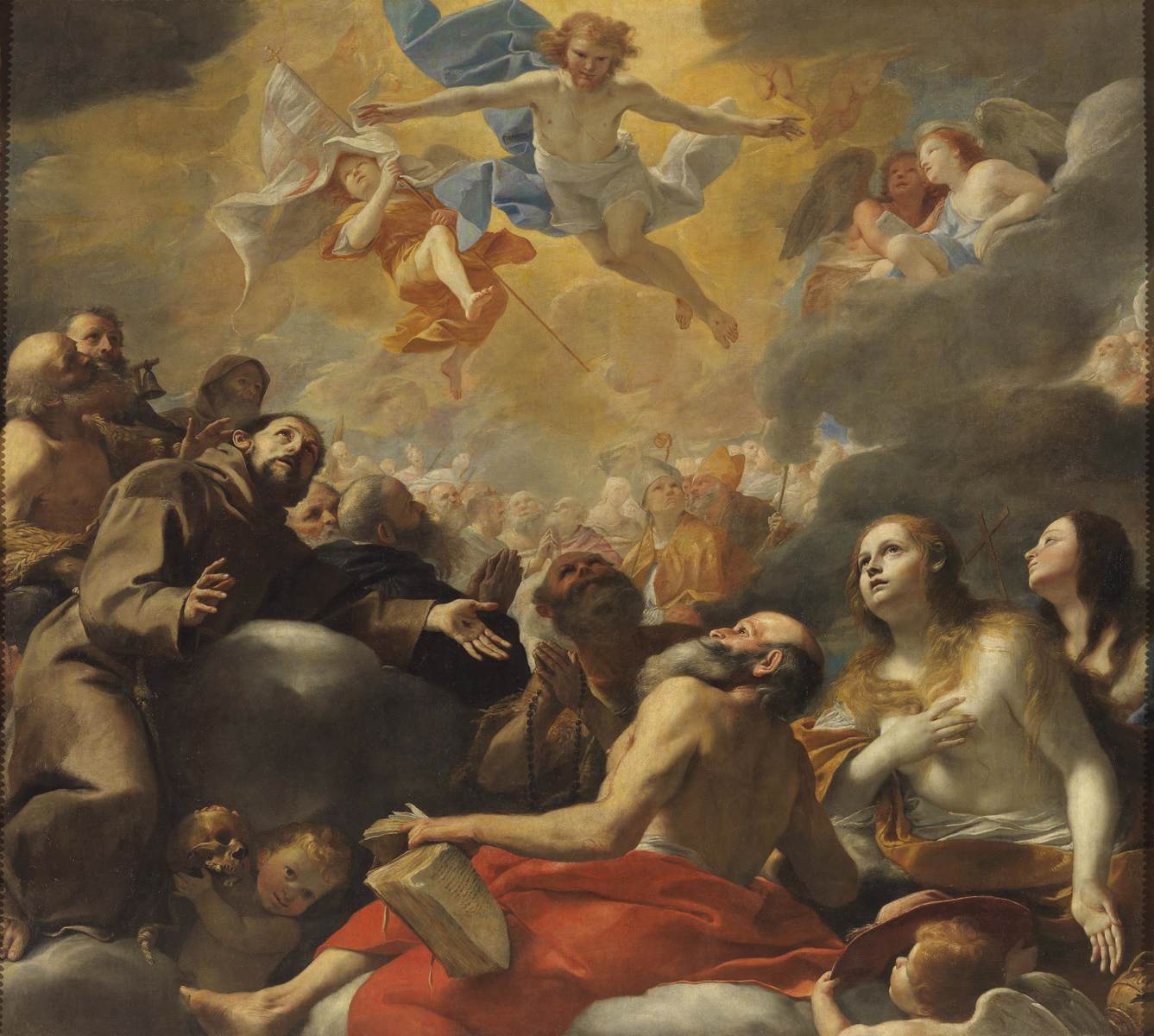
Christ in Glory
Mattia Preti
c. 1660
Oil on canvas, 220 x 253 cm
Museo del Prado, Madrid
10
posted on
07/11/2025 4:58:07 AM PDT
by
annalex
(fear them not)
To: annalex
St. Benedict of Nursia
Founder of western monasticism, born at Nursia, c. 480; died at Monte Cassino, 543. The only authentic life of Benedict of Nursia is that contained in the second book of St. Gregory's "Dialogues". It is rather a character sketch than a biography and consists, for the most part, of a number of miraculous incidents, which, although they illustrate the life of the saint, give little help towards a chronological account of his career. St. Gregory's authorities for all that he relates were the saint's own disciples, viz. Constantinus, who succeeded him as Abbot of Monte Cassino; and Honoratus, who was Abbot of Subiaco when St. Gregory wrote his "Dialogues".
Benedict was the son of a Roman noble of Nursia, a small town near Spoleto, and a tradition, which St. Bede accepts, makes him a twin with his sister Scholastica. His boyhood was spent in Rome, where he lived with his parents and attended the schools until he had reached his higher studies. Then "giving over his books, and forsaking his father's house and wealth, with a mind only to serve God, he sought for some place where he might attain to the desire of his holy purpose; and in this sort he departed [from Rome], instructed with learned ignorance and furnished with unlearned wisdom" (Dial. St. Greg., II, Introd. in Migne, P.L. LXVI). There is much difference of opinion as to Benedict's age at the time. It has been very generally stated as fourteen, but a careful examination of St. Gregory's narrative makes it impossible to suppose him younger than nineteen or twenty. He was old enough to be in the midst of his literary studies, to understand the real meaning and worth of the dissolute and licentious lives of his companions, and to have been deeply affected himself by the love of a woman (Ibid. II, 2). He was capable of weighing all these things in comparison with the life taught in the Gospels, and chose the latter, He was at the beginning of life, and he had at his disposal the means to a career as a Roman noble; clearly he was not a child, As St. Gregory expresses it, "he was in the world and was free to enjoy the advantages which the world offers, but drew back his foot which he had, as it were, already set forth in the world" (ibid., Introd.). If we accept the date 480 for his birth, we may fix the date of his abandoning the schools and quitting home at about A.D. 500.
Benedict does not seem to have left Rome for the purpose of becoming a hermit, but only to find some place away from the life of the great city; moreover, he took his old nurse with him as a servant and they settled down to live in Enfide, near a church dedicated to St. Peter, in some kind of association with "a company of virtuous men" who were in sympathy with his feelings and his views of life. Enfide, which the tradition of Subiaco identifies with the modern Affile, is in the Simbrucini mountains, about forty miles from Rome and two from Subiaco. It stands on the crest of a ridge which rises rapidly from the valley to the higher range of mountains, and seen from the lower ground the village has the appearance of a fortress. As St. Gregory's account indicates, and as is confirmed by the remains of the old town and by the inscriptions found in the neighbourhood, Enfide was a place of greater importance than is the present town. At Enfide Benedict worked his first miracle by restoring to perfect condition an earthenware wheat-sifter (capisterium) which his old servant had accidentally broken. The notoriety which this miracle brought upon Benedict drove him to escape still farther from social life, and "he fled secretly from his nurse and sought the more retired district of Subiaco". His purpose of life had also been modified. He had fled Rome to escape the evils of a great city; he now determined to be poor and to live by his own work. "For God's sake he deliberately chose the hardships of life and the weariness of labour" (ibid., 1).
A short distance from Enfide is the entrance to a narrow, gloomy valley, penetrating the mountains and leading directly to Subiaco. Crossing the Anio and turning to the right, the path rises along the left face oft the ravine and soon reaches the site of Nero's villa and of the huge mole which formed the lower end of the middle lake; across the valley were ruins of the Roman baths, of which a few great arches and detached masses of wall still stand. Rising from the mole upon twenty five low arches, the foundations of which can even yet be traced, was the bridge from the villa to the baths, under which the waters of the middle lake poured in a wide fall into the lake below. The ruins of these vast buildings and the wide sheet of falling water closed up the entrance of the valley to St. Benedict as he came from Enfide; to-day the narrow valley lies open before us, closed only by the far off mountains. The path continues to ascend, and the side of the ravine, on which it runs, becomes steeper, until we reach a cave above which the mountain now rises almost perpendicularly; while on the right hand it strikes in a rapid descent down to where, in St. Benedict's day, five hundred feet below, lay the blue waters of the lake. The cave has a large triangular-shaped opening and is about ten feet deep. On his way from Enfide, Benedict met a monk, Romanus, whose monastery was on the mountain above the cliff overhanging the cave. Romanus had discussed with Benedict the purpose which had brought him to Subiaco, and had given him the monk's habit. By his advice Benedict became a hermit and for three years, unknown to men, lived in this cave above the lake. St. Gregory tells us little of these years, He now speaks of Benedict no longer as a youth (puer), but as a man (vir) of God. Romanus, he twice tells us, served the saint in every way he could. The monk apparently visited him frequently, and on fixed days brought him food.
During these three years of solitude, broken only by occasional communications with the outer world and by the visits of Romanus, he matured both in mind and character, in knowledge of himself and of his fellow-man, and at the same time he became not merely known to, but secured the respect of, those about him; so much so that on the death of the abbot of a monastery in the neighbourhood (identified by some with Vicovaro), the community came to him and begged him to become its abbot. Benedict was acquainted with the life and discipline of the monastery, and knew that "their manners were diverse from his and therefore that they would never agree together: yet, at length, overcome with their entreaty, he gave his consent" (ibid., 3). The experiment failed; the monks tried to poison him, and he returned to his cave. From this time his miracles seen to have become frequent, and many people, attracted by his sanctity and character, came to Subiaco to be under his guidance. For them he built in the valley twelve monasteries, in each of which he placed a superior with twelve monks. In a thirteenth he lived with "a few, such as he thought would more profit and be better instructed by his own presence" (ibid., 3). He remained, however, the father or abbot of all. With the establishment of these monasteries began the schools for children; and amongst the first to be brought were Maurus and Placid.
The remainder of St. Benedict's life was spent in realizing the ideal of monasticism which he has left us drawn out in his Rule.
ewtn.com
11
posted on
07/11/2025 5:02:57 AM PDT
by
annalex
(fear them not)
To: annalex
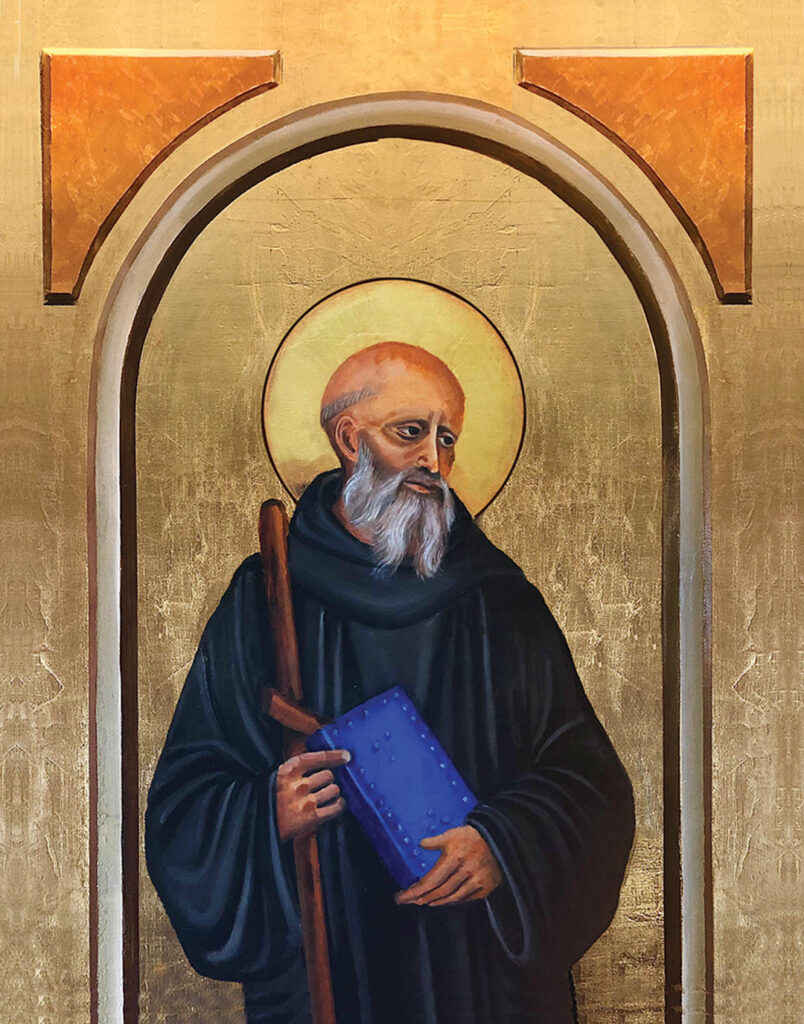
St. Benedict of Nursia
Rev. Dominic Bump, O.P.
2020
12
posted on
07/11/2025 5:06:15 AM PDT
by
annalex
(fear them not)
To: annalex
NAVARRE BIBLE COMMENTARY(RSV)
Ad Majorem Dei Gloriam (To the Greater Glory of God)
From: Genesis 46:1-7, 28-30
Jacob Journeys to Egypt
-----------------------
[1] So Israel took his journey with all that he had, and came to Beer-sheba, and offered sacrifices to the God of his lather Isaac. [2] And God spoke to Israel in visions of the night, and said, "Jacob, Jacob." And he said, "Here am I." [3] Then he said, "I am God, the God of your father; do not be afraid to go down to Egypt; for I will there make of you a great nation. [4] I will go down with you to Egypt, and I will also bring you up again; and Joseph's hand shall close your eyes." [5] Then Jacob set out from Beer-sheba; and the sons of Israel carried Jacob their father, their little ones, and their wives, in the wagons which Pharaoh had sent to carry him. [6] They also took their cattle and their goods, which they had gained in the land of Canaan, and came into Egypt, Jacob and all his offspring with him, [7] his sons, and his sons' sons with him, his daughters, and his sons' daughters; all his offspring he brought with him into Egypt.
[28] He sent Judah before him to Joseph, to appear before him. in Goshen; and they came into the land of Goshen. [29] Then Joseph made ready his chariot and went up to meet Israel his father in Goshen; and he presented himself to him, and fell on his neck, and wept on his neck a good while. [30] Israel said to Joseph, "Now let me die, since I have seen your face and know that you are still alive."
***********************************************************************
Commentary:
46:1-47:12. The narrative now focuses again on the family of Jacob in Canaan. The figure and position of Joseph act as the backdrop against which to explain the establishment of Israel in Egypt; it is the result of a divine command.
Jacob goes down to Egypt forced by the famine which is ravaging the land of Canaan (cf. 47:4). The Lord has prepared the way for him by means of a series of painful events and a series of tests whose meaning is now plain to see. This is a common human experience: "The test, I don't deny it, proves to be very hard: you have to go uphill, 'against the grain'. What is my advice? That you must say "omnia in bonum", everything that happens, 'everything that happens to me I for my own good...' Therefore the right conclusion is to accept, as a pleasant reality, what seems so hard to you" (St J Escrivá, "Furrow", 127).
46:1-5. This movement to Egypt could have put a question-mark against God' promise to give the descendants of Abraham and Isaac the land of Canaan. God's intervention convinces Jacob that this is all part of God's providential plans. In fact, Jacob's move to Egypt is the outcome of an express command from God. In Genesis 26:2 God forbade Isaac to go to Egypt: this was a sign that his land was Canaan. Now a similar command is needed to make Israel leave the country. Like everything in the patriarchal period this command is given in a night-time vision, the last such vision the patriarchs are to receive. The command does not however cancel God's promise about Canaan: God himself will go with Jacob to Egypt, and he will take him out of there. The reference to this is not just to the fact that Jacob will be buried in Canaan (cf. 50:1-14) but to the ultimate liberation, the Exodus.
Jacob's status is not reduced by his going into Egypt; on the contrary, it is enhanced and underlined: "For, what does he need if God goes with him? [...] Who is as powerful in his homeland as Jacob was in a strange country? Who had such abundance of wealth, as he had in a time of famine? Who was as strong in his youth, as this man was in his old age? [...] Who was as rich in his kingdom, as this man on his pilgrimage? He even blessed kings [...], and who will call him poor whom the world was not worthy to know? for his company was in heaven" (St. Ambrose, "De Iacob Et Vita Beata", 2, 9. 38).
46:28-34. Joseph does not wait for Jacob to visit him as would be his due, given his high social position and the fact that the patriarch has immigrant status. His filial feelings and the honor owed to his father lead him to go to meet him without delay and throw himself into his arms.
Jacob sees all his sons gathered around him. Now he knows that his mission as Israel, the father of the people, is accomplished; he can die in peace. Because the Israelites are shepherds, they keep a certain distance from the Egyptians; this also ensures they do not lose their identity as a people. As regards Goshen, see the note on 45:10.
13
posted on
07/11/2025 8:42:25 AM PDT
by
fidelis
(Ecce Crucem Domini! Fugite partes adversae! Vicit Leo de tribu Juda, Radix David! Alleluia!)
Gospel Reading: From: Matthew 10:16-23
Jesus' Instructions to the Apostles
-----------------------------------
(Jesus said to His disciples,) [16] "Behold, I send you out as sheep in the midst of wolves; so be wise as serpents and innocent as doves. [17] Beware of men; for they will deliver you up to councils, and flog you in their synagogues, [18] and you will be dragged before governors and kings for My sake, to bear testimony before them and the Gentiles. [19] When they deliver you up, do not be anxious how you are to speak or what you are to say; for what you are to say will be given to you in that hour; [20] for it is not you who speak, but the Spirit of your Father speaking through you. [21] Brother will deliver up brother to death, and the father his child, and children will rise against parents and have them put to death; [22] and you will be hated by all for My name's sake. But he who endures to the end will be saved. [23] When they persecute you in one town, flee to the next; for truly, I say to you, you will not have gone through all the towns of Israel, before the Son of Man comes."
***********************************************************************
Commentary:
16-23. The instructions and warnings Jesus gives here apply right through the history of the Church. It is difficult for the world to understand the way of God. Sometimes there will be persecutions, sometimes indifference to the Gospel or failure to understand. Genuine commitment to Jesus always involves effort--which is not surprising, because Jesus Himself was a sign of contradiction; indeed, if that were not the experience of a Christian, he would have to ask himself whether he was not in fact a worldly person. There are certain worldly things a Christian cannot compromise about, no matter how much they are in fashion. Therefore, Christian life inevitably involves nonconformity with anything that goes against faith and morals (cf. Romans 12:2). It is not surprising that a Christian's life often involves choosing between heroism and treachery. Difficulties of this sort should not make us afraid: we are not alone, we can count on the powerful help of our Father God to give us strength and daring.
20. Here Jesus teaches the completely supernatural character of the witness He asks His disciples to bear. The documented accounts of a host of Christian martyrs prove that He has kept this promise: they bear eloquent witness to the serenity and wisdom of often uneducated people, some of them scarcely more than children.
The teaching contained in this verse provides the basis for the fortitude and confidence a Christian should have whenever he has to profess his faith in difficult situations. He will not be alone, for the Holy Spirit will give him words of divine wisdom.
23. In interpreting this text, the first thing is to reject the view of certain rationalists who argue that Jesus was convinced that soon He would come in glory and the world would come to an end. That interpretation is clearly at odds with many passages of the Gospel and the New Testament. Clearly, Jesus refers to Himself when He speaks of the "Son of Man", whose glory will be manifested in this way. The most cogent interpretation is that Jesus is referring here, primarily, to the historical event of the first Jewish war against Rome, which ended with the destruction of Jerusalem and of the temple in the year 70, and which led to the scattering of the Jewish people. But this event, which would occur a few years after Jesus' death, is an image or a prophetic symbol of the end of the world (cf. note on Matthew 24:1).
The coming of Christ in glory will happen at a time which God has not revealed. Uncertainty about the end of the world helps Christians and the Church to be ever-vigilant.
14
posted on
07/11/2025 8:42:41 AM PDT
by
fidelis
(Ecce Crucem Domini! Fugite partes adversae! Vicit Leo de tribu Juda, Radix David! Alleluia!)
15
posted on
07/11/2025 8:43:28 AM PDT
by
fidelis
(Ecce Crucem Domini! Fugite partes adversae! Vicit Leo de tribu Juda, Radix David! Alleluia!)
Disclaimer:
Opinions posted on Free Republic are those of the individual
posters and do not necessarily represent the opinion of Free Republic or its
management. All materials posted herein are protected by copyright law and the
exemption for fair use of copyrighted works.
FreeRepublic.com is powered by software copyright 2000-2008 John Robinson
