Posted on 03/08/2025 9:35:24 AM PST by Antoninus
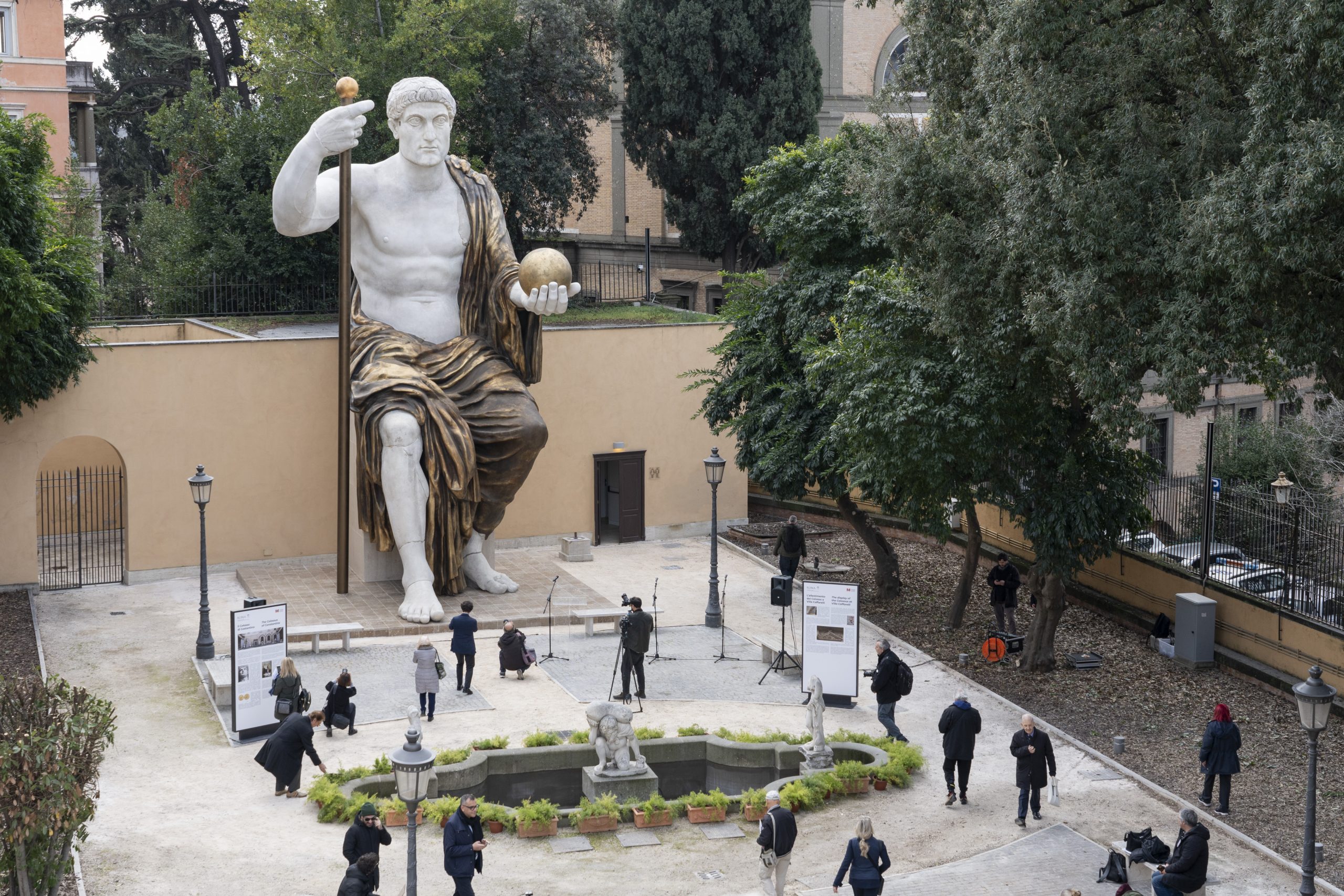
Most visitors to Rome over the years have marveled at the famous fragments of the Colossus of Constantine. Largely destroyed and dismantled in antiquity, this massive work of marble, wood and bronze once stood in the Basilica of Maxentius. Significant chunks of the Colossus are now located in a courtyard at the Capitoline Museum in Rome where my wife and I visited them on our honeymoon a few decades back.
In 2024, a magnificent replica of the Colossus was erected nearby in the garden behind the Capitoline Museum. While the sheer size of the work has drawn considerable attention, the fact that it does not display any obvious Christian iconography and, indeed, seems to portray the emperor as Zeus-like, has led some folks to assume that the replica is evidence that Constantine's Christianity was somehow insincere.
How close this modern replica resembles the original is a matter of conjecture, as its creators exercised some significant interpretive license with regard to the design. This matter is dealt with in considerable detail in an excellent post on the NumisForms site entitled: Designing a Colossus. So I'll not get into much detail on that question here. Suffice it to say that the decision by the Factum Foundation to portray Constantine as Zeus was based on "conjecture, maybe not even particularly well informed conjecture."
The point of this post is to contradict the facile confirmation bias that many experience when seeing this version of the Colossus. The most common immediate reaction is: "See? Constantine was a pagan and portrayed himself as such."
Well, sure. Up through about AD 306 Constantine was a pagan. Beyond that, he reportedly even had a vision of Apollo a few years before his more famous vision of the Cross. But after the Battle of the Milvian Bridge, Constantine began the process of becoming a Christian. It is not known when exactly he became a catechumen, but after about AD 312 when he and Licinius issued the Edict of Milan, his affinity for Christianity becomes increasingly evident.
By AD 324, following his defeat of Licinius, it is absolutely evident that Constantine is a Christian. Anyone who doubts that can read the words he himself spoke in his Oration to the Saints. The text of this lecture was preserved by the bishop Eusebius Pamphilus who knew Constantine personally and also wrote his well-known ancient biography, Life of the Blessed Emperor Constantine. The entire oration is a profession of Constantine's faith and a defense of Christianity. In it, you will find the emperor praying emphatically:
"Do thou, O Christ, Savior of mankind, be present to aid me in my hallowed task! Direct the words which celebrate your virtues, and instruct me worthily to sound your praises." [Oration to the Saints, Chapter 11]You will also find Constantine presenting evidence for the truth of Christianity, not only from the Hebrew prophets of the Old Testament, but also from pagans such as the Erythrean sibyl and from the Roman poet, Virgil, author of the foundational epic of Rome, the Aeneid.
The emperor goes on to condemn those pagans who have persecuted Christians, even going so far as to ridicule pagan beliefs, saying:
"What, then, have you gained by these atrocious deeds, most impious of men? And what was the cause of your insane fury? You will say, doubtless, these acts of yours were done in honor of the gods. What gods are these?...You will allege, perhaps, the customs of your ancestors and the opinion of mankind in general, as the cause of this conduct. I grant the fact: for those customs are very like the acts themselves, and proceed from the self-same source of folly. You thought, it may be, that some special power resided in images formed and fashioned by human art; and hence your reverence, and diligent care lest they should be defiled: those mighty and highly exalted gods, thus dependent on the care of men!" [Oration to the Saints, Chapter 22]Finally, in an echo of his contemporary and sometime confidant, Lactantius, Constantine gives a brief catalog of the dreadful ends suffered by those emperors who persecuted Christians most severely:
"To you, Decius, I now appeal, who has trampled with insult on the labors of the righteous: to you, the hater of the Church, the punisher of those who lived a holy life: what is now your condition after death? How hard and wretched your present circumstances! Nay, the interval before your death gave proof enough of your miserable fate, when overthrown with all your army on the plains of Scythia, you exposed the vaunted power of Rome to the contempt of the Goths.Of course, he could not leave out his contemporary and one-time mentor/captor, Diocletian. In this passage, Constantine provides his own witness of Diocletian's vicious character and unstable psyche, attributes which are echoed by Lactantius in his own work, On the Deaths of the Persecutors:
You, too, Valerian, who manifested the same spirit of cruelty towards the servants of God, hast afforded an example of righteous judgment. A captive in the enemies' hands, led in chains while yet arrayed in the purple and imperial attire, and at last your skin stripped from you, and preserved by command of Sapor the Persian king, you have left a perpetual trophy of your calamity.
And thou, Aurelian, fierce perpetrator of every wrong, how signal was your fall, when, in the midst of your wild career in Thrace, you were slain on the public highway, and filled the furrows of the road with your impious blood!" [Oration to the Saints, Chapter 24]
"Diocletian, however, after the display of relentless cruelty as a persecutor, evinced a consciousness of his own guilt and owing to the affliction of a disordered mind, endured the confinement of a mean and separate dwelling. What then, did he gain by his active hostility against our God? Simply this I believe, that he passed the residue of his life in continual dread of the lightning's stroke. Nicomedia attests the fact; eyewitnesses, of whom I myself am one, declare it. The palace, and the emperor's private chamber were destroyed, consumed by lightning, devoured by the fire of heaven. Men of understanding hearts had indeed predicted the issue of such conduct; for they could not keep silence, nor conceal their grief at such unworthy deeds; but boldly and openly expressed their feeling, saying one to another: What madness is this? And what an insolent abuse of power, that man should dare to fight against God; should deliberately insult the most holy and just of all religions; and plan, without the slightest provocation, the destruction of so great a multitude of righteous persons?" [Oration to the Saints, Chapter 25]Interestingly, Lactantius also reports fire destroying parts of the imperial palace in Nicomedia on two separate occasions 15 days apart. He claims that the fires were set by Diocletian's junior emperor, Galerius, in an effort to frame the Christians for the deeds. [see On the Deaths of the Persecutors, Chapter 14]
Constantine wrapped up his oration with a ringing profession of his faith in Jesus, urging his hearers to pray fervently to Christ:
"It becomes all pious persons to render thanks to the Savior of all, first for our own individual security, and then for the happy posture of public affairs: at the same time intreating the favor of Christ with holy prayers and constant supplications, that he would continue to us our present blessings. For he is the invincible ally and protector of the righteous: he is the supreme judge of all things, the prince of immorality, the Giver of everlasting life." [Oration to the Saints, Chapter 26]After reading the entirety of Constantine's oration, it becomes impossible to maintain the position that the first Roman emperor to tolerate Christianity formally in law did not truly believe Christian doctrine or remained partially pagan to the end of his life.
Although he was unbaptized until shortly before his death, Constantine was clearly a believing Christian catechumen with a zeal for bearing witness to the faith even publicly with his own lips.
Catholic ping!
An early archaeologist, Saint Helena traced the steps of Jesus and dug around in Jerusalem to find material remnants of the cross.
Ping
In Jerusalem at Helen’s time there were three places believed to be the tomb of Christ—the site of his resurrection. She pays to know which was the real one. In her dream Christ came to her and pointed out the true site. There they built a church. Recent studies by archaeologists made just a few years ago confirm—she was right! That or maybe Christ did come to her!
Constantine’s Elizabethan was spot on and centuries predictive.
The new colossus truly is an impressive work, though the modern creators scrupulously avoided including any Christian iconography.
Dura Europas was a fortified city on the border with Sassanid Persia. It was basically a garrison town of the Roman Army. Yet despite the empire-wide persecutions of Decius starting in 250, the church was in use surrounded by Roman soldiers until it was buried as part of the siege constructions in 256.
I can only conclude that either Roman military officials simply ignored imperial edicts (dubious) or a non-trivial number of the soldiery were already Christian. There also seems to have been cases where Roman officials who were Christian were given a pass. This would also explain why Constantine's instruction to put the chi-rho on their shields would have been understood by his soldiers at the Milvian bridge.
The Roman Army seems to have been more open to mystery cults like Mithraism from the late 2nd century than the general population. It may very well have been that Christianity was more prevalent in the Roman Army than in other parts of Roman society in the West at the time of Constantine.
This was common in the early church.
The thought behind the practice was the baptism cleansed all sin. Baptism being a once in a lifetime sacrament, if one received it just before death, one could immediately enter Heaven free of sin.
“in hoc signo vinces”

Ping.
Care to substantiate what "regulation" you're talking about? IIRC none of the council's decrees mention Constantine, or the office of Roman Emperor, at all.
If he were sincere, he would have gotten rid of his pagan idols because a sincere follower of Christ, certainly in those days, would understand what they mean.
Disclaimer: Opinions posted on Free Republic are those of the individual posters and do not necessarily represent the opinion of Free Republic or its management. All materials posted herein are protected by copyright law and the exemption for fair use of copyrighted works.