
Posted on 01/25/2025 5:58:26 PM PST by fidelis
By Dr. John Bergsma
The past three Sundays have focused on the three early “manifestations” or “epiphanies” of Jesus’ divine nature recorded in the Gospels: the Visit of the Magi, the Baptism, and the Wedding at Cana. Now the Lectionary “settles in” to Ordinary Time, which this year involves reading through the Gospel of Luke. This Sunday, we pick up the introduction to Luke’s Gospel (Luke 1:1-4), but then skip to the beginning of Jesus’ ministry (Luke 4:14-21) because we’ve already heard all the accounts of Jesus’ childhood and early life (Luke 1–3) during Advent, Christmas and Epiphany.
The Readings this Sunday focus on the importance of the public proclamation of God’s Word. In the First Reading, we see Ezra, the great priest and scholar of the Law, reading the Law of Moses out loud to the people of Israel after their return from Babylonian exile. In the Gospel, we see Jesus, our great high priest and interpreter of God’s Law, reading the promises of salvation from Isaiah to the Jews in the Synagogue of Nazareth. In both situations, the proclamation of God’s Word is a call both to repentance and to hope for salvation. However, in Ezra’s day, the salvation was far off; in Jesus’ day, He announces that the salvation is present now.
1. Our First Reading is Nehemiah 8:2-4a, 5-6, 8-10:
Ezra the priest brought the law before the assembly, which consisted of men, women, and those children old enough to understand. Standing at one end of the open place that was before the Water Gate, he read out of the book from daybreak till midday, in the presence of the men, the women, and those children old enough to understand; and all the people listened attentively to the book of the law. Ezra the scribe stood on a wooden platform that had been made for the occasion. He opened the scroll so that all the people might see it — for he was standing higher up than any of the people — and, as he opened it, all the people rose. Ezra blessed the LORD, the great God, and all the people, their hands raised high, answered, “Amen, amen!” Then they bowed down and prostrated themselves before the LORD, their faces to the ground. Ezra read plainly from the book of the law of God, interpreting it so that all could understand what was read. Then Nehemiah, that is, His Excellency, and Ezra the priest-scribe and the Levites who were instructing the people said to all the people: “Today is holy to the LORD your God. Do not be sad, and do not weep”— for all the people were weeping as they heard the words of the law. He said further: “Go, eat rich foods and drink sweet drinks, and allot portions to those who had nothing prepared; for today is holy to our LORD. Do not be saddened this day, for rejoicing in the LORD must be your strength!”
The historical context for this event is in Jerusalem, sometime in the 400’s BC. Israel conquered the Promised Land at some time between 1500-1100 BC, but their tenure in the Land was always unstable because of their disobedience to God’s Law as revealed through Moses. After reaching a high point under David and Solomon (c. 1000-900 BC), the nation of Israel split into a northern and southern kingdom, and a long decline in the moral and political life of Israel set in, culminating in the conquest and destruction of the southern kingdom of Judah by the Babylonians in 597-587 BC. The middle and upper classes of Jews were deported to Babylon.
In 537 BC the Medes and Persians conquered Babylon and introduced a new policy of allowing exiled peoples to return to their homeland. Many Jews returned to Jerusalem, and a sorry replica of the Temple was rebuilt by about 516 BC. But the morality and morale of the returnees remained low.
Ezra, a high-ranking priest from Babylon, returned to Jerusalem c. 458 BC to rally the people around the Law of Moses. He experienced mixed success. Nehemiah, a high-ranking Jewish aristocrat who held a high post in the Persian government, returned to Jerusalem in 445 BC to rebuild the city walls and boost Jewish morale. Today’s Reading is from about that time, recording the public rally and revival that took place shortly after the walls were completed.
The public reading of the Law recorded here, with a wooden pulpit built for the purpose, is often regarded as the historical beginnings of the Liturgy of the Word in Judaism and Christianity.
The people of Judah weep at the reading of the Law, because they realize what a great distance there is between their own behavior and what God commanded through Moses. Moreover, Ezra probably read generous portions from the end of Leviticus and/or Deuteronomy, where the future infidelities and resultant national disasters of the people of Israel were prophesied (Leviticus 26; Deuteronomy 27-32). Hearing these ancient prophecies and recognizing that they all came to fruition in the sorry history of their nation, the people are moved to tears. Nonetheless, the intention of Ezra and Nehemiah was not to depress the populace, but to encourage repentance and revival. So they strenuously urge the people: “Do not weep … rejoicing in the LORD must be your strength!”
A few words about Ezra-Nehemiah, which are generally considered one book in the tradition: Liturgical celebrations manifesting the unity of God’s people and celebrating His mercy form the high points of the narrative of Ezra-Nehemiah: the dedication of the Temple and celebration of Passover (Ezra 6:13-22), the Feast of Tabernacles and the dedication of the city walls (Nehemiah 8–12). The people of God finds its identity in worship. In the absence of political power or economic prosperity, they find hope, joy, and peace in celebrating liturgy, which recalls God’s saving acts in the past and anticipates the ultimate salvation of God in the future. In many ways, this paradigm remains in place for the people of the New Covenant.
The Church seldom reads from Ezra-Nehemiah in the Eucharistic Liturgy or the Liturgy of the Hours. Today’s reading from Nehemiah 8 is the only one from Ezra-Nehemiah in the cycle for Lord’s Days and Feast Days. The great liturgical act of covenant renewal recorded here, focused on the proclamation of God’s word, is understood as type of the Liturgy of the Word and of the Eucharist in the New Covenant community.
2. The Responsorial Psalm is Psalms 19:8, 9, 10, 15
R. (cf John 6:63c) Your words, Lord, are Spirit and life.
The law of the LORD is perfect,
refreshing the soul;
The decree of the LORD is trustworthy,
giving wisdom to the simple. R.
The precepts of the LORD are right,
rejoicing the heart;
The command of the LORD is clear,
enlightening the eye. R.
The fear of the LORD is pure,
enduring forever;
The ordinances of the LORD are true,
all of them just. R.
Let the words of my mouth and the thought of my heart
find favor before you,
O LORD, my rock and my redeemer. R.
This psalm is a celebration of the written Word of God, in keeping with the theme of public proclamation of Scripture in the First Reading and Gospel. Yet as Christians we are more than “people of the Book.” The Word of God has become Flesh in Jesus Christ. The perfections of God’s Word in this Psalm find their truest meaning when applied to Him.
3. The Second Reading is 1 Corinthians 12:12-30:
[Brothers and sisters:] As a body is one though it has many parts, and all the parts of the body, though many, are one body, so also Christ. For in one Spirit we were all baptized into one body, whether Jews or Greeks, slaves or free persons, and we were all given to drink of one Spirit.
Now the body is not a single part, but many. If a foot should say “Because I am not a hand I do not belong to the body, “it does not for this reason belong any less to the body. Or if an ear should say, “Because I am not an eye I do not belong to the body,“ it does not for this reason belong any less to the body. If the whole body were an eye, where would the hearing be? If the whole body were hearing, where would the sense of smell be? But as it is, God placed the parts, each one of them, in the body as he intended. If they were all one part, where would the body be? But as it is, there are many parts, yet one body. The eye cannot say to the hand, “I do not need you“ nor again the head to the feet, “I do not need you.” Indeed, the parts of the body that seem to be weaker are all the more necessary, and those parts of the body that we consider less honorable we surround with greater honor, and our less presentable parts are treated with greater propriety, whereas our more presentable parts do not need this. But God has so constructed the body as to give greater honor to a part that is without it, so that there may be no division in the body, but that the parts may have the same concern for one another. If one part suffers, all the parts suffer with it; if one part is honored, all the parts share its joy.
Now you are Christ’s body, and individually parts of it. Some people God has designated in the church to be, first, apostles; second, prophets; third, teachers; then, mighty deeds; then gifts of healing, assistance, administration, and varieties of tongues. Are all apostles? Are all prophets? Are all teachers? Do all work mighty deeds? Do all have gifts of healing? Do all speak in tongues? Do all interpret?
The Second Reading is “marching to the beat of its own drum” this Sunday, because the Lectionary is simply reading semi-continuously through 1 Corinthians. Much like last week, this reading focuses on the importance of every baptized believer contributing to the edification of the whole Church. This is often not carried out very well at the level of our local parishes. Typically only around 10% of those who show up for Church on Sunday are actually involved in the life of the congregation in any significant way. That is to say nothing of the parishioners who do not even attend worship regularly! One of the most serious pastoral needs we face right now is the education and mobilization of the laity in the local congregation. One thing that can be done is to make sure the RCIA process does not stop with the sacraments of initiation, but continues into post-baptismal mystagogy, with a component dedicated to helping the new believer identify charisms and practical roles of service within the local congregation.
4. The Gospel is Luke 1:1-4; 4:14-21:
Since many have undertaken to compile a narrative of the events that have been fulfilled among us, just as those who were eyewitnesses from the beginning and ministers of the word have handed them down to us, I too have decided, after investigating everything accurately anew, to write it down in an orderly sequence for you, most excellent Theophilus, so that you may realize the certainty of the teachings you have received.
This well-written opening Greek sentence of the Gospel of Luke provides an occasion for St. Luke to “show off” his Greek style, which is very good. The reader is thus put on notice: the author of this book (Luke) is a well-educated man, a master of Greek literature who understands the criteria for writing a reliable historical work: “investigating everything accurately … write it down in an orderly sequence.”
Luke’s intention is to convey history, not myth or legend. This is so that his readers may “realize the certainty of the teachings” they have received. In Greek this is literally “that you may realize the ‘asphalt’ of your ‘catechesis.’” The word for “certainty” is asphaleia, for “teachings,” katachethes. Luke is a “catechetical” Gospel.
Jesus returned to Galilee in the power of the Spirit, and news of him spread throughout the whole region. He taught in their synagogues and was praised by all.
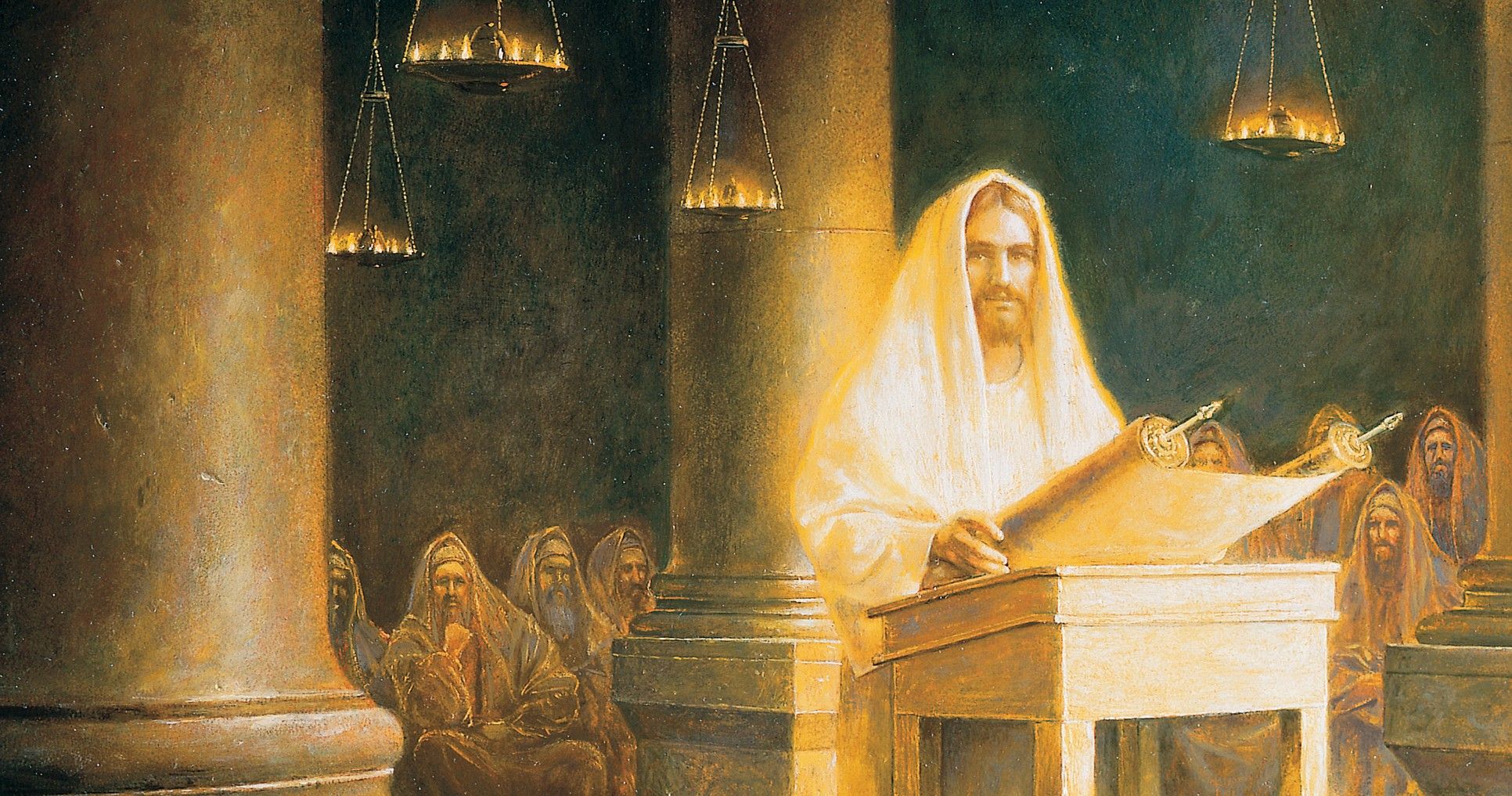
He came to Nazareth, where he had grown up, and went according to his custom into the synagogue on the sabbath day. He stood up to read and was handed a scroll of the prophet Isaiah. He unrolled the scroll and found the passage where it was written: The Spirit of the Lord is upon me, because he has anointed me to bring glad tidings to the poor. He has sent me to proclaim liberty to captives and recovery of sight to the blind, to let the oppressed go free, and to proclaim a year acceptable to the Lord. Rolling up the scroll, he handed it back to the attendant and sat down, and the eyes of all in the synagogue looked intently at him. He said to them, “Today this Scripture passage is fulfilled in your hearing.”
Our Gospel reading now skips to the beginning of Jesus’ public ministry. He goes to Nazareth and reads from the Book of Isaiah, primarily Isaiah 61:1-2.
We must understand that after Jesus reads the scroll, he “sits down” to begin preaching. Rabbis preached sitting down, from the “seat of Moses,” so to speak. This is contrary to our practice, where the celebrant rises to preach. For this reason, Christians typically misunderstand the passage. When Jesus sits down, they think he has decided not to preach.
But precisely the opposite is the case. Sitting down, he signals that he is about to begin his sermon. There is a great deal of anticipation, because Isaiah 61:1-2 was a “hot” text. There was a great deal of “end times” expectation associated with this passage.
Among the Dead Sea Scrolls, we discovered a sensational document, called by scholars “11QMelchizedek.” From this document it has become clear that in the days of Our Lord, at least one sect of Jews (the “Essenes”) were anticipating the return of a savior figure they called “Melchizedek,” who was expected to proclaim a great Jubilee Year (see Leviticus 25:8-55) that would involve forgiveness of the debt of sin. The document 11QMelchizedek quotes from both Leviticus 25 and Isaiah 61.
In Isaiah 61:1-2, the prophet is indeed predicting that at some time in the future, a mysterious “servant of the LORD” will arrive, bearing the anointing of the Holy Spirit, and will proclaim the “Year of the LORD’s favor,” that is, a great Jubilee Year (see Leviticus 25:8-17) involving debt forgiveness, freedom for slaves, and restoration of families.
The beginning of Jesus’ sermon is sensational: “Today this Scripture passage is fulfilled in your hearing.” This amounts to a claim to be the “servant of the LORD” of whom Isaiah spoke, to be the “Melchizedek” that the Essenes were anticipating, the savior figure who would announce the great Jubilee.
In a very real sense, as we participate in Mass this weekend, the Scriptures are “fulfilled in our hearing.” The same Jesus who fulfills all the prophecies comes to us and is truly present to us in the Eucharist, the Word made Flesh. His healing power, and specifically his offer of forgiveness of sin and freedom for those held captive by evil, is still available to us, if we will have faith in Him and in his promises.
Please keep in mind that this is a Catholic Caucus/Devotional thread for the purpose of prayerful reflection on the Sacred Scriptures and is closed to debate of any kind. Per FR policy on Religion Caucus threads, off-topic, argumentative, and abusive comments are not allowed and will be submitted to the Mods for deletion. Thanks, and God bless you and have a holy Lord’s Day.
Pinging the weekly Sacred Page list!

Disclaimer: Opinions posted on Free Republic are those of the individual posters and do not necessarily represent the opinion of Free Republic or its management. All materials posted herein are protected by copyright law and the exemption for fair use of copyrighted works.