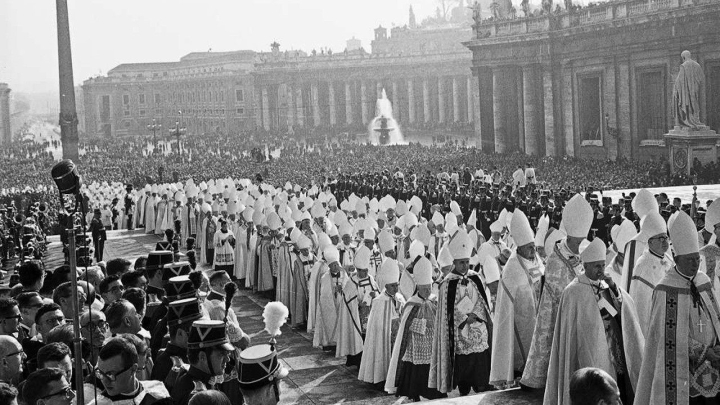
The Church had already reached the point of crisis before Jorge Bergoglio was even ordained to the priesthood (on December 13, 1969).
Posted on 12/04/2024 9:51:40 AM PST by ebb tide
The Church had already reached the point of crisis before Jorge Bergoglio was even ordained to the priesthood (on December 13, 1969).
Most of us understand that the Catholic Church is currently undergoing a profound crisis and that Francis seems to be doing everything in his power to make it worse. While Catholics justifiably consider how to best counteract the frequent outrages from Rome, it is worth considering the broader context of the crisis. To that end, the following milestones paint a picture that we may sometimes forget as we consider the latest heresies from Francis: the ongoing onslaught against the Church had already reached the point of crisis before Jorge Bergoglio was even ordained to the priesthood (on December 13, 1969).
Aside from placating non-Catholics, the entirely predictable results of the document were pure evil: convincing souls that they did not really need to become (or remain) Catholic, and falsely signaling to the world that the Catholic Church could change its theology to contradict what it had authoritatively taught previously.
Cardinal Pacelli’s Warning
While he was Pope Pius XI’s Secretary of State, Cardinal Eugenio Pacelli (the future Pope Pius XII) warned about the “suicide of altering the faith”:
“I am worried by the Blessed Virgin’s messages to little Lucia of Fatima. This persistence of Mary about the dangers which menace the Church is a divine warning against the suicide of altering the faith, in her liturgy, her theology and her soul . . . I hear all around me innovators who wish to dismantle the Sacred Chapel, destroy the universal flame of the Church, reject her ornaments and make her feel remorse for her historical past.” (quoted in Christopher Ferrara’s The Secret Still Hidden, p. 31)
The future Pius XII was worried about the “suicide of altering the faith,” particularly by changing the Catholic Church’s liturgy and theology. In the decades following his warning, the world would see both a dramatic change in the theology and liturgy promoted by Rome, as well as a level of apostasy that we could characterize as akin to suicide. Was it merely a coincidence that the future Pius XII saw a causal relationship between these developments?
Pius XII’s Humani Generis
In his 1950 encyclical “concerning some false opinions threatening to undermine the foundations of Catholic doctrine,” Humani Generis, Pius XII described various errors threatening the Church, including the attack on the Catholic teaching regarding the “necessity of belonging to the true Church in order to gain eternal salvation”:
“Some say they are not bound by the doctrine, explained in Our Encyclical Letter of a few years ago, and based on the Sources of Revelation, which teaches that the Mystical Body of Christ and the Roman Catholic Church are one and the same thing. Some reduce to a meaningless formula the necessity of belonging to the true Church in order to gain eternal salvation.”
Obviously this question of whether people must belong to the Catholic Church to save their souls is of major importance. If a person who has reached the age a reason can save his or her soul through the practice of the Lutheran or Baptist religions, why would he or she choose instead to become or remain Catholic? If, other the other hand, it would be extraordinarily difficult for a non-Catholic with the use of reason to save his or her soul, then the greatest act of charity we can have for our neighbors is do all we can (through prayer and encouragement) to bring them to the Church.
John XXIII clearly wanted to cast aside the caution that his predecessors had exercised in the face of so many errors threatening the Catholic Church. The Church and world would soon discover if his cavalier attitude was appropriate.
Prophets of Doom
In his address to open the Council, John XXIII belittled the “prophets of doom”:
“In the daily exercise of Our pastoral office, it sometimes happens that We hear certain opinions which disturb Us—opinions expressed by people who, though fired with a commendable zeal for religion, are lacking in sufficient prudence and judgment in their evaluation of events. They can see nothing but calamity and disaster in the present state of the world. They say over and over that this modern age of ours, in comparison with past ages, is definitely deteriorating. One would think from their attitude that history, that great teacher of life, had taught them nothing. They seem to imagine that in the days of the earlier councils everything was as it should be so far as doctrine and morality and the Church's rightful liberty were concerned. We feel that We must disagree with these prophets of doom, who are always forecasting worse disasters, as though the end of the world were at hand.”
Whether or not he specifically had in mind those who, like Pius XII, were concerned with the warnings of Fatima, John XXIII clearly wanted to cast aside the caution that his predecessors had exercised in the face of so many errors threatening the Catholic Church. The Church and world would soon discover if his cavalier attitude was appropriate.
Unitatis Redintegratio, the Council’s Decree on Ecumenism
The first sentence of Vatican II’s Decree on Ecumenism, Unitatis Redintegratio, stated one of the fundamental objectives of the Council:
“The restoration of unity among all Christians is one of the principal concerns of the Second Vatican Council.”
The document might have been much more clear and concise if it had simply restated what the Catholic Church had always taught. However, here is what the document said in relation to what Pius XII had described as the “necessity of belonging to the true Church in order to gain eternal salvation”:
“The brethren divided from us also use many liturgical actions of the Christian religion. These most certainly can truly engender a life of grace in ways that vary according to the condition of each Church or Community. These liturgical actions must be regarded as capable of giving access to the community of salvation. It follows that the separated Churches and Communities as such, though we believe them to be deficient in some respects, have been by no means deprived of significance and importance in the mystery of salvation. For the Spirit of Christ has not refrained from using them as means of salvation which derive their efficacy from the very fullness of grace and truth entrusted to the Church.”
Defenders of Vatican II tend to argue that there is some logical way reconcile the following statement with what the Church had always taught: “the Spirit of Christ has not refrained from using [non-Catholic religions] as means of salvation.” These defenders of the Council often point to the Catholic teaching that even non-Catholics who are validly baptized in heretical sects will be saved if they die before the age of reason.
But if that is what the Council Fathers wanted to express, why did they not just plainly state it? They were not constrained by a word limit in the document and, indeed, it would have taken fewer words to simply recite the clear teaching of the Church. As we can see from the praise of the “liturgical actions” of non-Catholic religions, though, the goal was to make the case for why souls could be saved by their non-Catholic religions. In other words, the entire point was to contradict what the Church had always taught on this all-important issue.
Aside from placating non-Catholics, the entirely predictable results of this were pure evil: convincing souls that they did not really need to become (or remain) Catholic, and falsely signaling to the world that the Catholic Church could change its theology to contradict what it had authoritatively taught previously.
The introduction of the Novus Ordo Mass would have two disastrous consequences: it would remove the barriers to various heresies associated with the Mass, and it would falsely signal that the immutable Faith can be changed or ignored.
Peace with Secular Humanism
Paul VI closed Vatican II by boasting that the Council had made peace with secular humanism:
“Secular humanism, revealing itself in its horrible anti-clerical reality has, in a certain sense, defied the council. The religion of the God who became man has met the religion (for such it is) of man who makes himself God. And what happened? Was there a clash, a battle, a condemnation? There could have been, but there was none. The old story of the Samaritan has been the model of the spirituality of the council. A feeling of boundless sympathy has permeated the whole of it. The attention of our council has been absorbed by the discovery of human needs (and these needs grow in proportion to the greatness which the son of the earth claims for himself). But we call upon those who term themselves modern humanists, and who have renounced the transcendent value of the highest realities, to give the council credit at least for one quality and to recognize our own new type of humanism: we, too, in fact, we more than any others, honor mankind.”
Here, Paul VI declared that Vatican II had made peace with secular humanism, the religion of “man who makes himself God.” As he noted, those who understood what the Church had always taught would have thought that the Council would have condemned secular humanism. Unfortunately, Paul VI was correct in his assessment, because in various ways the Council brought about a shift in focus: every new development inspired by Vatican II leads to a turning away from God, toward man. To the extent that there is anything from the Council’s documents that leads souls to God’s truth, it had already been stated even more clearly by the Church’s Magisterium for hundreds of years prior to the Council.
Ottaviani Intervention
On September 25, 1969, Cardinals Bacci and Ottaviani submitted a letter to Paul VI presenting a critical study of the Novus Ordo Missae. This study is worth reading in its entirety but the accompanying letter from the cardinals shows specific concerns about the momentous changes that would be caused by the promulgation of the Novus Ordo Missae:
“The accompanying critical study of the Novus Ordo Missae, the work of a group of theologians, liturgists and pastors of souls, shows quite clearly in spite of its brevity that if we consider the innovations implied or taken for granted which may of course be evaluated in different ways, the Novus Ordo represents, both as a whole and in its details, a striking departure from the Catholic theology of the Mass as it was formulated in Session XXII of the Council of Trent. The ‘canons’ of the rite definitively fixed at that time provided an insurmountable barrier to any heresy directed against the integrity of the Mystery. . . . The innovations in the Novus Ordo and the fact that all that is of perennial value finds only a minor place — if it subsists at all — could well turn into a certainty the suspicion, already prevalent, alas, in many circles, that truths which have always been believed by the Christian people can be changed or ignored without infidelity to that sacred deposit of doctrine to which the Catholic faith is bound forever. Recent reforms have amply demonstrated that fresh changes in the liturgy could lead to nothing but complete bewilderment on the part of the faithful who are already showing signs of restiveness and of an indubitable lessening of faith.”
Cardinals Bacci and Ottaviani wrote these words without having in mind the various practices that have become commonplace today, such as Communion in the hand and girl altar servers. Still, they could see enough to understand that the introduction of the Novus Ordo Mass would have two disastrous consequences: it would remove the barriers to various heresies associated with the Mass, and it would falsely signal that the immutable Faith can be changed or ignored.
Pius XII’s warning about the suicide of altering the Faith had effectively been proven to be true already, which is why Paul VI, John Paul II, and Benedict XVI had lamented the calamities caused by the Council.
Paul VI’s Assessment of the Council’s Aftermath
In his study on Paul VI, Paul VI beatified?, Fr. Luigi Villa included two famous quotes from Paul VI regarding the aftermath of Vatican II. In the first, from December 7, 1968, Paul VI spoke of the self-destruction taking place in the Church:
“The Church, today, is going through a moment of disquiet. Some indulge in self-criticism, one would say even self-destruction. It is like an acute and complex inner upheaval, which no one would have expected after the Council. One thought of a flourishing, a serene expansion of the concepts matured in the great conciliar assembly. There is also this aspect in the Church, there is the flourishing, but . . . for the most part one comes to notice the painful aspect. The Church is hit also by he who is part of it.”
Three years later, on June 29, 1972, his assessment was even more dire:
“Through some cracks the smoke of Satan has entered the temple of God: there is doubt, uncertainty, problematic, anxiety, confrontation. One does not trust the Church anymore; one trusts the first prophet that comes to talk to us from some newspapers or some social movement, and then rush after him and ask him if he held the formula of real life. And we fail to perceive, instead, that we are the masters of life already. Doubt has entered our conscience, and it has entered through windows that were sup- posed to be opened to the light instead. . . Even in the Church this state of uncertainty rules. One thought that after the Council there would come a shiny day for the history of the Church. A cloudy day came instead, a day of tempest, gloom, quest, and uncertainty. We preach ecumenism and drift farther and farther from the others. We attempt to dig abysses instead of filling them.”
Defenders of the Council often try to argue that these calamities were somehow caused by the overall social revolution plaguing so much of the world, but that suggestion falls flat when we consider that Traditional Catholics have thrived despite being persecuted by Rome.
No new pope was going to rectify the situation without first reversing the suicidal alterations of the Faith we saw from the Council and its aftermath.
John Paul II’s Assessment of Apostasy in Europe
In his 2003 Post-Synodal Apostolic Exhortation, Ecclesia in Europa, John Paul II wrote of the silent apostasy devastating Europe:
“Certainly Europe is not lacking in prestigious symbols of the Christian presence, yet with the slow and steady advance of secularism, these symbols risk becoming a mere vestige of the past. Many people are no longer able to integrate the Gospel message into their daily experience; living one's faith in Jesus becomes increasingly difficult in a social and cultural setting in which that faith is constantly challenged and threatened. In many social settings it is easier to be identified as an agnostic than a believer. The impression is given that unbelief is self-explanatory, whereas belief needs a sort of social legitimization which is neither obvious nor taken for granted. This loss of Christian memory is accompanied by a kind of fear of the future. Tomorrow is often presented as something bleak and uncertain. The future is viewed more with dread than with desire. . . . At the root of this loss of hope is an attempt to promote a vision of man apart from God and apart from Christ. This sort of thinking has led to man being considered as ‘the absolute centre of reality, a view which makes him occupy – falsely – the place of God and which forgets that it is not man who creates God, but rather God who creates man. Forgetfulness of God led to the abandonment of man.’ . . . European culture gives the impression of ‘silent apostasy’ on the part of people who have all that they need and who live as if God does not exist.”
What caused Europe’s Catholics to lose the Faith? Going back to Cardinal Pacelli’s warning about the suicide of altering the Faith, the answer seems clear: by making dramatic changes to theology and liturgy, the innovators destroyed the Faith of millions of Catholics.
With his predecessors, we saw a mix of the Vatican II religion and the Catholic religion; with Francis we see only the Vatican II religion.
Benedict XVI’s Final Address to the Clergy of Rome
In his final address to the clergy of Rome, Benedict XVI spoke of the great crisis in the Church in the decades following Vatican II:
“We know that this Council of the media was accessible to everyone. Therefore, this was the dominant one, the more effective one, and it created so many disasters, so many problems, so much suffering: seminaries closed, convents closed, banal liturgy . . . and the real Council had difficulty establishing itself and taking shape; the virtual Council was stronger than the real Council. But the real force of the Council was present and, slowly but surely, established itself more and more and became the true force which is also the true reform, the true renewal of the Church. It seems to me that, 50 years after the Council, we see that this virtual Council is broken, is lost, and there now appears the true Council with all its spiritual force.”
Benedict XVI attributed so many evils to the “Council of the media.” And yet he had some optimism that the “real Council” had finally been able to become a true force for renewal and reform. However, if we reflect on what serious Catholics appreciate about Benedict XVI, it was not that he was implementing Vatican II’s “reforms.” Instead, we liked much of what he did because he was, in at least some ways, trying to bring the Church back to its pre-conciliar beliefs and practices.
Thus, the liberals hated him for doing the things that pleased many Traditional Catholics. But none of the things that Traditional Catholics praise him for had their actual origin at Vatican II. Everything true and worthwhile in the Council documents had been better expressed by the Church for centuries.
So what should we have expected when Benedict XVI stepped aside? Pius XII’s warning about the suicide of altering the Faith had effectively been proven to be true already, which is why Paul VI, John Paul II, and Benedict XVI had lamented the calamities caused by the Council. No new pope was going to rectify the situation without first reversing the suicidal alterations of the Faith we saw from the Council and its aftermath.
The “problem” with Francis is that he does not pretend to retain a love and respect for any of the pre-Vatican II Catholic Faith. With his predecessors, we saw a mix of the Vatican II religion and the Catholic religion; with Francis we see only the Vatican II religion. This is actually a blessing if we see things as they are and decide that we can no longer serve two masters. If we want to serve God, we cannot do so by practicing the religion unleashed upon the Church by Satan at Vatican II. Immaculate Heart of Mary, pray for us!
Ping
Seems as if he was coerced.
Would have been much better if F1 had never been Pope, obviously. Perhaps if Benedict had survived as pope a few more years the outcome of the election would have been different.
It could hardly have been worse.
What a bunch of tripe; a non-sequitur making a determined effort for its self-serving conclusion. Instead of your usual cartoons you/your author have mis-placed quotes and used them improperly.
A more valid argument would be the French revolution, which led to nationalizing the lands of the Roman Catholic Church in to pay off the public debt, which led to a widespread redistribution of property and the slow demise of France from divine right of Kings/alligance to Rome, to present day secular atheism. I am sure you know Notre Dame is no longer Catholic (I know your readers don’t know this.)
Throw in the 60s era in which Man rocketed to the moon in less than a decade, birth control (and Roman condemnation) and the soon spread of “legalized” abortion all at an extremely fast pace and in a very short period of time, and which, by the way, coincides at the same time as VII, changed in the world; and change, in all its forms, continues to accelerate in the present.
Having a priest speak in the local tongue, and not latin, while facing his parish is not Satan’s doing or leading to Catholic problems. Nor did some “fake resignation” by Pope Benedict. Nor did some Satan influence of Pope Francis. Nor has any of reasons expressed in the cartoons and concoctions you routinely post.
Why are you on this thread? You are not Catholic and it’s clearly marked “Caucus.” You routinely barge in on Caucus threads, just to argue and stir the pot. Go away!

Could you please point out where any of those topics were mentioned in the above article?
If not, is this just another one of your "bad" days?
You're obviously one of my "readers".
Is this Satan reference clear enough, ebby? “If we want to serve God, we cannot do so by practicing the religion unleashed upon the Church by Satan at Vatican II.” It is literally in the last few words of this craziness.
I am starting to believe you aren’t even a “reader” of your misguiding posts.
What about it?
You don’t believe in Satan and all his pompous works?
Join the novena for the conversion of Pope Francis starting December 8
We are the sheep.
The sheperds do good or ill, we are nonetheless still the sheep.
If it was Jesus’ teaching 200 years ago, it is still holy and wholly true, now and forever, to loosely paraphrase St Jerome.
If my sheperd does ill, I still nred my sheperd for sacramebts that only his hands and words may perform. He may close off my sacrements to submut to his bishop, to collect govt funds, but where else will I go? Nowhere. I will tell my brother he is wrong, then atrend the greatest sacrifice or greatest act of mercy upon man, but I must await God’s fixing of this gordian knot.
My holy parents never voiced objection to the new mass though felt it, so I knew nothing of how bad things were not always so bad....but I figured it out, my children know well and are holier than me! Trust in God during this desert. So much truth has been written and lived in the Church. A couple centuries of ill is worth the medicine in punishment for our Catholuc culture to allow, push, these bishops upward into places of power that brought this ill.
We did this to our young men, who became bishops, catdinals, who brought such ill upon us. God must repair this, we are but sheep who must servive with poor sheperds mostly.
We don’t need more priests and religious. We need more goid priests and religious.
We don’t need a new pope, we need a good holy pope. We have the other, and God permitting, I pray him to become a good holy one sooner than a new likely picked in the same mold.
Benedict didn’t prevent the current mess, neither did JP2, and Francis has only fluffed it up. Who cares if my favorite, B16 quit with God’s permission or was pushed out, the cancer of satan has l9ng spread around the body and he could not cure it any better than JP2 coukd not.
It is the Catholic people that let in this cancer, into their sons and daughters, selves, that created these Church problems.....we succumbed to the evil in the culture instead of being leaven.
We must fix ourselves, be fruitful and multiply, as our Church has tried to explain to us in saintly example and writing. God will fix us in our messing up his Church by our love for Him fixing US and raising up good holy bishops to fix the Church of his fixed people. Fixed enough people, that the bishops must work hard to lead, help better.
It is a cyclic process. Better families make better priests make better bishops make a better pope, and satan grabs as many as he can trick and chose him.
Latin mass prefer-ers.....not necessarily go-ers anymore....are trying to do this, having big families, making good men and women. Tge cancer attacks, but what is new? We have books and books to learn from. Mother Theresa’s, Monsignor Reilly’s, Bishop Striclands, Cardinal Burkes
want = won’t
One and the same, foister:
Cardinal Leo Jozef Suenens, Archbishop of Brussels, affirms that the Council “marks the ends of both the Tridentine epoch and the era of Vatican Council I. It is the French Revolution in the Church.”
And
In another place Congar says that at Vatican II, “the Church had its peaceful October Revolution,” referring to the well-known “Red October,” when Communism destroyed the Empire of the Czars in Russia.
Foister, do you, like Cardinal Ratzinger, have problems with Pope Blessed Pius IX' Syllabus of Errors?
What "errors" do you contest, foister?
What do you think all of Bergoglio's synods about "discerning the Spirit" have been, foister, if not the above Error?
So, with an open mind, I took a look at the Novena. Some parts are naively “ok” but most are not so good. When your premise is, “Is Francis really the pope? Is Pope Francis even Catholic?” it’s really quite profane to any rational Catholic (or even non-Catholic). It seems Satan has infiltrated your group.
Who are you to judge who is a “rational Catholic”?
Fr. Michele wrote, “homosexual love is a gift from (God) no less than heterosexual.” He also disparaged the idea of homosexual couples not having sex.
Disclaimer: Opinions posted on Free Republic are those of the individual posters and do not necessarily represent the opinion of Free Republic or its management. All materials posted herein are protected by copyright law and the exemption for fair use of copyrighted works.