Skip to comments.
Catholic Caucus: Daily Mass Readings 16-June-2024
Universalis/Jerusalem Bible ^
Posted on 06/16/2024 8:36:45 AM PDT by annalex
16 June 2024
11th Sunday in Ordinary Time

Cathedral of Meissen Readings at MassLiturgical Colour: Green. Year: B(II).
| First reading |
|---|
| Ezekiel 17:22-24 |
|---|
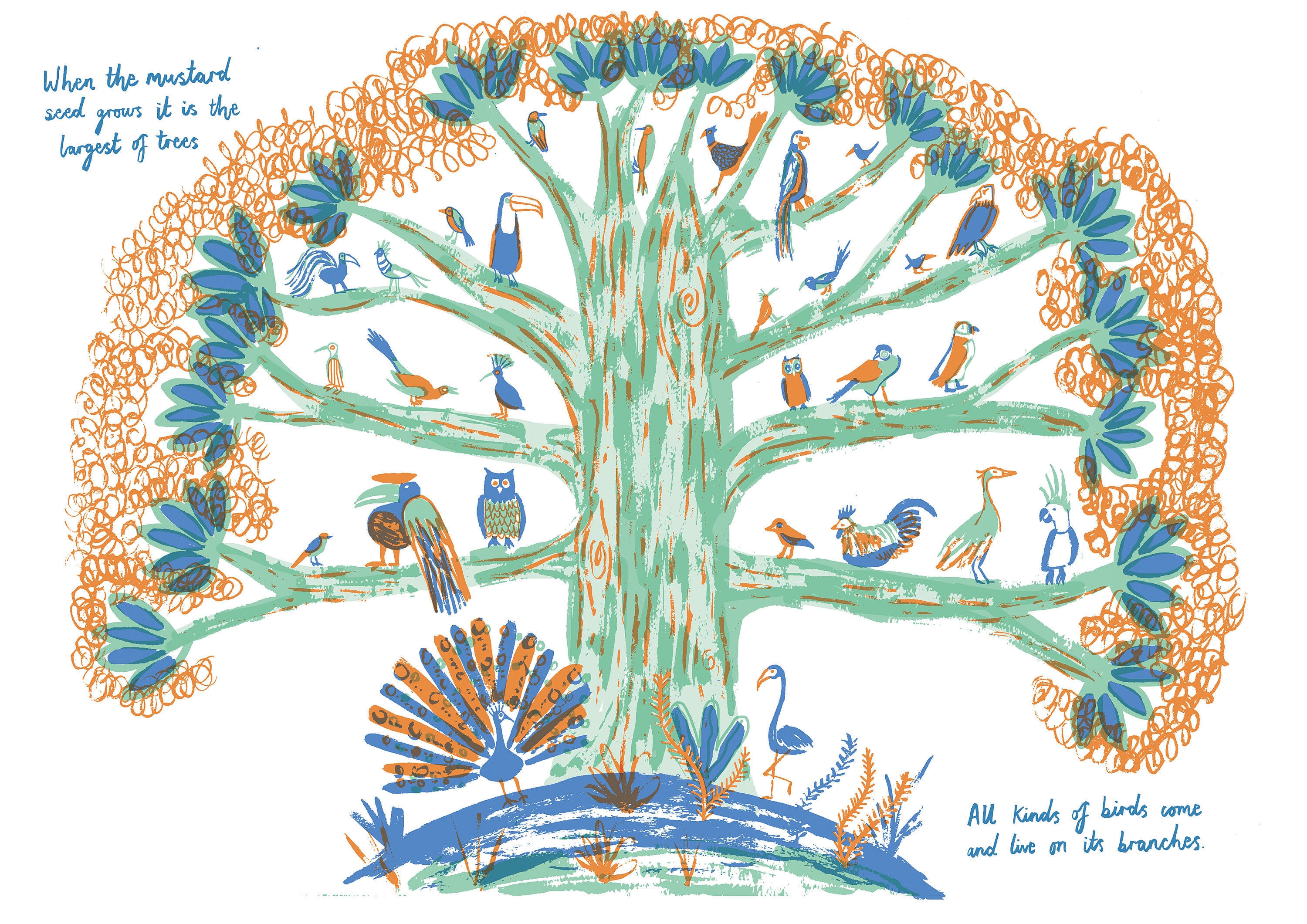
I will plant a shoot on the high mountain of IsraelThe Lord says this: ‘From the top of the cedar, from the highest branch I will take a shoot and plant it myself on a very high mountain. I will plant it on the high mountain of Israel. It will sprout branches and bear fruit, and become a noble cedar. Every kind of bird will live beneath it, every winged creature rest in the shade of its branches. And every tree of the field will learn that I, the Lord, am the one who stunts tall trees and makes the low ones grow, who withers green trees and makes the withered green. I, the Lord, have spoken, and I will do it.’
| Responsorial Psalm |
|---|
| Psalm 91(92):2-3,13-16 |
|---|
It is good to give you thanks, O Lord. It is good to give thanks to the Lord, to make music to your name, O Most High, to proclaim your love in the morning and your truth in the watches of the night. It is good to give you thanks, O Lord. The just will flourish like the palm tree and grow like a Lebanon cedar. It is good to give you thanks, O Lord. Planted in the house of the Lord they will flourish in the courts of our God, still bearing fruit when they are old, still full of sap, still green, to proclaim that the Lord is just. In him, my rock, there is no wrong. It is good to give you thanks, O Lord.
| Second reading |
|---|
| 2 Corinthians 5:6-10 |
|---|
We want to be exiled from the body and make our home with the LordWe are always full of confidence when we remember that to live in the body means to be exiled from the Lord, going as we do by faith and not by sight – we are full of confidence, I say, and actually want to be exiled from the body and make our home with the Lord. Whether we are living in the body or exiled from it, we are intent on pleasing him. For all the truth about us will be brought out in the law court of Christ, and each of us will get what he deserves for the things he did in the body, good or bad.
| Gospel Acclamation | Jn15:15 |
|---|
Alleluia, alleluia! I call you friends, says the Lord, because I have made known to you everything I have learnt from my Father. Alleluia! Alleluia, alleluia! The seed is the word of God, Christ the sower; whoever finds this seed will remain for ever. Alleluia!
The kingdom of God is a mustard seed growing into the biggest shrub of allJesus said to the crowds: ‘This is what the kingdom of God is like. A man throws seed on the land. Night and day, while he sleeps, when he is awake, the seed is sprouting and growing; how, he does not know. Of its own accord the land produces first the shoot, then the ear, then the full grain in the ear. And when the crop is ready, he loses no time: he starts to reap because the harvest has come.’ He also said, ‘What can we say the kingdom of God is like? What parable can we find for it? It is like a mustard seed which at the time of its sowing in the soil is the smallest of all the seeds on earth; yet once it is sown it grows into the biggest shrub of them all and puts out big branches so that the birds of the air can shelter in its shade.’ Using many parables like these, he spoke the word to them, so far as they were capable of understanding it. He would not speak to them except in parables, but he explained everything to his disciples when they were alone. Universalis podcast: The week ahead – from 16 to 22 JuneThe Psalms and their position in the Liturgy of the Hours. Saint Thomas More. (17 minutes)
Episode notes.Play Christian Art Each day, The Christian Art website gives a picture and reflection on the Gospel of the day. The readings on this page are from the Jerusalem Bible, which is used at Mass in most of the English-speaking world. The New American Bible readings, which are used at Mass in the United States, are available in the Universalis apps, programs and downloads.
You can also view this page with the Gospel in Greek and English. |
TOPICS: Catholic; General Discusssion; Prayer; Worship
KEYWORDS: catholic; mk4; ordinarytime; prayer
For your reading, reflection, faith-sharing, comments, questions, discussion.
1
posted on
06/16/2024 8:36:45 AM PDT
by
annalex
To: All
KEYWORDS: catholic; mk4; ordinarytime; prayer;
2
posted on
06/16/2024 8:37:15 AM PDT
by
annalex
(fear them not)
To: nickcarraway; NYer; ELS; Pyro7480; livius; ArrogantBustard; Catholicguy; RobbyS; marshmallow; ...

Alleluia Ping Please FReepmail me to get on/off the Alleluia Ping List.
3
posted on
06/16/2024 8:38:07 AM PDT
by
annalex
(fear them not)
To: annalex
4
posted on
06/16/2024 8:38:35 AM PDT
by
annalex
(fear them not)
To: annalex
| Mark |
| | English: Douay-Rheims | Latin: Vulgata Clementina | Greek NT: Byzantine/Majority Text (2000) |
| | Mark 4
|
| 26. | And he said: So is the kingdom of God, as if a man should cast seed into the earth, | Et dicebat : Sic est regnum Dei, quemadmodum si homo jaciat sementem in terram, | και ελεγεν ουτως εστιν η βασιλεια του θεου ως εαν ανθρωπος βαλη τον σπορον επι της γης |
| 27. | And should sleep, and rise, night and day, and the seed should spring, and grow up whilst he knoweth not. | et dormiat, et exsurgat nocte et die, et semen germinet, et increscat dum nescit ille. | και καθευδη και εγειρηται νυκτα και ημεραν και ο σπορος βλαστανη και μηκυνηται ως ουκ οιδεν αυτος |
| 28. | For the earth of itself bringeth forth fruit, first the blade, then the ear, afterwards the full corn in the ear. | Ultro enim terra fructificat, primum herbam, deinde spicam, deinde plenum frumentum in spica. | αυτοματη γαρ η γη καρποφορει πρωτον χορτον ειτα σταχυν ειτα πληρη σιτον εν τω σταχυι |
| 29. | And when the fruit is brought forth, immediately he putteth in the sickle, because the harvest is come. | Et cum producerit fructus, statim mittit falcem, quoniam adsit messis. | οταν δε παραδω ο καρπος ευθεως αποστελλει το δρεπανον οτι παρεστηκεν ο θερισμος |
| 30. | And he said: To what shall we liken the kingdom of God? or to what parable shall we compare it? | Et dicebat : Cui assimilabimus regnum Dei ? aut cui parabolæ comparabimus illud ? | και ελεγεν τινι ομοιωσωμεν την βασιλειαν του θεου η εν ποια παραβολη παραβαλωμεν αυτην |
| 31. | It is as a grain of mustard seed: which when it is sown in the earth, is less than all the seeds that are in the earth: | Sicut granum sinapis, quod cum seminatum fuerit in terra, minus est omnibus seminibus, quæ sunt in terra : | ως κοκκον σιναπεως ος οταν σπαρη επι της γης μικροτερος παντων των σπερματων εστιν των επι της γης |
| 32. | And when it is sown, it groweth up, and becometh greater than all herbs, and shooteth out great branches, so that the birds of the air may dwell under the shadow thereof. | et cum seminatum fuerit, ascendit, et fit majus omnibus oleribus, et facit ramos magnos, ita ut possint sub umbra ejus aves cæli habitare. | και οταν σπαρη αναβαινει και γινεται παντων των λαχανων μειζων και ποιει κλαδους μεγαλους ωστε δυνασθαι υπο την σκιαν αυτου τα πετεινα του ουρανου κατασκηνουν |
| 33. | And with many such parables, he spoke to them the word, according as they were able to hear. | Et talibus multis parabolis loquebatur eis verbum, prout poterant audire : | και τοιαυταις παραβολαις πολλαις ελαλει αυτοις τον λογον καθως εδυναντο ακουειν |
| 34. | And without parable he did not speak unto them; but apart, he explained all things to his disciples. | sine parabola autem non loquebatur eis : seorsum autem discipulis suis disserebat omnia. | χωρις δε παραβολης ουκ ελαλει αυτοις κατ ιδιαν δε τοις μαθηταις αυτου επελυεν παντα |
5
posted on
06/16/2024 8:42:14 AM PDT
by
annalex
(fear them not)
To: annalex
26. And he said, So is the kingdom of God, as if a man should cast seed into the ground;
27. And should sleep, and rise night and day, and the seed should spring and grow up, he knows not how.
28. For the earth brings forth fruit of herself; first the blade, then the ear, after that the full corn in the ear.
29. But when the fruit is brought forth, immediately he puts in the sickle, because the harvest is come.
PSEUD-CHRYS. A parable occurred, a little above, about the three seeds which perished in various ways, and the one which was saved; in which last He also shows three differences, according to the proportion of faith and practice Here however, He puts forth a parable concerning those only who are saved. Wherefore it is said, And he said, So is the kingdom of God, as if a man should cast seed into the ground, &c.
PSEUDO-JEROME; The kingdom of God is the Church which is ruled by God, and herself rules over men, amid treads down the powers which are contrary to her, and all wickedness.
PSEUD-CHRYS. Or else He calls by the name of kingdom of God, faith in Him, and in the economy of His Incarnation; which kingdom indeed is as if a man should throw seed. For He Himself being God and the Son of God, having without change been made man, has cast seed upon time earth, that is, He has enlightened the whole world by the word of divine knowledge.
PSEUDO-JEROME; For the seed is the word of life, the ground is the human heart, and the sleep of the man means the death of the Savior. The seed springs up night and day, because after the sleep of Christ, the number of Christians, through calamity and prosperity, continued to flourish more and more in faith, and to wax greater in deed.
PSEUD-CHRYS. Or Christ himself is the man who rises, for He sat waiting with patience, that they who received seed should bear fruit. He rises, that is, by, the word of His love, He makes us grow to the bringing forth fruit, by the armor of righteousness on the right hand, by which is meant the day, and on the left, by which is meant the night of persecution; for by these the seed springs up and does not wither.
THEOPHYL. Or else Christ sleeps, that is, ascends into heaven, where, though He seem to sleep, yet He rises by night, when through temptations He raises us up to the knowledge of Himself; and in the day time, when on account of our prayers, He sets in order our salvation.
PSEUDO-JEROME; But when He says, He knows not how, He is speaking in a figure; that is, He does not make known to us, who amongst us will produce fruit to the end.
PSEUD-CHRYS. Or else He says, He knows not, that He may show free-will of those who receive the word, for He commits a work to our will, and does not work the whole Himself alone, lest the good should seem involuntary. For the earth brings forth fruits of its own accord, that is, she is brought to hear fruit without being compelled by a necessity contrary to inner will. First the blade.
PSEUDO-JEROME; That is, fear. For the fear of God is the beginning of wisdom. Then the full corn in the ear; that is, charity, for charity is the fulfilling of the Law.
PSEUD-CHRYS. Or, first it produces the blade, in the law of nature, by degrees growing up to advancement; afterwards it brings forth the ears, which are to be collected into a bundle, and to be offered on an altar to the Lord, that is, in the law of Moses; afterwards the full-fruit, in the Gospel. Or because we must not only put forth leaves by obedience, but also learn prudence, and, like the stalk of corn, remain upright without minding the winds which blow us about. We must also take heed to our soul by a diligent recollection, that, like the ears, we may bear fruit, that is, show forth the perfect operation of virtue.
THEOPHYL. For we put forth the blade, when we show a principle of good; then the ear, when we can resist temptations; then comes the fruit, when a man works something perfect. It goes on: and when it has brought forth the fruit, immediately he sends the sickle, because the harvest is come.
PSEUDO-JEROME; The sickle is death or the judgment, which cuts down all things; the harvest is the end of the world.
GREGORY; Or else; Man casts seed to the ground, when he places a good intention in his heart; and he sleeps, when he already rests in the hope which attends on a good work. But he rises night and day because he advances amidst prosperity and adversity, though he knows it not for he is as yet unable to measure his increase, and yet virtue, once conceived, goes on increasing. When therefore we conceive good desires, we put seed into the ground; when we begin to work rightly, we are the blade. When we increase to the perfection of good works, we arrive at the ear; when we are firmly fixed in the perfection of the same working, we already put forth the full corn in the ear.
30. And he said, Whereto shall we liken the kingdom of God? or with what comparison shall we compare it?
31. It is like a grain of mustard seed, which, when it is sown in the earth, is less than all the seeds that be in the earth:
32. But when it is sown, it grows up, and becomes greater than all herbs, and shoots out great branches; so that the fowls of the air may lodge under the shadow of it.
33. And with many such parables spoke he the word to them, as they were able to hear it.
34. But without a parable spoke he not to them: and when they were alone, he expounded all things to his disciples.
GLOSS. After having narrated the parable concerning the coming forth of the fruit from the seed of the Gospel, he here subjoins another parable, to show the excellence of the doctrine of the Gospel before all other doctrines. Wherefore it is said, And he said, Whereto shall life liken the kingdom of God?
THEOPHYL. Most brief indeed is the word of faith; Believe in God, and you shall he saved. But the preaching of it has been spread far and wide over the earth, and increased so, that time birds of heaven, that is, contemplative men, sublime in understanding and knowledge, dwell under it. For how many wise men among the Gentiles, quitting their wisdom, have found rest in the preaching of the Gospel! Its preaching then is greater than all.
CHRYS. And also because the wisdom spoken amongst the perfect expands, to a extent greater than all other sayings, that which was told to men in short discourses, for there is nothing greater than this truth.
THEOPHYL. Again, it put forth great boughs, for the Apostles were divided off as the boughs of a tree, some to Rome, some to India, some to other parts of the world
PSEUDO-JEROME; Or else, that seed is very, small in fear, but great when it has grown into charity, which is greater than all herbs; for God is love, whilst all flesh is grass. But the boughs which it puts forth are those of mercy and compassion, since under its shade the poor of Christ, who are meant by the living creatures of the heavens, delight to dwell.
BEDE; Again, the man who sows is by many taken to mean the Savior Himself, by others, man himself sowing in his own heart.
CHRYS. Then after this, Mark, who delights in brevity, to show the nature of the parables, subjoins, And with many such parables spoke he the word to them as they could hear him.
THEOPHYL. For since the multitude was unlearned, he instructs them from objects of food and familiar names, and for this reason he adds, But without a parable spoke he not to them, that is, in order that they might be induced to approach and to ask Him. It goes on And when they were alone, he expounded all things to his disciples, that is, all things about which they were ignorant and asked Him, not simply all, whether obscure or not.
PSEUDO-JEROME; For they were worthy to hear mysteries apart, in the most secret haunt of wisdom, for they were men, who, removed from the crowds of evil thoughts, remained in the solitude of virtue; and wisdom is received in a time of quiet.
Catena Aurea Mark 4
6
posted on
06/16/2024 9:02:28 AM PDT
by
annalex
(fear them not)
To: annalex
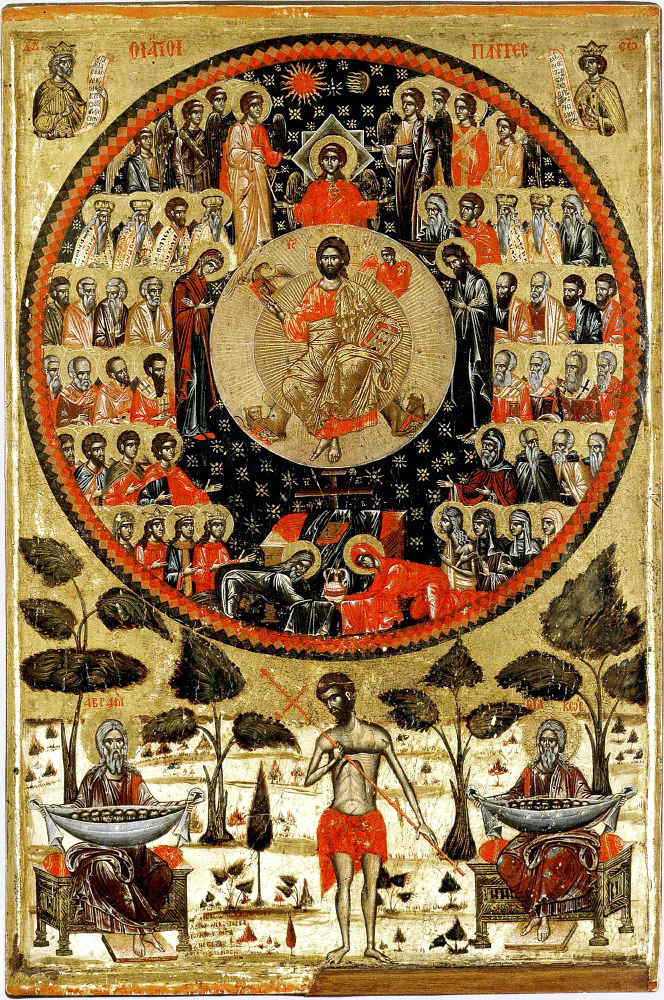
Communion of Saints
Greek icon
7
posted on
06/16/2024 9:04:57 AM PDT
by
annalex
(fear them not)
To: annalex
June 16
Saint of the day:
Saint Benno of Meissen
Patron Saint of fishermen, weavers, Dresden-Meissen, Munich
Saint Benno of Meissen's Story
Little is known of Benno's early life. Born in Hildesheim, it is reported that he was the scion of a Saxon noble family, such as the Woldenburgs; and may have been educated at the monastery of St. Michael in Hildesheim. However it is certain that Benno was a canon of the Goslar chapter. In 1066 he was nominated by King Henry IV to the episcopal see of Meissen. Benno appears as a supporter of the Saxon Rebellion in 1073, though the chronicler Lambert of Hersfeld and other contemporary authorities attribute little weight to his share in it. Henry IV exiled Benno in 1075, but allowed him to return to his see the following year. During the fierce Investiture Controversy, Benno supported Pope Gregory, and allegedly took part in the election of antiking Rudolf of Rheinfelden in 1077. After Rudolf's death he turned to the new antiking Hermann of Salm and was accordingly excommunicated and deprived of his bishopric by the 1085 Synod of Mainz. Benno betook himself to Archbishop Guibert of Ravenna, supported by Henry as Antipope Clement III, and by a penitent acknowledgment of his offences obtained from him both absolution and a letter of commendation to Henry, on the basis of which he was restored to his see. Benno promised, apparently, to use his influence for peace with the Saxons, but again failed to keep his promise, returning in 1097 to the papal party and recognizing Urban II as the rightful pope. With this he disappears from authentic history; there is no evidence to support the later stories of his missionary activity and zeal for church-building and for ecclesiastical music. Benno died of natural causes on June 16, 1106.
Benno did much for his diocese, both by ecclesiastical reforms on the Hildebrandine model and by material developments. Benno enjoyed veneration in his native Saxony throughout the later Middle Ages. Adrian VI issued the bull of canonization in 1523. Although Benno's sainthood had little to do with Luther's call for reform, once canonized he became a symbol for both sides of the reforming debate: Luther reviled him in early tracts against the cult of the saints. Catholic reformers turned him into a model of orthodoxy; and after Protestant mobs desecrated Benno's tomb in Meissen in 1539, the Wittelsbach dynasty ultimately made him patron saint of Munich and Old Bavaria. For his part, the English Protestant John Foxe eagerly repeated the charges which Benno, who opposed Gregory VII, made against Henry IV during the Investiture Controversy, such as necromancy, torture of a former friend upon a bed of nails, commissioning an attempted assassination, executions without trials, unjust excommunication, doubting the Real Presence in the Eucharist, and even burning it. Benno's feast day is 16 June. He is the patron-saint of anglers and weavers. His iconographic figures include a fish with keys in its mouth and a book. The reason for the fish is a legend that upon the excommunication of Henry IV the bishop told his canons to throw the keys to the cathedral into the Elbe; later a fisherman found the keys in a fish and brought them to the bishop.
saintsfeastfamily.com
8
posted on
06/16/2024 9:13:02 AM PDT
by
annalex
(fear them not)
To: annalex

St.Benno
Johann Michael Rottmayr (–1730)
Alte Pinakothek
9
posted on
06/16/2024 9:16:17 AM PDT
by
annalex
(fear them not)
To: annalex
NAVARRE BIBLE COMMENTARY (RSV)
Ad Majorem Dei Gloriam (To the Greater Glory of God)
First Reading:
From: Ezekiel 17:22-24
The allegory come true (Continued)
--------------------------------------------------
[22] Thus says the Lord GOD: "I myself will take a sprig from the lofty top of the cedar, and will set it out; I will break off from the topmost of its young twigs a tender one, and I myself will plant it upon a high and lofty mountain; [23] on the mountain height of Israel will I plant it, that it may bring forth boughs and bear fruit, and become a noble cedar; and under it will dwell all kinds of beasts; in the shade of its branches birds of every sort will nest. [24] And all the trees of the field shall know that I the LORD bring low the high tree, and make high the low tree, dry up the green tree, and make the dry tree flourish. I the LORD have spoken, and I will do it."
****************************************
Commentary:
17:22-24. Chapters 15-17 contain a number of allegories. The special feature of the cedar tree allegory describing the eventual restoration is the way it puts the stress on God's action by explicitly repeating the first person singular: "I myself", "I the Lord will bring low", "I the Lord have spoken". Some commentators think that these verses might have been inserted in the text later, but the style and content of the oracle are perfectly in line with Ezekiel's thinking.
"In the shade of its branches birds of every sort will rest" (v. 23): the same words are used in the account of the flood about all sorts of birds entering Noah's ark. It points therefore to the eschatological nature of the oracle: after the exile, just as after the flood, everything will be completely new, although it will derive from something that already existed. Also, the reference to "birds of every sort" points to the catholic nature of the new Israel. It is no surprise therefore that our Lord should use similar imagery to describe the Kingdom of God: it is like a grain of mustard seed that grows and "becomes a tree, so that the birds of the air come and make nests in its branches" (Mt 13:32).
"I the Lord bring low the high tree" (v. 24): here again we see the Lord as the protagonist in the history of the chosen people. He is the author of life, which makes what is dry flourish, and of death, which withers the green tree. He has set his might against those who, in their arrogance, do not accept him (cf. 31:10-14). The New Testament will have much to say about the value of humility; for example: "whoever exalts himself will be humbled, and whoever humbles himself will be exalted" (Mt 23:12).
10
posted on
06/16/2024 4:14:18 PM PDT
by
fidelis
(Ecce Crucem Domini! Fugite partes adversae! Vicit Leo de tribu Juda, Radix David! Alleluia!)
Second Reading:From: 2 Corinthians 5:6-10
He is sustained by hope of heaven
-----------------------------------------
[6] So we are always of good courage; we know that while we are at home in the body we are away from the Lord, [7] for we walk by faith, not by sight. [8] We are of good courage, and we would rather be away from the body and at home with the Lord. [9] So whether we are at home or away, we make it our aim to please him. [10] For we must all appear before the judgment seat of Christ, so that each one may receive good or evil, according to what he has done in the body.
******************************************
Commentary:
6. St Alphonsus says apropos of this verse: "This is not our fatherland; we are here, as it were, passing through, like pilgrims [. . .]. Our fatherland is heaven, which we have to merit by God's grace and our own good actions. Our home is not the one we live in at present, which serves only as a temporary dwelling; our home is eternity" (Shorter Sermons, XVI).
However, as St Paul himself shows elsewhere (cf. Acts 16:16-40; 22:22-29; Rom 13:1-7; 2 Thess 3:6:13), this "being away" from the Lord does not mean that a Christian should not concern himself with the building up of the earthly city. On the contrary, he should do everything he can to build a world which is more and more like what God wants it to be. Vatican II, for example, exhorts "Christians, as citizens of both cities, to perform their duties faithfully in the spirit of the Gospel. It is a mistake to think that, because we have here no lasting city, but seek the city which is to come (cf. Heb 13:14), we are entitled to shirk our responsibilities; this is to forget that, by our faith, we are bound all the more to fulfil these responsibilities according to the vocation of each one (cf. 2 Thess 3:6-13; Eph 4:28) [.. .]. The Christian who shirks his temporal duties shirks his duties towards his neighbour, neglects God himself and endangers his eternal salvation. Let Christians follow the example of Christ who worked as a craftsman; let them be proud of the opportunity to carry out their earthly activity in such a way as to integrate human, domestic, professional, scientific and technical enterprises with religious values, under whose supreme direction all things are ordered to the glory of God" (Gaudium et spes, 43).
7. St Paul here speaks of faith as light which shows us the way as we progress towards eternal life. However, when we reach our home in heaven we will no longer need the light of faith, because God himself and Christ will be our light (cf. Rev 21:23).
8-10. Here we can see the Apostle's firm conviction that he will meet the Lord the moment he dies. In other passages of Sacred Scripture the same truth is stated (cf. Lk 16:22-23; 23:43), and the Magisterium of the Church has defined that souls will receive their eternal reward or punishment immediately after death -- or after they pass through purgatory, if they have to do so (cf. Benedict XII, "Benedictus Deus, Dz-Sch", 1000).
This sentence of reward or punishment -- given at the particular judgment and ratified at the general judgment at the end of time -- is based on the person's merits gained during his life on earth, for once he has died he can no longer merit. In view of this judgment St Paul exhorts us to do everything we can in this life to please the Lord. "Does your soul not burn with the desire to make your Father-God happy when he has to judge you?" (St J. Escrivá, "The Way", 746).
11
posted on
06/16/2024 4:14:37 PM PDT
by
fidelis
(Ecce Crucem Domini! Fugite partes adversae! Vicit Leo de tribu Juda, Radix David! Alleluia!)
Gospel Reading:From: Mark 4:26-34
Parables of the Seed and of the Mustard Seed
--------------------------------------------
[26] And He (Jesus) said, "The Kingdom of God is as if a man should scatter seed upon the ground, [27] and should sleep and rise night and day, and the seed should sprout and grow, he knows not how. [28] The earth produces of itself, first the blade, then the ear, then the full grain in the ear. [29] But when the grain is ripe, at once he puts in the sickle, because the harvest is come."
[30] And He said, "With what can we compare the Kingdom of God, or what parable shall we use for it? [31] It is like a grain of mustard seed, which, when sown upon the ground, is the smallest of all the seeds on earth; [32] yet when it is sown it grows up and becomes the greatest of all shrubs, and puts forth large branches, so that the birds of the air can make nests in its shade."
The End of the Parables Discourse
---------------------------------
[33] With many such parables He spoke the word to them, as they were able to hear it; [34] He did not speak to them without a parable, but privately to His own disciples He explained everything.
***********************************************************************
Commentary:
26-29. Farmers spare no effort to prepare the ground for the sowing; but once the grain is sown there is nothing more they can do until the harvest; the grain develops by itself. Our Lord uses this comparison to describe the inner strength that causes the Kingdom of God on earth to grow up to the day of harvest (cf. Joel 3:13 and Revelation 14:15), that is, the day of the Last Judgment.
Jesus is telling His disciples about the Church: the preaching of the Gospel, the generously sown seed, will unfailingly yield its fruit, independently of who sows or who reaps: it is God who gives the growth (cf. 1 Corinthians 3:5-9). It will all happen "he knows not how", without men being fully aware of it.
The Kingdom of God also refers to the action of grace in each soul: God silently works a transformation in us, whether we sleep or watch, causing resolutions to take shape in our soul--resolutions to be faithful, to surrender ourselves, to respond to grace--until we reach "mature manhood" (cf. Ephesians 4:13). Even though it is necessary for man to make this effort, the real initiative lies with God, "because it is the Holy Spirit who, with His inspirations, gives a supernatural tone to our thoughts, desires and actions. It is He who leads us to receive Christ's teaching and to assimilate it in a profound way. It is He who gives us the light by which we perceive our personal calling and the strength to carry out all that God expects of us. If we are docile to the Holy Spirit, the image of Christ will be found more and more fully in us, and we will be brought closer every day to God the Father. `For whoever are led by the Spirit of God, they are the children of God' (Romans 8:14)" (St J. Escriva, "Christ Is Passing By", 135).
30-32. The main meaning of this parable has to do with the contrast between the great and the small. The seed of the Kingdom of God on earth is something very tiny to begin with (Luke 12:32; Acts 1:15); but it will grow to be a big tree. Thus we see how the small initial group of disciples grows in the early years of the Church (cf Acts 2:47; 6:7; 12:24), and spreads down the centuries and becomes a great multitude "which no man could number" (Revelation 7:9). This mysterious growth which our Lord refers to also occurs in each soul: "the Kingdom of God is in the midst of you" (Luke 17:21); we can see a prediction of this in the words of Psalm 92:12: "The righteous grow like a cedar in Lebanon." To allow the mercy of God to exalt us, to make us grow, we must make ourselves small, humble (Ezekiel 17:22-24; Luke 18:9-14).
12
posted on
06/16/2024 4:15:12 PM PDT
by
fidelis
(Ecce Crucem Domini! Fugite partes adversae! Vicit Leo de tribu Juda, Radix David! Alleluia!)
To: fidelis
13
posted on
06/16/2024 4:24:43 PM PDT
by
fidelis
(Ecce Crucem Domini! Fugite partes adversae! Vicit Leo de tribu Juda, Radix David! Alleluia!)
To: fidelis
14
posted on
06/16/2024 4:30:12 PM PDT
by
fidelis
(Ecce Crucem Domini! Fugite partes adversae! Vicit Leo de tribu Juda, Radix David! Alleluia!)
To: fidelis
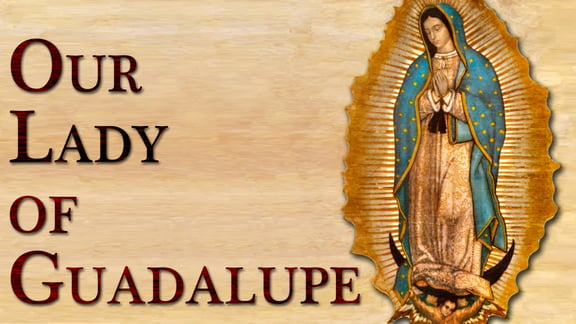 Please join Cardinal Burke’s novena to Our Lady of Guadalupe for ‘crises of our age’ (Started March 12—Never too late to join!)
Let us pray.
O Virgin Mother of God, we fly to your protection and beg your intercession against the darkness and sin which ever more envelop the world and menace the Church. Your Son, Our Lord Jesus Christ, gave you to us as our mother as He died on the Cross for our salvation. So too, in 1531, when darkness and sin beset us, He sent you, as Our Lady of Guadalupe, on Tepeyac to lead us to Him Who alone is our light and our salvation.
Through your apparitions on Tepeyac and your abiding presence with us on the miraculous mantle of your messenger, Saint Juan Diego, millions of souls converted to faith in your Divine Son. Through this novena and our consecration to you, we humbly implore your intercession for our daily conversion of life to Him and the conversion of millions more who do not yet believe in Him. In our homes and in our nation, lead us to Him Who alone wins the victory over sin and darkness in us and in the world.
Unite our hearts to your Immaculate Heart so that they may find their true and lasting home in the Most Sacred Heart of Jesus. Ever guide us along the pilgrimage of life to our eternal home with Him. So may our hearts, one with yours, always trust in God's promise of salvation, in His never-failing mercy toward all who turn to Him with a humble and contrite heart. Through this novena and our consecration to you, O Virgin of Guadalupe, lead all souls in America and throughout the world to your Divine Son in Whose name we pray. Amen.
15
posted on
06/16/2024 4:30:48 PM PDT
by
fidelis
(Ecce Crucem Domini! Fugite partes adversae! Vicit Leo de tribu Juda, Radix David! Alleluia!)
To: fidelis
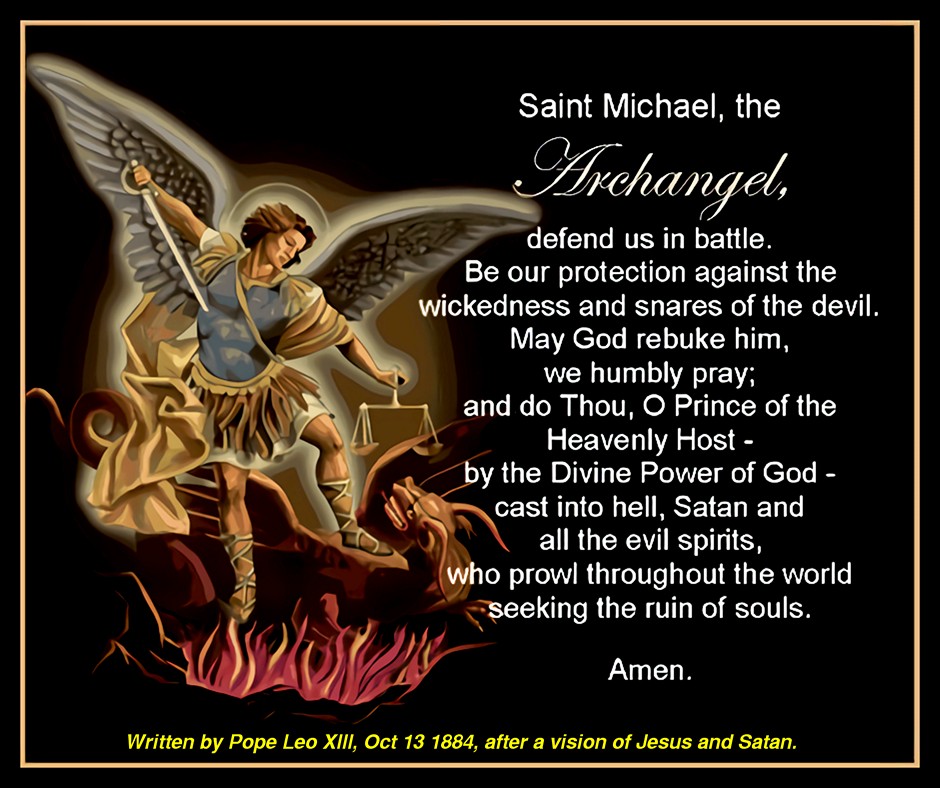
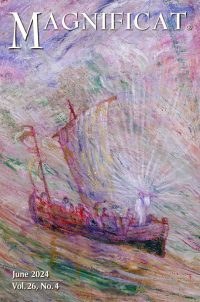
“Almighty Father, you are our strength in the fight against evil. Guard us against all the deceits of the enemy, that we may serve you in this world and in the next. Through Christ our Lord. Amen.” (From Magnificat magazine)
16
posted on
06/16/2024 4:31:43 PM PDT
by
fidelis
(Ecce Crucem Domini! Fugite partes adversae! Vicit Leo de tribu Juda, Radix David! Alleluia!)
To: fidelis
17
posted on
06/16/2024 4:32:10 PM PDT
by
fidelis
(Ecce Crucem Domini! Fugite partes adversae! Vicit Leo de tribu Juda, Radix David! Alleluia!)
June is the month of devotion to the Sacred Heart of Jesus: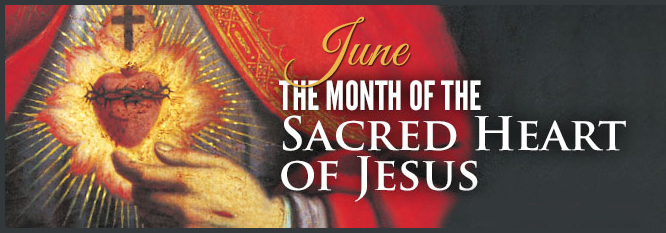
"Come to me, all who labor and are heavy laden, and I will give you rest. Take my yoke upon you, and learn from me; for I am gentle and lowly in heart, and you will find rest for your souls. For my yoke is easy, and my burden is light.”
(Matthew 11:28-30)
18
posted on
06/16/2024 4:32:40 PM PDT
by
fidelis
(Ecce Crucem Domini! Fugite partes adversae! Vicit Leo de tribu Juda, Radix David! Alleluia!)
19
posted on
06/16/2024 4:33:19 PM PDT
by
fidelis
(Ecce Crucem Domini! Fugite partes adversae! Vicit Leo de tribu Juda, Radix David! Alleluia!)
Disclaimer:
Opinions posted on Free Republic are those of the individual
posters and do not necessarily represent the opinion of Free Republic or its
management. All materials posted herein are protected by copyright law and the
exemption for fair use of copyrighted works.
FreeRepublic.com is powered by software copyright 2000-2008 John Robinson