Posted on 10/23/2022 3:25:50 AM PDT by Cronos
30th Sunday in Ordinary Time
Readings at MassLiturgical Colour: Green
The humble man's prayer pierces the cloudsThe Lord is a judge who is no respecter of personages. He shows no respect of personages to the detriment of a poor man, he listens to the plea of the injured party. He does not ignore the orphan’s supplication, nor the widow’s as she pours out her story. The man who with his whole heart serves God will be accepted, his petitions will carry to the clouds. The humble man’s prayer pierces the clouds, until it arrives he is inconsolable, And the Lord will not be slow, nor will he be dilatory on their behalf.
This poor man called; the Lord has heard him. I will bless the Lord at all times, his praise always on my lips; in the Lord my soul shall make its boast. The humble shall hear and be glad. This poor man called; the Lord has heard him. The Lord turns his face against the wicked to destroy their remembrance from the earth. The just call and the Lord hears and rescues them in all their distress. This poor man called; the Lord has heard him. The Lord is close to the broken-hearted; those whose spirit is crushed he will save. The Lord ransoms the souls of his servants. Those who hide in him shall not be condemned. This poor man called; the Lord has heard him.
All there is to come now is the crown of righteousness reserved for meMy life is already being poured away as a libation, and the time has come for me to be gone. I have fought the good fight to the end; I have run the race to the finish; I have kept the faith; all there is to come now is the crown of righteousness reserved for me, which the Lord, the righteous judge, will give to me on that Day; and not only to me but to all those who have longed for his Appearing. The first time I had to present my defence, there was not a single witness to support me. Every one of them deserted me – may they not be held accountable for it. But the Lord stood by me and gave me power, so that through me the whole message might be proclaimed for all the pagans to hear; and so I was rescued from the lion’s mouth. The Lord will rescue me from all evil attempts on me, and bring me safely to his heavenly kingdom. To him be glory for ever and ever. Amen.
Alleluia, alleluia! Blessed are you, Father, Lord of heaven and earth, for revealing the mysteries of the kingdom to mere children. Alleluia!
Alleluia, alleluia! God in Christ was reconciling the world to himself, and he has entrusted to us the news that they are reconciled. Alleluia!
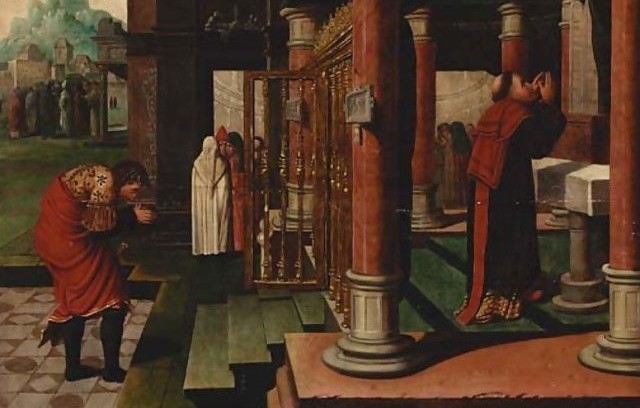
The tax collector, not the Pharisee, went home justified.Jesus spoke the following parable to some people who prided themselves on being virtuous and despised everyone else: ‘Two men went up to the Temple to pray, one a Pharisee, the other a tax collector. The Pharisee stood there and said this prayer to himself, “I thank you, God, that I am not grasping, unjust, adulterous like the rest of mankind, and particularly that I am not like this tax collector here. I fast twice a week; I pay tithes on all I get.” The tax collector stood some distance away, not daring even to raise his eyes to heaven; but he beat his breast and said, “God, be merciful to me, a sinner.” This man, I tell you, went home again at rights with God; the other did not. For everyone who exalts himself will be humbled, but the man who humbles himself will be exalted.’ The readings on this page are from the Jerusalem Bible, which is used at Mass in most of the English-speaking world. The New American Bible readings, which are used at Mass in the United States, are available in the Universalis apps, programs and downloads. You can also view this page with the Gospel in Greek and English. |
catholic, prayer, ordinarytime, lk18a
Please FReepmail me/annalex to get on/off the Alleluia Ping List.
Feel free to add your content, so long as it conforms with the rules of the Catholic Caucus. For example, post your prayers, thoughts, art that you like.

9. And he spake this parable unto certain which trusted in themselves that they were righteous, and despised others:
10. Two men went up into the temple to pray; the one a Pharisee, and the other a Publican.
11. The Pharisee stood and prayed thus with himself, God, I thank thee, that I am not as other men are, extortioners, unjust, adulterers, or even as this Publican.
12. I fast twice in the week, I give tithes of all that I possess.
13. And the Publican, standing afar off, would not lift up so much as his eyes unto heaven, but smote upon his breast, saying, God be merciful to me a sinner.
14. I tell you, this man went down to his house justified rather than the other: for every one that exalteth himself shall be abased; and he that humbleth himself shall be exalted.
AUGUSTINE. (Serm. 115.) Since faith is not a gift of the proud but of the humble, our Lord proceeds to add a parable concerning humility and against pride.
THEOPHYLACT. Pride also beyond all other passions disturbs the mind of man. And hence the very frequent warnings against it. It is moreover a contempt of God; for when a man ascribes the good he doth to himself and not to God, what else is this but to deny God? For the sake then of those that so trust in themselves, that they will not ascribe the whole to God, and therefore despise others, He puts forth a parable, to shew that righteousness, although it may bring man up to God, yet if he is clothed with pride, casts him down to hell.
GREEK EXPOSITOR. (Asterius.) To be diligent in prayer was the lesson taught by our Lord in the parable of the widow and the judge, He now instructs us how we should direct our prayers to Him, in order that our prayers may not be fruitless. The Pharisee was condemned because he prayed heedlessly. As it follows, The Pharisee stood and prayed with himself.
THEOPHYLACT. It is said “standing,” to denote his haughty temper. For his very posture betokens his extreme pride.
BASIL. (in Esai. c. 2.) “He prayed with himself,” that is, not with God, his sin of pride sent him back into himself. It follows, God, I thank thee.
AUGUSTINE. (Serm. 115.) His fault was not that he gave God thanks, but that he asked for nothing further. Because thou art full and aboundest, thou hast no need to say, Forgive us our debts. What then must be his guilt who impiously fights against grace, when he is condemned who proudly gives thanks? Let those hear who say, “God has made me man, I made myself righteous. O worse and more hateful than the Pharisee, who proudly called himself righteous, yet gave thanks to God that he was so.
THEOPHYLACT. Observe the order of the Pharisee’s prayer. He first speaks of that which he had not, and then of that which he had. As it follows, That I am not as other men are.
AUGUSTINE. (ut sup.) He might at least have said, “as many men;” for what does he mean by “other men,” but all besides himself? “I am righteous, he says, the rest are sinners.”
GREGORY. (23. Mor. c. 6.) There are different shapes in which the pride of self-confident men presents itself; when they imagine that either the good in them is of themselves; or when believing it is given them from above, that they have received it for their own merits; or at any rate when they boast that they have that which they have not. Or lastly, when despising others they aim at appearing singular in the possession of that which they have. And in this respect the Pharisee awards to himself especially the merit of good works.
AUGUSTINE. (ut sup.) See how he derives from the Publican near him a fresh occasion for pride. It follows, Or even as this Publican; as if he says, “I stand alone, he is one of the others.”
CHRYSOSTOM. (Hom. 2. de Pœn.) To despise the whole race of man was not enough for him; he must yet attack the Publican. He would have sinned, yet far less if he had spared the Publican, but now in one word he both assails the absent, and inflicts a wound on him who was present. (Hom. 3. in Matt.). To give thanks is not to heap reproaches on others. When thou returnest thanks to God, let Him be all in all to thee. Turn not thy thoughts to men, nor condemn thy neighbour.
BASIL. (ubi sup.) The difference between the proud man and the scorner is in the outward form alone. The one is engaged in reviling others, the other in presumptuously extolling himself.
CHRYSOSTOM. He who rails at others does much harm both to himself and others. First, those who hear him are rendered worse, for if sinners they are made glad in finding one as guilty as themselves, if righteous, they are exalted, being led by the sins of others to think more highly of themselves. Secondly, the body of the Church suffers; for those who hear him are not all content to blame the guilty only, but to fasten the reproach also on the Christian religion. Thirdly, the glory of God is evil spoken of; for as our well-doing makes the name of God to be glorified, so our sins cause it to be blasphemed. Fourthly, the object of reproach is confounded and becomes more reckless and immoveable. Fifthly, the ruler is himself made liable to punishment for uttering things which are not seemly.
THEOPHYLACT. It becomes us not only to shun evil, but also to do good; and so after having said, I am not as other men are, extortioners, unjust, adulterers, he adds something by way of contrast, I fast twice in a week. They called the week the Sabbath, (Sabbatho) from the last day of rest. The Pharisees fasted upon the second and fifth day. He therefore set fasting against the passion of adultery, for lust is born of luxury; but to the extortioners and usurists he opposed the payment of tithes; as it follows, I give tithes of all I possess; as if he says, So far am I from indulging in extortion or injuring, that I even give up what is my own.
GREGORY. (19. Mor. c. 21.) So it was pride that laid bare to his wily enemies the citadel of his heart, which prayer and fasting had in vain kept closed. Of no use are all the other fortifications, as long as there is one place which the enemy has left defenceless.
AUGUSTINE. If you look into his words, you will find that he asked nothing of God. He goes up indeed to pray, but instead of asking God, praises himself, and even insults him that asked. The Publican, on the other hand, driven by his stricken conscience afar off, is by his piety brought near.
THEOPHYLACT. Although reported to have stood, the Publican yet differed from the Pharisee, both in his manner and his words, as well as in his having a contrite heart. For he feared to lift up his eyes to heaven, thinking unworthy of the heavenly vision those which had loved to gaze upon and wander after earthly things. He also smote his breast, striking it as it were because of the evil thoughts, and moreover rousing it as if asleep. And thus he sought only that God would be reconciled to him, as it follows, saying, God, be merciful.
CHRYSOSTOM. He heard the words, that I am not as the Publican. He was not angry, but pricked to the heart. The one uncovered the wound, the other seeks for its remedy. Let no one then ever put forth so cold an excuse as, I dare not, I am ashamed, I cannot open my mouth. The devils have that kind of fear. The devil would fain close against thee every door of access to God.
AUGUSTINE. (Serm. 115.) Why then marvel ye, whether God pardons, since He himself acknowledges it. The Publican stood afar off, yet drew near to God. And the Lord was nigh unto him, and heard him, For the Lord is on high, yet hath he regard to the lowly. He lifted not so much as his eyes to heaven; that he might be looked upon, he looked not himself. Conscience weighed him down, hope raised him up, he smote his own breast, he exacted judgment upon himself. Therefore did the Lord spare the penitent. Thou hast heard the accusation of the proud, thou hast heard the humble confession of the accused. Hear now the sentence of the Judge; Verily I say unto you, this man went down to his house justified rather than the other.
CHRYSOSTOM. (de Inc. Dei Nat. Hom. 5.) This parable represents to us two chariots on the race course, each with two charioteers in it. In one of the chariots it places righteousness with pride, in the other sin and humility. You see the chariot of sin outstrip that of righteousness, not by its own strength but by the excellence of humility combined with it, but the other is defeated not by righteousness, but by the weight and swelling of pride. For as humility by its own elasticity rises above the weight of pride, and leaping up reaches to God, so pride by its great weight easily depresses righteousness. Although therefore thou art earnest and constant in well doing, yet thinkest thou mayest boast thyself, thou art altogether devoid of the fruits of prayer. But thou that bearest a thousand loads of guilt on thy conscience, and only thinkest this thing of thyself that thou art the lowest of all men, shalt gain much confidence before God. And He then goes on to assign the reason of His sentence. For every one who exalteth himself shall be abased, and he that humbleth himself shall be exalted. (in Ps. 142). The word humility has various meanings. There is the humility of virtue, as, A humble and contrite heart, O God, thou wilt not despise. (Ps. 51:17.) There is also a humility arising from sorrows, as, He has humbled my life upon the earth. (Ps. 142:3.) There is a humility derived from sin, and the pride and insatiability of riches. For can any thing be more low and debased than those who grovel in riches and power, and count them great things?
BASIL. (in Esai 2. 12.) In like manner it is possible to be honourably elated when your thoughts indeed are not lowly, but your mind by greatness of soul is lifted up towards virtue. This loftiness of mind is seen in a cheerfulness amidst sorrow; or a kind of noble dauntlessness in trouble; a contempt of earthly things, and a conversation in heaven. And this loftiness of mind seems to differ from that elevation which is engendered of pride, just as the stoutness of a well-regulated body differs from the swelling of the flesh which proceeds from dropsy.
CHRYSOSTOM. (Hom. de Prof. Ev.) This inflation of pride can cast down even from heaven the man that taketh not warning, but humility can raise a man up from the lowest depth of guilt. The one saved the Publican before the Pharisee, and brought the thief into Paradise before the Apostles; the other entered even into the spiritual powers. But if humility though added to sin has made such rapid advances, as to pass by pride united to righteousness, how much swifter will be its course when you add to it righteousness? It will stand by the judgment-seat of God in the midst of the angels with great boldness. Moreover if pride joined to righteousness had power to depress it, unto what a hell will it thrust men when added to sin? This I say not that we should neglect righteousness, but that we should avoid pride.
THEOPHYLACT. But should any one perchance marvel that the Pharisee for uttering a few words in his own praise is condemned, while Job, though he poured forth many, is crowned, I answer, that the Pharisee spoke these at the same time that he groundlessly accused others; but Job was compelled by an urgent necessity to enumerate his own virtues for the glory of God, that men might not fall away from the path of virtue.
BEDE. Typically, the Pharisee is the Jewish people, who boast of their ornaments because of the righteousness of the law; but the Publican is the Gentiles, who being at a distance from God confess their sins. Of whom the one for His pride returned humbled, the other for his contrition was thought worthy to draw near and be exalted.
| Luke | |||
| English: Douay-Rheims | Latin: Vulgata Clementina | Greek NT: Byzantine/Majority Text (2000) | |
| Luke 18 | |||
| 9. | And to some who trusted in themselves as just, and despised others, he spoke also this parable: | Dixit autem et ad quosdam qui in se confidebant tamquam justi, et aspernabantur ceteros, parabolam istam : | ειπεν δε προς τινας τους πεποιθοτας εφ εαυτοις οτι εισιν δικαιοι και εξουθενουντας τους λοιπους την παραβολην ταυτην |
| 10. | Two men went up into the temple to pray: the one a Pharisee, and the other a publican. | Duo homines ascenderunt in templum ut orarent : unus pharisæus et alter publicanus. | ανθρωποι δυο ανεβησαν εις το ιερον προσευξασθαι ο εις φαρισαιος και ο ετερος τελωνης |
| 11. | The Pharisee standing, prayed thus with himself: O God, I give thee thanks that I am not as the rest of men, extortioners, unjust, adulterers, as also is this publican. | Pharisæus stans, hæc apud se orabat : Deus, gratias ago tibi, quia non sum sicut ceteri hominum : raptores, injusti, adulteri, velut etiam hic publicanus : | ο φαρισαιος σταθεις προς εαυτον ταυτα προσηυχετο ο θεος ευχαριστω σοι οτι ουκ ειμι ωσπερ οι λοιποι των ανθρωπων αρπαγες αδικοι μοιχοι η και ως ουτος ο τελωνης |
| 12. | I fast twice in a week: I give tithes of all that I possess. | jejuno bis in sabbato, decimas do omnium quæ possideo. | νηστευω δις του σαββατου αποδεκατω παντα οσα κτωμαι |
| 13. | And the publican, standing afar off, would not so much as lift up his eyes towards heaven; but struck his breast, saying: O god, be merciful to me a sinner. | Et publicanus a longe stans, nolebat nec oculos ad cælum levare : sed percutiebat pectus suum, dicens : Deus propitius esto mihi peccatori. | και ο τελωνης μακροθεν εστως ουκ ηθελεν ουδε τους οφθαλμους εις τον ουρανον επαραι αλλ ετυπτεν εις το στηθος αυτου λεγων ο θεος ιλασθητι μοι τω αμαρτωλω |
| 14. | I say to you, this man went down into his house justified rather that the other: because every one that exalteth himself, shall be humbled: and he that humbleth himself, shall be exalted. | Dico vobis, descendit hic justificatus in domum suam ab illo : quia omnis qui se exaltat, humiliabitur, et qui se humiliat, exaltabitur. | λεγω υμιν κατεβη ουτος δεδικαιωμενος εις τον οικον αυτου η γαρ εκεινος οτι πας ο υψων εαυτον ταπεινωθησεται ο δε ταπεινων εαυτον υψωθησεται |
Ad Majorem Dei Gloriam (To the Greater Glory of God)
From: Sirach 35:12-14, 16-18
Worship pleasing to God
--------------------------------
[12] Do not offer him a bribe, for he will not accept it; and do not trust to an unrighteous sacrifice; for the Lord is the judge, and with him is no partiality. [13] He will not show partiality in the case of a poor man; and he will listen to the prayer of the one who is wronged. [14] He will not ignore the supplication of the fatherless, nor the widow when she pours out her story. [16] He whose service is pleasing to the Lord will be accepted, and his prayer will reach to the clouds. [17] The prayer of the humble pierces the clouds, and he will not be consoled until it reaches the Lord; he will not desist until the Most high visits him, and does justice for the righteous, and executes judgment.
****************************************************
Commentary:
[35:11-20.] From 35:11 on, the Lord is the subject of the sentences. Ben Sirach tells us who God is: he pays well (35:11), he is a just judge (35:11-15), who rewards a person according to his works; and he identifies the person whom God listens to—the generous giver (35:11), the one who is wronged (35:13), the orphan and the widow (35:14), the one who serves Him (35:16), the humble person (35:17). Most of these qualities (those of God as well of those of people who have recourse to him) can be found, all together, in Jesus’ attitude to the sick, to sinners and to the poor.

The Crown of Righteousness
------------------------------------
[6] For I am already on the point of being sacrificed; the time of my departure has come. [7] I have fought the good fight, I have finished the race, I have kept the faith. [8] Henceforth there is laid up for me the crown of righteousness, which the Lord, the righteous judge, will award to me on that Day, and not only to me but also to all who have loved his appearing.
[16] At my first defense no one took my part; all deserted me. May it not be charged against them! [17] For the Lord stood by me and gave me strength to proclaim the word fully, that all the Gentiles might hear it. So I was rescued from the lion's mouth. [18] The Lord will rescue me from every evil and save me for his heavenly kingdom. To him be glory for ever and ever. Amen.
***********************************************************************
Commentary:
6-8. Conscious of his closeness to death, St Paul writes in poetic strain about his life in the service of the Gospel, about the meaning of death and his hope of heaven. The imagery he uses shows how he interprets his experience in the light of faith. "On the point of being sacrificed": literally "poured out in sacrifice": death is an offering to God, like the libations of oil poured on the altar of sacrifices. Death is the beginning of a journey: "the point of my departure has come", the anchor is being weighed, the sails unfurled.
The Christian life is like magnificent Games taking place in the presence of God, who acts as the judge. In Greece the Games had close connections with religious worship; St Paul presents the Christian life as a type of spiritual sport: "races" indicates the continuous effort to achieve perfection (cf. Phil 3:14); training for athletics indicates the practice of self-denial (cf. 1 Cor 9:26-27); fighting stands for the effort required to resist sin even if that means death, as can happen in the event of persecution (cf. Heb 12:4). It is well worthwhile taking part in this competition, because, as St John Chrysostom points out, "the crown which it bestows never withers. It is not made of laurel leaves, it is not a man who places it on our head, it has not been won in the presence of a crowd made up of men, but in a stadium full of angels. In earthly competitions a man fights and strives for days and the only reward he receives is a crown which withers in a matter of hours [. . .]. That does not happen here: the crown he is given is a glory and honor whose brilliance lasts forever ("Hom. on 2 Tim, ad loc".).
All Christians who "have loved his appearing", that is, who stay true to Christ, share St Paul's expectation of eternal life. "We who know about the eternal joys of the heavenly fatherland should hasten to reach it by the more direct route" (St Gregory the Great, "In Evangelia Homiliae", 16).
9-18. In his letters St Paul often asks people to do things for him; his messages here are particularly moving, given as they are on the eve of his martyrdom. He is following the example of Christ: he puts his trust in God even though his friends desert him (vv. 10-12, 16); his enemies harass him more than ever, yet he forgives them (vv. 14, 16); in the midst of his sufferings he praises the Lord (v. 18). His mention of Thessalonica, Galatia, Dalmatia, Ephesus, Troas, Corinth and Miletus show how warmly he remembers places which were very receptive to the Christian message. These few verses constitute a mini-biography.
16-17. St Paul points to the contrast between the way men treat him and the way God does. Because of the hazards involved in staying with Paul or defending him, some of his friends, even some of his closest friends, have deserted him; whereas God stays by his side.
"You seek the company of friends who, with their conversation and affection, with their friendship, make the exile of this world more bearable for you. There is nothing wrong with that, although friends sometimes let you down. But how is it you don't frequent daily with greater intensity the company, the conversation, of the great Friend, who never lets you down?" (St J. Escriva, "The Way", 88).
Parable of the Pharisee and the Tax Collector
----------------------------------------------------------
[9] He (Jesus) also told this parable to some who trusted in themselves that they were righteous and despised others: [10] "Two men went up into the temple to pray, one a Pharisee and the other a tax collector. [11] The Pharisee stood and prayed thus with himself, `God, I thank Thee that I am not like other men, extortioners, unjust, adulterers, or even like this tax collector. [12] I fast twice a week, I give tithes of all that I get.' [13] But the tax collector, standing far off, would not even lift up his eyes to Heaven, but beat his breast, saying, `God, be merciful to me a sinner!' [14] I tell you, this man went down to his house justified rather than the other; for everyone who exalts himself will be humbled, but he who humbles himself will be exalted."
***********************************************************************
Commentary:
9-14. Our Lord here rounds off His teaching on prayer. In addition to being persevering and full of faith, prayer must flow from a humble heart, a heart that repents of its sins: "Cor contritum et humiliatum, Deus, non despicies" (Psalm 51:19); the Lord, who never despises a contrite and humble heart, resists the proud and gives His grace to the humble (cf. Peter 5:5; James 4:6).
The parable presents two opposite types--the Pharisee, who is so meticulous about external fulfillment of the Law; and the tax collector, who in fact is looked on as a public sinner (cf. Luke 19:7). The Pharisee's prayer is not pleasing to God, because his pride causes him to be self-centered and to despise others. He begins by giving thanks to God, but obviously it is not true gratitude, because he boasts about all the good he has done and he fails to recognize his sins; since he regards himself as righteous, he has no need of pardon, he thinks; and he remains in his sinful state; to him also apply these words spoken by our Lord to a group of Pharisees on another occasion: "If you were blind, you would have no guilt; but now that you say, `We see,' your guilt remains" (John 9:41). The Pharisee went down from the temple, therefore, unjustified.
But the tax collector recognizes his personal unworthiness and is sincerely sorry for his sins: he has the necessary dispositions for God to pardon him. His ejaculatory prayer wins God's forgiveness: "It is not without reason that some have said that prayer justifies; for repentant prayer or supplicant repentance, raising up the soul to God and re-uniting it to His goodness, without doubt obtains pardon in virtue of the holy love which gives it this sacred movement. And therefore we ought all to have very many such ejaculatory prayers, said as an act of loving repentance and with a desire of obtaining reconciliation with God, so that by thus laying our tribulation before our Savior, we may pour out our souls before and within His pitiful heart, which will receive them with mercy" (St. Francis de Sales, "Treatise on the Love of God", Book 2, Chapter 20).
Interesting that the icon shows two of each, even though the inscription contains “the Publican” and “the Pharisee” in singular.
We all are a bit of one and a bit of the other, the smart iconographer says.
Invoked as a patron of military chaplains, St. John of Capistrano was praised by St. John Paul II in a 2002 general audience for his “glorious evangelical witness,” as a priest who “gave himself with great generosity for the salvation of souls.”
Born in Italy during 1385, John lost his father – a French or possibly German knight who had settled in Capistrano – at a young age. John’s mother took care to have him educated, and after learning Latin he went to study both civil law and Church law in Perugia. An outstanding student, he soon became a prominent public figure and was appointed governor of the city at age 26.
John showed high standards of integrity in his civic career, and in 1416 he labored to end a war that had erupted between Perugia and the prominent House of Malatesta. But when the nobles had John imprisoned, he began to question his life’s direction. Encountering Saint Francis of Assisi in a dream, he resolved to embrace poverty, chastity, and obedience with the Franciscans.
Abandoning his possessions and social status, John joined the religious order in October 1416. He found a mentor in Saint Bernardine of Siena, known for his bold preaching and his method of prayer focused on the invocation of the name of Jesus. Taking after his teacher in these respects, John began preaching as a deacon in 1420, and was ordained a priest in 1425.
John successfully defended his mentor from a charge of heresy made against his way of devotion, though he found less success in his efforts to resolve internal controversy among the followers of St. Francis. A succession of popes entrusted important matters to John, including the effort to reunite Eastern and Western Christendom at the Ecumenical Council of Florence.
Drawing immense crowds in his missionary travels throughout Italy, John also found success as a preacher in Central Europe, where he opposed the Hussites’ error regarding the nature and administration of the Eucharist. After Constantinople fell to Turkish invaders in 1453, Pope Nicholas V sent John on a mission to rally other European leaders in defense of their lands.
Nicholas’ successor Pope Callixtus III was even more eager to see the Christian world defend itself against the invading forces. When the Sultan Mehmet II sought to extend his territorial gains into Serbia and Hungary, John joined the celebrated general Janos Hunyadi in his defense of Belgrade. The priest personally led a section of the army in its historic victory on Aug. 6, 1456.
Neither John nor the general, however, would survive long past the battle.
Weakened by the campaign against the Turks, Hunyadi became sick and died soon after the victory at Belgrade. John survived to preach Janos Hunyadi’s funeral sermon; but his own extraordinary life came to an end after a painful illness, on Oct. 23, 1456. St. John of Capistrano was canonized in 1724.

Yes, interesting icon!
Sunday Scripture Study for Catholics - 30th Sunday of Ordinary Time, Year C
Disclaimer: Opinions posted on Free Republic are those of the individual posters and do not necessarily represent the opinion of Free Republic or its management. All materials posted herein are protected by copyright law and the exemption for fair use of copyrighted works.