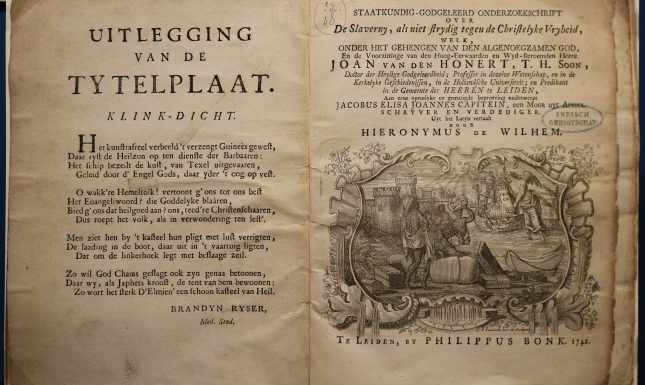
The rare "Slave Bible" on display in the Netherlands is seen here in its pre-conservation form. | Courtesy University of Glasgow
Posted on 10/18/2022 3:37:47 PM PDT by SeekAndFind
The rare "Slave Bible" on display in the Netherlands is seen here in its pre-conservation form. | Courtesy University of Glasgow
A rare edition "Slave Bible" — a heavily-edited version of Scripture with omitted references to anything that could promote freedom among enslaved people — is on display as part of a Dutch exhibition on gospel music.
One of only three known surviving copies, the Bible titled "Select parts of the Holy Bible for the use of the Negro Slaves in the British West-India Islands" was published in London in 1807 for Christian missionaries.
It's now part of an exhibition called "Gospel: Musical Journey of Spirit and Hope" at the Museum Catharijneconvent in Utrecht, Netherlands, known as the Dutch national museum for the art, culture and history of Christianity.
Among 12,000 books donated to the University of Glasgow by insurance broker William Euing in 1874, the Slave Bible was used by British missionaries in the British West Indies, among other places.
According to a museum spokesperson, it was in those locations that "Bible texts were used to legitimize slavery and other texts were censored and kept away from the enslaved."
"However, these measurements did not prevent faith from taking root on the plantations," the spokesperson added. "The passages about freedom that were omitted turned up in spirituals, the songs of enslaved people in the United States. We are very fortunate and proud that we can show this impressive object in our exhibition."
Julie Gardham, a senior assistant librarian at the University of Glasgow Library, said the "important and scarce" Bible is part of Scottish philanthropist William Euing's renowned library and is "one of some 3,000 Bibles that he collected in many different editions and languages."
While a standard King James Version Bible contains 1,189 chapters, the Slave Bible has only 282, among other differences.
"In omitting all references to freedom, it is a powerful and chilling reminder of how white Christians manipulated and misused even sacred texts to control the enslaved and legitimize slavery," said Gardham.
That includes the removal of the fifth chapter of Exodus, in which Moses demands Pharaoh set the Israelites free from captivity in Egypt before God makes way for them to leave.
The entire book of Jeremiah — which references "making … people work for nothing, not paying them for their labor" — is also omitted.
Among the removed verses is Exodus 21:16, which reads, "And he that stealeth a man, and selleth him, or if he be found in his hand, he shall surely be put to death."
Other passages, however, such as Ephesians 6:5, which reads, "Slaves, obey your earthly masters with respect and fear, and with sincerity of heart, just as you would obey Christ," are included in the book.
The copy itself has seen better days, however. The Bible's condition so deteriorated it had to be treated by the university's conservation team ahead of its transfer to the Netherlands so that it could be loaned for exhibition with minimal risk of further damage.
"The Bible had detached boards, splits in the sewing, and extensive losses to the fragile paper covering material. This meant that the Bible's condition could quickly worsen with very little handling," Keira McKee, a book conservator at the University of Glasgow, said.
McKee added that the conservation treatment stabilized each of these issues through a combination of linen threads and Japanese paper, retaining as much original material as possible.
The Slave Bible will remain on display in Utrecht until January 2023.
While the Bible contains numerous references to slavery, theologians have argued that context is essential when looking at Bible verses that appear to favor slavery.
In a video on the YouTube apologetics channel Reasons to Believe, Pastor Gavin Ortlund of First Baptist Church of Ojai, California, says, "you have to look at the whole of Scripture to say that there might be something that's accommodated to in one passage, but the whole of the Bible gives you a different picture."
"I like to go all the way to the Gospel and say what's the biggest picture we can get on the whole of Scripture and kind of the trajectory of what God is doing throughout redemptive history," he continued.
"A good case can be made that from the sum total teaching of Scripture, any form of slavery is condemned and that we have good grounds to oppose all forms of slavery."
Now THAT was an evil thing to make.
I think those people who perverted and rewrote Scripture are seeing a different future than they expected.
Meanwhile, the Koran fully endorses slavery, which is why there is still slavery in the Middle East and Africa. No one mentions that, however. Too politically incorrect. Let’s just forget about those slaves.
I thought Americans were tho only people who practiced slavery! Hell, I think we came up with the concept according to commie libtards.
Philemon was typically quoted since in it Paul tells run away slave Onesimus to return to his master.

I always understood that slavery was a condition of man. It existed in the past. It still exists today. The Bible, unedited, is pretty neutral, but recognizes that there was slavery. We are even given instructions on how to treat slaves in a Christian manner. That is not advocacy, it’s recognition. How people view slavery today is far different than just a couple centuries ago. People will use the Bible to make arguments one way or another. Other people will make arguments devoid of any religion. It was that way in the past and will be that way in the future.
Yep.
The thing that hath been, it is that which shall be; and that which is done is that which shall be done: and there is no new thing under the sun. (Eccl. 1:9)
Of course it’s a Protestant Bible.
Are you saying that Roman Catholic countries were never involved in the slave trade?
“Are you saying that Roman Catholic countries were never involved in the slave trade?”
Name a single Catholic country that produced a pro-slavery Bible that eliminated verses that inspired readers or hearers to aspire to freedom.
Name it.
If you can’t, then stay in your corner and take the L like a man.
I don’t think you answered my question. Here it is again:
“ Are you saying that Roman catholic countries were never involved in the slave trade?”
It is spelled k-o-r-a-n
I don’t have to answer your question since it’s idiotic. All societies were involved in the slave trade to one extent or another. But only one Christian group choose to produce a Bible which endorsed it - Protestantism.
Take the L.
RE: All societies were involved in the slave trade to one extent or another. But only one Christian group choose to produce a Bible which endorsed it - Protestantism.
So, why did Church tradition NOT prevent the Roman Catholic Countries from being involved in slave trading?
Also, regarding this one Christian Group CUTTING LARGE PORTIONS of the Bible in order to endorese slavery, you ignore the fact that the Bible ITSELF be it used by Protestant or Catholic in whichever translation CONDEMNS what they do.
Read Deuteronomy 4:2:
“You shall not add to the word which I am commanding you, nor take away from it, that you may keep the commands of the Lord your God which I command you.”
So, this group SUBTRACTS from the word of God. Do you think the vast majority of Protestants then would approve of what they did? No. They would be condemened an should be.
Yes I take it, but I don’t think your point of blaming Protestantism as a whole for this anomaly sticks.
And it was soundly rejected by the vast majority of Protestants. Just as the heretical bible of the Catholic Marcion was rejected by the majority of Catholics.
“Just as the heretical bible of the Catholic Marcion was rejected by the majority of Catholics.”
Marcion was a heretic and excommunicated. Were the compilers of this pro-slavery Bible excommunicated by Protestants?
“So, why did Church tradition NOT prevent the Roman Catholic Countries from being involved in slave trading?”
Why didn’t God stop them?
Precisely. We all have free will and if individuals did wrong and God struck people dead for doing so, there would be no one around to read history.
So, The conclusion is both Catholics and protestants do wrong, Putting the blame on one church for what a few individuals did doesn’t prove anything.
Did the Muslims and African Kings read the same book?
Disclaimer: Opinions posted on Free Republic are those of the individual posters and do not necessarily represent the opinion of Free Republic or its management. All materials posted herein are protected by copyright law and the exemption for fair use of copyrighted works.